Out of School STEM Learning Summit: National Academy of Sciences

By Bonnie Bracey Sutton

Associate Editor

What I liked about this summit was that it was representative of various places in the US and very diverse. It was interesting that all of the researchers used terminologies that even I did not know, but I learned during the process.

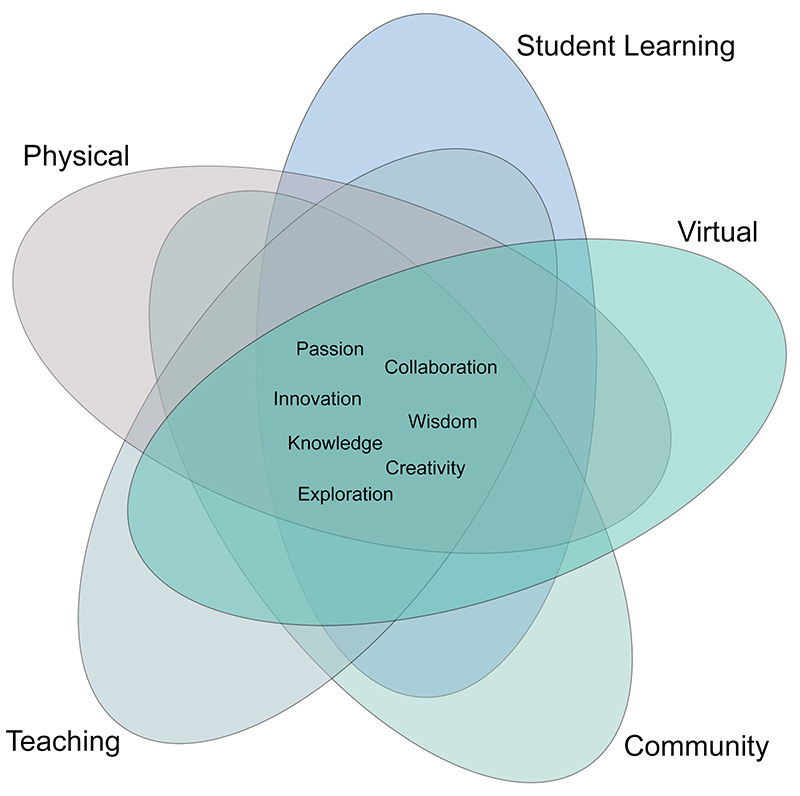
This seminar was basically on extended-learning projects and outside organizations that aim to further STEM education. The authors call these joint efforts “STEM learning ecosystems,” and they can deepen student understanding and engagement and broaden access to a well-rounded education in science, technology, engineering, and mathematics. I had to get used to the terminology and wondered if people who are interested would be scared away by the eduspeak. I think people at the Summit heard the terms often enough to finally be comfortable with “learning ecosystems.”

I looked online because I still, at the end of the day, did not have a fluid understanding of ecosystem in this context. This is what I found that may be helpful so you don’t have to puzzle the term.

They share this common term: Learning Ecosystem.

Click image to enlarge.

Click image to enlarge.

After school programs come in many varieties. Since we were dealing with understanding of a variety of groups, museums, networks and other providers, I thought that the diagram above would aid understanding.  Continue reading

Thoughts on the Surface Pro 2 After 8 Months

Jim ShimabukuroBy Jim Shimabukuro
Editor

Updated 7/21/14, 7/26/14

(Related articles: “The Surface Pro 2 Will Be the Death of Notebooks” and “Why the Surface Pro 2 Will Be a Game Changer in the Tablet World Series.”)

Steven Brown, in a 15 July 2014 comment, asked, “Curious to hear how it went after 8 months –- any updates?” His question refers to my October 2013 article, Why the Surface Pro 2 Will Be a Game Changer in the Tablet World Series, and the follow-up in November, The Surface Pro 2 Will Be the Death of Notebooks.

Steven, thanks for the question. Microsoft’s recent offering of SP3 means that the SP2 is no longer a viable purchase option — except for those interested in picking up a bargain. Used, they’re currently going on eBay for about half the original price. However, the differences between the 2 and the 3 are small enough to justify this article update.

For me, the critical variable is weight. The quarter pound difference between the 3 and 2 is negligible. To put this in perspective, it’s the difference between my first-gen iPad and the SP2. They’re both equally heavy — or light, depending on your perspective. The SP3 screen size is touted as a breakthrough, but the 1.4″ difference isn’t that impressive considering the bulk that it adds to the overall size. By desktop and notebook standards, it’s still far too small for serious work for prolonged periods.

The 2160 x 1440 resolution seems enormous compared to the SP2’s 1080 x 1920, but it’s negligible considering the pixels per inch, which is 216 vs. 208. The SP2’s resolution is excellent. I’m using it right now, with the power cover, to write this article. I have it connected to a 32″ 1080P monitor via the SP2’s proprietary HDMI adaptor, and the clarity is equal to my desktop’s.  Continue reading

Widget Archive

TCC 2018

 Call for Participation: Registration
 Prelude March 21: Institutional Initiatives in Digital Credentials (FREE)
 Main Conference (Apr 17-19) Registration

HOT@ PLENK 2010

Stefanie Panke: PLENK2010: Weeks 7-10 – The End
Stefanie Panke: PLENK 2010: Weeks 4-6 – Learning Theories, Evaluation and Literacies
Stefanie Panke: PLENK2010: Week 3 – ‘Web XXO’ Emerging Technologies
Stefanie Panke: PLENK2010: Week 2 – Personal Learning & Institutional Learning or ‘A Great Course in Diagram Making’!
Stefanie Panke: PLENK 2010: Week 1 – Just Like ‘Watching Football’
Lynn Zimmerman: PLENK2010 – How Can PLEs Benefit My Students?
Lynn Zimmerman’s account of her first day at PLENK 2010
George Siemens’ (PLENK 2010 facilitator) comment to Stefanie re “curating resources”

Live!
Solar Impulse: Around the World in a Solar Airplane

MOOC MOOC! The interview (9/11/13)

MOOCulus for Calculus Fun: An Interview with Tom Evans (7/11/13)

***

megaphone with writing: Call For Chapters

***

an apple core with text: core issues with John Sener
Do We Really Need a Core Curriculum? (2.22.11)

The Value of Curriculum Cores (3.3.11)

Standardized Tests and Foul Shooting: Look Out, Michael Jordan! (3.12.11)

***

OpenCourseWare
Open Educational Resources – An Invitation to Reflect Your Practice by Stefanie Panke

HippoCampus, Monterey Institute for Technology and Education (sources Ray Schroeder and Sara Bernard)

MIT OpenCourseWare

OpenLearn, The Open University

Open Learning Initiative, Carnegie Mellon

Tufts OpenCourseWare

Stanford on iTunes U

Webcast.berkeley

Utah State OpenCourseWare

On-Demand Online Learning Programs, Kutztown University Small Business Development Center

University of Southern Queensland’s OpenCourseWare

University of California Irvine OpenCourseWare

***

ETC Mailing List
To receive periodic email announcements about the latest articles and discussions on ETC, send your name and email address to jamess@hawaii.edu

***

Links
100 Excellent Open Access Journals for Educators, 11 Nov. 2009

***

Encounters

‘Digital_Nation’ – Two Reviews

Assuming that Teachers Aren’t the Primary Obstacle to Change . . .

Sloan-C’s Virtual Attendance Option: Real or an Afterthought?

Sidewiki – Handy Tool or Destructive Weapon?

‘College for $99 a Month’

USDE 2009 Report on Effectiveness of Online Learning

Blended Learning Is Largely an Illusion

Email your ideas for an encounter to Jim at jamess@hawaii.edu

***

Breaking News

The latest ed tech news selected by ETCJ writers and editors.

Martian Rhapsody: Chapter 2 – Rocks

[Note: See chapter 1, Landing. Also see Harry’s Mars One: Exciting Adventure or Hoax?, especially the long-running, extended discussion at the end of the article. See his other Mars related articles in his list of publications. Chapter 2 is being published as submitted, without editing by ETCJ. -Editor]

Martian Rhapsody
by Harry E. Keller, PhD

CHAPTER 2
Rocks

The four hopeful settlers stare open-eyed at the vista that confronts them. Mars stares back, red-faced and malevolent. They discern nothing friendly or helpful in that stare. Some might see indifference, but they’d be wrong. If ever mankind faced evil, it is here in this impossibly alien and lifeless environment.

Even the dark, sharp-edged rocks strewn across the landscape with apparent reckless abandon seem infused with baleful intent, waiting patiently for countless eons for these soft Earthlings, waiting to cut them and trip them. The surface between the rocks is red, not the red of a poppy or even an Earth sunset, but an intense red that fills the land with emanations of harm. Despite the extreme thinness of the atmosphere, the strangely close horizon does not immediately and sharply turn to the black of space as on the Moon. The red dust of Mars hangs in the sparse air and softens the horizon just enough to give the appearance of red sand reaching up, an almost living thing.

As if sensing the planet’s personality, Chun speaks up, “We have to get that module back so we’re at full strength.”

“You bet!” responds Dawit excitedly, pumping his fist. He is undaunted by the landscape or the problem of the errant module.

“Sure,” says Aleka, “but first we have to put our habitat together.”

“Sorry,” says Chun as she moves into position.

“We all feel the same. All right, we’ve practiced this plenty of times,” says Aleka.

“Seems like thousands,” responds Dawit with a gesture none of the others can see because he’s inside.

“We don’t have all that long before our suits have to be recharged,” warns Balu.

“Right. Let’s rotate and connect,” says Aleka.

“Good thing that missing module connects at the end,” comments Chun.

“The rovers have done a nice job of clearing the site and putting the modules in place,” says Balu.

“I cannot wait to get a plan for the missing module,” comments Dawit over their intercom. Everything is an exciting adventure for Dawit.

Continue reading

Geography? T3G…ESRI in Education

VicSutton80By Vic Sutton

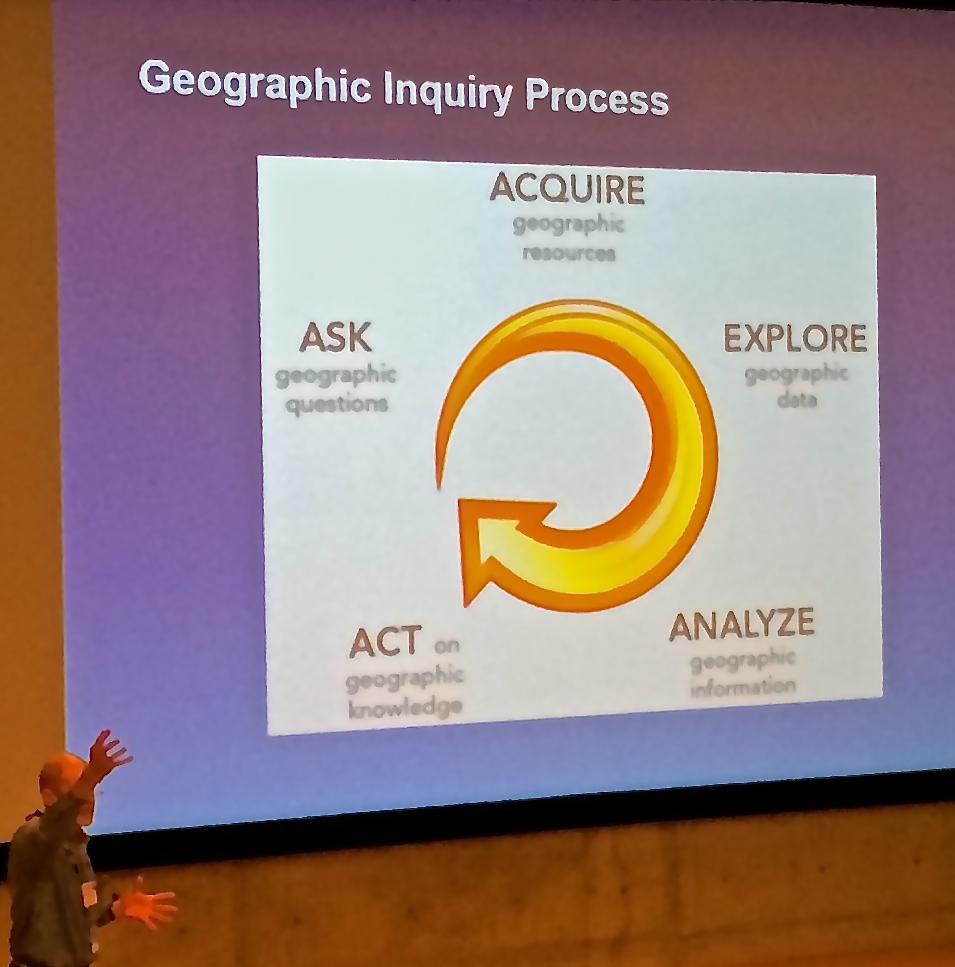
While at a recent workshop at the Redlands, CA, headquarters of the Environmental Science Research Institute (ESRI), I heard the most concise definition of geography yet: “What where? Why there? Why care?”

vic063014 1

My wife, Bonnie Bracey Sutton, had been accepted for a week-long workshop in ESRI’s T3G Institute. I traveled with her, thinking I was heading for a holiday in Southern California – maybe visit the beach and chill out in wine country.

No such luck. As soon as he saw me, Charlie Fitzpatrick said, “I’ll get you a badge.”

Charlie Fitzpatrick is the K-12 education manager at ESRI. Before joining ESRI in 1992, Charlie taught social studies in grades 7-12 for 15 years.

vic063014 2

“T3G” is ESRI’s acronym for “teachers teaching teachers GIS.” So the goal of the workshop was to give a group of some 90 educators the knowledge and hands-on skills to be able to teach other colleagues how to use geographic information system information in their work.  Continue reading

What Does Cyberlearning Mean to You? Cyberlearning Summit 2014

By Bonnie Bracey Sutton
Associate Editor

(Note: See Vic Sutton’s report on this conference. -Editor)

Teachers working in classrooms need ideas and frameworks and support for initiatives beyond the ideas that have been classified as regular education. Sometimes funding is a problem. Powerful partners get you permission to do wonderful things in the classroom.

My first involvement with a network of powerful people, learning ideas and new technologies was with Cilt. You can tell that it was some time ago. We called STEM, SMET. Here is a look at what we started with:

bonnie 062514 01

We investigated, learned, shared and promoted ideas. Concord has wonderful free resources to share, and here is a summary:

The Center for Innovative Learning Technologies (CILT) was founded in October 1997 with a grant from the National Science Foundation (NSF) to stimulate the development and study of important, technology-enabled solutions to critical problems in K-14 science, mathematics, engineering, and technology (SMET) learning. Four “theme teams” focused the efforts in areas of highest promise. CILT events, often workshops organized by theme, provided a collaborative forum in which people in the learning science community met to assess the progress of the field, define research agendas, and initiate new collaborations. Many of these collaborations form seed grants funded by CILT. In addition to these successful CILT programs, CILT has generated many resources for the learning science community, including tools, publications, and NetCourses.

In this day and time, people sometimes do not think that meeting people and sharing in conferences is necessary. But the leaders of Cyberinfrastructure have better ideas. They do a conference and put the ideas online. You have a choice. There are pieces of brilliant ideas, presentations and demonstrations, and even poster sessions for you online.  Continue reading

Cyberlearning Summit 2014: A Quick Recap

VicSutton80By Vic Sutton

[Note: See Bonnie Bracey Sutton’s report. -Editor]

There is reportedly a wealth of research being conducted unto cyberlearning, but there are no clear views about how to translate research results into action in the community context, in particular for schools or informal education.

This emerged from the recent Cyberlearning Summit held in Madison, Wisconsin, on 9-10 June 2014, which brought together some 200 participants — mostly academics, plus some educators, industry representatives and grant makers — to highlight “advances in the design of technology-mediated learning environments, how people learn with technology, and how to use cyberlearning technologies to effectively shed light on learning.”

Bonnie's photos

There was no discussion about quite what cyberlearning is, but it appears to be a fancy name for on-line learning.

The meeting was organized by the Center for Innovative Research in Cyberlearning (CIRCL), funded by the National Science Foundation (NSF), and featured a number of eminently qualified speakers.

Yasmin Kafai, from the University of Pennsylvania, reminded participants of the remark by the late Steve Jobs that “everybody in this country should learn to program a computer, because it teaches you how to think.”  Continue reading

Review: ‘The New Digital Age’ by Schmidt & Cohen

Frank B. WithrowBy Frank B. Withrow

Review: Eric Schmidt and Jared Cohen, The New Digital Age: Reshaping the Future of People, Nations and Business, Knopf, 2013.

The authors visited thirty-five countries and examined the Internet’s impact in each. The new digital age has a significant impact with both positive and potentially negative outcomes. They discuss both possibilities. They focus on the new level of connectivity that the digital world brings to individuals and nations.

NDA2

In perspective, connectivity in mankind has always been the yeast that has led to social and collective growth. In early man, the spoken word allowed groups to share sensory experiences and form collective societies. About five thousand years ago, the written word allowed mankind to share experiences across geography and time. Knowledge could be passed from one generation to another and transferred across geographic boundaries. The printing press increased our ways of storing and retrieving experience and documenting the ways man governed himself. Knowledge was stored and retrieved in libraries.  Continue reading

Mars One Seals TV Deal with Endemol

In a press release this evening, Bas Lansdorp, Co-founder and CEO of Mars One, announced an international partnership with multi-award winning producer Darlow Smithson Productions (DSP, an Endemol company) to follow and screen the selection and training of Mars One astronauts.

DSP will be the exclusive worldwide production partner for the Mars One astronaut selection and training program, which will see 705 candidates, shortlisted from over 200,000 who applied, undergo the assessment processes. The candidates, from all walks of life, will be tested as part of a training program run by a panel comprised of scientists, adventurers and astronauts.

With the astronaut selection process already underway, the first installments of DSP’s production are expected to begin broadcasting around the world in early 2015. Further details will be announced.  Continue reading

Unite or Die

picture of Harry KellerBy Harry Keller
Editor, Science Education

For at least two centuries, education has been divided up into separate compartments. In most recent educational history, the so-called core compartments or “subjects” have been social studies, English (now known as English language arts or ELA), mathematics, and science. Along side these have been physical education and a number of other artistic or artisan activities such as music, drama, art, and woodworking.

A great number of educators have noticed that this separation has made less and less sense as time has passed. Similar issues exist within these disciplines. For example, my own area of science was divided up long ago into physics (the original natural philosophy encompassing motion, light, and other physical phenomena such as electricity and magnetism), chemistry (changes in matter), and biology (study of living things that was mostly limited to classification in its earliest days). Biology has changed enormously and now no longer depends on classification. Understanding chemistry requires plenty of physics and often heavy-duty mathematics. And so it goes.

If we are to educate our youth, we must break down the artificial barriers between the compartments formed so long ago. They make little sense these days.

For example, mathematics and science are kept separate in our schools, and their teachers are trained separately. Yet, mathematics, as taught in grades K-12, is mostly applied mathematics at its heart. It was created for commerce, engineering, and surveying. Calculus was created for science. These connections are lost in most mathematics courses. Once you’ve learned to count, that is, learned the names of the numbers, the rest follows logically as you begin to figure out the world around you. Were science and math merged into a double-period class, it could make much more sense to students — especially if engineering is included in science, and commerce is included in math.  Continue reading

Social Media Tips for Virtual Conference Attendance

By Melissa A. Venable

[Note: Jessica Knott, ETCJ’s Twitter/Facebook editor, has coordinated the publication of this article. -Editor]

Last month The Sloan Consortium’s 7th Emerging Technologies for Online Learning took place in Dallas, Texas. According to the latest Sloan-C View newsletter, there were “more than 700 onsite and 1,000 virtual attendees representing 47 states including DC and 23 countries.”

Saint Leo University provided virtual access to a limited number of instructors, including adjuncts like myself. In my formal request to attend, I made a commitment to “be active on multiple social media platforms and use the symposium hashtag – #et4online – to further engage in live sessions and network with other attendees.” I was fortunate to be selected to attend, and it was this social media commitment that made all the difference in my experience.

Recorded sessions are helpful but don’t provide the energy and interaction of real-time attendance. And there is a lot to be gained from following the social media backchannel of a conference, but formal registration allows for a different level of access to the sessions and other attendees. This article includes a few of my lessons learned as a virtual conference participant.

Prepare to Participate

Are your social media accounts up-to-date? This may be the best place to start. Take a look at the platforms that are being encouraged by the conference organizers and review your profiles before the event starts. If it has been a while since you logged in to an account, it could take some time to review and refresh the information you are providing about yourself. Keep in mind that these profiles serve as your business card in an online networking sense.

Follow the conference itself and the sponsoring organization. In addition to the conference hashtag, this Sloan Consortium event was also active with social media accounts focused specifically on this conference, including Twitter and Facebook. These accounts provided a constant stream of reminders, letting participants know about upcoming sessions, highlighting participants and presenters, and announcing schedule changes.

Set Realistic Expectations

The Sloan symposium offered fewer streamed sessions than onsite sessions, but there were multiple presentation options for each time slot. The streamed sessions took place in Dallas with a live audience and allowed virtual attendees to watch both the presenter and his or her slide presentation simultaneously. Members of the online group were able to interact with each other via text chat and ask questions of the presenter through an online session chairperson who relayed them in real-time. We also connected and exchanged thoughts and resources through our social media accounts.

Take a look at your schedule for the week and identify, in advance, the sessions you would like to attend. Add these sessions to your calendar. I was tripped up when logging into my first session (an hour early), before I realized I needed to calculate time zone differences. The website mentioned this, of course, but sometimes you have to learn on your own, and I instantly connected with other virtual attendees on Twitter who made the same mistake.  Continue reading

GIS Helps School District Extend Facilities Management Beyond the Physical Plant

By Jim Baumann
Esri Writer

The Garland Independent School District (GISD) is located in north-central Texas, adjacent to Dallas. The district encompasses approximately 100 square miles and serves the Dallas suburb cities of Garland, Rowlett, and Sachse. With an enrollment of about 58,000 students, it is the thirteenth-largest school district in the state of Texas.

The GISD has a “district of choice” policy. This policy allows parents to choose where their children will attend school, based on established criteria for ethnic balance. Annually, the district has a one-month selection period for both secondary and elementary schools. Once the selection period ends, the district’s Student Services department begins the process of assigning students to campuses based on building capacity, grade-level capacity, and seat availability. Other criteria, including campus demographic data, are considered before making the final decision on school placement.

To help with student travel and support the district of choice policy, the district’s GIS (geographic information system) department developed a Flex application for distance routing. With this application, officials can determine the location of a student’s home and local schools within the immediate vicinity.

Converting AutoCAD Files to Geospatial Data

Garland maintains 7 high schools, 12 middle schools, 47 elementary schools, and 2 pre-K schools, as well as a number of administrative offices and special use facilities. Managing these facilities for compliance with governing standards, current use, past maintenance data, and potential renovation or remodeling projects became increasingly difficult, and it was decided that an automated system was needed to prepare plans and data for quick and easy access.

For several years, the district used Autodesk’s AutoCAD for facilities management. The district’s AutoCAD facilitator, Kelli Daughtry, was responsible for converting all paper drawings into AutoCAD and maintaining facility floor plans during the district’s $385 million bond program. Approximately four years ago, the facilities department began implementing a GIS to be used in conjunction with AutoCAD. The district retains all facility floor plans in AutoCAD while using GIS to provide easy access to site plans, floor plans, room numbers, and data referenced to them.  Continue reading

Understanding the Brain, Flipped Teaching, Suicide Prevention, Common Core Shifts

inmynet

University of Chicago MOOCing in a big way… a free MOOC, Understanding the Brain: The Neurobiology of Everyday Life (Coursera), begins on April 28. According to Hannah Nyhart and Steve Koppes, “enrollment for [the] course has reached 27,000 and climbing” (“Neurobiology Online Course to Attempt World’s Largest Memory Experiment,” Medical Press, 4/23/14). Last fall, the university’s Asset Pricing MOOC enrolled 41,000 and Global Warming, 15,000.

Getting What You Pay For? A Look at America’s Top-Ranked Public Universities (ACTA, April 2014) is available for download. Here’s a quote from the 75-page document: “In a 2013 survey of over 300 employers, 93% of the executives responded that critical thinking, clear communication skills, and problem solving ability are more important to them than the undergraduate major. A majority called upon colleges to put more emphasis on writing, science, and mathematics, and over 40% called for greater emphasis on foreign language proficiency” (8). If you’ve been following studies such as this, you’re probably thinking, So what else is new. Seems the year is interchangeable, with the results remaining constant.

In an email conversation earlier this morning re this ACTA report, Harry Keller said, “At least in K-12 education, we should … merge these into a single curriculum that reaches into ELA, math, and science and that uses, as necessary, art, engineering, history, etc.” I agreed with Harry. The separation of subjects to fit schooling is unnatural. In the real world, they’re all part of a whole. Teachers have tried team teaching and interdisciplinary approaches to simulate an integrated approach, but these are always awkward and, IMHO, not sustainable. The integration has to be within the teacher. The implication for schools is flipped teaching — instead of teaching from the inside (classroom) out, they would be teaching from the outside (real world) in. This would also mean a whole new breed of teachers, with significant background in the arts and sciences as well as skill in bringing the different disciplines together in seamless learning activities in a way that’s similar to the project-learning approach.

Engaging College Students in Mental Health Awareness and Suicide Prevention (Kognito and Active Minds)… “a free one-hour webinar to discuss best practices for engaging and training students in gatekeeper skills” and suicide prevention. Scheduled for Wed, Apr 30, 2014, 4:00 PM – 5:00 PM EDT. A second webinar is scheduled for Fri, May 2, 2014, 2:00 PM – 3:00 PM EDT. Hopefully they’ll include a segment on detecting the need for help among students enrolled in online courses.

The Most Challenging Instructional Shifts in the CCSS for English/Language Arts (Education Week)… a free webinar with an emphasis on changing the way students think as well as instruction and administration. “Four of the most challenging shifts” are: Emphasis on Academic Vocabulary, Complex Text, Close Reading, and Greater Emphasis on Informational Text. Scheduled for May 1, 2014, 2 to 3 p.m. ET. As an online teacher, I’ve learned that the ability to read, correctly interpret, remember, and apply textual information is the most important skill for students in online classes.

Flipping Without Flopping: A Three-Year Study. Real Results (Echo 360)… a free webinar. Two separate sessions, May 8 for US/Europe at 11am EDT and May 14 for ANZ/Asia at 11am AEST. Review the research.

SoTL Commons 2014 in Savannah: ‘Teaching Without Learning Is Just Talking’

By Stefanie Panke
Editor, Social Software in Education

The 7th SoTL commons conference at Savannah, Georgia, was held from March 26-28, 2014. The annual event is organized by Georgia Southern University. SoTL commons is a small conference; the 2014 edition attracted around 180 participants. The majority of the participants came from small colleges and universities in the southern United States, though the event also had national reach with people from Wisconsin, Louisiana, and the Midwest, as well as a few international attendees from Colombia, South Africa, Sweden, Portugal and Nigeria.

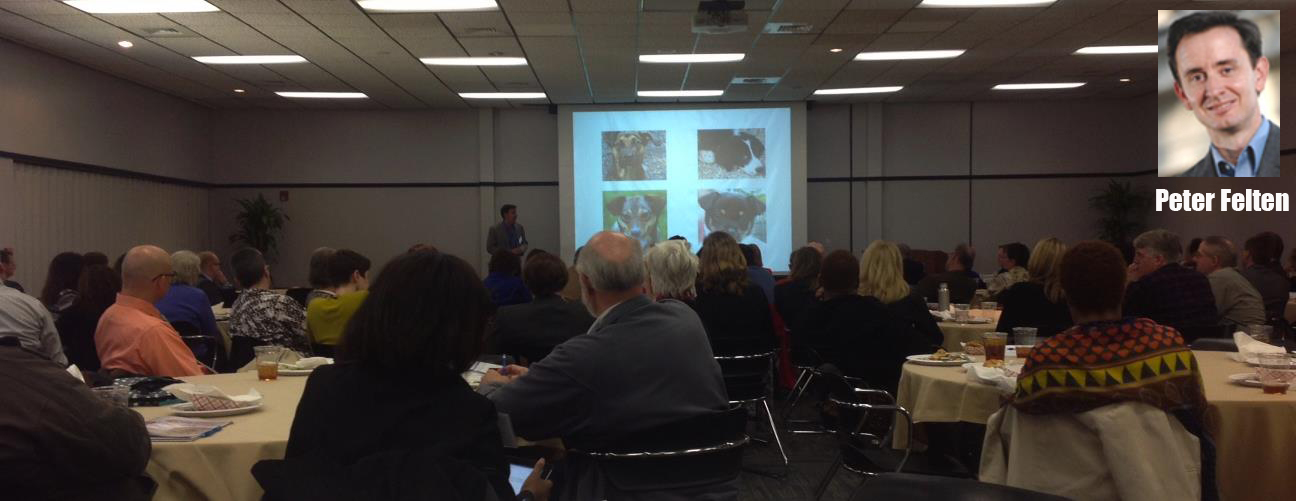
My personal conference highlight was the keynote by Peter Felten, Director of the Center for the Advancement of Teaching and Learning at Elon University. Peter used an amusing and powerful analogy to clarify the question that seems to be a crucial, non-negotiable ingredient of every SoTL gathering: What do we mean by Scholarship of Teaching and Learning?

Peter Felten: ‘Which mutt is the cutest?’ Can you give criteria for cuteness? How about criteria for excellence in SoTL?

Peter Felten: “Which mutt is the cutest?” Can you give criteria for cuteness? How about criteria for excellence in SoTL?

He  characterized SoTL as a mutt discipline — in contrast to the “best in show approach” of disciplinary research. Just as a show dog will be only appreciated by few experts in the breeding trade, disciplinary research often resides in the ivory tower. SoTL has the advantage of being widely accessible to a broader audience. However, it has to define its boundaries to be (accepted as) a scholarly discipline.
To this end, Peter presented five principles, which offer a heuristic framework to characterize any SoTL project:

  1. The inquiry is focused on student learning.
  2. The research is grounded in context — both scholarly discourse and local, organizational environment.
  3. The approach is methodologically sound.
  4. The project is conducted in partnership with students.
  5. The results are appropriately public.

These principles allow for common ground among SoTL inquiries, can help clarify and demystify SoTL to others and ultimately enhance the influence of SoTL. (For more details, see “Principles of Good Practice in SoTL.”)

The talk spurred a debate among the audience, in particular the absence of “teaching” as a perspective in the first principle. What if you are working with faculty to improve their teaching? Peter argued that ultimately every SoTL project aims at improving student learning and referred to Angelo and Cross (1993), who stated that “learning can — and often does occur without teaching but teaching cannot occur without learning; teaching without learning is just talking” (p.3 — see full text at ERIC).

Nancy Chick

Nancy Chick

Peter’s thoughts were taken up by Nancy Chick’s keynote address on the following day. She focused on the question “What is methodologically sound research in SoTL?” As editor of Teaching & Learning Inquiry, the new ISSOTL journal launched in spring 2013, Nancy was in a perfect position to highlight methodological aspects. What sets SoTL apart from disciplinary research is the variety of data sources scholars use to trace learning. Although SoTL projects comprise a wide range of theoretical, methodological, and empirical perspectives, it is crucial to find a good fit between research question and data sources.  Continue reading

A Glimpse at ‘Digital Life in 2025’

Jim ShimabukuroBy Jim Shimabukuro
Editor

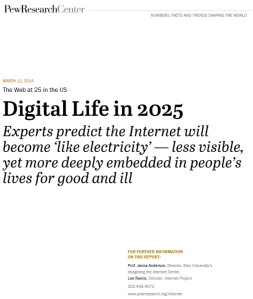
The conclusion of Pew’s Digital Life in 2025 (3/11/14) report1 is a simple one. In the next eleven years, the internet will become ubiquitous. A few tiny voices disagree, claiming governments will shut it down or balkanize it, turning it into a virtual reflection of the planet’s jigsaw geography. But the overwhelming prediction is the internet will be more of everything2 that we currently associate with it. The 61-page document is devoted to explaining the how and the implications, split between mostly optimism and some pessimism.

Click image to view the full report in PDF.

Click image to view the full 61-page report.

The ubiquity of the internet is already a reality so projecting more of the same is not surprising. Echoing words and phrases abound throughout the report: pervasive, connected, global connectivity, ubernet, and “world-spanning information fabric known as the Internet of Things.” The phrase “like electricity” is incorporated into the subtitle, and it serves as the starting point for the rest of the discussion: “Information sharing over the Internet will be so effortlessly interwoven into daily life that it will become invisible, flowing like electricity [through our lives].”

This simile lends itself to a vision of humans as altered or transformed3, as wired to participate in an “augmented reality,”4 a reality that is no longer defined by time and geographical boundaries. Perhaps the most profound implication is the irrelevance of national borders in the ubernet. This is how David Hughes puts it:

All 7-plus billion humans on this planet will sooner or later be ‘connected’ to each other and fixed destinations, via the Uber(not inter)Net. That can lead to the diminished power over people’s lives within nation-states. When every person on this planet can reach, and communicate two-way, with every other person on this planet, the power of nation-states to control every human inside its geographic boundaries may start to diminish. Being replaced — over another 50 or more years — by self-organizing, trans-border people-groups. Nations will still have military and police forces, but increasingly these will become less capable of controlling populations.

Again, this trend is already in motion. Today, the fact that websites are hit daily by people from around the world, attracted by mutual interest rather than shared nationality, is a given. No one gives it a second thought.  Continue reading

Free Higher Ed, 21st Century Learning, ELLs, Standardized Tests

lynnz_col2

Online Universities 2.0: Taking Education to the Next Level — Worldwide by Dominik Knoll in Huff Post Impact 3/12/14
The author expresses his opinion that free and accessible university education is just around the corner for anyone who wants it via the Internet. A commenter to the article says that most MOOCs are merely replicating the face-to-face classroom and not using the technology to its fullest extent.

Five Ways that 21st and 20th Century Learning Will Differ by Steven Mintz from Inside Higher Ed 3/5/14
Mintz proposes 5 ways that education is changing. He suggests it will move more toward 100% proficiency and mastery of skills and competencies; based in the science of learning; be data-driven; be personalized; and take advantage of technology in ways that truly enhance the learning experience.

Will classroom technology help English Language Learners? From Reflejos 3/16/14
With advent of Common Core and computer-based testing, schools are increasing online connectivity. Pilar Carmina Gonzalez, a researcher for the Education Development Center, a leading expert on children and technology and a former ESL teacher, says technology will open new avenues of learning for English language Learners (ELL students).

11 key questions on standardized testing for Congress to answer by Valerie Strauss from The Washington Post 3/9/14
The Network for Public Education, which includes among its member education historian Diane Ravitch, has asked congress to look into the what they see as the overuse of standardized tests.

GIS Can Transform Learning: Bracey Sutton at SITE.org AACE Conference

VicSutton80By Vic Sutton

Geographic Information System (GIS) technology has the potential to transform learning, argued long-experienced teacher Bonnie Bracey Sutton at a workshop at the conference of the Society for Information Technology and Teacher Education (SITE), Jacksonville (FL), March 17-21, 2014.

Bonnie Bracey Sutton

Bonnie Bracey Sutton

Geography is presently a low priority in U.S. school curricula, partly because of the emphasis that the ‘No Child Left Behind’ law places on reading and math. The result is that American children’s awareness of where they live, and where their country is in the world, is at an all-time low.

Yet the ability to know where you are, and where you are going, is crucial in life. And mapping is the way that we record what we know about where we are, and where we are going.

Workshop participant Ray Rose recalled that the earliest maps in America were made by people standing on tall hills and drawing what they saw below them.

vic01

There was also discussion about map projections. Most of us know the world from Mercator’s projection, which – as one participant argued – is ‘culturally biased’. Just look, for example, at the size of the African continent on a traditional map, and then compare the size of Africa to other countries or regions.

Other map projections correct this, and provide other perspectives. But as another person commented, “the Mercator projections are what we carry around in our head.”
vic02
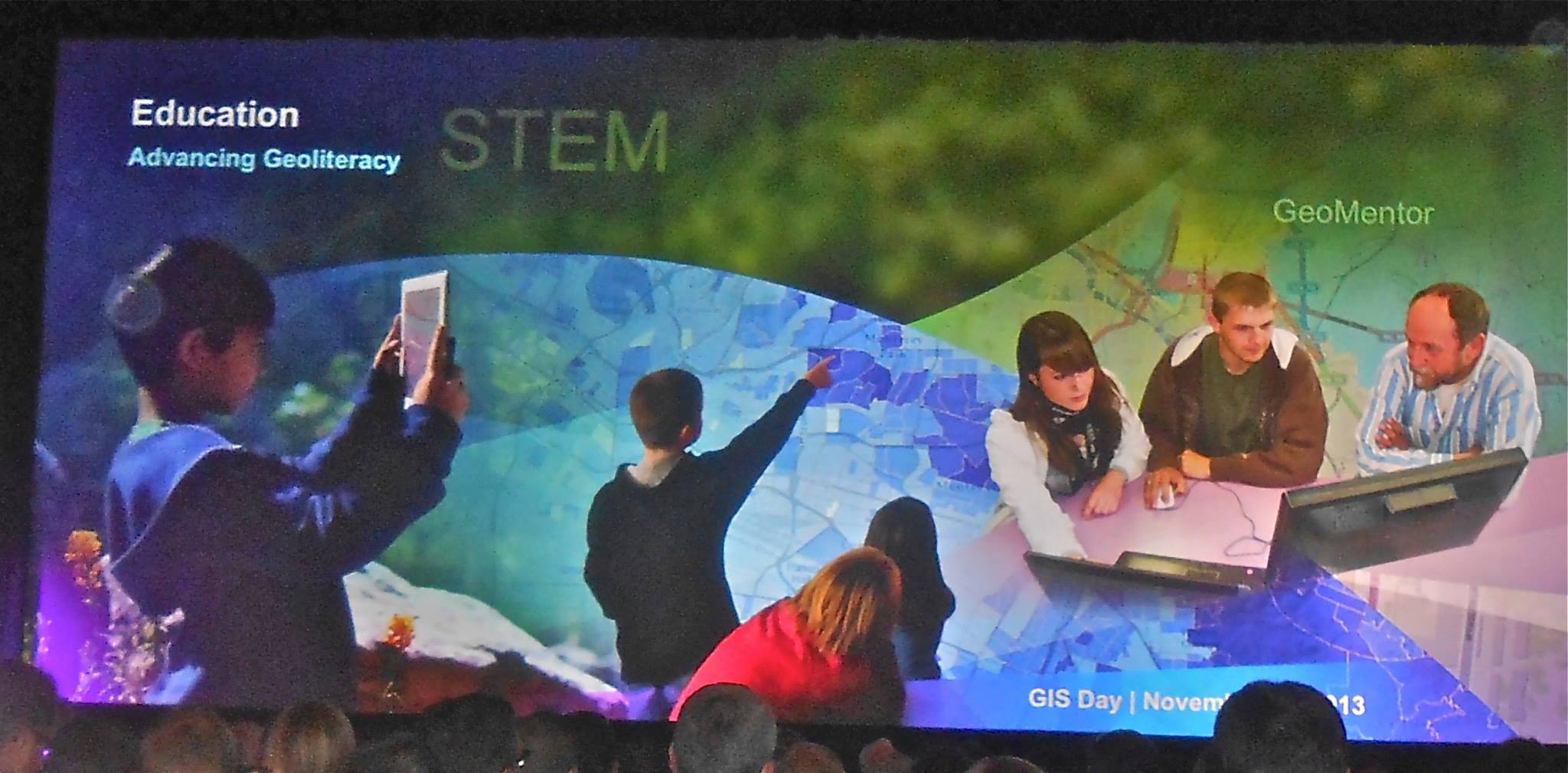
Bracey Sutton presented a wealth of resources that educators can use, in the classroom or in informal education, to provide children with tools to map their immediate environment, or to explore wider environments, from their community to their state, country or region.
Nowadays we tend to take GIS for granted, for example when using a GPS to guide us to a destination. But for students to understand it they still have to tackle the basics of latitude and longitude.

And there are any number of alternative map projections. See for example the Gall stereographic projection, which long predated the better-known Peters projection.

But the conclusion is that depicting the earth on a flat surface almost inevitably leads to distortions. GIS can help students to understand how they arise, and – sometimes — how to compensate for them.


vic03

Some Resources:

Do you know the true size of Africa?
Does size matter? US vs Russia
What is GIS?

  • ESRI ~ A geographic information system (GIS) is a computer-based tool for mapping and analyzing things that exist and events that happen on earth. GIS technology integrates common database operations such as query and statistical analysis with the unique visualization and geographic analysis benefits offered by maps.”
  • 20 Minute Video on GIS

Participatory Event 2014: GIS DAY


MOOCs Are Going Prime Time

Tremors 02

MOOCs for Penn State Credits — A Shift with Radical Implications

Good ideas don’t fade away. They have a habit of sticking around, and in time, they become great ideas. MOOCs are like that. The stumbling block was bucks: “Is there money in this thing?” It took a while, but name brand universities are beginning to see the green. You have to wonder why it took so long since the idea has been around from day one. Regardless, the business model that’s been hiding in plain sight is the multi-track option, and it will soon be featured in Penn State’s MOOC on Coursera, “Presumed Innocent? Social Science and Wrongful Conviction.”1 It will offer two options: free and for credit. Here’s a description: “The course…will be open to University students and the public with two track options. The free track will function much like Penn State’s previous MOOCs, while the for-credit portion will require a heavier workload and offer instructor and TA feedback and assessment on completed work in exchange for a fee less than that for an average college course.”

The fascinating part of this is what appears to be a waiving of standard admission procedures. I haven’t read the details on how this will all work out, but it seems anyone anywhere can register for the credit version, and if successful, earn Penn State credits. The only requirement is a fee that’s described as lower than average for a college course. If this is indeed what’s planned, then they’re setting a precedent that could ultimately change the higher ed landscape. Students will soon be able to earn college credits from top universities around the world from the comfort of their home and for a price that many if not most will be able to afford.

The impact on higher ed will be immense. Colleges and universities will need to open up their policies for granting degrees, and their emphasis will probably shift from primarily instruction to include large scale certification options, and this may mean a realignment of staff, with many leaving the classroom for duty as advisors.

Multimedia Web Skills — A Coming Crisis for Teachers

Paul Beaudoin, in “Six Ways to Be a Better Online Teacher,”2 explains how Shoba Bandi-Rao, an assistant professor at Borough of Manhattan Community College/CUNY, has “her students combine e-text, audio, images and video to create their digital stories.” They use “free software such as Wevideo and Window’s Movie Maker.” According to Bandi-Rao, “They shared their projects in class and had the opportunity to comment and receive feedback from their peers.”

This ability to create video presentations and share them online is the 21st century equivalent of posters and term papers. The question is, are our teachers prepared to demonstrate and teach these skills? If not, how do we get them there?

I believe this trend toward multimedia is a matter of when and not if. In preparation, colleges have two basic options: (1) Build up their IT service departments or (2) encourage and insist on teacher competency. The first is probably where most colleges will end up by default since it’s the path of least decisiveness. But the problem is cost, which will mushroom and quickly become prohibitive. The second, teacher competency, is the most sustainable in the long run. The key is to design and fund plans that will not only reward teachers who become skilled in the use of technology but to actively recruit new faculty who are technically adept.

Anant Agarwal: A Massive Contradiction?

Anant Agarwal, founder and president of edX, continues to push the value of on-campus learning as he touts the power of MOOCs3. For Agarwal, MOOCs are part of a blend, an enhancement for F2F courses. But he also sees MOOCs as vital beyond the campus experience. He says, “We also envision the world shifting toward a continuous education system — one that doesn’t stop after four years of college.” When pressed for examples of invaluable on-campus experiences, he offered two: “Universities provide…a space for students to learn how to work collaboratively with each other and gain those critical soft skills, and close interaction with faculty and senior students on research.”

Agarwal is probably representative of most leaders in higher ed when it comes to MOOCs. They want to have their cake and eat it, too. The fundamental contradiction is between the concept of open and closed. Unfortunately, they don’t blend very well. A closed course with an open module (MOOC) is still a closed course. Similarly, an open course with a closed module is also still closed. In the MOOC game, the only ultimate winner is an open course with no closed modules.

Returning to Agarwal’s two examples above, I don’t think it takes much imagination to see how collaboration and interaction are already integral parts of the online learning experience. Examples abound.
__________
1 Katie Jacobs, “Digital learning technologies enable students to become better rounded,” Penn State News, 3/25/14.
2 Campus Technology, 3/26/14.
3 Hayleigh Colombo, “EdX founder – sheer numbers means MOOCs will stay relevant,” Boilerstation, 3/25/14.

Introduction to ‘Jewish Studies and Holocaust Education in Poland’

Jim ShimabukuroBy Jim Shimabukuro
Editor

(Note: Earlier this month, we published an announcement of Lynn Zimmerman‘s Jewish Studies and Holocaust Education in Poland [McFarland, 2014]. As a follow-up, I planned to publish an interview with Lynn. However, after reading excerpts, I realized that she had answered all my questions in the introduction of her book. I asked for permission to publish the introduction, and she gracefully consented. Lynn’s focus “is the educational function and value of a Jewish studies program, of teaching young people about the Holocaust, of going to a cultural festival. How effective is each as an educational tool?…Are they perpetuating stereotypes or breaking them down?…How does each reflect current trends in identity politics?…Can these issues be the foundation for teaching about human rights in general?” Lynn’s probing style takes the issues beyond the covers of her book. -Editor)

Introduction by Lynn Zimmerman

Lynn Zimmerman

Lynn Zimmerman

One evening in 2002 I was listening to This American Life, a public radio program in the United States. A young American woman who was Jewish was talking to Ira Glass, the host, about living in Krakow, Poland. She talked about Polish interest in Jewish culture and the Jewish cultural festival, which has been hosted in Krakow since the early 1990s. This young woman said that she had mixed feelings about the interest in Jewish life and about this festival. She told him that on one hand she was happy that people in Poland were recognizing the contributions of Jews to their culture, history, and society. However, she was also slightly disturbed and even offended by it. She said she felt uncomfortable because at times she felt like she was watching outsiders reenact a romanticized version of culture that no longer existed (Glass, 2002).

Her story piqued my interest. Even though I had been to Krakow several times, I had never been to the festival, partly for the reasons she had mentioned. I thought that it would feel odd going to see other people celebrating a culture that was not theirs and that no longer existed in their country. I have never been to one of the popular American Indian festivals in the United States for the same reason. I had been to Kazimierz, the former Jewish quarter in Krakow, on several occasions, and I felt that I was in a museum or in a place whose past and present did not match. Like this young woman, I felt some discomfort. I knew from reading and talking to others that most of the residents and shop and restaurant owners were not Jewish. However, Judaica and Jewish souvenirs were being sold, and there were several restaurants featuring “Jewish” food.

I did finally attend the festival in 2005. I had similar mixed feelings as the young woman whose story I had heard. The unease started with the Friday Shabbat service at the Tempel Synagogue. This formerly “progressive” synagogue has a women’s balcony so that men and women could sit separately during services, women upstairs and men below in the main sanctuary. This arrangement is more in line today with traditional and Orthodox branches of Judaism, so I assume that the Friday evening service I attended was organized with the requirements of the more orthodox Jews in mind. As a modern Conservative Jewish woman, it was strange to have to sit in the women’s balcony since I am accustomed to egalitarian services in which men and women sit together and participate equally in the services. Not only was being segregated in this way strange for me, the set-up of the balcony was not comfortable. The panel on the front of the women’s balcony in Tempel Synagogue is over a meter high, so although you can hear quite well while sitting, you can see nothing of what is going on down below. To see what is happening in the main sanctuary below, one must stand and look over the rail. Therefore, during the service — and it was a religious service, not a show — there were quite a number of women in the balcony, some sitting, but most standing looking over the rail. Although I was sitting with some Jewish women from the United States, most of the people were Poles who came to see what the service was like. Think about how you would feel if you were attending mass in your church or services in your mosque and there was a group of people there as curiosity-seekers — not just to see the building, but to see what you were doing. It is a disquieting feeling. The other American women I spoke to expressed that same feeling. Not only was I participating in a service in a way that was strange to me, but I also felt as if I was part of a spectacle.

Photo of the Warsaw Festival of Jewish Culture, "Singer's Warsaw," by Radeksz, 9/2/09.

Warsaw Festival of Jewish Culture, “Singer’s Warsaw“; photo by Radeksz, 9/2/09. Click image to enlarge.

Continue reading

‘Invasion of the MOOCs’ – Grounded and Free

Jim ShimabukuroBy Jim Shimabukuro
Editor

Every once in a while, a book comes along that puts a grin on your face, and the more you think about it, the wider your grin becomes. Invasion of the MOOCs: The Promises and Perils of Massive Open Online Courses (Parlor Press, 2014), by Steven D. Krause and Charles Lowe, is such a book. And for all the right reasons.

Krause and Lowe

The sources are right: “Unlike accounts in the mainstream media and educational press, Invasion of the MOOCs is not written from the perspective of removed administrators, would-be education entrepreneurs/venture capitalists, or political pundits. Rather, this collection of essays comes from faculty who developed and taught MOOCs in 2012 and 2013, students who participated in those MOOCs, and academics and observers who have first hand experience with MOOCs and higher education.”

And the price is right. Free. Or you can choose to pay $30.00.

Krause and Lowe photo

Contents

“Introduction: Building on the Tradition of CCK08” by Charles Lowe
“MOOCology 1.0” by Glenna L. Decker
“Framing Questions about MOOCs and Writing Courses” by James E. Porter
“A MOOC or Not a MOOC: ds106 Questions the Form” by Alan Levine
“Why We Are Thinking About MOOC” by Jeffrey T. Grabill
“The Hidden Costs of MOOCs” by Karen Head
“Coursera: Fifty Ways to Fix the Software (with apologies to Paul Simon)” by Laura Gibbs
“Being Present in a University Writing Course: A Case Against MOOCs” by Bob Samuels
“Another Colonialist Tool?” by Aaron Barlow
“MOOCversations: Commonplaces as Argument” by Jeff Rice
“MOOC Feedback: Pleasing All the People?” by Jeremy Knox, Jen Ross, Christine Sinclair, Hamish Macleod, and Siân Bayne
“More Questions than Answers: Scratching at the Surface of MOOCs in Higher Educatio” by Jacqueline Kauza
“Those Moot MOOCs: My MOOC Experience” by Melissa Syapin
“MOOC Assigned” by Steven D. Krause
“Learning How to Teach … Differently: Extracts from a MOOC Instructor’s Journal” by Denise K. Comer
“MOOC as Threat and Promise” by Edward M. White
“A MOOC With a View: How MOOCs Encourage Us to Reexamine Pedagogical Doxa” by Kay Halasek, Ben McCorkle, Cynthia L. Selfe, Scott Lloyd DeWitt, Susan Delagrange, Jennifer Michaels, and Kaitlin Clinnin
“Putting the U in MOOCs: The Importance of Usability in Course Design” by Heather Noel Young
“’I open at the close’: A Post-MOOC Meta-Happening Reflection and What I’m Going to Do About That” by Elizabeth D. Woodworth
“Here a MOOC, There a MOOC” by Nick Carbone
“Writing and Learning with Feedback Machines” by Alexander Reid
“Learning Many-to-Many: The Best Case for Writing in Digital Environments” by Bill Hart-Davidson
“After the Invasion: What’s Next for MOOCs?” by Steven D. Krause

Why Educational Equity Is Important

By Allan C. Jones

“What the best and wisest parent wants for his own child, that must the community want for all its children. Any other ideal for our schools is narrow and unlovely; acted upon, it destroys our democracy.” (John Dewey)

Every child deserves an excellent education. This statement is supported by an impressive collection of studies, reports, articles, and comments by national leaders. If you believe that a person’s intellectual capacity is racially, ethnically, or culturally predetermined, you may as well stop reading at this point. If you don’t believe it, then you can’t be in favor of a program that tacitly accepts some schools will be better than others and seeks equity by balancing access instead of raising quality.

A_Jones

If you believe that everyone has the potential for greatness, then you must also want to ensure that every child is nurtured to achieve that greatness. And you should not only want it on moral or ethical grounds; you should also want it on economic grounds. There are many reports on the economic and social benefits of providing equitable access to quality K-12 education. America has some excellent public schools, but that is not enough. America’s future is at risk as long as we continue to allow poor schools to exist.

The news programs and business publications constantly remind us that we are increasingly competing in a global economy. Our ability to compete is directly related to how well we prepare each individual citizen to participate. America’s K-12 public education system is the most important single factor in preparing citizens to compete. The personal costs of a poor education are the first manifestations of the problem of educational inequity. But, as the McKinsey report demonstrates, the issue is much more than a collection of individual, personal costs. The lack of quality education for large numbers of our population has a previously hidden cumulative national cost that is staggering.  Continue reading

LLT 18:1 – “Using Peer Computer-Mediated Corrective Feedback to Support EFL Learners’ Writing”

Dorothy M. Chun and Mark Warschauer

Dorothy M. Chun and Mark Warschauer, editors, Language Learning & Technology.

Using Peer Computer-Mediated Corrective Feedback to Support EFL Learners’ Writing,” by Ali AbuSeileek and Awatif Abualsha’r, is available in Volume 18, Number 1 of Language Learning & Technology. LLT, edited by Dorothy Chun and Mark Warschauer, is a refereed ejournal that disseminates research to foreign and second language educators worldwide on issues related to technology and language education. It is available online, free.

Sign up here to receive your free subscription if you have not already done so. LLT welcomes contributions for future issues. Submission guidelines can be found here.

FEATURE ARTICLES

Fostering Foreign Language Learning Through Technology-Enhanced Intercultural Projects
by Jen Jun Chen & Shu Ching Yang

Using Peer Computer-Mediated Corrective Feedback to Support EFL Learners’ Writing
by Ali AbuSeileek and Awatif Abualsha’r

Direct and Indirect Access to Corpora: An Exploratory Case Study Comparing Students’ Error Correction and Learning Strategy Use in L2 Writing
by Hyunsook Yoon and JungWon Jo

Effects of Captioning on Video Comprehension and Incidental Vocabulary Learning
by Maribel Montero Perez, Elke Peters, Geraldine Clarebout, and Piet Desmet

Ecological Affordance and Anxiety in an Oral Asynchronous Computer-Mediated Environment
by Levi McNeil

Use of Wikis to Promote Collaborative Writing in EF
by Zelilha Aydin and Senem Yildiz

Continue reading

Journeys of the Mind: Yes, We Went to the Moon

I was trained by NASA. Let me be clear that I personally don’t want to colonize space, but I thought that thinking futuristically was a great idea for children, and science fiction is an interesting topic. We started with Space Science Education.

First, we did the NASA thing, that is, learning and creating mock colonies on the moon, on Mars, and fussing about which would be the better place. The Challenger Center created programs that let us think really hard about landing on the moon. Here is a song we used to sing:

Mission Control, can you hear me? Think of this with kids’ lovely voices, not this one single voice.

Then, NASA had a series of projects: Marsville, then Mars, City Alpha.

I live in Washington, DC, so there is of course the National Air and Space Museum, and we have had programs there, small programs and overnight programs. I love the study of space, astronomy, astrophysics. Now we have Cosmos. I welcome it. In case you missed it, click here for a link to the discussion following the presentation. We have those who debate the issue of how, where, when and why.  Continue reading

Registration for TCC 2014 Is Now Open

bert_kimura2Aloha,

Registration for TCC 2014 is now open.

http://2014.tcconlineconference.org/

General information about the conference is also available at this web site.

The conference fee is $99 USD for individuals prior to April 1. There are also special registration rates for graduate students and a group rate for unlimited participation by an entire campus.

For your information, we will hold a special pre-conference event (Pre-Con) on March 26 from 2:00-3:15 PM Hawaii time. For other time zones see:

http://www.timeanddate.com/worldclock/fixedtime.html?msg=TCC+2014+Pre-Con&iso=20140325T14&p1=103&ah=1&am=15

This FREE event (RSVP required) will feature presentations about social media in education and an orientation to the conference schedule and activities.

http://2014.tcconlineconference.org/precon/

We look forward to seeing you online on April 22-24.

Warm regards,
Bert Kimura
For the TCC Conference Team

Back From Russia: It Was COLD

I am still waking up at 4 in the morning. I have not been out of the house. There has been a big snowstorm. I did go to the grocery store, but I have been lazing around. In Samara, we had about four to five meetings a day. We flew back on a 23 hour trip, three hours in Frankfurt, and came home.

Vic treated me to caviar and champagne. For a couple of days after, I cooked. (Hint. You don’t have to cook it.) We had that for two days, but the first day I did cook. Did lamb rib chops, stuffed potatoes and sliced tomatoes, and crashed. I have a terrible cold and have been in bed most days.

Bonnie and Vic, 2nd and 3rd from the right, at Peterhof Palace.

Bonnie and Vic, 2nd and 3rd from the right, at Peterhof Palace.

We had a mountain of mail, email and mail to go through, and my bags are still not unpacked. Well, the technology has been unpacked, and I have done a few online meetings. There was a bit of stress in working with 20 somethings, gifted and talented ones who spoke fluent Russian but who did not want to spend any money. They often ate ramen noodles in the hotel. Breakfast was free and huge, so they could survive on little or nothing for dinner.

Saint Petersburg3

Russia was not as scary as I was told. The hardest part is the language. I learned some of it, but I was with fluent speakers. Sadly, cab drivers don’t care how well you speak. They are out to get you, so we spent a lot of time in the Metro.  Continue reading