Posted on April 2, 2012 by JimS
 By Harry Keller
Editor, Science Education
There’s much truth in what Prof. Diane Ravitch says in “The Pattern on the Rug” (Ed Week, 3.27.12) and some exaggeration. She tars every single effort at improving our educational system with the same brush. However, education is not so simple.
The budget cuts have been devastating. Some even seem to believe that our education “deserves” this treatment. Right here at the beginning, everyone should recognize that we will not be able to survive as the preeminent nation in the world with a poor education system. Everyone should also understand that universal public education will not become 100% private in any believable scenario. Our K-12 public schools and community colleges are a bulwark of our free nation. Competition in schooling with a profit motive attached would spell disaster for schools. It’s just too difficult to measure success for a business except for gross revenues, profit, and market capitalization.
Ravitch turns the Race to the Top into white hats and black hats. I have some disagreements with this program, especially its definition of the “Top.” However, such programs can be a stimulus for our schools. As for NCLB, our problems lie not with the intentions but with the execution.
She lashes into the multiple foundations that fund education initiatives. Again, although I don’t agree with all of these, we have to try something to evaluate it. The effort by the Gates Foundation to make many small schools out of one big one had an obvious flaw before it even started, but the foundation did realize its error and withdraw its support.
Continue reading →
Filed under: Uncategorized | 3 Comments »
Posted on March 23, 2012 by JimS
 By Michael Hurwitz
[Note: This series is being brought to you by ETCJ associate editor Lynn Zimmerman. See Part I: “Technology Is a Game Changer” and Part II: “Technology Makes English the Global Language.” -Editor]
It’s an oft-discussed topic in the media that Chinese, specifically the Mandarin Chinese form that has become the official language of Mainland China, is the “language of the future.” This might sound a bit odd because Chinese is in fact one of the oldest languages in the world, but it’s pretty irrefutable that it’s also one of the fastest-rising languages in terms of global prominence. Learning to speak, read and write Chinese is becoming increasingly popular around the world, but as such an old and unusual language, Chinese presents a lot of problems for learners. Technology, however, is beginning to alleviate this on many fronts.
Chinese is a unique language and can be very difficult for Westerners who are native Romance or Germanic language speakers. Even Japanese speakers, whose native language has a lot in common with Mandarin (including some characters), can struggle mightily with learning it. That’s part of why it helps to approach Mandarin more methodically and tactically than one might a language that’s closer to their native tongue. For instance, while exposure and listening practice are still very important, it’s much more difficult to simply “pick up” Chinese than it would be to pick up Spanish for, say, a native English or French speaker. Much of this has to do with Mandarin’s tonal nature, with different pronunciations of the same syllable taking on (often wildly) different meanings. Without careful instruction and practice in differentiating the five tones, it’s tough to get going in the learning process. This hurdle is especially problematic for adult learners not only because they’ve spent decades in non-tonal or semi-tonal language environments but because they often don’t have the big blocks of time necessary to devote to language learning.
Continue reading →
Filed under: Uncategorized | Leave a comment »
Posted on March 16, 2012 by JimS
 By Samantha Peters
Digital textbooks are all the rage these days as students and school districts clamor to get the iPad, download and fill it with $15 textbooks, and rid themselves of the heavy traditional versions once and for all. But digital textbooks are not the present – or even the future – of education. Here’s why:
1. School districts still save money by using textbooks.
Yes, digital textbooks are far cheaper than the physical variety. But various other costs – chief among them the price of an iPad and the need to periodically repurchase digital versions – drive the digital price far higher. One study found that an average school would spend $215 per student per year when following a digital textbook strategy. This compares with a far lower cost of $90 per student when only traditional textbooks are used. Although some schools with sufficient resources will surely still jump at the chance to make backpacks lighter and lessons more interactive, the significant costs associated with a digital program will prevent most districts from following this course.
Continue reading →
Filed under: Uncategorized | 6 Comments »
Posted on March 11, 2012 by JimS
 By Jim Shimabukuro
Editor
(Note: This is the first of two reports on the iFacilitate 2012 online workshop. I participated as a student and opted for the certificate option to make sure that I stayed the course. I created a temporary blog for the coursework, and the excerpts below link to posts in that blog. Click here to see the second report. -js)
In early February, when I found an invitation from Greg Walker, Leeward Community College (University of Hawaii System) Distance Education Coordinator, in my emailbox, I decided to go for it. Some of my ETCJ colleagues have written about their MOOCing experiences, and I wanted to see, firsthand, what it was like. In the following weeks, I’ll be sharing some observations and comments that I’m posting in my workshop blog.
The invitation was for a five-week online faculty workshop, iFacilitate:
Aloha mai e. Are you an adventurous “life long learner” who is interested in experiencing the future of online learning? iFacilitate is …. FREE and open. It does not consist of a body of content you are supposed to remember. Rather, the learning in the course results from the activities you undertake, and will be different for each person. In addition, this course is …. distributed across the web….Your active participation in this workshop will help you to acquire the skills needed to function in this type of course. iFacilitate is a 5 week open workshop [beginning 2.27.12] that introduces a variety of facilitation skills to help participants engage learners across a range of conversational spaces, including online discussion forums, web conferencing rooms, and wikis and blogs. This workshop explores building online learning communities and communities of practice …. Online learning communities develop through interaction among participants. Participation is open to everyone …. Your level of participation is up to you. [One of the options is a letter of completion.]
My First ‘Week 1 Online Learning Communities’ Post
Feb. 27 – I haven’t done the readings yet, but here are some preliminary thoughts and concerns. I’ve found that both a challenge and an advantage is the openness of online learning communities. In other words, as a teacher, I can’t and shouldn’t want to control the networks that students naturally create with classmates — individually and in small groups — as well as with me and course spaces I’ve created. In the students’ personal [click here to read the rest of the post]
Continue reading →
Filed under: Uncategorized | 3 Comments »
Posted on March 7, 2012 by JimS

Report from SITE2012 AACE in Austin, Texas.
Social Justice and Digital Equity SIG has, with Mike Searson, created a project in Digital Citizenship that is funded by Facebook. We will hold our first meeting tomorrow to iron out details. We are at the SITE.org Conference in Austin, Texas.
Digital Citizenship is a concept which helps teachers, technology leaders and parents understand what students/children/technology users should know to use technology appropriately. Digital Citizenship is more than just a teaching tool; it is a way to prepare students/technology users for a society full of technology. Too often we are seeing students as well as adults misusing and abusing technology but aren’t not sure what we can do. The issue is more than what the users do not know but what is considered appropriate technology usage.

You have probably heard about the parent who shot his child’s computer. There was an interview with the student and parent on NBC to explore the incident.
Continue reading →
Filed under: Uncategorized | 1 Comment »
Posted on March 6, 2012 by JimS
 By Melissa A. Venable
[Note: ETCJ’s Twitter editor, Jessica Knott, has been working with Melissa to develop this series. See Part 1: Getting Started, Part 2: Channeling the Streams, and Part 4: Participating in a Live Event. -Editor]
In part one of this series we covered many of the fundamental tasks of Twitter, and in part two we addresed basic techniques and workflow management. As you gain more experience with Twitter and grow more confortable using it as a platform for sharing and conversation, you may find you need better organization techniques and more advanced tools. Dashboard applications present linear, chronological streams. If you prefer a more reader-friendly format in terms of information browsing, you should consider other options.
Reader-Friendly Formats
Paper.li, Zite, Twylah, Summify, and The Tweeted Times are all applications with easy to read interfaces featuring the most popular items of the day, as shared by members of your social network. These tools aggregate links in one place, display images, and categorize the information for easy scanning.
Establishing an account includes opening a link to your Twitter feed (or other social media account, as applicable) and configuring the customization options in terms of categories, keywords, screen layout, color, etc. The result is a custom user interface crafted to your specifications. You’ll find headlines, article snippets or previews, links, and navigation menus that cycle through periodic updates (e.g., every 24 hours).
Continue reading →
Filed under: Uncategorized | 6 Comments »
Posted on March 6, 2012 by JimS
 By Frank B. Withrow
Our technology has led the way to thinking of new and efficient ways to distribute videos and computer learning experiences. The entertainment fields with programs such as NetFlix have set the stage for a new format for marketing learning resources. The streaming of video or transmedia distribution can make thousands of lessons available to learners when needed. For an inexpensive monthly service fee, we can make vast libraries of lessons universally available in the home, the library, the classroom and the workplace.

While we are in an economic slow down, we are at the same time faced with the most productively efficient period of American industry. With a high rate of unemployment we are faced with increased individual productivity based upon technical applications of digital technologies. The retooling of the auto industry is an example of this increased efficiency. We are manufacturing better and more efficient automobiles with fewer people and more computer driven machines than ever before.This is true not only in the auto industry but in many manufacturing industries. As new and more complicated machines come on line, we need fewer but smarter workers.
Continue reading →
Filed under: Uncategorized | 3 Comments »
Posted on March 2, 2012 by JimS
By Frank B. Withrow
[Note: Dr. Withrow was the Director of Educational Programs for the NASA Classroom of the Future from 1996 to 1998. He served in the U.S. Department of Education from 1966 to 1992 as the Senior Learning Technologist. In the USDE, he was the program manager for the development of Sesame Street and also supported some work on Mister Roger’s Neighborhood. Click here for a brief bio. -Editor]
From the late 1960s until the Reagan Administration, the U.S. Department of Education invested $150 million in children’s television series. Half of this investment was for general television, such as Sesame Street, and half for ESSA television. ESSA TV was devoted to emphasizing Hispanic, Afro-American Asian American, Franco American and Indian American heritages. These efforts funded fifty-four series from Sesame Street to The Voyages of the Mimi. They were not limited to PBS carriage but most were aired on PBS. No commercials were possible when they were broadcast. Sesame Street has become a worldwide early childhood success and is coproduced in many countries and in many languages.

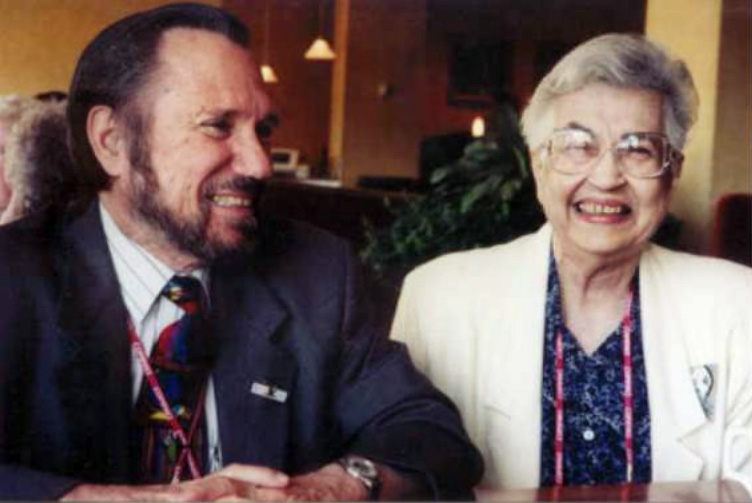
Frank and his wife, the late Margaret Schram Withrow
There was a concerted campaign against ESSA TV by talk radio hosts claiming that Social Security was in danger because of these minority-based programs. Sixty Minutes ran a segment on “Hollywood on the Potomac,” which featured World War II training films but was used to kill USDE television programs. Since most of the productions were multi-year contracts rather than grants, we were able to finish the work that had been started, but Congress at the urging of the Reagan Administration killed the programs. The third season of The Voyage of the Mimi, which was to be a trip down the Mississippi, was canceled, but we were allowed to finish the second season.
Continue reading →
Filed under: Uncategorized | Leave a comment »
Posted on February 28, 2012 by JimS
By Frank B. Withrow
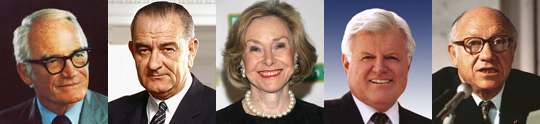
There are some people that have extraordinary visions of greatness. President Lyndon Banes Johnson’s vision of a Public Broadcasting Service was one of those great accomplishments. Senators Barry Goldwater and Jacob Javits’s unrelenting support of Joan Ganz Cooney’s dream of television to teach young children has changed early childhood education around the world. Senator Ted Kennedy’s vision of distance learning through technology has opened the door to 21st century learning and teaching though Star Schools.
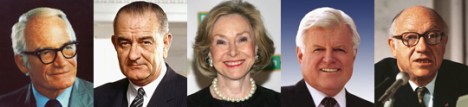
By 2020, most learning and teaching will be a blended experience of online and classroom courses tailored to the needs of each learner. Learning for the average student will take place at the home, the classroom and the workplace. Young and older workers may spend as much as one fourth of their time refining and improving their work skills on their jobs.
Access to high quality learning experiences will continue to expand to mobile devices. Management of learning will continue to increase as we are able to track learning progress by the student and to reinforce those areas where the learner shows weaknesses. There will be a cornucopia of online resources that can address the learner’s needs.
Continue reading →
Filed under: Uncategorized | 1 Comment »
Posted on February 26, 2012 by JimS
By Jim Shimabukuro
Editor
The University of Edinburgh MSc in E-learning program’s “Manifesto for Teaching Online” is a bold move to break the chains that bind completely online to traditional and blended instructional models. The basic assumption is that onground and online are fundamentally different and that whereas approaches to one are well established, approaches to the other aren’t precisely because little or no effort is being made to fully understand the differences. The list of 20 tenets provides a useful starting point for a discussion, and the developers are to be commended for opening this discussion to the world.
The first tenet, “Distance is a positive principle, not a deficit,” decries the current practice of viewing online as simply a crippled or inferior extension of traditional or blended instruction, a second best alternative when the first is unavailable. This statement provides the raison d’etre for the manifesto, the radical view that “distance,” the factor that distnguishes one from the other, has the potential to not only provide a different learning environment but a superior one. In other words, the twin concepts of anytime and anywhere are the foundations for a whole new approach to teaching and learning.
The second tenet, “The best online courses are born digital,” is an amplification of the first, a declaration that methods brewed for onground classrooms fail to take advantage of the VLE (virtual learning environment) and are, thus, ill-suited for online teaching. Online pedagogy, at its best, must make full use of the features available in the anytime-anywhere classroom. The fourth tenet, “‘Best practice’ is a totalising term blind to context,'” is an extension of the second. The message here is that best onground may not be best online.
Continue reading →
Filed under: Uncategorized | 4 Comments »
Posted on February 26, 2012 by JimS
By Harry Keller
Editor, Science Education
[Note: The following article was first posted by Harry Keller as a comment to “A ‘Manifesto for Teaching Online’: The Edinburgh Edict” on 2.25.12. -Editor]
In “Manifesto for Teaching Online,” I find a subtext that’s disturbing. The statements suggest an active and strong group of people opposing online distance learning in a variety of ways. In other words, such a manifesto would not be necessary in a logical world.
Imagine the introduction of the book. Was such a manifesto necessary to get people to use books in learning? Did people suggest that books stifled creativity by putting the ideas on pages? Did they say that books created a “literacy divide” by denying learning to those who could not read? Did they complain that books result in a decline in people’s ability to remember because they could just look in the book? Of course, I wasn’t there at the time, and anti-book people would be unlikely to put these thoughts into books for us to read today. Some historian may be able to answer this question. It doesn’t matter.
Learning through online communication makes perfect sense. Books actually allowed people to learn things without being physically present at the side of the author. In a sense, they were the first distance learning. I learned electrical wiring through books and much more without having to sit in a class or become an apprentice. That learning was “distance learning,” although not as wonderfully dynamic as today’s online distance learning. Continue reading →
Filed under: Uncategorized | 1 Comment »
Posted on February 24, 2012 by JimS
By Jim Shimabukuro
Editor
The Manifesto for Teaching Online (2.24.12), written by teachers and researchers in the MSc in E-learning program at the University of Edinburgh from June 2010 to May 2011, is arguably the most exciting document for discussion to emerge thus far in 2012. It was distributed in the following format, but other formats are also available.
 Click the image for the PDF version.
The manifesto is described as “a series of brief statements that attempt to capture what is generative and productive about online teaching, course design, writing, assessment and community. It is, and may remain, a living document that is reviewed and reworked periodically with colleagues, students and amongst the programme team …. Its primary purpose is to spark discussion, and to articulate a position about e-learning that informs the work of the project team, and the MSc in E-learning programme more broadly.”
The creators, however, are opening the discussion to a wider audience: “Our intention is that over the next few months the manifesto will stimulate discussion on a wider stage, fuel further research, and draw attention to the work being done here at Edinburgh in developing new perspectives on e-learning.”
Continue reading →
Filed under: Uncategorized | 12 Comments »
Posted on February 21, 2012 by JimS
By Jim Shimabukuro
Editor
Updated 6/15/15
Years ago, when I first began reading about a smartboard in every classroom and a laptop for every student, I was overjoyed. When the smartboards grew increasingly sophisticated and laptops morphed into netbooks then tablets, I was ecstatic. Yes, teachers and students were finally beginning to use some of the latest internet technology to breach the classroom walls and tap into the growing universe of online information, resources, and services.
The transformation was nothing short of miraculous. The electronic screens in classrooms became instant windows to a seemingly infinite wealth of not only information and knowledge but of experts and other human resources. Stepping through the electronic windows, teachers and students broke free from their tiny classrooms and soared into the new world of learning that transcended time and space barriers. Without moving an inch from their desks, they could, with a click, be anywhere and communicate with anyone in the world.
But as the trickle of technology into classrooms grew into a torrent and every day brought a flood of new announcements of schools and entire districts investing in smartboards, laptops, and iPads, I no longer found myself cheering. Now that we’re past the initial hurdle of simply getting the technology into the classroom, I’m beginning to pay attention to other factors, and some of what I’m seeing worries me.
For example, I’m becoming increasigly concerned about the hands in the cookie jar. I expect to see the hands of students and teachers — the intended recipients, the targets of the funding for new technology. However, I don’t expect to see other hands, especially when they’re grabbing a sizable portion of the cookies.
Continue reading →
Filed under: Uncategorized | 8 Comments »
Posted on February 21, 2012 by JimS
By Michael Hurwitz
[Note: This series is being brought to you by ETCJ associate editor Lynn Zimmerman. See Part I: “Technology Is a Game Changer” and Part III: “Chinese As the Language of the Future.” -Editor]
English has become one of the world’s most widely-spoken languages as well as the most popular second language and lingua franca of academics in no small part due to the heavy concentration of top universities and the large quantities of educational materials produced in English-speaking countries. Another reason for its popularity is the huge amount of entertainment content and other media produced in the Anglosphere. For instance, nearly every English-language training school here in Shanghai has a TV in the lobby showing DVDs of “Friends” (老友记, Lǎoyǒujì) or other American television shows to help students practice their English.
One of the great victories of the Information Age is the ability of learners the world over to access content in almost any language, giving them unprecedented variety in terms of learning style, pace, and method. English-language TV has been around for decades, of course, but the spread of high-speed internet and satellite connections has made accessing content, be it entertainment or educational, much easier. DVDs and streaming web video, for instance, have brought English-language educational content to places that had none just a decade ago. In addition, technology like smart phones and tablets has made mobile learning much simpler and more effective – convenience and flexibility can make it seem as though there’s more time in the day, so to speak, for practice in speaking and listening as well as exposure to a language, and with English in particular it’s easier than ever.
Continue reading →
Filed under: Uncategorized | 4 Comments »
Posted on February 16, 2012 by JimS
 By Thomas Ho
Of course they should, but what tone should it convey? Actually, I’m really asking about students’ digital identity, but the title of this post merely reflects the “branding” I employed to attract students to my upcoming presentation about personal branding and digital identity. It is that presentation which prompts this post.
This is a touchy subject because parents and schools are so “conflicted” about it! On top of that, students’ immaturity calls for lots of caution! The “facts of life” are that most students do indeed have a digital identity so digital literacy compels that we teach them to be prudent about what they post with respect to content they create or share, permissions, and much more!
Nevertheless, the personal branding principles that apply to their parents and teachers apply equally to students with the exception that we can “cut them some slack” (or can we?) for not starting to “build their brand” yet (my daughter is among them L), but they certainly ought to be made aware of the implications for their future competitiveness, don’t you think?
After all, almost all of them are already online and, in many cases, they have already lost their opportunity to make a positive first impression. So, what should I say (or not say) to the students?
This post is full of questions and I hope to follow it up with subsequent posts with some answers…or at least to let you know what happens next. The future is full of problems and opportunities!
Filed under: Uncategorized | 22 Comments »
Posted on February 15, 2012 by JimS
 By Stefanie Panke
Editor, Social Software in Education
For a conference to run smoothly and professionally, a large amount of work happens “behind the curtains” without the conference attendees being necessarily aware of it. The Association for the Advancement of Computing in Education (AACE) was founded in 1981 and has been organizing international conferences since the 1990s. However, bringing a conference online requires new approaches from the program committee. Theo Bastiaens, program chair of the 2011 and 2012 Global TIME conference, talks about lessons learned, the quality of online talks, and the online experience from an attendee’s point of view.
 Theo Bastiaens, program chair of the 2012 AACE Global TIME conference.
SP: What makes or breaks a successful online conference?
TB: As the online conference Global TIME was organized for the second time we certainly fine-tuned the format, schedule, and technical platform. Since an online conference is somewhat different from a face-to-face conference we had to make sure that people had a virtual space to contact each other. For that reason, AACE developed “Academic Experts.” In my opinion, a great new platform to organize these online conferences. A very important aspect of this platform is that it integrates participants’ social profile with discussion features and the paper presentations. Little things that we learned from the online conference last year, like the automatic adaption of the program to the time zone of the participant, are very important for a smooth organization. Continue reading →
Filed under: Uncategorized | 3 Comments »
Posted on February 14, 2012 by JimS
By Stefanie Panke
Editor, Social Software in Education
The second edition of the AACE Global TIME online conference took place from February 7 to 9, 2012. The annual event aims to connect and engage educators, researchers, consultants, trainers, policy makers, curriculum developers, entrepreneurs, and others. Sectors covered include adult learning, higher education, informal learning, K-12, libraries, and museums as well as vocational education and corporate training. It was my pleasure to cover the second edition of Global TIME for the Educational Technology and Change Journal on behalf of AACE.
Global TIME 2012 hosted attendees from 28 countries, 34 presentations, 44 additional “asynchronous” papers, 3 excellent keynotes, and 4 workshop sessions. Even though the program was less packed than the usual week-long AACE conferences, the following overview is still necessarily a rather idiosyncratic collection of my manifold personal impressions and encounters.
Day 1 – Getting Started: Cultural Change in Workplace Learning
“We are having a PowerPoint war.” With these words from Sarah Benson, member of the AACE organization team, the conference started on February 7 at 4 p.m. GMT. Benson’s comment referred to some initial technological hiccups with loading the keynoter’s slides – fortunately, one of the very few problems with the Adobe Connect virtual conference space.
Program chair Theo Bastiaens, director of the Institute of Educational Science and Media Research at the German “Fernuniversität Hagen” and professor at the Open University of the Netherlands, officially opened the conference with a short welcoming address, greeting everyone from a freezing Europe. Approximately 20 participants from all over the world joined in – and immediately started to compare notes on their local time, weather, and physical location. Penelope Neuendorf said “Hello” from Canberra (Australia) at 3 in the morning, Luigi Riscaldino from the University of Calgary (Canada) sipped his coffee at 9 am, Manar Hosny logged in from Riyadh (Saudi Arabia), and Mark Curcher said “Hi” from Dubai (Arab Emirates).
Continue reading →
Filed under: Uncategorized | 6 Comments »
Posted on February 10, 2012 by JimS
OK, I am spoiled. Henry Jenkins, Bill Clinton, Vice President Gore, Danah Boyd, George Lucas, Ron Brown (he is deceased), Seymour Papert — and lots of other luminaries. In person and in your face. Wendy Pye face to face and online. More about that later.
Face-to-face, people intrigue me. I know Chris Dede and was mentored by him. I worked with Seymour Papert and was taught by him, and I have had tussles with people who are very well known about technology in schools, broadening engagement and digital equity. In courses, there are people who have watched my work and who know my personality, even when I shrink back from too much of everything in technology. Gently they beckon. I meekly follow. I think I only have the courage to continue to learn based on the friendship and encouragement of my educational friends. Vint Cerf has remained a friend and email keeps us in touch.
I sat around tables that contained important CEOs and learned to negotiate, I learned to listen well, I learned to push MY ideas.
If I had only met these people online, the relationship would be different and unreal, but the Facebook, and online communications cement our friendships and continue the dialogue. I loved talking with Henry Jenkins about New Orleans and our first impressions as children when we went.
Continue reading →
Filed under: Uncategorized | 5 Comments »
Posted on February 9, 2012 by JimS
By Jim Shimabukuro
Editor
According to Kyle Webb, at yesterday’s Lane Community College (Oregon) Board of Education meeting, the dean of academic technology, Brad Hinson, “presented the state of online education and its potential future.”* Webb quotes Hinson: “Faculty [need] to understand ‘the demand is there. It’s modern education. It is what the students demand.'”
Hinson’s observations are enlightened, but they didn’t push me to the keyboard to write a comment. The shove came from concerns by two of the board members. Gary LeClair, according to Webb, “said there seems to be more ‘social isolation due to more computers.’ LeClair said he already notices students glued to cell phones and computers as it is, and that he is concerned that students with college-issued iPads might increase this social isolation, thus impeding their educations.” Webb also quotes Jim Salt, LCC’s Education Association president, who, along with LeClair, “voiced concerns about the potential loss of student-instructor connection.”
These two concerns, about the causal relationship between personal communication devices, on the one hand, and social isolation and deterioration of student-instructor relationships, on the other, are the issue. They’re reminders that, in most disagreements, the root is not in what we actually observe but with our interpretations. We’ve all witnessed the first scenario where students share the same geographical location, e.g., a cafeteria table, but are oblivious to one another because each is engrossed in her/his smartphone or tablet PC.
Continue reading →
Filed under: Uncategorized | 6 Comments »
Posted on February 7, 2012 by JimS

 [Note: Snagged spotlights some of the latest and most stimulating articles on educational technology. This article by David Nagel was brought to my attention by ETCJ science education editor Harry Keller. Please send your catch of the day to me, jamess@hawaii.edu, for possible snagging. -Editor]
David Nagel, in “Feds Look to Accelerate E-Textbook Adoption with ‘Digital Textbook Playbook'” (THE Journal, 2.1.12), describes the “Playbook” as “a guide designed to help schools overcome the challenges associated with the shift to e-textbooks. The ‘Playbook’ is the product of the Digital Textbook Collaborative, a group put together by ED and the FCC and composed primarily of technology companies and textbook publishers, along with two education organizations, one school district, and one university.”

Nagel quotes FCC Chairman Julius Genachowski: “‘When we talk about transitioning to digital textbooks, we’re not just talking about giving students e-readers so they no longer have to carry around backpacks filled with 50 pounds of often out-of-date textbooks. We’re talking about students having interactive learning devices that can offer lessons personalized to their learning style and level, and enable real-time feedback to parents, teachers, or tutors. Imagine a student who has trouble doing his geometry homework; the digital textbook automatically inserts a supplemental lesson. Imagine a teacher who has instant access to the results of a pop quiz; she can immediately see that four of her students didn’t understand the concept of photosynthesis and is able to offer an extra lesson.'”
Continue reading →
Filed under: Uncategorized | 27 Comments »
Posted on February 6, 2012 by JimS

 Click the image to visit the site.
You are invited to be part of the second annual Innovator Spotlight virtual event!
Every year the League honors outstanding innovations through the presentation of its Innovation of the Year Award. These innovations represent significant achievements at member colleges and the continuing renewal of the spirit of innovation and experimentation upon which the League was founded. Award-winning innovations will be presented in collaboration with Teaching Colleges and Community (T.C.C.) and Learning Times by some of the brightest minds in the community college world. Join us Wednesday, February 15th, 2012, for this exciting one-day online event for as little as $75! Register today! Continue reading →
Filed under: Uncategorized | Leave a comment »
Posted on February 2, 2012 by JimS
By Michael Hurwitz
[Note: This series is being brought to you by ETCJ associate editor Lynn Zimmerman. See Part II: “Technology Makes English the Global Language” and Part III: “Chinese As the Language of the Future.”-Editor]
People have been learning languages since…well, since people have been, pretty much. For as long as we can remember, however, most people have approached SLA (second-language acquisition) with what we sometimes call a “classroom mentality,” meaning language learning must involve long hours in a classroom with static (sometimes outdated) textbooks.
This is the way language learning has been for a long time primarily because there really weren’t many alternatives: it was prohibitively expensive (and time-consuming) for most people to travel to a foreign country to learn in a native-speaking environment, and there weren’t many good or affordable ways to access educational or entertainment content in other languages. Those days, however, have come to a spectacular and speedy end since technology has totally changed the game.
In the Information Age, there’s really nothing you can’t do if you put your mind (and your web browswer) to it. First and foremost, learning a new language is about exposure and access. Hearing a language spoken proficiently, processing it, and then using it yourself is a fantastic way to advance your skills, and technology has made that easier than ever before. For example, programs like Skype have made live video chatting, not long ago an elaborate and expensive pipe dream, as convenient as a few clicks of the mouse.
Continue reading →
Filed under: Uncategorized | 2 Comments »
Posted on January 30, 2012 by JimS
By Harry Keller
Editor, Science Education
Nearly a year ago, in “On Evolution, Biology Teachers Stray From Lesson Plan” (NY Times, 2.7.11), Nicholas Bakalar quoted Randy Moore, professor of biology at the University of Minnesota: “With 15 to 20 percent of biology teachers teaching creationism, this is the biggest failure in science education. There’s no other field where teachers reject the foundations of their science like they do in biology.”
A week ago, Sam Favate, in “A ‘Critique’ of Evolution Proposed in Oklahoma” (Wall Street Journal, 1.23.12), reported that Oklahoma has just introduced the sixth anti-evolution bill this year.
It’s not surprising that some people still deny evolution, but the size of the effort does not bode well for our future in science. Evolution is not only established scientific fact, but is the central unifying concept for all of biology. It allows scientists to understand life better and to decide where to look to find new drugs, cures for diseases, and prevent new infections from becoming pandemics.
Not only do 15 to 20 percent of biology teachers teach creationism, but 60% take no stand on evolution versus creationism. Generations of students are being handicapped in their desire to understand and succeed in life.
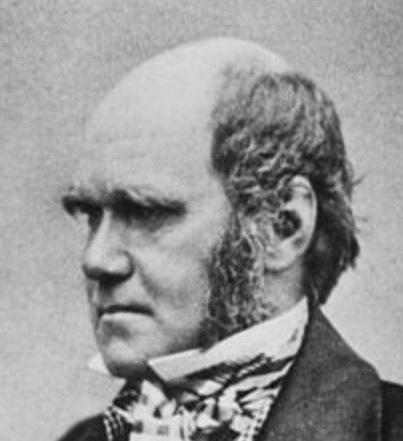
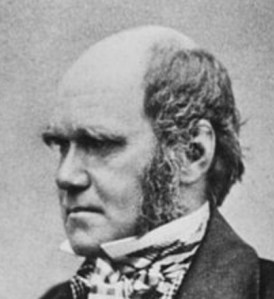 Charles Darwin
Charles Darwin published On the Origin of Species in 1859, long after he had formulated his theory. He was attacked immediately and, at the same time, lauded by a minority who understood science. At that time, as today, too many people misunderstood the role of science, what it’s really about.
Continue reading →
Filed under: Uncategorized | 4 Comments »
Posted on January 28, 2012 by JimS
 [Note: Snagged spotlights some of the latest and most stimulating articles on educational technology. This article by Anthony Cody was emailed to me by ETCJ associate editor Bonnie Bracey Sutton on Jan. 27. To share your catch of the day, email it to me, jamess@hawaii.edu, for possible snagging. -Editor]
Anthony Cody, in “How the War on Teachers Is Changing the Profession” (Valerie Strauss, The Answer Sheet, Washington Post, 1.27.12), calls it like it is. The national reaction against teachers (and their unions) is gaining momentum, and the blame for failure is being dumped on their shoulders. In Cody’s article, we find the following statements:
- “The teaching profession is being redefined. Teachers will now pay the price: They will be declared successes or failures, depending on the rise or fall of their students’ test scores.”
- “Under NCLB, it was schools that were declared failures. In states being granted waivers from the most onerous requirements of NCLB, it is teachers who will be subjected to this ignominy.”
- “The individual teacher’s accountability for student performance is absolute.”
To hold teachers 100% responsible when they can account for only “10 percent of the variability in student test scores” is insane, especially in light of the fact that other factors such as “family income and education levels” account for 90% of the variability.
Why is this happening? Or more importantly, why are we, educators, allowing this to happen? -js
Filed under: Uncategorized | 14 Comments »
Posted on January 28, 2012 by JimS
 By Michael Biocchi
[See Educational Games Part I: A Way to Make Even Math Fun and Educational Games Part II: Using New Technologies in the Classroom.]
A game is not “educational” just because it involves a few puzzles or steers away from violence. An educational game has to have certain characteristics beyond the obvious one of helping students learn. It can be argued that, in some way, all games help people learn. Even a violent fighting game can help with hand-eye coordination (Roach). Does this mean that all games are educational? Of course not, but it does help us develop characteristics that will make a game educational.
The best educational games in my opinion are those that are based on textbooks. The material and research is already developed. Should a grade two math game involve long division? Check a grade two textbook and see what is covered! The game does not have to be word for word of what is in the textbook (this would involve partnering with the publisher and going through many legal procedures), but it should be relevant to what the children are learning at that grade level.
So now that we know what material is going to be covered in the game, we still need to know what makes the game educational. Obviously content is a big part of it, but the look, feel and gameplay is also important. First, the game should offer some sort of social interaction. This does not mean that the game needs to be multiplayer, but it should somehow involve players talking to and interacting with each other. For example, together, they could be creating avatars, going through levels, or experiencing compelling stories. The students should care about what they are doing. Continue reading →
Filed under: Uncategorized | 3 Comments »







 Educational Technology and Change Journal
