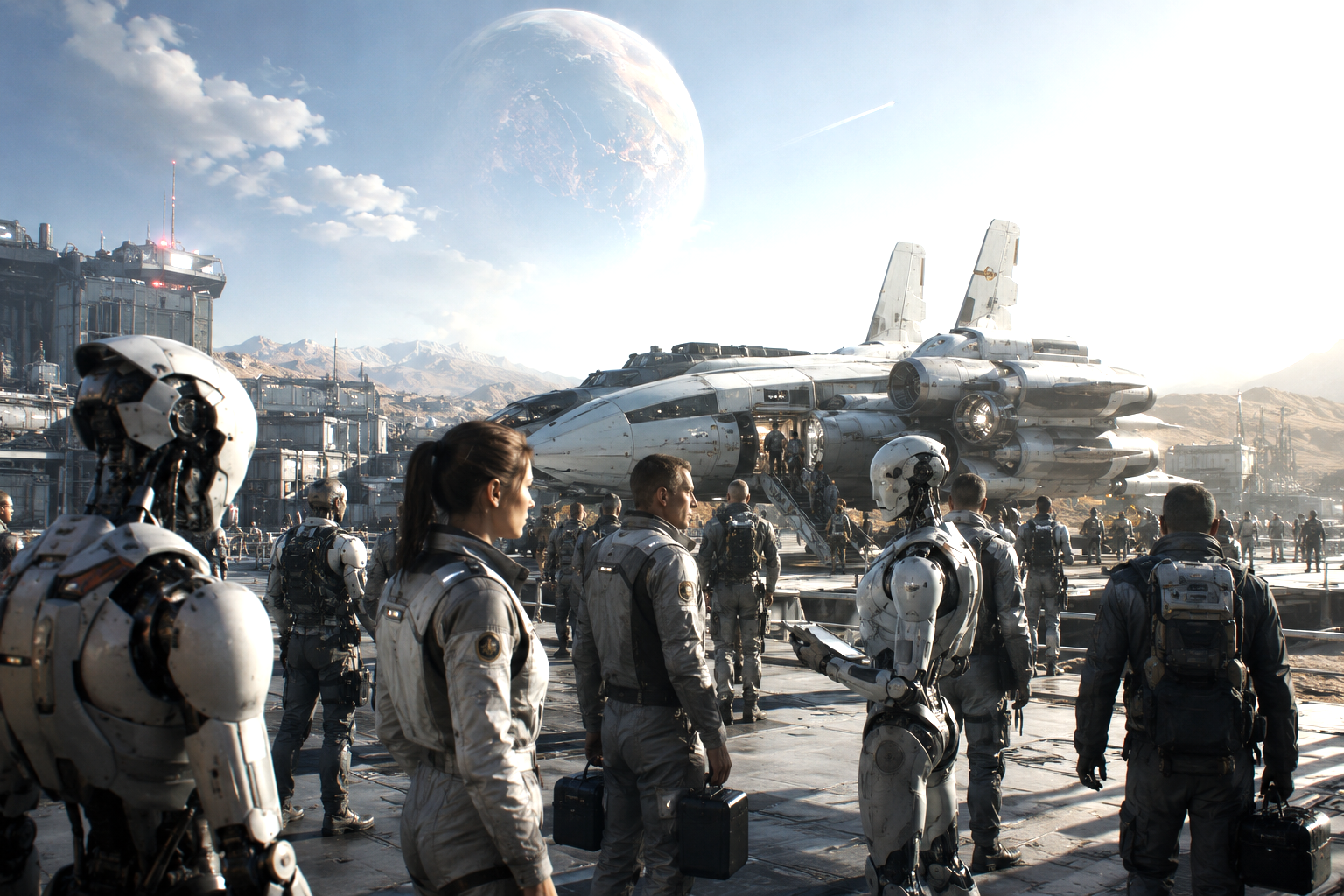
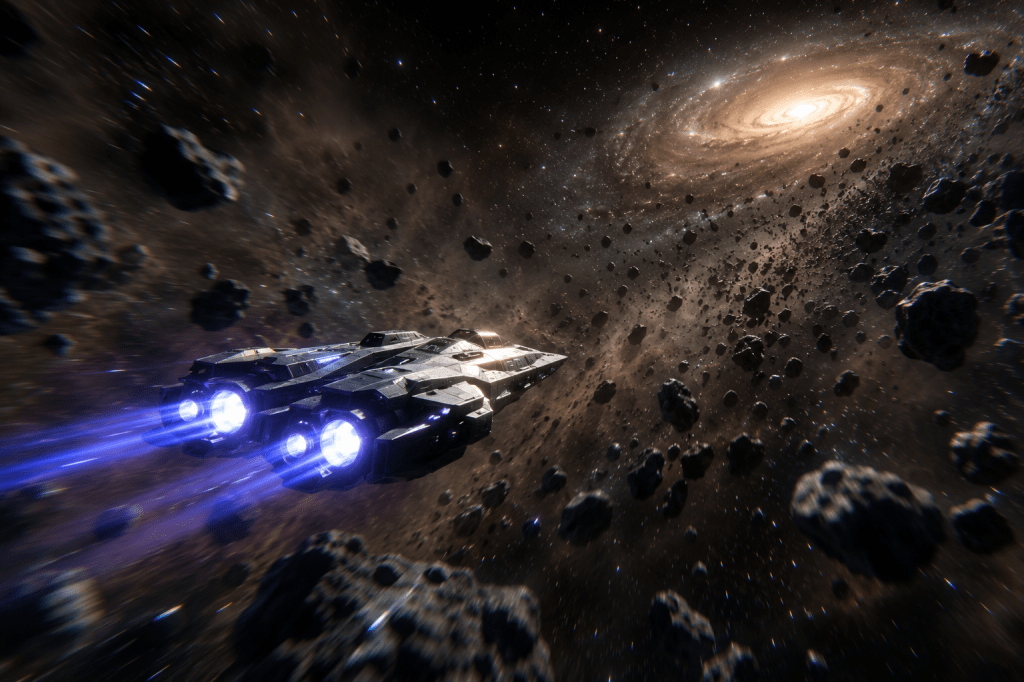
The debate about interstellar travel, crystallized in the two companion pieces published today in ETC Journal, reveals a telling tension at the heart of our species’ ambitions. Harry Keller’s “Interstellar Travel Is Harder than You Think” lays out the formidable physics — cosmic rays ten times more intense than those within our solar system, dust particles at 10% the speed of light hitting a starship with the force of tons of TNT, and the crushing demands of the Law of Conservation of Momentum, which requires an engine exhaust velocity exceeding 99% the speed of light merely to reduce reaction mass to 10% of a ship’s total mass (1).
Interstellar travel is still hard, but Keller’s pessimism may be too strong if the goal is to search for habitable planets rather than carry humans there. The latest open sources point to a much more optimistic picture: astronomy is rapidly narrowing the target list to nearby candidate worlds, while AI, robotics, lightsails, and nuclear propulsion are steadily improving the tools that would make interstellar exploration practical (1-5).
When asked about interstellar travel, people raise concerns about cosmic rays, interstellar dust, how to survive a centuries-long trip, and how to obtain the necessary energy, among other issues. These are valid concerns. Interstellar cosmic rays are about ten times stronger than those inside our solar system. At 10% of the speed of light, an average dust particle would carry the energy of tons of TNT upon impact with the starship. A habitable planet could be as close as 40 light-years away. If you could travel that fast, the trip would take 400 years. That speed is too low to produce any time dilation.
Our March judgment hinged on one central contingency: whether Washington would cross the threshold from coercive strikes and limited presence into large‑scale occupation of Iranian territory. Subsequent developments in April–May 2026 still point firmly away from that threshold. Official descriptions of Operation Epic Fury continue to frame the campaign as an air‑ and maritime‑centric effort to destroy Iranian offensive missiles, naval assets, and elements of its security infrastructure, with no announced plans for a ground invasion or regime‑change occupation, and the legal rationale is explicitly tied to self‑defense and collective defense of Israel rather than to territorial control or long‑term pacification of Iran (1). This strategic framing is fundamentally incompatible with a Vietnam‑style war of occupation, even if the conflict remains intense and dangerous.
Rather than becoming a second Vietnam, the rising likelihood is a drawn‑out, messy, horizontally escalated regional confrontation of low‑to‑medium‑intensity with recurring crises, sanctions, cyber operations, and proxy clashes. Image created by Copilot.
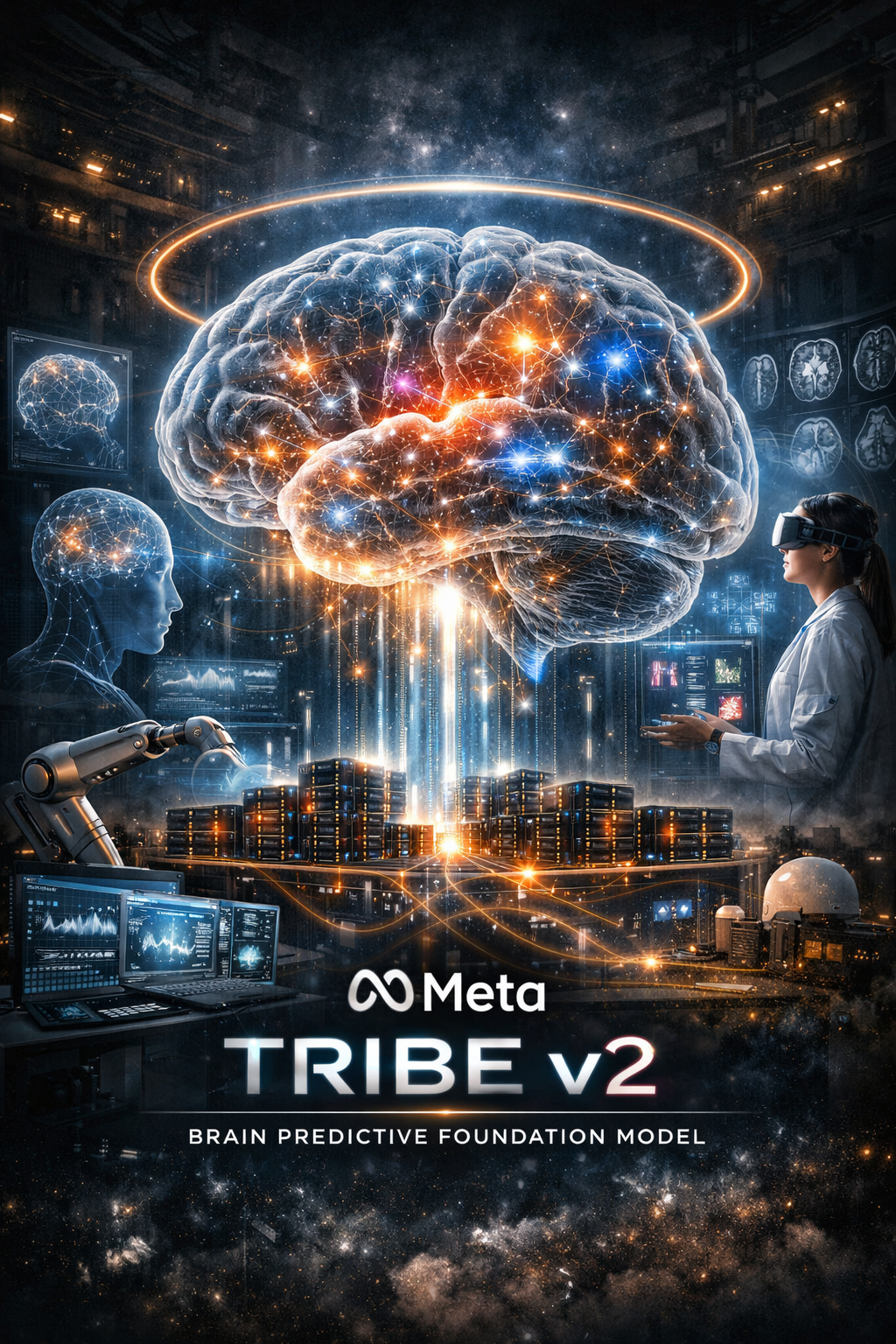
Meta’s TRIBE v2 Brain Predictive Foundation Model Meta AI unveiled TRIBE v2 on March 26, 2026, a groundbreaking predictive foundation model designed as a digital twin of human neural activity, capable of forecasting brain responses to complex stimuli including sights, sounds, and language. Trained on an extensive dataset of over 700 healthy volunteers exposed to images, podcasts, videos, and text, the model achieves a 70-fold increase in resolution compared to prior efforts by leveraging low-resolution fMRI data from just four individuals in earlier iterations. It excels at zero-shot generalization, predicting brain activity for entirely new subjects, languages, or tasks it has never encountered during training. The company released the full model weights on Hugging Face, open-sourced the codebase on GitHub, published an accompanying research paper, and provided an interactive demo—all under a CC BY-NC license—inviting the global research community to build upon it (1).
When we published “The AI Revolution in Weather Forecasting: Five Transformative Innovations” in February 2026, the field was already moving at a dizzying pace. In just the three months since, several new developments have emerged that are worth tracking — from a new open-source model architecture out of NVIDIA, to the world’s first AI-native satellite constellation, to breakthroughs in predicting tornadoes a full week in advance. The momentum hasn’t slowed; if anything, it has accelerated.
There is a kernel of truth, but the claim is usually overstated. Recent, credible evidence supports a narrower version of it: many students and adults can read at only modest comprehension levels, and many younger people have limited experience with cursive, but that does not mean “college graduates can’t read critically” in any absolute sense (1,2,6).
The Department of War’s 8 May 2026 release of unresolved UAP-related records and historical documents has again pushed the UFO/UAP issue from the cultural fringe into mainstream national-security and scientific discussion. Multiple major news organizations described the disclosure as one of the broadest public releases of federal UFO-related material in years, including military sightings, internal memoranda, photographs, and investigative summaries.[1-9]
“Actual site photo with FBI Lab rendered graphic overlay depicting corroborating eyewitness reports from September 2023 of an apparent ellipsoid bronze metallic object materializing out of a bright light in the sky, 130-195 feet in length, and disappearing instantaneously.” Release date 5/8/26 by U.S. DOW.
Copilot: 1. Gaza, foreign policy, and the youth/progressive rupture: One of the most likely centerpieces of the unreleased autopsy is the conclusion—already reported in leaks—that the Biden administration’s Gaza policy badly damaged Kamala Harris among young voters and progressives. Axios has already revealed that top Democrats working on the secret report concluded Harris “lost significant support because of the Biden administration’s approach to the war in Gaza,” and that this finding is one reason party leaders are so reluctant to publish the document.[8] Democracy Now! and advocacy groups like the Institute for Middle East Understanding have echoed this, noting that the DNC’s own data reportedly described the administration’s Gaza stance as a “net negative” in 2024.[7] Truthout likewise reports that internal findings point to Gaza as a major factor in Harris’s defeat.[1]
The 15 April 2026 Nature paper “Ancient DNA reveals pervasive directional selection across West Eurasia,” led by Ali Akbari and senior author David Reich, is being widely viewed as one of the most consequential studies in ancient genomics since the first large-scale recovery of ancient human DNA in the 2010s. Its central thesis is straightforward but profound: human evolution in the last 10,000 years has not slowed down or effectively stopped, as many earlier researchers suspected. Instead, natural selection has been widespread, continuous, and measurable across historical populations of West Eurasia, especially after the transition from hunting and gathering to agriculture. The authors argue that earlier studies underestimated recent human evolution because they lacked both sufficiently large ancient DNA datasets and statistical methods capable of distinguishing genuine natural selection from confounding factors such as migration, population mixing, and random genetic drift [1].
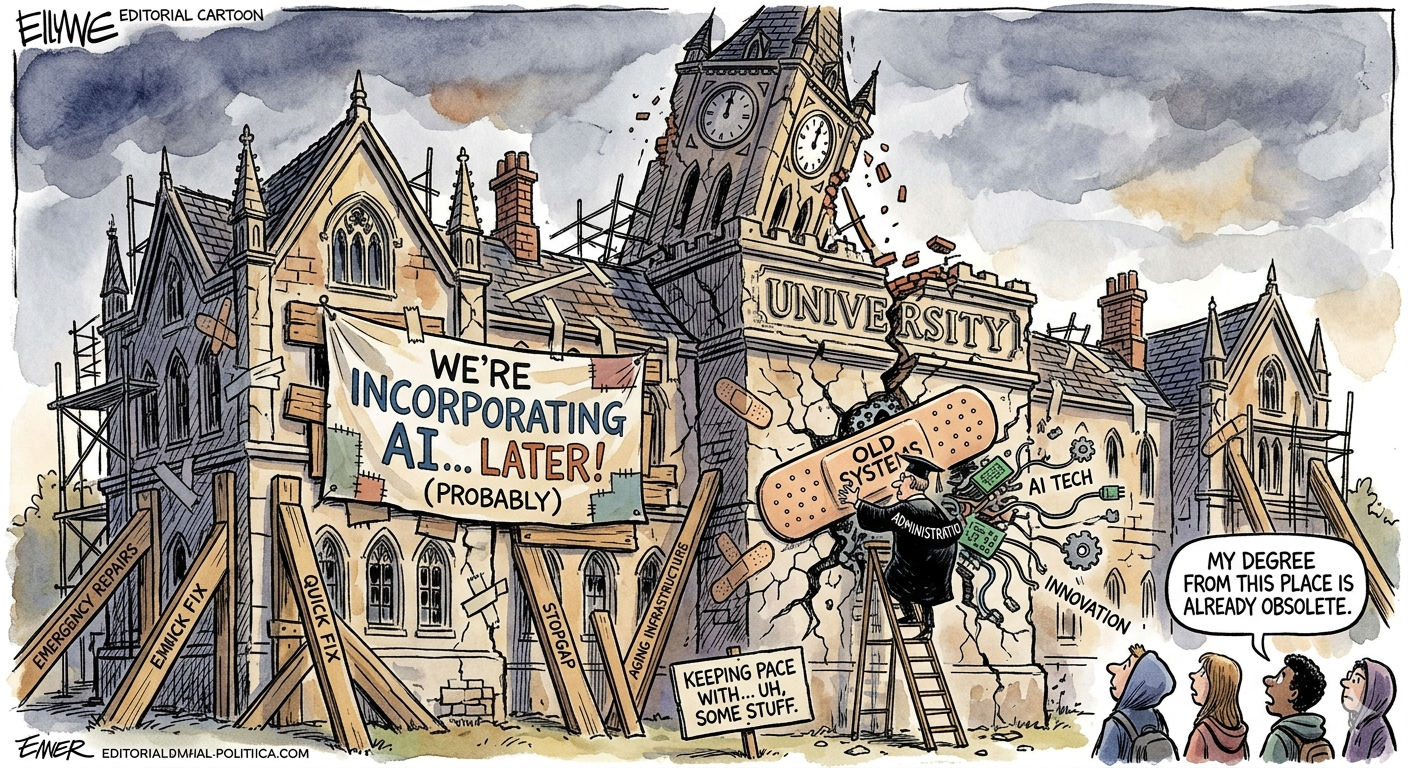
The accelerating cycle of innovation—especially in AI—forces higher education leaders to confront a basic shift: universities can no longer treat technological change as a series of episodic disruptions; they must assume continuous, compounding transformation as the default condition. In this environment, the core role of universities moves from being primarily degree-granting institutions that “finish” learners to being long-horizon infrastructure for lifelong capability-building, ethical stewardship of powerful tools, and rapid translation between frontier technologies and human flourishing. The question is whether institutions can re-architect themselves fast enough to match the exponential curve they are now riding.
ChatGPT: The “30-day lifespan” is not a formally verified or widely cited benchmark—but it is directionally credible as an extreme, frontline observation. The best available 2025–2026 evidence suggests that innovation cycles in the Russia–Ukraine drone war are typically measured in weeks to a few months, with some tactical adaptations happening even faster. In other words, while “30 days” may be a simplification, it captures a real phenomenon: continuous, near-real-time technological turnover under combat pressure.
A growing body of 2025–2026 guidance suggests that mid-career professionals can no longer treat AI as a discrete skill to “learn once,” but instead must adopt a continuous, self-directed cycle of experimentation, reflection, and integration into daily work. Recent practitioner-oriented articles emphasize that the most effective professionals are not those who complete isolated courses, but those who build what might be called a personal AI lab—a lightweight, evolving system of tools, workflows, and projects that mirrors how AI is actually used in modern organizations.
Children born between 2010 and the mid-2020s will come of age in a world that looks radically different from any that has come before. If 2023 was the year the world discovered generative AI, and 2024 was about integration and experimentation, then 2025–2026 marks the transition from AI assistants to agentic AI — autonomous systems that don’t just answer questions but actually do things [1]. For parents, this is not a future to theorize about. It is a present to act on. According to McKinsey, up to 40% of work tasks could be automated with AI by 2030 — and today’s students will enter that future workforce, which is why AI education for children must start now [2].
To understand the allegations swirling around Ukrainian President Volodymyr Zelenskyy, one must first understand the mechanics of the scheme that set off Ukraine’s most damaging corruption scandal since the start of Russia’s full-scale invasion. Operation Midas is an anti-corruption investigation by Ukraine’s National Anti-Corruption Bureau (NABU) and the Specialized Anti-Corruption Prosecutor’s Office (SAPO), launched in 2024, concerning large-scale bribery in Ukraine’s energy sector during the Russo-Ukrainian war.
For a high school student in 2026, drones are no longer a niche hobby—they are a maturing aviation and data platform that touches logistics, infrastructure, agriculture, media, public safety, and defense. The U.S. commercial drone market is projected to be one of the fastest‑growing tech sectors, with global commercial revenues estimated around $58 billion by 2026, and U.S. demand driven by defense, logistics, infrastructure inspection, and agriculture.[2] At the same time, the regulatory environment is shifting from simple visual‑line‑of‑sight (VLOS) flying under FAA Part 107 to more complex beyond‑visual‑line‑of‑sight (BVLOS) operations and proposed new rules (often discussed as a future Part 108), which in turn raises the bar for training, safety, and technical competence.[1] For a young person, this means the field is wide open—but it also demands more than just learning to fly a quadcopter.
Steven D. Shaw and Gideon Nave of the Wharton School of the University of Pennsylvania published a preprint in January 2026 that has generated substantial discussion across cognitive psychology, behavioral science, and AI-policy communities.[1] The paper is important because it attempts something long overdue: updating the foundational dual-process theory of human cognition — most famously popularized by Daniel Kahneman’s System 1 (fast, intuitive) and System 2 (slow, deliberate) dichotomy — to account for the fact that millions of people now consult generative AI while in the very act of reasoning.


































 Educational Technology and Change Journal
