


[Note: This article is a response to a discussion last week on the ETCJ staff listserv re Providence Talks. -Editor]
Vocabulary can indicate success in schools. English is the most used language in the world and has an estimated one million words. From age two, growing children add 800 to 1000 words a year to their vocabulary. The average kindergartener has a 4000-word vocabulary. However, kindergarteners will range from 2000- to 6000-word vocabularies. In preschool classes, the kids do not appear to be different, but when reading skills are developed, the 6000-word vocabulary learners excel and the 2000-word vocabulary kids are likely to fall behind.
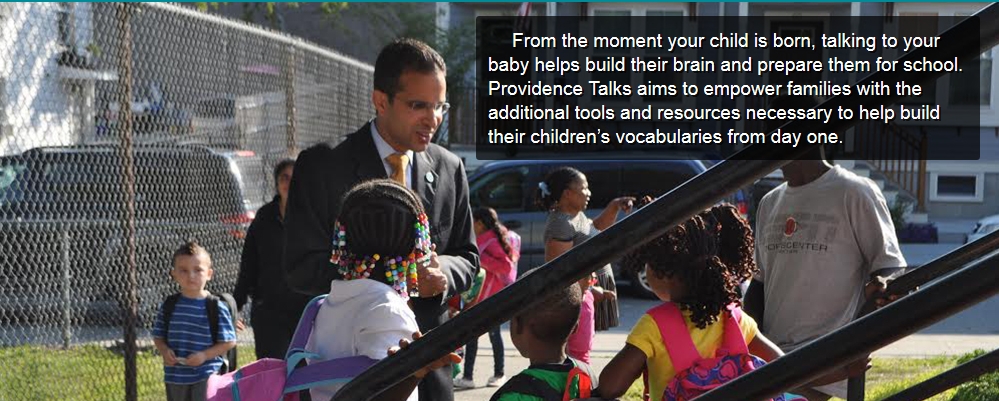
From the Providence Talks website.
Basic English has 2000 words. If Tom Sawyer were to be printed in Basic English, it would have to be ten times as long. To illustrate this, Basic English has no word for disciple; therefore “Jesus’ disciples” become “twelve fishermen who were good friends and followers at the time Jesus was alive.”
The child who starts school with a limited vocabulary is behind the eight ball to start with.
How can you ensure that your child is going to succeed in school subjects like reading? Research has shown that children whose parents talk with them are more likely to have large vocabularies.
From an early age, parents should read books to and with their children. Parents need to ask questions and to encourage the child to ask questions. Children are fascinated with animation on television. Parents should watch such shows with their children and ask such questions as, “Can an Elephant Fly? Can the roadrunner fall off the cliff and live?” Watching television together and discussing what the child understands and thinks is important.
Children are able to develop sophisticated ideas and to detect truth from fiction if encouraged to think.
Why can’t an elephant fly? She is too big. She has no wings.
Even very young children can play word games like Stinky Pinky. A STINKY PINKY is a smelly little finger. What is an overweight feline? An overweight feline is a FAT CAT. What is a heavenly automobile? A STAR CAR is a heavenly automobile. Little children love these word games. They will take words they have learned in a word game and use it.
Children whose parents take them to the beach, a circus, a museum or zoo and talk about things they see and do have larger vocabularies.
Studies have shown that children with low vocabularies continue to under perform well into middle school years if something is not done to increase their vocabularies.
Again research has shown that parents from any socioeconomic level that talk with their young children are likely to have children with large vocabularies. It is simply the greatest gift you may give your child. It expands their interests and increases their vocabularies.
Filed under: Uncategorized | Leave a comment »





 By Leilani Cohen











 Educational Technology and Change Journal
