Why the Surface Pro 2 Will Be a Game Changer in the Tablet World Series

Jim ShimabukuroBy Jim Shimabukuro
Editor

Last updated 9/6/14

(Related articles: “Thoughts on the Surface Pro 2 After 8 Months” and “The Surface Pro 2 Will Be the Death of Notebooks.”)

I’m one of the 15 million who bought the first generation iPad in 2010-11, and I’m still using it today as a flexible extension of my desktop. I can take it anywhere within my WiFi zone and have instant connection to the web. Press, sweep, and tap, and I have my email. Tap and tap, my favorite websites. Tap and press, I’m done. No desk, no mouse, no keyboard, no waiting around.

Microsoft Surface Pro 2

Microsoft Surface Pro 2

But it’s not a desktop PC, and it still can’t do some of the basics. It can handle email, both reading and writing, but it can’t multitask very easily. This means that any task that requires grabbing info from one app and using it in another is iffy and requires so many steps that it’s almost not worth doing unless you’re desperate.

My iPad also can’t do standard PC apps such as MS Word and Excel and the gazillion little utilities that I can’t live without, and its ability to handle the vast range of webpage styles is poor, which makes web browsing and research a more miss than hit exercise. There are countless workarounds for mainstream desktop programs and app alternatives for mobile devices that are supposed to render standard websites readable, but these are clunky and offer poor alternatives to the real deals.

My iPad can’t handle images and videos very well, and it balks at most online video formats outside of YouTube. Thus, it’s a great tool for what it can do, but it leaves me on a short tether to my desktop.

I’ve been closely following the 2nd-to-4th generation iPad releases, but I haven’t seen the breakthroughs that I need. I also have an android tablet to keep an eye on what’s happening in that sector, but the issues are similar.  Continue reading

ISSOTL 2013: ‘Doing SoTL Means You Never Have to Say You’re Sorry!’

By Stefanie Panke
Editor, Social Software in Education

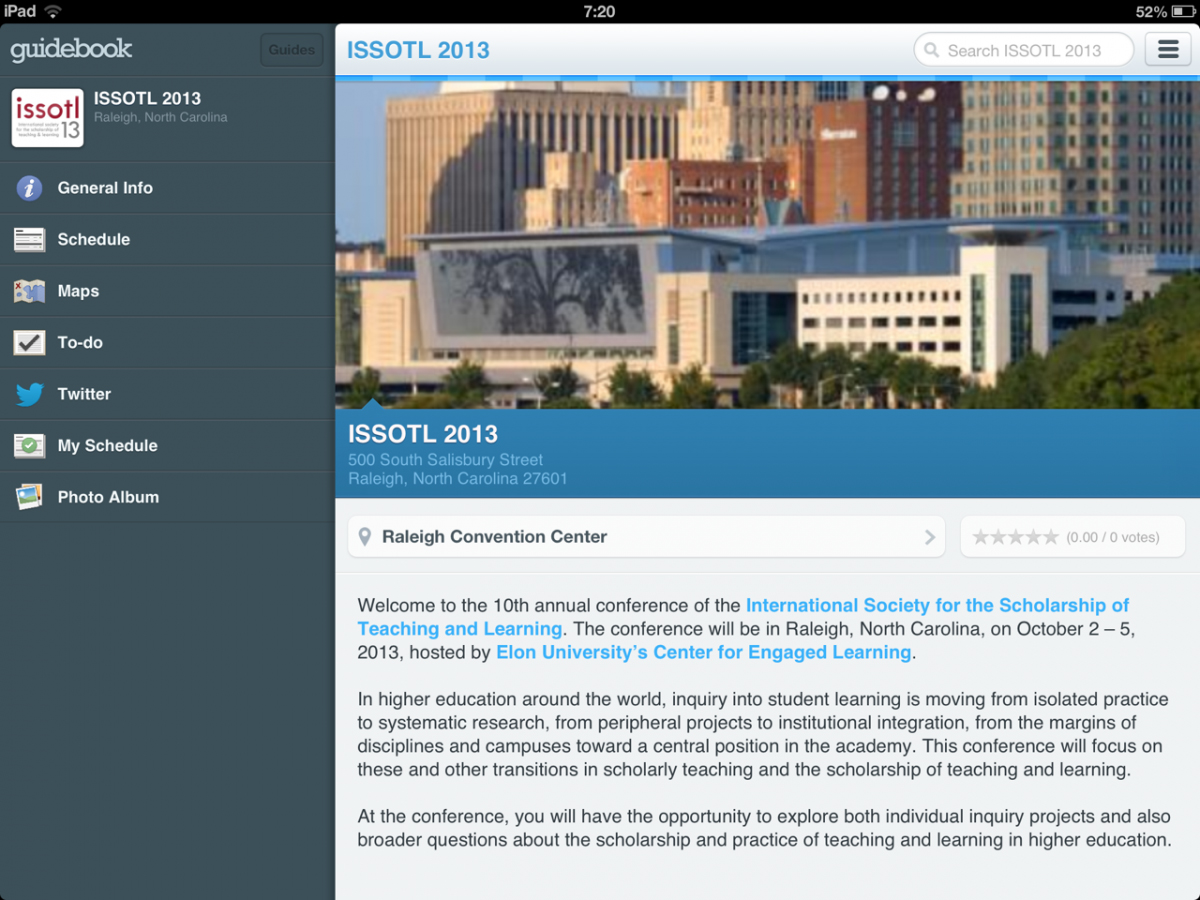
The 10th annual conference of the International Society for the Scholarship of Teaching and Learning was held in Raleigh, North Carolina, on October 2–5, 2013, hosted by Elon University’s Center for Engaged Learning (CEL). ISSOTL 2013 attracted approximately 600 participants. Most of the attendees came from universities across the US. Visitors from Canada, Europe, Australia, and other countries added an international flair to the event.

The conference organizers Peter Felten, Jessie Moore and Heidi Ihrig did a remarkable job in bringing together the traditions and values of the SoTL community with innovative ideas and emerging technologies. The conference was preceded by a free online series that featured videos, chats and discussion forums. During the event, participants were able to follow their personalized schedules on their mobile devices using the guidebook conference app.  At the same time, plenary presentations did not rely on Twitter-walls for interaction, but used buzz groups and other small group discussion formats to foster in-depth dialogue and deep processing.

 Schedule, planner and collective photo album: ISSOTL Guidebook App. Click image to enlarge.

Schedule, planner and collective photo album: ISSOTL Guidebook App. Click image to enlarge.

Wednesday, October 2: ‘The 8-track-tape Player of Opening Plenaries’

issotl 02For me, who like most participants did not book an additional pre-conference workshop or symposium, the conference started at 6:30 pm on Wednesday with the initial plenary session. The purpose of the plenary was to bridge from the online pre-conference to the live event, as the moderator Randy Bass (Georgetown University) jokingly explained: “This is not a task that anybody had to do a few years ago, and this is probably not a task that anyone will have to do a few years from now. We are the 8-track-tape player of opening plenaries.”  Continue reading

Students: Win a Trip to L.A. – Enter the IWitness Challenge – Deadline 12/2/13

i witness
Students across the country have already started working on their IWitness Challenge project sponsored by the USC Shoah Foundation – The Institute for Visual History and Education, but there’s still time for youngsters in your community to enter this free online program geared to all secondary-school students.

The deadline to enter the Challenge is Dec. 2, 2013. The winning student, along with their teacher and a family member will be brought to Los Angeles to showcase their work as part of the 20th anniversary activities for the Shoah Foundation, which was founded by director Steven Spielberg in 1994 after making “Schindler’s List.”

The IWitness Challenge (iwitness.usc.edu) connects students with the past in a very personal way that spurs them to take action to improve the future.

With access to many of the Shoah Foundation’s 52,000 testimonies of survivors, liberators and rescuers, students experience history in a way that hits home. Instead of reading facts from textbooks, students feel the emotions and build relationships with those who lived through seemingly impossible situations.

But students do more than watch the testimony. The IWitness Challenge compels them to think, to make smart choices and to create their own project and video from what they’ve learned. By encouraging teachers and students to create their own lesson plans, IWitness allows them to expand on practically any subject they wish to pursue. From civics, government and history to poetry, art and ethics, educators can tailor lessons appropriate for their classrooms.  Continue reading

VLC Media Player: Many Hidden Features

Chaz Baruela80By Chaz Baruela
Student, University of Hawai’i at Hilo

The first time I bought a laptop I used the default media player program, which is Windows Media Player. Unfortunately, there are some file types that do not work unless you download extra codecs for them. I didn’t want to download extra codecs, so I asked my friends what media player they use. That is when VLC media player was introduced to me. I have been using this program for the past five years, and in my opinion it is one of the best media players around.

VLC Media Player

VLC Media Player

First, the program is 100 percent free plus the download and install is quick and easy. When you install VLC, you don’t need to download extra codecs. Almost all video and music files such as mp4, mkv, avi, mp3, and ogg are playable as soon as VLC is installed. One classmate, Kai, commented on my post and said that he uses VLC media player to play flash video and matroska video files (Gilding). Another, Leleiohoku, said that she only found one movie that they couldn’t play (Stafford). My point is that VLC plays almost everything.

When you start up the media player, one of the first things you will notice is the interface. Reviews about how simple and attractive it looks are mixed. However, I think it is simple and has the basic functions covered such as a loop and a playlist. What you might not know is that there are some other “hidden” buttons that allow you to record, take a snapshot from a video, and a frame by frame button. I don’t see much use for frame by frame because all it does is stop the video and play it forward one frame at a time.  Continue reading

Language Is the Key to Community

Frank B. WithrowBy Frank B. Withrow

Human infants come into this world seeing, hearing, smelling, tasting and feeling the sensory world around them. The human culture developed the spoken word so that they could share private sensory experiences publicly. That enabled them to develop communities that built civilizations. About five thousand years ago mankind discovered that they could transform the spoken word into the written word. That enables mankind to transfer experience and knowledge over time and space.

Albert Einstein

“Albert Einstein . . . felt the development of speech and language was one of mankind’s greatest accomplishments.”

I have been enjoying the thoughts and ideas about a peaceful world by a German Jew. They were written some eighty years ago as he worked at the League of Nations trying to avert World War II. He did not write in English so his original thoughts were in German and subsequently translated into English. He was very thoughtful in his deliberations. Among other things he felt technology would make us so efficient that there would not be enough work to employ everyone. He also felt the development of speech and language was one of mankind’s greatest accomplishments. I have been reading Albert Einstein’s papers of the 1930s.

We know our world through our sensory perceptions. They are the beginnings that are followed by words. There is an inherent desire by humans to communicate one with another. If our sensory perception are disabled we find a way around them to meet our needs to share. If we are deaf we use American Sign Language or lip-read. If we are deaf blind we learn touch signs. Even mentally slow children learn speech and language.  Continue reading

A Conversation with Curtis Ho: AACE E-Learn SIG on Designing, Developing and Assessing E-Learning

By Stefanie Panke
Editor, Social Software in Education

Dr. Curtis P. Ho is professor and former chair of the Educational Technology department at the University of Hawai’i at Manoa. His research interests comprise collaborative learning through distance education, instructional design strategies for teaching online, instructional technology standards in teacher education and the integration of technology into the curriculum. Dr. Ho serves on the executive committee for the AACE E-Learn conference (forthcoming in October 2013), where we co-chair a new Special Interest Group on Designing, Developing and Assessing E-Learning. Since we have never met in person (yet), I asked Curtis to comment on six statements related to assessment.

Curtis P. Ho

Curtis P. Ho

Statement 1: Authentic assessment is the “silver bullet” for deep, transfer-oriented learning – if only we knew how to do it right.

Curtis: Yes, I like the term “transfer-oriented learning” to define how we need to shape assessment. This is the gold standard for learning outcomes. After all, this is Robert Gagne’s 9th event of his Nine Events of Instruction. The challenge will be to create and implement authentic learning in an online course. How authentic can learning be if we are confining it to a 15-week semester at a distance?

Stefanie: I find David Jonassen’s work on problem solving (i.e., Jonassen 2011) a great starting point to think about the instructional design of assessment.

I am particularly interested in the design of assessment that fosters mastery orientation and offers gratification to performance-oriented learners. How can we make students want to improve and push themselves, and give them opportunities to shine and prove what they can do?

Statement 2: Assessment in online learning needs to move beyond multiple-choice quizzes in PowerPoint modules.

Curtis: I would generally agree. The ideal is to have authentic assessment at all times. However, multiple-choice quizzes may be useful in reinforcing short-term learning, and I see using this for self-check or practice. It may be used to scaffold lower level learning.

Continue reading

USC Shoah Foundation: Video Challenge for Grades 6-12

Lynn ZimmermannBy Lynn Zimmerman
Associate Editor
Editor, Teacher Education

In 1994, Steven Spielberg established the Survivors of the Shoah Visual History Foundation, a nonprofit organization whose original mission was to videotape “the testimonies of 50,000 survivors and other witnesses of the Holocaust from around the world for educational purposes before it was too late.” In the years since then the foundation’s mission has changed from just archiving to establishing educational uses for the materials that are archived. The education department has developed “educational programs and products for classroom use by students of all ages.”

iwitness02

This year (2013) is the 20th anniversary of Spielberg’s movie, Schindler’s List, which provided the impetus for the establishment of this foundation. To commemorate this anniversary, an online learning initiative has been set up to engage high school students in a competition that uses IWitness, a website set up for secondary educators and their students. Students participating in IWitness Video Challenge will have access to the 1,300 testimonies available on IWitness and will create their own video-essay.

This project seems to offer opportunities for students and teachers to engage in an assignment that would not be as accessible without modern technology. They can view, copy, and create using multimedia tools to develop a video essay that connects the students with the past and the present. To find out more about IWitness Challenge, I contacted Josh Grossberg of the USC Shoah Foundation – The Institute for Visual History and Education.

LZ: Who do you think will participate?

JG: We certainly hope that all students participate; it is our core belief that one person can make the world a better place and we want to reach as many of them as possible. Although IWitness is still in beta, it has already been accessed by more than 10,000 high-school students and 3,200 educators in 39 countries and all 50 U.S. states.

Continue reading

10th Annual Teaching and Learning Conference at Elon University: Cutting Edge Without Being Trendy

Stefanie Panke, Rob Moore, and Jamar Jones

Stefanie Panke, Rob Moore, and Jamar Jones

By Stefanie Panke, Rob Moore, and Jamar Jones

The 10th Annual Teaching and Learning Conference held on August 15 at Elon University (NC) is a regional event that attracts teachers, instructional designers, curriculum specialists, researchers, and students interested in the Scholarship of Teaching and Learning (SoTL). The UNC School of Government instructional support team spent a day of professional development there that proved to be a cornucopia of fresh ideas, concepts and insights.

Morning Plenary Session

R. Michael Paige

R. Michael Paige

The opening keynote featured an inspiringly passionate talk by Michael Paige, Professor Emeritus of International and Intercultural Education at the University of Minnesota. Paige’s keynote raised awareness of the multifaceted and multilayered nature of the concept of intercultural sensitivity. In a nutshell: Every classroom is an intercultural experiment. Learners’ cultural backgrounds, values, and life experiences differ. What does it mean to become intercultural? Diversity and intercultural encounters go beyond different nationalities and include sexual orientations, localities, ethnicities, as well as learning and communication styles. “Who is the role model for us?” asked Paige. “In most societies, this is still really a challenge.” Getting students to transcend ethnocentrism and explore intercultural relations is a demanding pedagogical task. Intercultural sensitivity is not innate but needs to be learned and taught.  It is normal for students to be in denial of cultural patterns and to feel more comfortable in monocultural environments. Paige introduced the Intercultural Development Continuum (IDC) as a useful model to help students navigate intercultural experiences.

fig01

Concurrent Sessions

After the morning plenary, we split up to attend different sessions: Each of us had a few personal highlights.

Stefanie’s Favorites: Authentic Learning , Motivation, and Big Data

Deandra Little and Paul Anderson

Deandra Little and Paul Anderson

Deandra Little and Paul Anderson from Elon University delivered the next talk I attended. The speakers connected their introduction to the keynote and revealed they both recently moved to North Carolina. They asked the audience, “Well, who else is new?” which led to interesting intercultural discoveries. It turned out that Anderson, academic literacy specialist, had worked as a consultant with the University of Bielefeld (Germany) where I completed my PhD.

Anderson and Little defined authentic assignment as asking students to produce intellectual work (at an appropriate level) that mirrors a typical task that practitioners or scholars in the respective discipline perform. Thus, students are placed in a realistic situation where they use the knowledge and skills they are learning in the course to help someone else outside the classroom – not the instructor.  “Think about it from the student’s perspective – you need to write something for someone who already knows more about the subject than you do,” Anderson said, describing the problem of traditional writing assignments. Little explained in more detail their narrative approach towards authentic assignments. The instructors immerse the students in a story in which they use the subject knowledge to help another person or group. This approach comprises seven components: (1) The learning goal of the assignment, (2) the role the student will play, (3) the person (audience) who asks for the student’s assistance, (4) the problem or question, (5) the reason why the audience seeks the student’s help, (6) what the audience will do with the student’s work, and (7) the type of communication (genre) the student will produce to solve the problem.  Continue reading

My Vision for the 21st Century School

Frank B. WithrowBy Frank B. Withrow

A school facility is too expensive to operate only part of the year; therefore the 21st century school is designed to operate year round. The school day or time the school is open is at least twelve hours per day. Staff work on different shifts in order to efficiently use resources. Students attend at times scheduled in conjunction with their parents. Students can also access some instruction from their homes.

Obviously individual students do not attend all the hours the school is available. Students, in fact, attend at different times and different lengths of time in order to have the maximum learning take place.

schoolhouse_day_night7Students, with the help of the school, schedule family vacations when all the members of the family have common vacation windows. Such vacations can happen at any time of the year. In fact, if a family is vacationing at a historical site such as the Grand Canyon, Washington, DC, Europe or Asia, the school can work with the student and family to document the vacation and share such results in the school library of vacation experiences. If the family is attending the Olympics, the student might even report back to the school events from their viewpoint. For example, my ten-year-old granddaughter attended my wife’s burial in Arlington Cemetery. She produced a slide show on the history of Arlington Cemetery and discussed who could be buried there. Her grandmother had been a Navy Corpsman in World War II. The service included a 21-gun salute and a formal Navy internment. She shared this with her class in Pennsylvania when she returned home. Obviously, family vacations can be extended learning experiences.

Dr. Margaret S. Withrow, author of Auditorily Augmented Interactive Three-dimensional Television as an Aid to Language Learning Among Deaf and Hearing Impaired Children: Final Report (1980), is buried at Arlington National Cemetery.

Dr. Margaret S. Withrow, author of Auditorily Augmented Interactive Three-dimensional Television as an Aid to Language Learning Among Deaf and Hearing Impaired Children: Final Report (1980) and a Navy Corpsman in World War II, is buried at Arlington Cemetery.

The 21st century school contains a range of learning environments that includes classrooms, small team rooms, laboratories, technology centers and digital libraries as well as gyms and sports fields. In addition, schools have camping facilities that can be used year round. Schools have shops where students can create various projects they have designed. School auditoriums are used for community meetings so that the school becomes a center of community activities.  Continue reading

Sloan-C’s Blended Learning 2013 — Best Yet!

By Jessica Knott
Associate Editor
Editor, Twitter/Facebook

A couple of weeks ago I had the opportunity to attend the Sloan Consortium’s Blended Learning Conference (July 8-9) in beautiful Milwaukee, Wisconsin. I had attended earlier iterations of this event with mixed satisfaction. But when it comes to their face-to-face events, the planning committees and conference chairs seemingly step up their game every year. This conference, chaired by Tanya Joosten (@tjoosten), was one of the best I have ever attended, in person or virtually.

Tanya Joosten

Tanya Joosten, conference chair.

While there, I had the opportunity to give a workshop entitled Visualizing Your Blended Course Design. Those who know me might be giggling a bit as it is common knowledge that my art skills are somewhat mediocre. One might say that my stick figures belong in the wood chipper. But the point of this workshop is to show people that the art isn’t the important part of the process. It doesn’t matter if you produce the most beautiful picture that ever was. What I want is for you to think a little differently about the design of the experience you provide your students.

Too often, we see the word “design” and zero right in on the elements of graphic design. Indeed, in my past, I’ve had people tell me that I’m not an instructional designer because I’m just not that good at the visual aspects. I vigorously disagree. A well-orchestrated teaching activity, executed in an environment spanning face-to-face environments and the virtual world where everything tangible is only tangible because we make it so, requires careful design and planning. We are all designers, even if our artistic skills more closely resemble third grade art class projects than they do the Mona Lisa. I’m proud of every third grade-level piece I produce because of the thought that goes into it.

Conan Heiselt

Conan Heiselt

Drawing lets us think differently. It gets us away from what we know and allows us to use different parts of our brain. It makes us see our content in new ways. It lets us explore frameworks without the pressure of choosing “the right one.” A former colleague, Conan Heiselt, taught me that when you’re looking at a big, white, blank piece of paper, the first thing you should do is mess it up. This removes even more of the pressure to be perfect. I have incorporated this idea and found that he is absolutely right. Participants laugh and look at me like I’m crazy, but it’s often the point in the workshop where they begin to let go and have fun. This was no different at the blended conference. Workshop participant Brandi Leming (@BMPLearning) documented some of her thinking on Twitter. For me, the coolest part of the whole thing is looking around and seeing inside the brains of 20 – 60 different workshop participants; everyone visualizing differently, different pictures, motion, thoughts and structure.

Of course, for some, this workshop just simply doesn’t connect. Maybe the drawing is too stressful, or I am just unable to make the connections for them. Heck, I’ve been flat out told that drawing your ideas was “stupid and a waste of my time.” That’s okay too. I think this workshop went well, and several people told me so. I’m always curious about what the others thought. Wouldn’t it be awesome to know what the people you’re teaching are thinking as you’re teaching them? The best thing about working in the field of education is that right to explore, question, challenge, and finally settle on what’s best for you and your students. This is one of the things that the Sloan blended conference did really well this year. Continue reading

Esri 2013 – The Best Conference I’ve Attended This Year

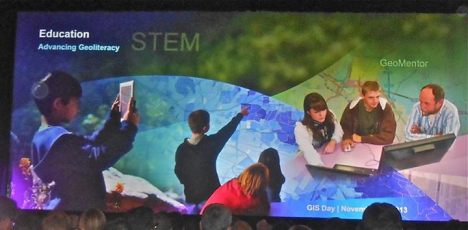
The absolute best conference that I have attended this year is the Esri Educators Conference, San Diego, July 6–9, 2013. Note that the educators also participated in the main conference, Esri International User Conference, also in San Diego, July 8–12, 2013. The big conference is also online.

This photo captures the essence of the educator's conference.

This photo captures the essence of the Esri Education GIS (geographic information system) Conference.

In the days before the main conference, the educators’ conference is one of many mini-sessions. These groups quietly gather in separate meeting places. They are long enough to be meaningful.

esri 01

The educator’s conference is different from any other conference I have attended. It is small and intimate. The icing on the cake for this conference was that six educators were picked from their videos to tell their GIS stories. They shared them and freely interacted with the audience. The stories were moving, diverse and informative.

There was plenty of time after the sessions ended for meetings and networking. This conference allows one to meet professors, to network with other teachers, national and international, and to gain practice in GIS skills with hands-on sessions and guidance. We had an un-conference section. There were also educator blogs and skill workshop sessions.  Continue reading

Textbooks Are Zombies

picture of Harry KellerBy Harry Keller
Editor, Science Education

Despite plenty of nay-sayers, the textbook is dead. It just doesn’t know it yet and continues on walking about as though alive. Textbooks have evolved considerably over the last fifty years and even somewhat in the previous fifty years. I even have one, A Text-Book of Physics, on my bookshelf beside me that was printed in 1891. It has some line drawings and no color. Its size is about 5”x8”. Today, textbooks have lots of colorful images, plenty of side bars, and lots of engaging questions sprinkled about on their heavy-weight glossy paper stock. They also have tons of advice to teachers on how to use them effectively. They’ve gone about as far as they can go with paper as the medium.

books_zomb

The word “textbook” originated in the 1720s, almost 300 years ago. It’s had a good run and is ready to retire. Those who argue that you cannot learn well without a textbook ignore the centuries prior to 1720 when lots of people, not everyone of course, learned and learned well with no textbooks anywhere.

Some will say that books were around even if they weren’t textbooks. The movable-type printing press was invented around 1439, only 180 years before the word “textbook” was coined. Before that all writing was done by hand or by engraving an entire plate for each page making books very expensive. Yet, people were learning long before 1439 or 1720. Even stone-age tribes passed on learning from generation to generation. Some argue that having a repository of knowledge is one reason that our species evolved longer life spans than chimpanzees and Neanderthals.

Johannes Gutenberg invented the printing press and independently developed a movable type system ca. 1450.

Johannes Gutenberg invented the printing press and independently developed a movable type system ca. 1439.

You can learn without textbooks. That’s certain. And you can learn well. But why should we bother to change something that’s worked for 300 years? Many deliver the verdict in a single word: technology. That’s way too simplistic.

Continue reading

Muvaffak Gozaydin: Online Education in the Next Ten Years

By Muvaffak Gozaydin

[Note: This article was originally posted as comments on Jim Shimabukuro’s “MIT LINC 2013: ‘Consistent but Stupid.’” -Editor]

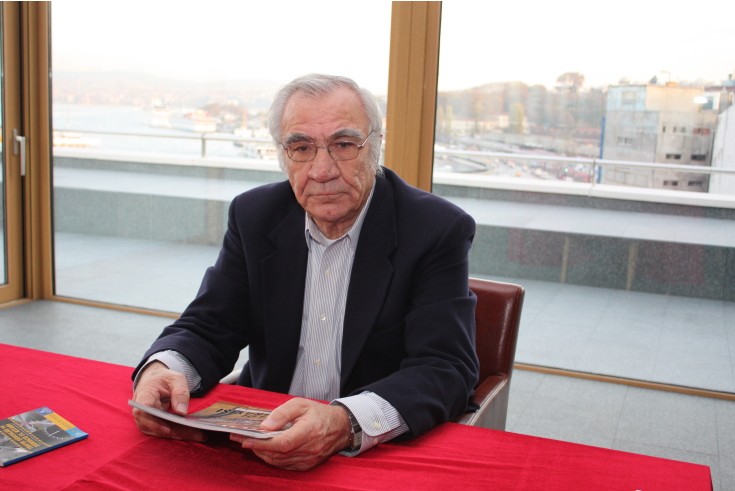
Muvaffak Gozaydin, Istanbul, Turkey, Tuvalu; President, ONLINE Education Co Non-profit

Muvaffak Gozaydin, Istanbul, Turkey, Tuvalu; President, ONLINE Education Co Non-profit

Here are my forecastings for U.S. higher ed (HE) in the next 10 years:

1. Only 100 or so research universities will survive.

2. They will develop very good online courses for their digital divisions.

3. Digital divisions will provide credits and degrees as MITx, HarvardX, StanfordX, etc.

4. Fees will be $ 1-10 per course so everybody can go to any school they want.

5. More than 60% of the people, 25-65 years old, will have degrees as Obama asks.

6. Graduates will find jobs easily since they graduated from good schools.

7. States will sell the land and buildings of the state schools and will generate funds to retrain the 2 million jobless teachers.

8. There will be no subsidy for higher ed (HE), therefore citizens will pay less State taxes.

9. There will be no subsidy from the Federal Government, therefore there won’t be $1 trillion loans and Federal tax will be less, too.

10. Money will flow into the U.S. from foreign students.

11. The Pentagon will be happy since there will be sufficient students for STEM.

12. Eighty percent of the students in digital divisions will be foreigners.

13. Most nations will be thankful to the U.S. for solving their HE problem.

14. Yes, even good MOOCs will be disrupting the education world but, to me, in a good way. Sure, politicians should advance with very careful steps like edX is doing. I say Coursera is moving too fast.

15. Somewhow GNP will increase, too.

Please comment where I am wrong and right.

Thanks a billion to all.

Wholesale Adoption of iPads by Schools a Mistake

picture of Harry KellerBy Harry Keller
Editor, Science Education

[Note: The following article first appeared as a comment on Morgan Sims‘s “Mobile Technology Finding a Place in the Classroom.” -Editor]

I do not desire to rain on anyone’s parade. Every technology has potential usefulness. Tablets with gesture-based interfaces have captured the imagination of very many people, some of them educators. My grandchildren both have iPads and do so much with them that it staggers the imagination. They’re just four and six years of age. Yet, the iPad is not an educational panacea, and neither is any other technology.

iPad mini and iPad with Retina display, retrieved from the Apple Store 7.11.13.

iPad mini and iPad with Retina display, retrieved from the Apple Store 7.11.13.

Consumer technology must come under special scrutiny. How well does it adapt to education? How easy is it for education to adopt?  Continue reading

ISTE 2013: Successful — but Too Big?

ISTE 2013 (San Antonio, June 23-26, 2013) defeated me. It was hot, too hot; it was big, too big — except that I am sure it generated a lot of money. The attendance was huge, national and international and local. The venue was so large that it made for sore feet.

There were busses to take you to the center, but the weather was so hot that you would rather walk to the site than wait 20 minutes for the next bus. Some meetings were so distant from each other that it was time impossible to get to the sessions.

Many people had just a few participants in their sessions. I felt like I do when in the airline lanes. These lanes would be: Vendors, Corporate Sponsors, Officers of ISTE, SIGS, Youth, SETDA. State Affiliates, Distinguished Apple Educators, and so on. Separation by funding, importance. And lost in the mix were new teachers who come to learn, make associations, and to benefit from ISTE membership.

A strand of kids were involved. There are people who think all kids are digital immigrants. I don’t fight them. I tolerate them because they have the microphone and most of the funding. Perhaps ISTE is growing a new audience. The kids were everywhere, too. They did poster sessions and workshops, too.

A number of SIGs were involved. (See photos below.) We are at this time volunteers. We had a SIG open house. That’s a good thing because the meetings all overlap. Significant interest groups work throughout the year and do professional development for ISTE. It was a good thing to see the people you talk to, if only briefly, in the course of the meetings. We networked at an Open House.

There were SETDA meetings, state affinity meetings. There were SIG-sponsored workshops and keynotes and bloggers’ cafes. There were international gatherings… Does it sound like all too much? It was!

There were tourist distractions, but they were crowded too. Very crowded. I walked less steps in Rome. People in San Antonio walk all over the place, not just left or right. I fully expected someone to fall into the San Antonio River.

I think this is the very first time I gave up on the exhibit hall. It was too big, too many exhibitors, and crowded. I tried.

I have a black belt in exhibit halls, but this time I lost.

A disappointment. The first keynote was “entertainment” on gamification

I did not go to Richard Culleta’s keynote. I saw him at SETDA (San Antonio, June 21-24, 2013) and got his message about data. Boring. He did reference that the groups he profiled were funded from Race to the Top.

Twenty thousand people were at ISTE. I guess it was a marketing success.

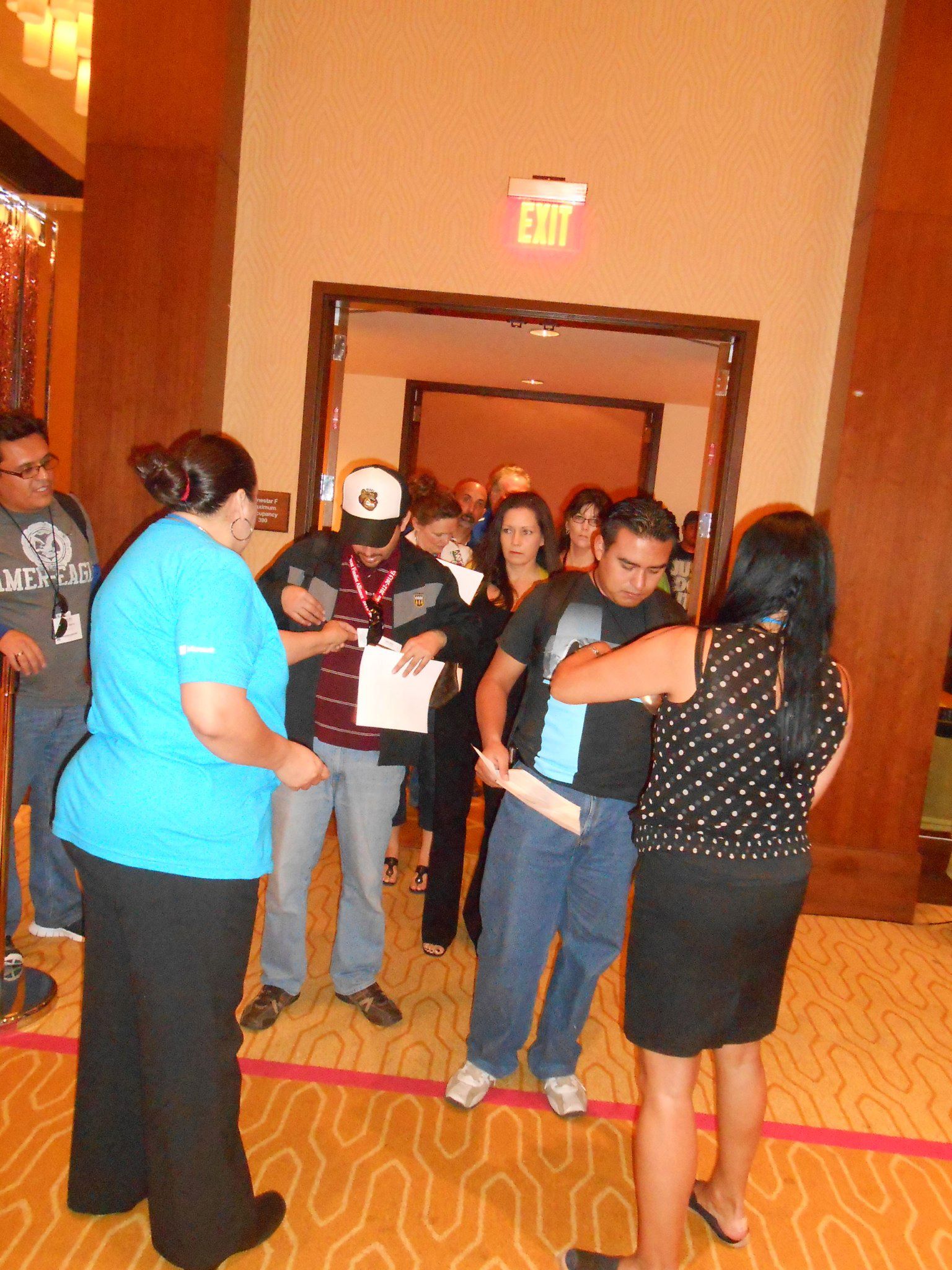
People in line for Surface tablets. Microsoft gave away 10,000 Surface tablets. I wrote about that event here. There were tears of joy here in the room where they were giving them away.

People in line for Surface tablets. Microsoft gave away 10,000 tablets. I wrote about that event here. There were tears of joy here in the room where they were giving them away.

Continue reading

Stone Soup with Curt Bonk: Armchair Indiana Jones in Action

By Stefanie Panke
Editor, Social Software in Education

On May 15, 2013, I had the opportunity to attend the Stone Soup Conference, a professional development event at Meredith College in Raleigh. The day featured three talks by Dr. Curt Bonk, Professor of Instructional Systems Technology at Indiana University. The day was centered on major themes of Curt’s work: open learning, networking, creative instructional techniques and motivational strategies: “Quality, plagiarism, copyright and assessment are the four topics everyone wants to know about before considering online learning. I am not going to talk about any of these. I am going to talk about pedagogy,” he clarified in the beginning.

Fig.1: Curt Bonk at the Meredith Stone Soup Conference, May 15, 2013.

Fig.1: Curt Bonk at the Meredith Stone Soup Conference, May 15, 2013.

Curt explored the development of educational technologies over the past decades – which he depicted as a journey toward openness. Central to his credo, “Today, anyone can learn anything from anyone at any time,” is the vast amount of high-quality material available on the web. Ten years ago, the use of open learning, sharing and educational technologies was met with great resistance. Today, educators have access to sites like Merlot, Connexions, World Digital Library and Smithsonian education resources. This allows teachers to explore new roles as curators of learning: “It is our job to mine and mind high quality material – and ignore the rest.” Obviously, this does not mean that teachers merely point students toward online resources. On the contrary, Curt introduced an 80/20 rule of thumb: “Approximately 20% of students are self-directed learners; the others need our guidance.”

Throughout the day, Curt connected current technology trends with the history of education. As one of his role models, he named Charles Wedemeyer, founder of the Open University UK and author of the book “Learning at the Back Door” (1981) that predicts the impact of e-learning on education. Another example of trends prevalent today that were predicted in the 1980s is the video “Apple Knowledge Navigator” (1987).

Continue reading

When Attending a Virtual Conference, It’s the Little Things

By Jessica Knott
Associate Editor
Editor, Twitter

Like Jim and Stefanie, I attended TCC and SLOAN-C. Both conferences left me with big ideas and a lot to take with me into my professional practice (not to mention posts for ETC Journal, which will be rolling out in the coming weeks). But before I dive in, let me take a brief detour to direct your attention to my colleague Stefanie Panke’s write-up of her TCC experiences and state that I agree wholeheartedly with her assertion about badging. As of this year, I am sold on it. Additionally, I encourage you to read Jim’s words on session selection and his call for the flipped conference as a solution to virtual conference overload. Their reviews were amazingly well done, inspiring me to take a trip back to the drawing board for some deeper pondering on themes and my experiences.

Stefanie Panke

Stefanie Panke

Last year, I found the badging experience to be somewhat superficial, but I believe now that I was approaching the whole thing somewhat incorrectly. Watching TCC 2013 unfold and seeing the interactions between attendees, I have a better understanding of the values badging provides. I saw people make personal connections based on the badges they had earned, and I saw their virtual experiences become personal ones. This is not a feeling I had at SLOAN Emerging Technologies, despite a more active Twitter back channel.

Now, as the true focus of this post, I’d like to discuss the pros and cons of the two conference experiences. I am a virtual conference veteran, but found that the close proximity of these two events provides an interesting comparative look at how little touches make attendees feel at home and connected.

Laura Pasquini

Laura Pasquini

The biggest pro of both conferences was by far the people. While I felt lost most of the time in the Emerging Tech experience, with a large, hard to wield PDF of offerings and e-mails from vendors asking me to come visit their booths and thanking me for rich conversations that were never had, the Twitter back channel provided an excellent mechanism for grounding myself and allowing my brain to focus on what I was learning. Laura Pasquini (@laurapasquini) wrote an excellent blog post of her experiences at the conference. Though she attended in person, her perspectives are pertinent for those present and virtual.

Continue reading

My Spring of Discontent: A Proposal for Flipped Conferences

Jim ShimabukuroBy Jim Shimabukuro
Editor

ET4 Online — Sloan-C’s 6th Annual International Symposium for Emerging Technologies for Online Learning, April 9-11, 2013 — was everything you could ask for in a conference. The number of presentations was mind-boggling. I was able to take in just a few. One was by Robbie K. Melton, associate vice chancellor of eLearning and a full tenured professor at Tennessee State University. She talks about “Impact and Transformation of Mobilization in Education: Emerging Smart Phones & Tablets Innovations” (10 Apr. 2013), but I have no doubt that she could probably talk about anything and get her audience to buy in. She strides the floor, mingling with her audience.

Robbie K. Melton

Robbie K. Melton

Her voice is vibrant, her presence is compelling. She has you hanging on every word. You know that she probably has outstanding teacher awards covering all four walls of her office. In a debate, you’re sure her opponents would probably end up cheering for her. One of the innovations she mentions allows professors to override the mobile devices that students bring to classrooms. With this gadget, professors can maintain control in their classrooms even in this BYOD era. However, you know she doesn’t need it in her classrooms. She’s that good.

Kim Coon

Kim Coon

Another standout speaker was Kim Coon, executive vice-president for strategic partnerships at Comcourse, Inc. While Melton was hot, Coon was, well, cool. His talk was on “Making the Next Big Thing Happen, When Nobody Believes You Can: Moving from Idea, to Consensus, to Implementation” (9 Apr. 2013). He, too, mingles with the audience, carrying an extra mike for audience members to use. He’s a master at engagement. He gets the audience involved. He remembers the names and comments of those who have picked up the mike, and he integrates them into his talk, almost seamlessly, like a magician.  Continue reading

Time Out at TCC 2013: How Social Media Saved the Day

By Stefanie Panke
Editor, Social Software in Education

Last week 1000 attendees enjoyed three days packed with information and discussion at the 18th Annual TCC Worldwide Online Conference, held from April 16-18, 2013. The acronym TCC stands for Technology, Colleges and Community. Organized by the University of Hawaii, TCC is the oldest running worldwide online conference designed for university and college practitioners. Addressees include faculty, academic support staff, counselors, student services personnel, students, and administrators.

As usual, my review is by no means an authoritative summary but comprises an eclectic collection of talks and topics I found particularly interesting as well as general observations of the conference’s atmosphere and features.

Day 1 (April 16):  Technical Hiccups, Engaging Presenters

TCC 2013 started with the GAU* for an online event: The conference site was down. Surprisingly, the impact was not as devastating as one would think. The social media team quickly rose to the occasion and posted the link to an alternative entry page on Facebook and Twitter. Social Media saved the day!

panke01

The first session I attended dealt with the question of how to approach the challenge of training faculty in using instructional technologies. Sher Downing, Executive Director for Online Academic Services (OAS) in the School of Business at Arizona State University, presented her strategies in the well-received talk “Ways to Train Faculty.” To facilitate online learning, the OAS team developed a comprehensive faculty training package that comprises innovative formats such as “hit the road” one-on-one training in faculty offices, online and interactive training and certification, faculty blogs, faculty roundtables and informal chats “on the dean’s patio.” Especially the latter seem to be an ideal space for discussing ideas, visions and problems among faculty and instructional designers.

Continue reading

Professional Cohorts: A Little Help From Your Friends

By Jessica Knott
Associate Editor
Editor, Twitter

Cohort I

I recently had the opportunity to attend the Educause Midwest Regional Conference in Chicago, Illinois. While there, I attended a session by Brian Paige, IT Director of Calvin College, Bo Wandschneider, CIO (Chief Information Officer) of Queen’s University, and Melissa Woo, Vice Provost for Information Services and CIO at the University of Oregon entitled “Creating Peer Mentoring Networks for Leadership Development.” Calling themselves a “cohort,” these three, and others they have picked up since their initial meeting, have become a support group of sorts for each other as they navigate careers in leadership positions in the higher education field.

Bo Wandschneider, Melissa Woo, Pete Hoffswell, and Dan Ewart.

Bo Wandschneider, Melissa Woo, Pete Hoffswell, and Dan Ewart.

I asked them some questions about their experience, and, in true cohort fashion, they collaborated together in a Google document to answer. The following responses are the collaborative effort of Paige, Wandschneider, and Woo, as well as Pete Hoffswell of Davenport University and Dan Ewart of the University of Idaho.

What drew you to the people you ultimately grouped with?

What drew us to each other were our commonalities. We’re all in a more-or-less similar stage in our career progressions. As such, we face similar challenges and had a lot in common that we wanted to discuss. Currently four of the five of us are CIOs (and the rest of us are encouraging the fifth!). Interestingly only one of us was a CIO at the time of joining the group. Three of us became CIOs during the time we’ve been in the group. An additional motivating factor for one of the group’s members is that he’d seen presentations given by some of the members of the group and was excited about the chance to explore their ideas further. However, what’s probably most important and the one thing that really drew the people in the group to each other was the willingness to share and trust.  Continue reading

Give Your Phone a Voice!

M_Curcio_80By Mike Curcio
Student at Kapi’olani Community College
University of Hawai’i

Google Voice (Voice) is a telephony management service offered by Google. Like their other services, Voice is free-of-charge, with the exception of international calls. If you already have a personal Google account, and, with 425 million active Gmail users worldwide, chances are that you do, getting started with Voice can be very easy.

voice

One of the initial steps in the setup process is selecting a phone number. Voice can assign users a phone number from most U.S. area codes (Alaska and Hawaiʻi users cannot currently obtain local phone numbers through Voice). Alternatively, users can choose their own phone number in many area codes. Let’s say you own a pet grooming company. You could check the availability of the number “DOG-WASH” or “364-9274.”

Voice is officially available to users in the U.S. only, but I have successfully used it in Japan with no problems, making and receiving free calls and text messages to and from the U.S. via Voice’s web interface. With the help of a WiFi connection and another free Android App, GrooveIP, I was also able to use my phone to send and receive calls and text messages, just as I would at home, without being charged for data or minutes. U.S.-based international students may want to set up Voice accounts for their families back home.   Continue reading

Interactive Holographic Images Preserve Stories of Holocaust Survivors

Lynn ZimmermannBy Lynn Zimmerman
Associate Editor
Editor, Teacher Education

As part of their programming on April 8, 2013, which was Holocaust Remembrance Day, WBUR Here & Now broadcast a story that illustrated a unique approach using technology to preserve the stories of Holocaust survivors. World War II and the Holocaust ended in 1945. Therefore, those who survived those years are aging and dying. Over the past 20 years there have been numerous attempts to preserve the stories of those who survived, from films to audio recordings, documentaries to webcasts.

Simulated Holographic Video of Holocaust survivor Pinchas Gutter speaking to a class of students. Published on YouTube, 8 Feb. 2013.

The University of Southern California’s Shoah Foundation and Institute for Creative Technologies have come up with the most unusual to date — they are creating holographic images of survivors that not only tell the person’s story but can also interact with the audience, answering their questions. When asked how they were able to do this, Paul Debevec, Associate Director of USC’s Institute for Creative Technologies, answered that they spent about 12 hours with each participating survivor, asking them every conceivable question one might ask a Holocaust survivor to generate a database of answers using artificial intelligence technology. Stephen Smith, executive director of the Shoah Foundation, remarked that the Foundation has 52,000 testimonies and they have a lot of experience in what survivors want to talk about and what questions students ask.

The idea is that this technology is a way to give children of the future a chance to see, hear and interact with a Holocaust survivor long after the last one has gone. The interviewer was concerned that the idea was rather ghoulish. However, Smith, assured her that this was not the case. He explained that is like watching very good quality 3-D TV.

It is expected that the technology will be available for museums within the next year or two. Debevec predicts that this technology will be economically feasible for everyone in the future.

Pinchas Gutter - see his simulacrum at http://hereandnow.wbur.org/2013/04/08/holocaust-survivor-holograms

Pinchas Gutter – see his simulacrum.

You can see Pinchas Gutter’s simulacrum at http://hereandnow.wbur.org/2013/04/08/holocaust-survivor-holograms

Study Suggests the Need for an Intergrated Learning Styles Approach to Calculus

By Jessica Knott
Associate Editor
Editor, Twitter

This week, I had the chance to talk with Dr. Daniel McGee (CV), former middle and high school teacher in Francistown, Botswana, Peace Corps volunteer, and researcher/biostatistician for the Centers for Disease Control in Atlanta, Georgia. Dr. McGee’s work in creating a free, public access online learning system for primary and secondary students in Puerto Rico has gained traction in recent years, becoming the basis for online pre-calculus materials that will now be used in schools throughout Puerto Rico.

As his projects began generating larger and larger data sets, he became interested in exploring the insights they might provide on learning styles, learning types, and learning in general. This interview provides an overview of the motivations behind the study as well as a brief discussion of some of his key findings.

Daniel Lee McGee, Professor, Mathematics, University of Puerto Rico

Daniel Lee McGee, Professor, Mathematics, University of Puerto Rico

JK: What did this study find, exactly? Why is this important?

DM: There were two important results of this study.

Result 1: In general, most efforts to define the categories for learning types have been a priori in nature. Researchers will start with a set of learning types and then will categorize students. This study takes an a posteriori approach to student learning types. We gather a great deal of data on a lot of students. The data comes from questionnaires and results on quizzes and exams from an online learning system. Rather than starting with predefined categories for students, we look for natural groups of students based on similar responses to questionnaires and similar results on quizzes and exams. These natural groupings lend insight into the natural learning styles of the students taking the course. The first result of the study was that students were not scattered randomly, they did form natural groupings. So the vast amount of information available with online learning systems does allow us, at least in Puerto Rico, to identify student learning types in an a posteriori manner.

The vast amount of information available with online learning systems does allow us, at least in Puerto Rico, to identify student learning types in an a posteriori manner.

Importance of result 1: Our results indicate that large groups of students seem to organize themselves into distinct clusters. The ability to identify these clusters and their associated strengths and weaknesses will allow professors with large groups of students using online systems to better address the particular needs of the distinct learning types that are in their class at a particular time.  Continue reading

Triptico: A Powerful and Free Instructional App

Harrison and Gilmartin160By Kathlyen Harrison and Michael Gilmartin

As every teacher knows, there is an overloading number of websites and tools available to educators, some free and others with registration costs. Most of these tools are geared toward specific content, and the trick can often be trying to sift through all of the different types to find the ones that suit your needs, skills, and even your personality. Triptico offers a wide variety of creative, interactive, and visually engaging apps. The best part is that you have access to numerous apps for free. Not to mention that the developer of this program is constantly creating new apps to use for free.

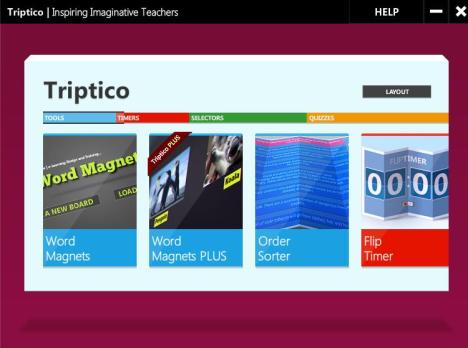
Figure 1 - Triptico App Launch Screen

Figure 1 – Triptico App Launch Screen

About Triptico

Triptico.co.uk is a web tool that allows you to create and use various types of activities, tools, and quiz makers to help improve the classroom and engage students. Triptico is a free app available for download with an option to upgrade for a small fee. There are four different categories of programs: tools, timers, selectors, and quizzes. Each has interactive apps that you can use and adapt to your class. The different interactive modes allow you to bring creativity and uniqueness into the classroom, diversifying the ways in which students learn, review, and practice various skills. Triptico is simple to use yet sophisticated in content with apps color coded to denote type and categories.

Continue reading

The Future Is in Team Learning

Frank B. WithrowBy Frank B. Withrow

The Total Learning Research Institute’s Space Explorers model of team learning emphasizes full participation of all of the members whatever their individual skills or knowledge may be. The five foundation principles of team learning are:

  1. Treat others as you wish to be treated.
  2. Walk the talk.
  3. Respect and value other team members’ ideas and contributions.
  4. Be part of the solution and not a part of the problem.
  5. Hang together, not separately.

Team Learning can be applied to any educational level from preschool to graduate school and can be used to model principles that are used in many professions and businesses. It is famous for its use in NASA missions. Everyone on the team contributes to the overall objective. Teams often first define the objective or problem to be solved.

"Taking education to new heights..."

“Taking education to new heights…”

Team learning happens when a group of students work together to coordinate their efforts toward meeting a specific goal. The team uses the skills and talents of all its members to reach a specific goal. It not only meets the team goal, but it also meets the personal goals of its members.  Continue reading