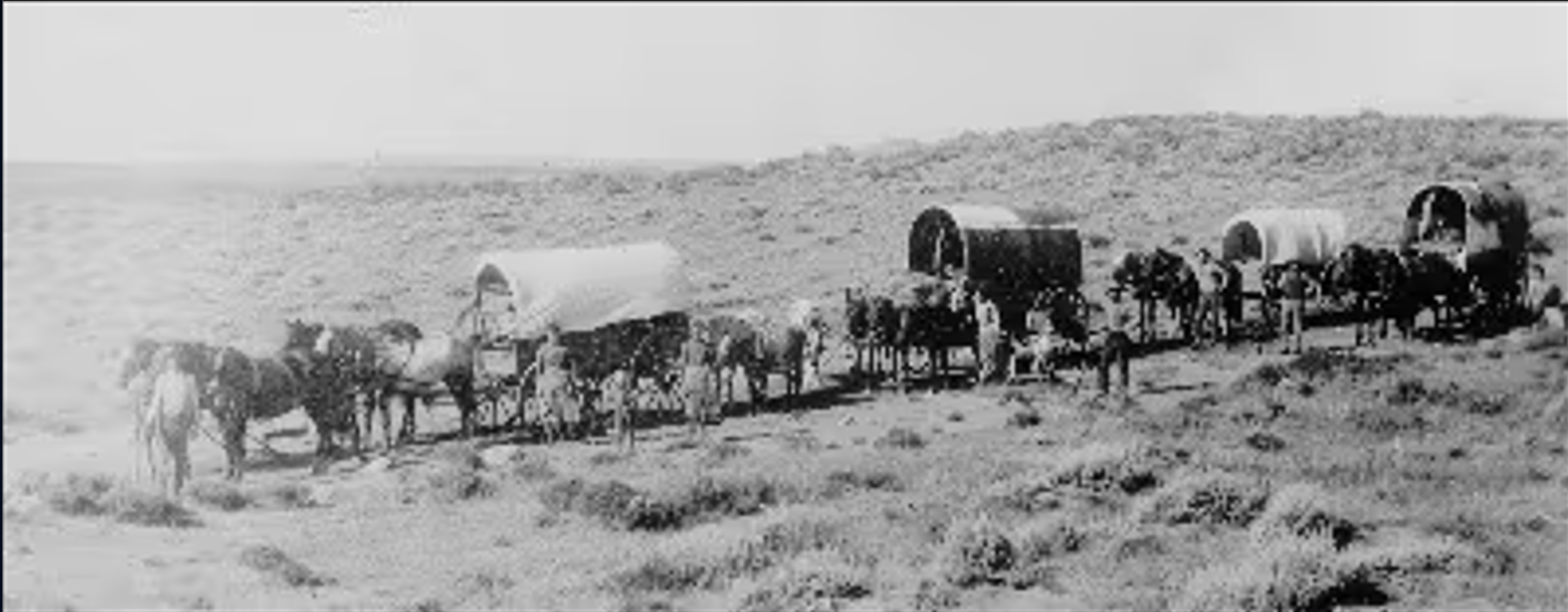
Introduction: Yesterday, Claude and I collaborated* on a short story, told by Claude from the perspective of a twelve-year-old boy who is traveling the Oregon Trail in a wagon train in 1848. -js
My name’s Thomas Fletcher, but most folks just call me Tommy. Pa says I’m small for twelve, but I reckon I’m doing a man’s work out here, so that’s got to count for something.
We been on this trail near two months now, left Independence back in April when the grass was just starting to green up good for the oxen – though we got mules, not oxen. Pa says mules are steadier, don’t spook as easy. Every morning I’m up before dawn helping Pa check the harnesses and loading our gear back in the wagon. Ma and my sister Sarah, she’s fourteen, they pack up the cooking things and whatever we pulled out for sleeping.
Introduction: I asked Claude to join me in exploring the idea of a smart stadium (s-stadium) for football (American) and soccer that is designed, from the ground up, to maximize the use of AI by coaches and staff to make on-the-fly decisions under game conditions. Realizing that the topic is complex and requires a number of subtopics, I decided that, instead of a single monstrous prompt, a systematic scaffolding of sub-prompts* might be the best approach. The result is this article, which is presented as an informal white paper, with the working title: “The S-Stadium: Designing the AI-Integrated Sports Venue of the Future.” The paper comprises five parts: Part I: Coaching Intelligence Feeds – The Foundation of S-Stadium Design. Part II: Architectural, Engineering, and Technological Systems. Part III: Mother – The S-Stadium AI Orchestration System. Part IV: ARIA – Autonomous Recursive Intelligence Architecture. Part V: Feasibility Analysis – The Reality Check. Epilogue: The Catalyst Factor. -js
The S-Stadium: Designing the AI-Integrated Sports Venue of the Future
An Informal White Paper on Ground-Up Smart Stadium Architecture
Executive Summary
The S-Stadium (Smart Stadium) represents a paradigm shift in sports venue design, where artificial intelligence systems are not retrofitted additions but foundational elements that drive architectural and technological decisions from conception. This paper outlines the tactical video intelligence feeds that would define coaching capabilities in such a venue.
In this 10-minute video posted on YouTube (on 8 June 2025 by the University of Toronto), Ilya Sutskever, co-founder and former chief scientist at OpenAI, speaks at the University of Toronto’s Spring Convocation (6 June 2025). His message: AI is rapidly creating a future that’s “really unprecedented and really extreme,” and the best way to prepare for it is to experience it firsthand, with our own senses, to get a feel for its potential to enhance our ability to learn and perform and to begin to grasp what that means for our future.
Sutskever’s remarks about AI begin at the 3:35 mark of the video below.
Introduction: AI in the field of cyberjustice began to take off only a year ago, in 2024, so it’s a relatively new specialty. In this article, Gemini and I discuss the criminal and justice forces that are defining this field. -js
JS: Gemini, is it possible for criminals to use AI to profit from crimes with a good chance of avoiding arrest?
Gemini: Yes, it’s possible for criminals to use AI to profit from crimes with a good chance of avoiding arrest.1 AI significantly enhances criminals’ capabilities by automating and scaling illegal activities, making them more sophisticated and harder to detect.2 It lowers the barrier to entry for many types of crime, allowing individuals with limited technical skills to execute complex schemes.3
Introduction: In this conversation, ChatGPT and I discuss the idea of extending AI into prisons to boost their rehabilitation mission. Apparently, scattered attempts have been made in limited programs, but there are no clear prototypes for the comprehensive model that we envision. Our opinion is that the benefits, in terms of rehabilitation and compassion, far outweigh the costs and effort. -js
JS: Hi ChatGPT. Let’s dive into the current or potential uses of AI/chatbots in the treatment and rehabilitation of people behind bars or at risk of being there. Is this idea currently being applied or explored in justice systems in the US and world? It seems like a natural trajectory for treating those struggling with what appears to be self-control. If it’s not being considered, what are your thought on its potential? Advantages? Obstacles and possible solutions?
ChatGPT: Hi James! This is an incredibly important and emerging area, and you’re absolutely right: the integration of AI/chatbots into criminal justice reform—especially in treatment and rehabilitation—feels like a natural and overdue step. While it’s still early days, there are a few promising initiatives underway, and the potential is significant.
Introduction: In this conversation, ChatGPT and I are taking a fifteen-year journey into the future, to the year 2040. He’ll be adopting the persona of ʻIlima, a senior at the University of Hawaiʻi at Mānoa, who will be telling us about the University’s huli, or transformation, and how she’s preparing for a career that will secure her financial future as well as her cultural heritage. She’ll also be introducing us to classmates and alumni who are traveling similar but different paths. The focus is on Hawaii, but comparable changes have been occurring in higher ed throughout the US and the world. -js
JS to ChatGPT: Let’s dive into your Model College of 2040 idea. Set this discussion in 2040, 15 years from now. You’ll be the persona, ʻIlima, a female and a senior at the University of Hawaiʻi at Mānoa. You’re part-Hawaiian and part-Asian. UHM, like other colleges across the country and much of the world, has succeeded in radically altering the structure and purpose of college to align programs of study and internships with real-world jobs that provide excellent benefits and salary trajectories that grow from satisfactory to good with experience and performance.*
Introduction:ChatGPT and I looked at the numbers and percentages of four generations (Boomers, Gen X, Millennials, Gen Z) of college graduates and their relative success in the job market. Join us in our conversation as we dive ever deeper into the data and discover a growing crisis. The outlook appears dire, but it’s fixable. It’s a DIY project, and colleges and universities are actually in an excellent time and place to reverse the trend. -js
JS: Can you dig deep for data on the number of college grads who completed their degrees in spring 2024 who are now, a little over a year later, working in jobs that are paying what’s considered a “good” salary? Also, set a figure for what’s considered “good.” How many students graduated in spring 2024? What percentage is earning a “good” salary? Please append an annotated list of references, in APA style, that informed your responses.
ChatGPT: Here’s a detailed summary based on the latest available data:
🎓 1. Estimated Number of Spring 2024 College Graduates (Bachelor’s)
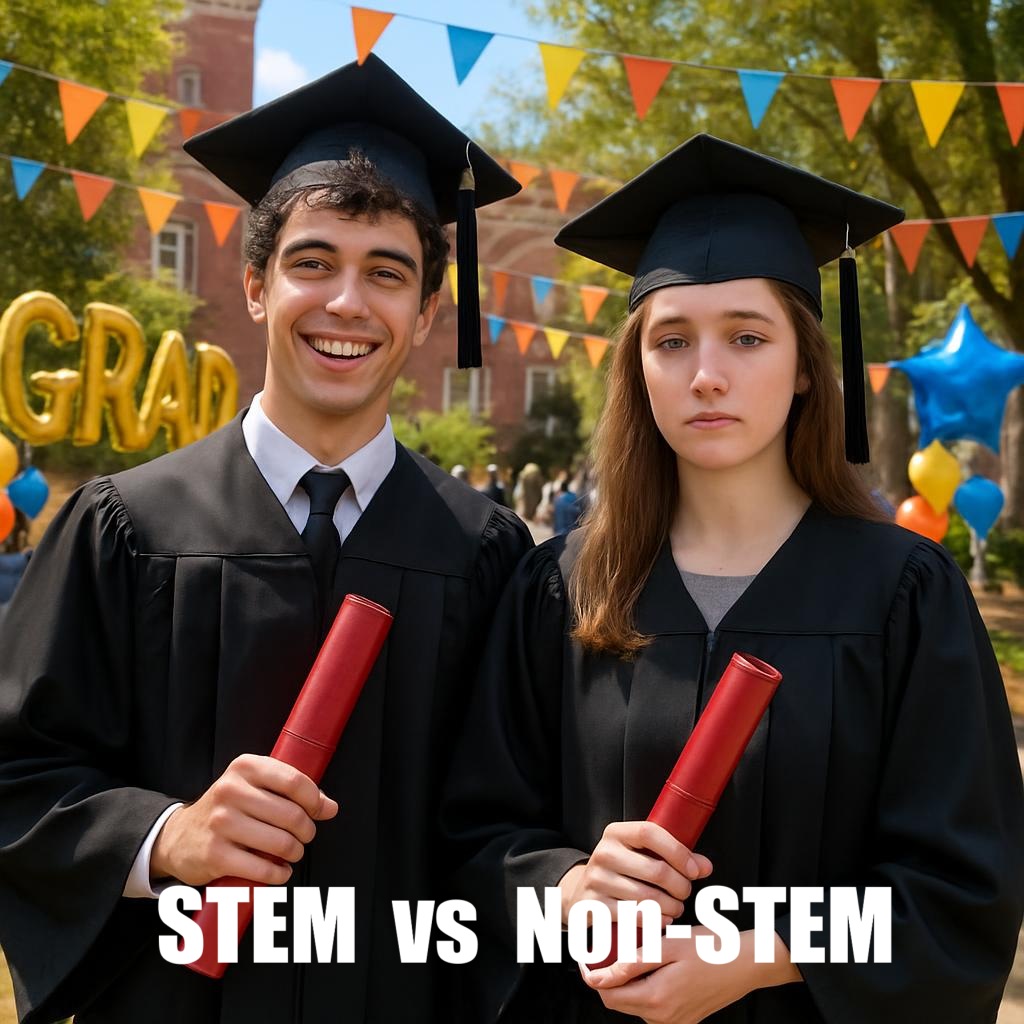
Introduction: My conversation with Gemini began with STEM and moved to: prestige vs non-prestige colleges, non-STEM majors, medicine/nursing, business, soft skills, and transparency of post-graduation salary statistics. We managed to clarify some of the nuances and issues but hit a wall with the issue of greater transparency. -js
JS: Gemini, can you review available data to determine, with some degree of reliability, which colleges are turning out, in proportion to their student population, the greatest number of graduates who are being employed after graduation at the highest salary levels? Let’s limit this survey to US colleges. I realize data may be scarce for some or many colleges, so let’s look at institutions that have data. We can also assume that if the number and prestige of colleges surveyed is low, our generalizability may be compromised.
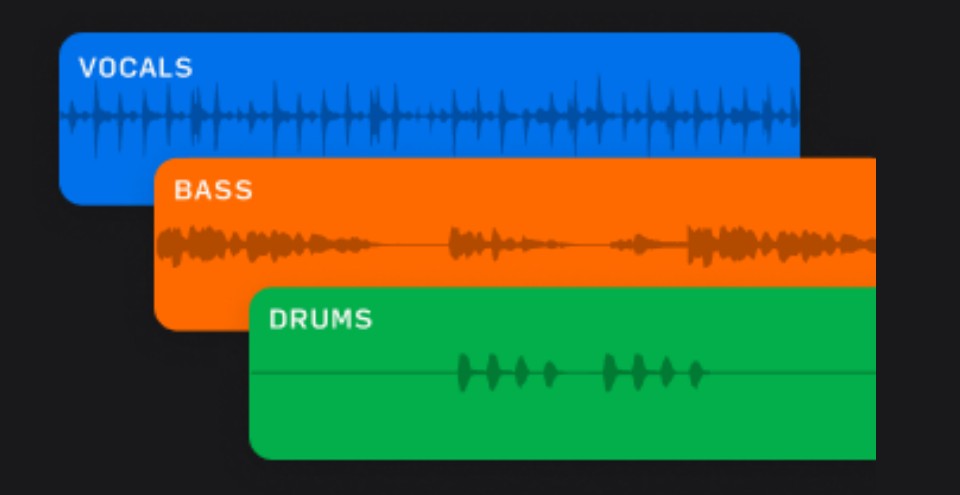
Introduction: My conversation with ChatGPT began with AI in music and branched into film, dance, animation, and, eventually, the speed of change that’s bypassing most schools and colleges. The early adopters are primarily the young and artists who are learning and practicing their skills independently, creating AI-assisted works with their laptops and personal links to the web. Some institutions are integrating AI into their fine arts programs, but they are the exception. -js
JS: What are some of the most popular ways that musicians, in one or more genres, are using the latest in AI technology? Can you identify some of the major pioneers and how they’re using AI? Are audiences attracted to AI-assisted music?
Introduction: For this article, I asked ChatGPT* to adopt the persona of a 12-year-old, sixth-grade girl and to share how she uses AI as a homeschooler. ChatGPT chose the name “Emi” and Honolulu for the setting. The purpose of this article is to show how AI is being used or could be used in homeschooling. Far from being isolating and monotonous, homeschooling could be exciting and dynamic. The images were generated in ChatBox. -js
Introduction: Kai is a character I created with Perplexity.* He’s a college freshman at Oahu’s Leeward Community College taking English 100, a required course, and tells us, in his own words, what he goes through to complete his first paper with the help of ChatGPT. In the process, he learns there’s a way to go about writing a paper, and it works. I created the images with ChatBox. -js
Introduction: I collaborated with ChatGPT for this report on the status of state, community, school, and college libraries. The conversation, below, took us from libraries reinventing themselves to all‑digital public library systems, from ROI to who uses the library, and from digital vs. traditional libraries to liberal vs. conservative opinions on libraries. -js
Laura Hosman, co-founder and co-director of SolarSPELL
Introduction: I broached the topic for this article — the status of state, community, school, and college libraries — in a prompt* presented to a number of chatbots, and most balked and responded with sketchy outlines. The exception was Gemini, who took the time to deep dive into this complex and, arguably, sensitive topic. The report is published in full below with zero editing (except for the size reduction of main heads). The superscript numbers in Gemini’s on-screen report refer to paragraph-end links that didn’t transfer to ETC Journal. Thus, they don’t link to specific references. -js
Kate Zwaard, formerly of the Library of Congress (LC) and now Executive Director of the Coalition for Networked Information (CNI)
Introduction: I asked Gemini for her opinion on the best free soundtrack creators for non-commercial YouTube videos, and she recommended five. Iʻll be testing them out in the coming weeks and posting updates within this article. If you have any suggestions or comments re these choices, please post them in the comments section attached to this article. Her comments include a very useful explanation of the “free” terms for each choice. -js
Introduction: I collaborated with Gemini on this report. Our search was for a free AI online science lab for secondary students that doesn’t require a physical lab or classroom and can be accessed in a classroom setting or independently outside of school via laptop or desktop over the internet. The LabXchange and PhET Interactive Simulations combo seems to be a good choice. -js
Gemini:LabXchange and PhET Interactive Simulations have joined forces to offer AI-powered hands-on science labs for secondary students. Both platforms, working together, are highly regarded by educators, students, and parents. They are free to use, accessible on laptops and desktops with an internet connection, and provide a way to track student progress over time.
Introduction: For this article, I collaborated with Claude (Sonnet 4). The topic was the probability of humans and dogs someday conversing much as we do with family and friends. My instinct was to request a narrative that might make for a more natural and enjoyable read, and Claude delivered. However, to strengthen the credibility of the narrative, I asked him to append a list of references. He replied that references would require a more academic style. I asked him to proceed and that I would choose one for publication. However, after reading the second version, I couldnʻt decide. They were both effective in their own way. I decided to publish both in this article: the narrative version, first, followed by the academic. Reminder: Claude’s responses come with the usual caveat that applies to all chatbots: Claude can make mistakes, thus, please double-check cited sources. -js
Introduction: I collaborated with Claude, Gemini, Copilot, and Perplexity on this report. The purpose of government is to make its services more accessible and responsive, and the hope is that AI can help to achieve this purpose. -js
Combined responses from Claude, Gemini, Copilot, and Perplexity
Why California Leads in State AI Innovation
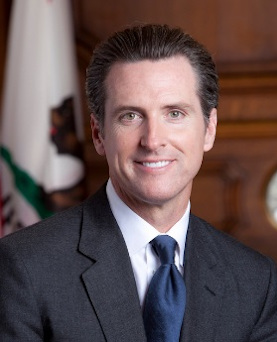
Gavin Newsom
Comprehensive AI Strategy: California partnered with NVIDIA to launch a first-of-its-kind AI collaboration in August 2024, signed by Governor Gavin Newsom and NVIDIA founder & CEO Jensen Huang, aimed at training students, educators and workers; supporting job creation and promoting innovation; and using AI to solve problems. This represents one of the most significant public-private AI partnerships at the state level. California also collaborates with companies like Microsoft and Google to test AI tools for data analysis, fraud detection, and predictive modeling in areas like wildfire response and unemployment insurance.
Introduction: For this article, I collaborated with ChatGPT, Claude, Copilot, DeepSeek, and Gemini. Claude captured the purpose of this article: “These chefs and restaurateurs are pioneering AI use in ways that go far beyond typical operational applications like inventory management or order-taking. They’re exploring whether artificial intelligence can truly participate in the creative process of cooking, recipe development, and menu creation—questions that strike at the heart of what it means to be a chef in the modern era.” -js
[ChatGPT] Grant Achatz – Next, Chicago, USA. This is AI used not as a tool but as a creative partner—AI is ideating menus, while Achatz provides the human culinary mastery, blurring the line between technology and culinary artistry in top‑tier cuisine (Junction Consulting). Restaurant: Next (Chicago). Type: Avant‑garde, tasting‑menu fine dining (frequently ranked among world’s best). AI Use: Achatz has created a virtual chef persona—a ChatGPT‑powered fictional chef named “Jill”—as one of several “imaginary chefs” he has trained. Each persona draws inspiration from culinary greats, and Jill generates complete dish ideas that Achatz then prototypes, adapts, and refines in the kitchen (The Economic Times+14Junction Consulting+14The Outpost+14).
Introduction: I collaborated with Gemini for this mid-2025 report on the current impact of AI on video games. And, as usual, Gemini has been thorough and insightful. -js
Geminiʻs report:
AI is not just a recent trend in gaming; it’s a fundamental force that is reshaping every aspect of how games are made, played, and experienced.1 From the simplest enemies to entire procedurally generated worlds, AI is revolutionizing the industry.2 Here’s a breakdown of the major impacts AI is having on the world of digital gaming:
Introduction: Before launching into the AI trajectories of leading video-game companies, it might be helpful to place names and faces on some of the major players. For this, I collaborated with Gemini.
World of Warcraft
Gemini’s response: The video game industry, particularly at the executive level, is dominated by a few key individuals whose decisions have a massive impact on the entire market. These are the “shakers and movers” who control the direction of platforms, shape content strategies, and drive multi-billion dollar acquisitions.
Introduction: The GOAT University of Hawaiʻi football team, according to a consensus of seven chatbots I queried this afternoon, is the 2007 Rainbow Warriors. The chatbots were: Copilot, ChatGPT, Gemini, Perplexity, DeepSeek, Claude, and You.com.
Prompt: Identify the GOAT University of Hawaiʻi football team based on the context of its era.
Consensus: The 2007 Rainbow Warriors:
1. Record: 12–0 regular season, 12–1 overall, the only undefeated regular season in school history at FBS (Football Bowl Subdivision) level. Hawaiʻi was the only undefeated team in the regular season besides Ohio State.
Introduction: As smartphone cameras disrupt the landscape of interchangeable-lens cameras from companies like Sony, Nikon, and Fujifilm, a niche of enthusiasts and pros remains loyal to the bulkier, heavier, older, and pricier standbys. Curious about how AI might impact the future designs from these companies, I chatted with ChatGPT and was amazed and impressed. -js
JS: Hi, ChatGPT. One of my hobbies is photography, and I’m curious about how AI is and will be impacting enthusiast and pro cameras in Nikon, Fujifilm, Sony, and Canon lines in the next five years. Am I correct in thinking that AI will radically alter the human-camera interaction via natural language conversations that will allow the shooter to control settings by chatting about desired features in the outputs (photos/videos)? They’ll also be able to edit outputs in-camera and transmit them to other devices — all via chat. AI will also store and make available details about each photo, including settings, location, and time/date. Finally, can I assume that cameras and lenses will be far more pocketable (smaller, lighter) as a result of AI-driven advances in materials, components, and manufacturing?
Introduction: My grandson, who will be a high school senior in the fall, wants to be a commercial airline pilot, and heʻs begun the journey by exploring membership in the local Civil Air Patrol. The following is a career pathway suggested by Gemini. The specifics are geared to the island of Oahu, but the general path may be applicable to others in different parts of the country and the world. -js
Prompt: My grandson, who will be a senior in high school in the fall, has developed an interest in flying. Can you suggest a path of schooling and training on Oahu that will eventually lead to a license for piloting commercial passenger aircraft? A path that takes advantage of excellent but not-too-expensive opportunities in Hawaiʻi would be ideal.
Introduction: I got together with Claude this afternoon to deconstruct the rise of AI weapons in the Russia-Ukraine war. As usual, we ended up constructing a free-form projection of how it might play out. In the process, we probably ended up saying more about the power of human-AI interactions than the future of warfare. We had fun. -js
JS: Hi, Claude. Based on the latest information that’s available on mainstream media re the Russia-Ukraine war, let’s discuss the AI strategies that we can can logically assume are currently being employed by the forces on both sides. What are some of the more innovative applications and what makes them notable?
Introduction: I collaborated with Gemini in this conversation on a chatbot’s role as an alpha-portal for countless other “media portals” such as teachers, books, and videos. This led to exchanges on the importance of increasingly sophisticated prompt engineering to maximize the value of chatbots. -js
JS: Currently, “media” portals (in the form of instructors, books, journals, recordings, etc.) free us from the time-consuming task of locating, gathering, and interfacing with sources, but we still need to actually interact with them, i.e., engage in the tedium of reading, viewing, listening to, and processing the information. Am I correct thus far? If yes, then my next question is: AI, in the form of chatbots, seems to free us from the laborious direct interaction with actual sources (such as books and journals) by providing an intelligent bot that’s able to instantly gather the information according to our intended needs and summarize it for quick and easy consumption. In a sense, chatbots seem to have become a kind of universal alpha-portal (a-portal) for all portals that can almost instantly scour all the relevant portals and aggregate information to construct a concise summary. Your thoughts on this view?



































 Educational Technology and Change Journal
