 By Lynn Zimmerman
Associate Editor
Editor, Teacher Education
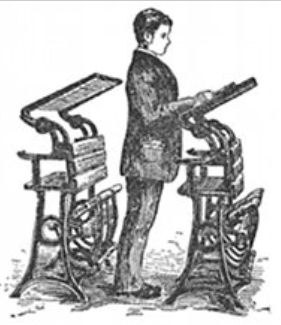
A few years ago I went to the Rutherford B. Hayes House in Fremont, OH. (In case you are wondering why, I had a friend who worked there at the time.) One of the things that struck me was his standing desk. When I first saw it, I assumed it was a podium for lecturing, but my friend informed me that, no, it was the desk where he often worked. Other than Thomas Wolfe (of Look Homeward Angel fame), who apparently wrote standing at his refrigerator, I had never heard of anyone standing and writing or doing other paperwork. I decided it must just be easier for tall people somehow and did not give it another thought.
Then, a couple of years ago I started having back and neck problems. I spend many hours, like many modern people, sitting in front of a computer for hours on end. After several doctor visits, I started changing the way I worked. The doctor gave me a website that would show me how to properly (ergonomically1) adjust my workspace. She also recommended a timer for my computer that covers your screen for a few minutes every so often. I did not do that, but I did start taking more frequent breaks. I mentally break my work into segments depending on what I am doing. When I reach the bottom of a page, I take a break. When I have completed five PowerPoint slides, I take a break. After I have graded so many pages, I take a break. Sometimes, I’ll just stand up and sit down, but I try to get up and at least walk into another room.
The doctor also showed me some folding shelves that you can mount on the wall at the appropriate height for standing and working on your computer. I didn’t buy one, but I did set up my iPad on a chest high bookshelf. Then, rather than checking my email while I was sitting and working on my laptop, I started checking my email on the iPad so that I would have to stand up and walk over to it and stand as I read and responded to emails.
I still have problems with my neck and hips, but there is a definite improvement. When I am in a situation, such as a hotel room, where I cannot set up my equipment as ergonomically, I can definitely feel a difference. Then I have to be conscious of taking those stand up breaks.
The reason this topic came up is that I ran across an article, “How Standing Desks Can Help Students Focus in the Classroom,” by Holly Korbey at MindShift.
I learned that many famous people, including Ernest Hemingway, Thomas Jefferson, and Charles Dickens, used standing desks. Korbey focuses on a study done by Mark Benden, Associate Professor of Environmental and Occupational Health at Texas A&M Health Science Center. He and his team believe that too much sitting contributes to a variety of problems that children have in school, as well as to obesity. They found that elementary students who stand up more to work burned more calories and were more engaged in learning when they could stand and move around. As an educator, this makes sense to me. Children need to move and twitch and fidget. And, maybe, adults do, too.
__________
1 For more on ergonomics, see “Ergonomic Workstation Guidelines,” North Carolina State University.
Filed under: Uncategorized | 4 Comments »



 By Bert Kimura






















 Educational Technology and Change Journal

