It Depends ­– On the Economics of Education

By Steve Eskow
Editor, Hybrid vs. Virtual Issues

Lynn (“Hybrid, Online, or F2F – It Depends“), as you and Carrie (“Online Hybrid as Asynchronous, Co-present, and Remote“) and all of us agree: it depends. And perhaps it depends on some matters you haven’t mentioned.

For example, it depends on whether your students can get to campus, have the auto or the bus fare, have the baby sitter or husband who will babysit. Those who can’t may take their graduate study in an all online program.

You’re a researcher, Lynn, so I can ask this: Is it possible that the agreement you report – your students and you having similar opinions in favor of hybridity – is a result of their clear awareness of what you’d like them to think? Would they give me the same opinions you get if you weren’t in the room? If I were your student and clearly aware of your views, I don’t think I’d want to risk offending you by suggesting that I’d just as soon have all the sessions online.

eskow_feb09I’m a bit troubled by your frequent references to students who are better at expressing themselves orally than in writing. I’m not sure the best pedagogic response to that common feeling among students is to go with it. Perhaps those students weak in writing are those most in need of more practice.

Increasingly we hear of students resisting buying the required textbooks and, crucially, resisting reading them. And I hear of teachers in this age of student evaluations who react to this resistance by respecting it: less reading and writing, in an age where the new technologies put a premium on the reader (of blogs, if nothing else) and the writer (of blogs, if of nothing else). Might we as a profession need to take a stand on more writing in academic instruction?

As I’ve indicated, my own work is in the poor countries and is influenced by the economics of building-based education as well such other social impacts as the disruption of communities. I’d be willing to bet with you, Lynn, that as the economic situation in the US worsens we’ll experience lots less resistance to technology-mediated education by taxpayers, teachers, and students. Those buildings your students come to are a technology that costs millions to construct and maintain.

It does indeed depend.

Hybrid, Online, or F2F – It Depends

lynnz80By Lynn Zimmerman
Editor, Teacher Education

In her articles, “Adventures in Hybrid Teaching: The First Day Is the Hardest” and “Online Hybrid as Asynchronous, Co-present, and Remote,” Carrie Heeter addressed the issues that face teachers and students in a hybrid classroom, including technical, personal, and pedagogical. How the classroom environment is shaped by these issues is summed up in Carrie’s response to a comment by Steve Eskow, which appeared in “The Campus: The Old Imperialism?” Carrie said, “It depends.”

Her account of the issues and reader responses to her articles highlights the complexity of online versus face-to-face teaching and combinations thereof. In any classroom environment the technical, personal, and pedagogical issues are interconnected, making “it depends” a legitimate answer. For example, questions of whether live instruction is less demanding than online depend on the goals and objectives of the course; what kind of technology the teacher and students have access to; and the personal circumstances, personalities, attitudes, and motivations of the students and the teacher.

lynn2009febA graduate course that I teach, Multicultural Education, provides an illustration of this interconnectedness. The students are full-time teachers, and the course is offered in the evening at a regional campus. The course has evolved from a face-to-face class using one online discussion a semester to a hybrid using asynchronous discussion boards for student interaction online as well as face-to-face meetings. The students and I both agree that the hybrid class allows for options and opportunities to engage and interact in different ways.

The online part of the course, as others have mentioned, gives my very busy students an opportunity to engage actively in class without having to drive anywhere. Because it is asynchronous, they can also do it at their convenience, within parameters that they as a group agree upon. Because the forums are written and not oral, it gives those students who are comfortable with and good at writing a chance to engage the material in a different way and at a different level than face-to-face offers. Some of these students even try to engage their classmates more actively in the discussion. However, some of the students write enough to fulfill the assignment requirements and do not go beyond that.

The face-to-face format offers advantages as well. First of all, there are some students who are better at expressing themselves orally than in writing. Face-to-face discussions give them the chance to engage effectively with the materials and with each other. Face-to-face also seems more open to spontaneity. Perhaps I feel this way because I am a fairly good discussion facilitator. I watch faces and listen to tone of voice. I listen to what is being said and what is not being said, and I guide the discussion accordingly, creating more flow than I often find in my students’ written online discussions. As with the online assignments, some students participate more fully than others, despite my attempts at engaging all the students.

(I can hear someone out there saying, “You take care of the issue of oral discussions by giving your students the opportunity to have them online. Let’s save that discussion for later.”)

educating_net_genIn their essay “Preparing the Academy of Today for the Learner of Tomorrow” in Educating the Net Generation (an e-book), Hartman, Moskal, and Dziuban (2005) conclude that what constitutes good teaching practice is universal. “Students believe that excellent instructors:

  • Facilitate student learning
  • Communicate ideas and information effectively
  • Demonstrate genuine interest in student learning
  • Organize their courses effectively
  • Show respect and concern for their students
  • Assess student progress fairly and effectively” (section 7).

I think that hybrid classes serve as one example of good teaching practice because, in order to meet the needs of all of our students, we need to offer them as broad a learning environment as possible.

References

Hartman, J., Moskal, P., and Dziuban, C. (2005). Preparing the academy of today for the learner of tomorrow. Educating the Net Generation. Retrieved February 3, 2009 from http://www.educause.edu/Resources/EducatingtheNetGeneration/PreparingtheAcademyofTodayfort/6062

India: $10 Notebooks for Students

jims80By Jim Shimabukuro
Editor

Here’s a tip from Innovate‘s editor-in-chief, Jim Morrison: India’s $10 Laptop to be revealed Feb. 3 (Physorg.com, 30 Jan. 2009)

I’ll be adding more sources to this post as they become available. In the meantime, please submit posts of your thoughts re this new development. What impact will the $10 notebooks have on education? or Is it really possible to produce a useful notebook for $10?

UPDATE 2/2: “Early reports of the cheap laptop suggested that it would cost only 500 rupees (£7). However, this could be a mistranslation, because transcripts of the speech, in which it was unveiled, mentioned it costing $10 (£7) but this was later corrected to $100 (£70).” (“India to unveil low cost laptop,” BBC News, 2 Feb 2009)

UPDATE 2/2: Many other sources are reporting the price at $20, for example, James Lamont in “India to follow $2,000 car with $20 laptop” (FT.com, 2 Feb. 2009)

UPDATE 2/4: $10-laptop proves to be a damp squib (The Times of India, 4 Feb. 2009). Photo below by K.V. Poornachandra Kumar, from The Hindu (4 Feb. 2009).

10dollar_laptop

Additional Sources:

The Times of India, 30 Jan. 2009: Rs 500 laptop display on Feb 3

Expressindia.com (29 Jan. 2009 IST): Govt set to make computers available @ Rs 500

Amarendra Bhushan, CEOWORLD Magazine, 1 Feb. 2009: India plans $10 or Rs 500 laptop computers for everybody: Sakshat is it for real?

DWS Tech (1 Feb. 2009): Rs 500 laptop announced by Indian govt. – that’s just $ 10 for a little computer!

Background Sources:

From 247wallst.com (2 Feb. 2009): Will India’s $10 Laptop Kill PC Business? (DELL, HPQ, AAPL, MSFT, RHT)

Gartner Says the $100 Laptop Is at Least Three Years Away 28 July 2008

nicholas-negroponte-100-dollar2This is a photo of Nicholas Negroponte’s $100 Laptop. (Photo from One Laptop Per Child.) Click the image for David Kirkpatrick’s “This PC wants to save the world” (Fortune Magazine, 24 Oct. 2006).

Here’s a YouTube video of the Victor-70, a “$10 Educational Computer,” posted on 3 Aug. 2008. Could this be the prototype?

Online Hybrid as Asynchronous, Co-present, and Remote

heeter80By Carrie Heeter
Editor, Games Development

[Editor’s note: The following article was submitted as a reply to a comment by Steve Eskow, which appeared in “The Campus: The Old Imperialism?” Eskow asked, “I wonder how Carrie Heeter feels about hybrid learning.”]

“It depends” is a cop out but also usually true. A major factor in deciding whether or not to be together in the same room is how motivated students are not to have to come to campus every week to be in class. I have found that full-time students who are enrolled in an on-campus program are most resistant to fully online classes. They are used to and enjoy the presence of fellow students, and they have organized their lives to be able to go to classes. The familiarity of in-person togetherness overshadows potential benefits of fully online learning. Those exact same individuals welcome a fully online summer section, enabling them to go home (or anywhere else) for the summer but still complete requirements toward their degree.

Students who live a long distance from campus, those with full-time jobs, and parents of young children are much more likely to welcome a class that they can attend from home. Here, too, the convenience of fully online outweighs perceived and actual limitations of technology.

I would like to add a distinction regarding online class sessions. They take three different forms: asynchronous, synchronous-physically present (co-present), and synchronous-but-online (remote). Each has different teaching affordances. Physically present requires a building.

As a teacher, quality of teaching and learning is another critical factor. I live in San Francisco and teach at Michigan State University. So it is a given that my students are going to have a distant professor. I get to decide whether to teach fully online, to require them all to go to an on-campus classroom almost like a “normal” in-person class, or to do something hybrid (asynchronous, co-present, or remote).

For eight years I exclusively taught fully online. Then I started adding an hour of optional “in-person” time huddled around a conference phone in a conference room. I didn’t know exactly what to do with that hour, but it seemed to add something the students had been missing. Then I had some students who didn’t want to go to campus so about a third attended via free conference.com audio and Breeze for PowerPoint, and two-thirds were physically together in the conference room, also linked by Breeze and an audio conference call. This mixed mode is a bit bizarre but meets both the co-present and remote students’ needs.

This fall I taught an in-person class that met in a classroom, live, three hours every Wednesday night. The only reason this happened is that I stepped in to teach this already scheduled class at the last minute. But I learned a huge amount trying to figure out how to make three hours of live class vitally interesting with a Skyped in virtual professor. It helped me better understand what to do with my live student time.

My current best practice thinking is a hybrid solution. When I am providing linear information, I can offer a much better learning experience if I write documents, craft PowerPoint presentations, and record audio. I do that for mini-lectures, content modules, and introducing assignments. I also package guest interviews with industry professionals. If I want every student to participate, we do it asynchronously (via blogs or uploading project reports).

I use synchronous time for:

  • Any questions? (clarifying assignments and concepts works better when everyone is live)
  • Breakout small group discussion or activity during class period, followed by synthesis and full class discussion
  • Quick review (Q&A – with me doing the Q)
  • Thought provoking questions (students volunteer answers, and I sometimes call on random people)
  • Student presentations to the class

Because my class this semester turns out to be entirely comprised of on-campus students, everyone  – except for me  – is in the classroom. Technologically, everything I am doing right now could immediately accommodate remote students. But I don’t have any who want that. At the beginning of a semester, I start with a student survey, to help me decide how to offer the class.

ICT for Development and Education: Exit LIFI

claude80By Claude Almansi
Staff Writer

Thanks –

to all members of the LIFI (Laboratorio di Ingegneria della Formazione e Innovazione, or Laboratory of Educational Engineering and Innovation) team [1] for their concrete and theoretical work in the field of ICT (Information and Communications Technologies) for development and education, which I had the privilege to follow rather closely as translator of many of their texts since 1998.

Thanks also to Lynn Zimmerman and Steve Eskow for the discussion they started in this blog on the imperialistic characteristics of online and traditional approaches to teaching: her “Access: The New Imperialism?” and his “The Campus: The Old Imperialism?” articles are very relevant to the social and cultural situation in which the LIFI team had to operate: while Switzerland became technically highly connected fairly early, ICT literacy progressed more slowly, and powers-that-be in education were – and still are to some extent – very wary of these “new” technologies. It is in this background claude_jan29that the LIFI team nevertheless managed to offer opportunities for vocational training (both basic and lifelong) via ICT to people living in remote Alpine areas, but also in (African) Guinea, where creating new brick-and-mortar schools would have been much more expensive.

Progetto Poschiavo – LIFI movingAlps

In 1997, a group of researchers based in Lugano (CH) started organizing sustainable development and training projects that used online technology (video conference, virtual learning platform, e-mail, etc.) to connect people in remote areas with experts from a range of academic institutions.

The success of the first, Progetto Poschiavo (1997-2004), limited to one Alpine valley, led to further projects, among which movingAlps [2] (2004-2008), which covered Val Bregaglia, Vallemaggia and Val d’Anniviers.

These projects were characterized by a multidisciplinary approach combining economic analysis and cultural anthropology, in order to first gather data about the potential resources of the area and the wishes of the inhabitants, and only then help them to structure, finance and enact their own development initiatives.

During movingAlps, these researchers were based at the Università della Svizzera Italiana [3], where they created LIFI [4] and offered courses based on these concrete experiences. But in2008, the university council decided, to put an end to LIFI. There may have been administrative reasons for this decision – the status of LIFI was exceptional – yet it seems rather paradoxical in the year in which Michael Wesch became one of the CASE/Carnegie U.S. Professors of the Year for Doctoral and Research Universities (see [5]) for his own use of cultural anthropology in research and teaching about our present information society.

Taking Stock

Fortunately, the knowledge gathered in these projects remains available in two forms: the texts gathered in the movingAlps Vademecum (downloadable in Italian, German and French from [6]; see also the movingAlps Vademecum discussion in English on Innovate-Ideagora [7]) and in Graziano Terrani’s documentary “Un Successo Condannato” for Radiotelevisione della Svizzera di lingua italiana, which illustrates vividly the activities and results of movingAlps, for instance:

  • Punto Bregaglia, a business conference and training centre in Val Bregaglia [8],
  • PercorsoArianna [9], which fostered the creation of women’s micro-enterprises,
  • minimovingAlps [10], where pre-school children freely photographed their environment, which led to further initiatives, like the creation of a “Gnomes’ Village” playground in Avegno, where the children were directly involved in the design, and Cià c’am va [11], a series of itineraries in Val Bregaglia based on the photographs taken by the local kids, which offers activities for families with young children.

ciacamva_dianaFrom the site of Cià c’am va [11].

Participants’ Viewpoints

From Graziano Terrani’s documentary (GTD):

Maurizio Michael (Centro Punto Bregaglia): On the one hand, Punto Bregaglia strives to pursue what has been done so far within movingAlps, hence to provide a continuity and to reinforce those activities and initiatives. And on the other hand, it offers a space to local enterprises wishing to grow and cooperate towards the development of our area. . . .

Romana Rotanzi (PercorsoArianna): When movingAlps started here, it seemed aimed at teaching us how to fish rather than at giving us just one fish, I mean that its purpose was to give people the bases enabling them to do a thousand things. I didn’t want to be left out. So I was very pleased when I heard that we could learn how to use computers without having to go to Locarno – which, for me, means one hour’s journey. This training offer arrived when my children had reached school age. And with some cleverness and a few work-arounds, you can do it all, if you want to. I don’t feel in the marginalized anymore, it is as if I lived in Milan – why not? I too can find anything via the internet, now that I know how to use it . . . .

Gaby Minoggio (PercorsoArianna): At first, it seemed to be just a computer course. But afterwards, we discovered that it was a far more comprehensive kind of training, aimed at making women realize and exploit their know-how and potential. And I thought that a training offer here in the valley was an opportunity not to be missed. It was a full evolutionary process for us six women, which now we manage ourselves: training, at first, and then this evolution through our activities . . . . So, obviously, we are satisfied with our involvement.

logo_pa

Logo of the percorsoArianna project.

Outlook?

Giuliana Messi, of the movingAlps team in Lugano, says in GTD:

When you manage a project, it is right to leave it after a while, and let people continue on their own. I think that the 3-4 projects started in Vallemaggia last well. And then there are less visible, yet important, things: for instance, women who participated in percorsoArianna who tell me that they have become reference persons for others, and so on – this is positive empowerment.

And in fact, several initiatives started within movingAlps are still going on after the end of the project. Apart from the Punto Bregaglia business and communication center, in Val d’Anniviers: a census of local architectural and artistic works and a gathering of traditional legends and tales, for instance. Participants have found alternatives to the infrastructure offered by movingAlps. Again, from GTD:

Adriana Tenda Claude (PercorsoArianna): We have opened a blog as a way to replace the room we were able to use for our monthly meetings . . . before, and also, partly, the virtual learning platform we had for the two years of PercorsoArianna. Also to stimulate the development of our projects.

plateforme

Screenshot of the movingAlps virtual learning platform

Nevertheless, other initiative ideas were not yet sufficiently developed to be able to continue on their own.

Moreover, the work of the LIFI team has been characterized by the use of the data gathered in former projects to start new ones: apart from movingAlps, the initial Poschiavo project had also led to Projet Guinée, in collaboration with the Institut Supérieur des Sciences de l’Education (ISSEG) in Conakry, which aimed at the development of literacy through the creation of cooperative microentreprises (see Amadou Tidjane Diallo, “Aphabétisation, développement communautaire et utilisation des TIC dans la formation,” 2003 [12].

ma_initiative_develDevelopment process of movingAlps initiatives (from movingAlps Vademecum).

True, the summary of the movingAlps data in the above-mentioned Vademecum (see above and [6]) and in other LIFI publications (see [13]) are available for the development of further projects. But it will not be the same as the possibility to refer to a team working with the necessary infrastructure in one place. Hence the understandable disappointment expressed by its director, Dieter Schürch, at the end of Graziano Terrani’s documentary:

Involving such a conspicuous number of people, creating a team of collaborators from several fields, organizing a series of activities that have enabled these regions to launch sustainable initiatives – and being unable to continue – this is very sad. The fact that we cannot carry on beyond this deadline does not only harm these projects and regions, but also the image of the University where we were working until now, I think.

Steve Eskow: An Open E-University

eskow_tnBy Steve Eskow
Staff Writer

[Editor’s note: This was originally a comment by Steve Eskow on his article, “The Campus: The Old Imperialism?.” It is featured here to generate further discussion on the idea of an open e-university. In your opinion, what do we need to make this dream of a truly open, completely online, almost free, universally accessible university happen? -js]

Tad, what an exciting possibility you’ve opened up: we join or create an “open” university, all instruction online, academics from all over the world.

shai_reshef2The New York Times, and newspapers around the world, carried the story of the Israeli entrepreneur [Shai Reshef] now living in California who intends to start an almost-free online university. He’s putting up the first million of the five million US dollars he needs to start.

Perhaps Denise Easton, who knows communication software and is entrepreneurial, can be our organizer.

The Campus: The Old Imperialism?

eskow_tnBy Steve Eskow
Staff Writer

Lynn Zimmerman asks all the right questions in her article “Access: The New Imperialism?” I hope we can find some way to bring others into the discussion since those questions cut to the very heart of the matter of the new technologies—and the old technologies—and the future of education for a world in search of  rebuilding.

Here is  Lynn’s central thesis:

As I read some of the comments  [in Eskow’s article], I started to wonder if this insistence on “getting out of the building” and going strictly to an online format is a form of “technological imperialism.” (See “Aping the West: Information technology and cultural imperialism” by Paul Cesarini.) Although many people have ready access to all kinds of technology, not everyone in the world does. By saying that the brick and mortar classroom is out-of-date and should be disbanded, aren’t we in danger of disenfranchising a large number of people who have no capability of engaging in education through technology? That is not to mention the people who have no interest in and no ability for using technology.

Our difference begins with Lynn’s assumption that we technological imperialists are urging “getting out of the building.” She assumes that the buildings—that old, great, medieval instructional technology, the campus—are already built, available to those who need instruction, and that we are trying to empty them and replace the rich instruction that goes on in lecture halls and classrooms and libraries and media centers with computers.

eskow_jan09aFirst proposition: the campus, like the computer, is a technology, an instructional technology.

Second proposition: there are many students for whom the lecture hall and notetaking is a poor instructional technology, and who do not learn much in the conventional classroom

Third  proposition: the campus is a very expensive instructional technology. Keeping the building clean and the lawns trimmed and the parking lots patrolled costs—and of course it costs millions to build the campus in the first place. The 26 public and private universities in Ghana, where my work is now, are breaking down: students in hallways because the lecture hall cannot accommodate them, eight students stuffed into a dorm room built for two—and despite all this, only 5% of those 18-22 can be accommodated.

Note, too, that  the vast majority of Ghanaians are in rural areas, often remote from the nearest university or polytechnic, which typically are in cities or large communities. To use the instructional technology called the campus the student must leave home and family and live in one of those dorms and sit in one of those lecture halls, if there is a seat for him, or standing room.

That old instructional technology of campus is a form of internal brain drain, taking from the rural areas their best minds and crowding them into the cities.

Current books and journals  in that campus library? At current prices? Adequate collections in each of those 26 libraries?

The Nigerian Lynn cited talks about the failures: the computer centers equipped with  computers donated to schools unprepared to use them. He does not talk of the thousands of Africans who have no access to good secondary instruction and are debarred completely from higher education unless they are of the elite and can afford to leave home to study—often at a foreign university, perhaps never to return to Africa. Again, the campus as brain drain.

Lynn cites an article re “technological imperialism”: Western technologies promoted thoughtlessly destroy indigenous cultures.

Presumably the author does not consider the British educational system, with its streaming and creaming and building-based universities with campuses and dormitories and maintenance crews and Western-style curricula a form of technological imperialism—but if that language is appropriate for computers it is appropriate for  campuses. The university as we know it, then, is a colonial transplant and not an indigenous institution.

wealth_of_networksThere is of course something to worry about, something to look at carefully, in the current vogue of “global education,” the possibility that we are exporting Western ideas and ideologies along with t-shirts and McDonalds. It is important to note, however, that many of those leading the attack on the “digital divide,” urging the creation of new educational forms built on the new technologies—technologies perhaps less expensive in the long run than the old brick-and-mortar technologies—are themselves Third World intellectuals. Indeed, many of them resent the talk of “indigenous cultures” and propose that it means that we want computers for the West and drums and chanting for he South. Those that I work with think they can have both: computers and chanting.

In his Wealth of Networks, Yochai Benkler contrasts what he calls the “industrial age information economy” with the new “networked information economy.” In the old information economy, communicating ideas, knowledge, and culture required expensive capital equipment—printing presses, television studios and the like—and around this equipment the structure of knowledge and its dispersion was built. Although Benkler does not include the university in his discussion of the old information economies, the case seems apparent: to have a “real” higher education system, you must first spend millions or billions for brick and mortar universities, and millions for their upkeep and maintenance.

Now anyone with access to a reasonably inexpensive computer can create and publish video and radio and text, and be part of the new knowledge economy. And be a student in an online university.

And we can put the instructor’s face and voice and instruction online, and send them to a computer in a church basement in a rural community where one or three or five students can use that computer to see the lecture, and engage with the instructor, and discuss the issues with colleagues they don’t see—as I am engaging with Lynn Zimmerman, whom I can’t see, but has contributed to my learning.

It may be, then, that the campus is the old imperialism, and the computer the promise of a new possibility for democratizing education.

Unhide That Hidden Text, Please

claude80By Claude Almansi
Staff Writer

Thanks to:

  • Marie-Jeanne Escure, of Le Temps, for having kindly answered questions about copyright and accessibility issues in the archives of the Journal de Genève.
  • Gabriele Ghirlanda, of Unitas, for having tested the archives of the Journal de Genève with a screen reader.

What Hidden Text?

Here, “hidden text” refers to a text file combined by an application with another object (image, video etc.) in order to add functionality to that object: several web applications offer this text to the reader together with the object it enhances – DotSUB offers the transcript of video captions, for instance:

dotsub_trscr

Screenshot from “Phishing Scams in Plain English” by Lee LeFever [1].

But in other applications, unfortunately, you get only the enhanced object, but the text enhancing it remains hidden even though it would grant access to content for people with disabilities that prevent them from using the object and would simplify enormously research and quotations for everybody.

Following are three examples of object-enhancing applications using text but keeping it hidden:

Multilingual Captioning of YouTube and Google Videos

Google offers the possibility to caption a video by uploading one or several text files with their timed transcriptions. See the YouTube example below.

yt_subtYouTube video captioning.

Google even automatically translates the produced captions into other languages, at the user’s discretion. See the example below. (See “How to Automatically Translate Foreign-Language YouTube Videos” by Terrence O’Brien, Switch,

yt_subt_trslOption to automatically translate the captions of a YouTube video.

Nov. 3, 2008 [2], from which the above two screenshots were taken.) But the text files of the original captions and their automatic translations remain hidden.

Google’s Search Engine for the US Presidential Campaign Videos

During the 2008 US presidential campaign, Google beta-tested a search engine for videos on the candidates’ speeches. This search engine works on a text file produced by speech-to-text technology. See the example below.

google_election_searchGoogle search engine for the US presidential election videos.

(See “Google Elections Video Search,” Google for Educators 2008 – where you can try the search engine in the above screenshot – [3] and “‘In Their Own Words’: Political Videos Meet Google Speech-to-text Technology” by Arnaud Sahuguet and Ari Bezman. Official Google blog, July 14, 2008 [4].) But here, too, the text files on which the search engine works remain hidden.

Enhanced Text Images in Online Archives

Maybe the oddest use of hidden text is when people go to the trouble of scanning printed texts, produce both images of text and real text files from the scan, then use the text file to make the image version searchable – but hide it. It happens with Google books [5] and with The European Library [6]: you can browse and search the online texts that appear as images thanks to the hidden text version, but you can’t print them or digitally copy-paste a given passage – except if the original is in the public domain: in this case, both make a real textual version available.

Therefore, using a plain text file to enhance an image of the same content, but hiding the plain text, is apparently just a way to protect copyrighted material. And this can lead to really bizarre solutions.

Olive Software ActivePaper and the Archives of Journal de Genève

On December 12, 2008, the Swiss daily Le Temps announced that for the first time in Switzerland, they were offering online “free access” to the full archives – www.letempsarchives.ch (English version at [7]) – of Le Journal de Genève (JdG), which, together with two other dailies, got merged into Le Temps in 1998. In English, see Ellen Wallace’s “Journal de Geneve Is First Free Online Newspaper (but It’s Dead),” GenevaLunch, Dec. 12, 2008 [8].

A Vademecum to the archives, available at [9] (7.7 Mb PDF), explains that “articles in the public domain can be saved as

jdg_vm_drm

images. Other articles will only be partially copied on the hard disk,” and Nicolas Dufour’s description of the archiving process in the same Vademecum gives a first clue about the reason for this oddity: “For the optical character recognition that enables searching by keywords within the text, the American company Olive Software adapted its software which had already been used by the Financial Times, the Scotsman and the Indian Times.” (These and other translations in this article are mine.)

The description of this software – ActivePaper Archive – states that it will enable publishers to “Preserve, Web-enable, and Monetize [their] Archive Content Assets” [10]. So even if Le Temps does not actually intend to “monetize” their predecessor’s assets, the operation is still influenced by the monetizing purpose of the software they chose. Hence the hiding of the text versions on which the search engine works and the digital restriction on saving articles still under copyright.

Accessibility Issues

This ActivePaper Archive solution clearly poses great problems for blind people who have to use a screen reader to access content: screen readers read text, not images.

Le Temps is aware of this: in an e-mail answer (Jan. 8, 2009) to questions about copyright and accessibility problems in the archives of JdG, Ms Marie-Jeanne Escure, in charge of reproduction authorizations at Le Temps, wrote, “Nous avons un partenariat avec la Fédération suisse des aveugles pour la consultation des archives du Temps par les aveugles. Nous sommes très sensibilisés par cette cause et la mise à disposition des archives du Journal de Genève aux aveugles fait partie de nos projets.” Translation: “We have a partnership with the Swiss federation of blind people (see [11]) for the consultation of the archives of Le Temps by blind people. We are strongly committed/sensitive to this cause, and the offer of the archives of Journal de Genève to blind people is part of our projects.”

What Digital Copyright Protection, Anyway?

Gabriele Ghirlanda, member of Unitas [12], the Swiss Italian section of the Federation of Blind people, tried the Archives of JdG. He says (e-mail, Jan. 15, 2009):

With a screenshot, the image definition was too low for ABBYY FineReader 8.0 Professional Edition [optical character recognition software] to extract a meaningful text.

But by chance, I noticed that the article presented is made of several blocs of images, for the title and for each column.

Right-clic, copy image, paste in OpenOffice; export as PDF; then I put the PDf through Abbyy Fine Reader. […]

For a sighted person, it is no problem to create a document of good quality for each article, keeping it in image format, without having to go through OpenOffice and/or pdf. [my emphasis]

<DIV style=”position:relative;display:block;top:0; left:0; height:521; width:1052″ xmlns:OliveXLib=”http://www.olive-soft.com/Schemes/XSLLibs&#8221; xmlns:OlvScript=”http://www.olivesoftware.com/XSLTScript&#8221; xmlns:msxsl=”urn:schemas-microsoft-com:xslt”><div id=”primImg” style=”position:absolute;top:30;left:10;” z-index=”2″><img id=”articlePicture” src=”/Repository/getimage.dll?path=JDG/1990/03/15/13/Img/Ar0130200.png” border=”0″></img></div><div id=”primImg” style=”position:absolute;top:86;left:5;” z-index=”2″><img id=”articlePicture” src=”/Repository/getimage.dll?path=JDG/1990/03/15/13/Img/Ar0130201.png” border=”0″></img></div><div id=”primImg” style=”position:absolute;top:83;left:365;” z-index=”2″><img id=”articlePicture” src=”/Repository/getimage.dll?path=JDG/1990/03/15/13/Img/Ar0130202.png” border=”0″></img></div><div id=”primImg” style=”position:absolute;top:521;left:369;” z-index=”2″><img id=”articlePicture” src=”/Repository/getimage.dll?path=JDG/1990/03/15/13/Img/Ar0130203.png” border=”0″></img></div><div id=”primImg” style=”position:absolute;top:81;left:719;” z-index=”2″><img id=”articlePicture” src=”/Repository/getimage.dll?path=JDG/1990/03/15/13/Img/Ar0130204.png” border=”0″></img></div>

From the source code of the article used by Gabriele Ghirlanda: in red, the image files he mentions.

Unhide That Hidden Text, Please

Le Temps‘ commitment to the cause of accessibility for all and, in particular, to find a way to make the JdG archives accessible to blind people (see “Accessibility Issues” above) is laudable. But in this case, why first go through the complex process of splitting the text into several images, and theoretically prevent the download of some of these images for copyrighted texts, when this “digital copyright protection” can easily be by-passed with right-click and copy-paste?

As there already is a hidden text version of the JdG articles for powering the search engine, why not just unhide it? www.letempsarchives.ch already states that these archives are “© 2008 Le Temps SA.” This should be sufficient copyright protection.

Let’s hope that Olive ActivePaper Archive software offers this option to unhide hidden text. Not just for the archives of the JdG, but for all archives working with this software. And let’s hope, in general, that all web applications using text to enhance a non-text object will publish it. All published works are automatically protected by copyright laws anyway.

Adding an alternative accessible version just for blind people is discriminatory. According to accessibility guidelines – and common sense – alternative access for people with disabilities should only be used when there is no other way to make web content accessible. Besides, access to the text version would also simplify life for scholars – and for people using portable devices with a small screen: text can be resized far better than a puzzle of images with fixed width and height (see the source code excerpt above).

Links
The pages linked to in this article and a few more resources are bookmarked under http://www.diigo.com/user/calmansi/hiddentext

Adventures in Hybrid Teaching: The First Day Is the Hardest

heeter_upside80By Carrie Heeter
Guest Author

Monday was the first day of the semester, and Monday night, 6:30 to 7:20, is the live component of hybrid TC841, my graduate design research class. Hybrid means a third of class time happens in person, and two-thirds online at the students’ convenience.

This is the first year my department (Department of Telecommunication, Information Studies, and Media at Michigan State University) actually scheduled a class meeting time (yay!), meaning I did not have to begin by finding a time when every enrolled student was available to come to class. In prior years after I found a day and time every student could attend, we would squeeze into the GEL (Games for Entertainment and Learning) Lab conference room.

In spring 2009, we had an actual scheduled time AND place. Room 161 Comm Arts. The room has a projector. What luxury.

My department very generously lets me telecommute, but they do not consider it their responsibility to support my lack of physical presence in Michigan. So, as of Monday morning, I did not yet know how I was going to get to class from my office in San Francisco.

I saw that two students enrolled in TC841 had been my students in a class I taught in fall. Both had been gone over break so I waited to contact them until they returned. At 12:32 Sunday night, I emailed them to ask, “Do either of you have a laptop you would be willing to bring to class tomorrow night, to Skype me in?”

heeter01There was no answer when I got to the office at 8am California time. By 9am, I received a “sure!” email from YoungKim. I proposed we start trying to connect at 6, before the 6:30 class.

At 6:08pm Michigan time, I received an incoming Skype call. (Yay!) With some fumbling, my audio worked. He figured out how to connect to the classroom projector, and logged in to and opened Breeze, the TC841 blog, and ANGEL in separate browser windows. I got video of the class via YoungKim’s Skype.

My tablet PC was running Breeze for video (not audio). My desktop PC was running Skype for audio but no video (using a handheld mic) and a second Breeze connection as well as the blog and ANGEL.

Five minutes before class started, Breeze failed on the tablet PC, meaning they lost my video. Reconnecting never worked. My only connected camera was the laptop. But the Skype connection was to my desktop. Video of me was not going to happen.

I had forgotten that the last time I used Skype was showing it to Sheldon on his new laptop, and that while playing around I had turned my image upside down. So most of the class only saw me as a small upside down still image in the Skype window. I’m afraid to go check what I might have been wearing.

Students were still arriving, so some never saw me on video at all. I joked that I hadn’t had time to brush my hair but would be ready for video next week. It is unusual to be able to see the class when they can’t see me. Much better than not seeing them, that’s for sure. When one student walked into the classroom 10 minutes late, he entered a room with 13 students sitting at tables, looking at a projection screen. A disembodied voice (me) said, “Welcome to TC841! The students here are pretending there is a professor.”

Half an hour into class, one of my cats pried the office door open (which I had closed to keep them out). After meowing disruptively for a bit, she jumped onto my keyboard, switching the Breeze window to a mode I’ve never seen before, one where I could not control Breeze or change to any other windows on my computer. (Why would there be a “switch to larger than full screen and freeze all controls” special keystroke command? Just to give cats disruptive power, I think.) At that same moment a student who had logged in to Breeze (as I had proposed they do) took over Breeze and was playing around, resizing his video window, eliminating the class’ and my view of the PowerPoint.

After fumbling for a minute, I quit Breeze (command Q), went to the blog, and opened the PDF handout I had posted of the PowerPoint so I could know what else to talk about. Class moved into a lively discussion about “sampling” methods used in research about media design, and ended on time.

A good time was had by all.

A Model for Integrating New Technology into Teaching

By Anita Pincas
Guest Author

I have been an internet watcher ever since I first got involved with online communications in the late 1980s, when it was called computer conferencing. And through having to constantly update my Online Education & Training course since 1992, I’ve had the opportunity to see how educational approaches to the use of the internet, and after it, the world wide web, have evolved. Although history doesn’t give us the full answers to anything, it suggests frameworks for looking at events, so I ‘d like to propose a couple of models for understanding the latest developments in technology and how they relate to learning and teaching.

First, there seem to be three broad areas in which to observe the new technology. This is a highly compressed sketch of some key points:

1. Computing as Such

Here we have an on-going series of improvements which have made it ever easier for the user to do things without technical knowledge. There is a long line of changes from the early days before the mouse, when we had to remember commands (Control +  X for delete, Control +  B for bold, etc.), to the clicks we can use now, and the automation of many functions such as bullet points, paragraphing, and so on. The most recent and most powerful of these developments is, of course, cloud computing, which roughly means computer users being able to do what they need on the internet without understanding what lies behind it (in the clouds). Publishing in a blog, indeed on the web in general, is one of the most talked about examples of this at the moment. The other is the ability to handle video materials. Both are having an enormous impact on the world in general in terms of information flow, as well as, more slowly, on educational issues. Artificial intelligence, robotics, and “smart” applications are on the way too.

2. Access to and Management of Knowledge

This has been vastly enlarged through simple increase in quantity, which itself has been made possible by the computing advances that allow users to generate content, relatively easy searches, and open access publishing that cuts the costs. Library systems are steadily renewing themselves, and information that was previously unobtainable in practice has become commonplace on the web (e.g. commercial and governmental matters, the tacit knowledge of every day life, etc.). As the semantic web comes into being, we can see further advances in our ability to connect items and areas of knowledge.

3. Communications and Social Networking

We can now use the internet – whether on a desktop or laptop or small mobile – to communicate 1 to 1, or 1 to many, or many to many by voice, text and multimedia. And this can be either synchronous or asynchronous across the globe. The result has been an explosion of opportunities to network individually, socially and commercially. Even in education, we can already see that the VLE is giving way to the PLE (personal learning environment) where learners network with others and construct and share their own knowledge spaces.

For teachers there is pressure not to be seen as out of date, but with too little time or help, they need a simple, structured way of approaching the new technological opportunities on their own. The bridge between the three areas of development should be a practical model of teaching and learning. I use one which the teachers who participate in my courses regularly respond to and validate. It sees learning and teaching in terms of three processes:

  1. acquiring knowledge or skills or attitudes,
  2. activating these, and
  3. obtaining feedback on the acquisition and activation.

I start off by viewing any learning/teaching event as a basic chronological sequence of 3Ps:

But this basic template is open to infinite variation. This occurs by horizontal and vertical changes. The horizontal variations are: the order in which the three elements occur; the repetition of any one of them in any order; the embedding of any sequence within any other sequence. The vertical changes are in how each of the three elements is realised. So the model can generate many different styles of teaching and ways of learning, e.g., problem based, discovery based, and so on.

Finally, this is where the bridge to technology comes in. If a teacher starts from the perceived needs in the teaching and learning of the subject, and then systematically uses the 3Ps to ask:

  • What technology might help me make the content available to the learners? [P1]
  • What technology might help me activate their understanding/use of the new content? [P2]
  • What technology might help me evaluate and give the learners feedback on their understanding or use? [P3]

then we have needs driving the use of the technology, and not the other way around.

Here is a simple example of one way of organising problem based learning:

(Click on the table to zoom in.)

I have developed the model with its many variations in some detail for my courses. Things get quite complex when you try to cover lots of different teaching and learning needs under the three slots. And linking what the learners do, or want to do, or fail to do, etc., with what the teacher does is particularly important. Nevertheless, I find that my three areas of new development plus the 3P scaffolding make things rational rather than being a let’s-just-try-this approach. Perhaps equally important, it serves as a template to observe reports of teaching methods and therefore a very useful tool for evaluation. I have never yet found a teaching/learning event that could not be understood and analysed quickly this way.

Poetic Faith—the Magic of Belief

adsit80By John Adsit
Staff Writer

Bill Turque’s January 5 Washington Post article on Michele Rhee’s reform efforts contains this interesting comment in reference to staff development efforts:

  • Within the first five years on the job, most enroll in The Skillful Teacher, a program of six day-long sessions devised by Jon Saphier of the Massachusetts-based Research for Better Teaching program.
  • Saphier said the program fosters teachers’ belief in their power to lift student achievement despite conditions outside school.
  • An independent study in 2004 showed that before taking the course, Montgomery teachers rated students’ home life and motivation as the factors that most influenced learning. After the course, home life dropped to 11th on the list, and teacher enthusiasm and perseverance were described as most important.

A skeptical reader’s response would almost certainly be “So what? What difference would that change in attitude make?” In my experience, it is the most important difference-maker of all, for it is the basis of all other positive change.

In my own teaching, nothing transformed what I did more than adopting that attitude. Once I believed that all students could succeed if I made the right instructional decisions, I became diligent in seeking those approaches, but before that I just accepted student failure as a problem beyond my control.

When I was still a relatively young teacher, I was assigned sections of sophomores with a history of failure in writing. I saw that they universally wrote in fragments and run-ons, so I dedicated the next few weeks to intense, traditional, grammar-based instruction on sentence structure. When I saw scant improvement despite my most diligent efforts, I determined that they were incapable of doing better and moved on. There was no reason for me to change because their failure was their fault.

Not many years later I was a department chairperson trying to improve a school’s horrid writing achievement. I created an innovative (and controversial) approach, and, as a part of it, I assigned myself a class of sophomores with a history of writing failure. Once again, I had an entire class writing in fragments and run-ons, but this time I was armed with a new belief, a belief that they had the ability to succeed if I did the right thing. I therefore abandoned that intense, traditional, grammar-based approach that had failed in the past and did something totally different.

I taught almost all mechanics through editing. In my mastery learning system, students could not get credit for a piece of writing until the conventions met standard. A draft might be met with a response like, “Great ideas and support! This makes a lot of sense! Now, just fix those fragments and you’ll be done with it, and you’ll get a great grade!” Within a few weeks, 100% of the students were writing in complete sentences.

coleridgeNot long after that, I was part of a research team examining the results of a writing assessment given at the elementary, middle, and high school levels in a low SES area in a large school district. The overall results (a little over 50% proficient) had been reported for each grade level, and we surveyed the teachers to try to get more information. What none of the teachers knew was that none of them had anywhere near 50% proficiency in student performance. Teachers had either nearly all of their students proficient or nearly none of their students proficient. Even though our survey was anonymous, it was therefore easy to tell from their responses to certain questions which camp they were in.

We asked them for their overall beliefs about student achievement, using the kind of wording you see in the Turque article. All the teachers with high success rates believed that their actions were the primary forces determining student success. Every single teacher with high failure rates believed student success was entirely determined by student ability and other factors beyond the teacher’s control.

Just after Turque’s article was published, my hometown newspaper published an article about a similar survey done by the state department of a school with a history of failure to meet No Child Left Behind achievement goals. The school has a large Hispanic population, and the audit revealed that teachers believe that their population is not capable of achieving at a high level on state tests. The report noted that “Some parents and students feel that some of the teachers do not believe that all students can achieve at high levels. . . . It was observed and reported that there are some populations of students held to higher standards than others.”

Once you have accepted a reason for failure that is beyond your control, you are freed from any obligation to try to succeed.

In his Biographia Literaria, Samuel Taylor Coleridge coined the famous phrase “willing suspension of disbelief,” which he called “poetic faith.” In modern terms, this is the human trait that allows us to weep as a movie actor pretends to die. It causes us to jump in fright at the flickering image of a monster on a TV screen.

Poetic faith is a trait that serves a teacher well. The effective teacher looks at every student and thinks, “I believe that if I make the right instructional decisions and follow the right approach for you as an individual, you will succeed, despite all that stands in the way of that success. If I look long enough, I will find the path to your success.” The effective teacher searches education literature for strategies that will lead to that success.

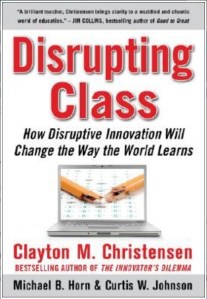
In Disrupting Class: How Disruptive Innovation Will Change the Way the World Learns, Clayton Christensen predicts that technology and online education will transform education because it will enable the teacher to identify student learning needs and take the appropriate steps to meet those needs. That cannot happen, though, until teachers fully believe there is a reason to make that effort.

If We Don’t, Someone Else Will

Harry KellerBy Harry Keller
Editor, Science Education

The United States is falling behind. For many, that’s not a surprising statement, but others will find it hard to believe.

We see statistics summarizing our declining science education, our lack of world-class Internet infrastructure, and many more. What we haven’t seen much of are examples of us falling behind in innovation. Yet, that’s exactly what’s happening. It’s been predicted for quite a long time now by some more pessimistic prognosticators but not demonstrated.

My field is science, and my current work centers on technology to support science education. It’s no surprise that my example comes from that area. For years, I’ve watched as company after company (and even individuals) make science simulations and attempt to sell them as science “labs.” Of course, they’re not truly labs, but that’s beside the point.

sebit2These companies all have produced essentially the same product. It’s a Flash-based animation system wherein students make some choices of parameters and see the result. These animations are two-dimensional and have little support added online for learning and essentially none for tracking. I don’t have to list them here because a quick Internet search for “virtual lab” will give you lots of examples.

So, from where does the first visually appealing, three-dimensional simulation system sold in the United States come from? Turkey! You may have thought of Turkey as some backwater country with lots of small, dusty villages. Not so. It’s a vibrant, secular society that’s put a premium on education in general and science education in particular. Furthermore, they’ve committed to using online education to reach their goal of an educated society. Sebit Technologies has been created by Turkey’s telecommunications leader, Türk Telekom. With all of the money at their disposal, they have made some real waves in online education.

turk_telekomYou can bet that Turkey will not be the last place we see new competition for United States education dollars. Unless our country gets moving with true innovation, we’ll watch as more and more foreign-created innovations take over our schools (and other business markets).

As I’ve suggested before, teaching itself could eventually be handled offshore. Your children or grandchildren may be learning from teachers in India or China. That might sound quite cosmopolitan but will have a huge impact on one of our most stable professions — teaching.

We shouldn’t give up without a fight. It’s time for our government to foster real education innovation. I don’t mean with tax breaks or allowing free market forces to work. We must have serious investment by government in technology infrastructure for education. We may even have to put tariffs on these sort of imports for a while in order to get our companies back into the game. The alternative is just to sit back and let the rest of the world take over education in the United States.

Michelle Rhee Has a Broom: Should She Use It to Sweep Out Experienced Teachers?

bbracey80By Bonnie Bracey Sutton
Editor, Policy Issues

If you want to start a heated discussion in the District of Columbia, just mention the name “Michelle Rhee.” We who live here don’t have a real political vote or a real senator, and now we have one more injustice to suffer. Ms. Rhee is the chancellor of education in DC with unlimited powers granted to her by Mayor Fenty. And one of those powers is to fire and hire.

Ms. Rhee doesn’t want citizens, parents, or teachers involved in her decisions about DC public schools. My concern is that many of us, DC educators, who have given our lives — our time, our money, and our dedication — to help bring up the race without special funding or fanfare, may be out of the picture. With Ms. Rhee in charge, we’re viewed as too old and unfit.

Seeing the ads in the help wanted pages, I initially intended to work with Ms. Rhee’s  program. I had worked with Teach for America informally in Arlington schools. I used to stay three hours after school to allow my students to use technology, and the Teach for America volunteers learned my software and used my resources to teach. I still had to put in time because it was important for me to know what the students learned or did not learn. But I changed my mind about applying after hearing Ms. Rhee’s comments about “seasoned” teachers. She felt that older teachers were not up to the job.

I am the teacher who was the technology director for the 21st Century Project when it was new. I am not a newbie. I know teaching, and I know curriculum. But given Ms. Rhee’s attitude toward “old” teachers, I simply decided not to apply.

As many of my “seasoned” colleagues and I disengage from the DC public school system, we take with us valuable knowledge and years of experience as well as an understanding and love for students that can’t be measured by test scores and dollars.

I am not a stranger to urban schools. I thought that my expertise and experience would be a good match. But I decided to keep doing outreach on my own. Ms. Rhee does not want interference in her plan. She knows it all.

For three years I worked in Anthony Bowen Elementary School in Southwest Washington, DC, before NCLB (No Child Left Behind) was even a policy. It was difficult work, but I loved it. I left when we were reduced to teaching on benches in the gym while renovations were taking place during the school year.

I had a foundation and funding to work with the school. But it was like flushing money down the toilet to see what happened and not fun to bonnie01bmonitor. We never had enough for regular school supplies, field trips, books, art materials, and other things we take for granted in other schools. Still, I made a difference in the lives of some of the children. The school was and is a ghetto school, and it was located across from a high rise in which kids fell to their death in the elevator shafts at least once a month.That facility has, thankfully, been shut down. It was about as ghetto as you could get. The little girls sometimes traded sex for sandwiches from the men working the food trucks. Drugs were a problem in the neighborhood. The school was ancient, and on the first day of heat the smell of ancient urine would choke in your throat and make tears come to your eyes. Then you would get used to it. Well, you can get used to it. As the children must.

I worked in Ballou High School, the one with the marching band that went to the Rose Bowl parade. Nearly 80 per cent of the students are so poor they qualify for a government-paid-for lunch. The school had many people trying to help. But not much has improved. Crime and student behavior were always a problem. A rape took place on my first day of work. Getting to the school was also difficult unless one drove. Cabs would not take you there.

Teachers who teach in urban schools suffer a very different set of circumstances. Children come to us with a variety of problems. I won’t detail them all, but often the biggest is the lack of involvement of the parents and community, as well as poorly chosen resources for students. Some of the children live in environments where being out after dark is dangerous. Still, some children try to do after school programs.

When I taught in DC schools, children would follow me home and sleep in front of my door if I didn’t know they were there, and once I found a child sleeping under my car. When they came to my home, I would feed them and walk them back home. I did not keep students overnight in my home. I was asked to move from an apartment because the children followed me there to sleep in the lobby or in the halls. It was a safe haven for them when they could not get into their own homes. I was called the pied piper of Southwest, but I could not care for all of the children.

I doubt if anyone monitored those kinds of problems, the drug problems, the kids who were being mistreated in foster care. We met them all in the classroom, but we were judged in the same way as those schools where the problems are less severe.

Every set of schools has its own unique problems. Read the DC news for a while and you will see what I mean. Once a child brought me a still breathing aborted child. Life is not easy in very poor urban schools. You have to think about much more than the basics. In fact, you learn the skills of a social worker if you can.

Substituting is a good way to get a picture of the reality of the schools. I recommend it for a reality check.

In DC schools, the nurse only came once a week. So my friends who were medical doctors did duty for me by treating the students with permission from the parents.

The non-textbook equipment that I shared in school was mine, paid for out of my own pocket. I couldn’t leave my resources in the schools because they would disappear. I know that they made a difference. I worked in Arlington schools and DoDDS (Department of Defense Dependents Schools) in 22 countries. There was a tremendous difference in terms of equipment. In surburban schools and DoDDS there were supplies and budgets for special resources. In DC, most of the funding went elsewhere. There was no budget for field trips. We only had $40 worth of supplies so I spent a lot of my own money at the teacher’s store, the book store, and the museum for material to enhance the learning environment.

I fed the children with government cheese, crackers, and peanut butter or foods that were available, but until breakfast was started in the schools, bonnie01abubblegum was the smell of the classroom in the early hours of the day. It was strong enough to make one nauseous. The lunch was nothing special, but it was food. Some children’s parents were missing often from their homes. Here in the DC area we have had students killed and put in freezers, stabbed by their parents, and otherwise mistreated. The social network is hard to improve with those in need. People care, but there are so many problems.

Often I went to service establishments to find coats, shoes, socks, and hats for children without proper clothing. You have probably heard of the glove tree, or the coat collection, or the backpack that children now are given so that they will have food over the weekend. I even know how to find old eyeglasses when there is no other way. The Optimist group. Welfare does not take care of everything especially when parents are not involved or knowledgeable. A teenage group helped me teach students to go to the mall and to the museums, but we quickly found that they were not welcome unless we were there.

We had rats in the school that ventured out in the daytime. No fear. If the rats ate the graham crackers that were provided for students, the teacher had to pay for them. It was not unusual to find a tunnel through those crackers. The vermin were everywhere.

When I taught in DC schools, the library sent us a box of books for a month. They did not want the kids in the library. So I made them let the kids sign out the books by taking them there and complaining loudly.

Then there is the matter of science. There wasn’t anything to teach with. Science was  in a book, but a set of books had to be shared with four classes. Therefore most teachers did not teach science. We lived within walking distance of the national museums, yet most children had never been there. I was able to change that, but I found that the children were not welcome in the programs because of the logistics involved. They had to be picked up after a three or four hour session at the museum. Most parents did not drive and transportation was a problem even just to the mall.

My students could make money in drugs, prostitution, and with a five finger discount as well as the underground economy if you know what I mean. It really isn’t fun to teach where everything is a problem, but you do it for lots of reasons but certainly NOT the money.

Have you ever heard anyone say that teaching is lucrative? I have never. I also doubt that people enter teaching to bore the heck out of children. I doubt that people in DC, having been through so many changes, know what the pulse of education is. NCLB has created some problems in that teachers felt bound to teach to the test, but truthfully, DC schools have always been a problem for many reasons. Congress funds DC schools if it feels like it. Some special initiatives are poised for DC schools whether or not the schools really want them. The school board meetings can be a challenge. Ms. Rhee remarked that she did not have to put up with that “crap” (her word).

The technology in DC schools is wanting. Just take a look at the schools’ website. Sadly, I was working to create change in technology. It proved impossible at that time. Some groups make changes in a school, but the district is lacking in technology resources. Even Ms. Rhee will admit that. When ISTE (International Society for Technology in Education) has its conference in DC this summer, Virginia teachers will man the technology.

Later in my life, when I worked for President Clinton and Vice President Gore, we tried to change schools in DC, too. We deliberately picked those that needed the most help. I worked with the vice president on the CyberED Initiative that had us traveling the country in empowerment and enterprise zones. We worked in Baltimore, New Jersey, New York, Boston, Atlanta, Houston, Clinton, Tennesee, Oakland, and other sites. Our job was to demonstrate, share, and let teachers, parents, and the community try out the new technologies. It was a wonderful job. It was a sharing of possibilities. We worked with community members, teachers, administrators, and parents.

Schools are communities made up of students, parents, and educators, not just a woman posing as a witch with a broom. Ms. Rhee should take that broom and sweep out the problem of thinking that the community is her enemy and that she alone can bring about change. She should use the resources available in the community, and that includes the layer of accomplished and experienced teachers.

[Editor’s note: For related articles, see Two Ambivalent Views of Michelle Rhee’s Efforts
and Michelle Rhee – What’s Really at Stake? Here’s a tip from Jim Morrison: For an update on Michelle Rhee, see Bill Turque’s 5 Jan. 2009 article, “Rhee Plans Shake-Up of Teaching Staff, Training,” at washingtonpost.com.]

Access: The New Imperialism?

lynnz80By Lynn Zimmerman
Editor, Teacher Education

In his article, The 375-billion dollar question. And the new agora , Steve Eskow wrote:

There is a new Agora in the process of creation, a new Commons. And it will flourish free of the constraints of buildings, and, if we let learning move to where it is needed, we will enrich the lives of all those who can’t find their way to our buildings, or can’t afford the price of admission.

This statement reminded me of some of the comments I had read on Innovate-Ideagora in response to James Morrison’s July 2008 discussion, which he called  “Addressing the problem of faculty resistance to using IT tools in active learning instructional strategies.” As I read some of the comments, I started to wonder if this insistence on “getting out of the building” and going strictly to an online format is a form of “technological imperialism.” (See “Aping the West: Information technology and cultural imperialism” by Paul Cesarini.) Although many people have ready access to all kinds of technology, not everyone in the world does. By saying that the brick and mortar classroom is out-of-date and should be disbanded, aren’t we in danger of disenfranchising a large number of people who have no capability of engaging in education through technology? That is not to mention the people who have no interest in and no ability for using technology. I will focus on the practical issues now, but we cannot ignore that while the technical issues can eventually be resolved, must people with no interest in or facility (ease of use – not building) for this type of learning be forced to adapt to it and adopt it?

How does technology access play out? I will offer two examples, one in the US and one in Africa. As I have stated before, I teach in a teacher preparation department. Recently some of my pre-methods students visited a high school lynn2_1located in an urban area in Northwest Indiana. This school has a very high percentage of students on free and reduced lunch. The facility is old and out of date. The technology available to the teachers and students is minimal. One of my students commented, “Do you know, many of the students I talked to don’t even have computers at home?” Because I am familiar with the area and the school, I told her that I was not surprised. She then said that she supposed they went to the library to do their computer work. Imagine her surprise when I told her that the public library in their neighborhood is only open limited hours. I have since checked and the hours are: Monday – Thursday from noon – 8 pm and on Friday and Saturday from 10 am – 5 pm. The small library has a limited number of computers available for patrons’ general use. This is hardly the type of access that would lend itself to a high school without walls.

Four years ago I met a man from Nigeria at a conference. His presentation was about information access, and he raised the same issue of imperialism. He said that you can send all the computers to Africa you want, but if there are no electricity and no phone lines to connect to, they become expensive paper weights. His contention was that money for computers would be better spent to help improve the infrastructure in these countries. Another question I raise is, why are outsiders making these types of decisions anyway? Would it not be better to find out what the people really want and need, rather than telling them what they want and need?

I think that now with weakening economies worldwide the question of who benefits from access to technology becomes even more critical. Countries with weak infrastructures are already being adversely affected by the growing global recession. (See World economic situation and prospects 2008: Update as of mid-2008.) As we academics explore, theorize, and debate the issues, we must not lose sight of the reality that many people face in the US and around the world, which precludes full access to technology. We must keep in sight that “the price of admission” may not be counted in tuition dollars but in “technology dollars.”

References

Cesarini, P. (n.d.). Aping the West: Information technology and cultural imperialism. Retrieved December 2, 2008 from http://www.arts.ualberta.ca/cms/cesarini.pdf

Eskow, S. (2008). The 375-billion dollar question. And the new agora. Retrieved December 20, 2008.

Morrison, J. (2008). Addressing the problem of faculty resistance to using IT tools in active learning instructional strategies. Retrieved November 21, 2008.

United Nations. (2008). World economic situation and prospects 2008: Update as of mid-2008. Retrieved December 5, 2008 from  http://www.un.org/esa/policy/wess/wesp2008files/wesp08update.pdf

Thoughts on the Green Computing Summit

thompson80By John Thompson
Editor, Green Computing

The conference, held in Washington, DC, on December 2-3, 2008, presented “incremental approaches to the greening of agency operations, within the bounds of government procurement, budget and regulatory requirements.” There were two tracks for participants – Track 1: Greening Federal Operations and Track 2: Virtualization – For the Data Center and Beyond. (Click here for the presentations.)

green_computing_summitMy panel presentation – “How Green Are Your Operations?” – was the first offering in track one. The other panelists included Juan Lopez from the Office of the Federal Environmental Executive, Dr. Ed Piñero from Rochester Institute of Technology, and Rob Pinkerton from Adobe Systems. A copy of my prepared remarks should be available at the conference presentations site shortly. The ensuing keynote was done by Dr. Daniel Esty, who is the Hillhouse Professor of Environmental Law and Policy at Yale University and the author of “Green to Gold.”

Day two started with another keynote, “Environmental Design and Energy Efficiency for Federal Facilities: An Executive Perspective,” by Kevin Kampschroer, Acting Director, Office of Federal High-Performance Green Buildings, Public Buildings Service, General Services Administration. He offered his insights into how to build green, energy efficient buildings. I spoke with him afterwards (and got his business card) as my college, Buffalo State College, is constructing a new science building and after that a new technology building. My department will be moved into the latter. I hope that these two pending structures will incorporate energy efficient designs. As pointed out by Kampschroer, energy saving design does not have to increase building cost. When asked how you can push for green design without being obnoxious about it, Kampschroer quickly advocated being obnoxious, if that’s what it takes. Unfortunately, I could not stay for day two’s concluding luncheon keynote as I had to go to the airport for my flight back to Buffalo.

Here are some selected notes from the keynotes, presentations, and table conversations:

  • The federal government prefers using “electronic stewardship” over “green computing.”
  • The federal government spends $60B (as in Billion) annually on electronics, making it the biggest IT user in the world.
  • There is an increased pressure for e-cycling at “end of life” for electronic equipment. Just discarding old tech stuff does not cut it any longer. One federal government program – Computers for Learning – directs excessed computers and related peripheral equipment (e.g., printers) from federal agencies be made available free to schools. All the necessary information is available at its Web site.
  • PC users can save $75-100 per PC per year using power management techniques on their desktop computers.
  • The green wave is not cresting. It’s more like a tsunami.
  • There is an underlying logic to eco-computing: save energy, reduce costs.
  • A lot of acronyms (a lot of federal employee presenters and participants in the audience) and green phrases like “carbon constrained future” were bandied around.
  • There is a price for inaction on green computing. Doing nothing can cost more than action.
  • There is a need for more efficient servers for IT.
  • Cool equipment, not rooms, in your IT operations.
  • Prioritize – what’s strategic, ROI (return on investment).
  • Kaizen – in chaos lies opportunities.
  • Government’s role is to incentivize, not control.
  • thompson28dec08Telework (aka telecommuting) agreement does not necessarily mean employees never go into the office. Barriers to telework include perceived loss of control (cannot manage who you cannot see), security, and negative impressions of past efforts.
  • Videoconferencing reduces pollution, speeds up decision making through increased communications, aids in recruiting and retaining employees, reduces travel costs and increases productivity, and enables real time face-to-face communication with remote employees.
  • Measure, measure, measure (e.g., energy costs, carbon emissions). What gets measured gets done. Conduct baseline of energy use with an energy audit. Implement your green initiatives. Measure again. Repeat.
  • Environmental Protection Agency has an energy savings calculator.
  • Green buildings:
    • Placing lights as close as possible to work sites reduces the amount of light needed.
    • Install waterless urinals.
    • Wireless sensors provide more local user control.
    • Install a green roof.
    • Challenge assumptions and “business as usual.” As the old saying goes, “If you always do what you’ve always done, you’ll always get what you always got.”
    • Possible to put up buildings that achieve 50% reduction in energy needs with no additional capital expense.
    • Giving users control for lighting leads to less light used.
    • Use LED lights (less energy, less maintenance).
  • US government has approximately 445,000 buildings with three billion square feet (and leases another 57,000 building with 374 million square feet).
  • Paper represents 37% of trash that is thrown out. One ton of recycled paper equals one acre of trees.
  • Successful program needs supportive leadership.
  • The Business of Green.
  • Greenbuild International Conference and Expo.

When I got back home, I put all this in a report to those who subsidized my travel to DC. I explained that the Green Computing Summit was a very worthwhile experience. We’ll have to see what changes on my campus as a result. But I’m going to talk with my department to start making some changes (e.g., use less paper, PC power management). Every journey of a thousand miles . . .

Worth Reading: “Myths Left Behind”

morrison80By James L. Morrison
Guest Author

[Comment (25 Dec. 2008) on I-Blog article: “Two Ambivalent Views of Michelle Rhee’s Efforts“]

I just read a Washington Post editorial “Myths Left Behind” (25 Dec. 2008) that relates to this discussion. The editor wrote: ”Graham Road was one of four schools recently singled out by the Education Trust for success in teaching low-income and minority students. The awards, now in their sixth year, are aptly named ‘Dispelling the Myth.’ The schools, as Education Trust President Kati Haycock said, shatter ‘the misguided and dangerous belief that achievement gaps are inevitable.’ No matter how difficult or intractable the problems in a child’s life, dedicated and effective educators can make a difference.” The editorial is worth a good read.

graham_road(photo source)

Live Radio Captioning for the Deaf

claude80By Claude Almansi
Staff Writer

Thanks to:

  • Sylvia Monnat, director of captioning at Télévision Suisse Romande (French-speaking Swiss television www.tsr.ch) for the explanations she gave me by phone on live captioning through re-speaking.
  • Neal Stein, of Harris Corporation (www.harris.com), for the authorization to publish on YouTube the video excerpt shown below, and for his explanations on the US live radio captioning project.

Why Caption Radio?

Making radio accessible for deaf and hard of hearing persons is not commonly perceived as a priority. For instance, the new version of the Swiss law and ordinance on Radio and Television that came into force in 2007 does add several dispositions about accessibility for people with sight and hearing disabilities but does not mention captioning radio. See art. 7 [1] of the law and art. 7 [2] and 8 [3] of the ordinance (in French). According to most non-deaf people’s “common sense,” deaf persons don’t use radio – just as many non-blind people still believe that blind people can’t use computers.

Yet deaf persons are interested in accessing radio content through captioning, as Cheryl Heppner, Executive Director of NVRC [4], explains in this video:

The video is from the January 8, 2008, I-CART introductory press conference at CES 2008. The full video can be downloaded from www.i-cart.net. Transcript of the above excerpt:

I’m one of 31 million people in the United States who are deaf or hard of hearing. A number that continues to grow. NPR Labs and its partners are on the verge of making many of my dreams come true. Beyond having that really crucial emergency information, captioned radio could also open up a world I’ve never had, because I lost my hearing before my seventh birthday.

When I am stuck in Washington’s legendary Beltway gridlock, I could check the traffic report and find out why, what my best route would be. I could check the sports scores and follow the games for all my favorite teams. I could know why my husband is always laughing so uproariously when he listens to “Car Talk.” And I could annoy him by singing along badly to the lyrics of his favorite songs.

I can’t wait. Thank you.

NPR’s Live Captioned Broadcast of Presidential Election

The work by NPR Labs and its partners, mentioned by Cheryl Heppner in this January 2008 conference, led to the broadcasting of live captioned debates on NPR during the US election campaign a few months later. The assessment by deaf and hard of hearing people of this experiment was extremely positive. According to the press release “Deaf and Hard of Hearing Vote Yes on New Radio Technology During NPR’s Live Captioned Broadcast of Presidential Election” (Nov. 13, 2008) [5]:

  • 95% were happy with the level of captioning accuracy, a crucial aspect for readability and comprehension
  • 77% said they would be interested in purchasing a captioned radio display unit when it becomes available
  • 86% indicated they would be interested in purchasing a “dual-view” screen display for a car (which would enable a deaf passenger to see the captioned radio text while the driver listens to the radio).

How Are Radio Captions Transmitted?

A digital radio signal can be divided to transmit audio and text, and the text can be read on the radio display. In fact, text messages are already being sent micro4_serviceon car radio displays through Radio Data System (RDS). For instance, this is how the Swiss traffic information service Inforoutes updated drivers in real time – or almost – about the state of traffic jams due to work in the Glion tunnel in 2004. (See “Service,” in French, on page 4, in the May 2004 newsletter of Les Radios Francophones Publiques [6].)

The radio devices used in the experience conducted by NPR Labs and its partners that Cheryl Heppner mentions have a bigger display. For the exact technical explanation of how the captions work, see the presentations section of www.i-cart.net.

Stenocaptioning vs. Respeaking

The NPR experiment mentioned above used “stenocaptioned,” i.e., they were written with a stenotype [7] whose output gets translated into captions in normal English by computer software. Live stenocaptioning – whether for news broadcasts or for in-presence events in specially equipped venues – seems to be the preferred solution in countries such as the US and Italy that have a tradition of stenotyping court proceedings or parliamentary debates.

In most other European countries, according to Ms. Sylvia Monnat, director of captioning at Télévision Suisse Romande (French-speaking Swiss TV – www.tsr.ch), broadcasters tend to prefer “respeaking,” which works with speech-to-text technology: the software gets trained to recognize the voice of respeakers, and then converts what they repeat into captions.

Ms. Monnat further explained that, on the one hand, the advantages of respeaking involves training. In fact, countries without a stenotyping tradition do not offer courses for it, whereas existing interpretation schools can arrange respeaking courses since it is a normal exercise in the training of conference interpreters. Moreover, respeaking is easier to learn than stenotyping.

On the other hand, it takes time to, first, train the speech-to-text software to recognize the respeakers’ voices and, second, to add words not present in its basic thesaurus for each respeaker’s voice. Moreover, enough respeakers have to be trained so that one whose voice is recognized by the software will be available when needed. Whereas once a new word has been added to the thesaurus of the stenocaptioning software, it can be used by any stenocaptioner.

Outlook

The fast evolution of technology makes it difficult to foresee the issues of live captioning, even in the near future. Radio and television are merging into “multimedia broadcasting.” And, in turn, the line between broadcasting and the internet is gradually fading (see the HDTV offer by internet providers). Speech-to-text technology will probably continue to improve. Mutimedia devices are also evolving rapidly.

However, the response of the deaf and hard of hearing people who participated in the NPR Live captioning experiment seems to allow one safe surmise: live radio captioning is here to stay, whatever the means it will use tomorrow.

Resources

Further information on live captioning can be found in the online version of the “Proceedings of the First International Seminar on Real-time Intralingual Subtitling” held in Forlì, Italy, on Nov. 17, 2006 [8].

This and other online resources mentioned here have been tagged “captioning” in Diigo and can therefore be found, together with resources added by other Diigo users, in www.diigo.com/tag/captioning.

Innovation in Education: What? How?

Harry KellerBy Harry Keller
Editor, Science Education

What is innovation in education? How can you make it happen?

Within my focus of science education, I see little in the way of really innovative ideas being implemented in classrooms. Part of the reason has been discussed by John Adsit (“Needed – A Professional Approach to Teaching“). More on that later.

I’ll begin with where education innovations originate.

“That which has come to be, that is what will come to be; and that which has been done, that is what will be done; and so there is nothing new under the sun” (Ecclesiastes 1:9).

And so it is with ideas. There are really no new ideas, just remixing and repackaging of old ideas. As I researched the ideas underlying the use of student science laboratory experiences in teaching science, I found a single theme repeated again and again: inquire, explore, and discover.

In many of these cases, the author did not acknowledge those who had gone before, suggesting a rediscovery rather than building on previous knowledge. What a waste! You’ll detect echoes of Adsit’s article here. If educators would just study what has gone before, they could save time and improve education.

Therein lies at least one fertile area for innovation. Seek out previous ideas that worked well in the classroom but failed to spread for some reason. Understand that reason. Find a way to overcome the problem and repackage the good idea so that it will work this time.

hallAs for inquiry learning in science, Prof. Edwin H. Hall of Harvard University was using it in 1891. He wrote a book, A Text-Book of Physics: Largely Experimental, that included his philosophy in its introduction. Reading that introduction was a real eye opener for me. Those old guys were really quite smart. I should note that Prof. Hall was famous for discovering the Hall effect.

Hall had great success initially with his idea, but it foundered. Why? The reasons are not hard to find. Hall himself states that the laboratory class sizes must be no greater than twelve students. Try to imagine that in today’s typical public schools. New York City limits class size to 34 students, nearly triple the Hall limit.

Another reason can be found in the writings of Frederic W. Westaway, a very well-known writer on science philosophy and education from the 1890s through the 1920s. He also supported the inquiry approach to learning science and wrote eloquently about the qualifications of a science instructor in the inquiry mode. Such a person must be conversant with all science subjects, not just the one being taught. The instructor must also be well-acquainted with the history of science and understand the philosophy of science.

No amount of teacher recruiting, professional development, increase in teacher salaries (a good thing for other reasons), curriculum reform, or other traditional methods of improving instruction will fix these problems – at least not in a reasonable amount of time and with a reasonable amount of money. So, for over 100 years, this concept has languished. Periodically, it’s been resurrected and promoted by this person or that. Teacher workshops result in enthusiastic responses. Yet, it dies again and again. The pressures of required curriculum, tight budgets, limited and diminishing instruction time, remedial work with unprepared students, and so on prevent using this technique. Also, the teachers are not prepared for the demands of this teaching style. They haven’t the background that Westaway suggests they must have.

The rapidly and exponentially increasing computational and communication capabilities provided by today’s technology provide the best means to get out of this situation. Software can build in process and support so that teachers don’t have to be experts. Software can track student progress and success and suggest where extra effort should be expended. Administration can see whether teachers are using the tools well. I’ve implemented these ideas for online/offline science labs and found that they work very well. The best part, in some ways, is being able to make adjustments in the software rapidly. The software evolves much more rapidly than traditional textbooks or curricula. It just keeps getting better.

I can recommend this approach to innovation to anyone:

  • Research your particular area of interest.
  • Find educational approaches that have worked very well but failed to spread out into the general population.
  • Find out why.
  • Think about how technology can overcome the obstacles.

If you find a way, you could be the author of the next great education innovation.

kellerdec1808Lest you jump too quickly into innovating, allow me to add a small caution. You’ll have to get the educators who will use your innovation on board. Here’s where Adsit’s comments really come into play. Working for a school is completely unlike working for a company. The company will tell you what tools to use. You’ll be reviewed once or twice a year. Your salary and continued employment depend on the outcome of the review. Even if your job has little that can be measured objectively, you’ll still be measured.

If you invent a truly astounding education innovation that can transform students everywhere into great learners, you’ll face very high hurdles. You won’t be able simply to sell a school district on your invention. They have to get the buy-in of the teachers, who may say nice things about your idea and then go back to the classroom and continue on as though you didn’t exist. The teachers cannot be forced to use new ideas. Unless you’re relieving some real pain that these teachers feel, you won’t succeed without Herculean efforts. And failing students are not pain.

Adsit comments that a school leader was sticking to the “tried and true” methods. He was right to put that phrase in quotes. The real tried and true methods are those that have been tried and found to be true in that they work well. The methods the leader was implementing were “tried and false” instead. It’s insanity to expect doing more of the same in a failing situation will change the result.

For all of us who would like to see education progress to greater success, we have to identify the problems. That’s easy. We have to determine how to fix the problems. That’s proven to be very hard indeed. Someone once told me that education is the institution that is the third most resistant to change. “What are the first two?” I asked. Monasteries and nunneries was the answer.

Needed – A Professional Approach to Teaching

adsit80By John Adsit
Staff Writer

I approach the subject of Rhee and the reactions of the teaching “profession” with a sadness bordering on despair for I enter a battlefield on which I have often fought. My few small victories pale in comparison with my many painful defeats.

I put “profession” in quotations because I am not sure teaching can be called a profession. In what other profession can its members practice with no training whatsoever, as happens frequently at the college level? In what other profession can its members start with basic training and learn nothing new over a 40 year career, as frequently happens at the K-12 level? If a doctor were to start bleeding patients rather than use the results of the latest medical research, he or she would be hauled before a medical tribunal, but in education ignoring research results is the norm.

adsitdec1508Nearly 20 years ago I was a highly regarded teacher. Although I was somewhat innovative, I used a largely traditional approach, imitating the best of those who had in turn taught me. All my graduate work was in my content area so I had little education training beyond my initial certification. One day I was sent to a workshop introducing a very different educational approach. Most of what I heard sounded perfectly wrong, and I was close to dismissing it.

I was intrigued by some points, though, that made me fear some of my practices might be harmful to student learning. I took some of the more interesting ideas back to my classroom and gave them a go. I first completely changed some of my favorite lessons into authentic learning projects, and I started experimenting with a mastery learning assessment process at the same time. (For more on the “mastery learning assessment process,” see my earlier article, “Old School Thinking Blocks Quality Online Science Classes.” In upcoming articles, I’ll delve deeper into these approaches.) The level of immediate success was shocking. I implemented one change after another and watched student achievement soar beyond my wildest dreams until I was a complete convert.

One year I had more students get top scores (5) on the AP exam than all the other AP teachers in the school combined had students pass (3). I also taught a remedial writing class, and its average score on the district writing assessment was higher than most of the regular classes. Despite objective measures of success, my colleagues angrily accused me of lowering standards because so many of my students were getting A’s and B’s! I was not teaching the right way, the way teaching had always been done.

When I was brought into the central administration to help teach these methodologies, I became an education literature junkie, learning many things that the general education community evidently does not wish to know. Longitudinal studies, for example, have shown that some teachers have significantly superior student achievement than their colleagues in the same school, year after year, and some teachers have consistently poorer student achievement, year after year. If an elementary student is blessed with three consecutive years of good teaching, his or her achievement scores will be about 50 percentile points higher than a student cursed by three consecutive years of poor teaching. The most effective and least effective methods of instruction have been identified. Processes by which whole schools can be turned from failure to success are known.

adsitdec1508bNone of this is a secret. All of the nation’s top theorists are largely in agreement. Outline the main concepts before a meeting of district curriculum leaders, and they, too, will nod in agreement.

But talk about it in a meeting at the school level, and you’ll be lucky to get out alive.

Only a few weeks ago I watched a school leader outline the steps her school would take to improve its miserable failure rate, and I saw the same failed ideas that have been used for decades. I asked if they were planning to investigate the latest research on successful schools, and she said no, they were sticking with “tried and true” methods.  I was reminded of how George Washington’s doctors bled about half of the total blood volume from the choking ex-president  (the tried and true cure) and refused to allow another doctor to perform a new procedure, the tracheotomy that might have saved his life[1].

Change can happen. Individual teachers can change instructional methods and vastly improve student achievement. Schools can adopt processes that have been proven successful. This will not happen, though, as long as the majority of educators stick with the “tried and true” methods that have brought us to where we are today. This will not happen until education becomes a true profession, with members who view the educational process as worthy of study in and of itself.

POLL: Grade Michelle Rhee’s Approach

This question is based on articles that have appeared in I-Blog (see “Two Ambivalent Views of Michelle Rhee’s Efforts” and “Michelle Rhee – What’s Really at Stake?“) as well as the Atlantic, Time, and Newsweek. Please share your thoughts on this issue by participating in this poll and using the comment feature below to explain your grade. To vote: (1) click on the grade, and (2) click on “vote.” Don’t use the “comment” in the poll to expand on your decision; instead, use the one that appears at the end of this article, below the poll. Thanks!

Two Ambivalent Views of Michelle Rhee’s Efforts

By James L. Morrison
Guest Author
and
MaryAnne Gobble
Guest Author

[Editor’s note: These two comments, by Morrison and Gobble, Innovate‘s editor-in-chief and managing editor, were part of a December 8 email discussion on Michelle Rhee, the controversial superintendent of DC public schools.]

Morrison:

After reading Clay Risen’s article about Ms. Rhee, “The Lightning Rod,” in a recent issue of Atlantic, I am a bit ambivalent about what she means for education reform. For me, the three most salient parts of the article are these excerpts:

[1] “As a teacher in this system, you have to be willing to take personal responsibility for ensuring your children are successful despite obstacles,” she told me. “You can’t say, ‘My students didn’t get any breakfast today,’ or ‘No one put them to bed last night,’ or ‘Their electricity got cut off in the house, so they couldn’t do their homework.’” This sort of moral certitude is exactly what turns off many veteran teachers in Washington. Even if Rhee is right, she seems to be asking for superhuman efforts, consistently, for decades to come. Making missionary zeal a job requirement is a tough way to build morale, not to mention support, among the teachers who have to confront the D.C. ghetto every day.

[2] Rhee advocates another controversial plank in the reformist agenda: merit pay. Vociferously opposed by the teachers unions—a National Education Association convention audience booed Barack Obama when he told them he supported it—merit pay scales a teacher’s salary based on student achievement. Proponents say this is the only way to make teachers want to improve their performance. Opponents say it will torpedo already low morale and drive a wedge through faculty solidarity, and that basing merit pay on student performance leaves out all sorts of nonquantifiable aspects of learning.

[3] The divide means that Rhee’s challenge is not just to reform one of the worst school systems in the country and, in effect, prove whether or not inner-city schools can be revived at all. It is to answer a basic question about the nature of urban governance, a question about two visions of big-city management. In one, city politics is a vibrant, messy, democratic exercise, in which both the process and the results have value. In the other, city politics is only a prelude, the way to install a technocratic elite that can carry out reforms in relative isolation from the give-and-take of city life. Rhee’s tenure will answer whether these two positions are mutually exclusive—and, if they are, whether public-school reform is even possible.

I applaud Rhee’s efforts at reform, particularly with the DC schools, but it appears that she may not recognize or address the influence of parents, the community, and peer groups on human behavior and learning. Incorporating a plan to address and use these factors are also necessary to achieve her objectives, which are laudable.

Gobble:

I would agree that “business as usual” is not an option. Change is necessary and inevitable. I applaud Ms. Rhee’s drive to bring change to the DC system, which is among the systems most in need of some kind of reform. I think she has the best of intentions; her dedication to the cause is indisputable, and her tolerance of risk and uncertainty is absolutely necessary to the job she’s trying to do. I think she has the potential to do a lot of good — unless she so profoundly alienates her constituency that she cannot function. As the Atlantic profile points out, “Whether she recognizes it or not, her task is political as well as educational.”

I would disagree with Rhee’s fundamental assumptions: that there’s only one way to get there; or that you can get there by imposing a single set of views and standards on teachers, students, parents, and the community at large; or that there is only one possible measure of success. As a parent, I’m alarmed by the reliance on standardized test scores, which Ms. Rhee seems very invested in. Sure, a test score can tell you if a kid can read, and I think there’s a place for them in education. You have to make sure everyone’s got the basics somehow. But it can’t tell you if the kid can understand what he has read at any level beyond basic comprehension, or connect it to something else he saw or heard or read, or see its relevance to his own life. And, at least the way we’re testing now, when that test score becomes the end-all of the education process, it means there’s no time to explore those connections or build the kind of love for learning that means that kid will read.

Worse, there is not yet a test score that can account for the kid who can read and appreciate, but can’t function under the pressure of a test gobble01bor has a disability that keeps him from grasping what’s asked for in those circumstances. I have a brother with a serious learning disability. He barely escaped high school, and yet he’s a brilliant satellite electronics engineer, a very smart, imaginative writer, and a prolific reader. His emails and letters are, in his own words (although not his spelling), “grammatical train wrecks” that require a certain kind of translation, but they are imaginative and engaging, full of original imagery, as are his stories and comics. He can’t spell, and he would never, ever have passed the end-of-grade tests my middle-school son must take almost every year, but I would argue that he is as smart as or smarter than many students who ace all the tests, and in ways that matter more profoundly to his adult life than any end-of-grade test score will ever be able to measure.

I think that what’s wrong with public education is that it has become so profoundly separated from the communities in which it is supposed to happen. Standardized tests are part of that, because they force teachers and students to sit in classrooms focusing on a test that has little to do with the world around them, rather than turning outward to explore the world they live in. Imposing a change from above, without considering the community and the context and without involving those most invested in it, both expresses and perpetuates that reality. It is the most damaging kind of business as usual.

And that’s what scares me about Michelle Rhee’s approach.

Ineffective Use of Computers in Schools

Harry KellerBy Harry Keller
Editor, Science Education

On Tuesday, December 9, 2008, the New York Times columnist David Brooks wrote, “Obama wants to put more computers in classrooms, an old idea with dubious educational merit”[1].

It’s true that people have been putting computers in classrooms for many years. It’s also true that the impact of these computers has often been less than wished. However, neither of those facts tell us that we should stop. Rather, they tell us to review how and why computers are being used in those classrooms.

In my own visits to schools across the country, I have seen those computers being both underutilized and over-utilized. In some schools, the computers sit idle while traditional instruction continues. Occasionally, students are allowed to use the computers, and they get to use the standard business tools available such as spreadsheets and word processors. Sure, it’s nice that the students are learning to use those tools, but are they helping students learn their subject? I think not.

In other schools, I’ve seen computer rooms fully booked so that some teachers are unable to use them at all for their students. Upon inquiry, I discovered that math and English classes have priority because of high-stakes testing. The computers have various programs on them that drill the students on concepts required on those tests. In my opinion, these schools are wasting a valuable resource.

Computers slowly and quite certainly have revolutionized many businesses. Lawyers, among the last to succumb, now cannot live without their word processors with the ability to rewrite accurately, insert boilerplate, and check spelling and grammar. Software has been created to support the advances in productivity that we’ve seen in many industries. So, what’s the matter with education?

keller04The larger class sizes we see in schools are not the result of improved worker productivity; they’re caused by budget shortfalls. Clearly, computers have not improved teacher productivity. Students aren’t learning better. Just look at any number of international measures of student success in mathematics and science. We (the United States) are losing.

At least in traditional classrooms, neither the quantity nor quality of product has improved in this age of technology. Charter schools are making some headway mostly because their employees work multiple job descriptions and long hours. Generally, online education works because students self-select based on study skills, and teachers have tools to allow them to have slightly larger numbers of students. Those tools come with “learning management systems” (LMS) that online schools use to handle administration of classes.

To be fair, the United States has over 50 different sets of standards for education and administers those standards from a very large number of individual school districts. That fact makes creating software usable across the entire country quite difficult. Turkey has committed its education system to online learning and doesn’t have the same problems. The software I’ve seen from Turkey is first-rate and shames our own home-grown efforts.

If we don’t get moving on real innovation in education right now, we may find our children learning from online schools headquartered in Turkey, Israel, and Singapore quite soon. Teachers, like factory workers, will see their jobs disappear overseas.

Instead of waiting, as the automobile industry did, until it’s too late, begin today by merging the various state standards, requiring teachers to use good computer-based learning tools, and having our federal government support innovation that uses technology to make a real difference and that’s not just drill repackaged or textbooks converted to online format with animations and sound or other similar old methods with new facades.

Defining One’s Diversity Philosophy: A Crucial Skill in a Changing World

osborne80By Randall E. Osborne
Staff Writer

In a world that is becoming increasingly “smaller” due to technology and ease of travel, it seems imperative to help individuals to expand their diversity views BEFORE they venture out into that world. In other words, it seems important to make an effort to expand people’s abilities to accept difference before they venture out into a world that is so obviously different from any one individual’s background. In an effort to do this, the author incorporates a diversity philosophy into his internet course on the Politics and Psychology of Hatred. Through assignments on middle class mentality, analysis of hate sites on the web, reading books about the Holocaust, personal explorations of privilege and other assignments, students are required to explore their own personal philosophies and views about the importance of difference.

The following is excerpted from a “Philosophy of Diversity” survey created by Cornell Thomas and John Butler (2000). Students are given an opportunity to answer questions about their diversity philosophy and then score them to determine whether they had more responses in assimilation, tolerance, multiculturalism, or inclusiveness. These categories were defined by Thomas and Butler in the following manner:

Tolerance = acceptance and open-mindedness of different practices, attitudes, and cultures; does not necessarily mean agreement with the differences. Implies an acknowledgement, or an acceptance or respect. Not necessarily an appreciation and usually consists of only surface level information.

Essentialism/Assimilation = the practice of categorizing a group based on artificial social constructions that impart an “essence” of that group, which homogenizes the group and effaces individuality and differences. The word implies that we are forming conclusions, relationships, and other cultural ties based only on the essential elements, as determined by “us.” It also implies that there is some minimal level of understanding that applies to groups.

Multiculturalism = the practice of acknowledging and respecting the various cultures, religions, races, ethnicities, attitudes and opinions within an environment. The word does not imply that there is any intentionality occurring and primarily works from a group, versus individual, orientation.

Inclusiveness = the practice of emphasizing our uniqueness in promoting the reality that each voice, when, valued, respected and expected to, will provide positive contribution to the community.

This was a learning experience for many students. For example, the “lesbian-identified bisexual” wrote that she was surprised to find that several of her responses had only been tolerant. She said osborne1she had expected that, because she was different, she should have all multicultural or inclusive responses. Another concern she brought up revolved around the possibility of using inclusive language but having the goal of making all people think or act the same way. This sparked an interesting debate about both inclusiveness and assimilation.

Before another assignment was due, students had a chance to “talk” via email and to “interact” through two discussion forums, one centered around the relationship between fear and hate, the second related to our moral or ethical obligations when dealing with hate. These fora allowed students to share their views and develop a sense of trust with each other. Next came the “hate site” assignment. It required the student to go to sites on the web that promoted hate and to analyze them by describing each site, defending its right to be there, and then explaining why it should not be there. By the time we were faced with the “hate site” assignment, many of us had already started to develop a sense of understanding regarding our own assumptions and biases. What resulted was that many of the students this semester did not “pat themselves on the back” over their own acceptance of difference after the evaluation of these sites; instead, many of them discussed their own reactions to the sites, sharing how it angered them or frightened them because some of the sites were written so well that they could almost be convincing.

It seems to me that such an exploration would be healthy for everyone. As people are exposed to more people in the world (through travel and through technological access to that world), stark differences in viewpoints and ideologies are going to become even more apparent. If we are to avoid having these differences only strengthen existing prejudices or even prompt hate-based behavior, it seems necessary to promote progression along the diversity philosophy continuum outlined by Thomas and Butler. This must be done at home, through schools and through the media.

Reference

Thomas, Cornell, and John Butler. 2000. Diversity philosophy. Paper presented at the Race, Gender and Class conference, Southern University at New Orleans.

An Interview with Terry Anderson: Open Education Resources – Part I

boettcher80By  Judith V. Boettche

This is my first experience with doing a formal blog posting, although it has been on my list for a while. Jim Morrison suggested that this format, the new blog area for Innovate, might be a good way to more quickly share a recent interview on open education resources with Terry Anderson, director, Canadian Institute for Distance Education Research, and one of the keynoters at the 14th Annual Sloan-C International Conference on Online Learning in Orlando, Florida, on 4 November 2008. Terry’s keynote title was “Social Software and Open Education Resources: Can the crowd learn to build great educational content?

One of my goals in going to the conference was to interview Terry about his perspectives on open education resources, and I was not disappointed! Terry was very gracious in meeting me over lunch the day of his keynote in the Caribe Royal restaurant. We had a broad-ranging conversation that included his personal experiences with making the book, The Theory and Practice of Online Learning, now in its second edition, freely available on the web. But more on that later.

So here goes. I hope you enjoy it!

terry_andersonJB: Terry, the abstract for your keynote emphasizes the promise of open education resources (OERs) to radically reduce the cost of educational content production and availability. Yet you seem to indicate that educators are not making much use of these resources. Why not?

TA: I don’t think that the availability of OERs has had much impact as yet. Lots of people download content, but how many people use it for serious academic work?

JB: Why do you think that is? What do you think has to happen before the adoption of OERs becomes more widespread and thus more of a force in keeping educational content costs down?

TA: I think there are two issues in the adoption and use of OERs: credentialing and the social support of learning experiences.

People work hard when they are motivated, and most people are motivated by credentialing or earning some kind of a certificate. What is needed for broadening the impact of open educational resources is to provide a pathway for credentialing. For example, with the open courseware from MIT, they provide the courseware resources, but no credentialing. It is up to other institutions to provide the pathway to credentialing. For example, at Athabasca University, a significant number of our Athabasca courses have what we call a “challenge alternative.” This means students can elect to writing an equivalent final exam or completing the final requirements of a course — without actually taking the course.

The second issue is that of social support. Many students find it difficult to learn on their own independent of a social environment. They like to struggle and engage with other learners as they learn. So one of our future tasks is likely to focus on developing educational experiences that include interaction with other students. For example, a learning experience that says, “Go to this site and do this with others who have started at about the same time.”

JB: What about the financial model for OER? How is this going to work? How do we ensure that people with expertise, talent get some compensation for their time and resources?

TA: What we have here, I think, is the same issue that exists with television, music and other creative industries. I think that micropayments are one approach that will work. We see this in the model from Apple with iTunes. Rather than buying a whole album, people select and pay 99 cents for one track of a CD. We need to experiment with additional different models that include reaching out with micropayment models to the long tail of the net —where there are millions of people on line today. We need to begin doing more looking out beyond the 200 or so million people in the U.S.

terry_anderson_sbJB: What about faculty members? Is the micropayments model going to be important for them?

TA: For many faculty it is not an issue. Even today, writing educational materials generally does not mean a lot of money coming back to faculty. And it does not matter as faculty are paid by the state or by the institution! Faculty may dream about writing a textbook that becomes a nationwide top seller, but it doesn’t happen very often.

I think we should move away from a production model where textbooks are written by one or two superstars to a production model with a much larger group of folks. Or move to a co-production model such as we do for research journals.

[Note: Terry’s thoughts on content production models made me think about the Wikipedia model. Maybe we should consider a Chemistry or Physics Resources Wikipedia? -JB]

JB: Terry, what bout the current costs of textbooks and educational materials. Are the costs for educational materials really a big deal?

TA: It really depends a great deal on where you are. When I am working on my campus I have access through our institution’s library database agreements to almost any resource I am interested in using. And this is the same for most of my colleagues in the academic community. So, we start to forget that materials may not be similarly “available” to others. If you go to Africa where the tuition is $45, and the libraries do not have access to content and the textbook is $90 to $100, it’s a very big deal!

JB: Let’s return to the question in the subtitle of your keynote presentation. Terry, do you think the “crowd” can learn to build great educational content?”

TA: Oh, I think “yes!” A colleague and I have been working on a book that is in a long gestation period. The book focuses on the “three aggregations of the many.”

The third “aggregation” is the collective, which is the “crowd.” A lot of people are using the net for many purposes. As they are doing this, they are all leaving traces of their activity, explicitly by voting or buying or doing something; or implicitly by which sites they are visiting and how long they stay on a site. Data mining and data capture techniques include tools that match what some people are doing with what other people are doing with some automatic filtering going on. We are at the early stages of that. Collectives are being used as learning resources without enrolling the class. This means if you use the net fairly frequently, it will reward you.

[Continued in Part II]

An Interview with Terry Anderson: Open Education Resources – Part II

boettcher80By Judith V. Boettcher
Guest Author

[Continued from Part I]

[Note: After listening to Terry’s description of how the crowd’s activity might be used to produce new information, I learned that Google announced a new tool on November 12 called the “Google Flu Tracker.” It tracks flu trends across the country by using aggregated Google search data to estimate flu activity! This service was developed after learning that “certain search terms are good indicators of flu activity”! -JB]

JB: It sounds as if we are on the brink of a number of new models, both for producing, using and paying for educational content. But let’s switch gears a little. Just as the net is changing how the crowd may be creating content, online courses are starting to use content in new ways. We have types of content: published content; “found content” for information that students bring to the course community; and we have the performance and teaching direction content, which students and faculty create during the course. What do you think the role of content is in a course today? What percent of a course is actually published content?

TA: Publishers are concerned that students are not buying the textbook, and faculty are saying that students who do buy the textbook are not reading the textbook. What I think is an important opportunity is giving students the option of creating and sharing their own conception of the course knowledge.

JB: Have you been sharing student-created content from year to year as yet?

TA: Not yet. I am encouraged by the use of a new system that we are using at Athabasca. The system is Elgg, a social networking tool that can be used by smaller communities. We wanted a system that was institution-centric rather than course-centric.

What I really like about ELGG is the permissions options. You use a menu to control access to any piece of information that you post, such as a phone number, blog posting or wiki entry. For example, the first option is to keep it private, just for yourself, then you might keep it to yourself and a friend, then to the people in your course, your teacher, people at your university, or Google or the world. Some things you want public, and some you want to keep private. You can’t resolve that on an institutional policy basis. It seems that having students in control and being knowledgeable about that control is the way to go.

theory_practiceWe use this for portfolios and graduation type of assignments so it really helps with getting content out of the LMS [learning management system]. You can show your work to your mother or anyone else who cares.

JB: Do you link to Elgg from your LMS, then?

TA: Yes, and what I have been doing this last term as an experiment is weaning students away from the discussion board environment to the blogging environment in Elgg. Blogging is not as good for threaded discussions, but then threaded discussions don’t allow people outside the course to pop in and read, contribute and comment. I use Moodle for the drop box, assignments, study guides, course content, and other non-interactive kinds of course pieces.

JB: Terry, let’s go back to your own book that you have made available on the net. Why did you make your book freely available online?

TA: The publication of the first edition of the The Theory and Practice of Online Learning was an experiment as it was published in both print copy and made available as a free download. The 400 copies of the printed version sold quickly, and in the first month there were about 6,000 to 7,000 downloads of the book. Over the years it has been online, there have been about 90,000 downloads, and portions of the book have been translated into five languages.

We now have a second edition out, and we are using the same model. The book and its individual chapters continue to be freely available online under a Creative Commons license. People are still downloading the first edition, but I would like to wean folks from the older version. The second edition has four new chapters, including chapters on Mobile Learning and Social Software and is available from the Athabasca University Press.

JB: So, does the freely downloadable option stimulate sales of the printed copy?

TA: I think that is an open question. We just don’t know. I do know that making it freely downloadable increases exposure and access. As for other models, I don’t know what the impact of the Amazon Kindle Reader will have. One thing I am disappointed about is the small price differential that is common on the Kindle books. But we will just have to keep experimenting I think.

JB: Terry, thanks so much for your time, your insights and your ongoing exploration and testing of the use of open education resources.