The more time I spend with the Raspberry Pi 4, the more I’m convinced that it could stand in for a desktop for many uses. For light users and perhaps for schools and colleges, the savings would be astronomical. I decided to add a small monitor to make the unit less cumbersome and more portable. School and college faculty, techs, and administrators ought to look into this tiny computer as a possible replacement or substitute for expensive desktops for class or lab use. Experiment with it. Can it cover the functions that are needed?
Added a lightweight, portable 1920×1080 HDMI monitor1 and some updates.
Tweaks abound. Enthusiasts and pros are sharing, via YouTube, new and exciting updates and upgrades. Here are a few that I completed in the last hour: Continue reading →
The CanaKit Raspberry Pi 4 Complete Starter Kit arrived yesterday evening. I got it up and running before turning in and did more extensive testing today. My overall early impression is “Wow!” Pi4 has all the earmarks of a desktop disruptor. Its tiny size and outrageousy low price is a dramatic departure from clunky and expensive desktops. I’ve always wondered why desktop computers have changed so little in the last ten to twenty years. Laptops, notebooks, tablets, and other computing devices are shrinking in size and price every year or so, but desktops seem to remain the same.
It was only a matter of time before a breakthrough like the Pi4 would occur. Earlier Pi versions didn’t have enough power to replace desktops. The Pi4 is a tipping point, marking the beginning of an era that might eventually see the decline of today’s major desktop producers as well as Microsoft’s monopoly on operating systems. For approximately $150, I have a desktop that can do almost everything my $1500 desktop can do1.
The Raspberry Pi 4 is the tiny box to the right of the keyboard. I have it set up for two monitors. The screen on the right is running a 1080p YouTube video. The screen on the left is running four apps: a webpage, an email page, a word processor, and a spreadsheet. The keyboard, mouse, and power supply are official Raspberry accessories. The two mini-HDMI and power cable with in-line power button are CanaKit products.
This book is designed for parents and other caregivers to read with children around five years old, kindergarten age. It’s a cautionary tale about the dangers that lurk online, which is a relevant topic for today’s young learners. The book aims to educate young children about the importance of privacy when online, such as not sharing information with strangers. The characters are animals, some representing children, others adults, and the cartoon-like illustrations would probably appeal to a child this age.
A page from Buzzy’s Adventures in Online Privacy.
However, I’m not convinced the book would be effective. It seems to have a dual personality, each of which is directed at a separate audience. The story that is directed at children addresses various issues at their level. It shows young animals on the Internet playing online games and using various apps being approached by strangers obtaining personal information in the guise of friendship. Continue reading →
After nearly ten years, I decided to upgrade my desktop computer. It was being overwhelmed by the multimedia tasks that I’ve been throwing at it. After reviewing the available options, I ended up getting a gaming PC. I’m not a gamer and never have been, but the features that I need happen to be in gaming machines. I got the HP OMEN Obelisk Desktop1 with an Intel Core i7-9700 processor and 16 GB system memory.2 (See the details below.) For serious gamers, this is a modest system.
I completed the purchase online and drove to the store, which is about four miles away. While waiting for the order to be filled, I browsed the keyboard section. I decided it was time to get a new one with backlit keys. The search led me to gaming keyboards, and the best for my needs was the HyperX Alloy FPS Pro mechanical gaming keyboard. It was compact and felt substantial. It didn’t have a numeric keypad. I never use a keypad, so I welcomed the smaller size.
HyperX Alloy FPS Pro mechanical gaming keyboard with backlit keys. All of the photos in this article can be enlarged by left-clicking the photo.
By Harry Keller
Former ETCJ Science Editor
& President of SmartScience
When Jim wrote about 5-1/4″ disks, it triggered a cascade of memories from my half-century of computer experiences. Today, it’s all miniature flash memories.
Seriously, I remember 8″ floppy disks. I had a bunch of them, now long gone to the landfill. I worked in the computer industry before ANY floppy disks existed. Oh, we had removable disks and were careful not to drop them on our toes.
8-inch, 5 1⁄4-inch, and 3 1⁄2-inch floppy disks. Wikipedia photo and caption by George Chernilevsky, 6 June 2009.
It gets worse. I remember working with punched cards — myself! I even edited the binary cards returned to you after a compilation to save time. Woe betide the person who dropped their cards if they were not sequenced. If they were, then you had access to a card sorting machine. Old movies showed them as though THEY were the computer. Ha ha ha. Continue reading →
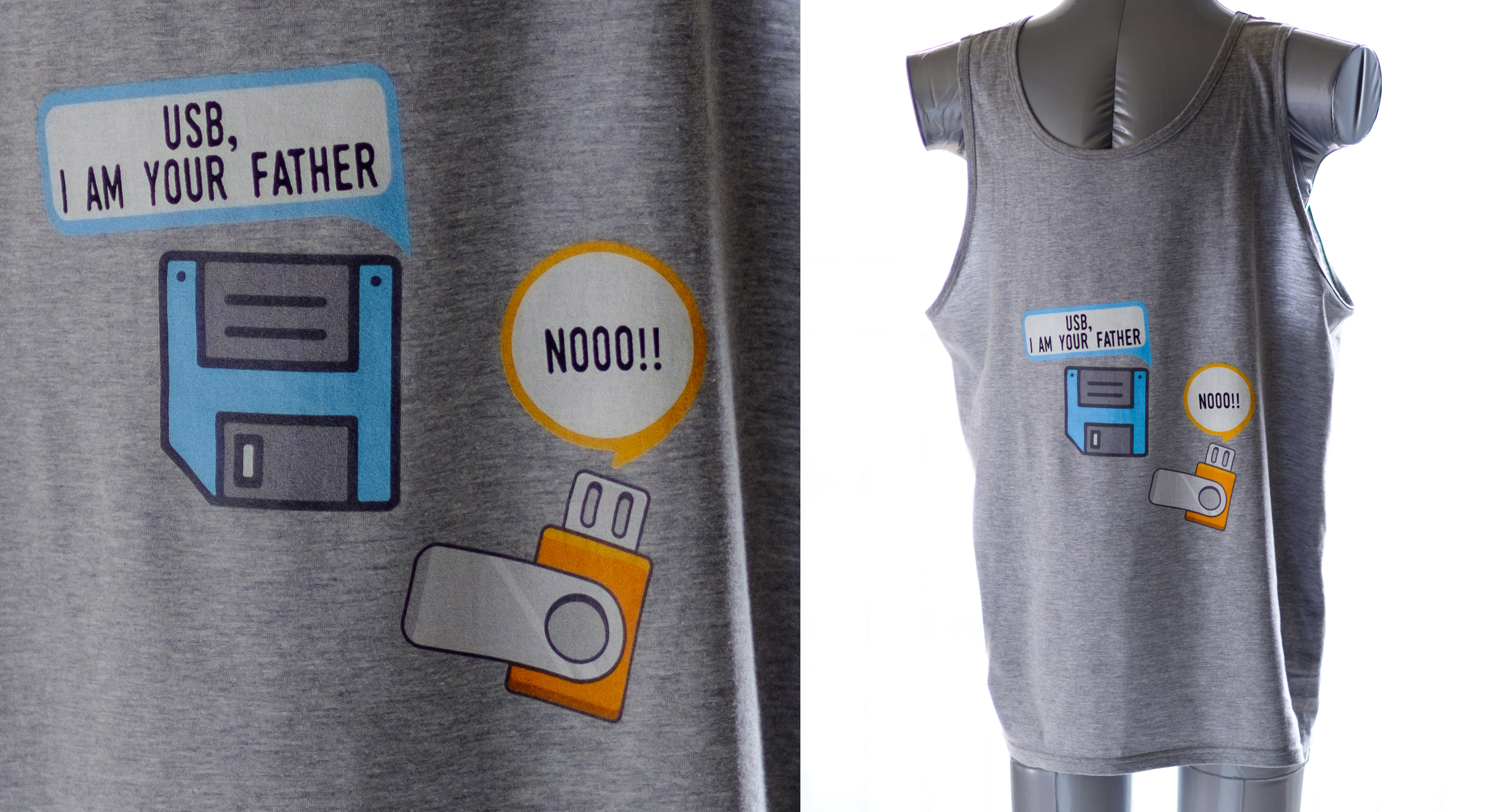
The message on this tanktop is a reminder of how far we’ve come in a very “short” period of time. I got it as a gift this past Father’s Day and catch myself smiling whenever I wear it.
My first personal computer, in the early-1980s, was a Kaypro 2 that came with two single-sided, double-density 5.25″ floppy drives. For all practical purposes, we needed two drives back then: one for the program and the other for our files. Wikipedia photo by Autopilot, 19 Mar. 2015.
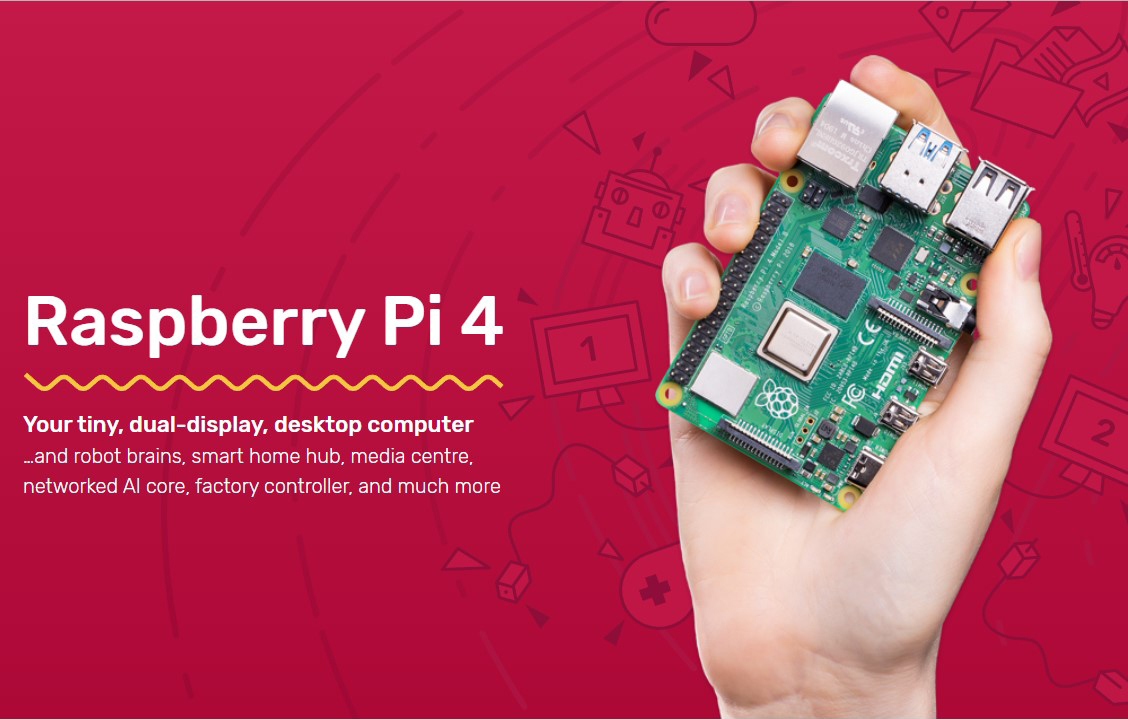
Officially released today, 24 June 2019, is the Raspberry Pi 4 single-board computer that fits in the palm of your hand. It’s made by the Raspberry Pi Foundation, a UK-based charity (nonprofit) that works to put the power of computing and digital making into the hands of people all over the world. They do this so that more people are able to harness the power of computing and digital technologies for work, to solve problems that matter to them, and to express themselves creatively.
The foundation provides low-cost, high-performance computers that people use to learn, solve problems and have fun. They provide outreach and education to help more people access computing and digital making. They develop free resources to help people learn about computing and how to make things with computers, and train educators who can guide other people to learn.
Three years ago, in 2016, four students (one was possibly an instructor) had a discussion on Reddit about an online course offering with a “lecture required” component. The original poster was byu:
Posted byu/[deleted]
[Subject:] Online Classes – Class Component: “Lecture Required”?
Signed up for a couple online classes and under the Class Details section is says Class Components: Lecture Required. The class is definitely listed as an online class, room says online and meeting day/times TBA, so what does this mean? Video lectures? Just making sure I don’t have to physically show up for anything.
TurtleWaffle: It could be a blended class. I had a class like this and we had 5 Saturday class sessions during the semester as well as the online stuff
Rhynocerous: In my expirience it means you have to physically show up at some point possibly for exams.
corner0ffice1: It sounds like a class with both an online lecture and online lab. You always enroll for the lab component, and then tack on the lecture, so SIS is just telling you that you need to enroll in both components. It does not always mean that you have to show up for anything in person. It SHOULD say if you have any on-campus obligations in the course description, but you can also ask the instructor to confirm.
If we took a moment to actually listen to our students, we’d learn that conversations like this pervade the higher ed landscape. In nearly all colleges, “online” is a confusing course label that can mean any number of things that fail to meet student expectations. byu’s “Just making sure I don’t have to physically show up for anything” captures students’ primary concern in selecting an online class.
Implicit in their expectations for an online class is the idea of not being required to “show up” in a specific place at a specific time. For them, online is virtual, a convenience that allows them to engage learning from anywhere at any time. Thus, synchronous meetings are also not part of their online expectations. “Online” ought to be reserved for courses that are completely online and completely asynchronous. Sync requirements are a real problem for students who choose online courses for their anywhere/anytime advantage. Many online administrators and faculty don’t realize that sync requirements are a carryover of F2F into the virtual environment. Requiring students to meet at a specific time is tantamount to requiring them to meet at a specific place.1Continue reading →
In our current discussion on “The Zen in Online Learning” (17 June 2019), Harry Keller says, “Life is about joy. Find your joy, and immerse yourself in it” (19 June 2019). His comment reminded me of Sir Ken Robinson’s TED Talks “Bring on the Learning Revolution!” (Feb 2010).
The transcript is available here. This video runs 21 minutes, but Robinson’s wit and wisdom make it seem much shorter. His message is similar to Harry’s, which is to change our model for education to develop and celebrate each student’s talents, interests, and dreams. Please make the time to watch this video. It was released in 2010, but its message is relevant today.
Also make the time to comment in the forum attached to this article. (If you’ve never posted a comment in ETC, it will be held for approval. I’ll be standing by to speed up the process. Once approved, future comments will be automatically published.) There’s a wide-ranging discussion on the TED site, so in our discussion, I’d suggest focusing on the takeaway for higher ed. What are your thoughts on Robinson’s call for an “organic” revolution? How does this apply to higher ed?
If you’d like to submit a longer comment as a stand-alone piece, email it to me at jamess@hawaii.edu. If this is your first submission, then please append a brief (1-to-3 line) professional bio and snapshot.
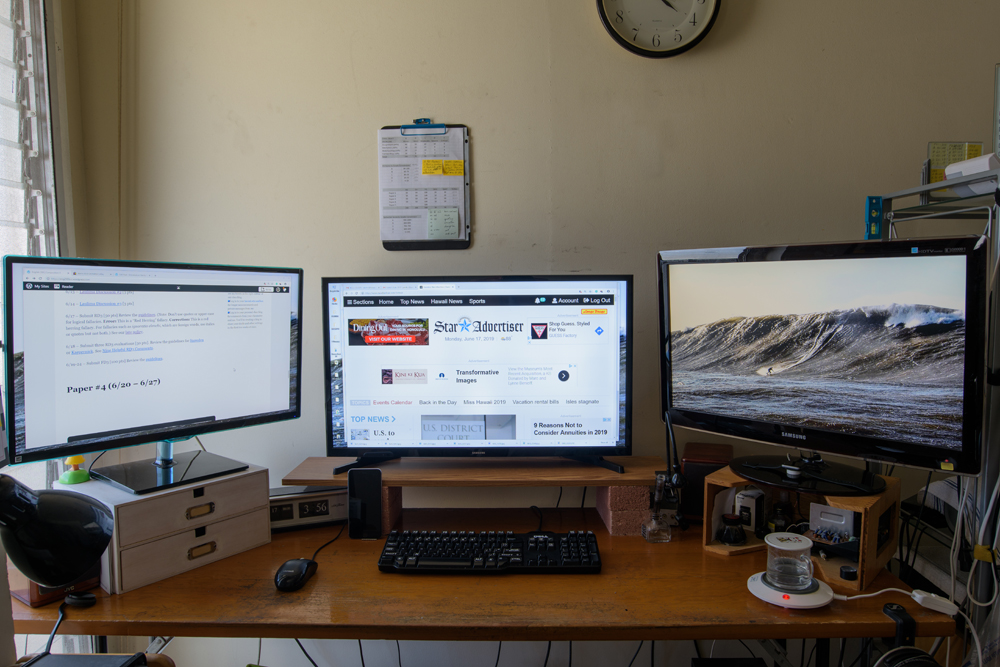
When the center monitor in my three-monitor setup failed to turn on this morning, I didn’t panic. It happened before, and reinserting the HDMI connector into the graphics card usually did the trick. So I turned the computer off, crawled under the desk, unplugged the connector, and plugged it back in.
I turned the computer on, but the monitor remained dark. No problem, I thought. Try the same maneuver again. I did, but it still didn’t work. I was beginning to panic a little. I turned it off and checked the back of the monitor to see if the power and HDMI connectors were tight. I unplugged and plugged them back in.
The three-monitor setup for my desktop computer.
I turned the computer on again, but the monitor was still dead. Panic was setting in. I tried the remote control to see if the settings were correct. (This monitor is also a TV set.) Nothing came up on the screen, not even the menu. Continue reading →
Ways to use the Community Reinvestment Act (CRA) to persuade banks to invest in projects to promote digital equity was the central focus of a meeting of the National Collaborative for Digital Equity (NCDE), held in Washington, DC, on 14-15 May 2019.
The meeting was hosted by the National Education Association and brought together some 70 participants from across the country.
The CRA is a federal statute enacted in 1977. It requires the Federal Reserve, the Federal Deposit Insurance Corporation and the Office of the Controller of the Currency (OCC) to encourage financial institutions to help meet the credit needs of the communities in which they do business, especially in low- and moderate-income neighborhoods. Continue reading →
AI in schools – Here’s what we need to considerby Neha Shivhare, The Conversation (7 Mar. 2019)
Regardless of what we want or think, AI will continue to be part of the educational landscape.
In the Times Higher Education (THE) global University Impact Rankings released today, U.S. colleges are woefully underrepresented in the top 25. The University of North Carolina at Chapel Hill is the top U.S. college in the rankings at 24th. The top five are from the Commonwealth realm: (1) University of Auckland, New Zealand, (2) McMaster University, Canada, (3) University of British Columbia, Canada, (3) University of Manchester, United Kingdom, (5) King’s College London, United Kingdom.
THE, which is headquartered in London, publishes “the only global performance tables that assess universities against the United Nations’ Sustainable Development Goals [SDGs]. [It] uses carefully calibrated indicators to provide comprehensive and balanced comparisons across three broad areas: research, outreach, and stewardship. This first edition includes more than 450 universities from 76 countries.” Continue reading →
TCC 2019 (April 16-18) : Call for Participation
Join us! TCC 2019 Worldwide Online Conference
Sustainable Learning, Accessible, Technologies, & Diverse Contexts
April 16-18, 2019 http://2019.tcconlineconference.org/
Keynote and invited plenary sessions
Dr. Charlotte “Lani” Gunawardena, University of New Mexico, USA
Dr.Ohkwa Lee, Chungbuk National University, South Korea
Dr. Matthew Schmidt, University of Cincinnati, USA
Dr. Yoon-Ah Rho, Kookmin University, South Korea
Dr. Hanna Teräs, Tampere University of Applied Sciences, Finland
Dr. George Veletsianos, Royal Roads University, Victoria, Canada
TCC is a three-day, entirely online conference for post-secondary faculty and staff worldwide that features over 100 concurrent sessions covering a wide range of topics related to educational technology, distance learning and emerging technologies for teaching and learning.
Individuals participate in real-time sessions from the comfort of their workplace or home using a web browser to connect to individual sessions. All sessions are recorded for on-demand viewing. View the current schedule of presentations and descriptions. Continue reading →
(March 8, 2019) In anticipation of Women’s History Month, Nobel Media has partnered with Microsoft to highlight the achievements of women who broke new ground in physics, chemistry, and medicine. The result, Women who changed science, is a unique web experience that trains a lens on the inspiring journeys and contributions of female Nobel Prize winners. In a world where 64% of American girls and women can’t name another woman in the sciences*, Nobel Media and Microsoft aim to inspire young women across the world to be the groundbreakers of tomorrow.
Women who changed science launches Friday, March 8th on International Women’s Day. Engage with luminaries like Marie Curie, who harnessed the promise of radioactivity, Rita Levi-Montalcini, who redefined how our bodies work, and Tu Youyou, whose breakthrough malaria treatment has saved millions throughout the world. The web experience brings to life the unique contributions of each laureate while exploring the interconnecting lineage of women in the sciences. Raising awareness of their tremendous impact, the collaboration aims to empower the next generation of scientists.
This unique collaboration with Nobel Media is one of Microsoft’s ongoing initiatives to build inclusion in STEM fields. Microsoft believes that nurturing diverse viewpoints and creating opportunities for everyone to experiment with technology incites innovation and sparks breakthroughs. Women who changed science transforms not only how we experience the odds-defying stories of grit behind the prizewinning discoveries of these laureates, but also emboldens the next generation of young women to change our world.
Teaching with Technology in 2018 by David Nagel in THE Journal
Nagel reports on the results of a survey conducted by THE Journal. It shows that teachers, by and large, have a positive attitude toward the use of technology in education.
The Importance of Teaching Technology to Teachers by Katt Blackwell in Teaching Community (a Monster community)
Blackwell focuses on the National Council of Teachers of English (NCTE) six points related to literacy and technology. These include not only the technology skills needed in the 21st century, but the critical literacy skills that today’s learners need.
How Teachers, Parents and Carers Can Spot and Prevent Online Grooming and Radicalisation by David Wright in Voices Magazine (British Council) Voices Magazine is part of the British Council’s website. It focuses on issues related to “education and culture from around the world.” In this article, Wright talks about Internet safety specifically focusing on how educators and others can identify and prevent radicalization, especially of young people.
As a lead-in to this year’s main conference, TCC 2019 is hosting a FREE special webinar, “Using Silly Media in Teaching & Learning,” featuring Alan Levine, longtime blogger of Cog Dog Blog.
Alan will suggest ways we can augment online teaching with memes by adding images to words, to visualize metaphors and facilitate discussions. As shortform videos, animated GIFs that loop are effective for demonstrating natural processes or illustrating techniques where repetition aids understanding. Learn what your students might accomplish by creating memes and animated GIFs.
Date & time:
Wednesday, March 20, 1400 HAST
1900 CDT, 2000 EDT; Thu Mar 21, 0900 Tokyo, Seoul Other timezones
Access information and a reminder will be sent to you a few days prior to this event. This online session will be held in Adobe Connect. The deadline to RSVP is March 13.
Entries in the International Serious Play Awards competition for digital training and educational games due Feb. 15, 2019.
Serious Play’s 11-year-old award program recognizes outstanding games designed for use for education or training in business, government/military, healthcare, museums, higher ed, K12.
Brief bio from Cambridge English: Scott Thornbury is an established author and series editor of the Cambridge Handbooks for Language Teachers since 2004. He had his first title published in 1997: About Language: Tasks for Teachers of English. He has co-written (with Diana Slade) Conversation: From Description to Pedagogy, in the Cambridge Language Teaching Library (2006) and (with Peter Watkins) The CELTA Course (2007). More recently, he has been focussed on online learning, having overseen the writing of a five-level internet-delivered course in general English. Scott is a regular contributor to the ELT conference circuit and is widely known and respected in the ELT world. He has had involvement Cambridge ESOL accredited teacher training schemes and is an Examiner for the DELTA scheme. He is currently Associate Professor of English Language Studies at their New School University in New York, where he directs and teaches the online MA TESOL program.
21 Online Pronunciation Resources for Teaching and Learning by Lynn Henrichsen. TESOL Connections.
Henrichsen suggests that while there are a wide range of computer-assisted pronunciation teaching (CAPT) websites and apps for the English teacher and learner, not all are created equal. He offers some suggests for assessing the usefulness of websites and gives reviews of 10 sites with his recommendations.
Motivation & Language Learning in Online Contexts by L.W. Zimmerman. OLLReN.
This research review looks at learner motivation in online language learning contexts. The author found that two significant factors are online learning readiness and promoting interaction, factors that would come into play for any learning context, not just language learning.
5 Effective Uses of Mobile Technology in the Classroom by Daniel Adeboye. eLearning Industry.
In the introduction to the article, Adeboye says, “Research has shown that though mobile technology is a great tool in our teaching and learning experience, many who use it only use it to increase efficiency and not necessarily effectiveness. This article provides 5 suggestions of how to effectively use mobile technology in the classroom.”
How mobile technology can benefit learning by Elliot Gowans. ET.
Gowans contends that the familiarity of mobile devices as entertainment devices makes them a natural way to “motivate today’s digital natives through new and innovative ways of learning.”
Don’t forget to register for the first (free) presentation in our 2019 Watermark Knowledge Ambassador Webinar Series, “Leveraging Technology for General Education Learning Outcome Assessment” featuring Hawai’i Pacific University on January 31, 2019, at 3:00pm ET.
Valentina Abordonado
In this webinar, you’ll learn how Hawai’i Pacific University leverages Watermark to engage faculty in the assessment of general education and institutional learning outcomes. Dr. Valentina Abordonado, Assistant Dean for General Education, will detail how their work helps faculty present actionable data, set targets for expected performance, and analyze student achievement of outcomes. Dr. Abordonado will also share how HPU closes the loop at the program level and documents their efforts to continuously improve teaching.
Measuring Up to the Model: A Ranking of State Public Charter School Laws, January 2019, is an annual publication by the National Alliance for Public Charter Schools. Nina Rees is the President and CEO, and Todd Ziebarth, the principal author, is Senior Vice President of State Advocacy and Support.
“From our perspective,” say Rees and Ziebart, “the point of our annual state charter school laws rankings report is to figure out which states are creating the conditions for high-quality charter schools by providing, among other things, flexibility, funding equity, non-district authorizers, facilities support, and accountability.”
Serious Play Conference is coming to the University of Central Florida (UCF) at the downtown Orlando campus Wednesday-Friday, July 24-26, 2019, hosted by the Florida Interactive Entertainment Academy (FIEA). (The Serious Play Conference will also be held at the University of Quebec at Montreal, July 10-12, 2019.)
Get current on the latest use of games and simulations for training, education and research in healthcare, the corporate environment, nonprofit and education. A design track will offer sessions on game and instructional design, technology and assessment. People new to serious games might like our pre-conference session.
We’re looking for speakers who will share their knowledge and experience, offering with take-aways attendees can apply immediately. Sessions are 45 min long for more lecture-based talks and panels and 90 min for participation-designed workshops.
New evidence that technology can contribute to positive learning outcomes in the school classroom emerges from the latest ‘SpeakUp’ survey of Project Tomorrow.
Project Tomorrow is a non-profit organization whose mission is to ensure that today’s students are well-prepared for the future.
SpeakUp is an annual research project that has been carried out since 2003, surveying students, teachers, librarians, principals, administrators and parents.
Its main finding is that “high school students with… access to a laptop or Chromebook are more likely to use those devices to personalize their learning process, to stay organized with their schoolwork and to leverage technology for more enhanced learning experiences than their peers with no access or only sporadic access.”
The importance of levering technology was:
to help students develop college-ready and workplace skills; and
to overcome the barriers that arise because technology resources are not always evenly distributed.
The report also notes that Internet access outside schools is critical, but there is still a digital divide. And only one-quarter of school districts allow students to take their devices home.
Click image to view the 9-page PDF.
It is interesting to see how students who do not have Internet access at home tackle the ‘homework gap’ that this creates. They go to school early, stay late, or use the facilities of libraries or even fast-food outlets. Continue reading →



 By Jim Shimabukuro





















 Educational Technology and Change Journal
