An Interview with Terry Anderson: Open Education Resources – Part II

boettcher80By Judith V. Boettcher
Guest Author

[Continued from Part I]

[Note: After listening to Terry’s description of how the crowd’s activity might be used to produce new information, I learned that Google announced a new tool on November 12 called the “Google Flu Tracker.” It tracks flu trends across the country by using aggregated Google search data to estimate flu activity! This service was developed after learning that “certain search terms are good indicators of flu activity”! -JB]

JB: It sounds as if we are on the brink of a number of new models, both for producing, using and paying for educational content. But let’s switch gears a little. Just as the net is changing how the crowd may be creating content, online courses are starting to use content in new ways. We have types of content: published content; “found content” for information that students bring to the course community; and we have the performance and teaching direction content, which students and faculty create during the course. What do you think the role of content is in a course today? What percent of a course is actually published content?

TA: Publishers are concerned that students are not buying the textbook, and faculty are saying that students who do buy the textbook are not reading the textbook. What I think is an important opportunity is giving students the option of creating and sharing their own conception of the course knowledge.

JB: Have you been sharing student-created content from year to year as yet?

TA: Not yet. I am encouraged by the use of a new system that we are using at Athabasca. The system is Elgg, a social networking tool that can be used by smaller communities. We wanted a system that was institution-centric rather than course-centric.

What I really like about ELGG is the permissions options. You use a menu to control access to any piece of information that you post, such as a phone number, blog posting or wiki entry. For example, the first option is to keep it private, just for yourself, then you might keep it to yourself and a friend, then to the people in your course, your teacher, people at your university, or Google or the world. Some things you want public, and some you want to keep private. You can’t resolve that on an institutional policy basis. It seems that having students in control and being knowledgeable about that control is the way to go.

theory_practiceWe use this for portfolios and graduation type of assignments so it really helps with getting content out of the LMS [learning management system]. You can show your work to your mother or anyone else who cares.

JB: Do you link to Elgg from your LMS, then?

TA: Yes, and what I have been doing this last term as an experiment is weaning students away from the discussion board environment to the blogging environment in Elgg. Blogging is not as good for threaded discussions, but then threaded discussions don’t allow people outside the course to pop in and read, contribute and comment. I use Moodle for the drop box, assignments, study guides, course content, and other non-interactive kinds of course pieces.

JB: Terry, let’s go back to your own book that you have made available on the net. Why did you make your book freely available online?

TA: The publication of the first edition of the The Theory and Practice of Online Learning was an experiment as it was published in both print copy and made available as a free download. The 400 copies of the printed version sold quickly, and in the first month there were about 6,000 to 7,000 downloads of the book. Over the years it has been online, there have been about 90,000 downloads, and portions of the book have been translated into five languages.

We now have a second edition out, and we are using the same model. The book and its individual chapters continue to be freely available online under a Creative Commons license. People are still downloading the first edition, but I would like to wean folks from the older version. The second edition has four new chapters, including chapters on Mobile Learning and Social Software and is available from the Athabasca University Press.

JB: So, does the freely downloadable option stimulate sales of the printed copy?

TA: I think that is an open question. We just don’t know. I do know that making it freely downloadable increases exposure and access. As for other models, I don’t know what the impact of the Amazon Kindle Reader will have. One thing I am disappointed about is the small price differential that is common on the Kindle books. But we will just have to keep experimenting I think.

JB: Terry, thanks so much for your time, your insights and your ongoing exploration and testing of the use of open education resources.

Three Video Captioning Tools

claude80By Claude Almansi
Staff Writer

First of all, thanks to:

  • Jim Shimabukuro for having encouraged me to further examine captioning tools after my previous Making Web Multimedia Accessible Needn’t Be Boring post – this has been a great learning experience for me, Jim
  • Michael Smolens, founder and CEO of DotSUB.com and Max Rozenoer, administrator of Overstream.net, for their permission to use screenshots of Overstream and DotSUB captioning windows, and for their answers to my questions.
  • Roberto Ellero and Alessio Cartocci of the Webmultimediale.org project for their long patience in explaining multimedia accessibility issues and solutions to me.
  • Gabriele Ghirlanda of UNITAS.ch for having tried the tools with a screen reader.

However, these persons are in no way responsible for possible mistakes in what follows.

Common Features

Video captioning tools are similar in many aspects: see the screenshot of a captioning window at DotSUB:

dotsub_transcribe

and at Overstream:

overstream_transcribe

In both cases, there is a video player, a lst of captions and a box for writing new captions, with boxes for the start and end time of each caption. The MAGpie desktop captioning tool (downloadable from http://ncam.wgbh.org/webaccess/magpie) is similar: see the first screenshot in David Klein and K. “Fritz” Thompson, Captioning with MAGpie, 2007 [1].

Moreover, in all three cases, captions can be either written directly in the tool, or creating by importing a file where they are separated by a blank line – and they can be exported as a file too.

What follows is just a list of some differences that could influence your choice of a captioning tool.

Overstream and DotSUB vs MAGpie

  • DotSUB and Overstream are online tools (only a browser is needed to use them, whatever the OS of the computer), whereas MAGpie is a desktop application that works with Windows and Mac OS, but not with Linux.
  • DotSUB and Overstream use SubRip (SRT) captioning [2] while MAGpie uses Synchronized Multimedia Integration Language (SMIL) captioning [3]
  • Overstream and Dotsub host the captioned result online, MAGpie does not.
  • The preparation for captioning is less intuitive with MAGpie than with Overstream or DotSUB, but on the other hand MAGpie offers more options and produces simpler files.
  • MAGpie can be used by disabled people, in particular by blind and low-sighted people using a screen reader [4], whereas DotSUB and Overstream don’t work with a screen reader.

Overstream vs DotSUB

  • The original video can be hosted at DotSUB; with Overstream, it must be hosted elsewhere.
  • DotSUB can also be used with a video hosted elsewhere, but you must link to the streaming flash .flv file, whereas with Overstream, you can link to the page of the video – but Overstream does not support all video hosting platforms.
  • If the captions are first written elsewhere then imported as an .srt file, Overstream is more tolerant of coding mistakes than DotSUB – but this cuts both ways: some people might prefer to have your file rejected rather than having gaps in the captions.
  • Overstream allows more precise time-coding than DotSUB, and it also has a “zooming feature” (very useful for longish videos), which DotSUB doesn’t have.
  • DotSUB can be used as a collaborative tool, whereas Overstream cannot yet: but Overstream administrators are planning to make it possible in future.
  • With DotSUB, you can have switchable captions in different languages on one player. With Overstream, there can only be one series of captions in a given player.

How to Choose a Tool . . .

So how to choose a tool? As with knitting, first make a sample with a short video using different tools: the short descriptive lists above cannot replace experience. Then choose the most appropriate one according to your aims for captioning a given video, and what are your possible collaborators’ availability, IT resources, and abilities.

. . . Or Combine Tools

The great thing with these tools is that you can combine them:

As mentioned in my former Making Web Multimedia Accessible Needn’t Be Boring post, I had started captioning “Missing in Pakistan” a year ago on DotSUB, but gone on using MAGpie for SMIL captioning (see result at [5] ). But when Jim Shimabukuro suggested this presentation of captioning tools, I found my aborted attempt at DotSUB. As you can also do the captioning there by importing a .srt file, I tried to transform my “.txt for SMIL” file of the English captions into a .srt file. I bungled part of the code, so DotSUB refused the file. Overstream accepted it, and I corrected the mistakes using both. Results at [6] (DotSUB) and [7] (Overstream) . And now that I have a decent .srt file for the English transcript, I could also use it to caption the video at YouTube or Google video: see YouTube’s “Video Captions: Help with Captions” [8]. (Actually, there is a freeware program called Subtitle Workshop [9] that could apparently do this conversion cleanly, but it is Windows-only and I have a Mac.)

This combining of tools could be useful even for less blundering people. Say one person in a project has better listening comprehension of the original language than the others, and prefers Overstream: s/he could make the first transcript there, export the .srt file, which then could be mported in DotSUB to produce a transcript that all the others could use to make switchable captions in other languages. If that person with better listening comprehension were blind, s/he might use MAGpie to do the transcript, and s/he or someone else could convert it to a .srt fil that could then be uploaded either to DotSUB or Overstream. And so on.

Watch Out for New Developments

I have only tried to give an idea of three captioning tools I happen to be acquainted with, as correctly as I could. The complexity of making videos accessible and in particular of the numerous captioning solutions is illustrated in the Accessibility/Video Accessibility section [10] of the Mozilla wiki – and my understanding of tech issues remains very limited.

Moreover, these tools are continuously progressing. Some have disappeared – Mojiti, for instance – and other ones will probably appear. So watch out for new developments.

For instance, maybe Google will make available the speech-to-text tool that underlies its search engine for the YouTube videos of the candidates to the US presidential elections (see “”In their own words”: political videos meet Google speech-to-text technology” [11]): transcribing remains the heavy part of captioning and an efficient, preferably online speech-to-text tool would be an enormous help.

And hopefully, there will soon be an online, browser-based and accessible SMIL generating tool. SubRip is great, but with SMIL, captions stay put under the video instead of invading it, and thus you can make longer captions, which simplifies the transcription work. Moreover, SMIL is more than just a captioning solution: the SMIL “hub” file can also coordinate a second video for sign language translation, and audio descriptions. Finally, SMIL is a W3C standard, and this means that when the standard gets upgraded, it still “degrades gracefully” and the full information is available to all developers using it: see “Synchronized Multimedia Integration Language (SMIL 3.0) – W3C Recommendation 01 December 2008 [12].

Michelle Rhee – What’s Really at Stake?

Jim ShimabukuroBy Jim Shimabukuro
Editor

She’s on the cover of Time (week of December 8), in a classroom, unsmiling, dressed in black, holding a broom, with the cover title, “How to Fix America’s Schools,” set to look as though it’s the lesson for the day written on the blackboard. Framing her head is the huge “TIME” trademark. She is Michelle Rhee, Chancellor of Education, District of Columbia Public Schools. And the question for the “class” is, Does she have the answer to America’s failing public school systems? Is it, finally, time to make the kinds of sweeping changes that she represents?

Her goal’s clear, “To make Washington the highest-performing urban school district in the nation” [1]. The yardstick is a simple one: reading and math scores on standardized achievement tests. And her formula’s just as simple: reward teachers who can help her reach her goal and get rid of the ones who can’t.

time_mag_cover_dec8This unflinching focus, she says, places the student’s best interest at the forefront of schools. Higher scores will eventually translate to college degrees and better jobs, which are the tickets out of poverty, discrimination, and all the other social ills.

The underlying assumption is that all students can significantly improve their scores IF they have teachers [1] who are willing to set that as the primary goal and do everything it takes to reach it. In this picture, there is absolutely no room for failure. Little or no gain in scores is a sign of failure, and failure means a quick exit from the teaching profession. When student success is weighed against teacher security, there is no issue. Tenure is a dead horse. For teachers, the decision is a simple one, too: Deliver higher scores or get out.

“She is angry at a system of education that puts ‘the interests of adults’ over the ‘interests of children,’ i.e., a system that values job protection for teachers over their effectiveness in the classroom. Rhee is trying to change that system” [2].

What about the gray area, the affective dimensions that defy objective measurement? Rhee says, “The thing that kills me about education is that it’s so touchy-feely. . . . People say, ‘Well, you know, test scores don’t take into account creativity and the love of learning.’ . . . I’m like, ‘You know what? I don’t give a crap.’ Don’t get me wrong. Creativity is good and whatever. But if the children don’t know how to read, I don’t care how creative you are. You’re not doing your job” [1].

michelle_rhee01In pursuit of her goal, Rhee has the complete backing of D.C. Mayor Adrian M. Fenty, who appointed her chancellor in June 2007. “In her first 17 months on the job, Rhee closed 23 schools with low enrollment and overhauled 27 schools with poor academic achievement. She also fired more than 250 teachers and about one-third of the principals at the system’s 128 schools” [3].

Rhee scares the daylights out of me because she may very well be the wish that we’re warned to watch out for, the one that we might actually get. Now that we have someone with the power to really change the system, I suddenly have cold feet. Yes, she seems to make sense. Student achievement should take precedence over the needs of teachers. But are there other issues waiting below the surface that might just jump out and bite us if we follow Rhee?

For example, despite the radical nature of her approach, the bundle that we think of as “school” remains pretty much the same. The burden of accountability has shifted to the teacher, but the roles, resources, goals, and environment remain constant. Even pedagogy seems to be the same–more homework, more demanding tasks, more discipline, more testing. In other words, the same, but more of it.

One could argue that Rhee’s changes don’t go far enough and need to include innovations in information technology. There’s the possibility that these innovations could enhance learning by dramatically altering schools as we know them without some of the harsher consequences that seem to be a part of Rhee’s strategy.

Another issue is the effectiveness of strategies that Rhee lumps into the category of “touchy-feely.” Are these affective, student-centered, holistic, indirect methods proven ineffective? Or are they, perhaps, just as if not more effective than Rhee’s hard-nosed direct approach? Are we ready to toss these out as useless?

Yet another issue is the similarity of Rhee’s model to test-oriented systems in Asia. Is Rhee simply transporting a traditional model from China, India, Japan, and South Korea to the U.S.? If yes, then are there consequences that we need to be aware of?

Finally, are we beginning to draw a line between schools in general and poor urban schools in particular? A line that requires a radically different approach for the latter? Are we bending to the notion that schools not only can be but should be different for resource-poor inner-city schools? If this is the case, then could we be developing a system that channels or tracks children into careers at an early age, forever excluding college for many in favor of technical training? This could result in a form of economic and racial discrimination with far-reaching consequences.

In conclusion, my initial reaction is that Rhee’s ideas sound good, but I’m not quite ready to dump what we have now for an approach that we haven’t fully discussed or studied. At this juncture, an open discussion about the implications of Rhee’s tactics may be in order. I’m sure there are many other issues at stake. Thus, please share your thoughts with us. Either post them as comments to this article or email them to me at jamess@hawaii.edu

(Note: For a quick background, see Amanda Ripley’s “Rhee Tackles Classroom Challenge” [26 Nov. 2008] at Time.com and Thomas, Conant, and Wingert’s “An Unlikely Gambler” [23 Aug. 2008, from the magazine issue dated 1 Sep. 2008] at Newsweek.com. Finally, go to YouTube and do a search on “michelle rhee” for lists of videos.)

Green Computing: How to Reduce Our Personal Carbon Footprints

thompson80By John Thompson
Staff Writer
22 November 2008

“I’d put my money on the sun and solar energy. What a source of power! I hope we don’t have to wait until oil and coal run out before we tackle that.” That quote sounds quite timely as President-elect Obama made “green energy” part of his vision for America’s future, including using clean energy as an engine to create millions of new “green collar” jobs. So over the course of the 2008 presidential campaign, the general public has heard about his vision for clean energy and should be primed for that issue to be addressed in his new administration. But apart from what government and business can and should do to address the energy situation, what can and should individuals do to support this initiative? Specifically, what can individual computer users do to reduce their personal carbon footprints?

However, it seems somewhat self-defeating to embark on new, costly initiatives to reduce energy costs without also first examining ways in which we can make cost saving adjustments on the personal level. With over 300 million people in the USA, if each person, or even each office or household, made a conscious effort to examine his or her own use of energy, it would seem that the multiplier effect of millions of small daily changes would yield significant results on a national scale. What are some changes that individuals can make to support green computing and reduce their technology carbon footprints? Let’s look at some ways to start making a difference by picking just a few low-hanging fruits.

thompson01Power management. Keep computers and printers turned off unless you’re using them. Or at least set computer and monitor power management controls to enter low power “sleep” mode when your system is not actively in use. And while a PC does use some power in sleep mode, it’s very small—maybe 10% of what’s needed when it’s running at full power. Also, cut down on the time a computer operates unattended before it goes into sleep mode. The US Department of Energy estimates that a PC wastes up to 400 kilowatt-hours of electricity a year just by functioning at full power even though it’s not being used. Dell reportedly has saved almost $2 million and avoided 11,000 tons of CO2 emissions in one year through a global power-management initiative that calls for its employees to say “nighty-night” daily to their PCs by changing the power management setup so their PCS enter sleep mode each night.

E-mail. Look at our use of e-mail, which continues to explode. Personally, a quick count shows that I have sent close to 400 personal and business-related e-mails this month, and there’s still a week left in the month. And that number is a small fraction of the hundreds that I receive each day and of the estimated several hundred billion sent daily worldwide. Use e-mail to minimize paper use, but don’t routinely print them. Add a message at the bottom of your e-mails requesting that recipients save paper by thinking twice before printing them off their screens. I’ve seen administrators who have their administrative assistants print out all e-mails so they can read and maybe reply to them. Suggest outsourcing your organization’s e-mail to Gmail as Google probably runs its data centers much more economically and greener than you do. And switching can generate cost savings and maybe increased e-mail features for users.

Online learning. By clicking to enter your course instead of driving to campus you do away with commuting and parking hassles while also eliminating your car exhaust emissions. A 2005 report on the environmental impact of providing higher education courses found, “on average, the production and provision of the distance learning courses consumed nearly 90% less energy and thompson02produced 85% fewer CO2 emissions” (p. 4). Online courses also typically reduce paper use since traditional classroom courses still use large amounts of paper (e.g., handouts). Unless your instructor assigns a textbook (many of the online courses I teach have not used a print text in years), everything is digital through e-mail or using the Internet. So if you have a choice between taking a college course in a traditional campus setting or accessing your course from work or home, consider the online choice. No campus presence equates to less energy use, but be sure to use the power management settings on your computer system and resist the temptation to print out all your online reading assignments.

All these suggestions sound doable to most folks. In addition, there are many other simple ways to reduce your personal energy use. But we aren’t talking about going totally “green” and parking your car and walking everywhere. We’re simply looking at ways you—the person reading this blog online right now—can start making a small but significant difference.

Then why are most of these simple strategies not being implemented? Why are computer users not seeking to achieve the TBL—triple bottom line (economic, environmental and social)—and save money, help protect the environment, and do what’s right for society? Is it strictly an “I didn’t know” reason, or are there other obvious and not so obvious reasons that individuals are not taking personal responsibility to reduce their own carbon footprints? Is this a nation (world?) of people with little awareness of these small yet effective changes or just plain lazy folks waiting for government and business to light the light and lead us to reduced energy consumption? What do you think?

Oh, that opening quotation? That’s from Thomas Edison—in 1931. One would hope that there is more progress on sustainable energy in the near future than in the past 77 years.  Don’t leave it up to government or your boss. Little things YOU can do can make a big difference. Making small, almost seemingly insignificant changes can yield huge cumulative results. Green computing is just a change of habit.

Quality in Distance Education: Stakeholders’ Perspectives – Part I

greenberg80By Gary Greenberg
Staff Writer
22 November 2008

Introduction

The large number of students in the U.S. taking one or more courses online in 2006—nearly 3.5 million—reflects another trend: more faculty members are teaching online than ever before (Allen & Seaman, 2007). As they gear up for their first course taught at a distance, faculty must balance their drive to be innovative teachers with their institution’s demands for online course quality.

At the 2008 University of Wisconsin Distance Teaching and Learning Conference, I conducted a discussion with seven conference-goers on the topic of innovation and quality.

Discussion

Gary Greenberg: Some observers of distance education, including Curtis Bonk, who was here at the conference, and Kurt Squire, who is here at the greenberg04University of Wisconsin, have charged that innovation in the creation of online courses has stalled out. I wonder if any of you share this concern about lack of innovation going on in distance courses.

Robert Bulik: I think it’s not necessarily innovation, but I think it’s getting away from the basic theory of education. If we think that online learning should be as good as, better, or equivalent to face-to-face classroom learning then we need to consider what goes on in the classroom, which includes interactivity and learner control. And if we give that background away when we go into an online environment then we’ll just have page turning virtually on the screen versus in the book. That gets away from the basic tenets—theory —of education, and I think that’s a different issue than innovation. (Bulik, MD, is an associate professor for the University of Texas Medical Branch in Galveston and is currently developing case-based instruction and software for the education of medical students.)

Kay Shattuck: I think what’s happening with the comment that distance education or e-learning has stalled because the innovators aren’t there—I think some of that comes from the sheer numbers of . . . people who are told, in many cases, they have to put something online from their institution.

My other perspective on innovation is: Who’s the innovation for? Is it because an instructor wants to use a new toy? Or has the instructor really been looking for a way to improve a piece of the course and has, through her investigation, shattuck11discovered a really nice toy? I think we’re sometimes led by toys. (Shattuck is director of research for Quality Matters™ [MarylandOnline, 2006], an organization offering a faculty-centered, peer review process for distance learning courses.)

Katie McDonald: I love going to conferences and [taking notes] about all the tools, looking them up online, and playing or trying them. But I always have to keep myself grounded at the level that faculty don’t want this just because I think it’s cool and because I think it would help their course. The designer really has to build a relationship with the faculty and have the trust that when I say this is technology that will really help you, it’s because it will really help you in this way. Not just to use it because it’s fun and it’s new and it’s innovative. (McDonald represented the views of working instructional designers in the discussion. She is an instructional technologist for RIT Online.)

Joeann Humbert: I think that’s where the instructional designer is key in the process of putting a course online because it is different teaching online. And a person in that role can translate—help to translate—effective pedagogy. So I think if you go back to the core [issue] of helping people teach good courses online, the instructional designer can be a key person for the faculty member. I think having their skill in the balance is critical.

I still meet faculty—and many are in engineering and areas that have more traditional lecture-based courses—who don’t know about all the research in the field. They have no clue about distance education and are thinking about delivering a distance course but wouldn’t even consider [consulting] an instructional designer. It’s only after building credibility with those faculty, and building trust, that they’ll begin to reconsider how they develop their course. (Humbert is the director of RIT Online, the distance learning support organization for the Rochester Institute of Technology in Rochester, NY.)

Shattuck: I think that is what we’re talking about, the masses, the mass of instructors, that have now moved into distance education, and I think that people who are the innovators are frustrated at seeing this. But I think that’s the natural process. Eventually, because students will not take the courses, people will find an instructional designer. They will, for their survival.

Conclusion

The discussion concluded with remarks on the importance of conversations—between faculty members and more experienced colleagues; between faculty members and instructional designers—in the design of a quality distance education course. There was general agreement that these conversations play a crucial part in the creative process and are deserving of further attention in the ongoing debate about quality. I’ll post that part of the discussion next time.

(Author’s Note: This work was supported in part by a travel grant from the School of Educational Policy and Leadership at The Ohio State University.)

[Editor’s Note: Part II to follow in a coming article.]

Resistance to Technology: Conscious or Unconscious?

lynnz80By Lynn Zimmerman
Editor, Teacher Education
10 November 2008

In July 2008 James Morrison initiated a discussion on Innovate-Ideagora which he called  “Addressing the problem of faculty resistance to using IT tools in active learning instructional strategies.” This lively discussion has touched on any number of issues related to education, teaching, and learning. The contradictions inherent in education always fascinate me, and this topic has brought up many of them, from assessment issues to institutional climate.

In his introduction to the discussion Jim wrote that “we should be using technology enhanced active learning strategies to improve student learning” and effect changes in the organizational culture “so that most professors [and teachers] will be receptive to adopting active learning methods and using IT tools to enhance the effectiveness of these methods in their classes.” I assert this “resistance” is also embedded in how teachers view education.

Although most of the discussion centered on higher education, as a teacher educator, I am always focused on what is happening in the K-12 classroom and what my students may confront as they go into their classrooms. The issue of teacher resistance to technology has immediacy for teachers in zimm02K-12. As I was thinking about these issues, I remembered something I had read when I was teaching an Introduction to Teaching course: many teachers consider that they have a fairly liberal teaching philosophy. However, in practice, their teaching styles tend to be more conservative than their philosophical stance. (If you would like to make this comparison yourself, you can look at your teaching style at Grasha-Reichmann Teaching Style Inventory.) Therefore, it is possible that not only are teachers actively resisting learning about technology and technological advances, but some are perhaps unconsciously resisting it. In trying to determine where the disconnect is, researchers may need to look more closely at what teachers are really doing as opposed to what they think they are doing in the classroom/educational space.

My undergraduate students recently observed teachers and classes in a new elementary school which has up-to-date technology. One student was dismayed to see that the teacher was using the Smart Board to produce worksheets! I know that teachers at this school had received in-service training for using the technology in their classrooms and I assume the training was focused on the effective use of these technologies. As the student described the teacher’s style, it appeared that she used an authoritarian model of teaching, which seems to be reflected in her view of how to use technology. Was she consciously resisting using the technology to its fullest or was she just unaware that she had not made a shift in her thinking about using technology?

Making a Case for Online Science Labs

Harry KellerBy Harry Keller
Editor, Science Education
10 November 2008

In my last article, I spoke of states blocking progress in online science education. California and New York proscribe the use of virtual labs for their high school diplomas. Rather than complain about this situation, the online community must find ways to work with the University of California Office of the President (UCOP) and the New York State Board of Regents (Regents) to amend their rules.

There’s much at stake here — too much to waste our efforts attempting somehow to make simulations okay as labs. Realize that if these states modify their rules, then we open up a great set of opportunities for online education.

Instead of beginning by opposing UCOP and Regents, begin where they are and work with them. I read in the UCOP position a statement that no virtual labs that they had seen were good enough to substitute for hands-on labs. Take that as our starting point.

First, make contact with these groups. Then, show them the possibility of using online labs as a part of the instructional process. What’s the best way to make that demonstration?

Because the UCOP and Regents have not seen any virtual labs that they feel are suitable, and they have seen plenty of simulations (data, objects, and phenomena generated by equations and algorithms), do not begin by showing them what they’ve already rejected. Instead, show them something completely different.

keller10nov08Remember that the decision makers are taking their guidance from scientists. I’m a scientist (chemistry) and have some ideas about how these important advisors view science lab experience. Understand that the traditional education community is very protective of hands-on labs. Any solution must include these to some extent. The exact extent should be a subject of negotiation. The College Board, for example, mandates 34 hours of hands-on time for AP Chemistry.

Use America’s Lab Report for guidance and as a possible neutral virtual meeting ground. Showing adherence to all aspects of the report will, I believe, demonstrate the required possibility.

Having established communication and demonstrated the potential for online science to succeed, engage in a dialog regarding any deficiencies perceived by the UCOP and/or Regents in the various presented alternatives. Agree that one or more, if amended, can substitute for some fraction of the total hands-on requirement. Some approach may even succeed without modification.

Overcoming any such deficiencies and presenting our case again will complete the process and open the door for online science instruction throughout the United States.

Our initial presentation should include as many innovative approaches to virtual labs as we can muster and should not include simulations as lab substitutes for the reasons stated above.

I’m aware of three possibilities for presentation. None use simulations. All use the methods of science.

1. Large online scientific database investigation. Prof. Susan Singer, the lead author for America’s Lab Report, uses this approach in her own classes.

2. Remote, real-time robotic experimentation. Prof. Kemi Jona, one of the authors of the NACOL document about online science (together with John Adsit), is working with the MIT iLab people to supply these labs to students.

3. Prerecorded real experiments embedded in highly interactive software allowing students to collect their own personal data. The Smart Science® system is the only known example of this approach. (Disclaimer: I’m a creator of this system.) Apex Learning and Johns Hopkins University’s CTY are just two organizations that use these integrated instructional lab units.

I’d be happy to hear of other approaches that are not simulations and to work with anyone who’d like to see a change in the UCOP and Regents standards for lab experience. I’d especially like to talk to anyone who has contacts with the UCOP or Regents. The sooner we start in earnest, the sooner we’ll succeed.

POLL: Rate the Quality of Online Courses

This question is aimed at online courses in general and not the exceptions. If you don’t have sufficient hard data to support your opinion, then base it on your best guess. Please use the comment feature below to explain your vote. Don’t use the “comment” in the poll; instead, use the one that appears at the end of this article. Thanks!

[Edited 11 Dec. 2008]
The results as of 11 Dec. 2008:
iblog_poll01_121108

Making Web Multimedia Accessible Needn’t Be Boring

claude80By Claude Almansi
Guest Author
7 November 2008

Some people see the legal obligation to follow Web content accessibility guidelines – whether of the W3C or, in the US, of section 508 – as leading to boring text-only pages. Actually, these guidelines do not exclude the use of multimedia on the web. They say that multimedia should be made accessible by “Providing equivalent alternatives to auditory and visual content” and in particular: “For any time-based multimedia presentation (e.g., a movie or animation), synchronize equivalent alternatives (e.g., captions or auditory descriptions of the visual track) with the presentation.”[1]

This is not as bad a chore as it seems, and it can be shared between several people, even if they are not particularly tech-savvy or endowed with sophisticated tools.

Captioning with DotSUB.com

Phishing Scams in Plain English, by Lee LeFever[2], was uploaded to DotSub.com, and several volunteers did the captions in the different languages. The result can be embedded in a blog, a wiki or a web page. The captions also appear as copyable text under dotsub“Video Transcription,” which is handy if people discussing the video want to quote from it. Besides, a text transcription of a video also tends to raise its ranking in search engines, which still mainly scan text.

The only problem is that the subtitles cover a substantial part of the video.

Captioning with SMIL

This problem can be avoided by captioning with SMIL, which stands for Synchronized Multimedia Interaction Language. A SMIL file, written in XML, works as a “cogwheel” between the original video and other files (including captioning files) it links to and synchronizes.[3]

The advantage, compared to DotSUB, is that captions stay put in a separate field under the video and don’t interfere.

This is why, after having tried DotSUB, I chose the SMIL solution for: “Missing in Pakistan – Sottotitolazione Multilingue.[4]

So far, the simple text timecoded files for SMIL captioning still have to be made off-line, though Alessio Cartocci – who conceived the player in the example above – has already made a beta version of an online SMIL captioning tool.

Captioning with SMIL Made Easy on Webmultimediale.it

The Missing in Pakistan example is on Webmultimediale.org, the site where the WebMultimediale project team experiments with the creative potential of applying accessibility guidelines to online multimedia – for instance, in collaboration with theatrical companies.

web_multiHowever, the project also has a public video sharing and captioning platform, Webmultimediale.it, where everyone can upload a video and its captioning file to produce a captioned video for free. The site is fairly bilingual, Italian-English. By default, you can only upload one captioning file, but you can contact Roberto Ellero, the founder of the project, through http://www.webmultimediale.org/contatti.php if you wish to add more captions.

Webmultimediale.it also has a video tutorial in Italian on how to produce a time-coded captioning file using MAGpie, which is only accessible when you are signed in, but as it is in Italian, English-speaking users might prefer to use the MAGpie Documentation[5,6] directly.

Other Creative Potentialities of SMIL

As can be seen in the MAGpie Documentation and in the W3C Synchronized Multimedia page[3], SMIL also enables the synchronization of an audio description file and even of a second video file, usually meant for sign language translation. While these features are primarily meant to facilitate access to deaf and blind people, they can also be used creatively to enhance all users’ experience of a video.

Old School Thinking Blocks Quality Online Science Classes

adsit80By John Adsit
Staff Writer
6 November 2008

Online education is bringing quality education to many thousands of K-12 students who would otherwise not be able to access it, but in doing so it is forcing us to rethink some of our traditional ways. Unfortunately, we are too often clinging to old rules and old ideas that stand in the way of this progress.

One example is in science education. In 2005, the National Research Council published America’s Lab Report, a scathing indictment of how science classes in regular schools include labs in their instruction. [The entire report is available online at no cost. Click here for the table of contents.] It identified seven goals for a lab program:

  1. Enhancing mastery of subject matter
  2. Developing scientific reasoning
  3. Understanding the complexity and ambiguity of empirical work
  4. Developing practical skills
  5. Understanding the nature of science
  6. Cultivating interest in science and interest in learning science
  7. Developing teamwork skills

After examining hundreds of studies, the NRC concluded that what it called “typical” lab programs did a “poor” job of attaining any of those goals.

adsit012The problem is not in the labs themselves but rather in how they are included in the instructional plan—or rather how they are not included in the instructional plan. The NRC identified a different approach, which it called an “integrated” lab program, a design that makes science labs a critical part of the instructional process in ways that are fully in keeping with modern concepts of best practice in education. The report is pessimistic about the chances for this happening, though, for it notes that these methods are not a part of typical science teacher training.

After reading the report, several educators active in the North American Council for Online Learning (NACOL) theorized that by using this report as a guide, online education schools could create science courses that far surpass the quality of what students in “typical” schools are experiencing now, and they convened a committee under the direction of Dr. Kemi Jona of Northwestern University. Eventually, Kemi and I coauthored the results of that committee’s work in the form of a white paper describing how online science courses could be designed, using a variety of inquiry experiences that can include high quality virtual labs, to follow those guidelines and produce an excellent total lab experience.

Unfortunately, the old rules are getting in the way.

For example, the University of California Office of the President (UCOP) has established the “a-g standards” that determine if a high school course is adsit021acceptable for admission to any of the UC schools. They require online students to make some sort of arrangements with a school to use their lab facilities under supervision. Students must leave their online setting, travel to a supervised lab, and follow precisely the procedures the NRC describes as “poor.” If an online program contains even a single virtual lab or simulation of any kind, it is not acceptable for admission. If an online class meets all their requirements and then decides to add a high quality simulation to the program, then it is no longer acceptable. If a student takes and passes a College Board approved Advanced Placement class that includes a single virtual lab, that course cannot be counted for college admission.

UCOP is only an example; it is not the only institution or state to have such a rule or law. If online education is to bring quality science education to students in remote areas, we must do what we can to help the die hard traditionalists who make the rules understand the new realities:

  • The traditional lab experiences students have in regular schools are not as valuable as is assumed, and in fact research says they are “poor” and ineffective.
  • Well-designed online classes have lab programs that are far superior to what students encounter in “typical” lab programs.
  • Archaic restrictions based on false assumptions are depriving thousands of students of the high quality online and computer-based educational resources that are not otherwise available to them.

Responding Article

Simulated Labs Are Anathema to Most Scientists by Harry Keller

Simulated Labs Are Anathema to Most Scientists

Harry KellerBy Harry Keller
Editor, Science Education
7 November 2008

[Editor’s note: This article was originally submitted as a comment to John Adsit’s November 6 I-Blog article, “Old School Thinking Blocks Quality Online Science Classes,” on 11.6.08.]

I completely agree with the last portion of what John [Adsit says in “Old School Thinking Blocks Quality Online Science Classes“]. My own blogging on the subject is at smartscience.blogspot.com.

I also mostly agree with the rest of his comments.

1. Typical lab experiences are poor. However, many science teachers, using the same labs, provide great lab experiences. Online science courses must do as well.

2. John refers to an “‘integrated’ lab program” in America’s Lab Report. [The entire report is available online at no cost.] Actually, the report refers to “integrated instructional units” more than twenty times. It never uses the phrase “integrated lab program” or even “integrated lab.” It’s not the lab program that they wish to be integrated but the instructional unit containing the lab.

keller013. The question of exactly how online science courses will meet the goals is left open. That’s partly good because new technologies cannot always be anticipated. However, the range of options should be restricted a little. Here, America’s Lab Report provides an excellent guideline. Here it is.

“Laboratory experiences provide opportunities for students to interact directly with the material world (or with data drawn from the material world), using the tools, data collection techniques, models, and theories of science.”

As long as your online science labs fill this definition, you can go forward and test it against the lab goals and the integration goals.

4. Absolutely, old school thinking is blocking excellent innovation in science, especially in the lab area. The reason for this blockage is not hard to find. In addition, the blockage comes in the form of restricted means rather than ends. The blockers (e.g., UCOP) say you cannot use online labs in any form rather than specifying results that must be achieved. America’s Lab Report took the opposite approach.

The reason for the blockage clearly comes from a statement on one UC web page that no virtual lab THAT THEY HAD SEEN could substitute for hands-on labs. Yet, they steadfastly refuse to look at new technologies in virtual labs.

Here’s the problem. A plethora of virtual labs have appeared, and they’re all SIMULATED. That is, they use equations and/or algorithms to generate data, objects, and phenomena for investigation by students. This approach is anathema to most scientists. The attempts to make simulations into science labs has so turned off these scientists that now they won’t even consider ANY virtual labs.

alrYet, many people continue to attempt to create virtual labs from simulations. Instead, they should be looking elsewhere. For example, one of the authors of the NACOL report, Kemi Jona, has been working on an alternate approach: remote real-time robotic labs. They’re virtual, online, and real. They violate the rules of the UCOP, but they meet the America’s Lab Report definition and goals.

That such exemplary work is banned by California and New York is a travesty. With ever-declining budgets and schools in crisis, any valid approach should be supported.

The approach should be as good or better than the best traditional labs. The standard cannot be the “typical” labs that are so poor. They’re a “straw man” and should not be part of the debate.

I hope that someone can get the attention of the UCOP and have them look into some of the excellent alternatives to supervised traditional labs. If they end up looking at simulations, they’ll just be turned off again, and we’ll have to suffer many more years of banned virtual labs. We must present them with real innovations that don’t depend on simulated activities but use real data from the real world with highly-interactive collection of personal data by students.

The 375-Billion Dollar Question. And the New Agora

eskow_tnBy Steve Eskow
Staff Writer
3 November 2008

I’m a chronic reader of The Chronicle of Higher Education. Part scholarly journal, part  newspaper and gossip column and help wanted advertising, each week its reporting brings to me the doings and thinking of faculty, students, academic administrators and education officials and accrediting agencies and all the shapers of academia in the colleges and universities in the US and around the world.

Lately I’ve been bemused by that 375-billion dollar question asked in the October 3, 2008 issue:

“The 375-Billion Dollar Question: Why Does College Cost So Much?”

The article itself never really gets around to answering the question. But each issue of the Chronicle provides pieces of the answer—and often analyses that are quite convincing.

Here is the answer of Honor Jones, a student. Her piece in the May 8, 2008 Chronicle is titled “Invest in People, Not Buildings.”

eskow01“Everywhere I hear the sound of dump trucks. It’s my fourth year at the University of Virginia, and they haven’t stopped building since I got here. A new commerce school, a new theater. If  UVA is any example of the state of public education in general, we need to evaluate our priorities before another brick gets bought.”

In his “Meditation on Building”  in the October 20 Chronicle faculty member David Orr paints this grim picture:

“It is estimated that the construction, maintenance, and operation of buildings in the United States consumes close to 40 percent of the country’s raw materials and energy and is responsible for about 33 percent of our CO2 emissions, 25 percent of our wood use, and 16 percent of our water use. In 1990, 70 percent of the 2.5 million metric tons of non-fuel materials that moved through the economy were used in construction.

“Further, by one estimate we will attempt to build more buildings in the next 50 years than humans did in the past 5,000. Most of this development will be driven by individuals operating in a market system that does not account for losses of farmland, forests, wetlands, or biological diversity — or for the human need for community.”

So: to students—some thoughtful students—and to faculty—some ecologically sensitive faculty—the university invests in buildings, not people, not the environment. The counter, of course, might well be: how else does the university house its students and the apparatus it needs for learning? How would the critics provide spaces for instruction, for housing, for study, for recreation? Are there alternatives to the buildings, or are the critics beneficiaries of the structures they deplore?

Which brings us to the question of the new information and communication technologies and how to bring their benefits to the university.

Xavier University’s answer is typical: build a building around the new technologies, and have the students come to the building to use them.

From the Chronicle, January 1,2008:

“A $28-million building called the Learning Commons will be erected to house the organization and serve as a center for various educational programs. Users will be able to get technical help, use multimedia software at any one of a bank of computers, view the library’s online holdings, and have their reference questions answered.

“The library, which will be attached to the new building, is being refashioned as simply a warehouse for books.”

eskow02The Xavier officials, of course, could not have seen the October 17, 2008 issue of the Chronicle and the story headlines “Colleges Struggle to Keep ‘Smart Classrooms’ Up to Date,” which  describes such a “learning commons” shared by the University of Colorado at Denver, Metropolitan State College of Denver, and the Community College of Denver.

“Professors who hold classes there say that years of financial neglect have left the smart classrooms nearly unusable.”

Xavier, then, might find that its $28-million is only the beginning of its commitment to keep its Commons smart and usable.

We need—need desperately—a new Learning Commons: a new Agora.

There are those who point out that we already have such a commons in the Internet itself. It is a worldwide commons that need not be enclosed in buildings: indeed, its possibilities for serving students and teachers and researchers are limited when it is enclosed.

The new Agora of the Internet is classroom, lecture hall, library, and students can take the Agora with them and listen to lectures and read books and engage in dialog with teachers and students who are scattered in time and space.

MIT, Yale, Stanford, Rice have put syllabi and lectures online.

David Wiley, then at Utah State, let unenrolled students take one of his online courses, and gave them his own unofficial certificates to show employers: this as a public service. And Stephen Downes and George Siemens allowed more than 2,000 unofficial students to take their online course “Connectivism and Connected Knowledge.”

There is a new Agora in the process of creation, a new Commons. And it will flourish free of the constraints of buildings, and, if we let learning move to where it is needed, we will enrich the lives of all those who can’t find their way to our buildings, or can’t afford the price of admission.

What Is the 21st Century Model for Education?

By Jim Shimabukuro
Editor
3 November 2008

The Problem

“We have a 21st century economy with a 19th century education system,”[1] says Rupert Murdoch, “the Australian-born US resident whose News Corp empire ranges from the Wall Street Journal and the Fox News Channel to British television and newspapers”[2] and “whose New York-based conglomerate includes Twentieth Century Fox, Fox News Channel, Dow Jones & Co., [and] MySpace.”[3]

He is referring to Australia in the opening segment of his 2008 Boyer Lecture series, “A Golden Age of Freedom,” which was broadcast from Sydney on 2 Nov. 2008,[4] but he could just as easily have been referring to the US.

jims01The upshot of Murdoch’s assessment is that we’re “leaving too many children behind”[5] and they won’t be able to compete in the global economy, opening the door for countries such as China and India to eventually “reshape the world.”[6]

Robert A. Compton, a former venture capitalist, “former President of a NYSE company, . . . entrepreneur founder of four companies, and . . . an angel investor in more than a dozen businesses,” was inspired by his travels to India in 2005 and 2006 to create the 54-minute documentary Two Million Minutes (see the 3-minute trailer below)[7] in 2007[8]. He, too, raised the alarm about the inability of our current educational system to produce graduates capable of competing against their counterparts in India and China. He says, “We are not preparing our children for the careers of the 21st century. We ignore the global standard of education at our peril.”[9]

The Question

Assuming that Murdoch and Compton are in the ballpark with their assessment of our educational system and assuming that technology will have to play a key role in the change process, what are the key elements for an effective 21st century model for schools and colleges?

The Answer?

Please email your thoughts and responses to me at [jamess@hawaii.edu] for possible publication in I-Blog. It should be in the form of a brief article or personal essay, from 250-750 words in  length. Be sure to indicate if it has been published elsewhere. Click on the “Guidelines” tab at the top of the page for submission information. Include your full name, affiliation, position, and email address. If you have a personal website or an Innovate bio, include the URL. I’ll email you and wait for a confirmation before posting.

Responding Article

Technology Must Be Based on Quality Instructional Practice, by John Adsit

Technology Must Be Based on Quality Instructional Practice

adsit80By John Adsit
Staff Writer
5 November 2008

Four decades ago the Coleman Report examined student achievement and concluded that the primary factors for student success belonged to the student—ability and socioeconomic status. The school could not control those conditions of success. Recent research has revealed the fatal methodological flaw in the Coleman study and reversed those findings. The primary factor in student success is now believed to be that student’s teacher.

Coleman compared the average results of schools, without comparing the results of individual teachers within those schools. I once participated in an internal study for a school district. Students had taken a pilot writing assessment in grades 4, 8, and 10. The average results for each of the schools was about the same, and they were consistent with what would be expected for the socioeconomic status of the area—something over 50% of the students were proficient or better. Our research team had access to the raw data, though, and the results were startling. Many of the teachers had more than 80% of their students rated as proficient, and some had 100% proficient. Many of the teachers had fewer than 20% proficient, and some had none at all. (These were all heterogeneous classes.) Not a single teacher had results between 20% and 80%.

Because of this huge disparity in results, it was easy to tell which teachers were in each group when we analyzed the anonymous surveys. Most interestingly, 100% of the low-performing teachers believed that academic success depended upon the abilities of the student, and 100% of the high performing teachers believed that the teacher could make any student successful by applying appropriate instructional techniques to meet that student’s needs.

adsit05For much of educational theory, research has shown us what methods are most effective. Convene a meeting of the top theorists in instruction and they will spend their time agreeing with each other. Unfortunately, much of what they will be agreeing on is counterintuitive and non-traditional. School districts must officially adopt them quietly, or the local newspapers will scream that they are destroying education. Even when they are officially adopted, most teachers ignore them and go on as they always have, so nothing actually changes.

At the college level, those theories are rarely even introduced. I was once invited by a prestigious technical college to help them improve their writing program. It did not go well. When I told them my plans, they were aghast and would have none of it. If I were to use those techniques, too many students would be successful, they would earn high grades, and the school would be accused of grade inflation. In higher education, educational excellence is still too often believed to occur in a 400 student lecture hall.

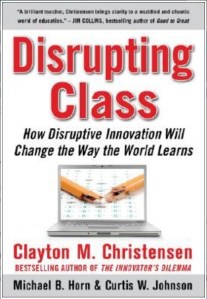
In Disrupting Class: How Disruptive Innovation Will Change the Way the World Learns, Clayton Christensen identifies the primary path to student success, and he predicts that technological changes, particularly in the world of online education, will make it possible. The successful teacher diagnoses the learning needs of individual students and makes appropriate adjustments to that student’s learning plan. The truly skilled individual teacher is able to do that in a face to face classroom, but it is not easy. Technological advances to make that possible would indeed disrupt all of education.

That means, though, that these changes must serve those counterintuitive instructional strategies that actually work.

I was approached by a vendor with the technology that would supposedly solve all my online education instructional needs. They had gone into the lecture halls of various colleges and recorded lectures. On your computer you could watch the fascinating talking heads and view the accompanying PowerPoints. Instead of being mind-numbingly bored to tears in a 400 seat lecture hall, you could be mind-numbingly bored to tears in the comfort of your home.

Much of the educational technology I see is imitating the bad instruction that produces poor student achievement. Technology developers must seek out what really works and focus their attention accordingly. I visited such a program recently, and what I saw gave me great hope for the future. As a developer of online education curriculum, I know what kind of technology we need to be successful, and when it comes, it will certainly transform education.

Hot@ Emerging Tech San Jose – July 20-23

ETCJ’s Jessica Knott will be at the 3rd Annual Sloan-C Symposium: Emerging Technologies for Online Learning Conference, in San Jose, California, July 20-23, 2010. While participating as tech support for TechSmith Corporation’s Camtasia Relay team, she plans to share — via live ETCJ updates — her impressions on trends, questions being asked, things people are buzzing about, etc. These will be gathered and posted, as she submits them, on this page. Please stand by. (Note: If you bookmark this page, a link will be provided at this URL to take you to the article. We plan to bump Jessica’s report to the top of the first page on July 20. A quirk in WordPress changes the URL when the publishing date is changed.)

Updated 7.21.10: Click here for Jessica’s latest reports.

‘Digital_Nation’ – A Digital_Dud

Jim ShimabukuroBy Jim Shimabukuro
Editor
Published 18 Feb. 2010

The use of personal digital communication devices (PDCDs) is growing exponentially in the U.S. and the rest of the world, pervading nearly every aspect of our lives. Rachel Dretzin and Douglas Rushkoff’s Frontline special, “Digital_Nation: Life on the Virtual Frontier” (2 Feb. 2010), purports to examine this phenomenon, this invasion of electronic devices, if you will, and to provide a report on its implications for the nation.

The fact that the program tries to cover the impact of PDCDs in one 90-minute special should have been ample warning that Dretzin and Rushkoff really couldn’t be serious. But I was curious and logged in to the site to view the segments in order.

I had my paper notebook and pen ready, planning to take notes for this article. However, I quickly gave up all hope of notetaking when it became obvious from the get-go that the pace was going to be frenetic and fragmented. So I watched, instead, and went along for the ride, allowing the rush of images and comments to lead me to the gist or point of the program.

In the end, after 90 minutes, I had the kind of “Huh?” moment that comes after I’ve watched a video out of sequence with key scenes omitted. I must’ve missed something because that couldn’t be all there was.

So I downloaded and replayed the sequence once more, beginning to end, fast-forwarding through parts that were familiar and reviewing key segments.

After the second time through, I realized that I hadn’t missed anything. The sequence was correct. And this was all there was.

The this is some generalizations, poorly guised as implications, that emerged from the disjointed blasts of video bites that were barely coherent from one segment to the next. The logic that bound the parts into a whole was elusive if not totally absent.

Perhaps the most damning is the idea that the nation’s brightest college students are growing dumber because of their preoccupation with PDCDs. The proof or evidence comprises a few testimonials by college faculty and alleged authorities on the subject matter as well as interviews with a handful of students. The charge is that today’s college students can no longer express themselves coherently in sustained pieces of writing. They’re capable of thinking in paragraph fragments only with little or no connection between thoughts. The proof is a student’s admission that he did, indeed, think and write in paragraph fragments.

The evidence also includes a “scientific” study of multitasking and its effect on performance. The conclusion, similar to that of driving while talking on a cellphone, is that performance suffers. But the experiment is far too simplistic and fails to address the notion that complex cognitive activities such as writing are inherently multitasking, requiring the control and coordination of many different cognitive procedures all at the same time. In fact, PDCDs actually ease the cognitive load by providing a means to instantly locate information and references, schedules and resources, with a click of the mouse.

Douglas Rushkoff’ and Rachel Dretzin

Without further evidence, the claim that students today are dumber because of digital distractions is hogwash. It doesn’t match my experience, and I’ve been teaching college composition for over thirty years.

One prof says that his students averaged only 75% in a midterm that tested them on their ability to recall info from his lectures and assigned readings. Had they not been distracted by their web-connected laptops and cellphones, he claims, they would have easily gotten 100%. Ironically, he says they’re not dumb — they’re just distracted. This is ironic because they’re really not dumb in the sense that they’re not limiting themselves to the prescribed sources and modes of information provided by the prof. There are many more ways of learning the same info, and the midterm tests but two.

One of the “experts” cites the results of a survey conducted by The Chronicle of Higher Education and claims that writing and reading skills of college students are deteriorating. What the expert and correspondents fail to consider is today’s radically altered rhetorical context. The context they’re using as a reference is based in 19th century technology. In the 21st century, classrooms, lectures, books, blackboards, paper and pencil have been augmented or replaced by electronic media that extends the rhetorical context to the entire planet, across time and space barriers, allowing potential access to all the world’s knowledge 24-7 and giving Aristotle’s definition of rhetoric a whole new meaning. For today’s students, “the faculty of observing in any given case the available means of persuasion” (Aristotle’s Rhetoric, book 1) includes PDCDs.

Throughout the program, we see similar shortsighted conclusions for the American home, social relationships, work, etc.

In the segment on the home, we see a typical middle-class family (Dretzin’s) living the American dream. Dretzin’s comment is that the family is physically together but alone at the same time, separated by PDCDs. In one sense, yes, this is true. But in another, the members of the family are connected in ways that transcend the traditional family-at-home model. Through PDCDs, they are instantly accessible to one another 24-7 — not only when they’re at home, together.

In the segment on people who socialize and meet others online, the implication is that many of us are losing sight of the distinction between real and virtual interactions. The assumption seems to be that we’re becoming alienated and delusional, less human. But are we? The fact is, we may have reached the tipping point for maintaining a distinction between F2F (face-to-face) and virtual. For digital natives, there may be no distinction, and insisting that there is may be delusional. Thus, conversing with someone digitally is simply an extension of F2F communication. In both cases, the interaction is real.

In the segment on work, Rushkoff takes us to an IBM business complex. The drive up through the manicured park and parking lot is eerily quiet and static. No one’s around. The vast lobby of the building is empty of people, and so are the hallways and offices that are open to our view. He finally finds a single worker in an office, sitting with a laptop and headset. She explains that she’s collaborating in real-time with distant colleagues via a virtual reality program. They are physically separated, and, no, they have never met F2F.

The point seems to be that the American worker is becoming increasingly alone and that business offices are becoming ghost towns. A walk through most college faculty office buildings on any given day would reveal the same. The hallways are empty, and the offices are locked tight. No one seems to be around. And the assumption is that there is something wrong with this picture.

One could argue that there’s nothing wrong with this picture. In fact, workers and faculty are realizing that they can communicate with others much more efficiently and effectively via PDCDs. An office or conference room is no longer the only or best medium for communication.

Other segments of the program take a look at addiction to video games and the use of video simulations and remotely controlled weapons by the military. The warning is that overdoing games is unhealthy and that digital distance may blur the distinction between real and virtual violence. My reaction to the dangers of game addiction is “So what else is new.” Too much of anything is bad for your health. Period. The comments from those interviewed re the military’s use of digital devices seem to pooh-pooh the fear that the young can’t distinguish between real and faked. They can.

I won’t try to cover all the points made in the program, but there’s one more that ought to be mentioned. This is the segment where a researcher claims that reading uses less brain energy than digital multitasking, and this is somehow healthier. During the latter, the person is supposedly distracted and confused while in the former the person is focused and relaxed. I’d need to hear other interpretations before deciding that multitasking is, indeed, bad for your health.

In conclusion, I’d say that Dretzin and Rushkoff simply tried to cover too much of a complex subject in a relatively brief program. To do the subject justice, no less than a well-researched 12-part series spread out over a year would suffice. Each segment would need to be 90 minutes or longer, and the pace would need to be slowed to allow for thoughtful viewing.

Beyond just the scope of coverage, however, there’s need for a more intelligent approach to the underlying issues. Producers, writers, and correspondents have to get beyond the sensational and zero in on the more profound and complex implications of PDCDs in our lives. How are they making us more instead of less human? How are they positively changing the way we live and define our lives? How are they promoting a global village mentality and thus underscoring similarities rather than differences? How are they removing boundaries that separate nations and peoples and promoting world peace? How are they providing a means for everyone, regardless of age, gender, socio-economic status, or national origin to get a first-rate K-16 education? How are they improving the ways in which we learn and teach? How are they erasing the discrepancies that doom so many to poverty and suffering? How are they contributing to a more just and humane world? How are they being used to battle crime and political corruption? How are they helping us to recover and maintain the health of our environment?

So many questions, so many issues, so much to be learned. As a topic that impacts all our lives and the world we share, our digital nation deserves more than 90 minutes of our time.

Digital Nation – Geeks May Be Normal, but Are They Listening?

Jessica KnottBy Jessica Knott
Editor, Twitter
Published 18 Feb. 2010

Hello, my name is Jessica, and I’m attached to my Blackberry like a sand burr to a pant leg. When I’m not sleeping, I’m answering e-mails, texting my friends and checking my Twitter account. Embarrassing fact: I’ve been known to text message my ever-patient husband from another room of the house to ask him to bring me a soda. I believe in gaming as education, in building social networks and making education engaging and effective using technology. I identify as a girl geek and revel in technology as a powerful life-enhancing tool.

That said, as with all things, I believe that moderation is key in technology, lest our lives be overtaken by the flashing Blackberry LED or the pressure of harvest season in FarmTown. I view life through the lens of higher education practice and scholarship. Sherry Turkle’s statement that “students need to be stimulated in ways they didn’t need to be stimulated before” is powerful and holds many implications for teaching, learning and design with technology. Does this mean we should design every lesson of every course as an adventure in learning? Not necessarily. But consciousness in regard to technology-assisted content delivery is of the utmost importance not only for student engagement but in ensuring that students are processing the information and transforming content into knowledge.

As a PhD student and practitioner of online learning, my laptop is a critical tool in my knowledge construction and application. As concepts are presented in classes or meetings, I often Google them to see elements of what I’m learning at play in “real life.” This allows me to transcend physical walls and immediately familiarize myself with the practices and applications of what I’m learning. However, I would be lying if I said I didn’t feel the tempting lure of my Facebook friends or the intense need to check my Twitter stream. Fighting these urges, while difficult, is necessary for me to truly process the information I receive. When I fall prey to temptation I later find holes in my understanding that may not have been there had my multitasking not interfered with my concentration.

A further example of the power of distraction comes in the form of how I watched this video segment. As I watched this video, I took notes but found myself checking e-mail, responding to professors and answering the questions of co-workers. How much of the information in these segments did I really process? More importantly, what did I miss?

The front page of The Chronicle Review for February 5, 2010 screams “Attention Deficit? Distraction and the Data Deluge.” Scholars are increasingly concerned about learning retention and the digital age, seemingly for many of the reasons I stated above. Are we engaging with the content or are we sort of engaging with the content and sort of engaging with everything else around us? Technology is a powerful engagement tool, but course design is incredibly important in that it should guide technology use, channeling cognition and facilitating exploration. We need to make them listen; more importantly we need to make them want to listen.

With technology comes responsibility. Be it a conference back channel or a course lecture, expectations for use must be set and outcomes made explicit. Ample opportunity for exploration and self-reflection is crucial in any learning environment, and technology can facilitate this in ways that were impossible even 15 years ago. It is important, however, not to lose ourselves in the technical abyss. We are not educators of technology, we are educators harnessing technology. This is an important lesson not only for our students, but for us as individuals. As you watch “Digital_Nation,” I encourage you to reflect upon your own practices. How much of this segment do you see at work in your own life? What do you find problematic or concerning? And, most importantly, how can you not only co-exist with technology but most effectively take command of what it has to offer? This program is an eye-opener on many levels, not the least of which is thsese implications for the future.

(Disclaimer: This reaction essay contains my own thoughts regarding Digital_Nation: Life on the Virtual Frontier. My thoughts do not necessarily reflect those of Michigan State University, Libraries, Computing and Technology or Virtual University Design and Technology. Please feel free to contact me at jlknott@gmail.com with any questions or concerns.)

Further Reading:

Divided Attention by David Glenn, The Chronicle Review, February 5, 2010

Appraising Information Abundance by W. Russell Neuman, The Chronicle Review, February 5, 2010

From Distraction to Engagement: Wireless Devices in the Classroom by Berlin Fang, Educause Quarterly

Student Engagement and Technology in the Classroom, Tech Ticker

Thomas Ho

Thomas Ho, Ph.D.

Previously, he was Professor of Computer and Information Technology atIndiana University Purdue University Indianapolis (IUPUI). Previously, he was a Senior Fellow in Information Systems and Computer Science at theNational University of Singapore from 1993-1994. From 1990-1992, he was Director of the Information Networking Institute atCarnegie Mellon University. From 1978 to 1988, he was Head of the Department of Computer and Information Technology at Purdue University which was recognized by the Data Processing Management Association for its Four-year Institution Award for undergraduate computer information systems programs. From 1986-1988, he was on loan from Purdue to serve as Executive Director of the INTELENET Commission which pioneered the INdiana TELEcommunications NETwork. He received his BS, MS, and Ph.D. degrees in computer science from Purdue University.

ETC Publications

Should Students Have a Personal Brand?
Facebook Timeline: They’re Already Telling Us the Story of Their Life…

Franklin P. Schargel

Franklin P. Schargel
Bio
Website

Franklin Schargel, a native of Brooklyn, New York now residing in Albuquerque, NM, is a graduate of the University of the City of New York. Franklin holds two Masters Degrees: one in Secondary Education from City University and a degree from Pace University in School Administration and Supervision. His career spans thirty-three years of classroom teaching, school counseling and eight years of school supervision and administration. In addition, Franklin taught a course in Dowling College’s MBA Program.  Read more.

ETC Publications

Sound Bites Aren’t the Answer for Reform

Robert Plants

Robert Plants
Bio

Dr. Plants serves as Assistant Dean, Director of Off-campus Undergraduate Advising, and Assistant Professor. Bob teaches the School of Education’s only technology classes, online and a live lab-based course. While not performing his off-campus duties, he has served as the School of Education’s “webmaster” and on its technology committee. Read more.

ETC Publications

Living in Glass Schoolhouses: 21st Century Teaching and Learning Is Much More Than Standards
Arne and Michelle vs. Larry: The Statistical Battle
Real Change with 21st Century Learning Communities
Computer Science – A Field of Dreams

Marc Prensky

Marc Prensky
Guest Author
Bio

Marc Prensky is an internationally acclaimed speaker, writer, consultant, and designer in the critical areas of education and learning. He is the author of 3 books: Teaching Digital Natives — Partnering for Real Learning (Corwin 2010), Don’t Bother Me Mom — I’m Learning (Paragon House 2005), Digital Game-Based Learning (McGraw-Hill, 2001).

Marc is the founder and CEO of Games2train (whose clients include IBM, Nokia, Pfizer, the US Department of Defense and the L.A. and Florida Virtual Schools) and creator of the sites http://www.dodgamecommunity.com and http://www.socialimpactgames.com .

Marc has created over 50 software games for learning, including the world’s first fast-action videogame-based training tools and world-wide, multi-player, multi-team on-line competitions. He has also taught at all levels. Marc has been featured in articles in The New York Times and The Wall Street Journal, has appeared on CNN, MSNBC, PBS, and the BBC, and was named as one of training’s top 10 “visionaries” by Training magazine. He holds graduate degrees from Yale (Teaching) and Harvard (MBA).

ETC Publications

Simple Changes in Current Practices May Save Our Schools

Jim Shimabukuro – Publications & Presentations

Selected Publications

Innovate Blog: Need for More Discussion.” Innovate, the journal of online education, February/March 2009 (Volume 5, Issue 3).

Innovate-Blog: A Step into Blog 2.0.” Innovate, the journal of online education, December 2008/January 2009 (Volume 5, Issue 2).

Innovate-Ideagora: Introducing a New Feature in Innovate.” Alan McCord, Denise Easton, and James N. Shimabukuro. Innovate, the journal of online education, October/November 2008 (Volume 5, Issue 1).

Freedom and Empowerment: An Essay on the Next Step for Education and Technology.” Innovate, the journal of online education, June/July 2005 (Volume 1, Issue 5).

Rising Stars in Virtual Education: A Peek into 2010.” Technology Source, November/December 2002.

The Evolving Virtual Conference: Implications for Professional Networking.” Technology Source, September/October 2000.

What Is an Online Conference?Technology Source, January/February 2000.

“How to Get the Most Out of an Online Conference.” TCC Worldwide Online Conference: Looking Back Towards the Future, April 7-9, 1999.

How to Survive in an Online Class: Guidelines for Students.” First published at the Fourth Annual TCC Online Conference: Best Practices in Delivering, Supporting, and Managing Online Learning, April 7-9, 1999.

CMC and Writing Instruction: A Future Scenario.” A chapter in volume 1 of Berge and Collins’ Computer-Mediated Communications and the Online Classroom (Cresskill, NJ: Hampton Press, 1995).

Stimulating Learning with Electronic Guest Lecturing.” A chapter coauthored with Morton Cotlar in volume 3 of Berge and Collins’ Computer-Mediated Communications and the Online Classroom (Cresskill, NJ: Hampton Press, 1995).

Beyond the Classroom: International Education and the Community College. A four-volume series co-edited with Robert W. Franco (University of Hawaii, 1992).

Selected Presentations

“The Force Is with US—The Teachers: Freedom in the New Classroom.” Keynote presentation. Ninth Annual TCC 2004 Online Conference Apr. 20, 2004.

“The Evolving Virtual Conference: Trends in an Emerging Medium for Professional Networking.” Keynote presentation. GATE 2000 International Virtual Conference. June 15-16, 2000.

“Teaching a Required Freshman Course Online: Implications for Distance Education.” Presentation. Third Seminar for Presidents of Junior and Community Colleges, June 16, 1997, at the East-West Center, University of Hawaii at Manoa.

David G. Lebow

lebow160aPresident, HyLighter, Inc
ETC Guest Author
dglebow@comcast.net

USDE 2009 Report on Effectiveness of Online Learning

The following excerpts are from Evaluation of Evidence-Based Practices in Online Learning: A Meta-Analysis and Review of Online Learning Studies (Washington, D.C., 2009), conducted by the U.S. Department of Education, Office of Planning, Evaluation, and Policy Development. It was prepared by Barbara Means, Yukie Toyama, Robert Murphy, Marianne Bakia, and Karla Jones. Click here for the complete report.

Abstract

A systematic search of the research literature from 1996 through July 2008 identified more than a thousand empirical studies of online learning. Analysts screened these studies to find those that (a) contrasted an online to a face-to-face condition, (b) measured student learning outcomes, (c) used a rigorous research design, and (d) provided adequate information to calculate an effect size. As a result of this screening, 51 independent effects were identified that could be subjected to meta-analysis. The meta-analysis found that, on average, students in online learning conditions performed better than those receiving face-to-face instruction. The difference between student outcomes for online and face-to-face classes—measured as the difference between treatment and control means, divided by the pooled standard deviation—was larger in those studies contrasting conditions that blended elements of online and face-to-face instruction with conditions taught entirely face-to-face. Analysts noted that these blended conditions often included additional learning time and instructional elements not received by students in control conditions. This finding suggests that the positive effects associated with blended learning should not be attributed to the media, per se. An unexpected finding was the small number of rigorous published studies contrasting online and face-to-face learning conditions for K–12 students. In light of this small corpus, caution is required in generalizing to the K–12 population because the results are derived for the most part from studies in other settings (e.g., medical training, higher education).

USDOE

Executive Summary

Online learning—for students and for teachers—is one of the fastest growing trends in educational uses of technology. The National Center for Education Statistics (2008) estimated that the number of K-12 public school students enrolling in a technology-based distance education course grew by 65 percent in the two years from 2002-03 to 2004-05. On the basis of a more recent district survey, Picciano and Seaman (2009) estimated that more than a million K–12 students took online courses in school year 2007–08.

Online learning overlaps with the broader category of distance learning, which encompasses earlier technologies such as correspondence courses, educational television and videoconferencing. Earlier studies of distance learning concluded that these technologies were not significantly different from regular classroom learning in terms of effectiveness. Policy-makers reasoned that if online instruction is no worse than traditional instruction in terms of student outcomes, then online education initiatives could be justified on the basis of cost efficiency or need to provide access to learners in settings where face-to-face instruction is not feasible. The question of the relative efficacy of online and face-to-face instruction needs to be revisited, however, in light of today’s online learning applications, which can take advantage of a wide range of Web resources, including not only multimedia but also Web-based applications and new collaboration technologies. These forms of online learning are a far cry from the televised broadcasts and videoconferencing that characterized earlier generations of distance education. Moreover, interest in hybrid approaches that blend in-class and online activities is increasing. Policy-makers and practitioners want to know about the effectiveness of Internet-based, interactive online learning approaches and need information about the conditions under which online learning is effective.

The findings presented here are derived from (a) a systematic search for empirical studies of the effectiveness of online learning and (b) a meta-analysis of those studies from which effect sizes that contrasted online and face-to-face instruction could be extracted or estimated. A narrative summary of studies comparing different forms of online learning is also provided.

These activities were undertaken to address four research questions:
1. How does the effectiveness of online learning compare with that of face-to-face instruction?
2. Does supplementing face-to-face instruction with online instruction enhance learning?
3. What practices are associated with more effective online learning?
4. What conditions influence the effectiveness of online learning?

This meta-analysis and review of empirical online learning research are part of a broader study of practices in online learning being conducted by SRI International for the Policy and Program Studies Service of the U.S. Department of Education. The goal of the study as a whole is to provide policy-makers, administrators and educators with research-based guidance about how to implement online learning for K–12 education and teacher preparation. An unexpected finding of the literature search, however, was the small number of published studies contrasting online and face-to-face learning conditions for K–12 students. Because the search encompassed the research literature not only on K–12 education but also on career technology, medical and higher education, as well as corporate and military training, it yielded enough studies with older learners to justify a quantitative meta-analysis. Thus, analytic findings with implications for K–12 learning are reported here, but caution is required in generalizing to the K–12 population because the results are derived for the most part from studies in other settings (e.g., medical training, higher education).

This literature review and meta-analysis differ from recent meta-analyses of distance learning in that they

• Limit the search to studies of Web-based instruction (i.e., eliminating studies of video- and audio-based telecourses or stand-alone, computer-based instruction);
• Include only studies with random-assignment or controlled quasi-experimental designs; and
• Examine effects only for objective measures of student learning (e.g., discarding effects for student or teacher perceptions of learning or course quality, student affect, etc.).

This analysis and review distinguish between instruction that is offered entirely online and instruction that combines online and face-to-face elements. The first of the alternatives to classroom-based instruction, entirely online instruction, is attractive on the basis of cost and convenience as long as it is as effective as classroom instruction. The second alternative, which the online learning field generally refers to as blended or hybrid learning, needs to be more effective than conventional face-to-face instruction to justify the additional time and costs it entails. Because the evaluation criteria for the two types of learning differ, this meta-analysis presents separate estimates of mean effect size for the two subsets of studies.

Key Findings

The main finding from the literature review was that

• Few rigorous research studies of the effectiveness of online learning for K–12 students have been published. A systematic search of the research literature from 1994 through 2006 found no experimental or controlled quasi-experimental studies comparing the learning effects of online versus face-to-face instruction for K–12 students that provide sufficient data to compute an effect size. A subsequent search that expanded the time frame through July 2008 identified just five published studies meeting meta-analysis criteria.

The meta-analysis of 51 study effects, 44 of which were drawn from research with older learners, found that

• Students who took all or part of their class online performed better, on average, than those taking the same course through traditional face-to-face instruction. Learning outcomes for students who engaged in online learning exceeded those of students receiving face-to-face instruction, with an average effect size of +0.24 favoring online conditions. The mean difference between online and face-to-face conditions across the 51 contrasts is statistically significant at the p < .01 level. Interpretations of this result, however, should take into consideration the fact that online and face-to-face conditions generally differed on multiple dimensions, including the amount of time that learners spent on task. The advantages observed for online learning conditions therefore may be the product of aspects of those treatment conditions other than the instructional delivery medium per se.

• Instruction combining online and face-to-face elements had a larger advantage relative to purely face-to-face instruction than did purely online instruction. The mean effect size in studies comparing blended with face-to-face instruction was +0.35, p < .001. This effect size is larger than that for studies comparing purely online and purely face-to-face conditions, which had an average effect size of +0.14, p < .05. An important issue to keep in mind in reviewing these findings is that many studies did not attempt to equate (a) all the curriculum materials, (b) aspects of pedagogy and (c) learning time in the treatment and control conditions. Indeed, some authors asserted that it would be impossible to have done so. Hence, the observed advantage for online learning in general, and blended learning conditions in particular, is not necessarily rooted in the media used per se and may reflect differences in content, pedagogy and learning time.

• Studies in which learners in the online condition spent more time on task than students in the face-to-face condition found a greater benefit for online learning. The mean effect size for studies with more time spent by online learners was +0.46 compared with +0.19 for studies in which the learners in the face-to-face condition spent as much time or more on task (Q = 3.88, p < .05).

• Most of the variations in the way in which different studies implemented online learning did not affect student learning outcomes significantly. Analysts examined 13 online learning practices as potential sources of variation in the effectiveness of online learning compared with face-to-face instruction. Of those variables, (a) the use of a blended rather than a purely online approach and (b) the expansion of time on task for online learners were the only statistically significant influences on effectiveness. The other 11 online learning practice variables that were analyzed did not affect student learning significantly. However, the relatively small number of studies contrasting learning outcomes for online and face-to-face instruction that included information about any specific aspect of implementation impeded efforts to identify online instructional practices that affect learning outcomes.

• The effectiveness of online learning approaches appears quite broad across different content and learner types. Online learning appeared to be an effective option for both undergraduates (mean effect of +0.35, p < .001) and for graduate students and professionals (+0.17, p < .05) in a wide range of academic and professional studies. Though positive, the mean effect size is not significant for the seven contrasts involving K–12 students, but the number of K–12 studies is too small to warrant much confidence in the mean effect estimate for this learner group. Three of the K–12 studies had significant effects favoring a blended learning condition, one had a significant negative effect favoring face-to-face instruction, and three contrasts did not attain statistical significance. The test for learner type as a moderator variable was nonsignificant. No significant differences in effectiveness were found that related to the subject of instruction.

• Effect sizes were larger for studies in which the online and face-to-face conditions varied in terms of curriculum materials and aspects of instructional approach in addition to the medium of instruction. Analysts examined the characteristics of the studies in the meta-analysis to ascertain whether features of the studies’ methodologies could account for obtained effects. Six methodological variables were tested as potential moderators: (a) sample size, (b) type of knowledge tested, (c) strength of study design, (d) unit of assignment to condition, (e) instructor equivalence across conditions, and (f) equivalence of curriculum and instructional approach across conditions. Only equivalence of curriculum and instruction emerged as a significant moderator variable (Q = 5.40, p < .05). Studies in which analysts judged the curriculum and instruction to be identical or almost identical in online and face-to-face conditions had smaller effects than those studies where the two conditions varied in terms of multiple aspects of instruction (+0.20 compared with +0.42, respectively). Instruction could differ in terms of the way activities were organized (for example as group work in one condition and independent work in another) or in the inclusion of instructional resources (such as a simulation or instructor lectures) in one condition but not the other.

The narrative review of experimental and quasi-experimental studies contrasting different online learning practices found that the majority of available studies suggest the following:

• Blended and purely online learning conditions implemented within a single study generally result in similar student learning outcomes. When a study contrasts blended and purely online conditions, student learning is usually comparable across the two conditions.

• Elements such as video or online quizzes do not appear to influence the amount that students learn in online classes. The research does not support the use of some frequently recommended online learning practices. Inclusion of more media in an online application does not appear to enhance learning. The practice of providing online quizzes does not seem to be more effective than other tactics such as assigning homework.

• Online learning can be enhanced by giving learners control of their interactions with media and prompting learner reflection. Studies indicate that manipulations that trigger learner activity or learner reflection and self-monitoring of understanding are effective when students pursue online learning as individuals.

• Providing guidance for learning for groups of students appears less successful than does using such mechanisms with individual learners. When groups of students are learning together online, support mechanisms such as guiding questions generally influence the way students interact, but not the amount they learn.

Conclusions

In recent experimental and quasi-experimental studies contrasting blends of online and face-to-face instruction with conventional face-to-face classes, blended instruction has been more effective, providing a rationale for the effort required to design and implement blended approaches. Even when used by itself, online learning appears to offer a modest advantage over conventional classroom instruction.

However, several caveats are in order: Despite what appears to be strong support for online learning applications, the studies in this meta-analysis do not demonstrate that online learning is superior as a medium, In many of the studies showing an advantage for online learning, the online and classroom conditions differed in terms of time spent, curriculum and pedagogy. It was the combination of elements in the treatment conditions (which was likely to have included additional learning time and materials as well as additional opportunities for collaboration) that produced the observed learning advantages. At the same time, one should note that online learning is much more conducive to the expansion of learning time than is face-to-face instruction.

In addition, although the types of research designs used by the studies in the meta-analysis were strong (i.e., experimental or controlled quasi-experimental), many of the studies suffered from weaknesses such as small sample sizes; failure to report retention rates for students in the conditions being contrasted; and, in many cases, potential bias stemming from the authors’ dual roles as experimenters and instructors.

Finally, the great majority of estimated effect sizes in the meta-analysis are for undergraduate and older students, not elementary or secondary learners. Although this meta-analysis did not find a significant effect by learner type, when learners’ age groups are considered separately, the mean effect size is significantly positive for undergraduate and other older learners but not for K–12 students.

Another consideration is that various online learning implementation practices may have differing effectiveness for K–12 learners than they do for older students. It is certainly possible that younger students could benefit more from a different degree of teacher or computer-based guidance than would college students and older learners. Without new random assignment or controlled quasi-experimental studies of the effects of online learning options for K–12 students, policy-makers will lack scientific evidence of the effectiveness of these emerging alternatives to face-to-face instruction.

__________

U.S. Department of Education, Office of Planning, Evaluation, and Policy Development, Evaluation of Evidence-Based Practices in Online Learning: A Meta-Analysis and Review of Online Learning Studies, Washington, D.C., 2009.
[www.ed.gov/about/offices/list/opepd/ppss/reports.html]

‘Charles Leadbeater: Education Innovation in the Slums’

Posted in dotSUB by tedtalks on 16 June 2010

Transcript for video: “Charles Leadbeater: Education innovation in the slums”

It’s a great pleasure to be here. It’s a great pleasure to speak after Brian Cox from CERN. I think CERN is the home of the Large Hadron Collider. What ever happened to the Small Hadron Collider? Where is the Small Hadron Collider? Because the Small Hadron Collider once was the big thing. Now, the Small Hadron Collider is in a cupboard, overlooked and neglected. You know when the Large Hadron Collider started, and it didn’t work, and people tried to work out why, it was the Small Hadron Collider team who sabotaged it because they were so jealous. The whole Hadron Collider family needs unlocking.

The lesson of Brian’s presentation, in a way — all those fantastic pictures — is this really: that vantage point determines everything that you see. What Brian was saying was science has opened up successively different vantage points from which we can see ourselves. And that’s why it’s so valuable. So the vantage point you take determines virtually everything that you will see. The question that you will ask will determine much of the answer that you will get.

And so if you ask this question: Where would you look to see the future of education? The answer that we’ve traditionally given to that is very straightforward, at least in the last 20 years. You go to Finland. Finland is the best place in the world to see school systems. The Finns may be a bit boring and depressive and there’s a very high suicide rate, but by golly they are qualified. And they have absolutely amazing education systems. And so we all troop off to Finland, and we wonder at their social democratic miracle of Finland and its cultural homogeneity and all the rest of it, and then we struggle to imagine how we might bring lessons back.

Well, so, for this last year, with the help of Cisco who sponsor me, for some balmy reason, to do this, I’ve been looking somewhere else. Because actually radical innovation does sometimes come from the very best, but it often comes from places where you have huge need, unmet, latent demand and not enough resources for traditional solutions to work — traditional high-cost solutions which depend on professionals, which is what schools and hospitals are.

So I ended up in places like this. This is a place called Monkey Hill. It’s one of the hundreds of favelas in Rio. Most of the populations growth of the next 50 years will be in cities. We’ll grow by six cities of 12 million people a year for the next 30 years. Almost all of that growth will be in the developed world. Almost all of that growth will be in places like Monkey Hill. This is where you’ll find the fastest growing young populations of the world. So if you want recipes to work — for virtually anything — health, education, government politics and education — you have to go to these places. And if you go to these places, you meet people like this.

This is a guy called Juanderson. At the age of 14, in common with many 14-year-olds in the Brazilian education system, he dropped out of school. It was boring. And Juanderson, instead, went into what provided kind of opportunity and hope in the place that he lived, which was the drugs trade. And by the age of 16, with rapid promotion, he was running the drugs trade in 10 favelas. He was turning over 200,000 dollars a week. He employed 200 people. He was going to be dead by the age of 25. And luckily, he met this guy, who is Rodrigo Baggio, the owner of the first laptop to ever appear in Brazil. 1994, Rodrigo started something called CDI, which took computers donated by corporations, put them in community centers in favelas and created places like this. What turned Juanderson around was technology for learning that made learning fun and accessible.

Or you can go to places like this. This is Kibera, which is the largest slum in East Africa. Millions of people living here, stretched over many kilometers. And there I met these two, Azra on the left, Maureen on the right. They just finished their Kenyan certificate of secondary education. That name should tell you that the Kenyan education system borrows almost everything from Britain, circa 1950, but has managed to make it even worse. So there are schools in slums like this. They’re places like this. That’s where Maureen went to school. They’re private schools. There are no state schools in slums. And the education they got was pitiful. It was in places like this. This a school set up by some nuns in another slum called Nakuru. Half the children in this classroom have no parents because they’ve died through AIDS. The other half have one parent because the other parent has died through AIDS. So the challenges of education in this kind of place are not to learn the kings and queens of Kenya or Britain. They are to stay alive, to earn a living, to not become HIV positive. The one technology that spans rich and poor in places like this is not anything to do with industrial technology. It’s not to do with electricity or water. It’s the mobile phone. If you want to design from scratch virtually any service in Africa, you would start now with the mobile phone. Or you could go to places like this.

This is a place called the Madangiri Settlement Colony, which is a very developed slum about 25 minutes outside New Delhi, where I met these characters who showed me around for the day. The remarkable thing about these girls, and the sign of the kind of social revolution sweeping through the developing world is that these girls are not married. 10 years ago, they certainly would have been married. Now they’re not married, and they want to go on to study further, to have a career. They’ve been brought up by mothers who are illiterate, who have never ever done homework. All across the developing world there are millions of parents, tens, hundreds of millions, who for the first time are with children doing homework and exams. And the reason they carry on studying is not because they went to a school like this. This is a private school. This is a fee-pay school. This is a good school. This is the best you can get in Hyderabad in Indian education. The reason they went on studying was this.

This is a computer installed in the entrance to their slum by a revolutionary social entrepreneur called Sugata Mitra who’s adopted the most radical experiments, showing that children, in the right conditions, can learn on their own with the help of computers. Those girls have never touched Google. They know nothing about Wikipedia. Imagine what their lives would be like if you could get that to them.

So if you look, as I did, through this tour, and by looking at about a hundred case studies of different social entrepreneurs working in these very extreme conditions, look at the recipes they come up with for learning, they look nothing like school. What do they look like? Well, education is a global religion. And education, plus technology, is a great source of hope. You can go to places like this.

This is a school three hours outside of Sao Paulo. Most of the children there have parents who are illiterate. Many of them don’t have electricity at home. But they find it completely obvious to use computers, websites, make videos, so on and so forth. When you go to places like this what you see is that education in these settings works by pull, not push. Most of our education system is push. I was literally pushed to school. When you get to school, things are pushed at you, knowledge, exams, systems, timetables. If you want to attract people like Juanderson who could, for instance, buy guns, wear jewelry, ride motorbikes and get girls through the drugs trade, and you want to attract him into education, having a compulsory curriculum doesn’t really make sense. That isn’t really going to attract him. You need to pull him. And so education needs to work by pull, not push.

And so the idea of a curriculum is completely irrelevant in a setting like this. You need to start education from things that make a difference to them in their settings. What does that? Well, the key is motivation, and there are two aspects to it. One is to deliver extrinsic motivation. That education has a payoff. Our education systems all work on the principle that there is a payoff, but you have to wait quite a long time. That’s too long if you’re poor. Waiting 10 years for the payoff from education is too long when you need to meet daily needs, when you’ve got siblings to look after or a business to help with. So you need education to be relevant and help people to make a living there and then, often. And you also need to make it intrinsically interesting.

So time and again, I found people like this. This is an amazing guy, Sebastiao Rocha, in Belo Horizonte, in the third largest city in Brazil. He’s invented more than 200 games to teach virtually any subject under the sun. In the schools and communities that Taio works in, the day always starts in a circle and always starts from a question. Imagine an education system that started from questions, not from knowledge to be imparted, or started from game, not from a lesson, or started from the premise that you have to engage people first before you can possibly teach them. Our education systems, you do all that stuff afterward, if you’re lucky, sport, drama, music. These things, they teach through. They attract people to learning because it’s really a dance project or a circus project or, the best example of all — El Sistema in Venezuela — it’s a music project. And so you attract people through that into learning, not adding that on after all the learning has been done and you’ve eaten your cognitive greens.

So El Sistema in Venezuela uses a violin as a technology of learning. Taio Rocha uses making soap as a technology of learning. And what you find when you go to these schemes is that they use people and places in incredibly creative ways. Masses of peer learning. How do you get learning to people when there are no teachers, when teachers won’t come, when you can’t afford them, and even if you do get teachers, what they teach isn’t relevant to the communities that they serve? Well, you create your own teachers. You create peer-to-peer learning, or you create para-teachers, or you bring in specialist skills. But you find ways to get learning that’s relevant to people through technology, people and places that are different.

So this is a school in a bus on a building site in Pune, the fastest growing city in Asia. Pune has 5,000 building sites. It has 30,000 children on those building sites. That’s one city. Imagine that urban explosion that’s going to take place across the developing world and how many thousands of children will spend their school years on building sites. Well, this is a very simple scheme to get the learning to them through a bus. And they all treat learning, not as some sort of academic, analytical activity, but that’s something that’s productive, something you make, something you can do, perhaps earn a living from.

So I met this character, Steven. He’d spent three years in Nairobi living on the streets because his parents had died of AIDS. And he was finally brought back into school, not by the offer of GCSEs, but by the offer of learning how to become a carpenter, a practical making skill. So the trendiest schools in the world, High Tech High and others, they espouse a philosophy of learning as productive activity. Here, there isn’t really an option. Learning has to be productive in order for it to make sense.

And finally, they have a different model of scale. And it’s a Chinese restaurant model of how to scale. And I learned it from this guy, who is an amazing character. He’s probably the most remarkable social entrepreneur in education in the world. His name is Madhav Chavan, and he created something called Pratham. And Pratham runs preschool play groups for, now, 21 million children in India. It’s the largest NGO in education in the world. And it also supports working-class kids going into Indian schools. He’s a complete revolutionary. He’s actually a trade union organizer by background. And that’s how he learned the skills to build his organization.

When they got to a certain stage, Pratham got big enough to attract some pro bono support from McKinsey. McKinsey came along and looked at his model and said, “You know what you should do with this Madhav? You should turn it into McDonald’s. And what you do when you go to any new site is you kind of roll out a franchise. And it’s the same wherever you go. It’s reliable and people know exactly where they are. And they’ll be no mistakes.” And Madhav said, “Why do we have to do it that way? Why can’t we do it more like the Chinese restaurants?”

There are Chinese restaurants everywhere, but there is no Chinese restaurant chain. Yet, everyone knows what is a Chinese restaurant. They know what to expect, even though it’ll be subtly different and the colors will be different and the name will be different. You know a Chinese restaurant when you see it. These people work with the Chinese restaurant model. Same principles, different applications and different settings. Not the McDonald’s model. The McDonald’s model scales. The Chinese restaurant model spreads.

So mass education started with social entrepreneurship in the 19th century. And that’s desperately what we need again on a global scale. And what can we learn from all of that? Well, we can learn a lot because our education systems are failing desperately in many ways. They fail to reach the people they most need to serve. They often hit the target but miss the point. Improvement is increasingly difficult to organize. Our faith in these systems, incredibly fraught. And this is just a very simple way of understanding what kind of innovation, what kind of different design we need.

There are two basic types of innovation. There’s sustaining innovation, which will sustain an existing institution or an organization, and disruptive innovation that will break it apart, create some different way of doing it. There are formal settings, schools, colleges, hospitals, in which innovation can take place, and informal settings, communities, families, social networks. Almost all our effort goes in this box, sustaining innovation in formal settings, getting a better version of the essentially Bismarckian school system that developed in the 19th century. And as I said, the trouble with this is that, in the developing world there just aren’t teachers to make this model work. You’d need millions and millions of teachers in China, India, Nigeria and the rest of developing world to meet need. And in our system, we know that simply doing more of this won’t eat into deep educational inequalities, especially in inner-cities and former industrial areas.

So that’s why we need three more kinds of innovation. We need more reinvention. And all around the world now you see more and more schools reinventing themselves. They’re recognizably schools, but they look different. There are Big Picture schools in the U.S. and Australia. There are Kunscap Skolan schools in Sweden. Of 14 of them, only two of them are in schools. Most of them are in other buildings not designed as schools. There is an amazing school in Northen Queensland called Jaringan. And they all have the same kind of features, highly collaborative, very personalized, often pervasive technology. Learning that starts from questions and problems and projects, not from knowledge and curriculum. So we certainly need more of that.

But because so many of the issues in education aren’t just in school, they’re in family and community, what you also need, definitely, is more on the right hand side. You need efforts to supplement schools. The most famous of these is Reggio Emilia in Italy, the family-based learning system to support and encourage people in schools. The most exciting is the Harlem Children’s Zone, which over 10 years, led by Geoffrey Canada, has, through a mixture of schooling and family and community projects, attempted to transform, not just education in schools, but the entire culture and aspiration of about 10,000 families in Harlem. We need more of that completely new and radical thinking. You can go to places an hour away, less, from this room, just down the road, which need that, which need radicalism of a kind that we haven’t imagined.

And finally, you need transformational innovation that could imagine getting learning to people in completely new and different ways. So we are on the verge, 2015, of an amazing achievement, the schoolification of the world. Every child up to the age of 15 who wants a place in school will be able to have one in 2015. It’s an amazing thing. But it is, unlike cars which have developed so rapidly and orderly, actually the school system is recognizably an inheritance from the 19th century, from a Bismarkian model of German schooling that got taken up by English reformers, and often by religious missionaries, taken up in the United States as a force of social cohesion, and then in Japan and South Korea as they developed.

It’s recognizably 19th century in its roots. And of course it’s a huge achievement. And of course it will bring great things. It will bring skills and learning and reading. But it will also lay waste to imagination. It will lay waste to appetite. It will lay waste to social confidence. It will stratify society as much as it liberates it. And we are bequeathing to the developing world schools systems that they will now spend a century trying to reform. That is why we need really radical thinking, and why radical thinking is now more possible and more needed than ever in how we learn.

Thank you.