




 By Jim Shimabukuro
Editor
As we teeter on the brink of the new year, we’re left with more questions than answers. In a way, that’s a good thing, considering the makeshift nature of technology in higher education. As we sidle into 2012, the same old questions will greet us. They’re about a world that’s rapidly changing and about our ability or inability to change with it. Let’s face it. The cat’s out of the bag, but some of us are still trying to lure it back in.
Issue #1: Can current leaders take higher education into the 21st century?
Most indications are no. They’re good at preserving the 20th century model and eager to add some technology glitz to make their brick and mortar campuses look modern. But it will be business as usual, with technology applied to brighten up the old way of doing things. Cost effectiveness will be the public mantra, but savings will be offset by the huge piles of money thrown at the makeover. The fact is that the overwhelming majority of today’s leaders have been formed and rewarded by the brick and mortar learning environment. They define themselves and what they do in terms of campuses, buildings, and offices. For them, technology is something to be brought into and added to their domain even if it means severely restricting and crippling its full potential.
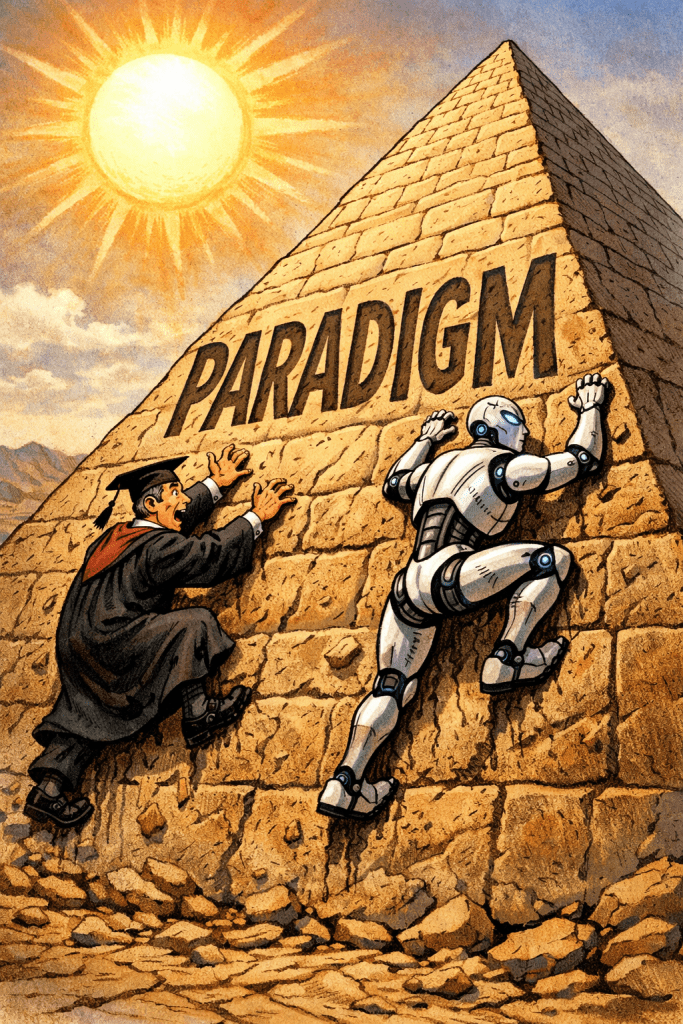
 Make no mistake. Change will come, but it will come from new leaders who realize that the paradigm for learning environments has shifted from the ground to the virtual. They realize that educational technology is no longer a single innovation or a group of innovations but a sea change based on the awareness that face-to-face (F2F) pedagogy is a subset of the virtual learning environment — and not the other way around. For these leaders, online is the world’s largest learning environment, and brick and mortar facilities are a shrinking part that’s becoming increasingly irrelevant.
The traditional campus-based college won’t disappear, and it will remain the environment of choice for those who can afford the nostalgia, the privilege of dormitories and ivy-covered lecture halls. But in the wake of the first wave of the digital tsunami, their foundations are eroding. The second wave is building just beyond the horizon, and when it strikes it will further undermine land-locked institutions. The select few on high ground will survive, but the vast majority on lower ground will be forced to migrate to the virtual world.
Issue #2: Are we past Web 2.0 yet?
I think we are. The web has never shut down for maintenance. Not for a moment. It’s continually evolving, changing by the day if not by the hour. Social networking is its hallmark, but that’s slipping into the past. We’ve seen countless definitions of Web 3.0, but they all add up to one thing — the web has changed not only the way we interface with information and interact with one another and the world, but it has changed us. Thus Web 3.0 is no longer about the web per se but about the way it has combined with other technology to alter or extend what it means to be human. To get a sense of the immensity of this e-volution, imagine life without the internet, broadband, Wi-Fi, iPhones, iPads, high-definition digital TV, open courseware, blogs, microblogs, YouTube, Facebook, Netflix, Google, wikis, email, ejournals, enews, and ebooks. I rest my case.
Issue #3. Is the F2F vs. online debate over?
For those who answer yes, the fact that all learning today is blended to some degree means that the issue is dead. For those who answer no, the assumption is that blended and completely online learning are fundamentally different. It boils down to this: All blended courses require in-person attendance in one or more classes or locations at specified times; online courses don’t. For the latter, this single distinction removes the geographical and time boundaries that used to define student and instructor populations as well as pedagogy. One of the obvious implications is that completely online classes don’t require campuses, classrooms, and offices. Until educators acknowledge this anytime-anywhere difference and how it redefines learning and teaching, the debate will continue.
Issue #4. Is multimedia better than text?
Much of our effort in course development is based on the assumption that multimedia is superior to text-only approaches and the path to best practice is paved in video, audio, and animation. The old saw is that a picture is worth a thousand words, that learning is much easier and a lot more fun in multimedia. This is true — to an extent.
The fact is that text is faster, which translates to easier, cheaper, and more efficient. Multimedia takes time, effort, and bandwidth. Furthermore, the cost for equipment, resources, space, software, staff, and expertise to produce it can be outrageous. The point is, when you can kill a bird with a stone, why use a cruise missile. Or put another way, more can be less.
So, is multimedia better? Yes, in cases when showing something is easier than trying to explain it in words, e.g., an exotic new plant or butterfly, a dress, a person’s appearance, a building, a painting, a football play, a procedure for drawing blood, instructions on how to assemble a carburetor. However, this answer has to be weighed against cost effectiveness. If it is ineffective or takes too much effort and costs too much for the desired outcome, then the answer is no. Also, the choice isn’t always either-or. There are times when a simple photo or crude diagram is just as effective as a sophisticarted video.
Issue #5. Is synchronous better than asynchronous?
This issue goes hand in hand with #4 above. In course development, we often assume that synchronous is better. Thus, a huge amount of effort, resources, and expense is devoted to producing and facilitating live video and audio events. Live text chat is also viewed as more dynamic. The problem is that the cost to effectiveness ratio for synchronous is exhorbitant in comparison to asynchronous. When weighed against the anytime advantages of asynchronous communications, synchronicity loses some of its appeal.
Issues 4 and 5, above, are important because they color our definition of best practice. The superiority or necessity of multimedia and synchronicity isn’t clear-cut. In some or even most cases, text and asynchronous may be the better choice. When we consider cost effectiveness and simplicity, they look even better.
Issue #6. Is “net generation” a misnomer for today’s students?
Some say yes when they find that students have difficulty functioning in the college’s CMS or using technology in ways they deem important. The argument is, “If they can’t use technology I select in the way that I expect them to, then they’re technologically ignorant.”
Obviously, facility in learning how to use technology is part of the definition of a netgen, but it may not be the most important. Perhaps more significant is their expectation. Those born or growing up in the last twenty to thirty years are different from previous generations. The mobile web is their primary medium for information and communication, and they expect to participate at anytime from anywhere. If it’s not and they can’t, they’ll wonder why.
Thus, it’s not a matter of how well they use the technology we’ve selected but what they expect in terms of content and pedagogy. Given a genuine choice between traditional and online, they’ll choose online options every time.
These are only six issues that I think will stay with us into 2012. There are many more, and I’d like to invite you to share others as well as your thoughts on the ones I’ve chosen. For me, questions are far more important than answers because if we don’t ask the right ones, even the best answers will be wrong.
Filed under: Uncategorized |






































































































































































































































































































































































Great list and commentary. F2F people just don’t understand because they would like to be F2F. It’s like those teachers who won’t accept our software because “It’s too hard for my kids.” Yet, the “kids” jump right in and do it with no problems or questions. So, we have to dumb it down and slow it down so that teachers will accept it. That’s going away soon but cannot say how soon.
F2F can be totally non-existent or virtual but does not have to be physically present. My analogy is with hands-on labs. They’re not just last century; they’re 19th century. Finally, we have the means to break those chains but attitudes change slowly. When I ask a teacher what the purpose of those hands-on labs is, I get very few valid responses.
Multimedia vs. text is a somewhat bogus debate, except for the die-hard people. Text is a part of multimedia. Multimedia need not encompass all forms. It could be a video recording — NBD. Balancing the quality, cost, and bandwidth with the learning benefits is a tricky business. All fancy multimedia is as bad as all text. A simple audio track can do plenty. Back it up with a few images with text words and you potentially have a great learning experience. Just look at the buzz surrounding Khan Academy.
However, the multimedia focus misses the most important aspect of online learning. It can be INTERACTIVE. I’m not talking about quizzes or even adaptive assessments. I mean truly interactive where the student activities produce unique results that depend on those actions. Media will be there, but it all centers on interactivity. One of the early RPGs was Rogue, which had only text graphics and was very popular. Earlier RPGs that I also played included Dungeon and Zork. They were very engaging because they were interactive. Yet, both were entirely text with no graphics at all (not even text graphics).
So, my big addition is more and more interactivity in the future.
Hi Harry. The reason I’ve included the multimedia vs. text issue is that bells and whistles are often mistaken for best practice. Thus, we have faculty spending hours developing powerpoint presentations filled with multimedia graphics, video, audio, and animations. If it helps comprehension, that’s great. But if the same info could be posted in a text-only file with similar results, then the ppt is overkill. We don’t have to sugarcoat everything. Information in text form is sometimes the best approach.
Jim,
I basically agree. I just don’t see as much of a dichotomy as a continuum. In the early days of Powerpoint, people went overboard with fonts, colors, backgrounds, etc. and diluted their impact. You saw (and sometimes still see) the same thing with web pages. Some still have sound and animations distracting from their basic message. With multimedia, a little can go a long way.
Making your learning materials more interactive will be the giant step forward in the near future. Except for skilled programmers, this capability is not widely available, AFAIK. Once money can be made from highly-interactive tools, they’ll appear — I hope.
BTW, I completely agree with the asynchronous vs. synchronous analysis, except that some classes manage to be both. A class might have a synchronous final exam but the rest all asynchronous, for example.
Future learning will be asynchronous (or completely independent), online, interactive, adaptive, and just plain better.
Hi Harry. Interactivity is definitely critical. However, I consider it a Web 2.0 standard. If Web 1.0 is considered static (noninteractive) and Web 2.0 participatory (interactive), then Web 3.0 is ubiquitous and transactional.
If it’s a Web 2.0 standard, why don’t I see more of it — in education anyway? I suspect that our respective definitions of interactive differ.
MMORPG games (and virtually all of today’s professionally created games) are interactive, but what else is?
Hi Harry. You’re right about interactivity. It continues to be a standard even as the web grows. It will always be important. Rather than disappearing, it is being transformed. With mobile and other digital technology, more people and more activities are gravitating to the virtual realm. With this expansion, I think we’ll see increased opportunities for interactive online learning. For online science education, I can imagine that an improved version of the satellite technology that’s used in Google maps could be adapted for use in experiments, giving students an opportunity to observe, gather, and process data. I can also imagine how they might use multimedia such as video and social media to share and discuss their formative progress with other students as well as experts from around the world. Finally, I can imagine students publishing their studies in appropriate ejournals and extending the dialogue even further. The student project team members could be from different parts of the world to add an international dimension. And this is just one example…
Let me rephrase. Another issue that refuses to die is moving the incredible interactivity we see in games to the educational arena. That’s not the same as educational “games.”
Discovery Publishing Group (DPG) just announced a 100% online biology “textbook” that competes with, for example, Pearson’s Campbell. They tout its interactivity, but it’s not at all interactive. Online interactivity must, as a minimum, have the feature that your actions affect your online environment immediately or close enough that it doesn’t matter.
Some do it now with adaptive Q&A, but that’s just a pale forerunner of what it might be.
I’m excited about the no-textbook future when you go online and immerse yourself (mentally, not in the virtual world sense) in highly interactive, adaptive, at-your-own-pace, engaging, effective, and powerful learning software. I’m of the book generation where we immerse ourselves in a good book. That’s the sort of immersion I’m thinking of.
The learning of the future will have short- and long-term goals that you are measured on and score some sort of reward for. It will recognize problems immediately and, to the extent programmed in, will provide remediation. You’ll be able to try again and again until you master the concept being presented. Testing will become antiquated as the very process of learning gets quantified by the software, and everyone has the opportunity to obtain the highest score.
The costs will drop, except for having teachers. Watch out, however, for India. They’re already offering online tutoring services. How long before your teacher is in India? Even without outsourcing teaching, the teaching loads will increase as the amount of oversight per student begins to drop. I’ve already heard of online teachers with 450 students! And, they haven’t any teaching assistants. While that sort of situation must impact education quality, it won’t in the future.
Harry Keller: “Watch out, however, for India. They’re already offering online tutoring services. How long before your teacher is in India?”
Harry, this trend is inevitable. The role of teacher has been unbundling for the last few years, and it’s just a matter of time before we realize that many of the services provided by teachers could and perhaps should be outsourced to paraprofessional specialists. Because of the web, the paras can be anywhere in the world.
It would be interesting to project a scenario in which a single teacher works with 500 students. However, she’s not alone. She has a team of paraspecialists who manage and monitor the learning activities. She also taps into other service options that are provided to the entire school, college, or district.
When this happens, the idea of one teacher-one class will be obsolete, a remnant of the pre-web days.
But, I have personally spoken to a K-12 teacher with 450 students and no paraprofessionals. The software is not fully created yet that can make this teacher’s job easy. With the economy as it now is, this is the reality. Believe me; she is alone.
Harry Keller: “I have personally spoken to a K-12 teacher with 450 students and no paraprofessionals. The software is not fully created yet that can make this teacher’s job easy. With the economy as it now is, this is the reality. Believe me; she is alone.”
Harry, this is exploitation and misuse of online technology at its worst. This 450:1 ratio is cutting corners with no thought to quality. Hopefully, people won’t assume that this is the only model for online learning.
To make the most of the virtual learning environment (VLE), the teacher’s role and instruction in general will have to change. Simply dumping the old into the new or vice-versa isn’t going to work. VLEs invite new pedagogy, and we won’t know what our options are until we’ve migrated.
Not disagreeing; just telling it as it is. BTW, this approach exploits teachers AND students. Really unfortunate.
Thank you for #4 which I totally agree with – provided the text is written in such a way to facilitate learning, engage the reader and promotes crtical analysis. It should, in my view, also require the learner to participate in conversation (whether that be synchronous or asynchronous) and conduct additional (perhaps directed) research.
Clive, yes, definitely. Text can and should generate response, critical thinking, and action — learning. And it does when crafted properly. I think we sell our students short when we assume that they can’t learn as well via text, that they need pictures, videos, etc. to learn. In my mind, a student hasn’t mastered a concept until s/he can clearly explain, manipulate, apply, or evaluate it in writing.
With respect to #6, I can’t wait to see how the “net gen” uses their Facebook Timelines! With their affinity for Facebook, I’m hopeful to find how we might harness their energy and enthusiasm for the inane things they currently do on Facebook in order to encourage them to use social media for LEARNING!
My current efforts to encourage administrators to enable teachers to use social media have been frustrating as I’ve reported at:
http://blog.LearnStream.info
Maybe the “net gen” will show them the way? The “net gen” may have high expectations for “anytime, anywhere” BUT I wonder IF they have very high expectations for collaboration and cooperation in their learning? I think NOT because we have NOT encouraged cooperation or collaboration in their learning…that must CHANGE!
Hi, Thomas. I think that’s the key — educators need to “[encourage] cooperation or collaboration in [students’] learning…that must CHANGE!” The netgen are used to cooperating and collaborating with peers on informal, nonacademic activities via social networks and mobile communications. We need to move them toward doing the same in more formal academic environments. Still, my guess is that, regardless of what we do as teachers, the netgen will use social networking in backchannels with classmates to enhance and facilitate their learning.
Up until now, I believe part of the reason for poor performance in collaborative activities has been the lack of universally accessible media to facilitate it. I can’t imagine any college student today without anytime-anywhere mobile web connection. And they’ll use it to work with classmates — even if we don’t.
I feel online learning has a role in supplementing traditional education and not completely replacing it. That way the best from both worlds can be available to students giving them more of an edge in the job market
Hi, Jose. Many are surprised when I agree that blended approaches that combine F2F with online strategies are very effective for many if not most college students. I don’t see this as inconsistent with my insistence on distinguishing between blended and completely online. I don’t advocate one over the other because I believe they serve different populations.
The problem is that when we ignore the difference, the completely online segment is shortchanged and ignored. Furthermore, when we view them side by side, the F2F segment seems so much more engaging and dynamic. It’s like the online portion of a conference that’s primarily F2F. The online simply can’t compete.
Just as there will always be a place for F2F conferences, there will always be a place for blended approaches.
However, technology is changing our world, and in the process it’s changing us. By the day, we’re not only turning to but expecting to turn to virtual alternatives to F2F interactions and transactions. The reason is that digital is much more convenient. We don’t have to travel to it. It’s available to us, 24-7, from anywhere at anytime. It’s the difference between having a remote vs. having to get up and walk over to an appliance to turn it down or up.
For those who value this digital independence, completely online classes are a godsend. Just as we’re continually improving blended approaches, we need to continually improve completely online strategies. However, this won’t happen if we lump them together. Blended will automatically receive most of the resources and attention.
The concept that you cannot replace F2F with online learning is understandable but ignores many realities. Of course, you can find many people who are uncomfortable with completely online learning. Furthermore, those lacking sufficient self-discipline will fail in a totally online environment as it is today.
The advantages of online learning come from such ideas as learning to mastery, adaptive learning, and self-paced learning. Technology makes the virtual environment potentially as personal as F2F. Breaking the chains of synchronicity in learning is so desirable that totally asynchronous online learning will someday be the norm, and all will accept it and even wonder why anyone resisted.
In the meantime, while online technologies develop, yes we cannot recklessly abandon F2F learning.
Another dimension to this discussion relates to the age/maturity of the students. It will be some time, even decades — if ever, before our youngest learners can leave the F2F environment.
So, I would say that Jose is partially correct, that today’s online technologies are not ready for total F2F abandonment and that F2F must remain for our younger learners for the foreseeable future. However, that’s no reason to stop working on online technology. Instead, it’s good reason to redouble our efforts.
As a f2f English professor for one of the City College of Chicago, I am most concerned with honing my students’ abilities to navigate/manipulate the English language. That said, I also believe the college experience is intended to help persons in developing their identity (Chickering’s body of work comes to mind). As I delve into the field of online education one of my primary issues is that of identity development. What stages of identity development do online students go thru and how do we gauge that development? I remember finding my place in this world due in part to my time on campus. How do online students do that?
Not every person goes to college. Yet, they do find their identities. All of us too readily believe that because we had some good experience somewhere, that everyone else will too.
Today, many young people are finding their identities online.
I do not think F2F will disappear altogether and one advantage of being in campus is meeting our leaders and role models (instructors) who guide students in their educational goals. Not that role models cannot be successful online, but online instructors need to remember this as they guide students.
I agree that F2F won’t ever disappear completely and remains best practice for specific areas within certain disciplines. However, that F2F could easily move online via interactive live video, underscoring the anywhere advantage of the virtual learning environment.
In general, though, I think the F2F advantage you mention is offset by the wider net that online offers. In other words, the likelihood of finding the best possible mentors or advisors is enhanced when the search includes the web rather than the staff in a single department on a specific campus. No team of role models on campus, however large, can match the web’s worldwide pool of potential role models.
In the coming years, we’re going to learn how to build online communities that ignore geographical borders to serve educational purposes, and the winner in all of this will be students who are no longer limited to the expertise and guidance in their immediate time and space.
Good point on having a wider range of mentors and role models, which are not limited by on campus faculty. I remember having my mentors while I was achieving my PhD from different states.
Julianne
Lori, good question. No, great question: “What stages of identity development do online students go thru and how do we gauge that development?”
My apologies for the slow response. I’m not sure if I just forgot or subconsciously chose to not remember because I simply couldn’t come up with a response. So, after over a year, here are my thoughts.
I believe the idea of presence is a useful continuum to measure student development in the online learning environment.
The first stage, differentiation, is perhaps the most daunting. This is where the student understands and accepts the fact that presence online is not the same as presence in F2F classes.
The second stage, extension, is where the student posts a message to an online audience that could number anywhere from one to dozens to hundreds. S/he realizes that, online, she is invisible, nonexistent, unless she posts a message.
The third stage, interaction, is where the student enters into dialogues with individuals or groups. This is the first step in networking, or community building.
The fourth stage, networking, is where the student is able to bond with others to form social groups, or communities, that range from loose to tight, for a wide range of purposes.
The fifth stage, independence, is where the student transcends the bonds of specific communities and becomes a web citizen, comfortable and effective in engaging in a wide range of networks and playing active and leadership roles in those that matter most to her. At this stage, she is also adept at creating her own communities for different purposes, both short- and long-term, formal and informal.
In all five developmental stages, discrete skill or attitudinal sets are required to grow online presence. For all five, courage is essential. The student needs to have the courage and skills, both technical and affective, to risk entering a completely alien learning environment. She needs skills to post a message to an unseen audience. She needs skills to communicate with others. She needs skills to actively participate in social communities. She needs skills to transcend “local” communities and become a dynamic participant in the mother of all social networks, the worldwide web.
I believe we can use a scheme such as this — or similar — to measure the development of students online. In a sense, it may not be as “different” from pre-web developmental models as we might imagine. Teaching then becomes a matter of determining where the student is and developing curricula to facilitate movement to the next level.
Of course, the biggest difference online is the absence of physical presence and the imperative for communication that’s digital — primarily text for the time being and multimedia in the long run. In the near future, text will be only a subset of ways we communicate, and the implication is that students will have to become adept at using a wide range of increasingly sophisticated multimedia to advance through the developmental stages.
Presence that’s textual now will soon be multimedia as a matter of course.
Is Multimedia better than text?
There are many advantages to multimedia tha are not present with a text. However, in my discipline which is accounting, there are drawbacks to the students not having a text in the classroom. Because we use the end of chapter problems for classroom exercises, it requires the students to bring in their computers or other readers to have the text available to do these problems. By itself, this is not a big problem. However, there are students who always forget their electronic devices. The bigger problem is that if they have these readers in class, many times they are doing other things rather than listening to the lecture or doing the assigned work. All methods have disadvantages and advantages and sometimes it is just a matter of getting used to using them and making hte most of them.
Hi, Linda. You raise some good points. One concerns students who fail to bring their e-reading devices to class. This problem seems to underscore the value of smartphones in the teaching-learning process. Assuming that the vast majority of (if not all) students always have their smartphones with them, perhaps it’s time for publishers to provide variable access, including smartphones. In selecting texts for our classes, we could then make smartphone-friendly a criterion
These problems are simply typical roadblocks on any road to progress. We have to look to the future and be willing to put up with situations such as Linda describes while doing so.
Eventually, F2F will be unnecessary. We’re not there yet in many subjects, but are progressing. The tools are still being developed and perfected that will allow this future where learning costs less and is better than ever.
In terms of issue number 5 “Issue #5. Is synchronous better than asynchronous? If one is engaged in online formal education asynchronous is better than mandated synchronous contacts for assigned work because of the many different obligation and responsibilities students have. Getting everyone together to work on an assigned project or a problem is not worth the energy or the effort required. However when a student has a problem or an issue that needs to be resolve synchronous communications is the most effective. Rater than asking which is better synchronous or asynchronous, the question would be more appropriate if it asked in what situation is asynchronous communication most effective and in what situations is synchronous communication most effective.
Good point, D Degrado. In 1-on-1 conferences with students, synchronous is sometimes very effective. However, one of the things I’ve learned in teaching a completely online schedule of classes is that many if not most of the types of conferences that require synchronous interaction can be averted by proactive or immediate adjustments in course information. In other words, nearly all requests for synchronous conferences are signals of gaps in course info that can be addressed, proactively, via asynchronous means.
In my experience, the overwhelming bulk of requests for synchronous interaction is from a certain category of students who lack confidence in their own ability to undertand, interpret, and apply (UIA) guidelines. These are roughly ascending orders of comprehension, but each is fundamental to learning. I’ve found that those who seek synch meetings are often dependent on instant step-by-step confirmation on their UIA grasp, and once they establish this pattern with the instructor, they will continue it for the remainder of the course: Is X what you want us to do? Can I do X to meet the requirement? Does my paper meet the X requirement?
The result could be an enabling or a reinforcement of a behavior that stymies growth — not to mention the inordinate amount of time an instructor will spend repeatedly explaining guidelines, which are clearly published online, to one or a handful of students.
I’ve found that pointing these students to existing webpages (or to webpages newly created to address the problem) with a clickable URL will drive home the message that, to succeed in online (as well as blended) classes, students must grow confidence in their UIA ability.
Also, providing exercises where students receive feedback from peers on various stages of the writing process can be helpful. However, the deeply needy student will distrust peer feedback — just as s/he distrusts his own ability to UIA.
The question thus becomes, What’s the best way to teach students to become confident in their own ability to UIA?
I agree one of the many reasons students take online courses is due to their varied schedules and inability to commit to specific time slots. Asynchronous gives students the ability to succeed and do work at their one schedule rather than forcing them to synchronously log in when their schedules and other obligations do not allow them to do so.
I think this is a trend that will grow exponentially — traditional on-campus students opting for online courses because of the time and space advantage. They prefer texting over voice in their private communications, and the simple reason is the freedom to decide when to respond. When it comes down to choice vs. no choice, choice wins every time. Thus, even when they’re dorming on campus, many students are choosing online variants of F2F courses in growing numbers.
Good idea, when it comes down to choices, this wins every time, even when a student lives on campus!
Multimedia tools are valuable to online teaching. I believe they have the ability to reach and teach students multidimensionally. Students have various learning styles thus if various approaches are utilized we can teach successfully with different modes.
Good point, Julianne. I’m only now experimenting with self-created videos for my online courses and realizing that this ability is the missing piece of the online instructional challenge puzzle. I’m convinced that the door to successful virtual teaching is technological skill. Just yesterday teachers had to be skilled speakers; tomorrow’s teachers will need to be skilled users of technical tools that will give them the ability to personally design instruction to suit their style and purposes. The one-size-fits-all basic tech package that’s handed to us by IT departments simply won’t cut it.
Teaching online is quickly approaching the equivalent of designing online. To do it well means skill in constructing dynamic online learning environments that reflect the teacher’s unique peronality and style.
This means that teacher training programs will need to shift their emphasis to not only include but emphasize multimedia approaches and design.
My thoughts loosely relate to issue one and issue four, and I’d like to ask my own questions. First of all, great questions/issues here!
The one element I would add to leaders taking education into the 21st century and to the f2f vs online debate is this: improving education and instruction, whether it’s online or f2f, is all about the quality of the teacher.
It goes without saying that a bad instructor will create a bad environment, in either forum. A great instructor will have a positive impact on students, no matter the environment. So the questions I would add: what are the characteristics of strong educator? Are there different characteristics for the online instructor compared to the f2f instructor?
A good online instructor must be well-organized, must create a solid structure within the CMS, and must be active and involved with the students. A good f2f instructor: well, it’s similar, right? So what are the differences?
I think it helps to have a strong personality in the f2f environment, and for me, it’s that social interaction that I enjoy the most about teaching. I build a rapport with my students, and I think that makes them enjoy class more and thus learn more. It sure makes me enjoy my career more.
Can we do that online? Many try, but it’s not quite the same. Then I wonder: So am I selfish? Do I just want to enjoy my work more? Maybe.
I do know without a doubt that teaching online has enhanced my f2f classes. It has improved my organization, my rubrics, my instructions, and much more in the f2f classroom. It’s easy to sit down and talk to someone about a topic or assignment. It’s significantly more challenging to clearly articulate strong discussion topics and assignments when teaching online.
I know this reply is a little all over the place, but I wanted to reply here because I really enjoy thinking about these questions. I want to be the best educator I can be, no matter where I’m teaching. And I think it’s important for people to know that we can all learn from one another- that there is value in reflecting what we lose or gain in either medium of teaching. I want to keep asking questions like those in this reply and those in the primary article, and I want to get better at what I do without insulting anyone’s teaching or teaching preferences. Let’s simply strive to improve.
Is the debate of F2F vs online over? I would say absolutely not based on my many consultations and meetings with faculty. As stated in the post above, educators have to first come to terms with the way teaching and learning is redefined based on the anytime anywhere concept. While I think some instructors are embracing this wholeheartedly, there are so many that are still fighting it, not understanding it, and ultimately debating the validity of online learning and how it compares to the F2F classroom environment. While they all have their personal reasons for the debate, for many it is simply a fear of the unknown. It’s not what they are comfortable with, it’s not how they were taught, and it’s not what they have been doing for many years. However, when we work with newer faculty, they sometimes come in with a higher level of comfort with the technology and an eagerness to apply the new means of teaching and learning so that it works with the online facilitation.
Fearful, tired, overwhelmed, technologically ignorant — you can make this list up yourself, the reasons that educators are sticking to F2F.
Remember that old phrase, “Get a horse,” hollered at passing “horseless buggies.” In the early days of the automobile, roads were poor, driving laws were virtually non-existent, stop signs didn’t exist, gas stations were nowhere, and so it went. Few of the older generation took to the new contraptions. The young couldn’t get enough of it and even took to tinkering and fixing those machines.
It’s too bad that the old have to get out of the way for new ideas to take hold. As a member of the gray generation, it upsets me more that I can say. I dislike travel except for pleasure. I hate having my daily schedule set by someone else, especially a course provider.
The role model thing is vastly overrated. Too many educators are role anti-models and way more are neither models nor anti-models. They just are.
Forget technology. Too much hype about that term that encompasses everything from the invention of the wheel to an automatic dishwasher. It’s really about communication and specifically Internet-based communication. You can call it 21st century, but it’s really the communication era now. We have English or ELA courses, but \those should be communication courses that cover all media and deployment means. And, they should be online.
It’s not just the courses that should be online. Before we can reach fully online learning, all of the learning tools have to be there too. Can you imagine a play with the actors on different continents and the audience too? Can you imagine doing real science labs online? (Hey, I’m doing that!) A class on Shakespeare can use Lawrence Olivier’s Hamlet, and the role model need not be the instructor. How about an English writing class using crowd-writing? There’s just so much to explore now that the Internet door is open.
Step out of the shadows of classrooms with four walls and desks in rows. Who needs that? Learning should be a pleasure, not a chore. It’s no wonder so many people stop learning as soon as they leave school (and many stop being productive as soon as they retire).
F2F is leaving us. Textbooks strive to remain viable, but we all know they’re not. F2F will go the same way. In 20 years, people will wonder how anyone could learn anything the old way. Today, people don’t understand that a world once existed in which communication was only F2F or by written letter that could take days or weeks (if across the seas) and that the old world did work in its own way.
Ask yourself how much of your total communication, both input and output, is F2F. Occasionally, you absolutely must do F2F, which is my choice with potential investors in my company. Skype suffices for just about everything else, and drops down to email, voice mail, text messages, phone conversations, and whatever I’ve left out when live visual communication is unnecessary.
Imagine a typical teacher facing an empty classroom but having just as many, if not more, students. There’s the problem. Feels lonely if you think about it. But, it should feel like freedom.
I am a graphic designer making a career move into teaching. And since I’m looking at this “from the outside”, I think education is going through a metamorphosis similar to that of other industries (print, music, etc.).
With the introduction of computers, the nay sayers predicted that within a few years, print shops would be nonexistent because no one would be printing on paper. Well, we still use paper. But, a lot of print shops did close, because they were replaced with larger shops that were able to invest in quicker, less labor intensive, computers connected directly to digital presses.
And as a young designer, I was told that there would be no job opportunities, because eventually “anyone and everyone” would be creating everything they needed on their own computer. Well, my career change is about my own dreams, not of lack of work.
My point is that, in my humble opinion, Issues #2 (Are we past Web 2.0 yet?) and #4 (Is Multimedia better than text?)… can not be answered yet, because this is just the beginning of the transformation. Even though the internet has evolved from the early skeletal static pages into Web 2.0 elaborately designed interactive blogs, social media, etc., it seems that those changes are just now starting to nudge their way into education practices.
I realize that courses have been taught online for many years. That’s because, just like those early websites, “content is king”. But, the processes for interaction with the content, interaction/communication with other people, and opportunities for collaboration are still in the development stage within the education sector. From what I see, some instructors are “making do” with the technology tools that were created for corporate or commercial tasks. But, a screwdriver only works so well as a hammer. Plus, apparently, teacher specific tools aren’t “cash cows”, so the reconstruction of learning management systems is slow (at this point, I think Moodle is Web 1.3 and Blackboard is closer to Web 1.7).
Eventually, instructors who don’t recognize Web 2.0+ items or multimedia as valuable assets and tools, will find themselves “out of business” just like the design companies and print shops that specialized in large retail catalogs or the printing of inter-office correspondence.
I believe more changes are coming, and the fully formed creature has not yet emerged. But, as long as you’re willing to adapt a bit here and there, it won’t be as horrible as the nay sayers predict.
It’s high time that some educators began to voice this opinion — that commercial software has not been designed for education and that few have viewed education-specific software as a profit-making opportunity.
The additional observation regarding Web 2.0 and beyond should be more specific. Multimedia is only a Web 2.0 development, AFAIK. Beyond that horizon lies real interactivity. The game makers know all about that. Perhaps, that’s why so many educators continue to become excited about educational games or about “gamification.”
Educational games should be an oxymoron, IMO. Most gamification focuses on the wrong parts and misunderstand the underlying aspects of games that make them so successful. Once in a while I see an instance where someone gets a part right, but that’s fodder for a column someday.
I’d like to focus my reply on issue #3. Is the F2F vs. online debate over?
Social networking brings the debate alive again. Unfortunately the debate over F2F instruction vs online teaching and learning is not over. The simple reason is that many F2F educators are still afraid of technology. For example, some educators still think YouTube is inappropriate for classroom use while online instructors use it as a regular practice to teach. Many F2F instructors still don’t know how easy it is to sign up for a YouTube account. They don’t know that one can change his or her settings at any time, delete a video if necessary, or make a video post private or public. It is still blocked at some institutions of higher education. There are F2F teachers who are recently using PowerPoint to enhance their lectures. I have recently experienced educators in higher education who are still uncomfortable with adding their syllabi or profiles to Blackboard. No, the debate about F2F instruction and online learning is not over because there is still a huge digital divide, especially in urban and rural areas. Plus, institutions are redirecting monies for professional development to other pockets. There are teachers who have not been trained in technology by their institutions and they neglect experimenting themselves. Check out the Blackboard trainings at some of these institutions, very often, attendance is extremely. Faculty development for technology trainings are option and not mandatory. Many students know a lot more about technology than many educators. Unfortunately, until the fear of technology can be dissipated, this debate will not end. Fear keeps a large number of F2F educators from embracing technology. What are they afraid of? They are afraid of their information getting in the wrong hands. They are afraid of others “getting in their business.” They are afraid of technology itself. They are afraid of losing information after working hard on it. They are afraid of messing up the technology. Look around you, haven’t you heard a teacher say, “my computer won’t let me do this or that.” Look around you, don’t you still have educators who shrill when they think something has gone wrong. Has an educator come to your office recently and said, ” can you help me upload a document.” Some even fear they don’t write well enough to reply to a blog post. Others fear their responses won’t be accepted. Because of fear, this subject is still controversial. “Fear stifles our thinking and actions. It creates indecisiveness that results in stagnation. I have known talented people who procrastinate indefinitely rather than risk failure. Lost opportunities cause erosion of confidence, and the downward spiral begins.” ~ Charles Stanley
Yes, today’s students have grown up with technology and are familiar with its use. They’re also often dependent on technology for social interaction (through Web 2.0 applications, including FaceBook and Twitter) and are used to the ‘”twitch speed” of video games and MTV … the instantaneity of hypertext, downloaded music, phones in their pockets, a library on their laptops, beamed messages and instant messaging’ (Prensky, 2001). So, yes, you can call them the ‘net generation’ (Tapscott, 1999; Oblinger and Oblinger, 2005) or ‘digital natives’ (Prensky, 2001), if you like. However, you cannot consider them ‘digital native learners’. Familiarity with technology and learning with technology are two different things. Familiarity does not create a readiness to learning with and/or through technology. Unfortunately, there are still technophilic commentators out there, making gross claims that are not supported by research, such as, our students’ minds are ‘wired differently’ (Prensky, 2001) and that they will take to online learning ‘like ducks to water’. Like Shimabukuro (2011) I have also worked with faculty members, in Malta and the UK, who believe that ‘if you build it (online learning system) they will come’ because students live in social networking sites and have a predisposition to learning to use any smartphone and/or tablet. Yet, my experience of teaching and rigorous scientific work confirm that the key to successful online learning efforts is, as Shimabukuru notes, the right ‘content and pedagogy’. Traditional ‘schooling’ practices in which the teacher is the owner of knowledge which s/he delivers to his patient students (who act like empty vessels ready to be filled with this knowledge) were harmful in the past, as much as they are today. Indeed, in the early 20th century John Dewey had already been advocating for an alternative pedagogy in which the student is actively involved in dialogue and knowledge creation. Today, technology is facilitating and enhancing this democratic educational process. So, I must agree with Shimabukuro in that, ‘given a genuine choice between traditional’ and the more constructivist ‘online’ educational dimension, students will probably ‘choose online options every time’. However, what about those students who, for years, have only experienced traditional teaching and learning approaches? Might they not be fearful of unknown new pedagogies?
In learning, the medium is not the message.
The mode of learning is more important than the technology of learning.
In science education, my area, the idea of finding out for yourself goes back to around 1850.
Most technology in education does not utilize its potential well.
Regarding being fearful, I think the issue is a bit different. As you suggest, it’s not the new technologies but rather the new pedagogies that are off-putting. Old unused portions of those brains must be harnessed and put to work. Memorizing is replaced, for assessment, with thinking. Students don’t so much fear this change as they realize that it means more work for them. For the good memorizers, it means a loss of their easy grades. Once they get used to thinking, it becomes more engaging and interesting for them. Sure, there’s an initial hesitation, but we must push through it.
I think there’s more nuance to issue 3, “Is the F2F vs. online debate over”. I haven’t seen anything definitive to settle whether or not certain types of courses and programs are ill suited to the online format.
I am a math instructor, and I teach mostly remedial algebra. I have taught statistics online. A student in the statistics class is a very different type of student than a student in the first semester of a two semester remedial algebra sequence.
I know that my college system is moving some College Success courses online, and I am deeply concerned that students are being set up to fail. Underprepared, unmotivated, and tech-challenged students who are led to sign up for online sections will be negatively impacted by their decision for the rest of their lives.
Of course, I am open to evidence that the benefits of remedial and college success curriculum are at least the same online as they are in person. I just haven’t seen anything to suggest that they are.
I agree, for now. Online instructional tools have not developed to the point where they can replace all F2F instruction. Too many are boring or at least not motivating. That’s not to suggest that many F2F courses aren’t boring or not motivating. However, taking best practices from the classroom to the web is not trivial. It won’t work YET for everyone.
I have the optimistic view that eventually, online tools for learning will work for everyone. I also think that a talented instructor must be a part of any learning process for nearly all learners. (A few seem to be capable of learning entirely on their own.)
I agree with Harry that online tools are not developed to point where f2f instruction can be replaced completely.There are a few glitches here and there
A “few glitches”?
There’s a problem with building great online learning tools. It’s business. The ROI is so small and uncertain that investments also are small and tentative. We must have bold ideas boldly implemented with bold infusions of cash. It is very likely that only disruptive ideas will do and that the big players just won’t disrupt themselves. So, we await a startup that can stand up to the giants and survive years of low income.
Learning online is, of course, not the same as learning actual f2f classroom instruction, and that is great news for anyone who can recall lost youth during Spring 19XX Boring class 102. While right outside you can see (please plug whatever you saw there). Additionally, you are almost sure that your instructor gave the same lecture 3 times in 2 weeks. Thanks goodness you actually read the chapter. The lesson is that students get what we give as Instructors. I have only taught f2f courses and I have concerns that student engagement might be lost in translation during online instruction.
Good courses, whether on campus or online, are engaging and foster active learning communities. In the best online courses, learners connect, collaborate, inspire, discover and create through myriad technologies.
My background is Biology (Anatomy and Physiology), I see endless options when using online hybrid Instruction in certain courses. Could you imagine the cost savings to Institutions of higher learning as it relates to cadaver cost and student lab fees? I would imagine that the debate will not be ending anytime soon. We as masters of instruction should embrace what works in the online realm and reject what does not yield successful student outcomes.
Mike Thiry Is multimedia better than text ?
I believe it is, students learn from different forms , They learn from verbal, written and experience .
My experience in teaching online is that most students in their education careers have learned through verbal communications. Their verbal communication is better than written . This is starting to change with technology . Written communication is becoming the favorite avenue.
With multimedia ,students now have choices and more students can be reached
Re. Can current leaders take higher education into the 21st century?
A fully virtual model is not necessarily the “paradigm” for learning environments. I have 30 years of engineering and corporate finance experience. More recently I have two years experience teaching various flavours of Project Leadership courses to graduate students, in face/face and fully online settings at Fanshawe College in London, Ontario. It appears that successful educational models entail a “hybrid” model, consisting of mixed face/face and online curricula.
1. The Ivey Business School http://www.ivey.uwo.ca/mba/about/real-world-learning/ evaluates face-face students based on class participation, with a grade weight of at least 25% of final grade. Though sometimes confusing and inefficient at first, it does incent insightful collaboration and real-time learning. This does not work so well online, where interaction is not necessarily real-time. Mind you, the students are expected to collaborate online after class.
2. The Woodhouse Partnership http://www.twpl.com/ offers certifications in Asset Management, endorsed by the professional body http://www.theiam.org. Students are professionals who work full-time; course participants work remotely online for several weeks, then meet face-face for 2 days for the final wrap-up and exam. This, therefore, is a hybrid model which suits the needs of the working world.
3. The academic research group of http://www.theiam.org. works online and by Skype, literally across the world; however, most participants meet face/face at professional or academic conferences, which goes a long way to cementing relationships. The research groups include Masters and PhD students, too. This is a collaboration model, emulating the real world.
4. The Athabasca University http://www.athabascau.ca/in Alberta provides online education to participants in graduate programs; students work remotely for a month, then collaborate face/face on campus. It suits the needs of motivated and competent students.
5. Western University http://www.uwo.ca and Fanshawe College http://www.fashawec.ca have marketed online learning to supplement the face/face offers; they are also motivated to increase market share relative to similar institutions. As it transpires, several fully online students struggle with the course material; they do not realize it takes work and persistence to do well. Hence, while committed on online curricula, the academic leaders are also reviewing market position and course content.
Bottom line: online earning is NOT the Royal Road to Learning or “the way of the future”. Instead, for motivated and competent students, it is complementary to interactive face/face learning. The better academic leaders understand this.
Sincerely,
David Sumpton
David,
Excellent comments, I love it. I think with today’s student, it is important that educators continue to seek educational strategies that touch on all learning styles.
I happen to teach an allied health education program and have discovered that each year I use a different strategy, tool, lesson plan, to teach something I have taught for 15 years. Education and learning is not set in stone and it is important that teachers reach all of their students. Effective, efficacious, and interactive teaching strategies produce improved student outcomes.
Thank you for the discussion.
Kathy
Reginah Walton
I don’t think that it’s a matter of “either / or” but “both / and”. As each has it’s own stand-alone relevance, the wedding of the two serve to facilitate students’ needs in totality. Observing the “millennial learner” who wants the information quick and has absolutely no desire to read anything, it seems as though multimedia would be the way to go. For students who still embrace the art of reading and comprehension, the text is far better and allows more reflective thought. In my opinion, if we allow ourselves to yield to the theories of various learning styles, then the joining of multimedia with text would seem to be the boat that would stay afloat. I have taught a Theater course online as well as hybrid courses in Speech and African American Studies and to this end, the combination of multimedia with text served the students well and speaks to all learning styles according to VARK.