The End of Dark Energy

picture of Harry KellerBy Harry Keller
Editor, Science Education

Dr. Peter A. Milne and his associates have found an unexpected and, to the cosmological community, startling result from their surveys of supernovae. This result illustrates both the consistent and varying nature of science at the same time.
Dr. Peter Milne

Dr. Peter Milne

We know from a great many astronomical observations that the universe has been expanding for a little short of 14 billion years and continues to expand. Because of gravity, everyone expected that this expansion was slowing over time with theories and measurements suggesting that this expansion would eventually coast to a very dilute universe drifting apart at ever slower speeds.

In the 1990s, some astronomers separately discovered that the universe is expanding ever more rapidly instead of the expected opposite slowing of expansion using measurements of he brightness of very distant supernovae. They received the Nobel Prize in physics for this work in 2011.

Stars can explode. One common explosion is called a nova. A much more cataclysmic and extremely brighter explosion is a supernova. Supernovae shine with a brightness that can exceed that of all of the hundred billion or so stars in its galaxy. For this reason, we can see them in distant galaxies that are barely visible in our best telescopes. A supernova is a rare event occurring about three times a century in a galaxy the size of our Milky Way. With hundreds of billions of galaxies, however, it’s not too hard to find hundreds each year using modern astronomical equipment.

A special sort of supernova created when the two stars in a binary star system go through a specific series of interactions is known as a type 1a supernova. Because of the steps required to reach supernova status, the brightness of these type 1a supernovae has been considered to be a constant that can be used to estimate distances to very distant galaxies. Brightness declines with distance in a very precise manner.

There remains the possibility that acceleration of very distant bodies in our universe away from each other is a basic property of our space-time structure not detectable at smaller distances of only millions or even tens of millions of light-years, that “dark energy” is just an attempt to recast a phenomenon into understandable terms, just as the caloric theory of heat was long ago. -HK

The measurements of these supernovae were the reason to believe that the expansion of the universe was accelerating. We are seeing these very distant supernovae with light that started its journey over ten billion years ago when the universe was very young. Dr. Milne has discovered that type 1a supernovae are not all the same but fall into two categories of different brightness. Furthermore, the supernovae from the early universe are, on average, less bright than those in the more recent universe.

The lower brightness of the distant supernovae may well be due to less inherent brightness instead of greater distance. This finding destroys a fair piece of that Nobel Prize discovery. Dr. Milne still attests that the universe’s expansion is accelerating, just not so fast, but the vast number of recalculations being done to account for this new discovery will take some time.  Continue reading

Digital Privacy, ELL, Smartphones and GPA, Language and Smell

lynnz_col2
Bill Would Limit Use of Student Data by Natasha Singer in the New York Times, 22 Mar. 2015
Singer looks at some of the issues raised by the Student Digital Privacy and Parental Rights Act, a bill to place limits on how “companies that operate school services — like online homework portals, digital grade books for teachers or student email programs —” can use or disclose “students’ personal information to tailor advertisements to them” and “bar them from collecting or using student data to create marketing profiles.”

Digital curriculum targets ELL learning gap from eSchool News, 19 Mar. 2015
Middlebury Interactive Languages has developed English Language Learner programs which “are modeled after Middlebury Interactive’s world language courses and, like those programs, integrate research-based learning techniques, cultural awareness and project-based activities into blended learning classrooms.”

Increased Smartphone Use Equals Lower GPA Among College Students by Brian Heaton from from Government Technology, 17 Mar. 2015
This study from Kent State University about the effects of smartphone use on grades is sure to cause a stir. Even controlling for certain “known predictors, the group still found the relationship between cellphone use and GPA was ‘statistically significant and negative.’”

Does speaking English limit our sense of SMELL? The ability to identify and describe odours depends on the language you speak by Richard Gray for Mail Online, 30 Mar. 2015
While this article is not technology and educated related, it does look at the science of language from a different perspective as researchers describe the relationship between the language we speak and our sense of smell and our perception of colors.

Robots in Movies

picture of Harry KellerBy Harry Keller
Editor, Science Education

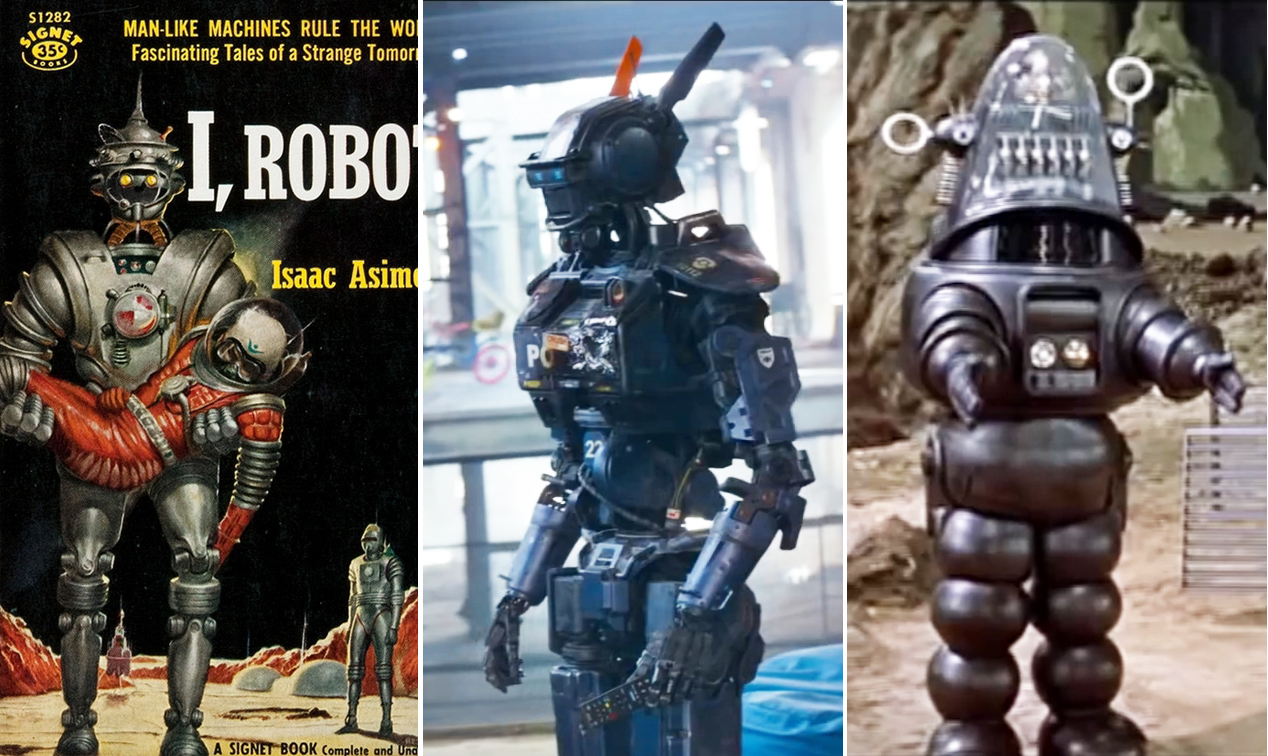
Artificial intelligence has appeared in a great many movies over the years, often as robots. The latest is Chappie, a movie that has been panned by a majority of critics but apparently enjoyed by quite a few movie goers.

Robots (or AI) have been good and bad. The first that I recall was Robby in the first science fiction (SF) movie to adhere to scientific ideas (of the time), Forbidden Planet. This 1956 movie starred Leslie Nielsen when he was still doing romantic leading roles. The character of Robby created quite a stir at the time. He was definitely a benevolent robot who was unable to harm humans. An immense computer system, the hidden evil element of the movie, served as a foil.

robots 03
Most people remember HAL, the AI embedded in the spaceship of 2001, a Space Odyssey. This movie debuted twelve years later and showed how AI could be a force of evil. Few who saw it will forget the creepy voice of HAL (notably one letter apiece short of IBM alphabetically).

I probably will not see Chappie for several reasons based on the reviews and my viewing of the trailers. The concept of artificial intelligence rising to the level of human consciousness bothers me, not for religious but for scientific reasons. However, many students probably will see it if only because of its themes involving street gangs and defiance of authority.  Continue reading

Videos on Demand: Education Week ‘Leaders to Learn From’ 2015

On 18 March 2015, Education Week recognized 16 exceptional district-level leaders at an exclusive event in Washington, D.C., featuring presentations and discussions on leadership and education policy. Featured speakers included Assistant Secretary, U.S. Department of Education Deborah S. Delisle and Adviser to the Premier and Minister of Education in Ontario, Canada Michael Fullan. Watch the videos from the event.

Recognition Presentation: Meet the Leaders To Learn From (Part I)


Recognition Presentation: Meet the Leaders To Learn From (Part II)

Continue reading

‘Peer Reviewing in Political Science’ – April 2015 Issue of PS

PS Header2
In The Profession section of its April 2015 (v48, 02) issue, PS: Political Science & Politics (PS)1 scrutinizes the peer review system, a core value in the research community. Some question whether or not peer review is sustainable given the increased and unequal burdens placed on reviewers. In “Peer Reviewing in Political Science: New Survey Results”, Paul Djupe of Denison University argues that the common perception that reviewers are overburdened with requests has never been tested through reliable data collection. He finds, contrary to the conventional wisdom, that most scholars appreciate peer review, and that most peer review requests by journals are accepted. The only common complaint is that peer review is not considered as part of the tenure and promotion process.

Also in The Profession, the right time for associate professors to go for promotion is considered by Kurt Weyland of the University of Texas in “The Logic of the Promotion Decision: In Dubio Pro Patientia”. Weyland argues that it is in the associate professor’s own interest to establish a convincing case before they bid for the rank of full professor and efforts to ‘force’ a promotion prematurely can leave a bad impression and damage the career. Accumulating a strong record in research and publication is the best way to assure a smooth path to tenure.

PS Toolbar2

In the Profession Symposium, see the articles on “Reinventing the Scholarly Conference: Reflections from the Field.”

In The Teacher , Matthew Woessner of Penn State shows how computer games like SimCity can be used to engage young people to think about politics, governance, and the challenges of managing cities in the real world.  Continue reading