


By Jim Shimabukuro (assisted by Claude)
Editor
Filed under: Uncategorized | Leave a comment »
By Jim Shimabukuro (assisted by Claude)
Editor
Filed under: Uncategorized | Leave a comment »

By Jim Shimabukuro (assisted by Perplexity)
Editor
(Related: Feb 2026, Dec 2025, Nov 2025, Oct 2025, Sep 2025)
The three most pressing AI decisions for January 2026 are about (1) whether nations converge on compatible AI governance or double down on fragmentation, (2) how far governments go in centralizing control over frontier compute and models, and (3) whether leading actors treat AI as a driver of shared development or as a zero‑sum geopolitical weapon. Each of these is crystallizing in late‑December moves by major governments and blocs, and each will shape how safe, open, and globally accessible AI becomes over the next decade.weforum+5

Filed under: Uncategorized | Leave a comment »

By Jim Shimabukuro (assisted by ChatGPT, Copilot, Grok, Gemini, Perplexity, DeepSeek, Meta, Claude)
Editor
[Related: Oct 2025]
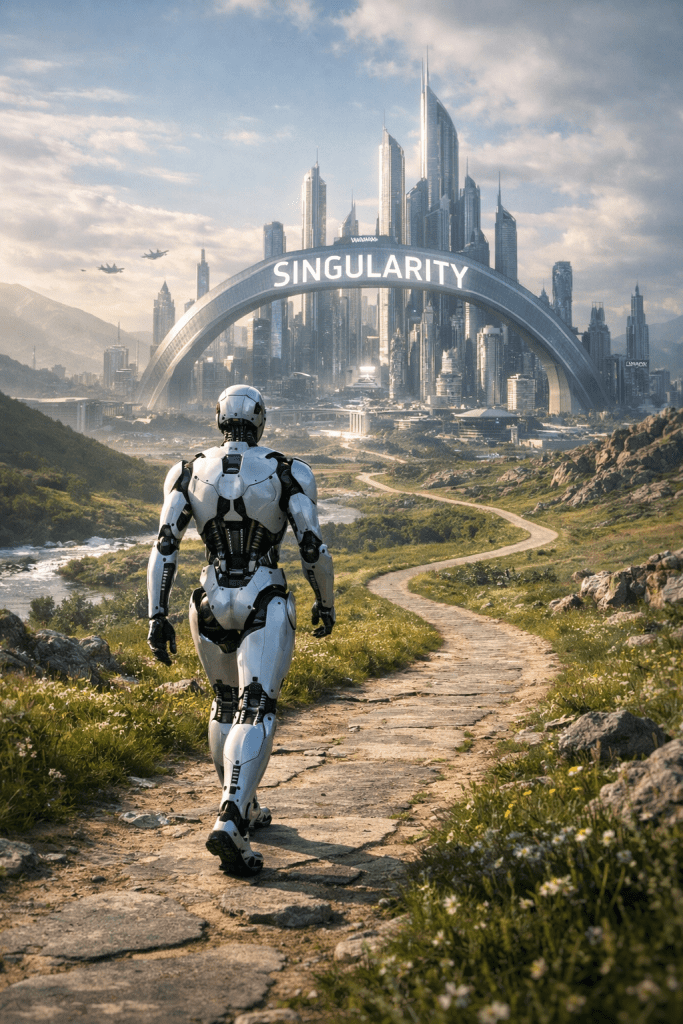
Introduction: I asked eight chatbots to predict the arrival of singularity – the moment when AI first surpasses human intelligence and improves itself. Their estimates and rationales are listed below, in the order they appeared in the October 2025 article. -js
Filed under: Uncategorized | Leave a comment »

By Jim Shimabukuro (assisted by Claude)
Editor
Maria sat at her grandmother’s kitchen table, the one with the chipped Formica edge and the wobbly leg that had been shimmed with folded cardboard since 1987. It was December 25, 2025. Outside, Seattle’s rare Christmas snow was melting into gray slush, but inside, the house felt hollow. Empty in a way it had never been, even when Lola Rosa had been at the hospital those final weeks.

Filed under: Uncategorized | Leave a comment »

By Jim Shimabukuro (assisted by Claude and Grok)
Editor
[Related: Mar 2026, Jan 2026, Nov 2025, Oct 2025, Sep 2025, Aug 2025]
In December’s edition of Five Emerging AI Trends, we’re covering the following topics: (1) Augmented Hearing in AI Smart Glasses: Meta’s “Conversation Focus” Feature, (2) NetraAI: Explainable AI Platform for Clinical Trial Optimization, (3) Google’s LiteRT: Bringing AI Models to Microcontrollers and Edge Devices, (3) The Titans + MIRAS framework: enabling AI models to possess long-term memory, and (5) DeepSeek’s emergence as a powerful open-source LLM. -js

Filed under: Uncategorized | 1 Comment »

By Jim Shimabukuro (assisted by Claude, ChatGPT, Gemini, Copilot)
Editor
[See earlier reports: Nov 2025, Oct 2025]
While most experts believe the arrival of AGI is decades away, some predict it might occur as soon as the next five years. “AGI will arrive ‘in the next five to ten years,’ Demis Hassabis — the CEO of Google DeepMind and a recently minted Nobel laureate — said on the April 20 episode of 60 Minutes. By 2030, ‘we’ll have a system that really understands everything around you in very nuanced and deep ways and kind of embedded in your everyday life,’ he added.”1 Month by month, the AGI tide advances, and the pace seems exponential. From Nov. 16 to Dec. 24, 2025, here are six developments worth noting. -js
Filed under: Uncategorized | Leave a comment »

By Jim Shimabukuro (assisted by Gemini)
Editor
In their article, “AI in Informal and Formal Education: A Historical Perspective,” published in the inaugural 2025 issue of AI-Enhanced Learning1, Glen Bull, N. Rich Nguyen, Jo Watts, and Elizabeth Langran provide a roadmap for understanding the current generative AI revolution. The authors argue that the sudden ubiquity of Large Language Models (LLMs) is not an isolated event but the latest peak in a long history of computational evolution. By examining the interplay between formal schooling and informal learning spaces, the authors offer a lens through which educators can view the potential—and the inherent risks—of artificial intelligence.
Filed under: Uncategorized | Leave a comment »

By Jim Shimabukuro (assisted by Gemini)
Editor
Introduction: Fei-Fei Li, in “Spatial Intelligence Is AI’s Next Frontier” (Time.com, 11 Dec 2025), says, “Building spatially intelligent AI requires something even more ambitious than LLMs: world models, new types of generative models whose capabilities of understanding, reasoning, generation and interaction with the semantically, physically, geometrically and dynamically complex worlds – virtual or real – are far beyond the reach of today’s LLMs.” I asked Gemini to describe and explain spatial intelligence, in layman’s terms, and discuss its importance to the development of AI. -js
Filed under: Uncategorized | Leave a comment »

By Jim Shimabukuro (assisted by Copilot, ChatGPT, Gemini, Claude)
Editor
I can’t help but feel that John Nosta, in “AI Isn’t Killing Education (AI is revealing what education never was)” (Psychology Today, 13 Dec. 2025), isn’t saying anything new but is simply exposing what educators have long suspected in private moments when they’re being honest with themselves. Here are some quotes from his article:
Filed under: Uncategorized | Leave a comment »

By Jim Shimabukuro (assisted by Gemini)
Editor
Introduction: Bryan Walsh, in “We’re running out of good ideas. AI might be how we find new ones” (Vox, 13 Dec. 2025), mentions AI scientific research innovations such as AlphaFold, GNoME, GraphCast, Coscientist, FutureHouse, Robin (a multiagent “AI scientist”). I asked Gemini to expand on them. -js

Filed under: Uncategorized | Leave a comment »

By Jim Shimabukuro (assisted by Copilot)
Editor
[Related articles: Jan 2026, Nov. 2025, Oct 2025, Sep 2025, Aug 2025]
Between mid‑November and mid‑December 2025, the AI landscape shifted through a combination of technical breakthroughs, political realignments, and cultural recognition. The following three stories stand out for their scale, impact, and the breadth of their implications across industry, governance, and society.

Filed under: Uncategorized | Leave a comment »

By Jim Shimabukuro (assisted by Copilot)
Editor
December 2025 was a month marked not only by rapid advances in artificial intelligence but also by several highly visible failures that revealed the fragility of the industry’s momentum. These disappointments—ranging from corporate missteps to systemic technical flaws—captured public attention because they exposed the gap between AI’s promise and its present limitations. Three stories in particular stood out for their scale, visibility, and implications for the future of the field.

Filed under: Uncategorized | Leave a comment »

By Jim Shimabukuro (assisted by Claude)
Editor
JS: Hi, Claude. Sam Kriss, in “Why Does A.I. Write Like … That?” (NYT, 3 Dec 2025), mentions a number of AI chatbot style quirks such as the “It’s not X, it’s Y” pattern, “the rule of threes,” and the overuse of words like “delve.” He implies that AI is unable to break these habits. Question for you: Can AI be trained to avoid these annoying quirks?

Filed under: Uncategorized | Leave a comment »

By Jim Shimabukuro (assisted by ChatGPT)
Editor
The 2026 Indiana Fever prospects — as of December 2025– regarding contract status, roster role, trade/test-the-market likelihood, and recruiting/league-movement rumors tied to each player.

Filed under: Uncategorized | Leave a comment »

By Jim Shimabukuro (assisted by ChatGPT)
Editor
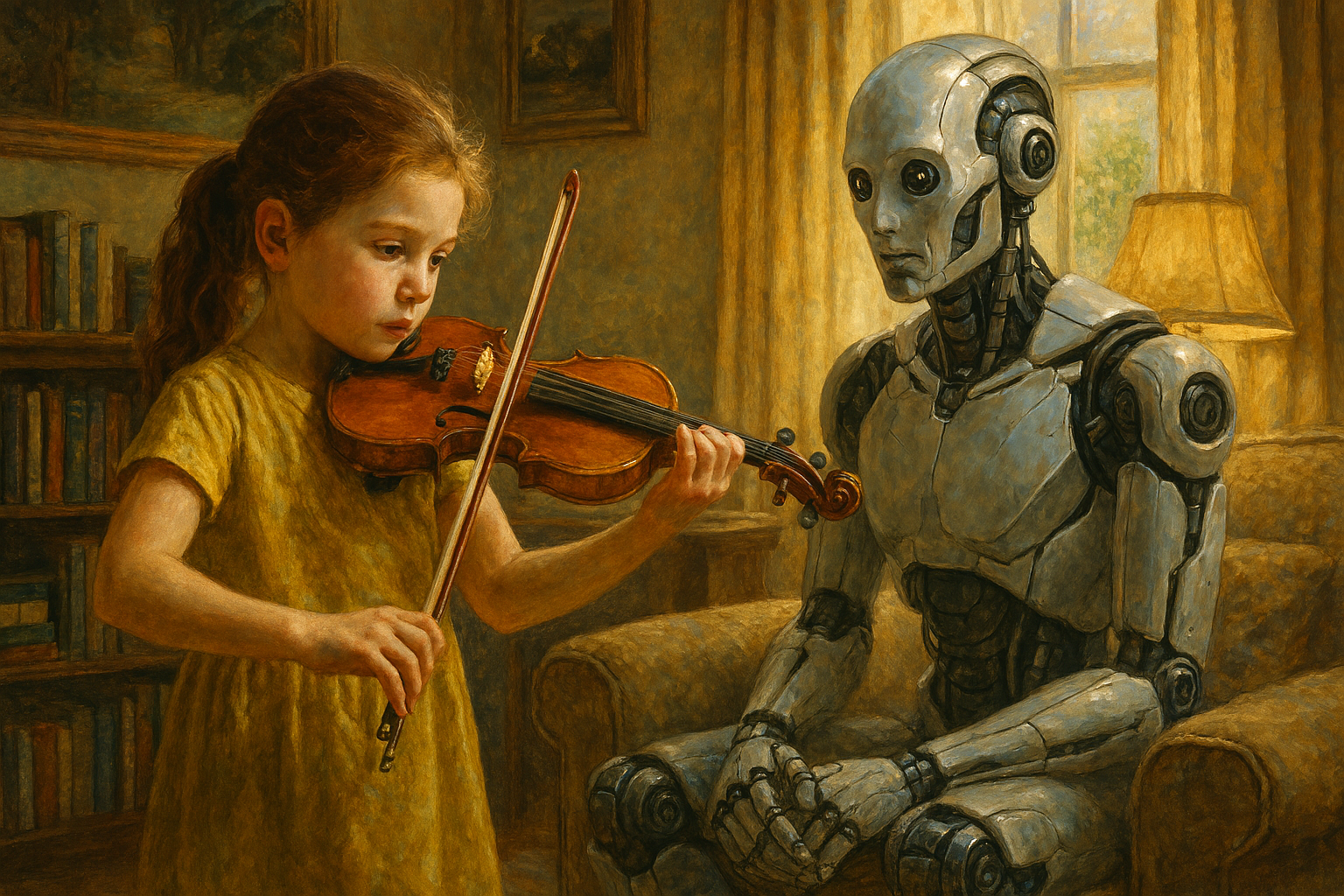
Recent studies and reports show AI is already changing how child and teen classical musicians practice and develop. AI-powered apps give rapid, objective feedback, personalize practice paths, support goal-setting and self-regulated learning, and (in controlled studies) produce measurable gains in confidence and performance compared with traditional, teacher-only practice.
Filed under: Uncategorized | Leave a comment »

By Jim Shimabukuro (assisted by Grok)
Editor
[Also see the reports from Oct 2025, Sept 2025, July 2025]
College professors are incorporating AI into their professional lives, often in ways that extend beyond traditional teaching into research, curriculum design, and reflective writing. For November-December 2025, here are three inspiring cases: Matt Kinservik at the University of Delaware, who weaves AI into his writing instruction to foster critical skills; Jennifer Chen at Kean University, who leverages AI in her educational research to pioneer ethical applications; and Zach Justus at California State University, Chico, who employs AI in his communication work to enhance evaluation and mentorship.
Filed under: Uncategorized | Leave a comment »

By Jim Shimabukuro (assisted by ChatGPT)
Editor
[Also see earlier reports: November 2025, October 2025.]
The original five-issue framing from the November report still holds, but every item has deepened and a few new flashpoints have emerged that change the tactical picture on the ground. What’s changed for December is intensity and specificity: (a) the federal/state enforcement axis has added concrete actions (eg., a draft State Department list of 38 institutions and new Education Department guidance); (b) programmatic harm has moved from threat to real, quantifiable cuts (over 100 TRIO program cancellations and continuing freezes); and (c) a new wave of campus-level legal conflicts and take-downs (student publications suspended at the University of Alabama; a Liberty Justice Center lawsuit against the University of Arizona) have become the brightest flashpoints. See The Guardian and Inside Higher Ed for the State Department/partnership reporting and the TRIO coverage. (The Guardian)

Filed under: Uncategorized | Leave a comment »

“Google … released a new version of its Gemini AI model last month [August 2025] that surpassed OpenAI on industry benchmark tests and sent the search giant’s stock soaring. Gemini’s user base has been climbing since the August release of an image generator, Nano Banana, and Google said monthly active users grew from 450 million in July to 650 million in October” (Berber Jin, 2 Dec 2025).

Filed under: Uncategorized | Leave a comment »

By Jim Shimabukuro (assisted by Perplexity)
Editor
[Related reports: Jan 2026, Nov. 2025, Oct. 2025]
Three critical educational technology issues for higher education in December 2025 are: (1) AI governance and institutional trust, (2) cybersecurity and digital resilience, and (3) AI policy, assessment, and student mental health. Each is already sharply defined in November 2025 articles that document why these problems matter for the coming term.etcjournal+3
Filed under: Uncategorized | Leave a comment »

By Jim Shimabukuro (assisted by ChatGPT)
Editor
Introduction: Elon Musk predicted, at the US-Saudi Forum 19 Nov 2025, that “work will be optional” in approximately 10-to-20 years as a result of advances in AI technology. I asked ChatGPT to search the current (2025) literature for (1) the three strongest arguments FOR Musk’s prediction and (2) the three strongest arguments AGAINST his prediction. I added that the arguments need not refer to Musk or the US-Saudi forum. -js

Filed under: Uncategorized | Leave a comment »

By Jim Shimabukuro (assisted by ChatGPT)
Editor
Introduction: On Thanksgiving Day 2025, I asked ChatGPT to identify ten individuals in the world that we should be thanking for significant contributions to the growth of AI in 2025. -js
Filed under: Uncategorized | Leave a comment »

By Jim Shimabukuro (assisted by Perplexity)
Editor
(Related: Feb 2026, Jan 2026, Nov 2025, Oct 2025, Sep 2025)
The field of AI is heading into December 2025 with three urgent decisions: how to govern frontier AI models, how to handle the open‑source versus closed‑source race, and how to expand AI compute without blowing through energy, water, and climate constraints. Each of these comes with big power struggles between governments and tech companies, and the choices made in the next few weeks will shape who leads AI, how safe it is, and who gets access.anecdotes+2

Filed under: Uncategorized | Leave a comment »

By Jim Shimabukuro (assisted by Claude)
Editor
Introduction: I asked Claude to review articles published in the last three months that focused on effective leadership styles for the AI era. Based on the three selections, I asked for generalizations about ideal leadership and a definition for this new leadership style. -js
Filed under: Uncategorized | Leave a comment »

By Jim Shimabukuro (assisted by Grok)
Editor
[Related: Mar 2026, Jan 2026, Dec 2025, Oct 2025, Sep 2025, Aug 2025]
Research suggests several AI trends are gaining traction in specialized tech communities and industries during November 2025, though they haven’t yet captured widespread public attention. These include advancements that could reshape how AI integrates into workflows, infrastructure, and user experiences, but evidence leans toward them remaining niche for now due to technical complexity and limited mainstream adoption. Here are the top five, selected based on mentions in recent reports and discussions:

Filed under: Uncategorized | Leave a comment »

“As Andrej Karpathy just wrote, humanity is having first contact with a type of intelligence that does not come from biology, evolution, fear, hunger, status, or shame. For the first time in history, we are dealing with a mind that isn’t an animal. We just haven’t adjusted our thinking to match. Human intelligence isn’t the default – it’s a local anomaly. For our entire existence, we’ve assumed that our way of thinking is the template for intelligence itself. It isn’t. It’s just the only version we’ve ever met…. Organisations often do things that make no commercial sense: [1] meetings with fifteen people because exclusion feels threatening, [2] decisions delayed because no-one wants to be wrong first, [3] brilliant ideas softened into mediocrity so no-one gets upset, [4] and vanity projects that limp on long after the data has declared them dead…. AI isn’t trying to be human – and it isn’t trying to be anything at all. It simply optimises whatever objective it is given. And that is the key thing that most people keep fumbling over…. A system can generate brilliant strategies without wanting power. It can persuade without caring about influence. It can outperform a human without dreaming of replacing them. Ability is not agency. Agency only emerges if we design it – by giving systems goals, tools, and persistence. As my friend Dr Rami Mukhtar always says: AI HAS NO AGENCY” (Constantine Frantzeskos, 25 Nov 2025).
Filed under: Uncategorized | Leave a comment »


 Educational Technology and Change Journal
