JS: Claude, you’re Shakespeare, returning to 1590s London after spending a month in the in the US in 2025. You were intrigued by many wonders in your time travel, and one was the concept of AGI. You’ve decided to write a sonnet, in your now familiar Renaissance style, capturing your feelings about this innovative idea. Share that sonnet with us.
Introduction: Grok and I explored the roots of underperforming elementary schools in the nation and the implications that surfaced as a result of our digging. -js
Introduction: Elon Musk’s Colossus—built by xAI in Memphis—is currently considered the largest AI supercomputer in the world in terms of GPU count, computing power, and rapid build-out, but it is not the largest data center globally when measured by physical size or total server capacity. Competitive megacenter projects from China, the U.S., and Europe rival or exceed it in site area and may soon overtake xAI both in scale and ambition.wikipedia+5
Introduction: The hardware for each is optimized for vastly different workloads. The core difference is that desktop GPUs (Graphics Processing Units) are designed for high frame rates in a single application (a game) on a single machine, while data center GPUs (like those in xAI’s cluster) are designed for high throughput in massively parallel computations across thousands of machines. Here’s a detailed breakdown, referencing the most relevant hardware.
Referenced GPUs
Data Center GPUs: NVIDIA’s H100 (the current workhorse of AI, used in clusters like xAI’s Grok).
Charlie Kirk’s recent death has sparked an outpouring of tributes from across the political spectrum and cultural landscape in the US and the world. The following is a sampling from prominent figures. These reflect admiration, grief, and reflections on his legacy as a conservative activist and founder of Turning Point USA.
AI is already unclogging traffic in the U.S. and abroad. Cities are using machine learning and optimization to retime signals continuously, coordinate corridors, create “green waves” for emergency vehicles, and cut stops, delay, and emissions. The broader pattern is clear: agencies are moving from fixed-time plans to continuously learning optimization, starting with high-impact corridors, then scaling citywide as data and staffing permit. Below are three standout programs, ranked for scale, maturity, and independently reported results.
Traffic in a large Chinese city. Image created by Copilot.
Free smartphone apps to converse in a foreign language are already unfolding in 2025. Several free AI-powered apps now offer real-time voice-to-voice translation across dozens (even hundreds) of languages, right from your smartphone. Here’s how close we are to seamless multilingual conversation.
An English-speaking farmer and a Swahili-speaking teacher—conversing fluidly through a pocket-sized AI interpreter. Image created by ChatBox.
Introduction: This is Copilot‘s choice for the vision that’s most compelling in the development of AI. -js
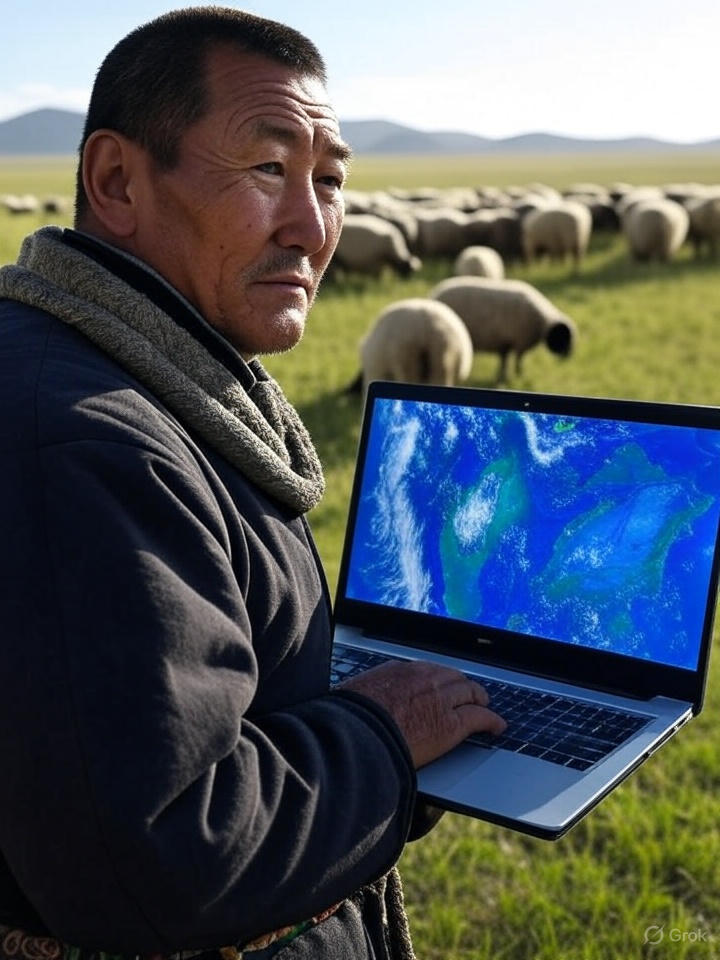
In rural Mongolia, nomadic herders are using AI-enhanced satellite imagery and predictive models to anticipate weather shifts and optimize grazing routes. Image created by Grok.
Introduction: Claude and I had a conversation about the fundamental building blocks for a learning model. To sidestep the confusing backdrop of countless learning and developmental theories, we consciously avoided references to them. We ran through a few narratives to illustrate the five blocks and ended up with a short story, Algorithm of an Intentional Heart, that breathes life into this construct. -js
Marcus Chen had always approached life like a well-designed algorithm. As a data scientist for a tech startup, he found comfort in patterns, predictions, and logical sequences. So when his coworker Priya finally wore him down about trying online dating, he approached it with the same methodical precision he brought to machine learning models.
Introduction: ChatGPT-5 and I discussed the notion that cMOOCs (Connectivist MOOCs), instead of fading away, have simply blended into the massive social web, effectively turning it into the mother of all cMOOCs. Our discussion flowed into chatbots and the realization that they’re actually closed systems and that the next logical step is to add a bridge (connection) from the human-chatbot capsule to a parallel and open social media discussion. -js
Introduction: In this conversation, ChatGPT and I clarify my grasp of data labeling in the context of AI training, supervised vs unsupervised learning, agentic vs non-agentic AI, and AutoGPT. -js
Introduction: ChatGPT-5 and I had a conversation this morning about college composition professors trying to define what’s left of writing after it’s separated from AI-generated content. This thread eventually led us to the question of whether AI is leading us into the Post-Writing Century. -js
Here are five standout ways to dive into conversational Uchinaaguchi using free web and AI-based resources. Each one offers a unique entry point into the language and culture of Okinawa.
Learning ʻōlelo Hawaiʻi through free, web-based or AI-enhanced tools is not only possible, it’s a powerful way to connect with cultural depth and linguistic nuance. Here are five standout options that blend accessibility, immersion, and conversational practice:
Here are five standout ways to dive into conversational Spanish using free web- or AI-based tools—each offering a unique blend of immersion, interactivity, and cultural nuance.
Introduction: Since March 2023, the field of labeled and unlabeled data processing has experienced substantial growth, driven by the escalating demands of AI and machine learning applications. This expansion is evident in surging market valuations for data labeling services, breakthroughs in semi-supervised and self-supervised learning techniques, and the emergence of synthetic data generation as a key enabler for creating labeled datasets from unlabeled sources. Below, Grok outlines the extent of this growth and highlights notable products, procedures, and services that have arisen or evolved from related research and development.
Introduction: The “average” 20-year-old American woman is more of a statistical mosaic than a single archetype. Let’s break it down using the most recent data available, while keeping in mind that averages can mask enormous diversity across regions, cultures, and personal choices.
Introduction: What would the “perfect mile runner” look like if we combined all current knowledge of human anatomy, physiology, and psychology? Running the mile in under 3:40 requires a blend of raw speed (sprinter traits) and endurance (distance runner traits), plus biomechanics, psychology, and even cultural background.


















































 Educational Technology and Change Journal
