ePortfolio Redux
Tom Segal, in “Rethinking the Learning Experience: Part IV,” says, “Perhaps the most elemental of credentialing bodies is the e-portfolio” (Huff Post, 8.9.12). He continues, “With an e-portfolio, students can share media demonstrating leadership (perhaps film of the league championship game where they captained the team to victory) or teamwork (like video of their A.P. European History final presentation) in an easily digestible format.” He mentions Desire2Learn, Pathbrite, and Pearson as providers of eportfolio services. However, he fails to mention the simplest, most accessible, most flexible, and least expensive eportfolio platform — blogs, e.g., WordPress and Google’s Blogger.
The Dark Side of Open Online Courses
This headline from the St. Louis Post-Dispatch, “Elite Colleges Transforming Online Higher Education” (by Terence Chea, 8.9.12), is just one of many that have been gushing over the open online courses being offered by top-tiers such as Harvard, MIT, and Stanford. We shouldn’t, however, forget that these changes have been initiated and developed by individuals, many or most of whom are classroom teachers. The administrators who have come around to supporting these innovators ought to be commended for their enlightened leadership and willingness to take risks. However, as of now, the support is apparently still tentative, judging by the conservative language of administrative policy that continues to insist on the superiority of blended approaches. The gap between the visions of innovators and administrators is huge, forcing some of the most progressive teachers to strike out on their own. The time is ripe for influential leaders to step forward and, first, declare the viability of open online courses; second, support explorations into credentialing strategies; and third, implement the development of procedures to integrate open and fully online courses into their mainstream offerings.
The Role of Mobiles in Selecting Colleges and Careers
In “Googling Across India for Education Courses and Choices,” Anubhuti Vishnoi (The Indian Express, 8.9.12) tells us that “India’s students are increasingly relying on the internet to make critical career decisions.” More specifically, they’re turning to mobiles: “There are as many as 70 million mobile internet users in India now and 54 per cent … are in the 18-35 age group.” Among students, “Over 66 per cent … said they use mobiles to access the Web.” The message seems to be clear: As smartphones and tablets erode the lines that separate computers from mobiles, higher ed institutions should be looking at ways to adapt their online info to accommodate mobiles.
A State Dept. of Ed That’s Taking Its Conference Online!
The West Virginia Statewide Technology Conference runs from August 8-9, 2012. What makes it really special is that it is completely virtual and free! Here’s a quote from their site: “You can attend and participate in the conference from the comfort of your favorite internet-connected computer. Look for an incredible collection of sessions from our presenters and demonstrations from our vendors. Yes this is a little different from what you have experienced in the past, but let’s give it a try! After all, technology is what we are about and our virtual conference will explore the limits of what can be done.” Kudos to the WV Department of Education for taking this gigantic leap for its K-12 educators. (Additional source.)
My own experiences with NBC Olympic streaming video ranged widely from fairly good to very poor.
What will tomorrow’s students expect? Do we really know? Online will be a component, certainly. However, what sort of interaction with their instructors will be the norm? Will it synchronous or asynchronous? Probably some of each.
Will textbooks be all online? Or will my vision of the future come true and textbooks in any form will disappear to be replaced by truly interactive online learning software?
Today’s interactive learning software makes a mockery of the word “interactive.” The online game companies know what interactive really means. Must learning software be games? Some think so. I strongly disagree. We can learn from them but don’t have to mimic them.
Regarding the physical plant part of educational institutions, I think that future will depend on the specific institution. K-5 will remain firmly physical. The top colleges, e.g., Ivy schools, MIT and Caltech, Stanford and Duke, et al., will be able to retain their hallowed campuses because their students gain so much for their futures from hanging out together physically. These institutions will also be reaching out to the world with online courses from the best instructors in the world.
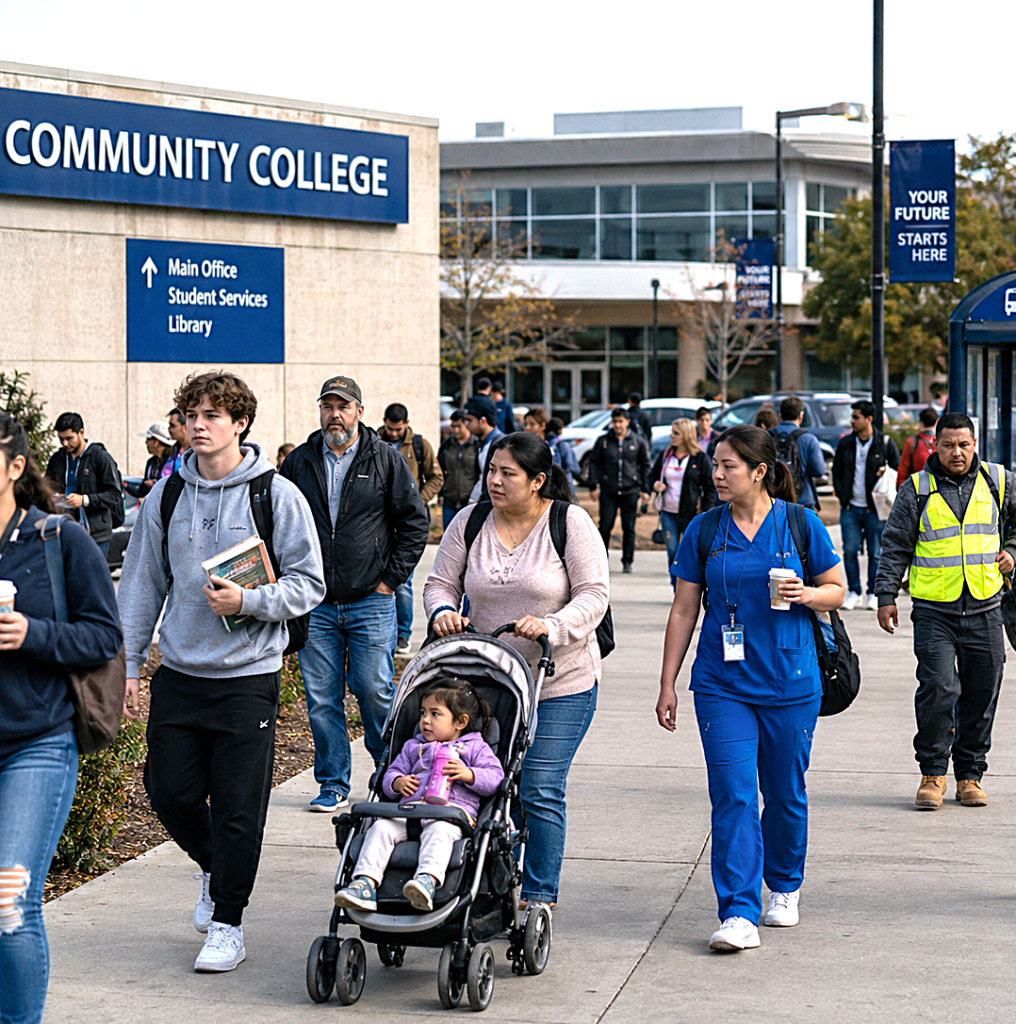
What will happen to community colleges? If you can replace a CC campus with an Internet server farm, will it happen?
What about the “Big Ten”? Will football and basketball support the old style? You can’t make football games virtual. These teams must actually play. The alumni must be able to freeze in the bleachers in December while watching their fellows on the field and then donate, donate, donate!
And so it goes. It’s not just about the courses.
Make no mistake. Big changes are afoot. Also, do not make the mistake of rash predictions. The potential for game-changing innovation is strong in the current climate. J. P. Morgan, when asked for his prediction about the stock market, famously said, “It will fluctuate.” So, I say to all of you about the future of education, It will be different. The specific differences are not predictable with any certainty, but some overall expectations are:
Fewer colleges.
Different modes of instruction — especially extremely interactive online learning.
Instructors will be critical, not just dull lecturers and graders; they will probably be paid less for their work — at least per student.
Redefinition of what a degree means.
Increasing separation of teaching and publication (e.g., research) personnel.
Hopefully, all of these changes will settle down to something really good and worthwhile. More hopefully, the escalating cost of a usable college degree will decline markedly.
NBC will be broadcasting the Rio Olympics in 2016, and a seemingly casual comment from a spokesperson in a recent TV news segment should have sent a shockwave throughout the world. The fact that it hasn’t says a lot about people’s attitude toward technology. They are either resigned to the coming upheaval or doubtful that it will ever happen. More than likely, most simply don’t care. If it happens, it happens. If it doesn’t, it doesn’t. The sense is that, either way, they’re powerless.
The comment was in response to criticisms aimed at NBC’s online streaming of live events and archived videos from the current London Olympics. If you’ve made the effort to register through your cable or other service provider and if you’ve then tried to actually log on and view events, then you’re probably part of the mob that’s throwing virtual bricks at NBC. “Poor” doesn’t even come close to describing the ordeal.
To NBC’s credit, the spokesperson made no attempt to defend or gloss over the snafu that takes on massive proportions in the context of the internet. He told it like it is. The planning for the media coverage was conceived two years ago when NBC won the contract to broadcast the Olympics, and in the time frame for change in online technology, two years may as well be two lifetimes, and, needless to say, a lot can and will happen in the interval.
The point is that, two years ago, NBC planners had no way of knowing the extent to which online media would come to dominate communications in general and broadcasting in particular. Television today is where hardcopy newspapers were a few years ago. The sweep is toward digital and online, away from analog and onground.
The lesson from 2012 is clear. For NBC, the emphasis for the 2016 Olympics will be digital and online. Increasingly, people expect and want their video broadcasts over the internet from anywhere at anytime via mobile devices such as iPhones and iPads as well laptops and desktops. What’s the prognosis for technology that’s built around standalone TV sets? We don’t have to look far for clues. Landlines. Phone booths. Film cameras. Dinosaurs.
For educators, the implications are enormous. When the video information we now receive from dedicated TV sets leaves the ground and goes virtual, mobile internet devices will take on a whole new dimension in the lives of students. For example, their visual perception of the world and reality will be continually reconstructed 24-7 in a medium that’s increasingly mobile and interactive. Information and learning resources as well as synchronous and asynchronous personal and group communications will be literally at their fingertips whenever they want it and wherever they are. The outcome is obvious. Students will expect their course work, learning support services, and teachers to be no less accessible — from anywhere at anytime.
Another implication is that educators have to rethink their budgets. Do they continue to pour their limited dollars into constructing and maintaining onground facilities such as buildings, classrooms, and offices? Or do they begin to invest in infrastructures and strategies that maximize the potential for online learning?
By Lynn Zimmerman
Associate Editor
Editor, Teacher Education
Clintondale High School near Detroit, Michigan, has instituted a different model for teaching in an effort to improve grades, increase learning, and better support students. They are using what principal Greg Green calls flipped schooling (aired on Dick Gordon’s The Story, April 16, 2012).
Students at Clintondale were struggling, not passing classes and not performing well on standardized tests. Green asked students what they thought was going on, and their reply was that they had trouble doing school work at home. They could not concentrate, or they had no one to help them if they did not understand the assignment or the concepts. In turn they were getting further and further behind.
Greg Green
Based on this information, Green decided that instruction was not aligned with how students learn. Change was needed. He and his staff re-imagined schooling so that, rather than sitting in class, listening to a lecture, and doing homework at home, students study background information on the topic at home then work on practical problems as well as ask and answer questions about the material in class. He said they use screen captures, videos, and other technology for at-home lectures. Students can look over the materials at their own pace, as often as they need to, in order to understand the concepts or to pinpoint problem areas. The next day students come to school to ask and answer questions about the materials and to solve problems in class.
Green reported that their experiment is meeting with some success. Failure rates in the courses that are using this flipped model have been cut in half. They also found that students who were in flipped math classes had a 10% gain on state standardized math tests.
The flipped school model is a good example of how technology can be used to enhance learning. Technology in this case can
optimize learning time
align with students’ learning styles and needs
provide opportunities for repetition as needed
When students are in class, they and their teachers can interact in the face-to-face context in meaningful and productive ways. This type of constructivist learning is effective as the student builds his/her own knowledge. They learn the content as they develop problem-solving and critical thinking skills.
In articles on the CNN Blog, Green elaborates on the benefits of flipped schooling and addresses the concerns that readers have about this model:
My friend Charlie Fitzpatrick and I attended a national summer workshop long ago. We were introduced to the rudiments of GIS (geographic information system). Years later, I attended one day of his conference. Charlie is now the education director for ESRI (Environmental Systems Research Institute, Inc.). The day I went was map day. I love maps and charts and geography books and citizen science. Some of the maps were on tiles and so beautiful.
A favorite starting point with students is My Wonderful World. This site is a great place to start to learn the GIS. There is also the teacher resource page of the National Geographic.
I never attended the whole conference before this year. At the time I was taking a super computing (SC) workshop and using GIS. But I had no idea of all of the creative and innovative ways in which it is used today. A look at ESRI is all you need to know about GIS. I could make a simple definition, but I like the ESRI definition because it is all inclusive.
This slideshow requires JavaScript.
Last summer we worked with inner city kids on several projects at the Joint Education Facilities, Inc., in Washington, DC. It is located in Southeast Washington and is the only neighborhood high performance computing center in the US. The kids came on Saturdays in the summer to learn GIS and then to complete projects in the GIS technology program. We used GIS to solve problems in the social sciences. Continue reading →
All teachers must learn certain things. For example, they learn about learning theory, classroom discipline, and how to write lesson plans. In addition, they learn the material and ideas of their chosen subject area. As I read articles about science education and communicate with many science teachers, I become more convinced that our teachers colleges are not providing the necessary learning to our future science teachers.
What is this necessary learning and why is it important?
To answer this question, you must first understand what science is. Science is not a bunch of “facts,” e.g., Mercury is closest to the Sun; prophase is the first phase of mitosis; force is proportional to the rate of change of momentum; igneous rocks are formed from molten rock. Science is an approach to finding out these things, a way of thinking, of solving problems. It uses the work of previous scientists and new data to be sure. So those “facts” are part of the learning but hardly the most important part.
So-called science facts are always subject to revision, but the means by which they were extracted from nature with great difficulty remains the same. We must teach some science content in order to have material upon which to apply the developing thinking skills of our students.
Science courses inflict lots of vocabulary on students too. Some words seem familiar but are used by scientists in a very specific manner. “Work,” for example, does not take place when you’re holding a heavy weight above your head – if you’re talking about science. Work is a specific and quantitative term in science. Other words seem entirely unfamiliar and even bizarre. In physical science, “entropy” is a made-up word for a measure of disorder in things.
Science education must provide the content of science including vocabulary, an understanding of the nature of science, and development of scientific thinking skills. Anything else is superfluous in primary and secondary education. In post-secondary education of science and medical majors, there’s more, but that part is not the subject of this discussion.
Without an understanding of the nature of science, students will not be able to interpret what’s going on around them every day. You read about global warming and conflicting claims regarding it. You read about protecting species from extinction and then about how 95% of all species in the history of the Earth have gone extinct naturally. You read about an energy crisis and then about how the price of gasoline is being manipulated by Wall Street traders and that the energy situation is just fine. All of this would be just entertainment were it not for the fact that so many countries are democracies, and the people are expected to vote, to make decisions, on these issues in elections. Continue reading →
In response to the explosive trend in higher ed toward open online courses (OOCs), Berkeley’s executive committee for online education published* the university’s plan for change. As a strategy, it’s an echo of similar guidelines across the country and the world. However, what distinguishes it from all the rest is intelligence. It’s obvious that the committee has done its homework and understands the deeper implications of online education.
The plan has two standout elements. The first is a flexible approach to defining “online” education:
certificate and graduate degree programs that are in high demand
undergraduate gateway and hybrid courses that increase available capacity and enrich learning for our on-campus students
“public good” courses that we will typically offer for free to a wide audience as a community service and as a proven approach to exposing potential students to outstanding Berkeley faculty
development and sale of online educational content that can be deployed by other institutions or organizations
Of these, the fourth is the breakaway, and it implies a deeper understanding of how the current flood of open online courses and platforms might play out. That is, in the coming weeks and months, the key to OOCs may be the way client institutions integrate the courses into their programs. In the end, the value of courses may be in their unbundled state rather than in their current bundled, all-in-one platforms. For example, as unbundled content, OOCs could serve course designers from institutions around the world who would pick and choose parts from different courses — from the same or different colleges — to construct unique course mashups for their students.
This mashing process is familiar to educators who have been doing it with textbooks and multimedia for years. The big difference is that they now have anytime-anywhere access to content provided by some of the top teachers in the world. Furthermore, that content is open (not the same as free) or mashable as well as recorded and available in various digital media. This content could be sold in creative packages to institutions everywhere. This OOC-based business model may be the virtual extension of publishing in the 21st century.
The second element is a vision of integration that implies, once more, a clear awareness of the process of change. Unlike the vast majority of colleges, Berkeley understands that the current practice of “bolting” online programs to traditional onground platforms is a transitional phase. The ultimate shape of viable programs is a work in progress, and no one knows for sure exactly what it will be. The one certainty, however, is that “online methods will ultimately transform our traditional teaching program and we need to begin to systematically align our administrative and support functions to meet the changing needs of online and traditional programs.”
“Systematically align” is a euphemism for change, and when applied to staff and leaders, it means to educate or to keep on top of current trends and developments from as broad and as deep a perspective as possible. In short, this isn’t a time for panic and bandwagon decisions, and this is definitely not a time to sit still, pout, or cling to tradition. At Berkeley, the leaders realize that the future is their responsibility and that it can’t be passed off to others, outside experts or entrepreneurs, or borrowed from other institutions. And a critical part of that responsibility is to think — inside and outside the box.
Pre-online models for education are no longer adequate, yet that is all we have for now. The challenge is to draw a clear distinction between the old masquerading as the new and the genuinely new, between the new as a “bolt on” to the old and the new as an entirely different model that fulfills the promise of online technology. Leadership is critical in times of tumultuous change, and at Berkeley, the leaders have stepped up.
Recently, Nora Fleming, in “NAEP Reveals Shallow Grasp of Science” (Education Week, 19 June 2012) reported on a new study regarding the 2009 NAEP (National Assessment of Educational Progress) exam for grades four, eight, and twelve. Around 2,000 students at each grade level were given three “Interactive Computer Tasks” (ICT) and one “Hands-On Task” (HOT) to perform. They were asked questions about each task.
We all know that conclusions such as “shallow grasp of science” are fraught with difficulties, especially when the results tell more about the test than the students. In this case, there are more issues. What exactly does “shallow grasp” mean in this situation? What sort of understanding is required to achieve a high result?
You can check for yourself at a website that allows you to take these tests yourself and score your answers, if you have patience with the tests. I went through the grade 8 and grade 12 materials (my work with science education focuses on grades 6-13) and did not approve of most of the content. Because it’s quite difficult to separate student ability from test quality, the results are suspect.
Because generalities won’t suffice, I’ll provide one example that shows how test results can mislead regarding understanding. This example shows how an eighth-grade student responds to the ICT, “Playground Soil.” According to the instructions,
In this 20-minute task, students investigate the permeability of soil samples from two sites a town is considering for a play area. Students use their results to help decide which site has the better water drainage and is therefore the better place for a grassy play area.
Students analyze two samples: soil sample A that is 10% clay, 50% fine gravel, and 40% silt; and soil sample B that is 10% clay, 50% sand, and 40% silt. Note that the only difference is the middle component. Diagrams illustrate the soil composition.
Students are asked to predict which soil will be more permeable. Generally speaking, the one with more voids (more space between soil grains) will be more permeable. Clearly, fine gravel has larger particles than sand. Now, do a thought experiment with me. Suppose that you increase the size of the fine gravel particles substantially. You might even have a rock in the midst of a clay-silt mixture. The permeability of this rock plus clay-silt will closely match that of clay-silt alone. Now, imagine reducing the size of the rock while keeping the volume equal to one-half of the total. Once the particle size reaches that of clay (60% clay, 40% silt), you’ll have very little permeability because mixtures that are mostly clay don’t allow much water to pass through them. Continue reading →
On May 7, 2012, Dick Gordon aired an interview with Sebastian Thrun and David Evans called Udacity: Teaching Online, an online university that came about almost by chance. Although The Story does not air on my NPR station, thanks to modern technology, namely the iPod and podcasts, I was able to download this story and listen to it two months later.
Thrun is Google’s vice president and is recognized as a pioneer in artificial intelligence and robotics. He was a tenured professor at Stanford when his story began. Fall 2011, Thrun decided to make his graduate level AI course, normally taught in a lecture hall to about 200 students, available online for free. He wanted to try to reach a larger audience. He sent out one email announcement. Much to his surprise 160,000 students from all over the world enrolled, and 23,000 completed the course. Thrun was gratified that his experiment was so successful, that free quality education could reach anyone who wanted it.
Sebastian Thrun
During the semester, Thrun had to mend some fences with the administration at Stanford. He had made this decision on his own, and they were concerned about having the Stanford name on certificates he had promised completers. They finally compromised that completers would receive a “statement of accomplishment” from Thrun, a private individual but affiliated with Stanford. So began Udacity, which offers STEM (Science, Technology, Engineering, Mathematics) courses that students can take for free. For a fee they can take tests that certify their knowledge. Although there have been bumps along the way, Thrun says that he cannot imagine teaching any other way. William Bennet, in an interview with Thrun for CNN, “asked Thrun whether his enterprise and others like it will be the end of higher education as we know it — exclusive enclaves for a limited number of students at high tuitions? ‘I think it’s the beginning of higher education,’ Thrun replied. ‘It’s the beginning of higher education for everybody.'” Continue reading →
Kris W. Kimel[1] says that “higher education, once open to a select portion of the citizenry, is now increasingly available to virtually everyone, anyplace at any time and oftentimes for free.” He also says that “the rise of the innovation and information economy is also sweeping aside the traditional role and position of gatekeepers, those institutions and people who have historically controlled access to the economic playing field, professions and customers.” These are the types of observations that we’d expect from the “president and a founder of the Kentucky Science and Technology Corporation, a non-profit company with an international reputation for designing and implementing innovative and broad-scale initiatives and programs.”[2] A gem, eloquent and accurate.
But hidden under this gem, barely noticeable, is a small stone so rare that it takes your breath away. It’s a comment by someone who goes by the username Seabees1. S/he says that “a larger question relates to academic resistance exercised by countless so-called educators and education planners.” He asks:
Why so much duplication in majors [courses?] among institutions, which siphons off excellence while also wasting taxpayer dollars? Why continue old-fashioned methods of foreign language instruction when new — yes, through technology — techniques trump the status quo?
Why constant boredom in classrooms thanks to professors offering limited lifetime working experience regarding the subjects they allegedly teach?
“Perhaps,” he says, “the culprit is a combination of petty politics, internal self-preservation couched in collegiate mumbo jumbo, and declining teacher preparation by the very organizations offering education degrees. ‘Physician, heal thyself’ doesn’t apply only to medicine.”
It seems Seabees1 has the kind of crap detector that is sorely missing among the vast majority of educators and so-called experts. When those with the power to impact education rely on “collegiate mumbo jumbo” and ignore the signs of their own failure, then the outlook for change is gloomy. Continue reading →
Two Americas? Are we marginalizing people of diversity by not including them in the conversations? Research? Advisory Boards? Are we the New Invisible Man? I don’t know what it was like during slavery. I do know what it was like during the days of segregation that were a big part of my life. We were an invisible part of the society. We had to follow all the rules, but we were like Ralph Ellison’s Invisible Man.
Now I think there is integration, but I think people in the U.S. live in two worlds, and if the world that they live in is good, they don’t include those from the other world who need to be a part of the ongoing conversation to make the whole continue to work. Most of the reports that we receive in journals and at conferences are well written and researched. However, very little involves those people who are not connected, whose schools are not the best, and whose teachers are not a part of the conversations. I am not talking about the media mavens with one minute pronouncements that dot our television stations. I am talking about the thought changers and the people who guide new ways of thinking, learning, politics, and all. A sustained exposure of diversity issues is critical because technology takes a longer time to dribble down than those twenty year old books that used to come to my community.
I am a member of ISTE. This year’s conference was great, like a moving train. I know how to negotiate it, network. I try to select the ideas that I am interested in and to see the rock stars of education. I notice that there are not that many people of diversity in the mix. A token or two. I watch the crowds to see who of broadening engagement is a part of our groups. Not many. I think ISTE is not making it happen because many people cannot afford the costs of the conference, membership, and travel.
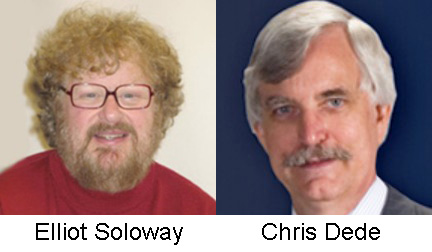
ISTE is no longer a teacher organization per se. It has changed. You can get updated on the latest technology, see this year’s trends, and meet and greet people. One highlight for me this year was to see that Elliot Soloway and Chris Dede‘s ideas of mobile technology have taken off. And then I thought of this article from MindShift. No one was talking about the lack of broadband or permissions to use technology in the schools or the way to negotiate that move. Digital equity seems to have died a quiet death. We did have an SIGDE workshop in the conference. Maybe it is our fault — we have no sponsors. I suppose that lets us know that we are not a real part of the mix. Or does it mean something else? Continue reading →
At this time of year I always wonder at our slavish adherence to an agrarian schedule for schools. Million dollar plants are closed for the summer. Well, not completely. We often have the athletic departments active with team sports.
Staff, from teachers to principals, find summer jobs. I once had a principal who had a summer company to paint houses. He hired his male teachers, and they had a good business. Some of his teachers made more on their summer jobs than they did teaching.
We know that students lose much of what they have learned during this down time and that much of the first two months of the fall semester is spent relearning what they have lost.
If Walmart and others can serve their customers 24 hours a day year round, why do schools continue to tie themselves into a rigid and ill-conceived obsolete schedule?
What if we had a year-round, open schedule school system designed for modern families? For example, the schedule follows the family’s schedule. The students are in school from 8 to 5 each day or from 10 to 6 or even assigned as it fits their individual learning plan (ILP). The school is open from 7 in the morning to 7 in the evening. Students are assigned based upon their ILPs. Teaching staff schedules are also flexible in order to cover the entire day.
In this projected school system, there are traditional classes as well as virtual learning at home and at school through social media. All year long students engage in special learning experiences built around project based learning where learners, working in teams, experiment with such things as actually constructing a robot to serve disabled individuals.
It’s hard to disagree with John Eger’s[1] take on the significance of the UVA president’s resignation and reinstatement. The message is change — or else. But this is precisely the problem — a definition of change that everyone agrees with is nice, but is it useful?
In my mind, change, per se, is not the issue. In fact, every leader in higher ed has embraced change via technology. Teresa Sullivan is no exception. However, in her case, the pace of change at the University of Virginia[2] seems to have been the thorn.
Still, in Sullivan’s case, I’m not sure if speeding up the incremental pace would produce the kind of change that edX and Coursera represent. These MIT/Harvard and Stanford MOOCs (massive open online courses) have apparently set a new standard for change that is a radical departure from the incremental. The incremental model is appealing because it seems to satisfy the majority of professors[3]. Those who want to change while maintaining business as usual can have their cake and eat it, too. They can go blended, which is another way of saying that they can change without really having to change. They can continue to base their instruction in F2F (face-to-face) pedagogy and satisfy the demand for change by adding bits and pieces of the latest rage in technology. Post your syllabus and course schedule online, add a whiteboard to your F2F lectures, replace a percentage of your lectures with online activities, allow students to contact you via email — and, presto, you’ve changed.
But the question remains: Is this enough, and, perhaps more importantly, what exactly is “enough”?
Do we attain “enough” by placing a greater percentage of course work online? Adding more whiteboards? iPads? Clickers? Incorporating mobile devices into the instructional mix? Using more social media such as blogs, Facebook, Twitter? Expanding learning and teaching media to include teacher- and student-generated videos?
Herein lies the problem. No. All of these and more of it — even at a faster pace — doesn’t move us any closer to enough. Classrooms overflowing with the latest gadgets and online activities can come close, but they can never be enough. Change demands something more. Continue reading →
For nearly 150 years since Darwin first published The Origin of Species in 1859, the controversy has continued. Despite mountains of evidence collected from many branches of science, some still fight vigorously against teaching evolution in our school science classes.
I maintain that those fighting against this teaching are harming our society but may just be helping out science education. I refer here to what’s happening in the United States, which seems to be the country most affected by this controversy as well as being the one in which I live.
Answering why the anti-evolution forces are harming our society and how they might end up helping improve science education requires some digging. Society depends on technology to support our standard of living and on the creation of new technologies for export to fund our ability to buy technology. More and more of these technologies are biological in nature. Research into biology and medicine moves forward best when we understand the underlying principles of life. A framework upon which to set ideas and to imagine new ideas helps immensely in both research and development of new technologies and new products.
If you study well the advances in biology and medicine in recent decades, you will see that the concepts inherent in evolution have played an important role. If our students leave school without this important framework, then they are ill-prepared to participate in the advancement of science. If, even worse, they leave school opposing science and its precepts, then they may work to retard scientific advances. Evolution, as a concept and framework, has become the underpinning, tying together previously disparate aspects in all of our life sciences.
Right now, the world is on the verge of eradicating polio. One of three strains has already been destroyed, and only a few countries still harbor reservoirs of the remaining two and possibly only one. While this effort has been largely one of vaccinating everyone, development of new vaccines rests on medical research that depends on understanding how life works. Evolution is a crucial component. The speed with which we find cures for cancer, Alzheimer’s disease, and Parkinson’s disease are likely to depend on scientists who use evolutionary theory in their work.
In ancient times young people were trained in apprenticeships. A few were lucky enough to sit at the feet of great scholars. For the most part young people learned by imitating skilled seniors. Only a few scholars and scribes were literate. Great events were often recorded in paintings by master artist and carried forth by storytellers and ballad singers.
The invention of the printing press slowly changed society. Books and libraries became storehouses of history, science and mathematics. Eventually textbooks gave rise to schools, as we know them today. Historical events were recorded in print, and it became essential that people become literate. In the 1850s there was an argument as to whether textbooks for learners should include pictures and illustrations. Books allowed the master scholars, scientists and historians to store and distribute their wisdom and knowledge.
Until about five thousand years ago society used a strictly oral-aural system of communications. Once writing became available, mankind could store information and knowledge over time and space. Ideas that were printed could travel over land from one place to the next. Printed materials could be handed down one generation to the next. The users had to be literate in the language used. Literacy became the doorway to self-learning.
Mankind took a major step forward when we learned to transcribe speech and language into a stable code called writing. When the printing press was invented new ideas of schooling were possible. A mediator, that is, teachers, could transfer the writings of scholars to the masses. No longer did the learner need to be in the presence of the master scholar.
Today, technology allows us to go far beyond the printed word. Digitization of information is as significant a change as the printing press. We are at a major shift because we have the ability to bring live living color and enhanced graphics to any learning event. If our students are learning about John Glenn’s first space flight (20 Feb. 1962), they can see the actual footage of his orbits. Moreover they can see and hear him talk about the event and what he thinks it meant to the world. In fact, with social media we have the potential to create a Facebook page where he answers learners’ questions. Technology through social media allows us to practice team learning. Through social media, team members can be in the same classroom or even in different countries around the world.
[Note: This is the last in a three-part series by Judith McDaniel. Read part 1 and part 2. – Editor]
If we define learning as content delivery, much that we now “know” about education follows from that premise. Freire calls it the “banking” method of education where the instructor deposits knowledge in the head of the willing “learner.” When that is what it means to learn, what could be wrong with standardized tests that measure content knowledge? If the transfer of knowledge is what it means to learn, then WHAT is transmitted takes on importance and HOW it is transmitted can be fairly standardized. This basically describes education today.
But if the cyberization of knowledge has produced “an unknowable body of knowledge,” how can anyone maintain that learning is about content, about knowing what has been known in the past? Not that we don’t need to know history and government and science and math, but that we need to know them differently?
I asked Sener, “If learning is NOT about content delivery/transfer/absorption, how should we define it?”
[Note: This is the second in a three-part series by Judith McDaniel. Read part 1 and part 3. – Editor]
I asked Sener, “How can we improve education, using all of the knowledge and resources available to us?” In Seven Futures, he provides data indicating “that at least 70 percent of American jobs now require specialized skills and knowledge, and that students need education that will help prepare them for jobs which haven’t even been invented yet” (29). It seems obvious to me that our entire educational system needs a jump start and that teachers trained in the old methods of teaching the old knowledge don’t have any chance at all of meeting that challenge.
Imagine what teaching today’s students for tomorrow’s needs might entail — “Realigning Education with Redefined Knowledge.” Simply put, old knowledge isn’t enough. What we know is changing, changing quickly, and it’s not just the sciences. Yes, the number and definition of the planets has changed, but so has every branch of knowledge. I talked with a discouraged college student who recently graduated from a prestigious university in journalism. His last course in college had consisted of an advanced journalism class that exclusively included information on working in print media. The professor was a woman in mid career who seemed not to know that these students had a very small chance of working on a newspaper or magazine. They were not even being prepared for the careers that have been invented in information production on the internet. Continue reading →
[Note: This is the first in a three-part series by Judith McDaniel. Read part 2 and part 3. – Editor]
So much about John Sener’s new book, The Seven Futures of American Education: Improving Learning and Teaching in a Screen-Captured World (CreateSpace, 21 March 2012), strikes me as right on and important that my first impulse is akin to wanting to take education by its figurative neck and shake it. He says things I have thought or intuited for years — and he says some things I need to argue with. He says things that educators and parents and well-intentioned politicians need to hear. Capturing the arguments of the book in one short conversation was not possible so I asked him three basic questions:
In a world of surplus information, a surfeit of easily accessed data and analysis, is there anything at all that “everyone” needs to know?
How can we improve education, using all of the knowledge and resources available to us?
If learning is NOT about content delivery/transfer/absorption, how should we define it?
When I was in graduate school (long before the internet), I remember being impressed when I read in one of John Keats’s letters that he was going to spend his summer rereading all of Greek literature. He was going to read it in Greek, of course, but that wasn’t what impressed me. What astonished me was that the amount of Greek literature was so small, only 100+ years before, that anyone could read it all in a summer. My job as a Ph.D. student was to read and read and read and then to select an area or two that I would focus on. In that general area, say Victorian literature, I would again select a smaller area that I would become an “expert” in.
Graduate school hasn’t changed that much since I was there; students in literature are still required to read the classics. There is a sense that “core knowledge” is important and every graduate student in literature needs to have read certain texts which we then have in common. Those texts become the basis for scholarly conversations.
“Friend Your Students? New York City Schools Say No“* focuses on the new social media policy put in place by the New York City Department of Education. The policy, which establishes guidelines for teacher use of social media, allows educators to use it to enhance their students’ educational experiences and to be more accessible to them. However, this policy and others like it raise concerns about the potential for social media to blur boundaries that should not be crossed in teacher-student interactions.
As I was reading this article, I found a link to another All Things Considered post related to a new technology segment that began in May 2012. It is a social media advice column, and the plan is for pros to answer listeners’ questions. This in itself is a 21st century approach to advice columns. Listeners can email their questions or post them to the site’s blog.
The first column addresses the question Should You Friend Your Boss on Facebook?, and two experts on social media offer their opinions. One issue is that social media uses a different meaning for the word “friend” and the types of boundaries that word implies. In a workplace relationship, you may ask yourself, “Are there items that I would normally share with a friend that I really don’t want the boss to see or know about?” One expert suggests putting the boss in the “safe zone” to create specific boundaries for your social network. In that way you still come across as a team player without opening up your personal life in a way that may be uncomfortable for you.
However, one cannot ignore that there are power issues inherent in any boss-employee relationship. Depending on the situation, some of your actions can be misinterpreted or used against you. Linking to a competitor’s website, for instance, may be interpreted as a lack of company loyalty or as possible interest in moving on. If the boss links to a site that lists donations and learns that you haven’t donated, how will s/he interpret it? What happens if the boss finds that you have linked to a site with political views that he opposes? In my opinion, this issue is a minefield, better to be avoided.
Why all the flap over the flip? On the surface, it seems nothing more than an ancient idea resuscitated by a hip metaphor. Ever since the first school bell rang, this has been the model for many disciplines, especially the ones that emphasize performance. Study, practice, and learn at home, alone; perform under the teacher’s watchful eye in the classroom. In other words, students prepare at home and demonstrate what they’ve learned in the classroom. Teachers use their performance to identify shortcomings and devote class time to coaching, guiding, and shaping.
However, as long as the paper medium held sway, the flip remained a good idea that was simply too cumbersome and labor intensive for both teachers and students. Back then as now, the medium is the message. Teachers could do little more than assign readings in outdated and often irrelevant textbooks, and if they made the time to compose and photocopy instructions and information, they soon learned that the effort to prepare handouts is extremely labor intensive. They could leave additional learning resources at the school library, but the number of copies available and the library hours made this alternative impractical for students.
The flip, sad to say, was mere lip until the arrival of smartphones, those bright little appendages that students reconnect as soon as they leave the classroom. Sit outside a classroom building when students, en masse, are emerging or entering. You’ll quickly notice the choreography: those entering are reluctantly shutting down and stowing their cellphones, waiting until the threshold before doing so, and those emerging are reaching into their pockets and bags for their cells, reconnecting with the world and reviving their lifelines.
We’ve passed the point, I think, where the classroom is the hub of learning. The hub is moving ever outward, and this transition has enormous implications for schools and colleges. One is that the classroom is quickly becoming a place for restricting rather than facilitating the information flow that’s vital to learning. And another is the flip. With smart phones and the web, a good idea is now sustainable best practice.
In two Illinois schools, Pekin Community High School and Havana High School, enlightened educators are head over heels for the flip, and at the forefront is Havana School District 126 Superintendent Mark Twomey. Hat’s off to Twomey, a leader for the 21st century who demonstrates that imagination, creativity, guts, and plain old-fashioned common sense can do far more than dollars when it comes to using the latest technology to improve learning. The formula is a simple one: Use the tools that are becoming readily available and accessible to leverage a practice that makes sense.
Midway through 2012, I can’t help but feel that the toughest job in higher education is that of president. With stakes so high and change so rampant, chaotic, and divisive, it must be close to impossible to please everyone. Thus, those who take on the challenge and actually thrive have become masters at tiptoeing around the edges of controversy. Perhaps the most active sinkhole on college campuses is technology, where presidents are damned if they do and damned if they don’t. Thus, I take little pleasure in spotlighting Adam F. Falk, president of Williams, for a presentation* at a recent conference, defending the traditional practices that have defined liberal arts colleges against the onslaught of the latest technology. However, I feel that the issues are important and that discussing them openly, even if it’s in the context of an outstanding educational leader, is necessary.
Falk defines the core values of a liberal arts education as a learning environment
that is “personal, intimate, collaborative”
in which students “will know the faculty and their fellow students, and the community will know them”
“that will prepare them best to be purposeful in their lives and effective in the world”
in which “education is still as much about human interaction as about delivering content”
He says “that the great potential of the new technologies is not to upend these core values, but to allow us to fulfill our existing educational mission more effectively, especially by giving us new strategies to transcend our limitations of scale and location.” He cites distance education in particular, which, “if thoughtfully deployed, [extends] our curricula into areas not covered by our relatively small faculties.”
Education is sometimes such a dance. There are so many ingredients that affect what we do and so many groups that influence it. A small child (a friend’s child) in Africa told his mother that he did not need to go to school any more. I laughed. My brother made the same pronouncement years earlier.
Jack Taub used to say that what we consider time out is exactly what we do in school. We sit them in a corner and don’t let them talk. Technology and well trained teaching professionals change that. But everyone is not ready for change. What is sad is that there are so many layers of bureaucracy between teachers and the latest technology and innovative practices. Not quite like slavery, but there are many overlapping levels of management.
The first several years of teaching can drive a person mad. There is never enough time, enough ways to get the job done, and it is a grueling task. Then one day, one day, you get it, and you feel like the teacher you wanted to be.
I loved learning from Project Tomorrow what I had discovered in my early years of technology use. There were two projects that led me to understand the value of technology in learning. One was the National Geographic, which offered a series of science projects for kids. So exciting.
It was science right on, a different kind of citizen science at the elementary level. It was called Kids Network. We had a PI in various areas, and we reported data to the group. We were placed in teams, some national and a couple international.
The project was about water or trash or pets or soil, but what really happened was that the learning became joyous because we were using math and science in a research way, and we plotted graphs and shared our sense of the place that we were in. But we also communicated with groups from various places in the world. Every child wanted to be a part of it. The other thing is that I was moved from the center of the room to the role of facilitator. I was the mailman — that was because we only had one printer. The folders of letters and information were so important to the children. Children who told me that they hated to write were sharing ideas and information with people from all around the US and the world. I had such joy in watching them share their information on a personal level. The learning was not incidental. We used math tools, graphs and pictographs, and we understood them well. We learned to use maps and charts. We were citizen scientists.
Michelle Fabio, in “Has the Internet Increased Plagiarism in Schools?” (Legal Zoom, May 2012), presents a useful distinction between plagiarism and copyright infringement. She also asks if plagiarism is illegal and answers yes, that is, “When the act of plagiarism is also copyright infringement.” The question of whether plagiarizing should be considered illegal is interesting. Most colleges and schools have policies on failure to credit sources, and these provide varying degrees of sanction. However, these regulations don’t have the weight of state and federal laws, and ethics rather than legality is the primary issue. An interesting topic, but perhaps for a later time.
For now, my interest is not in whether the internet increases plagiarism but, rather, how we can use technology to eliminate it. Fabio mentions online services such as The Plagiarism Checker and Turnitin. Teachers and students copy and paste suspected text in the site checker and receive reports on portions that may have been plagiarized. However, a far simpler and cost effective method is to do as Lynn Zimmerman, ETCJ associate editor, suggests: paste a suspected text string, in quotes, in a search engine such as Google. If there are hits in the works of other authors, then the text may have been plagiarized.
Teachers read literally hundreds of student papers a year, and after a few years, they develop a sixth sense for deviations from typical student prose. I’ve been teaching college composition for decades, and for me it’s like stepping into a suddenly cold spot in a shallow stream or a suddenly dark section of a forest. The change is abrupt, startling. It’s often a change in style, from the colloquial of students to the formality of professionals. It’s the use of vocabulary that sticks out like an island in an endless sea. It’s the appearance of complex sentence patterns in a field of simple and compound sentences. It’s the ray of logic in an otherwise cloudy sky. It’s a lack of transition from one thought to another, like missing planks in a dilapidated rope bridge. It’s a gut feeling based on the expected and unexpected. In short, a teacher can sense whether text has been plagiarized.
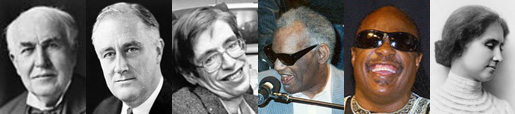
In the USA every child is entitled to a free and appropriate education regardless of ethnic background, disabling condition, or socioeconomic level. In the last part of the 20th Century, federal legislation ensured that all disabled children had a right to a free and appropriate public education. The contributions of disabled people in America have been tremendous. From Thomas Edison, Franklin Roosevelt, and Stephen Hawking to Ray Charles, Stevie Wonder, and Helen Keller, disabled people have enriched our society. Deaf people, blind people, cerebral palsied people, and mentally challenged people have made our lives better though their accomplishments.
Many of these young people have done well in regular classrooms with average learners. Others have had to have special programs and may from time to time be in separate classes or even individual tutoring. Learning comes through our sensory input, especially our sight and hearing. However the human mind is a marvelous thing that can compensate for distortions in our sensory inputs. Think with me for a moment about how we might reach a deaf blind infant. True, there are cochlear implants that might give the child a form of hearing. There have been experiments with ocular implants, but these have not been practical to date. How then will a deaf blind infant know his or her world? They must know their world primarily through the sense of touch, taste, and smell. Unlike sight and hearing, these three are near senses.
As everyone knows, college has become less demanding, students don’t learn much in college, and students spend much less time studying in college than they used to. At least that’s what most everyone thinks they know — thanks to the unfortunate residue of the study Academically Adrift, whose legacy has endured long after the storm of attention and controversy which accompanied its initial publication in early 2011 has faded.
An article by New York Times columnist David Brooks about this “landmark study” is our latest reminder of what happens when important opinion makers trade in the currency of catchy memes as received truth. As Brooks asserts in his recent NYT article (based on Academically Adrift’s findings, e.g., p.69):
Colleges today are certainly less demanding. In 1961, students spent an average of 24 hours a week studying. Today’s students spend a little more than half that time…
“Certainly”?? It’s understandable that informed laymen such as Brooks equate time spent studying with level of intellectual demand, since professional educational organizations such as ASCD do the same — but that doesn’t make it any less specious.
The real problem is that the destructive memes which Academically Adrift has spawned are based on a seriously outdated perspective about what constitutes a “demanding” college education. For starters, nothing says “welcome to the 20th century” quite like equating rigor or effectiveness with time spent studying. In almost any other endeavor, spending less time to accomplish a task would be called “improved productivity.” Back when students spent an average of 24 hours a week studying, a lot of that “study time” involved sifting through card catalogs, browsing book stacks, writing papers by hand or on typewriters, and doing many other tasks which can be done much more efficiently now via other means. But instead of giving higher education any credit for this, critics both inside and outside higher education persist in treating the act of studying as if it were analogous to punching a time clock. Study time is work; socializing time is play and doesn’t count, which is not surprising since Academically Adrift reflects an almost total lack of regard for the value of student time, and the notion of optimizing student time is nowhere to be found in its memes.
Thanks to the generosity of Bert Kimura of the University of Hawaii at Manoa, I was able to sit in on the 2012 Technology, Colleges and Community Worldwide Online Conference (TCC). This was not my first online conference, but it was the first I’ve encountered that incorporated a badging system so intrinsically into its programming.
Badges are by no means new to conference programming, though different environments lend themselves to different applications. For example, the first thing I do at Educause events is find the ribbon table and procure a “runs with scissors” ribbon for my badge. In some ways, I find this ribbon more important than the one labeling me as a presenter, as it gives those I meet an insight into who I am. Active in social media? Yes. Blogger? Yes. Instructional designer? Yes. The one in any given presentation most likely to say something a little crazy? Maybe. At Educause, badges are used as conversation starters, or ways to connect with those you meet to build richer dialogues and perhaps expand your personal learning network.
The Technology, Colleges and Community Worldwide Online Conference is an annual professional development event organized by the University of Hawaii at Manoa. The online conference invites faculty, staff, administrators and students worldwide to share their expertise and engage in discussions about innovative practices in the use of educational technology.
I was invited to attend and review this year’s event on behalf of ETC Journal. TCC 2012 took place from April 17-19. Over 500 participants gathered online for three days of online presentations and discussions. The conference schedule featured 2 keynotes, 50 general presentations, 40 student presentation and 7 peer-reviewed contributions in two parallel tracks.
Though many sessions were outside my time zone, I enjoyed several inspiring talks and was particularly impressed by the conference organization’s innovative technology use. “We are pilot testing ‘badgification’ in this year’s conference,” explained conference organizer Bert Kimura. Continue reading →
(Note: This is the second of two reports on the iFacilitate 2012 online workshop. I participated as a student and opted for the certificate option to make sure that I stayed the course. I created a temporary blog for the coursework, and the excerpts below link to posts in that blog. Click here to see the first report. -js)
The five-week workshop ended last Thursday. It was an exhausting yet exhilarating experience. Greg Walker and his team put together an event that challenged and inspired all of us to address key issues in online teaching and learning with an emphasis on facilitating discussions. As expected, I emerged from the experience with far more questions than answers, and I’ll be addressing some of these in future ETCJ articles. One that remains sticky for me concerns lurking.
The common wisdom is that the ratio for active participants to lurkers is 1 to 10, i.e., only 10 percent of participants actively engage in posting and commenting in online forums. This means that the vast majority, 90 percent, lurk. Is this simply a given, a natural phenomenon that can’t be changed? If yes, then why do we expend so much energy trying to get all our students to become active participants? It seems we’re swimming against a current with no expectation of success.
If, however, lurking is a problem, then what are the implications when educators themselves are lurkers?
There’s much truth in what Prof. Diane Ravitch says in “The Pattern on the Rug” (Ed Week, 3.27.12) and some exaggeration. She tars every single effort at improving our educational system with the same brush. However, education is not so simple.
The budget cuts have been devastating. Some even seem to believe that our education “deserves” this treatment. Right here at the beginning, everyone should recognize that we will not be able to survive as the preeminent nation in the world with a poor education system. Everyone should also understand that universal public education will not become 100% private in any believable scenario. Our K-12 public schools and community colleges are a bulwark of our free nation. Competition in schooling with a profit motive attached would spell disaster for schools. It’s just too difficult to measure success for a business except for gross revenues, profit, and market capitalization.
Ravitch turns the Race to the Top into white hats and black hats. I have some disagreements with this program, especially its definition of the “Top.” However, such programs can be a stimulus for our schools. As for NCLB, our problems lie not with the intentions but with the execution.
She lashes into the multiple foundations that fund education initiatives. Again, although I don’t agree with all of these, we have to try something to evaluate it. The effort by the Gates Foundation to make many small schools out of one big one had an obvious flaw before it even started, but the foundation did realize its error and withdraw its support.
It’s an oft-discussed topic in the media that Chinese, specifically the Mandarin Chinese form that has become the official language of Mainland China, is the “language of the future.” This might sound a bit odd because Chinese is in fact one of the oldest languages in the world, but it’s pretty irrefutable that it’s also one of the fastest-rising languages in terms of global prominence. Learning to speak, read and write Chinese is becoming increasingly popular around the world, but as such an old and unusual language, Chinese presents a lot of problems for learners. Technology, however, is beginning to alleviate this on many fronts.
Chinese is a unique language and can be very difficult for Westerners who are native Romance or Germanic language speakers. Even Japanese speakers, whose native language has a lot in common with Mandarin (including some characters), can struggle mightily with learning it. That’s part of why it helps to approach Mandarin more methodically and tactically than one might a language that’s closer to their native tongue. For instance, while exposure and listening practice are still very important, it’s much more difficult to simply “pick up” Chinese than it would be to pick up Spanish for, say, a native English or French speaker. Much of this has to do with Mandarin’s tonal nature, with different pronunciations of the same syllable taking on (often wildly) different meanings. Without careful instruction and practice in differentiating the five tones, it’s tough to get going in the learning process. This hurdle is especially problematic for adult learners not only because they’ve spent decades in non-tonal or semi-tonal language environments but because they often don’t have the big blocks of time necessary to devote to language learning.
Digital textbooks are all the rage these days as students and school districts clamor to get the iPad, download and fill it with $15 textbooks, and rid themselves of the heavy traditional versions once and for all. But digital textbooks are not the present – or even the future – of education. Here’s why:
1. School districts still save money by using textbooks.
Yes, digital textbooks are far cheaper than the physical variety. But various other costs – chief among them the price of an iPad and the need to periodically repurchase digital versions – drive the digital price far higher. One study found that an average school would spend $215 per student per year when following a digital textbook strategy. This compares with a far lower cost of $90 per student when only traditional textbooks are used. Although some schools with sufficient resources will surely still jump at the chance to make backpacks lighter and lessons more interactive, the significant costs associated with a digital program will prevent most districts from following this course.
(Note: This is the first of two reports on the iFacilitate 2012 online workshop. I participated as a student and opted for the certificate option to make sure that I stayed the course. I created a temporary blog for the coursework, and the excerpts below link to posts in that blog. Click here to see the second report. -js)
In early February, when I found an invitation from Greg Walker, Leeward Community College (University of Hawaii System) Distance Education Coordinator, in my emailbox, I decided to go for it. Some of my ETCJ colleagues have written about their MOOCing experiences, and I wanted to see, firsthand, what it was like. In the following weeks, I’ll be sharing some observations and comments that I’m posting in my workshop blog.
The invitation was for a five-week online faculty workshop, iFacilitate:
Aloha mai e. Are you an adventurous “life long learner” who is interested in experiencing the future of online learning? iFacilitate is …. FREE and open. It does not consist of a body of content you are supposed to remember. Rather, the learning in the course results from the activities you undertake, and will be different for each person. In addition, this course is …. distributed across the web….Your active participation in this workshop will help you to acquire the skills needed to function in this type of course. iFacilitate is a 5 week open workshop [beginning 2.27.12] that introduces a variety of facilitation skills to help participants engage learners across a range of conversational spaces, including online discussion forums, web conferencing rooms, and wikis and blogs. This workshop explores building online learning communities and communities of practice …. Online learning communities develop through interaction among participants. Participation is open to everyone …. Your level of participation is up to you. [One of the options is a letter of completion.]
My First ‘Week 1 Online Learning Communities’ Post
Feb. 27 – I haven’t done the readings yet, but here are some preliminary thoughts and concerns. I’ve found that both a challenge and an advantage is the openness of online learning communities. In other words, as a teacher, I can’t and shouldn’t want to control the networks that students naturally create with classmates — individually and in small groups — as well as with me and course spaces I’ve created. In the students’ personal [click here to read the rest of the post]
Social Justice and Digital Equity SIG has, with Mike Searson, created a project in Digital Citizenship that is funded by Facebook. We will hold our first meeting tomorrow to iron out details. We are at the SITE.org Conference in Austin, Texas.
Digital Citizenship is a concept which helps teachers, technology leaders and parents understand what students/children/technology users should know to use technology appropriately. Digital Citizenship is more than just a teaching tool; it is a way to prepare students/technology users for a society full of technology. Too often we are seeing students as well as adults misusing and abusing technology but aren’t not sure what we can do. The issue is more than what the users do not know but what is considered appropriate technology usage.
You have probably heard about the parent who shot his child’s computer. There was an interview with the student and parent on NBC to explore the incident.
In part one of this series we covered many of the fundamental tasks of Twitter, and in part two we addresed basic techniques and workflow management. As you gain more experience with Twitter and grow more confortable using it as a platform for sharing and conversation, you may find you need better organization techniques and more advanced tools. Dashboard applications present linear, chronological streams. If you prefer a more reader-friendly format in terms of information browsing, you should consider other options.
Reader-Friendly Formats
Paper.li, Zite, Twylah, Summify, and The Tweeted Times are all applications with easy to read interfaces featuring the most popular items of the day, as shared by members of your social network. These tools aggregate links in one place, display images, and categorize the information for easy scanning.
Establishing an account includes opening a link to your Twitter feed (or other social media account, as applicable) and configuring the customization options in terms of categories, keywords, screen layout, color, etc. The result is a custom user interface crafted to your specifications. You’ll find headlines, article snippets or previews, links, and navigation menus that cycle through periodic updates (e.g., every 24 hours).
Our technology has led the way to thinking of new and efficient ways to distribute videos and computer learning experiences. The entertainment fields with programs such as NetFlix have set the stage for a new format for marketing learning resources. The streaming of video or transmedia distribution can make thousands of lessons available to learners when needed. For an inexpensive monthly service fee, we can make vast libraries of lessons universally available in the home, the library, the classroom and the workplace.
While we are in an economic slow down, we are at the same time faced with the most productively efficient period of American industry. With a high rate of unemployment we are faced with increased individual productivity based upon technical applications of digital technologies. The retooling of the auto industry is an example of this increased efficiency. We are manufacturing better and more efficient automobiles with fewer people and more computer driven machines than ever before.This is true not only in the auto industry but in many manufacturing industries. As new and more complicated machines come on line, we need fewer but smarter workers.
[Note: Dr. Withrow was the Director of Educational Programs for the NASA Classroom of the Future from 1996 to 1998. He served in the U.S. Department of Education from 1966 to 1992 as the Senior Learning Technologist. In the USDE, he was the program manager for the development of Sesame Street and also supported some work on Mister Roger’s Neighborhood. Click here for a brief bio. -Editor]
From the late 1960s until the Reagan Administration, the U.S. Department of Education invested $150 million in children’s television series. Half of this investment was for general television, such as Sesame Street, and half for ESSA television. ESSA TV was devoted to emphasizing Hispanic, Afro-American Asian American, Franco American and Indian American heritages. These efforts funded fifty-four series from Sesame Street to The Voyages of the Mimi. They were not limited to PBS carriage but most were aired on PBS. No commercials were possible when they were broadcast. Sesame Street has become a worldwide early childhood success and is coproduced in many countries and in many languages.
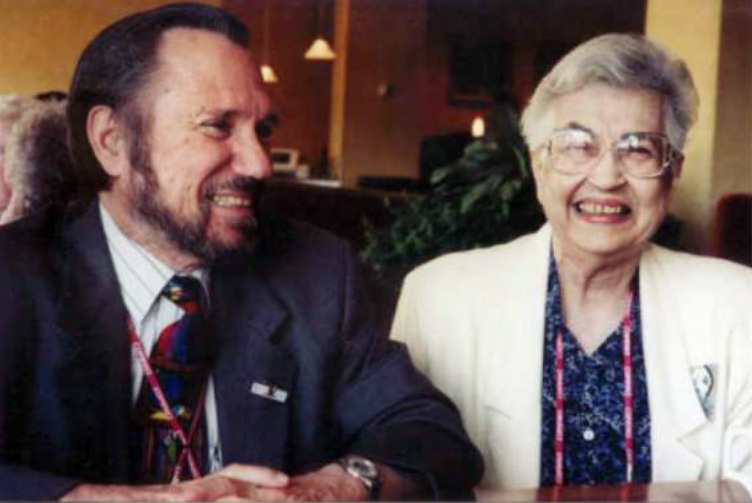
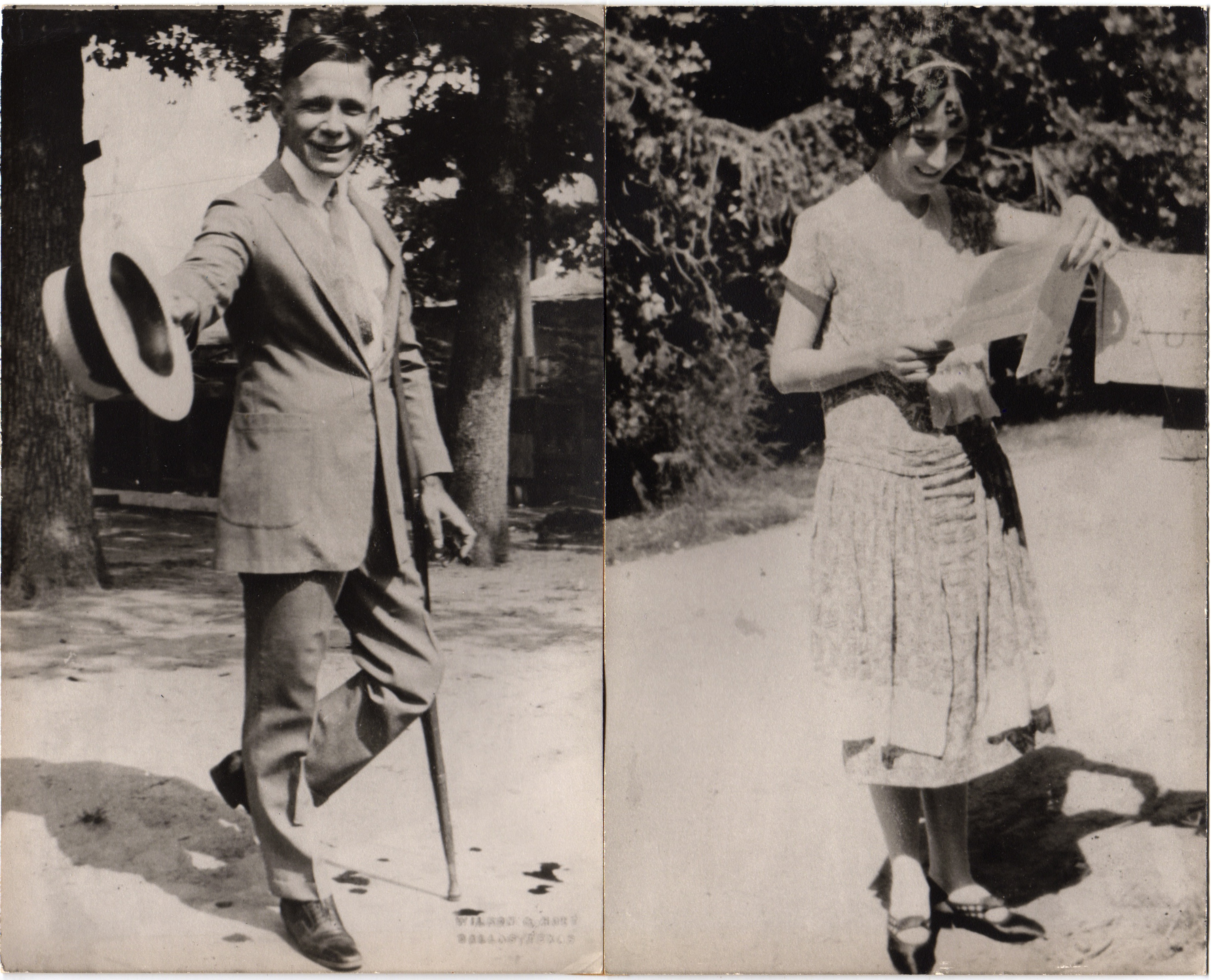
Frank and his wife, the late Margaret Schram Withrow
There was a concerted campaign against ESSA TV by talk radio hosts claiming that Social Security was in danger because of these minority-based programs. Sixty Minutes ran a segment on “Hollywood on the Potomac,” which featured World War II training films but was used to kill USDE television programs. Since most of the productions were multi-year contracts rather than grants, we were able to finish the work that had been started, but Congress at the urging of the Reagan Administration killed the programs. The third season of The Voyage of the Mimi, which was to be a trip down the Mississippi, was canceled, but we were allowed to finish the second season.
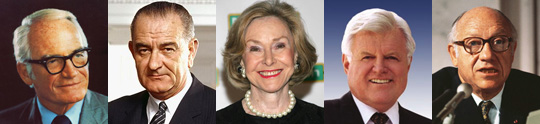
There are some people that have extraordinary visions of greatness. President Lyndon Banes Johnson’s vision of a Public Broadcasting Service was one of those great accomplishments. Senators Barry Goldwater and Jacob Javits’s unrelenting support of Joan Ganz Cooney’s dream of television to teach young children has changed early childhood education around the world. Senator Ted Kennedy’s vision of distance learning through technology has opened the door to 21st century learning and teaching though Star Schools.
By 2020, most learning and teaching will be a blended experience of online and classroom courses tailored to the needs of each learner. Learning for the average student will take place at the home, the classroom and the workplace. Young and older workers may spend as much as one fourth of their time refining and improving their work skills on their jobs.
Access to high quality learning experiences will continue to expand to mobile devices. Management of learning will continue to increase as we are able to track learning progress by the student and to reinforce those areas where the learner shows weaknesses. There will be a cornucopia of online resources that can address the learner’s needs.
The University of Edinburgh MSc in E-learning program’s “Manifesto for Teaching Online” is a bold move to break the chains that bind completely online to traditional and blended instructional models. The basic assumption is that onground and online are fundamentally different and that whereas approaches to one are well established, approaches to the other aren’t precisely because little or no effort is being made to fully understand the differences. The list of 20 tenets provides a useful starting point for a discussion, and the developers are to be commended for opening this discussion to the world.
The first tenet, “Distance is a positive principle, not a deficit,” decries the current practice of viewing online as simply a crippled or inferior extension of traditional or blended instruction, a second best alternative when the first is unavailable. This statement provides the raison d’etre for the manifesto, the radical view that “distance,” the factor that distnguishes one from the other, has the potential to not only provide a different learning environment but a superior one. In other words, the twin concepts of anytime and anywhere are the foundations for a whole new approach to teaching and learning.
The second tenet, “The best online courses are born digital,” is an amplification of the first, a declaration that methods brewed for onground classrooms fail to take advantage of the VLE (virtual learning environment) and are, thus, ill-suited for online teaching. Online pedagogy, at its best, must make full use of the features available in the anytime-anywhere classroom. The fourth tenet, “‘Best practice’ is a totalising term blind to context,'” is an extension of the second. The message here is that best onground may not be best online.
In “Manifesto for Teaching Online,” I find a subtext that’s disturbing. The statements suggest an active and strong group of people opposing online distance learning in a variety of ways. In other words, such a manifesto would not be necessary in a logical world.
Imagine the introduction of the book. Was such a manifesto necessary to get people to use books in learning? Did people suggest that books stifled creativity by putting the ideas on pages? Did they say that books created a “literacy divide” by denying learning to those who could not read? Did they complain that books result in a decline in people’s ability to remember because they could just look in the book? Of course, I wasn’t there at the time, and anti-book people would be unlikely to put these thoughts into books for us to read today. Some historian may be able to answer this question. It doesn’t matter.
Learning through online communication makes perfect sense. Books actually allowed people to learn things without being physically present at the side of the author. In a sense, they were the first distance learning. I learned electrical wiring through books and much more without having to sit in a class or become an apprentice. That learning was “distance learning,” although not as wonderfully dynamic as today’s online distance learning. Continue reading →
The Manifesto for Teaching Online (2.24.12), written by teachers and researchers in the MSc in E-learning program at the University of Edinburgh from June 2010 to May 2011, is arguably the most exciting document for discussion to emerge thus far in 2012. It was distributed in the following format, but other formats are also available.
Click the image for the PDF version.
The manifesto is described as “a series of brief statements that attempt to capture what is generative and productive about online teaching, course design, writing, assessment and community. It is, and may remain, a living document that is reviewed and reworked periodically with colleagues, students and amongst the programme team …. Its primary purpose is to spark discussion, and to articulate a position about e-learning that informs the work of the project team, and the MSc in E-learning programme more broadly.”
The creators, however, are opening the discussion to a wider audience: “Our intention is that over the next few months the manifesto will stimulate discussion on a wider stage, fuel further research, and draw attention to the work being done here at Edinburgh in developing new perspectives on e-learning.”
Updated 6/15/15
Years ago, when I first began reading about a smartboard in every classroom and a laptop for every student, I was overjoyed. When the smartboards grew increasingly sophisticated and laptops morphed into netbooks then tablets, I was ecstatic. Yes, teachers and students were finally beginning to use some of the latest internet technology to breach the classroom walls and tap into the growing universe of online information, resources, and services.
The transformation was nothing short of miraculous. The electronic screens in classrooms became instant windows to a seemingly infinite wealth of not only information and knowledge but of experts and other human resources. Stepping through the electronic windows, teachers and students broke free from their tiny classrooms and soared into the new world of learning that transcended time and space barriers. Without moving an inch from their desks, they could, with a click, be anywhere and communicate with anyone in the world.
But as the trickle of technology into classrooms grew into a torrent and every day brought a flood of new announcements of schools and entire districts investing in smartboards, laptops, and iPads, I no longer found myself cheering. Now that we’re past the initial hurdle of simply getting the technology into the classroom, I’m beginning to pay attention to other factors, and some of what I’m seeing worries me.
For example, I’m becoming increasigly concerned about the hands in the cookie jar. I expect to see the hands of students and teachers — the intended recipients, the targets of the funding for new technology. However, I don’t expect to see other hands, especially when they’re grabbing a sizable portion of the cookies.
English has become one of the world’s most widely-spoken languages as well as the most popular second language and lingua franca of academics in no small part due to the heavy concentration of top universities and the large quantities of educational materials produced in English-speaking countries. Another reason for its popularity is the huge amount of entertainment content and other media produced in the Anglosphere. For instance, nearly every English-language training school here in Shanghai has a TV in the lobby showing DVDs of “Friends” (老友记, Lǎoyǒujì) or other American television shows to help students practice their English.
One of the great victories of the Information Age is the ability of learners the world over to access content in almost any language, giving them unprecedented variety in terms of learning style, pace, and method. English-language TV has been around for decades, of course, but the spread of high-speed internet and satellite connections has made accessing content, be it entertainment or educational, much easier. DVDs and streaming web video, for instance, have brought English-language educational content to places that had none just a decade ago. In addition, technology like smart phones and tablets has made mobile learning much simpler and more effective – convenience and flexibility can make it seem as though there’s more time in the day, so to speak, for practice in speaking and listening as well as exposure to a language, and with English in particular it’s easier than ever.
Of course they should, but what tone should it convey? Actually, I’m really asking about students’ digital identity, but the title of this post merely reflects the “branding” I employed to attract students to my upcoming presentation about personal branding and digital identity. It is that presentation which prompts this post.
This is a touchy subject because parents and schools are so “conflicted” about it! On top of that, students’ immaturity calls for lots of caution! The “facts of life” are that most students do indeed have a digital identity so digital literacy compels that we teach them to be prudent about what they post with respect to content they create or share, permissions, and much more!
Nevertheless, the personal branding principles that apply to their parents and teachers apply equally to students with the exception that we can “cut them some slack” (or can we?) for not starting to “build their brand” yet (my daughter is among them L), but they certainly ought to be made aware of the implications for their future competitiveness, don’t you think?
After all, almost all of them are already online and, in many cases, they have already lost their opportunity to make a positive first impression. So, what should I say (or not say) to the students?
This post is full of questions and I hope to follow it up with subsequent posts with some answers…or at least to let you know what happens next. The future is full of problemsandopportunities!
For a conference to run smoothly and professionally, a large amount of work happens “behind the curtains” without the conference attendees being necessarily aware of it. The Association for the Advancement of Computing in Education (AACE) was founded in 1981 and has been organizing international conferences since the 1990s. However, bringing a conference online requires new approaches from the program committee. Theo Bastiaens, program chair of the 2011 and 2012 Global TIME conference, talks about lessons learned, the quality of online talks, and the online experience from an attendee’s point of view.
Theo Bastiaens, program chair of the 2012 AACE Global TIME conference.
SP: What makes or breaks a successful online conference?
TB: As the online conference Global TIME was organized for the second time we certainly fine-tuned the format, schedule, and technical platform. Since an online conference is somewhat different from a face-to-face conference we had to make sure that people had a virtual space to contact each other. For that reason, AACE developed “Academic Experts.” In my opinion, a great new platform to organize these online conferences. A very important aspect of this platform is that it integrates participants’ social profile with discussion features and the paper presentations. Little things that we learned from the online conference last year, like the automatic adaption of the program to the time zone of the participant, are very important for a smooth organization. Continue reading →
The second edition of the AACE Global TIME online conference took place from February 7 to 9, 2012. The annual event aims to connect and engage educators, researchers, consultants, trainers, policy makers, curriculum developers, entrepreneurs, and others. Sectors covered include adult learning, higher education, informal learning, K-12, libraries, and museums as well as vocational education and corporate training. It was my pleasure to cover the second edition of Global TIME for the Educational Technology and Change Journal on behalf of AACE.
Global TIME 2012 hosted attendees from 28 countries, 34 presentations, 44 additional “asynchronous” papers, 3 excellent keynotes, and 4 workshop sessions. Even though the program was less packed than the usual week-long AACE conferences, the following overview is still necessarily a rather idiosyncratic collection of my manifold personal impressions and encounters.
Day 1 – Getting Started: Cultural Change in Workplace Learning
“We are having a PowerPoint war.” With these words from Sarah Benson, member of the AACE organization team, the conference started on February 7 at 4 p.m. GMT. Benson’s comment referred to some initial technological hiccups with loading the keynoter’s slides – fortunately, one of the very few problems with the Adobe Connect virtual conference space.
Program chair Theo Bastiaens, director of the Institute of Educational Science and Media Research at the German “Fernuniversität Hagen” and professor at the Open University of the Netherlands, officially opened the conference with a short welcoming address, greeting everyone from a freezing Europe. Approximately 20 participants from all over the world joined in – and immediately started to compare notes on their local time, weather, and physical location. Penelope Neuendorf said “Hello” from Canberra (Australia) at 3 in the morning, Luigi Riscaldino from the University of Calgary (Canada) sipped his coffee at 9 am, Manar Hosny logged in from Riyadh (Saudi Arabia), and Mark Curcher said “Hi” from Dubai (Arab Emirates).
OK, I am spoiled. Henry Jenkins, Bill Clinton, Vice President Gore, Danah Boyd, George Lucas, Ron Brown (he is deceased), Seymour Papert — and lots of other luminaries. In person and in your face. Wendy Pye face to face and online. More about that later.
Face-to-face, people intrigue me. I know Chris Dede and was mentored by him. I worked with Seymour Papert and was taught by him, and I have had tussles with people who are very well known about technology in schools, broadening engagement and digital equity. In courses, there are people who have watched my work and who know my personality, even when I shrink back from too much of everything in technology. Gently they beckon. I meekly follow. I think I only have the courage to continue to learn based on the friendship and encouragement of my educational friends. Vint Cerf has remained a friend and email keeps us in touch.
I sat around tables that contained important CEOs and learned to negotiate, I learned to listen well, I learned to push MY ideas.
If I had only met these people online, the relationship would be different and unreal, but the Facebook, and online communications cement our friendships and continue the dialogue. I loved talking with Henry Jenkins about New Orleans and our first impressions as children when we went.
According to Kyle Webb, at yesterday’s Lane Community College (Oregon) Board of Education meeting, the dean of academic technology, Brad Hinson, “presented the state of online education and its potential future.”* Webb quotes Hinson: “Faculty [need] to understand ‘the demand is there. It’s modern education. It is what the students demand.'”
Hinson’s observations are enlightened, but they didn’t push me to the keyboard to write a comment. The shove came from concerns by two of the board members. Gary LeClair, according to Webb, “said there seems to be more ‘social isolation due to more computers.’ LeClair said he already notices students glued to cell phones and computers as it is, and that he is concerned that students with college-issued iPads might increase this social isolation, thus impeding their educations.” Webb also quotes Jim Salt, LCC’s Education Association president, who, along with LeClair, “voiced concerns about the potential loss of student-instructor connection.”
These two concerns, about the causal relationship between personal communication devices, on the one hand, and social isolation and deterioration of student-instructor relationships, on the other, are the issue. They’re reminders that, in most disagreements, the root is not in what we actually observe but with our interpretations. We’ve all witnessed the first scenario where students share the same geographical location, e.g., a cafeteria table, but are oblivious to one another because each is engrossed in her/his smartphone or tablet PC.
[Note: Snagged spotlights some of the latest and most stimulating articles on educational technology. This article by David Nagel was brought to my attention by ETCJ science education editor Harry Keller. Please send your catch of the day to me, jamess@hawaii.edu, for possible snagging. -Editor]
David Nagel, in “Feds Look to Accelerate E-Textbook Adoption with ‘Digital Textbook Playbook'” (THE Journal, 2.1.12), describes the “Playbook” as “a guide designed to help schools overcome the challenges associated with the shift to e-textbooks. The ‘Playbook’ is the product of the Digital Textbook Collaborative, a group put together by ED and the FCC and composed primarily of technology companies and textbook publishers, along with two education organizations, one school district, and one university.”
Nagel quotes FCC Chairman Julius Genachowski: “‘When we talk about transitioning to digital textbooks, we’re not just talking about giving students e-readers so they no longer have to carry around backpacks filled with 50 pounds of often out-of-date textbooks. We’re talking about students having interactive learning devices that can offer lessons personalized to their learning style and level, and enable real-time feedback to parents, teachers, or tutors. Imagine a student who has trouble doing his geometry homework; the digital textbook automatically inserts a supplemental lesson. Imagine a teacher who has instant access to the results of a pop quiz; she can immediately see that four of her students didn’t understand the concept of photosynthesis and is able to offer an extra lesson.'”
You are invited to be part of the second annual Innovator Spotlight virtual event!
Every year the League honors outstanding innovations through the presentation of its Innovation of the Year Award. These innovations represent significant achievements at member colleges and the continuing renewal of the spirit of innovation and experimentation upon which the League was founded. Award-winning innovations will be presented in collaboration with Teaching Colleges and Community (T.C.C.) and Learning Times by some of the brightest minds in the community college world. Join us Wednesday, February 15th, 2012, for this exciting one-day online event for as little as $75! Register today! Continue reading →
People have been learning languages since…well, since people have been, pretty much. For as long as we can remember, however, most people have approached SLA (second-language acquisition) with what we sometimes call a “classroom mentality,” meaning language learning must involve long hours in a classroom with static (sometimes outdated) textbooks.
This is the way language learning has been for a long time primarily because there really weren’t many alternatives: it was prohibitively expensive (and time-consuming) for most people to travel to a foreign country to learn in a native-speaking environment, and there weren’t many good or affordable ways to access educational or entertainment content in other languages. Those days, however, have come to a spectacular and speedy end since technology has totally changed the game.
In the Information Age, there’s really nothing you can’t do if you put your mind (and your web browswer) to it. First and foremost, learning a new language is about exposure and access. Hearing a language spoken proficiently, processing it, and then using it yourself is a fantastic way to advance your skills, and technology has made that easier than ever before. For example, programs like Skype have made live video chatting, not long ago an elaborate and expensive pipe dream, as convenient as a few clicks of the mouse.
Nearly a year ago, in “On Evolution, Biology Teachers Stray From Lesson Plan” (NY Times, 2.7.11), Nicholas Bakalar quoted Randy Moore, professor of biology at the University of Minnesota: “With 15 to 20 percent of biology teachers teaching creationism, this is the biggest failure in science education. There’s no other field where teachers reject the foundations of their science like they do in biology.”
A week ago, Sam Favate, in “A ‘Critique’ of Evolution Proposed in Oklahoma” (Wall Street Journal, 1.23.12), reported that Oklahoma has just introduced the sixth anti-evolution bill this year.
It’s not surprising that some people still deny evolution, but the size of the effort does not bode well for our future in science. Evolution is not only established scientific fact, but is the central unifying concept for all of biology. It allows scientists to understand life better and to decide where to look to find new drugs, cures for diseases, and prevent new infections from becoming pandemics.
Not only do 15 to 20 percent of biology teachers teach creationism, but 60% take no stand on evolution versus creationism. Generations of students are being handicapped in their desire to understand and succeed in life.
Charles Darwin
Charles Darwin published On the Origin of Species in 1859, long after he had formulated his theory. He was attacked immediately and, at the same time, lauded by a minority who understood science. At that time, as today, too many people misunderstood the role of science, what it’s really about.
[Note: Snagged spotlights some of the latest and most stimulating articles on educational technology. This article by Anthony Cody was emailed to me by ETCJ associate editor Bonnie Bracey Sutton on Jan. 27. To share your catch of the day, email it to me, jamess@hawaii.edu, for possible snagging. -Editor]
Anthony Cody, in “How the War on Teachers Is Changing the Profession” (Valerie Strauss, The Answer Sheet, Washington Post, 1.27.12), calls it like it is. The national reaction against teachers (and their unions) is gaining momentum, and the blame for failure is being dumped on their shoulders. In Cody’s article, we find the following statements:
“The teaching profession is being redefined. Teachers will now pay the price: They will be declared successes or failures, depending on the rise or fall of their students’ test scores.”
“Under NCLB, it was schools that were declared failures. In states being granted waivers from the most onerous requirements of NCLB, it is teachers who will be subjected to this ignominy.”
“The individual teacher’s accountability for student performance is absolute.”
To hold teachers 100% responsible when they can account for only “10 percent of the variability in student test scores” is insane, especially in light of the fact that other factors such as “family income and education levels” account for 90% of the variability.
Why is this happening? Or more importantly, why are we, educators, allowing this to happen? -js
A game is not “educational” just because it involves a few puzzles or steers away from violence. An educational game has to have certain characteristics beyond the obvious one of helping students learn. It can be argued that, in some way, all games help people learn. Even a violent fighting game can help with hand-eye coordination (Roach). Does this mean that all games are educational? Of course not, but it does help us develop characteristics that will make a game educational.
The best educational games in my opinion are those that are based on textbooks. The material and research is already developed. Should a grade two math game involve long division? Check a grade two textbook and see what is covered! The game does not have to be word for word of what is in the textbook (this would involve partnering with the publisher and going through many legal procedures), but it should be relevant to what the children are learning at that grade level.
So now that we know what material is going to be covered in the game, we still need to know what makes the game educational. Obviously content is a big part of it, but the look, feel and gameplay is also important. First, the game should offer some sort of social interaction. This does not mean that the game needs to be multiplayer, but it should somehow involve players talking to and interacting with each other. For example, together, they could be creating avatars, going through levels, or experiencing compelling stories. The students should care about what they are doing. Continue reading →
I’m wondering if some of those definitions of “distance/online courses” are just legalese. Here in Florida, we have definitions like these two below:
Each community college may assess a student who enrolls in a course listed in the Florida Higher Education Distance Learning Catalog established pursuant to s. 1004.09 a per-credit-hour distance learning course user fee. For purposes of assessing this fee, a distance learning course is defined to mean a course where a least eighty percent of the direct instruction of the course is delivered using some form of technology when the student and instructor are separated by time, space, or both. (From CS/SB 844 – Postsecondary Distance Learning [SPSC])
Then there is this:
Distance Learning Delivery Indicator denotes that the student and the instructor are separated in time and/or place during 50% or more of the instruction. (From Florida DOE)
The definition above is used for “Automated Student Information System — Automated Student Data Elements” (Florida DOE) and includes codes like these:
A Web-based or Internet-based courses.
B Video conferencing.
C Other distance learning delivery.
X Those combinations of Technology which do not meet the 50% requirement.
Z Not a Distance Learning class.
I’m pretty sure there are even more definitions floating around in the state laws. Not sure any of it is rational or has anything to do with pedagogy! It seems like it is just a way to do accounting! <grin>
Politically motivated program, “Race to the Top” (RTT), hits state politics head on. What did Arne Duncan expect? By putting political goals into an education program, the Department of Education has ensured problems would arise.
The Hawaii state teachers have rejected the RTT contract that required performance-dependent teacher evaluation and compensation for the simple reason that no teacher evaluation system shows an accuracy that would guarantee rewarding better teachers.
We can have national curriculum guidelines without harming education. RTT put some of Secretary Duncan’s personal preferences ahead of good education practice. Eliminating tenure would have much more benefit than these uncertain teacher evaluation programs. However, dropping tenure opens up the potential for schools firing the most experienced teachers to save money in times of stress. Instead, we might have a system where the teacher firing process has standards that increased over time so that teachers who have proven themselves for fifteen years would be more difficult to fire than those with only a five-year record.
It’s unclear exactly how best to fix things in the existing system, and I’d like to see comments from others. Moving forward, I would like to see higher pay for teachers tied to better qualifications and a way to eliminate tenure as it now stands. Getting a lifetime job after just three years makes no sense to me. Universities require seven years. Our K-12 schools are more important to our country.
Hailed by U.S. News & World Report as the “industry standard definition of what constitutes an online course” (Brooks 1.9.12), The Sloan Consortium’s nearly decade old “at least 80 percent” rubric was the basis for selecting education programs for its 2012 rankings. Here’s the rule, which has remained unchanged since the inaugural Allen and Seaman report in 2003:
Online courses are those in which at least 80 percent of the course content is delivered online. Face-to-face instruction includes courses in which zero to 29 percent of the content is delivered online; this category includes both traditional and web facilitated courses. The remaining alternative, blended (sometimes called hybrid) instruction has between 30 and 80 percent of the course content delivered online. (2011 report)
I’m not sure if the results of the U.S. News rankings would have been any different if it had not been based on this rule. Regardless, though, it may be time to re-examine the 80-percent rule, which, from its inception, seemed arbitrary, irrelevant, and practically impossible to apply.
For example, how would anyone possibly determine, with any kind of accuracy, that a course was 79.4% online and 20.6% F2F (face to face)? Six-tenths of a percent shy of 80% and the course is blended rather than online? This distinction is ultimately irrelevant and serves no practical purpose. And when you come right down to it, who cares? Or more importantly, why should anyone care?
The simple fact is that colleges need a workable “online course” definition for program planning, development, and evaluation. Those responsible for these types of operational decisions are practical. They have to be. Otherwise, they can’t function. Thus, to be useful, the rule has to be simple, clear, and applicable. As seems to be the case for the ones that work, the best standards can be found in the programs themselves. And the one that appears to fit most naturally is the fully online versus partially online division.
As any resource that talks about it will tell you, plagiarism is a serious infringement whether intentional or not. As the saying goes, ignorance of the law is no excuse. However, despite the numerous books, articles, brochures, blogs, and websites dedicated to educating and warning about plagiarism and how to avoid it, it still happens and happens frequently. The Plagiarism Prevention Blog, for instance, highlights a case of an individual being stripped of his PhD in education at the University of Virginia when plagiarism was discovered in his dissertation. Unfortunately this is not the only case.
As an instructor I make it clear to my students that plagiarism is a violation of academic integrity and encourage them to use sites such as Indiana University’s How to Recognize Plagiarism tutorial and Purdue OWL’s Research and Citation Resources. If they are still not sure, they should ask me.
We also have at my university, Purdue University Calumet, a couple of proprietary resources that can check for plagiarism. I am reluctant to use these because they store the student’s work for future comparisons and I am not comfortable with that. However, I do often use the simple expedient of searching for the suspicious word or phrase in Google. By capturing the phrase in quotes, I can learn if this exact wording is used in any of the millions of documents linked through Google. Sometimes, a phrase may fall under “common knowledge.” However, that is usually a fairly easy call to make. There are two red flags that identify a phrase or sentence as suspicious. One is when it is referring to something that is not really common knowledge, such as specialized knowledge about a topic. The other is when the tone or voice of the paragraph changes. For instance, a student’s style in a paragraph is rather informal and, suddenly, a very formal phrase or sentence, very different in character from the surrounding text, appears.
If you’re a gamer like me, you fire up your Xbox 360 and await that glorious in-game moment when the flashing icon on your screen notifies you of an unlocked achievement, earning you a fancy graphical badge and additional points on your geek cred card. Even for non-gamers, small tokens of recognition can make the mundane feel special: that final punch on your coffee frequency card, the “good point” from a fellow book club member, the envelope notifying you that you, too, may already be a millionaire. Well, maybe not that last one. Students in today’s increasingly wired, competitive and rubricated classrooms frequently seek the same spark of achievement and, from what I’ve seen, ClassDojo can provide it.
According to Kalen Gallagher, “Grand Hustle” at ClassDojo, this award-winning application puts real-time classroom management in the hands of instructors. In-class behavior, learning habits and skills can be immediately assessed via Internet or smartphone.
Here’s How It Works
Instructors sign up for an account and are taken through an intuitive walkthrough tutorial showcasing the different functionalities available on the site including setting up a class.
While primarily aimed at K-12 classrooms, flexibility is provided for university and other settings.
NSF has the potential to lead a new wave of STEM initiatives through its CyberLearning: Transforming Education program and its cross-cutting initiatives in cyberinfrastructure. To continue to lead in an increasingly crowded space of contributors from other agencies, corporations, and interest groups, however, the community NSF funding fosters will need to realize the “transformative potential” called for. Realizing this transformative potential requires vision, strategy, engagement, talent, and commitment to moving forward.
The Cyberlearning Research Summit is a high-profile gathering in Washington DC, featuring top quality research-based speakers who will share visions for the future of learning with emerging technologies. In the style of the TED conferences, speakers will:
Discuss big ideas on at the intersection of emerging technology and research on learning;
Articulate the “transformative potential” of a direction or approach;
Communicate a sense of the broad research on this topic;
Engage, inspire, and stimulate thinking in this new program area.
This is the year 2020, and Bobby is a freshman at UC San Diego worming at the New York Einstein, a three-star hybrid. His holemate, Chiu Wai, is a sophomore at Beijing University. Bobby is from Hawaii, and Chiu Wai is from Singapore. They’re up early this morning to complete their online classwork. Their plan is to spend the rest of the day hanging out at Union Square with friends from other worms.
Today, “going away to college” means selecting a college and a worm, a shortened version of worldwide dorm. All worms serve students from anywhere on the planet. Three-star worms offer shared holes, or rooms. Hybrid worms serve students from different colleges around the world; pure worms are reserved for students from specific colleges. The vast majority of worms are hybrid. Students are accustomed to and prefer international social networking, both online and onground.
In the context of worms, wormhole also refers to the spacetime curvature that theoretically shortens the distance between two points. Similarly, via the internet, students are able to instantly interact with classmates and professors from anywhere in the world.
Worms developed naturally as a result of two seemingly opposed forces colliding during the first decade of the 21st century. One was the value students, parents, and educators placed on “going away to college,” a rite of passage that boiled down to living in a dorm and experiencing a rich and full social life away from parents. The other was the virtual learning environment, or VLE, which theoretically negated the need for college campuses. College students grew up in and were comfortable in the VLE. They expected to take most if not all of their classes online, and this held true even when they lived in dorms.
As the VLE grew exponentially in response to a generation that actually lived in it outside of school, colleges began to not only upgrade but rethink the idea of dorms (see Cliff Peale’s “These Aren’t Your Parents’ Dorms: Residence Halls Provide More Amenities,” Cincinnati.com, 8.15.11). They realized that campus life was shifting from classrooms to dorms, where students were beginning to spend more of their formal learning time. In fact, most of the students who lived in dorms were taking classes online, and this trend was growing, fueled by an influx of younger professors who were equally at home in the VLE. In many large universities, students were registering in courses on different campuses throughout the system, and because the courses were online, students could do it all from the comfort of their dorms.
… Why not get them to tell us the story of their learning?
Since Facebook announced its Timeline feature last fall, some of us have been waiting anxiously for them to deploy it to its users. Now that the process has begun, we ought to be considering the implications of this development for teaching and learning!
Three years ago, I was already experimenting in a college information technology course with the concept of a course “lifestream,” which I subsequently renamed to LearnStream. I aggregated the social media identity of that course at a Netvibes site.
I have continued to develop those original ideas into a framework for encouraging their adoption in the school district in which my daughter is currently enrolled. For that reason, I was especially excited when Facebook announced its Timeline feature because I recognized the opportunity for these ideas to enter the mainstream of social media.
I published my own Timeline shortly after the Facebook announcement. Subsequently, I began publishing my own lifestream to my Timeline using techniques which I’ll describe later. I had been hopeful of using my Timeline to suggest how students might craft their digital identity by publishing their LearnStreams to their Facebook Timeline, but it’s been pointed out to me that students would be likely to resent doing that on Facebook because of the “creepy treehouse” effect!
By Chris Dede
Harvard Graduate School of Education
[Note: ETCJ associate editor Bonnie Bracey Sutton invited Chris Dede to submit this article. -Editor]
Educational transformation is coming not because of the increasing ineffectiveness of schools in meeting society’s needs – though that is certainly a good reason – but due to their growing unaffordability. We now see student-teacher ratios in some urban settings climbing to unworkable levels of 40 plus, even 60 pupils per class (Dolan, 2011; Dillon, 2011). This is not a temporary financial dislocation due to an economic downturn, but a permanent sea-change that has already happened in every other service sector of our economy.
Further, in K-12 schooling, our stellar illustrations of success are based on personal heroism, educators who make sacrifices in every other part of their lives in order to help their students. These are wonderful stories of saint-like dedication, but such a model for educational improvement is unscalable to typical teachers. We have not found a way to be effective and affordable at scale, and our resources are now dwindling rather than growing.
Events of the last few years and projections of our nation’s economic future paint a bleak picture of the financial viability of schools as we know them; we can no longer support an educational system based on inefficient use of expensive human labor. These inefficiencies are not simply within the walls of the school but reflect our lost opportunities to help students learn in all the hours and all the places they spend time outside of classrooms.
In “Internet Access Is Not a Human Right” (NY Times, 1.4.12), Vinton G. Cerf argues that internet access is neither a human nor a civil right. It is, simply put, a means to and end, “a tool for obtaining something else more important.” For Cerf, civil laws should focus on the rights themselves and not the means to achieve them. He views technology as a tool, “an enabler of rights, not a right itself.”
Cerf makes a lot of sense, but I’m not sure it’s a good fit for the internet. In most cases, the means and ends are clearly separate, e.g., the means to work (a horse, using Cerf’s example) and the right to earn a living. Everyone would agree that a right to own a horse is ridiculous. In other cases, however, such as schools and compulsory education, the means and ends aren’t so clearcut. In this case, the end would be unattainable without the means. Thus, the law specifies schooling. In the case of health and health care, too, the means and ends are, literally, one and the same.
I believe the same logic holds true for the internet and the means to access it. That is, without access service, the internet would be out of reach. Thus, legislation that guarantees a right to access information without provisions to act on that right would be meaningless. Continue reading →
[Note: Snagged spotlights some of the latest and most stimulating articles on educational technology. This op-ed by Vinton G. Cerf was emailed to me by ETCJ associate editor Bonnie Bracey Sutton. Please send your catch of the day to me, jamess@hawaii.edu, for possible snagging. -Editor]
In her email to me this morning, Bonnie says, “Here is a good discussion starter. It is from Vint Cerf.” I agree.
Vinton G. Cerf, in “Internet Access Is Not a Human Right” (NY Times, 1.4.12), explains that “Civil rights … are different from human rights because they are conferred upon us by law, not intrinsic to us as human beings.” He doesn’t see internet access as a right. It “is always just a tool for obtaining something else more important.” As such, “technology is an enabler of rights, not a right itself.”
What do you think?
Please share your thoughts with us as a comment to this article or as a separate article submission. If you encounter problems posting your comment, email it to me and I’ll post it for you. -Jim (jamess@hawaii.edu)
[Note: Snagged spotlights some of the latest and most stimulating articles on educational technology. I learned about Michael Staton’s article from Thomas Ho‘s Diigo group notification this morning. Please send your catch of the day to me, jamess@hawaii.edu, for possible snagging. -Editor]
Michael Staton, in “Eleven Tech Factors That Changed Education in 2011” (Mashable Tech, 12.21.11), provides a wealth of links to explore. They are listed under 11 categories — see the list below. I clicked on some that were free, open, and geared for instructors: Flat World Knowledge, Piazza,CourseKit, and ClassDojo. Flat World Knowledge is like wiki books but retains the look and feel of more traditional publications. I was interested in college composition textbooks and found only one entry. It’s very good, but it didn’t fit my needs. Still, I can imagine referring students to certain chapters. (See update below.)
Piazza and CourseKit are simple CMSs (course management systems). With Piazza, I had difficulty setting up my college. It tried to force me into a different campus in our university system. (See update below.) Getting started in CourseKit was easier, but the calendar templates are limited and didn’t fit my needs. I really like the concept of ClassDojo. I immediately got the feeling that this is a tool developed by an imaginative teacher in the trenches. It’s a quick way to comment on student behavior in class, providing a means to shape positive actions via analytics. All the students are listed on a single page. Click on one. Select from the preconfigured list of behaviors, and click. The information is automatically processed and distributed. Fast. Simple. Effective.
[Note: Snagged spotlights some of the latest and most stimulating articles on educational technology. This article by Sam Dillon was emailed to me by ETCJ associate editor Bonnie Bracey Sutton. Please send your catch of the day to me, jamess@hawaii.edu, for possible snagging. -Editor]
In his article, “In Washington, Large Rewards in Teacher Pay“* (NY Times, 12.31.11), Sam Dillon quotes Eric A. Hanushek, a Stanford University professor of economics: “‘The most important role for incentives is in shaping who enters the teaching profession and who stays. Washington’s incentive system will attract talented teachers, and it’ll help keep the best ones.'”
It’s tough to argue against attracting and retaining the crème de la crème, but is there a downside to this apparent solution to teacher quality? Dillon quotes Nathan Saunders, president of the Washington Teachers Union: “‘This boutique program discourages teachers from working together.'”
Bonnie says, “I am not sure what to do with this. In my mind there are lots of teachers who have worked under trying conditions, but in sharing this article I got a lot of push back from teachers. Here’s the thing: most people pointed out to me that the large rewards are not normal and, of course, that there are outstanding teachers who are run out of the school by the others.”
Bonnie asks, “What do you think?”
Please share your thoughts with us as a comment to this article. If you encounter problems posting, email your comment to me and I’ll post it for you. -Jim (jamess@hawaii.edu)
__________
* Click here for the Webcite alternative.
[Note: Snagged spotlights some of the latest and most stimulating articles on educational technology. This article by Larry Ferlazzo was emailed to me by ETCJ associate editor Bonnie Bracey Sutton. Please send your catch of the day to me, jamess@hawaii.edu, for possible snagging. -Editor]
Valerie Strauss, in The Answer Sheet (Washington Post, 12.30.11), features Larry Ferlazzo’s “Ten Education Predictions for 2012.” The ninth concerns technology in K-12:
9. Strategies to use technology as a transformative tool in education will take a backseat as for-profit online learning charlatans and the Khan Academy take up the tech money and the media space.
What are your thoughts on this prediction? Are K-12 educators going to increasingly rely on outside sources for leadership in technology? Or are they going to take more personal responsibility for the technology that enters their classroom? Or is there a third or even fourth scenario?
8. Former D.C. schools chancellor Michelle Rhee will continue her decline in public credibility and relevance. Her work with some of the most conservative, and anti-teacher, Republicans has made her highly unpopular among many Democrats. And, as her Republican allies falter in their own success and popularity across the country, she is, incredibly and unsuccessfully, trying to build a base here in California.
Can Rheeism rise from the ashes in 2012? Is it morphing into other isms?
Please share your thoughts with us as a comment to this article. If you encounter problems posting, email your comment to me and I’ll post it for you. -Jim (jamess@hawaii.edu)
As we teeter on the brink of the new year, we’re left with more questions than answers. In a way, that’s a good thing, considering the makeshift nature of technology in higher education. As we sidle into 2012, the same old questions will greet us. They’re about a world that’s rapidly changing and about our ability or inability to change with it. Let’s face it. The cat’s out of the bag, but some of us are still trying to lure it back in.
Issue#1: Can current leaders take higher education into the 21st century?
Most indications are no. They’re good at preserving the 20th century model and eager to add some technology glitz to make their brick and mortar campuses look modern. But it will be business as usual, with technology applied to brighten up the old way of doing things. Cost effectiveness will be the public mantra, but savings will be offset by the huge piles of money thrown at the makeover. The fact is that the overwhelming majority of today’s leaders have been formed and rewarded by the brick and mortar learning environment. They define themselves and what they do in terms of campuses, buildings, and offices. For them, technology is something to be brought into and added to their domain even if it means severely restricting and crippling its full potential.
Make no mistake. Change will come, but it will come from new leaders who realize that the paradigm for learning environments has shifted from the ground to the virtual. They realize that educational technology is no longer a single innovation or a group of innovations but a sea change based on the awareness that face-to-face (F2F) pedagogy is a subset of the virtual learning environment — and not the other way around. For these leaders, online is the world’s largest learning environment, and brick and mortar facilities are a shrinking part that’s becoming increasingly irrelevant. Continue reading →
In the United States of America, we are committed to the education of ALL children in appropriate educational settings. If possible this education should be in the least restrictive settings. At times this may mean individual tutoring to prepare them for broader educational experiences. The following is a case study of what might be for Orion, a child that is both deaf and blind. In the 1960s, due to a rubella epidemic and medical science learning how to bring pregnant women with rubella to full term, we created thousands of deaf-blind babies. Consequently, we have learned a great deal about the education of deaf-blind children. Some of those 1960 babies are now productive adults living interesting lives.
A Case Study
Perhaps a bit of genetics combined with environmental factors left Orion to be born both deaf and blind. Orion has a deaf older brother and a hearing sister. Both his parents have hearing losses. Orion’s family lives in a Maryland suburb of Washington, DC, not far from Gallaudet University and near excellent medical facilities. Perhaps there is no other place in the world that has a richer environment for Orion to grow in. In his first year, Orion received a cochlear implant.
Orion likes the Braille books, for blind children, with tactile pages. Heather, Orion’s mother, uses touch signs with him to begin his communication skills. He did develop stimulus response activities with the touch signs. Continue reading →
As we end the year 2011, we find our schools at best not reaching all students. In some instances we have excellent programs that are producing leading students, but far too often we have programs where students are dropping out and ending in a nonproductive stalemate of failure. At one end we have college graduates who are marrying one another and merging two reasonably well paying salaries and, at the other end, some poor kids just barely graduating from high school, failing to marry and often becoming struggling single moms with a dismal future that may include the increasing problems of single parenthood.
These trends are developing a bigger bridge between the haves and havenots. The rich are getting richer and the poor poorer. This chasm is neither good for the individual nor society. Our current educational system is neither engaging, inspiring nor empowering many of our young people.
Alternate learning patterns are developing from home schooling to charter schools to virtual schools. Sometimes significant engagement comes in clubs and extracurricular activities. On Internet sites many learners are engaged in complicated games that even allow for team activities with distant partners. Many learners are engaged in blended learning activities, that is, traditional classes and alternative learning environments.
To understand the challenges in today’s school system, we will follow five students that are on a TLRI (Total Learning Research Institute) Mars City blended learning team creating a Mars challenge weather balloon. Josh’s parents are both scientists working on environmental changes. Josh is an only child and has done well in traditional schools. He often reads his parents’ professional journals and enters into their professional discussions at the dinner table. Sue Ellen is a child of a single mother and, while she is a reasonably good student, does not have a rich scientific environment at home. Continue reading →
[Note: Snagged is a new feature in ETCJ to spotlight some of the latest and most stimulating articles on educational technology. The idea came about in an informal email exchange within the last 24 hours with Bert Kimura, who’s been sending me some of his best web snags for the last fifteen plus years. His latest, this article by Donald Clark, has moved us to develop Snagged, a platform for recognizing articles that hook our attention and, hopefully, encourage us to jump into a discussion. Please send your catch of the day to me, jamess@hawaii.edu, for possible snagging. -Editor]
Here are the ten technology innovations with excerpted explanations:
Asynchronous – the new default: Only after you’ve exhausted the asynchronous online options should you consider synchronous face-to-face events.
Links – free from tyranny of linear learning: It has allowed us to escape from the linear straightjacket of the lecture or paper bound text
Search and rescue: This pedagogic shift means more independence for learners, less dependence on memorised facts and answers to most questions, 24/7, for free.
Wikipedia and death of the expert: The radical pedagogic shift is not only in the way knowledge is produced but the fact that it’s free, seen as open to discussion and debate, and so damn useful.
Facebook and friends: Being networked means living within a new pedagogic ecosystem.
Twitter, texting and posting: Far from drifting towards high end media, text is alive and kicking.
Youtube – less is more and ‘knowing how’: YouTube has shown us how to do video, keep it short and that we don’t need big budgets to do good stuff.
Games: Gameplay is just another word for sophisticated, experiential pedagogy.
Tools: Tools [word processor, spreadsheet and presentation tools], pedagogically, allow us to teach and learn at a much higher level.
Open source: In this age of digital abundance, open and free content is the democratisation of knowledge…. Pedagogy, in this sense, has been freed from institutional teaching.
What are your thoughts? Do you agree with Clark? Disagree? Partially agree? Do you see it differently? If yes, how so? Please share your thoughts with us as a comment to this article. If you encounter problems posting, email your comment to me and I’ll post it for you. -Jim (jamess@hawaii.edu)
The Japan-U.S. study by Kimura et al. reports the following differences: Japanese students are nonconfrontational, consensus oriented, shy and modest. U.S. students are the opposite: direct, task oriented, and outgoing and assertive. In communication style, the Japanese students were “indirect,” e.g., they “suggested what they wanted to do” and “would not object if their ideas weren’t considered.” U.S. students were “more direct,” e.g., they “stated what they thought would be a good direction” and “would explain why and how to use their ideas” (italics added).
The Korea-U.S. study by Yoo and Huang looked at specific criteria to explain the differences: communication styles, level of power distance, and level of uncertainty avoidance. The authors found that Korean students’ communication style score was “very high” in collectivism while their U.S. counterparts’ was “very high” in individualism. This difference was further described in terms of high context vs. low context (249). This finding is similar to the consensus orientation of Japanese students reported in the Kimura et al. study.
This is the sort of article that you read and reread with a shake of the head in between. In “Onsite and Online Learning: A Meaningful Distinction Any Longer?” (WCET, 12.7.11), Gary Brown and Trent Batson claim that “the debate between online and traditional courses is over.” After repeated readings, I still find myself nodding in agreement with the conclusion that “almost all” classes include online components but shaking my head at the logical leap that, therefore, the debate is over.
In fact, in the statement that “almost all educational experiences, no matter where they occur, are now online to some degree,” Brown and Batson make a case for omitting the qualifier “almost” since, for all practical purposes, the web is an unavoidable, ubiquitous presence in all our lives. Thus, even when courses appear to be completely traditional with required physical attendance and no onsite web technology, they are still directly or indirectly associated with online learning resources and personal communications such as email. In other words, all courses are blended to some degree even when the online dimensions may not be obvious.
The authors also reiterate some of the main arguments that defend the quality of online practices.
Considering my agreement with their premises, why do I end up questioning their conclusion that the debate is dead? The problem may be in our perceptions of space in the learning environment. Brown and Batson say that “all learning now has become untethered from a single locus” and that “the locus of learning is not bounded by brick or LMS.” They add that, “unlike the traditional versus online debate,” the distinction between tethered and untethered matters. Continue reading →
Connecting formal education to social media/web 2.0 tools is a relatively new area. Educational institutions hope that by purchasing a virtual learning environment (VLE) all of their learning technology needs will be met. However, the world moves fast, and some educators find that our suite of communication and collaboration tools doesn’t cater to our teaching and learning needs as well as they might. Interestingly, VLEs are usually more suited to managing rather than learning (but that’s for another day). So there is an argument for looking outside of the VLE to expand and enhance our options for engaging students in learning activities using technology.
When it comes to thinking about social media or web 2.0 tools, we are looking at tapping into the affordances such tools have towards communication and collaboration. There’s a creative process involved in this, and it takes time, space and a certain amount of risk. However, it’s worth exploring if you want to keep developing as an educator and are always looking to improve the learner experience.
Usually the stimulus for such a process comes from seeing or hearing about a particular tools used in a particular context. In these instances, the process is focused and relatively easy. However, what if you want to explore for yourself what’s out there and make informed decisions on what tool to use?
Firstly, it’s useful to have in mind a set of criteria like the Sloan Consortium’s:
In Zhang Yimou’s 1999 film, Not One Less, Wei is a 13-year-old girl who is called upon to serve as a substitute teacher in a one-room primary school. The setting is a small rural village in Hebei province, in present day China. Her qualification is that she’s a primary school graduate, which places her a step ahead of the 27 students.
Technology is reduced to the bare minimum: the shabby schoolhouse, tables and chairs, chalkboard, chalk, teacher, a single textbook for the teacher, and a tablet and pencil for each student. Teaching is the copying of passages from the textbook to the chalkboard. Learning is the copying of passages from the chalkboard to the tablets.
By today’s standards in developed countries, this scene appears primitive. In contrast, the vast majority of students have access to many textbooks, and an increasing number have access to web-based learning resources. Teachers have access to a wide range of instructional resources, including the web. Continue reading →
If only we could have such a utopian society. Advocating government actions in the face of a government wherein many of its minions are set on dismantling the Department of Education seems a bit quixotic to me.
That said, I have specific issues with the initiatives proposed. R&D should not focus solely on social media content programs. That’s a limited perspective at best. There’s so much more to the potential for education technology. We can hardly claim that social media will not play a role, but we can discuss the magnitude of the role as well as its specific nature.
I’m all for broadband across all communities in the U.S. It’s not going to happen overnight however much we have to have it yesterday. Until it happens, online educational programs must be functional at lower bandwidths, and those communities with less bandwidth must be subsidized until they get the high speeds they deserve. This concept might possibly get past the political gridlock we’re seeing these days.
OK, how will you make the general public and “all elements” of the educational community aware of anything without spending lots of money on marketing? It’s just too easy to say these things. I’d be happy to see the money being spent on politically motivated nationwide competitions used in better ways. I just don’t believe that the will is there. That’s why I’ve written a book* on the subject of improving science education in the U.S.
Respecting assessment, it’s again easy to say “authentic,” but who decides on what is and is not authentic?
Overall, this prescription for fixing education relies too much on what’s been tried and failed. I see a pattern of attempts to fix education over the last three decades that uses all of these very well intentioned words and phrases but accomplishes little. It’s not because the ideas might work, it’s because the system won’t allow them to AND because some are just not viable here. Continue reading →
At a time when there are budget cuts in education at the local, state and federal levels, we need a well developed federal technology program headed and coordinated by an assistant secretary at the United State Department of Education. This secretary shall be a national leader capable of developing a vision and providing leadership to rebuild American education. Such a vision shall be built around a learner centric model of learning. There are today in place components of such a program, but they are loosely organized. A well-organized program will include:
Research, design and development programs.
Implementation and dispersion programs.
Staff development programs.
Assessment and evaluation programs.
Research and development programs: Funds should be available for the design, development and production of complex social media content programs that can reach learners in their homes and classrooms. These should be of sufficient size and scope to engage learners of all ages. They should include broadcast television and interactive Internet based social media. Grants should be made for no less than three years.
Implementation and dispersion programs: E rate shall ensure that all learners regardless of their location shall have the technological resources to receive and participate in these challenging new learning resources. This means the development and maintenance of a high band Internet system for every learner. Continue reading →
Free Live Webinar from Education Week: “Deepening and Strengthening Teacher Education”
Thursday, Dec. 8, 12 to 1 p.m. ET
Also available “on demand” 24 hours after the event and up to six months after the original live-streaming date. Free registration is now open.
University-based teacher education remains the engine of teacher preparation in the United States. Long criticized, it has come under increasing scrutiny in recent months—from outside reviewers, from the U.S. Department of Education, and even from accreditation bodies—all of whom are pushing for changes. This webinar will introduce participants to the approaches taken by two teacher education schools to make the student-teaching experience more relevant and to emphasize the specific teaching skills the teachers they produce are expected to acquire and demonstrate.
Guests: Mari Koerner, dean, Mary Lou Fulton College of Education, Arizona State University Deborah Loewenberg Ball, dean, School of Education, University of Michigan
This webinar will be moderated by Stephen Sawchuk, assistant editor, Education Week
Underwriting for the content of this webinar has been provided by The William and Flora Hewlett Foundation.
Bonnie Bracey Sutton‘s coverage of the 2011 Supercomputing Conference (More on SC11 – “Broadening Engagement” and Conferences Are About People – “Broadening Engagement”) brings one of the most critical developments in technology to the rest of the world. With supercomputing, we may begin to see change as a line that curves upward, beginning slowly but gradually accelerating at an exponential rate. As the curve grows increasingly steep, we approach the singularity.
Frank Withrow has mentioned Ray Kurzweil in a number of articles in regard to the latter’s work as an inventor. I’ve been intrigued by Kurzweil’s ideas about the singularity, a point in time when computers become not only faster but smarter than humans. At this stage, human history is transcended by AI systems that are capable of improving themselves at exponential rates. (See Kurzweil’s The Law of Accelerating Returns*; it was published over a decade ago, but it clarifies some of his basic ideas.)
Supercomputing is a step toward not only faster and bigger but to “wider” as well for increased accessibility. The speed, size, and breadth will make it possible for computers to become increasingly intelligent and, eventually, reach a point where they can begin to recursively learn and reproduce on their own.
The notion of intelligent computers creating even more intelligent offspring, exponentially and ad infinitum, is the stuff of sci-fi for most people, but the possibility is more than fantasy. The coming years — Kurzweil suggests by mid-21st century — will no doubt bring us closer to the singularity, but I don’t think the outcome or process will pit computers against humans. We’ll still be in control, using computers that may be thousands if not millions of times smarter than we are. Despite their power, they’ll continue to be under our control as extensions of ourselves, tools that allow us to transcend the limits of our biological intelligence. Continue reading →
The theme for the 2012 conference is “Emerging Technologies in Education: Trends & Issues.”
Social media, such as Twitter and Facebook, have facilitated communication, sharing, collaboration and creativity among students and faculty.
Students and faculty have converged on the Internet to share their views and utilize Web 2.0 tools for teaching and learning. However, many issues and concerns have yet to be answered fully: How do faculty, staff, students and communities produce positive learning outcomes? Can students learn through virtual worlds, educational games, augmented realities, or the use of mobile devices? What technologies continue to reshape e-learning? How do we support our colleagues?
Conference dates: April 17-19, 2012
Pre-conference: April 5, 2012
Fees for presentations by graduate students will be waived.
TCCHawaii.org produces this event with LearningTimes and assistance from volunteer faculty worldwide.
Cheers,
– Bert Kimura for the TCC 2012 Conference Team
UPDATE 4.4.12
Aloha:
The 17th Annual TCC 2012 Worldwide Online Conference is open for registration. Join us for 100 live presentations over three days about emerging technologies, collaboration, online learning, and social media for teaching and learning.
Register by April 10 for $99. A special fee is available for students at $19.
Contact Sharon Fowler <fowlers@hawaii.edu> for group registration (unlimited participation).
Click here to access the secure online registration forms directly.
We look forward to your support and participation in TCC 2012.
The amazing thing about the Supercomputing Conference is that it is still growing. I attended two parts of the conference and the exhibits, Education, and then Broadening Engagement (BE). Roscoe Giles chairs this part of the conference. The goal of broader engagement is to change the face of technology to be more inclusive. Remember I asked in my first take on the conference, “Where are the women?” Well, lots of women were involved in the Education and Broadening Engagement program.
Diane Baxter, Director of Education, San Diego Supercomputer Center at UCSD
We are mentored by these women — and the men. Diane Baxter, of the San Diego Supercomputing Center, is a friend and a mentor. She has been supportive through the years of my involvement, sharing, understanding and taking the pulse of K-12. Continue reading →
If you’ve set up your account and have had some initial experience tweeting, you may be wondering how you’ll sort through and keep up with the constant flow of information and resources brought to you via your Twitter account.
The main Twitter page can be frustrating to use since it presents long lists of incoming and outgoing tweets in non-sortable, chronological order, which can make data consumption a chore.
Ideally, Twitter will become a source of information when you need it, and not just another item on your already lengthy list of things to do. Dashboard applications offer one way to make the process not only more efficient in terms of your time and effort, but also more user friendly so you’ll want to return.
Try a Dashboard Application
Tools such as TweetDeck and Seesmic are popular options that take the main Twitter page to the next level by providing customizable screen layouts. You can choose what appears on screen: incoming tweets from those you follow, tweets in which you are mentioned, direct messages, specific hashtags, and more. You can also search for information by keyword and monitor multiple Twitter accounts simultaneously, which is helpful if you use multiple accounts for different purposes. These types of tools simplify how you receive information via Twitter, as well as how you share it. Continue reading →
I should be in bed. I am tired. I am at the Seattle Supercomputing Conference, and in the few days I have been here my mind has been challenged to think, stretch, create and expand my ideas on education. It it not my first time at the conference. As I continue to attend, I gather friends with benefits who have the same mission of changing the world and sharing their expertise. I have learned so much, I had to think how to share. Look here at the conference site and examine communities.
I am part of a team of teachers. We are an affinity team, and we sit and talk after the sessions, to strategize what we will do during the year after the conference is over. Jesse Bemley has created the first Supercomputer Center in a neighborhood. Mano Talaiver is a great friend from Virginia; she works with a consortium out of Longwood University, educating the rural populace and sharing new technologies, gender education and such. Bob Plants is a learning science specialist who trained at Vanderbilt and who currently works at the University of Mississippi; we work together at SITE.org. And my husband, Vic Sutton, is a journalist-educator. That is the core of our group, but already this year we have found a few others to bring along on our journey. No one is in charge of the team. Henry Neeman and Scott Lathrop are our main contacts within the SC community. Continue reading →
First was the SETDA 2011 Leadership Summit, Nov. 6-9, at the Gaylord National Hotel and Convention Center On the Potomac in National Harbor, Maryland. U.S. Secretary of Education, Arne Duncan, along with Aneesh Chopra, U.S. Chief Technology Officer, Dr. Laura Junor, Deputy Assistant Secretary of Defense for Readiness, and Richard Culatta, Education Fellow, Office of U.S. Senator Patty Murray, Washington, and Steve Midgley, Deputy Director, Office of Educational Technology, U.S. Department of Education, announced the launch (Nov. 7) of The Learning Registry. “The Learning Registry is a new approach to capturing, sharing, and analyzing learning resource data to broaden the usefulness of digital content to benefit educators and learners” (Learning Registry).
The next conference was at FOSI.org: “The nature of evolving technology sees the emergence of new trends and behavior among young people and new efforts by government and industry to combat harmful behaviors. FOSI provides periodic information to keep you informed about these issues.” Here are some featured publications:
I am currently at the Supercomputing Conference (SC11) in Seattle, Nov. 12-18: “Connecting Communities through HPC [High Performance Computing]. To build a larger, more diverse, knowledgeable and skilled community, SC11 is focusing on innovating HPC applications and advancing scientific discovery for the local, regional, national and global society.”
I will share more about these in an upcoming article.
Games and education seem not to fit for those who are traditional educators. For some reason they don’t think learning is fun. In a recent article, I shared how interactive demonstrations at museums captivate the interest of children. The interactive modules often integrated a short game. Here’s the thing. Games don’t write red marks all over the paper if you make a mistake. Instead, they are engaging in that you can continue to play to improve your scores.
Games let you explore different ways of working with data. I had a game, something about warlords, and I took the role of each of the groups to learn techniques that would let me play well. In some games, when you get a top score, you receive some type of special recognition.
Unfortunately most educators and administrators do not wade into games to understand the fascination, the intricacies and the methods that games use to entice, enchant and involve students, teachers and players.
I have worked with MECC, a group that started games in education. The great thing about it was that you had license to replicate the games in the school system. So, as fast as the ed tech people could copy, you could use the games. They were originally quite simple, but complicated enough to interest children. Continue reading →
My wife and I took a cruise around Italy, Spain and Portugal this fall. We were amazed at the number of iPads, Kindles and other devices being used. There was on the ship the usual room of computers and email connections, but WIFI was also available for those who brought their own devices.
There was a cruise ship reporter who had her four-year-old daughter with her. They had been on five cruises this year. The daughter told me how she read her books on her iPad and how she wrote things on it, meaning she spoke to it about the things she saw. She showed me how she could get her favorite stories to come up on the tablet.
Port at Lisbon
Suzy was our youngest fellow passenger, but not the only one with an iPad, Kindle or other mobile communications device. I was impressed by many of our senior ladies and their skills and knowledge about these devices. As far as I could tell they used them in two ways. Before shore visits they did searches on points of interest, the history of the place and other background information. On the shore visits they took pictures and posted notes on what they were seeing. When they got back to the ship at night they shared their shore visit photos with fellow passengers. Of course, the pictures and notes would be shared with family and friends via email and social media or in person when they returned home. Continue reading →
Classrooms in high schools and elementary schools are embracing technology more and more as time passes. That being said, some do not yet have whiteboards, projectors and video conferencing equipment. However, all the schools do have one thing — a computer. As of 2008, it is estimated that 100% “of [public] schools [in the United States] have instructional computers with Internet Access.” In fact, the “ratio of students to instructional computers with Internet access” is 3:1 (Educational Technology in U.S. Public Schools: Fall 2008, USDE, April 2010, p. 4). With these statistics, it is safe to say that technology is in the classroom. Nevertheless, it is not just about getting the technology into the classroom. It’s about how it is being used.
When looking at combining education and new technologies, such as games, with younger students, it is good to know that most have used a computer to complete homework. Furthermore, 18% of gamers are under 18 years of age (2011 Essential Facts About the Computer and Video Game Industry, Entertainment Software Association, 7 June 2011, p. 2). This means that, while there are a lot of adult gamers, there is still a large portion of players in elementary and high school.
Combining both the classroom and games is a perfect fit. Parents think so as well with 68% believing that “game play provides mental stimulation or education.” Also, 57% of parents “believe game play helps the family spend time together” and 54% “believe game play helps [children] connect with friends” (2011 Essential Facts, 5). Continue reading →
Jack Grove’s article begins with the phrase “Standardized teacher training,” and it goes on to say that 70% of British academics have rejected this proposal by the Higher Education Academy. The issue isn’t with teacher training per se. It’s with the whole notion of standardization. Grove cites Julie Hall, co-chair of the Staff and Educational Development Association, who defends the rejection: “Universities have designed their own programs over the past 20 years in this area, so this sounded like the HEA was telling institutions what to do. We are glad it has listened to us – a one-size-fits-all approach will not work” (“British Academics Reject Training,” Times Higher Education, 11.3.11).
Hall’s comment makes sense, until we realize that this may just be a case of the pot calling the kettle black. She is a staff development leader, and we have to wonder if the one-size-doesn’t-fit-all argument also applies to her work at her own institution. I don’t know the answer and can only hope that it does. However, my personal experience tells me that the vast majority of staff development programs are guilty of the same kind of top-down siloing. Under the guise of “best practice,” they relentlessly champion one approach or another, usually a FOTM with a catchy title. Convinced that they have the one answer for all pedagogical questions, they gather the weary classroom warriors on their parade fields and cheerfully attempt to get them to march in unison to their one-size cadence.
The problem is that “best practice” isn’t an answer. If it were, it would be static and old from the get-go. In other words, yesterday’s best would be today’s worst as a natural correlate of exponential change. The only viable take on “best practice” is that it’s a question, or more accurately, a set of questions. And the set would have to be open since tomorrow’s questions will be based on advances and conditions that we can’t begin to imagine today. Continue reading →
There was a time in the early days of mankind when life spans were less than twenty years. Today we are seriously finding ways to slow down or stop the aging process. The world just reached seven billion persons. With life spans being extended and more babies being born, we must ask: Are we getting too crowded?
There are researchers that believe we can extend life to 250 years. There are serious questions we need to ask with respect to population and whether or not we are headed to a standing room only Earth. We saw in the 20th Century life spans extend to 100 or more years in one century. We saw women in 1900 on average having seven children to today’s woman having only two. We have seen demographic shifts worldwide and in individual countries. For example, Japan has the oldest median age at about 53 whereas Afghanistan has the youngest median age at around 17.
Nations with younger median ages tend to be more violent and aggressive whereas older median aged nations are more passive and conservative. As life spans expand, there is more time for education and lifelong learning. In fact, older aged societies are more likely to have the senior population engaging in more informal and formal learning opportunities. Increased life spans are altering the stages of life. More and more people are shifting how they expand their life styles. Continue reading →
Even if the difference in learning styles between boomers and millennials is often ignored by educators in schools and colleges, it hasn’t gone unnoticed in the world of business. Douglas Dell, in “Changing Times, Changing Education Strategies: Ways of Learning Have Changed, So Have the Students” (PropertyCasualty360, 10.31.11), says that by 2015 the millennials will overtake boomers as the majority in the workforce.
This shifting demographic has consequences for training programs. Dell says that “traditional” classroom methods that work with boomers “will not suffice for Millennials, who are eager to learn and are used to seeking knowledge on demand. They will not wait to be assigned to classes, as they are true proponents of real-time learning.” Learning programs must therefore have the following qualities:
Immediate – offering access to knowledge nuggets at the point of application.
Specific – targeted to needs and focused on practical application rather than theory.
Validated – with user ratings and feedback to establish the value of learning.
Multi-channel – providing content in multiple formats, accessible from multiple appliances.
Collaborative – offering the ability to supplement information with additional feedback and observations.
Microsoft’s Office 365 and Google’s Apps for Education are the latest in an endless line of gimmicks for supremacy in the cloudy learning management platform (CLMP) battle. They’re waving the “open” flag to attract the administrators who determine how our colleges and schools will spend their technology dollars. But the problem is that free is only one side of the open standard. The other is freedom.
Microsoft and Google — as well as Blackboard and Pearson, with its OpenClass — just aren’t getting it. Free for the enterprise doesn’t necessarily translate to free for the individual in the classroom who actually uses the CLMP — the teacher. For the overwhelming majority of enterprises, the primary concern is control, and that control is ultimately manifested in power over how teachers will use technology.
The result, from the teacher’s standpoint, is the same old restrictions that apply to closed systems. The CLMP may be free to the enterprise, but it doesn’t spell “freedom” for the teacher. Instructional technology administrators are attracted to CLMPs because they cut operating costs while maintaining their power and control in the technology chain of command. Continue reading →
From: Education Week
Title: Training the Hybrid Educator
Date: Wednesday November 2, 2011
Time: 2:00PM EDT
Note: No special equipment other than Internet access is needed to participate in any of our text-based chats.
Hybrid learning, which blends face-to-face teaching techniques with online instructional aspects, is a rapidly growing sector of K-12 education. Although each hybrid, or blended, program varies on the spectrum of face-to-face vs. online elements, it is always important to properly train hybrid educators to meet student needs effectively. This chat will address what kinds of professional development are available to hybrid educators, as well as the key factors they need to know to be successful in the classroom. Our guests will share their experiences as hybrid and virtual instructors and talk about the role that hybrid education is playing in K-12 today. Guests: Erik Toman, middle school teacher, Chicago Virtual Charter School Tracy Sheehan, manager of instructional development, Virtual High School Global Consortium Katie Ash, staff writer, Education Week and Education Week Digital Directions, will moderate this chat.
This week: Interview with Steven Bell, Librarian/KeeperUpper Extraodinaire!
Steven Bell is currently the Associate University Librarian for Research and Instructional Services at Temple University and the Association of College and Research Libraries vice-president/president-elect. He will become the president of ACRL in July 2012 for a one-year term. Steven has been in the middle of new ideas in Higher Education Librarianship – notably in collaborating with others – especially Instructional Technologists for many years. He has also been very thoughtful and practical about “Keeping Up” which is an issue for all of us.
Some areas Steve and Steve will talk about:
1. What’s important, frightening, hopeful? About eTextbooks, Open <whatever>, Role of libraries and librarians…
2. How can we keep up without being overwhelmed?
3. Is Information Literacy still alive?
4. What can we all learn from reference librarians and browsing enthusiasts?
5. Top 5 things to help faculty help students become better researchers
Sessions will take place in multiple time zones and multiple languages over the five days. The conference seeks to present ideas, examples, and projects related to connecting educators and classrooms with a strong emphasis on promoting global awareness, fostering global competency, and inspiring action towards solving real–world problems. Through this event, it is our hope that attendees will challenge themselves and others to become more active citizens of the world. Let us learn, question, create, and engage in meaningful, authentic opportunities within a global context!
The Library 2.011 Worldwide Virtual Conference, November 2 – 4, 2011, is a unique chance to participate in a global conversation on the current and future state of libraries. Subject strands include the changing roles of libraries and librarians, the increasing impact of digital media and the e-book revolution, open educational resources, digital literacy, shifts from information consumption to production (Web 2.0), multimedia and gaming spaces, libraries as community centers, the growth of individualized and self-paced learning, the library as the center of new learning models, understanding users in the digital age, assessing service delivery, and defining leadership and information professional careers in a networked and changing world.
Nice response. I read it while at a conference that is very different. I was sitting with a group of teachers at the time. We were at the Wireless Ed Tech Conference, Oct. 20-21 in Washington, DC. I cite it because this conference was sectioned into Business, Technology and Education, and allowed networking, but also allowed the people attending to go to other sessions. Click here to read their research document and to download Chris Dede and Marie Bjerede’s “Mobile Learning for the 21st Century: Insights from the 2010 Wireless EdTech Conference” (March 2011).
The fun of the conference — a conference is fun? — is that it was not a big box carnival of things to buy. It was ideas to think about and engaging in conversation with people who were educators, policy makers or researchers. And everyone was allowed to ask questions. We were not in carnival mode with so much going on that there was not time to think. Carefully crafted, this conference allowed networking time. It was assumed that we would network, and we did.
There were real teachers at this conference, and some of the content and activities met their needs. We were able to see the big ideas, to meet the mentors, to be involved in the dialogue that is so usually top-down. We heard Chris Dede, Elliot Soloway, and Shirley Malcom from Digital Promise and James Shelton from the Department of Education. Continue reading →
One of the award winners for the 2011 Sloan-C Effective Practice Award is a paper written by six Seattle Pacific University professors, David Wicks, Andrew Lumpe, Henry Algera, Kris Gritter, Helen Barrett, and Janiess Sallee. The title is “bPortfolios: Blogging for Reflective Practice” (Sloan-C, 18 Oct. 2011), and the “b” in “bPortfolios” stands for “blogs.”
The use of blogs as eportfolios, in and of itself, is not especially new. Individual teachers in the field have been doing it for years. However, the fact that this move is being made by a large group of programs in a college of education – “undergraduate teacher education, Masters of Arts in Teaching, Masters of Teaching Mathematics and Science, and Masters of Education in Curriculum and Instruction” – and that the movement is outside the campus e-silo is definitely a radical departure from business as usual. In the last few years, blogs have been available in most LMSs (learning management systems), but the SPU group is emphatic about using WordPress, an “open” blog environment that’s freely available to everyone.
Here are some reasons they cite for their choice of an open blog service:
“Basic WordPress accounts are free of charge.”
The portfolios promote and support “autonomy,” i.e., “Students have ownership of their personal content management system.”
Students can use the portfolios across an entire “degree program” for “numerous on-campus and online courses and/or during … field experiences.”
The portfolios promote and support “social interaction,” i.e., “Students share their learning reflections in an open format.”
Students can “continue to maintain their site upon completion of the program as their individual accounts are not registered on a university server.”
The portfolio is “stored in the cloud (WordPress.com).”
The portfolios are “highly cost effective” and sustainable: “The university can focus its time and efforts on improving instruction and student support for the bPortfolio rather than allocate funds and personnel to web-hosting, software upgrades, and software support, etc. in the bPortfolio project.”
SPU’s movement away from the confines of closed campus systems to the open web is a sign that colleges of education – or at least this college of education — are beginning to expand the role of 21st century teachers to include independence and empowerment in making technology-related curricular and pedagogical decisions. In this scenario, teachers and students are firmly in charge, and IT staff and resources are clearly in a support position to facilitate rather than dictate. Continue reading →
[Note: The following article originated as a comment (10.19.11) to Bonnie Bracey Sutton’s “Who Speaks for Teachers?” (10.16.11). -Editor]
I don’t have your answer. So, don’t misinterpret my musings on this subject. That’s all they are.
Lots of people blame teachers for our problems because they’re an easy target. It’s not so simple. I see several sides to this discussion.
On one side, you have hard-working, capable teachers who just cannot cope with all that’s going on. Their class sizes have exploded, and their budgets have shrunk. Meaningful learning is hard to create under these circumstances except for the most talented and motivated (at the same time) teachers.
Another side shows us teachers who have chosen the wrong profession for whatever reason. Their personalities just don’t fit the necessities of teaching. Most of these will self-select themselves out of the profession, but some remain.
Some teachers have been assigned classes for which they were never trained. You see this problem in science where a life science teacher is given physical science classes or where the science teacher was trained in mathematics and not in science. Someone recently pointed out that only about 10% of K-12 STEM teachers have adequate training in their subject. Continue reading →
Over the ten years that I have been at Purdue University Calumet, I have seen the evolution of courses from being offered almost completely face-to-face to having a wide variety of hybrid and online offerings in all schools and departments. For a predominately commuter campus, the online format is a way to give students more choices and flexibility to fit around their busy schedules. The university has supported and encouraged this move to more online offerings.
Janet Buckenmeyer, PhD, Purdue University Calumet
About six years ago an online training/mentoring program was developed to train and certify faculty in the building of online courses. The idea was that if we are going to offer courses online, faculty would benefit from instructional designers helping them develop courses that fit seamlessly into the online environment. Although participants were taught some technology skills, the focus was on how to develop a pedagogically sound course using techniques and strategies that have proven successful in the online environment. Up to this time, faculty have generally had latitude in deciding how they want to deliver their courses and making decisions based on their own knowledge of the content and their students. Continue reading →
Surely the past few years we have heard people speak about teachers, and they have had plenty to say. Most of it was negative. Most of it was demeaning to the people who chose teaching as a profession. In 2009, the media featured Michelle Rhee with a broom, sweeping out teachers that were not wanted. The assault on teachers continued with the LA Times picking up the pace, and we learned about teacher evaluations. Here’s a thought: I kept wondering who would speak up for teachers. That discussion was very slow in coming. Incredibly, Diane Ravitch and Larry Cuban picked up the baton.
I was waiting for the groups that teachers support to come forward, but teacher unions were under the gun and had to circle the wagons in their own defense, and the ISTE (International Society for Technology in Education) was shocked at the defunding of ETAN and they were circling their wagons, mounting a defense for the funding of ETAN. And then CoSn came to the fore, with the Horizon report and some good data about education. Continue reading →
Idaho is stepping boldly into the future with its “Students Come First” law. A key emphasis is technology: “the state and local school districts will make every classroom a 21st Century Classroom.” This is how they define their new classroom: “Every student will learn in … a classroom that is not limited by walls, bell schedules, school calendars, or geography” (“About the Laws“).
To this end, they’ve created a technology task force chaired by Superintendent of Public Instruction Tom Luna. A topic at the top of its agenda is “one-to-one mobile computing devices in high schools” (Task Force), which they define as “not limited to a laptop. It could be any device such as an iPad, netbook, Nook, Kindle, etc.” (SCF). The group began meeting in June 2011 and will be reporting its findings to the Idaho House and Senate Education Committees by no later than January 31, 2012.
The law, at least on the surface, is enlightened. Its definition of “classroom” reflects the virtual learning dimension opened up by web technology. Its emphasis on internet-enabled personal communication devices for every high school student is a step toward a 21st century classroom. Continue reading →
A free, interactive, online event.
October 14 – 2-3 pm ET Click here for more info.
We’ll discuss how to recognize counterimplementation tactics, and how to distinguish between careful planning and undue restraint of innovation. We’ll exchange samples of both from participants’ own recent experience. We’ll suggest some Counter-Counter-Implementation Strategies and when they might be useful. We’ll explain how to use the TLT Group’s Fundamental Questions – which, unfortunately, have become especially helpful once again.
One image that comes to mind when I attend conferences is that of sheep, that is, the people who go to the conferences thinking that the featured speakers know all of the answers and are willing to pay them big money to be “educated.” Not so obvious is the fact that, often, the major conference providers are promoting the resources of the private sector groups who contribute to their conference and who exhibit in their hall.
Many of the stars at these conferences are what I call educational entertainers. Sometimes the keynote speakers are quite entertaining. Sometimes they are educators of note, but all too often most of them have NEVER taught in a classroom. It is a cut throat business so the emphasis is on being entertaining rather than enlightening.
Then there is the hill walk. There are great things to be accomplished going to the hill. I had never heard of it mainly because I am from DC. My friends from other states educated me about going directly to the people who represent you: make an appointment, and go talk with them. The hill walks are sometimes organized by special interest groups to “help” politicians learn about education. It is an interesting process if you have never done it, and there are things to be gained.
In “Free Trips Raise Issues for Officials in Education,” Michael Winerip reports on influence-peddling in public-private collaborations (New York Times., 10.9.11). The article is interesting, but it covers just one of many different types of perks that school officials can get. I am sure that many of you can think of perks that are obtained if one buys a certain curriculum or is able to demonstrate a service or app that’s associated with a major vendor. So the world of education exists in a kind of ideational scaffolding somewhat fueled by money and influence. Maybe it was never any different. Maybe I am naive.
Free Online Event: National Air and Space Museum
Conspiracy Theories in Aerospace History: A Lesson in Critical Thinking for the Internet Age
Join the Smithsonian Institution’s National Air and Space Museum for a free interactive online conference. Historians and educators from the Museum, and guests from the Department of the Navy and National History Day, will discuss four major events in aerospace history that have captured people’s imagination and given rise to speculation and conspiracy theories:
Collaborative Writing Prompts Featuring Exhibits from the Smithsonian Institution Sign Up to Receive ePals Extras, now featuring Smithsonian content.
Designed with Common Core Standards in mind, Email Extras are collaborative writing prompts that integrate media, engaging content and relevant topics from the Smithsonian Institution’s many museums into quick writing activities. Use them for morning warm-ups, journal writing topics, pen pal topics, extra credit assignments, and more.
In their joint essay, “New Higher Education Model,” released on 10.6.11 at the Future of State Universities Conference in Dallas, Jeb Bush (former Florida governor) and Jim Hunt (former North Carolina governor) call for a radical shift toward online learning. However, despite the fact that their new model addresses some of the critical problems of the old, it seems to ignore others that may eventually stymie its effectiveness. Thus, their message bears both good and bad news.
First, the bad news. The economic hard times facing colleges and universities aren’t likely to disappear anytime soon: “Rising costs and reduced government funding in the wake of an economic recession have resulted in financial burdens that our state universities have never known before, and it is clear that funding is unlikely to return to pre-recession levels.”
Second, the good news. Bush and Hunt are aware of the netgens. Unlike the yeti, their footprints are real. They describe today’s students as “tech-savvy” and “demanding a high-quality education when, where and how they want it. Today’s students live lives that are divorced from the static, brick-and-mortar reality of institutions built for 19thcentury economic circumstances.” Thus, the new model must embrace online technology: “This new technology-powered business model meets the needs of tech-savvy, far-flung, diverse student populations with minimal investment in infrastructure, since dormitories, laboratories and classrooms are not needed for this model to deliver real results.” Continue reading →
The STEMtech 2011 Online Conference is just a few days away and there is still time to register! Join us on October 12, 2011 for over a dozen interactive webcasts with the very best STEM and technology thought leaders who will share information about the growing importance of STEM and the strategic use of technology to better serve students, campuses, and communities. All you need to join the STEMtech Online is a computer with internet access. You can still save $25 off of individual and campus licenses with the coupon code below.
This post is the first in a series designed to familiarize you with the art and science of Twitter. In part 1, you’ll learn more about how to get your Twitter account set-up and find other accounts you might want to follow.
As an instructional designer, my interest in social media, in general, and Twitter, more specifically, is to encourage new and effective ways to interact and share information online. For instructors, that interaction could be with students, with other instructors, and with various sources of information. So, that’s the perspective I’ll take with this series – Twitter for professional use. (You may want to consider a separate account for use with friends and family. Read more about multiple accounts in “Academics and Colleges Split Their Personalities for Social Media” in The Chronicle of Higher Education.)
What Is Twitter?
Twitter is a social networking and microblogging tool that features 140-character messages known as “tweets.” The focus is on communication – exchanging ideas and resources, providing updates, following events, and engaging in conversation. Twitter has gained some popularity in higher education as a way to connect with and build learning communities, track trends, and disseminate information.
In an article in the New York Times, Trip Gabriel and Matt Richtel shine a light on an issue that’s been debated around this country for years. Does all of that technology really help learning?
To be fair, they’ve focused on student learning software and not on social media in education or other such technology that teachers have grafted into their classes, often with great success. Instead, they looked at just software that is supposed to help students learn specific subjects. The bulk of the article considers Carnegie Learning’s Cognitive Tutor program that works with algebra concepts.
The authors point out that the U.S. Department of Education reviewed educational software last year and found “Undistinguished math curricula. Unproven results.” Rather damning.
The Houghton Mifflin Harcourt product, Destination Reading, also comes under scrutiny. It was found “not to have statistically significant effects on test scores.” And so it goes.
Yet, the classroom software market has been estimated at $2.2 billion per year. The article points out that the cost of Cognitive Tutor to a school is triple what textbooks for the same number of students would cost. Carnegie Learning was just acquired by the Apollo Group who run the University of Phoenix. Continue reading →
Venue: Andrew W. Mellon Auditorium, Washington, DC
Please save the date for FOSI’s fifth Annual Conference and join our diverse group of participants as we discuss strategies for safe and healthy online use!
Who will be there? An international audience of policymakers, Internet Industry leaders, educators, legislators, law enforcement, Internet safety advocates, teachers, and technologists.
Why should you attend? This year’s FOSI conference and exhibition will be an opportunity for all stakeholders to discuss innovative ways to keep kids safe online.
If you are interested in sponsoring, exhibiting or more information, email us at:events@fosi.org
Click here for more information on the 2011 annual conference.
The Future of State Universities conference, held at the Four Seasons Hotel in Dallas, yesterday and today, attracted some very powerful people, including college presidents and provosts, public higher education leaders, and noteworthies such as WICHE president David Longanecker, Arizona State University’s Michael Crow, U.S. Under Secretary of Education Martha J. Kanter, Clayton Christensen, Britain’s Tony Blair and Australia’s John Howard, former U.S. governors Jeb Bush and Jim Hunt, Education Secretary Arne Duncan (via video), and Salman Khan. But what makes this conference “unusual,” says Doug Lederman, is the sponsor, “Academic Partnerships, a for-profit company that works with public universities to build, market and support online academic programs” (“An Unusual Conference,” Inside Higher Ed, 10.7.11).
The commercial shadow over a conference to decide the future of public universities was not lost on the commenters, and one in particular caught my attention. Titled “Self-importance on Display,” it was presumably posted by Bob Kustra, President at Boise State University (10.7.11). Here’s the full comment:
As President of Boise State University, I received an invitation to attend and promptly threw it in the circular file. Even though a strong supporter of online education, I couldn’t imagine what I would learn from a collection of self-important, traveling higher ed barkers who could really be more effective back on their own campuses rather than preaching from Olympian heights and a few has-been’s from the governmental world.
The LearningTimes – Jossey-Bass Online Teaching & Learning Conference (OTL 2011) will take place completely over the Internet on October 18-20, 2011.
Now in its 5th year, OTL 2011 is 3 days of live online sessions designed to equip educators and administrators with the essentials of online course design, development, instruction, and assessment with a comprehensive understanding of ‘the WHAT’ and ‘the HOW’ of online teaching & learning. You’ll interact live with leaders in this fast-growing field, right from your desk! Keynote presentations include:
Online Learning: How It Disrupts Traditional Higher Education for the Better with Henry J. Eyring
The Mobile Academy: The Future is in the Palm of our Hands with Clark N. Quinn
And don’t forget the Pre-Conference! Sponsored for the 5th consecutive year by Fielding Graduate University, the program features information and advice you can put to work immediately at your institution.
Today, the Indian government announced the Aakash (“Sky” in Hindi), a tablet that will initially be given free to students and, later, sold for $35 to $60 dollars. It is being developed by Canada’s Data Wind, and it’s sold by the company as UBISlate 7. The UBISlate will “be available at retail stores for … about $60, and it will feature a cellular modem and SIM card slot…. [The Aakash] version will be WiFi-only” (“Aakash Android Tablet Hits India for $60 or Less,” Liliputing, 10.5.11).
According to John Ribeiro, the Aakash “has a 7-inch display with 800-by-480 pixel resolution, 256MB of RAM, 2GB flash storage, and a 366MHz processor from Connexant. The tablet runs the Android 2.2 [Froyo] operating system.” He adds that, “with added GPRS (general packet radio service) capability … it [could] double as a phone” (“India’s Low-cost Tablet Is Made by Canada’s DataWind,” ComputerWorld, 10.5.11). Ribeiro, quoting Suneet Singh Tuli, CEO of DataWind, says that it “is adequate for most applications including HD quality video, reading books, and basic office applications.” Continue reading →
I live near the Washington Mall, where there are so many museums and learning places. I am also a short distance from the National Geographic Building, the NEA building and the headquarters of so many teacher organizations. I worry about the people who do not have access to the resources that I have. Even in this area, there are people who have never been down to the mall or any building in the Smithsonian. The last classroom job I had was teaching a school full of immigrants. Some of them cried when I took them on a field trip to Washington, D.C. They had never, NEVER been there.
Of course, my principal was not that keen on “wasting” educational time to take students to other learning places. So one of the things that we can do with the digital promise is to at least introduce students to museums and learning places. The Exploratorium is a wonderful place to visit online. They promise a lot and deliver.
Then there is this. Most of my students will not visit the Sistine Chapel anytime in the foreseeable future, but that doesn’t mean they can’t explore the place. Even when you go, there is too much to take in without preparation. And reflection is needed. However, through the web, you can re-visit the chapel.
Bonnie with her students at the Smithsonian National Air and Space Museum, learning about GIS and space photography.
JS: What about support for project-based learning? Group learning? Field experiments?
HK: Anyone can use our online labs as part of projects: as preparation, as a resource during a project, and as a comparison after project completion. The curriculum designer or teacher chooses how and when to use our lab units. We could build a series of modules that include hands-on or field trip activities along with supporting online experiences. If focused on a real-world challenge, these should qualify as project-based learning and evince active and engaged learning that inspires students to achieve deeper knowledge of their subjects. Continue reading →
It has always fascinated me to cogitate a bit about how we think. How do our thoughts become conscious to our minds? We examine the world through our senses and translate many of them into speech and language. Our memories of things often take on a wide range of sensory images. If we think about our mother’s apple pie that she baked for us when we were a kid, do we think in words or combinations of words, smells and tastes? Are most of our thoughts and memories in the form of a speaker in our heads? How do my fingers know what to type as I write this? If a stranger asks me how to find a place or address, do I see that address in my mind or do I just verbalize the directions or a bit of both? I often see in my mind the roads and buildings. If I am deaf, do I have an ASL signer in my mind? If I am deaf blind, do I have a tactile signer in my array of mental images?
If I am an architect, are my memories filled with architectural drawings of the inner workings of buildings or do I see the completed structures as well? If I am a musician, do melodies run through my head or do I see musical scores? If I am a computer programmer, do I think in code? If I am bilingual, do I think in one language only or a composite of languages? If I speak several languages, how do I organize my thoughts? Continue reading →
On July 8, 2011, I wrote about US News’s proposal to rank online education programs. I concluded:
U.S. News’s efforts at analyzing and ranking new online programs will be good if:
the data collected enhances knowledge about online approaches to higher education;
gathering information into one searchable site provides comparative data on the effectiveness of online academic programs;
the publicity assists the public to better understand online learning and the opportunities it offers;
and then (perhaps) this collective effort will expand the market for adult students.
If the new rankings are simply perceived as another way for some institutions to enhance their revenue, then this effort will not benefit a public that needs and deserves this information
Now US News is one step further on in its ranking process, and today Inside Higher Ed reported that some schools had opted out of the ranking questionnaire while others had answered it and filed complaints. Continue reading →
A month before Operation Iraqi Freedom was launched, Chief of Staff Eric Shinseki, the U.S. Army’s top general at the time, testified before the Senate Armed Services Committee that “several hundred thousand soldiers” would be needed to secure Iraq after the invasion. The U.S. Defense Secretary replied that the general’s estimate was “far from the mark”; the Deputy Defense Secretary chimed in, claiming it was “way off the mark.” Three years later, the CENTCOM Commander admitted that the general’s estimate had been correct after all.
The point of this bit of history is that the U.S. government is wont to take grand and dramatic action to solve problems without paying close attention to the consequences. In the short run, the greater the theatrics, the greater the impact on the public. In the spirit of No Child Left Behind, we have The Digital Promise, the latest shock and awe solution to our country’s broken public schools. The question, however, is the long run, the aftermath. If necessary, can we sustain the additional costs over many years?
I once was a scoutmaster and had two boys that were eager to become Eagle Scouts. They both succeeded. One was very smart and things came easy to him. The other had to sometimes struggle to master content. The smart kid was a loner and liked to work alone and could care less about what the other Scouts were doing. The other wanted everyone to join him in his effort to become an Eagle. When he discovered something new that he liked, he wanted all his friends to join in and share the joy with him. I knew both boys from when they were just preschoolers. Both made Eagle, both did well in college and both had successful families and were successful in their fields of work.
The lone wolf passed away a few years ago. He was a good citizen and a good professional and had a good life. The other is retired now after a life working to benefit others. I recently got an email from him on Facebook saying he was volunteering to work in a social charity effort to help disabled people. He in effect said he could not think of not working at something that brought good to other people. He indicated that he expected to continue doing such work as long as he lived. Continue reading →
Ipads, Ipods, smart phones and the Internet give educators new tools to rethink learning and schools. Today there are many learning places that our children engage in daily from Sesame Street as preschoolers and other learning programs on television to formal classes in schools. As educators we must develop new ways to certify that a student has learned his or her lessons. For example, a student may watch all of Ken Burns’s Civil War or the many videos on World War II and have gained a comprehensive understanding of those history lessons. How does the education system certify these informal learning experiences? There are many blended learning opportunities available to learners.
A student may be active in the Scouts and become an Eagle Scout. Can what the student learns in scouting somehow be considered in accreditation of his or her learning experience? Learning in traditional schools takes up about 1/9th of the student’s time. Can we blend the total learning experience of students into a comprehensive whole? Could some teachers become monitors of nontraditional learning? For example, we have published standards in subject areas. If students believe they have mastered the skills and knowledge in a given area, can they be tested and credited in that area? For example, in English literature, if they have read all the assigned materials, could they set up an appointment with a monitor and be tested and interviewed with respect to his or her knowledge? Continue reading →
The bi-annual conference of the European Association for Research on Learning and Instruction (EARLI) took place from August 29 to September 3 at Exeter University – “probably one of the best Universities in the World.” Approximately 1600 researchers with backgrounds in pedagogy, psychology, social sciences and educational technology traveled to the South-West peninsular of the UK to discuss educational ideas for “the dawning age of the Internet” (conference program). Delegates came from more than 35 countries and from every continent: Chile, Canada, South Africa, Indonesia, Australia, New Zealand and Europe. The largest contingents came from the Netherlands and Germany, followed by the UK and Finland.
EARLI has a reputation for its high standard of academic contributions and is a must-go-event for many researchers in the learning sciences. Numerous PhD students and postdocs use the opportunity to present their work, discuss research designs, and debate their findings and implications with more senior researchers. This year’s acceptance rate of papers and symposia was about 68%. Overall, the program comprised approximately 600 presentations, 160 symposia, 65 roundtables and 150 posters. Continue reading →
When your digital generation daughter is six she may guide you on the interactions on Facebook or show you how to leave a message on Twitter. It is a part of their lives, and it is an uncharted information resource. It is vast and it is comprehensive, but in many ways it is not vetted. Even primary information is not vetted very well. Nevertheless it is here, and the question is how well can we use it?
We are in a transitional period where we are all learning. As with any new technology there are problems of adjusting to this new cornucopia of information. The iPad and other comparable technologies can give a first grader a library of all the textbooks needed for K-12 schooling. It can be upgraded as new information becomes available. Some people reject the new technology and prefer to use the old guidelines and standards of the print on paper world. It is worthwhile to remember that Socrates worried that writing would interfere with memory. With each new technological advance we must adjust our society to its uses. We must remember that the young are more likely to use the new than the more mature. Often the older people reject the new because it is more difficult for them to understand and use. On the other hand it is second nature to the young. Continue reading →
Three items in recent ed tech news caught my eye this morning, more for their implications than their news value.
The first is Sharon Roznik’s “Your Schools: No More Pencils, No More Books?” (The [Fond du Lac] Reporter, 9.15.11). In Fond du Lac, Wisconsin, schools are increasingly opening their doors to allow students to bring the latest personal communication devices such as “laptops, iPads and iPods” into classrooms. One of the school districts, New Holstein, is developing a BYOD or Bring Your Own Device program.
Roznik quotes Carmen Klassy, the Oakfield School District’s director of 21st century learning, who lists reasons for the changes:
to introduce a mode of learning that “is relevant to [students’] everyday lives”
to keep “up with today’s technology”
“to bring the world into the classroom”
to interact “with business professionals and people from all different cultures”
to provide teachers with “a whole new toolbox for” instruction
Stefanie Panke: Tell me a little bit about yourself. Where do you live? Are you in school or working? How old are you?
Billy Sichone: I am Billy Sichone from Zambia and work as program manager for one of World Vision‘s large scale development programs, located north of Zambia, Africa. I am married to Jane, and we have two daughters. My work is very demanding and involves a lot of travel as well as interactions with different kinds of people. I am 41 years old and have been a student of the University of the People for two years now. I am pursuing an online undergraduate degree in business administration. I have found it fascinating and a serious learning point to update my knowledge base as well as acquire new skills. The most interesting thing is that it is 100% online and free in addition to a diverse learning environment with colleagues from all over the world.
Billy Sichone, a student at University of the People (UoPeople), “the world’s first tuition-free online university, dedicated to the global advancement and democratization of higher education.”
Please describe how you first got involved with University of the People!
Sichone: I first got involved with UoPeople in very interesting circumstances sometime in September 2009. I must have subscribed to some online site and stated that my interest was online learning, and then one day I just received a mail from an unknown source suggesting that there was an opening to study with an online university called the “University of the People.” At first I thought it was spam mail but decided to follow the link nonetheless. What I discovered surprised me, and I immediately signed up, commencing my studies in November 2009. Continue reading →
Test results for reading and math from the Kyrene School District in Arizona seem to prove that pouring millions of dollars of technology into traditional classrooms may be a waste of money. According to Matt Richtel,* in the last six years the district, “which serves 18,000 kindergarten to eighth-grade students, mostly from the cities of Tempe, Phoenix and Chandler,” has invested $33 million in “technology-centric” classrooms. In a few months, the district will be asking voters to approve “$46.3 million more in taxes over seven years” to continue this program.
If people are surprised, they shouldn’t be. In the photo that accompanies Richtel’s article, we see students in a traditional classroom, lined up in rows and sitting before notebook computers. A large screen at the front of the room projects a page that is apparently on the teacher’s notebook. All appear to be on the same page. This was held up “as a model of [successful innovation] by the National School Boards Association, which in 2008 organized a visit by 100 educators from 17 states.”
However, “as statewide scores have risen,” says Richtel, “the scores in Kyrene have “stagnated.” He concludes, and I have to agree, “The push for technology is to the benefit of one group: technology companies.” Continue reading →
“What’s the point?” I hear that a lot when it comes to the use of Twitter in education. And, in some cases, I completely agree. But if the beginning of the semester snuck up on you like it did me and you’re looking for quick student engagement wins, Twitter might be able to help. Here are three ideas to get you started:
Number 1 – Current events
As Hurricane Irene barreled toward the East Coast, citizens battened their hatches and concerned relatives rushed to the Web for the latest information. My husband, two friends and I had planned a trip to the Jersey Shore to watch our good friend play in her first roller derby bout with the Jersey Shore Roller Girls. Their bouting venue? On the boardwalk. Obviously, not the ideal place to be with a hurricane charging toward the Jersey shore.
While CNN.com and Weather.com provided frequent updates, the information on Twitter was instant. People reporting wind speeds, flooding conditions and general storm progress updates filled my Twitter stream, and I had some interesting conversations with people who knew exactly what was going on. The trip was ultimately canceled but imagine harnessing this in your classroom. Libya, Somalia, the world economy — we’re living in a time of rapid change, and Twitter can help your students interact with that history.
In the beginning was the word. Early man developed the ability to share his sensory world through spoken communications. Speech and language allowed mankind to share private sensory experiences publicly. Speech was superimposed on the breathing system, leaving the body free to engage the world. Receptive language was received through the ears. This system was global in nature and did not require light. Essentially the speech and language system was superimposed on the global warning system of the human animal. In fact, the communication system can be detected even in noise. This system worked for mankind and enabled them to share skills and knowledge from one individual to another.
However, the spoken word is a fleeting signal or a capsule in time. Being limited in time it was not completely stable. Some five thousand years ago a major step forward came when mankind began to write. First there were pictographic symbols and then phonetic symbols and codes. The written word bound mankind in space and time with a stable format for communications. Skills, knowledge and experiences could be handed down in time and space. They could be transmitted over distance and from one generation to the next over time. The written word was a tremendous advance in human knowledge, as were the management of that knowledge and its storage in libraries. However, scribes and scholars served as gatekeepers since often they were the only literate members of society.
Crowdfunding and social payments are alternative revenue models for (online) content, projects and initiatives that rely on voluntary support instead of consumerism. Web 2.0 platforms such as kickstarter, slicethepie, kiva, or flattr combine fundraising with transparency, networking support and active participation. Julia Kaltenbeck studies software-engineering and economics at Graz University of Technology (Austria). She recently completed her master’s project* on crowdfunding and social payments in the context of open educational resources (OER).
Julia Kaltenbeck
“When Martin Ebner, one of the editors of L3T, an open content textbook on learning and teaching with technologies, offered me the possibility to write my master’s project about this very prestigious project, I immediately agreed,” explains Julia. In total, more than 100 authors and 80 reviewers contributed to the L3T project. Within one year, the first German language textbook on educational technology made it to the shelf – and its online pendant is available for free. Recently, the L3T project has successfully carried out a crowdfunding initiative on the German crowdfunding plattform Startnext. For ETC, Julia summarizes the results of her project. Continue reading →
With each new technology we have pluses and minuses. It saddens me that teenagers are using the social media for criminal and destructive purposes. The slash and flash targeting of all night stores by mostly teenage girls, converging en masse to steal from them, is disturbing. We should be wise enough to counter these events and to use the power of social media for the benefit of young people.
It still takes a village to raise a child. By that I mean a culture must honor and reward the concept of education. For most of our history we have been an optimistic society that believes the younger generation will be better off than the current generation.
So let us begin anew – remembering on both sides that civility is not a sign of weakness, and sincerity is always subject to proof. Let us never negotiate out of fear. But let us never fear to negotiate.
Let both sides explore what problems unite us instead of belaboring those problems which divide us.
The problem is that we can’t expect to see this dialogue and exploration coming from technocrats or people who are hired to manage instructional technology. Their survival depends on centralization and a tight rein on all technology. The last thing they want is for teachers to become empowered and independent learners capable of creating their own learning environments from the best options that are available on the living and breathing web. –Jim Shimabukuro
I really agree with all until the final paragraph. It sounds good and would work if theory matched reality. For too many instructors and K-12 teachers, they just don’t know “the best options that are available on the living and breathing web.” Furthermore many don’t even know how to find out. Once they do, they have the problem of evaluation, of technological literacy, which means being able accurately to evaluate technology for a specific purpose and assess costs and benefits.
School technologists can help a great deal and should not be removed from the equation. They understand the technology; instructors understand the pedagogy. Together, they could make intelligent decisions. Continue reading →
Stefanie Panke, in the discussion (8.16.11) on her article, “Open Learning at P2PU: An Interview with Jessica Ledbetter” (8.11.11), asks critical questions re performance in open online classes: Why do people drop out or hang in? How does this affect class culture or the facilitators?
I’m not sure what the answers are for the first question, but I’m certain that most who have taught or learned online have an opinion. My guess is that “easy access” is a root cause. It takes little effort to register for an online class, it’s free, and anonymity is an option. Thus when a door is purposely left wide open, many will enter, and this will include those who are merely curious, marginally interested, or lack the necessary time, temperament, skills, or knowledge to succeed.
The paradox is that “easy access” is also the root cause for popularity, i.e., for the same reasons that many will drop out, many will register. Thus we have a case of you can’t have your cake and eat it, too. Continue reading →
The road to technological change in education isn’t going to be paved by those who are committed to traditional face-to-face pedagogy. Yet, Ann Taylor, interim director of the Dutton e-Education Institute at Penn State, suggests that colleges “use traditional face-to-face faculty as … lead instructors, but hire part-time individuals to handle grading and daily course interactions” (Mary Bart, “Best Practices Help Dispel the Myths of Online Faculty Hiring Practices,” Faculty Focus, 15 Aug. 2011). This advice will more than likely lead to more of the same old ground-based practices. The instructional base is still the classroom, and from this perspective, change doesn’t stand a chance.
Taylor also suggests hiring a “course manager to oversee … online courses” (Bart). Unfortunately, for the vast majority of colleges, this is the model for online classes. This, too, is a perpetuation of practice that’s proven inimical to change. The problem is that the only person who can and should manage a class, online or F2F, is the instructor. Adding a layer of bureaucracy isn’t the answer. This is an extremely costly stopgap and simply postpones the need for teachers to manage their online courses. Continue reading →
[Note: This is the first in a series of articles in which Stefanie plans to explore open and informal learning. -Editor]
Introduction
The peer-to-peer learning community, P2PU, was founded in 2007. Since then, it has grown to approximately 1000 members. The credo “everyone has something to contribute and everyone has something to learn” guides the design of this informal university. Users can create their own courses or choose to subscribe to an existing course – either as active participants or as followers. Courses run for several weeks at a time and are open for enrollment during this period. Course organizers can set up a list of tasks, link to online material or work through a book.
Jessica Ledbetter
As an example, one class I am currently following reads Ivan Illich’s Deschooling Society. Participants are supposed to reciprocally review their takes on the learning tasks, giving mutual support and helping to improve each other’s work. Though no traditional accreditation is provided, P2PU is currently developing a badging system together with Mozilla Foundation to recognize informal learning, in particular, in the field of web development (Kamenetz, 2011, p.85). Continue reading →
South Central is a rural school district in South Dakota, and next year it will be offering science classes without science teachers (Josh Verges, “Four Rural S.D. Schools Let Students Run the Show,” Argus Leader 23 July 2011). “The teachers,” according to Verges, “are not expected to know the science curriculum; they just have to know students and how to connect them with resources and experts who can teach it.”
The emphasis will be on STEM (science, technology, engineering, math), and the approach will be project-based: students work in small groups on a real world problem, and much of the learning is done online. The groups work independently, and teachers intervene only when needed.
The motivation for this change is economics – small, remote schools can’t afford to hire qualified science teachers. However, it puts a new twist into an old saw: Necessity is the mother of innovation. With this one decision, South Central steps out of the 19th century and into the 21st. Continue reading →
George Siemens, in an interview with Audrey Watters, says, “In terms of evaluation of learners, assessment should be in-process, not at the conclusion of a course in the form of an exam or a test” (“How Data and Analytics Can Improve Education,” O’Reilly Radar, 25 July 2011). In the context of online learning, he’s underscoring the data mining tools built into learning management systems to do just that – provide on demand information on student log-ins, participation, completion of activities, etc. that can be used to formatively monitor progress. He also mentions the capacity to mine more complex data such as the quality of a student’s performance, but this area is still relatively unexplored.
Still, teachers are discovering that online classes provide mountains of qualitative digital data for each student. In essence, everything that’s done by everyone in an online class is automatically recorded and archived. For example, I teach completely online writing courses and have access to a mind-boggling amount of performance information. For each student, I can access all email exchanges that we’ve had, all discussion forum and chat posts, all confirmations of tasks completed, all evaluations written for classmates’ drafts, and all drafts written and comments received from peers and from me. Because this data is in digital form, it’s also searchable, fluid, and portable. Continue reading →
With budget cuts eliminating teachers and other human resources in schools, ebooks, hand held devices and social media are stepping in to fill the void. Rip Van Winkle, if he returned today, would find the average school a strange place. For the most part educational reform has traditionally repackaged the old ways in only slightly different new formats, but the system has remained the same. The digital world, however, has the potential for radical changes.
Modern schools can be traced back to the 1700s because by then we were storing and retrieving skills and knowledge in relatively cheap printed books. Learning by the young was no longer limited to apprenticeships with master craftsmen or sitting at the feet of primary scholars. Libraries of information were no longer limited to scribes and scholars. Universal literacy was the doorway to learning and knowledge. Teachers replaced scholars as the guiding force for young learners. The United States of America led the world in providing schools for all children including disabled children. However, to our shame we created a dual system of segregated schools for Afro American learners. We have always had an elite element of schools that are not open to everyone. However, in general, our schools have been the open doorway to class mobility. Continue reading →
By Frank B. Withrow
[Note: In this article, Frank shares profiles of some very amazing people who view disabilities as inspiration rather than obstacles: Desdie and Frank, Nanette Fabray, Mabel Hubbard Bell, Henry and Emmanuel, and Dennis. -Editor]
Desdie and Frank
They were both independent and working for an insurance company. Desdie was a PBX operator, and Frank was a rising claims manager. Both came from large farm families. Frank was the oldest of ten children born in what is now Withrow Springs State Park in Arkansas. Desdie was among the younger daughters of a father who had ten children. Her birth mother had died two children after Desdie was born in Oklahoma.
Frank Sr. and Desdie (click to zoom in)
His stepbrother, Fred, had dropped Frank as an infant on a farm implement. At the time the wound had been treated, but his knee healed in a frozen 90-degree bend position. Frank and Desdie had been seeing one another for some time when Desdie took Frank to meet her father, Jack Thomas. Jack seemed to like Frank, but later talked to Desdie. He questioned whether they were developing a serious relationship and warned her about marrying a disabled person. Desdie responded by saying he was one of the most interesting men she had ever met. She thanked her father for his advice and went on to marry Frank in 1923. Frank’s mother died in 1925, and Desdie and Frank brought the three youngest girls and two youngest boys to Dallas to live with them. His father was unhappy since he used the children to pick cotton, but Frank had promised his mother on her deathbed to care for the younger children. Continue reading →
This journal, Educational Technology and Change, is built in a WordPress web publishing environment. I hesitate to call it a “blog” because people tend to immediately close on it and can’t see that WordPress is no more a blog than the smartphone is a phone.
I’ve had my iPhone 4 for about two months, and it’s already changing my view of what it means to be connected. WordPress and iPhone, together, are redefining the publishing landscape for me. They’re not only placing publishing in the hands of the many, but they’re making it possible for them to do it from anywhere at anytime. It’s no longer a matter of waiting until I can get to a computer with web access. Instead, I have it with me at all times wherever I am, eliminating the waiting altogether.
I can now write an article using the built-in notes application and a Bluetooth wireless keyboard that I originally purchased for the iPad. In fact, I’m writing the first draft of this article on the iPhone. A couple months ago, I would’ve scoffed at the idea of composing on a screen the size of a credit card. Impossible, I would’ve sworn. But I’m doing it now, and I find it just as comfortable as my laptop or desktop. Continue reading →
With a wide range of curriculum available on the Internet, home schooling has become a more viable option for some families. The schoolhouse offers more than just academic resources. It also offers a social environment where friendships are established and where students learn to work together in teams. Learning resources on the Internet offer high levels of content and highly qualified teachers. Such programs, especially if approved by the state, are viable opportunities for learners of all ages.
Consequently, some two million students (Dan Lips and Evan Feinberg, “Homeschooling: A Growing Option in American Education,” Heritage Foundation, 3 April 2008) in the USA are now engaged in home schooling. To partially make up for the social interactions of the regular public school, some areas have an extensive set of options for families with home scholars. These include field trips, debating contests, orchestras, community sports teams and even drama theaters.
The 23rd annual World Conference on Educational Multimedia, Hypermedia & Telecommunications (ED-MEDIA) took place from June 27 to July 1 in Lisbon, Portugal. The event brought together approximately 800 participants from 60 countries. At the backdrop of the beautiful Faculty of Letters Campus at Lisbon University, teachers, researchers, software vendors, instructional designers, administrators and multimedia authors discussed future directions at the crossroad of education and technology – which happened to blend perfectly with experiencing Portuguese hospitality!
ED-MEDIA attracts participants from various fields such as pedagogy, educational psychology, computational science and information science. Organized by the Association for the Advancement of Computing in Education (AACE), the annual conference takes place at various locations in the US, Canada, and, approximately every third year, Europe. The attendees of this year’s event experienced a packed conference program. In addition to various keynotes, invited lectures and an extensive graduate program track, approximately 600 presentations, posters, workshops and symposiums were competing for their attention. This report mirrors my own eclectic view based on four conference days that allowed participants to choose from up to twelve concurrent sessions. Continue reading →
In 1988, the Star Schools distant learning program was passed by Congress envisioning satellite delivered lessons to students in remote locations by well trained teachers that were not available locally. One rural superintendent estimated that with the Star Schools program he was able to offer twenty percent more advanced science, mathematics and language programs. More importantly these courses usually had more highly qualified teachers. Often teachers were university personnel. They had guests who were highly placed researchers from industry and research institutions, national figures and astronauts.
The design of these early programs followed the traditional classroom model. However, over time they developed styles of their own and moved from satellite distribution to Internet distribution. Satellite distributions meant that lessons were available at specific times even though they could be recorded and used as needed. Early classes were very much like traditional classes only delivered by the available technology.
The Internet offers a wider range of alternative learning options. Learners can work in either teams or individually in a learner centric blended environment. To understand a true blended learning program, we will follow two students. One is from a small rural school on the Texas-Mexican border, and the other is from an inner city school in Chicago. The small rural school has only eleven students in its senior class. Raymond is very good in STEM subjects and wants to go to the Massachusetts Institute of Technology and study computer science. Continue reading →
U.S. News & World Reportannounced last week that it was expanding its program of college ranking with a new category for online universities and programs. The announcement from editor Brian Kelly sounded upbeat, nonpartisan, and helpful. “Later this year, U.S.News & World Report will be publishing an expanded directory of online education programs with more detailed information including rankings and other searchable data.” The goal, says Kelly, is to help students make more “informed choices” about an online program. The survey questionnaires will be sent out next week (mid July) and will ask schools to provide information. The questions in the survey, Kelly promised, “are based on academic and industry literature reviews, as well as consultation with numerous heads of online degree programs in multiple disciplines.”
My own experience with the U.S.News rankings is limited and specific. As my first year of law school drew to a close, I realized that I wanted to transfer to another school — for a variety of reasons, both personal and academic. The school I was attending was ranked in the top 25 law schools in the country. The school that attracted me, because of its location and its focus on international law, ranked more than 50 places lower. And yet when I told the dean at the school I was currently attending that I was thinking about transferring and asked her about a reference, she was impressed that I had gotten into that school. Continue reading →
When I was four or five in the 1930s, my 20-year-old cousin came to Dallas and lived with us while he was looking for work. As a young man, he liked to play with me, tossing me in the air etc. I was fascinated since my father had a crippled leg and used a crutch and many of his friends used a wheelchair. When my cousin finally got a job, I cried bitter tears. I knew girls grew up and that I could see women still had two legs, but I got the idea that when men went to work their legs were broken or cut off. My mother assured me that my cousin would not lose his leg or legs because he had a job.
Paul Hubbard, a deaf player at Gallaudet University, invented the huddle in 1894.
When I became a teenager and learned some misconceptions about sex, teenaged bullies began to call me a bastard. My mother was an attractive woman, and they could not conceive of her having sex with my crippled father. They knew even less about sex than I did. I had read about the Monroe Doctrine of carrying a big stick and walking softly. I took a small baseball bat and threatened the biggest bully, which stopped me from being called a bastard and enhanced my reputation. Continue reading →
[Note: Judith is both a college professor (PhD) and a lawyer (JD). -Editor]
Under federal USDE rules that took effect on July 1, 2011, every online program, school, university is now required to apply for approval in every state in which it has (or recruits) students. Schools have three years to come into compliance with the new regulations, but as of July 1, they must show a “good faith effort” to meet this requirement. A number of educational journals have been following this implementation (“As Costs of New Rule Are Felt, Colleges Rethink Online Course Offerings in Other States“), but I’d like to look at the consequences down the road a bit further.
According to U.S. law, each state regulates its own education. In the past, this has meant that it could set the standards for the brick and mortar institutions that did business there — that have an actual physical presence in the state. Today’s new rules do not require that the institution have a brick and mortar presence in the state, but if a student is physically present in that state, the school in which the student is studying must meet state standards.
Disclosure: I teach in a fully online M.A. program. My students come from all over the United States. I have had students studying while they lived in Europe or South America. Today, one is attending a seminar in Dublin (physically present in Ireland) and receiving credit. Recently, a student living in Ohio lost her job and moved back to live with her parents in Texas. Another moved with her husband from Vermont to a new job in South Dakota. Life goes on, and adult students frequently choose online education because it allows them the flexibility they need as adults with professional and family lives. Continue reading →
In our Star Schools distance learning (DL) projects, the teachers had office hours where students could have phone conferences with them about any concern. Many students felt comfortable enough with the distant teachers that they called not only about academic issues but other personal needs. One girl from a rural area did well in physics and advanced placement calculus. She made all A’s in these courses, which was a surprise because in her regular courses she was at best a C student. Her online teacher encouraged her to think of college.
No one in her family had ever gone to college and her parents did not want her to go. However, thanks to her work in the Star School courses, she was offered a scholarship. The local school counselor was very skeptical when we recommended she accept the scholarship but eventually worked with us to have the girl enroll. The good new is she did well in college and graduated with honors. I talked with the girl and actually had her testify before Congress. Basically she said no one before the DL teacher had ever said she was smart or tried to help her when she didn’t understand an issue. It was as if she never understood you could ask a teacher a question. Continue reading →
American Education is controlled by a strong belief that local control is essential. The legislative authority is vested in state and not federal governments. The federal government does not mandate that state and local communities have a school system. It simply mandates that if there is a school system all children must be free to attend that system.
After the Civil War, the Supreme Court allowed segregated school systems in the South. They were supposed to be separate but equal, but they were not. There were some schools for Afro-American students that were excellent, but the majority were poor with poorly qualified teachers and often either no or outdated textbooks. In 1954, the Supreme Court in Brown vs. the Board of Edcuation ruled against segregated schools. They did not say that a community or state had to have schools; they did, however, say that if they did, all children must be eligible to attend.
There is a strong belief that local control is the most important aspect of American public schools. However, some communities have larger tax bases and therefore can afford better schools. To offset this inequality, states provide funds to equalize costs among local school districts. However, this does not completely equalize funding across states so the federal government provides compensatory funds. However, even this does not equalize costs. Some states have a significantly larger tax base and consequently a higher per pupil expenditure. Continue reading →
Mildred A. McGinnis* was a pioneer in the rehabilitation of children and adults with aphasia. She was a teacher of deaf children at Central Institute for the Deaf (CID) a part of the Washington University in St. Louis Medical School. After World War One, she worked with veterans that had aphasia and observed that some children had many of the same characteristics as the adults with head injuries and strokes. She became the director of the speech department at CID that served both children and adults.
“Ginty” developed the association method to work with both children and adults. She also trained teachers in applying this method. The association method was a very prescriptive system that relied upon the Caroline Yale phonetic charts and associating sounds and language in very precise ways. She believed in cursive script as opposed to print. She felt the writing of cursive letters reinforced the association with the phonemic sounds. She associated sound, sight and kinesthetic movement with speech and language development. Continue reading →
When I first read Jim Shimabukuro’s article, “A Quick and Dirty Look at Project-Based Learning,” I read it as Problem-Based Learning. I think that’s because he referred to Project-Based Learning as PBL in the body of the article, and I am accustomed to those initials meaning Problem-Based Learning. So, like Jim, I went to Google and found that while there are lots of similarities, there are also differences between the two. I Googled, problem based learning + project based learning.
Aside from the fact that when I see PBL I need to read more carefully, here is what I found. As opposed to Jim’s search, Edutopia did not come up on the first 5 pages of almost 5 million results, which meant to me that this was not going to be simplified easily! Most of the results were .edu addresses so I prepared myself for a slog through the papers.
At one time I was the chief speech pathologist at Washington University in St. Louis Medical School. Back then, we believed that there were fixed parts of the brain that were devoted to specific actions. This is true to a certain degree, but today we believe that different parts of the brain can take over from damaged parts of the brain. Modern technology has enabled us to learn much more about the brain and how it functions and how it can recover after damage.
We know that people with aphasia can often recover to an amazing degree. President Eisenhower recovered enough from a stroke that he spoke well enough to win reelection. Patricia Neal recovered from her stroke sufficiently well enough to appear in television programs as an actress. Continue reading →
Joseph Polisi, president of The Juilliard School, in “Put the Arts Back into Schools,” says, “Today the arts are simply undervalued or completely ignored by many school systems around America. In New York City, teachers, principals, and entire schools are evaluated based on test scores in reading, mathematics, the sciences, but not in the arts” (Education Nation, NBC News, June 21, 2011.)
Joseph Polisi
Polisi says, “It is time that legislators, school administrators, parents and the general public collectively come together to reinstate the presence of the arts in our schools’ curricula. Some of the attributes that we value most in our country – discipline, creativity, imagination, empathy, unconventional thinking – are exactly the qualities that are nurtured and developed by the study of the arts.”
What Joseph Polisi experienced, both personally with his own 1950s education in Queens New York and continues to realize in students who move through the Juilliard MAP program and no doubt what occurs in quality Arts programs around the country, is indeed not highly complex or esoteric. Daniel Pink does a job of explaining that the future belongs to the balanced brained student in his highly acclaimed book A Whole New Mind.
By Claude Almansi
Editor, Accessibility Issues
ETCJ Associate Administrator
The ongoing – June 15 to 24, 2011 – 22nd session of the Standing Committee on Copyright and Related Rights (SCCR/22) of the World International Property Organization (WIPO) is addressing, once again, the problem and removal of copyright barriers to accessing knowledge and information by people who are blind, sight-impaired or have other print disabilities.
In fact, copyright laws are national and — so far — international treaties and legal instruments have systematically aimed at globally reinforcing prohibitions, and rich countries, upholding the position of the content industry, have always opposed globalization of copyright restrictions in favor of people with disabilities, alleging that if they were officially globalized by WIPO, this would lead to further restrictions in favor of other groups.
From David Hammerstein's “I just called to say I want to read” post about a former discussion of a WIPO Treaty for the Blind, Visually Impaired and People with Print Disabilities. Site of the IP Policy Committee of the The Transatlantic Consumer Dialogue (TACD). Sept. 25, 2010.
When I was a teenager in the 1930s I developed a significant pen pal relation with a boy in Devonshire, England, and a girl in Spain. My Spanish was limited so the exchange with the girl was not very well developed. However, the boy and I corresponded monthly until he joined the RAF and I joined the Marines. We were both Boy Scouts so we exchanged badges etc.
After World War II, I was teaching a class and we sent CARE packages to Europe. My students began to correspond with their European counterparts. When we obtained computers and email became available, I encouraged exchanges. We had classes in San Diego exchanging information with kids in Alaska. In the 1980s, I funded the development of a TV series named Somebody Else’s Place by Aida Barrera. Students lived for a week with their counterparts in the series. A Mexican American kid from Texas might live with a German American kid from Milwaukie etc. They did everything including going to school with the host. The program documented all their activities. Continue reading →
The U.S. Congress created captioned films in 1958 to make film available to deaf individuals. It was considered comparable to the American Printing House for the Blind, which was established in 1858. The captioning techniques developed for film used a two-stage process. The first set on films developed the captions out of focus as a dark background, then a white caption was developed over the dark background, ensuring a readable caption regardless of the background where it was placed.
In the 1970s, captioning of television became a need for deaf people. Several different systems were examined. The National Institute of Standards and Technology, known between 1901 and 1988 as the National Bureau of Standards, was looking for a way to broadcast correct time signals and developed a coding system using line 21 in the TV signals.
The NIST did not understand the broadcast industry and that programs were rebroadcast so while line 21 worked, it did not work for correct time so they gave the technology to the Office of Special Education Programs (formerly the Bureau of Education for the Handicapped) in the U. S. Department of Education. The NIST and the Public Broadcasting Service experimented with the line 21 system and developed decoders for its use. Eventually Congress mandated that the decoding system must be built into all television sets. Continue reading →
This article posits an interesting dichotomy, if indeed it’s truly dichotomous. Possibly, this split between formal and informal (or tacit) knowledge is more of a spectrum. On the other hand, I see something akin to it in science education. Other fields are likely to see this divide as well.
Many science courses teach the concepts of science, memorizable bits of information such as vocabulary words, formulas, findings, and procedures. We teach students Newton’s three laws of motion in a form to be memorized and provide equations and definitions to support these laws.
Yet, science remains a way of thinking rather than a compendium of thoughts. I have read that this mode of thought is not intuitive but must be trained through practice. As the article suggests, the learning must involve failure. In my own experience, memorable learning takes place in failures, especially if you persist and eventually achieve success.
Many science teachers believe that they’ve provided the necessary training when they send their students into the science lab to perform experiments. Then, they take great pains to ensure that every student succeeds in performing the experiments. Their efforts may include telling students what to expect as the result of their experiments and writing careful, explicit directions on performing the experiments. In so doing, they are converting potential valuable learning experiences into “verification” labs and “cookbook” labs that do not deliver on their promise. They’ve been destroyed by good intentions. Continue reading →
As we often discuss in these articles, technology can offer innovative uses as a tool for education. Many of the activities of the NN Theatre (click on the Union Jack for English) at the Grodzka Gate demonstrate how technology can be used in creative ways for formal and informal education.
Grodzka Gate: Old and New
Recently I was in Lublin, Poland, where I visited the Grodzka Gate (Brama Grodzka). The gate, overlooking the castle, was one of the main entries into the old city of Lublin. In the period before World War II, Lublin’s population was about a third Jewish. Most of their houses, businesses, and places of worship and study were located in the area around the castle and the Brama Grodzka.
The gate served as the main passage between the Christian and Jewish parts of the city. After the destruction of World War II, the gate fell into disrepair. In 1992, a theatre group took possession of it and in doing so discovered a cultural link with symbolism that they could not ignore. The NN Theatre enlarged its activities from traditional theatre productions to becoming a vehicle for uncovering, preserving, and sharing the past.
Today, I had the opportunity to interview Susan Murphy, an instructor at Algonquin College and co-owner of Jester Creative, Inc. of Ottawa, Canada. This morning, while getting my Twitter fix and blearily sipping my first cup of coffee, I stumbled upon a blog post she wrote entitled “Credit Where Credit Is Due” in which she discusses the importance of remembering and considering the people behind the Twitter feed.
Susan Murphy
To me, this personal connection and the appreciation of the skills and ideas of those around us are the most powerful assets Twitter offers its users, and her post really gets to the heart of how important it is to remember that Twitter is more than just tweets. It is a massive network of people. I find that people who don’t follow back, only regurgitating the ideas of others, or never communicate outside of their small inner circle don’t last long on my list of followers. They seem to miss the humanity that lurks at once beneath the surface and in front of our faces. I contacted Susan (@suzemuse), and she was gracious enough to tell me a bit about what inspired her post and her thoughts on Twitter as it fits in the broader knowledge marketplace. Continue reading →
It may be that great learning is not a result of great teaching, but that great teachers are simply justified in taking some credit for it. I have heard so much about how good teachers inspire or engage students. And so much money is being spent on trying to define effective teaching attributes and somehow transfer them to teachers who are missing them. But the concept of teaching is actually a bit elusive. In his 1966 book The Tacit Dimension, the Hungarian philosopher-chemist Michael Polanyi introduced the idea of informal knowledge, or knowledge that could not be formally taught. He called it “tacit knowledge.”
Formal knowledge is basically the same for everyone, whereas informal knowledge is unique for each of us. Most experts today seem to think that this informal knowledge is the larger part of a person’s knowledge base, typically built from years of collecting experience, insight, and intuition. It may be that this informal knowledge is now becoming the primary focus of the learning process over the more traditional formal knowledge. Continue reading →
We often think of the early development of the computer as coming from the world of science and mathematics. However, much early exciting pioneer work was done in the areas of music and art. Raymond Kurzweil‘s early work with music synthesizers were historic. His were the only digital instruments allowed to be used in Carnegie Hall. He was able to make instruments that had the true tones of the better instruments. His father was an orchestra conductor, and he grew up with fine music.
In the fine arts world, Charles Csuri of Ohio State University has created some of the world’s finest computer art. Charles is a World War II veteran with a Bronze Star, an All American University of Ohio football player and a world-renowned computer artist.
Csuri’s images of the world give us a new perspective in a number of fields such as art, architecture, engineering, and basic science. He has been recognized as one of the world’s new artistic masters. As an octogenarian, he continues to explore and create new and exciting works. He has influenced computer art worldwide.
Charles Csuri is a new and true creative artist of the digital age. His works will most likely live on through the ages, and he will be considered a unique master of our time. Not only his original work but his students’ works, too, will be recognized as masterpieces.
Csuri and my late wife, Margaret, worked together in the 1980s to develop some animated language development tapes. I have known him for some time.
Mathematics is an essential part of the computer science and digital games curriculum. In order to gain employment in the gaming industry, the applicant must have a strong background in physics, calculus, algebra, and other math courses. In Ontario, Canada, where the gaming industry is currently booming, there are not enough students graduating with the appropriate skills and technical background. Canada currently employs over 15,000 people in the billion-dollar industry with over 300 gaming studios nationwide [1]. There are many jobs to be filled but not enough qualified people. This all relates to the “math problem” that plagues much of North America.
The problem can be traced all the way back to early childhood education. University students avoid math courses because they did not take enough math credits in high school. High school students don’t take math courses beyond the minimum requirements because they are either too difficult or not interesting. Elementary school students avoid math because it is simply not fun. Mathematics is not the only subject that students avoid. However, mathematics is very important in many aspects of life, and it is critical in the computer science field and in the gaming industry. Continue reading →
[Note: Frank was the program manager for the U.S. Department of Education’s television series, including Sesame Street, Footsteps, a series on child growth and development for parents, and The Voyage of the Mimi, a multimedia elementary science and mathematics series. He also directed bilingual television programming that included Hispanic, French, Native American, Asian, and Afro-American themes. All programs included captions. -Editor]
During the Carter administration the U.S. Department of Education issued a request for proposals for an upper elementary school multiple-media television series that featured science and mathematics. In addition to the television component, the product was to include books and computer programs in a comprehensive multiple-media package.
Bankstreet College received the award with veteran Samuel Y. Gibbon, Jr. as the executive producer. Two seasons of the series were produced with 26 programs altogether. Each series included a disabled character chosen not for their disability but for their expertise. The first season had a deaf woman that was a communication expert, and the second had a one-legged female scuba diver. The series began to air on PBS in the 1980s. Each program had a dramatic story section and a scientific documentary section that reinforced the storyline. We estimated that more than 60% of the elementary schools in the US used these materials. Continue reading →
In his e-G8 presentation, “Fostering Innovation: How to Build the Future,” Lawrence Lessig asks, “What unites all of these [Netscape, Hotmail, Google, Napster, Youtube, Skype, Facebook, Twitter] innovations?” His answer: “They were all done by kids, dropouts, and non-Americans. Outsiders.”
Well, Lessig pushes the facts just a bit. Facebook was done by a student who ended up dropping out. Microsoft was, too, and is not an Internet business.
Nevertheless, he has a point. The mentality of those who do innovations tends to be the “outsider” mentality, the person who distrusts authority and resists regimentation.
The Internet has opened up the opportunity for such people on a more worldwide basis so we see more non-Americans. Kids, at least those in reasonably well-off households, have more time to experiment with ideas and don’t have the demands of making a living or raising a family. Younger people are more likely to challenge our preconceptions as well. Continue reading →
“Any sufficiently advanced technology is indistinguishable from magic.” -Arthur C. Clarke, British science fiction author, 1917–2008.
What our children and we think of as common parts of our daily lives were once developed for other purposes. The good part of the human race has always sought ways to help the disabled among us lead more productive lives. The concept of IQs was developed as a way to better understand the mentally challenged among us. The typewriter was originally developed to assist Cerebral Palsied people write. Alexander Graham Bell was a teacher of deaf children when he developed the telephone. His wife, Mabel Hubbard Bell, a deaf woman, was a major funder of early aviation. She funded almost everyone that wanted to fly across the Atlantic Ocean with the exception of Charles Lindbergh.
In modern times Raymond Kurzweil developed OCRs in creating a reading machine for blind people. OCRs have opened up a wide range of new technological devices as well as given blind people unlimited access to the printed world. Ray Charles, an early user of his reading machine, said he could read his own mail and bills and not have to have another person read his most private correspondence. Continue reading →
Lawrence Lessig, a professor at Harvard Law School, was the featured speaker at “Plenary V: Fostering Innovation: How to Build the Future.” The video below was uploaded to YouTube by eg8 on May 25, 2011. The focus of this panel was entrepreneurship, but Lessig’s talk has tremendous implications for educators if we substitute “schools” for “modern democratic government.” In this altered scenario, the counterparts for “incumbents,” or “special interests,” the movers and shakers in the private sector, are the tradition-bound schools. In both cases, the environment is unfriendly to “outsider innovation.”
Lessig’s presentation begins at the 2:05 mark and ends at 12:30.
Lessig points to Netscape, Hotmail, ICQ, Google, Napster, Youtube, Skype, Facebook, and Twitter and asks, “What unites all of these innovations?” His answer is a wake-up call: “They were all done by kids, dropouts, and non-Americans. Outsiders.” Lessig explains that “the internet is … a platform… an architecture with consequences.” One of the consequences is that it invites outsider innovations. The problem is that outsider innovations threaten the incumbent, e.g., “Skype threatens telephone companies. Youtube threatens television companies.” Continue reading →
Humans developed oral aural speech and language to share publicly their private sensory experiences. In the beginning of civilization there was the WORD. About 5000 years ago humans developed a stable form of speech and language. The written form of language was made possible by the creation of a phonetic alphabet. They stored experiences and knowledge in libraries and could transport this information over space and time, handing it down from one generation to the next in scrolls and books. Then they developed the printing press, which made books more accessible.
Perhaps two of the most significant changes came with the development of wearable glasses and the electric light that vastly expanded the time a person could devote to reading. These factors remain critical even in today’s digital world. Wearable glasses on the personal level allow people to read their entire lives. The printing press and inexpensive books and the electric light enable modern schools to be developed. Teachers working with students with textbooks can impart the knowledge of all mankind from generations past to new generations. Continue reading →
Rupert Murdoch has taken on education for the benefit of the world and also for profit — as his recent hires and acquisitions attest. What he says in his speech is not at all diluted, in my mind, by this profit motive, which he left out entirely.
He said, “If we had a gold mine on our property, we’d do whatever it takes to get that gold out of the ground.” This metaphor is obvious, and we ignore it at our peril.
To me, the most telling thing he said was, “The key is the software that will engage students and help teach them concepts and learn to think for themselves.” The “think for themselves” is especially important to the future.
As we might have said 50 years ago, a computer is just a doorstop without decent software. Education has suffered from the software that was provided for it, by and large. Too many schools turned computers into instruments for learning “keyboarding.” Too many classes used computers as substitutes for other simpler technologies and adopted office software for the classroom. That software is not targeted to education by any stretch of the imagination, and it took considerable imagination of some teachers to make it do good things for their classes. But not every teacher was so talented.
Rupert Murdoch, chairman and CEO of News Corporation, presented “Digital’s Next Frontier: Education” at the e-G8 Forum, “The Internet: Accelerating Growth,” which was held in Paris, May 24-25, 2011.
The actual talk begins at the 2:28 mark, and the entire video runs for 23 minutes. From Murdoch’s perspective, the world’s children are human capital. However, our educational systems are broken and wasting our children’s potential. Schools represent “a colossal failure of imagination,” and one of the reasons is their inability to keep pace with change.
The greatest change of all is the digital revolution, which frees people from the “tyranny of time and distance,” and it’s occurring in every field except one — education. He says that a time traveler from the mid-19th century would find that schools today haven’t changed much. The classroom is still defined by a teacher with a book and a blackboard.
I continue to be fascinated with the education of disabled children and the impact of technology. A simple example of technology and the employment of disabled learners is the fast food market’s cash register. A mentally limited individual can be accurate by simply entering the cash register through pictures of items on the menu. Such registers calculate the cost, enter the money, and spit out the correct change. The only skill is the ability to use the pictographic keyboard of the cash register.
All infants join the collective society by learning the coding systems of communications. That is, through speech and language. By the time the average child enters first grade, he or she will have a 4000-word vocabulary. However, the range will be between 2000 and 6000 words. The range is partially determined by how much the parent talks with the child. The child with a 6000-word vocabulary will do well in our modern schools.
There are many acceptable producers and creators of learning materials. There are a few rare geniuses that can conceive of and develop extraordinary learning products. Samuel Y. Gibbon, Jr. is among the top creators of high quality digital resources. He pioneered in work on Captain Kangaroo, Sesame Street, The Electric Company, 3-2-1 Contact and The Voyage of the Mimi. In the 1980s we envisioned that multiple media programs would include television, books, and computer programs. In fact, we believed and still believe that coordinated computer programs can be embedded in the television signal.
Peter G. Marston as Captain Clement Tyler Granville in The Voyage of the Mimi
Sam, as the executive director of The Voyage of the Mimi, designed, developed and produced the series featuring twelve-year-old Ben Affleck as C. T. Granville. The program featured fifteen minutes of drama and fifteen minutes of documentary science that supported the dramatic actions. A book accompanied the television series, and computer programs supported the science and mathematics. Continue reading →
I just spent an hour viewing a YouTube video, “Plenary III – Future Net: What’s Next?” It’s part of the e-G8 Forum, “The Internet: Accelerating Growth,” which was held in Paris May 24-25, 2011.
The video was uploaded by e-G8 on May 24, 2011. The moderator is David Rowan, editor of Wired UK. Panelists are Peter Chou, CEO, HTC; Paul Hermelin, CEO, Capgemini; Danny Hillis, Co-Chairman and CTO, Applied Minds; Paul Jacobs, Chairman and CEO, Qualcomm; Craig Mundie, Chief Research and Strategy Officer, Microsoft; and Michel de Rosen, CEO, Eutelsat.
The session is divided into two parts. In the first, each member is asked to briefly talk about a technology trend that will impact our lives in the next five years. The second is devoted to questions and answers between the host and the panelists. Following is a brief summary of each person’s focus in the first part. Continue reading →
Since the late 1980s, distance learning programs have demonstrated that technology delivered education can be effective and bring learning to students in isolated and remote areas. Programs such as the old federal Star Schools Program brought highly qualified teachers to areas that cannot afford experts in subjects such as mathematics, science, and foreign languages.
From television to satellites to computers and Internet, distance learning offers high quality learning experiences. In the best of all worlds, a highly qualified personal tutor might offer the learner the best possible learning opportunity. Unfortunately, this is not an option nor is even the construction of classrooms and the training of a reasonably qualified cadre of teachers an option in many parts of the world.
Technology can and must bridge this gap for many of the worlds 120,000,000 children without a teacher or a classroom. Distance learning is affordable and available. We cannot allow the world’s children to grow up in ignorance. We cannot allow children to learn more about AK-47s than they know about reading and mathematics. We cannot allow children to know more about war than they know about peace. Children will learn whatever we do. The question is, will we provide them a healthy environment of learning that is scientifically accurate and socially healthy? Continue reading →
(Author’s note: this article is an adaptation of a recent blog piece on my web site.)
Is “UnCollege” a bold new approach to one’s education? A colleague recently told me about the UnCollege web site and the related manifesto. I’ll take a closer look later, but my first reaction is: been there, done that; still have the T-shirt in my rag pile though….
Reading this manifesto was a stroll down memory lane, recalling the similar movement in the 1970s and the critics who proliferated then. I did not see anything in this manifesto that I have not seen before, although maybe I’ll find a new nugget or two upon closer examination. (Nice collection of past critical quotes though, although where’s the Vonnegut quote about how my teachers could have ridden with Jesse James for all the time they stole from me?). Coyne and Hebert’s book, This Way Out, covered this ground for its time back in the mid-1970s, as did Ronald Gross’s The Lifelong Learner.
Despite the wonders of the Internet and digital technologies, the shortcomings of this approach are essentially the same now as they were then:
The “academic deviance” approach, like Anya Kamenetz’s, is a DIY (Do-It-Yourself) approach; the problem is that most people don’t want to be DIY with their education any more than they want to be DIY with their car repair, home building, etc. Everyone’s an autodidact to some extent — that is, they can teach themselves things on their own — but academic autodidacts who can do their entire education on their own are a far rarer species. The manifesto may move a few to action, but it lacks a driver to move masses of learners to action. Continue reading →
[Note: This article is from a private email sent by Bonnie on May 28. -Editor]
I am going to play this weekend. Rolling Thunder means that we have an invasion of motorcycles and terrible traffic.
I have opened a Diigo account, Ray [Rose] sent me a thing for some other account, and I have the game piece to work on.
I spent a Memorial Day in Hawaii. My mother wanted to see Pearl Harbor. She cried, along with some older servicemen, almost the whole time, holding my hand as if she were the little girl and I, the mother. I never knew it, but during WWII, her job was to send the missing in action and death certificates from the Naval Annex.
Memorial Day was started by Confederate Army relatives in the area of Petersburg. Recently I went to the Confederate Army Cemetery. My friend, Mano, from India, took me there. It was an interesting trip. It is the cemetery on a hill overlooking Richmond, Virginia.
Some people were startled to see a group of “colored” people touring the cemetery. It was like slipping into a time warp.
Also I had never seen Monument Row. Things have changed for the better I think.
Research now shows that people who remain active are less likely to have Alzheimer diseases. One interesting report indicates that people who Google every day are warding off the disease. However, there is another compelling question, and that is, What constitutes creativity at any age? The digital world offers us new mindsets, new ways to examine and know our world on Earth and to explore the universe.
The mysteries of the universe are open to us to explore as the Hubble telescope brings us visions from the distant past. Ironically, in our classrooms or homes, the pictures of NASA probes come to us in living color. We take these pictures and decode their meanings. We now can detect planets around distant stars, and we must ask, Is there life outside Earth? If so, what is the nature of that life?
As we explore space and dream of a habitat on Mars, we still have unsolved problems on Earth. We have the knowledge to feed the hungry of the world, but 1.02 billion people go to bed hungry each night. There are 125 million children without a teacher or a classroom. Technology can and must open the doors of learning and knowledge for those children. Who will create the systems that reach into the minds of these millions of children and free them with access to the world’s knowledge? Children are our future.
I have always considered Judah L. Schwartz a true pioneer in the field of learning technologies. He had the ability to look at the world through the new and different lens of the computer. He looked at the ethical and philosophical issues arising from the use of technology in education. His research interests include the use of the digital world to improve the teaching and learning of math and science. He designed the Geometric Supposer series of software and What Do You Do with a Broken Calculator? and other alternative software programs.
He is currently Professor of the Practice and Research Professor of Physics and Astronomy at Tufts University; he is also Emeritus Professor of Engineering Science and Education at MIT and Emeritus Professor of Education at the Harvard Graduate School of Education.
Judah L. Schwartz
He is a remarkable pioneer in our field because he saw technology as a way of looking at mathematics in very new and alternative ways. His software asks the learner to think over and over again, “What if?” What if I change this value. What happens? The computer allows for infinite changes and explorations of these alternative operations. He likes to say the Ptolemy observations of the solar system were accurate. There was just one thing wrong with them and that was they were basically incorrect. Continue reading →