






 By Morgan Sims
Many of us remember the days when monochrome-screened Macintosh Classic computers were used in classrooms. We played the old school games like “Oregon Trail” and “Where in the World Is Carmen San Diego.” Times have changed and schools are responding. No longer are kids reprimanded for having gadgets in view. In fact, teachers and students are reaping the benefits of mobile technology. Here are some of the ways we are seeing a new face of technology in the learning environment.
Teachers’ Trusty Toolbox of Goods
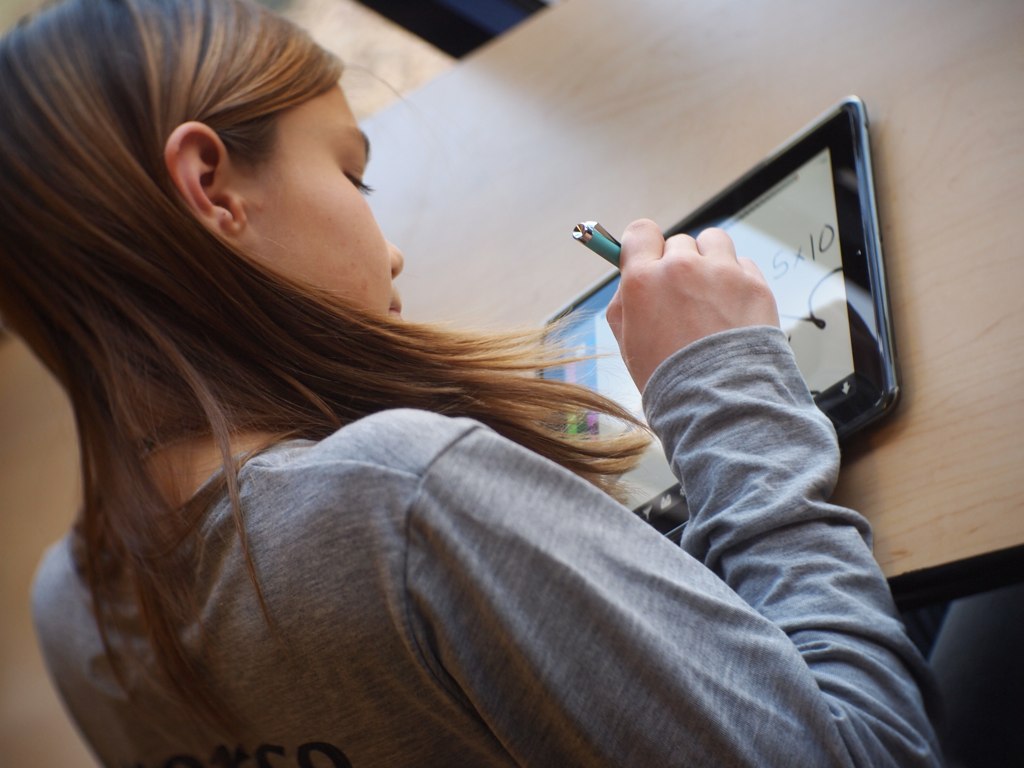
Student using iPad in school. Image via Flickr by Flickingerbrad.
There are several platforms, apps, and websites that are designed with mobile technology in mind. Taking care of the teacher, these resources help build lesson plans, virtually tutor students, provide file organization, and much more. The following tools are easy and helpful with educational planning in today’s world.
- Notability is an app specifically for note taking. Teachers are constant thinkers and planners. They’re always jotting ideas down on napkins and sticky notes when that light bulb goes off. Notability lets users take notes and annotate PDF files with Dropbox and Google Drive Sync. It’s a multi-functional app that keeps teachers organized and ready to seize the day.

Notability.
- MOBL21 allows teachers to design lesson plans, create study guides, and even construct flashcards for students. Students can access anything their teacher makes “public” from their smartphones or PCs. Recognized and accredited by school systems nationwide, it’s a platform educators can expect to see a lot from in the coming years.

Mobl21.
- Educreations Interactive White Board turns your iPad into a recordable whiteboard. Teachers can create engaging and interactive tutorials by simply touching, tapping, and recording their voices to their iPad. Then, by using the ELMO system or similar device, they can present the video to their class.

Educreations Interactive White Board.
Though these tools provide assistance outside of the classroom, it’s equally important that teachers use mobile technology in the classroom. Since schools are responding to the new age of tech, they’re seeing how crucial Internet service providers are with supplying quality, high-speed connections. High speed connections are vital in the classroom since teachers must quickly move from topic to topic to keep students engaged. Even a few minutes of download time can lose a child’s attention.
Schools Find Mobile Technology a Valuable Resource
While school districts and teachers used to fight against the rising trend of students carrying their cell phones and mobile devices with them at all times, some have begun to use it as a viable educational resource to enhance the learning experience. Here are a couple of examples of how mobile technology has specifically enhanced classroom experiences:
- Matt Cook’s fifth grade classroom at Trinity Meadows Intermediate School in Keller, Texas, has found mobile technology to be a wonderful resource for students. With the financial support of corporate sponsors, along with moral support from parents and the district school board, each student in Cook’s class carries a cell phone to document their work, collaborate on projects and to communicate with their teacher. The devices are not voice or text enabled, but Cook says they find other ways to enhance their learning. “As a teacher, I use GoManage to push out applications and files to the phones as the kids wireless sync. We also use Gaggle for e-mail communications with the kids. It is safe and filtered.”1
- The Beaufort School District in Beaufort, South Carolina, has recently expanded their iPad program to include some 8,400 tablet devices to be used by its middle and high school students. They say the program has “increased student engagement in learning and familiarized students with mobile technology that they will use in college and in their careers.”2
Students’ New Age Learning Aids and Games
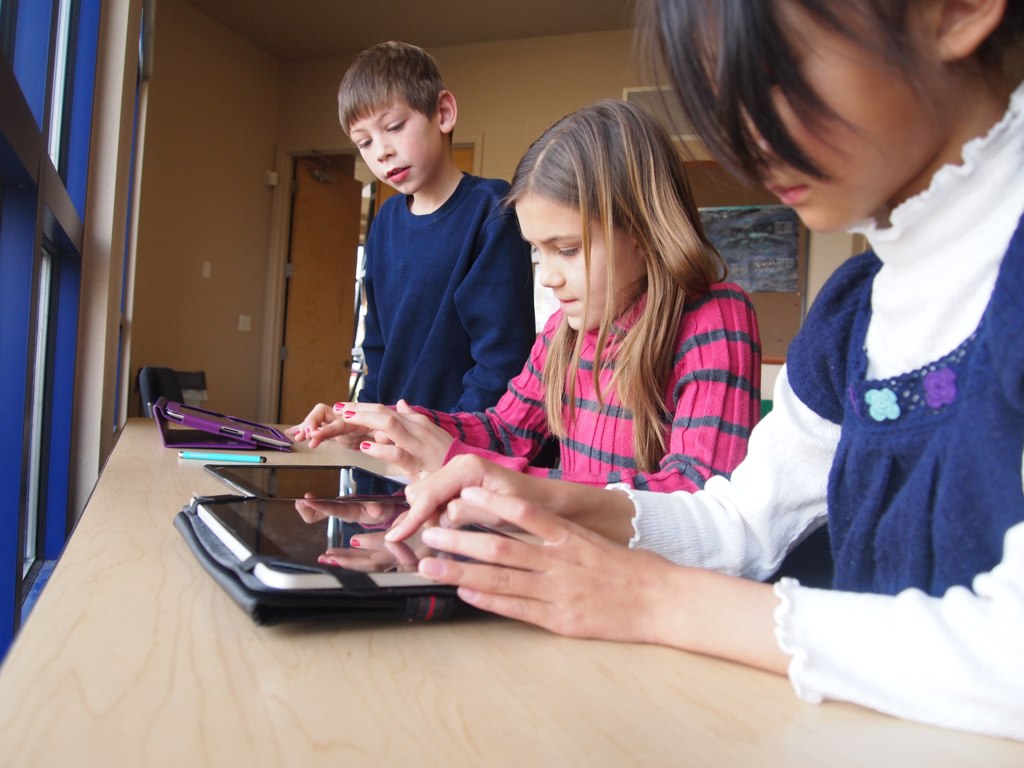
Students using iPads in school. Image via Flickr by flickingerbrad.
Teachers aren’t the only ones having fun with mobile technology. Students are having a good time with it too. There’s nothing better than disguising learning with fun, interactive apps. Here are a few educational applications kids are using.
- Stack the States is an app that teaches students about U.S. geography with a playful cartoon theme.

Stack the States.
- BrainPop/BrainPop Jr. is used in thousands of classrooms and is available by traditional website as well as a mobile app. Covering every subject and grade level, this diverse teacher’s assistant can keep kids learning at home too.

BrainPOP.
- Shakespeare is an app that provides all of Shakespeare’s greatest works along with concordance for easy referencing.

Shakespeare.
- Storykit is for the budding writer. With high stakes writing tests, Storykit is essential for elementary school students.

StoryKit.
With hundreds of educational apps, kids are staying busy and learning on mobile devices. The level of connectivity is at an all-time high, and we can only hope that technology continues to aid and benefit teachers and students.
__________
1 Cara Bafile, “Mobile Technology Goes to School,” Education World, 2009.
2 Ken Hawkins, “Beaufort School District calls iPad program a success, will bring total to 8,400,” The Digital, 22 May 2013.
Filed under: Mobile Technology |








































































































































































































































































































































































































































































I am at another conference, the ESRI conference which I will write about . It was a distinct pleasure to find this article and a message from Harry in my mail box.
I am old enough that I helped try out Carmen Sandiego and thank goodness we have new ways of working, but for the kids back in the day , it was exciting and new. I loved this article. I put it out on my Scoop-it. I learned more from this article than I did at ISTE about mobile because I could not attend the mobile workshops that I wanted to.
I feel better about my work on line now.
Hi Bonnie! Thanks so much for reading! So glad you enjoyed it. As a recent college graduate having my iPhone be a tool in many of my courses was so convenient and helpful. I think technology can absolutely help younger students stay engaged, and make life easier for teachers! Thanks again!
I do not desire to rain on anyone’s parade. Every technology has potential usefulness. Tablets with gesture-based interfaces have captured the imagination of very many people, some of them educators. My grandchildren both have iPads and do so much with them that it staggers the imagination. They’re just four and six years of age. Yet, the iPad is not an educational panacea, and neither is any other technology.
Consumer technology must come under special scrutiny. How well does it adapt to education? How easy is it for education to adopt?
With the iPad, we have a tool with much greater cost than alternatives, more than twice that of a Chromebook, for example. In some settings, the extra cost may be worth it. I see it as being especially useful in K-3, but would see similar value for an Android tablet. Keyboards and mice don’t work so well at the lowest grades, not that students cannot master them, just that keyboards are rather unnecessary at that level and that gestures are easier to master than a mouse is.
As the grade level advances, these tablets retain value, but alternatives that cost less can deliver more. I’m typing this on a MacBook Pro. I would be hard-pressed to do so on an iPad.
School districts are experimenting with all sorts of devices. One is standardizing on Chromebooks. Another has chosen iPads. Yet another is selecting a low-cost Android tablet. Some stick to low-cost laptops but are considering alternatives.
I don’t really see the rush, the extreme hurry exhibited by districts to buy expensive iPads, and forgo other expenditures to do so, when this development in computing devices is still playing itself out. The next great device could be announced tomorrow and could put iPads on the shelf until Apple manages to come out with a newer model. Manufacturers are scrambling to entice consumers to their particular device, while almost entirely ignoring the problems that schools face.
When a school chooses widespread adoption of a consumer or business product, it’s taking a risk. Often, it’s bowing to parental pressures at the same time. While we should applaud schools for overcoming traditional education inertia, we should also realize that some of these new things are just fads or early examples of an incompletely developed new technology.
The fact that so many districts are going in so many directions indicates strongly that we don’t know where these trends will end. Until we do, I think that wholesale adoption of iPads by high schools is a mistake. My specialty is science. I have yet to see a great science app for high school on an iPad. Mostly, they’re just games, animations, and other ordinary stuff.
My disclaimer here is that I run a company that puts out an online science application that I consider to be great and am currently porting to the Chromebook, iPad, and Android tablets. Vendors have to cover all bases eventually. I’d rather not have to spend all of this money on fads, but major customers are demanding it. The result will be higher prices.