What Should Pres. Obama Do About Educational Reform?

Bonnie BraceyBy Bonnie Bracey Sutton
Editor, Policy Issues

[Updated 8.2.10 – links added: “A Blueprint for Reform: The Reauthorization of the Elementary and Secondary Education Act”; “In the News: More Opposition to Duncan’s Reform Policies: Defending Obama’s Education Agenda”; “Our Communities Left Behind: An Analysis of the Administration’s School Turnaround Policies.” -bbs/js]

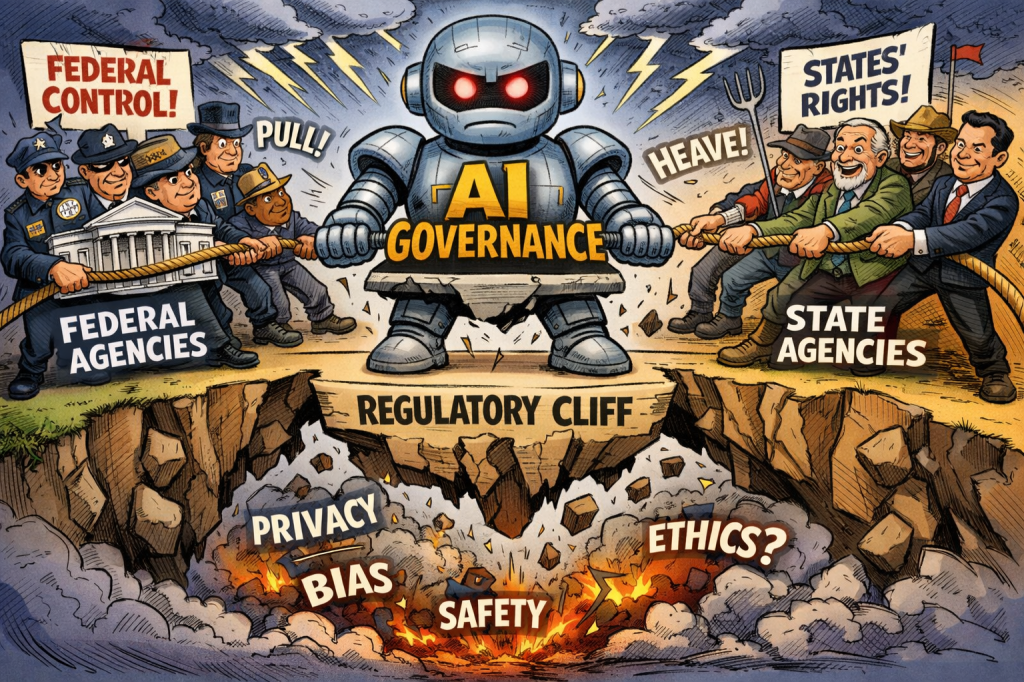
The problem that President Obama is having should be addressed. I think he is between a rock and a hard place in his efforts to change the face of education. What do you, our ETCJ readers, writers, and editors, think he should do?

To post your comment, click on the title of this article and scroll down to the comment box. To start the discussion, here are a few documents that you might want to read:

Valerie Strauss, “Obama, Education, Snooki, Civil Rights and Bryan Bass” (The Answer Sheet, Washington Post, 30 July 2010): The president’s “terribly misguided $4.35 billion competitive grant program is, apparently, more important than health care reform, the economic recovery program, improving the student loan program, increasing Pell Grant payouts, and, well, anything else he has accomplished since becoming president.” Continue reading →

Thinking Inside the Box

By Steve Eskow
Editor, Hybrid vs. Virtual Issues

In the United States the box is often 20′ by 30′, 600 square feet. It is furnished with 30 tablet arm chairs that encourage the sitting students to write. In front of the box there may be a lectern, which encourages the standing instructor to say things which the students can write.

There are other boxes in the building. One is called the “lecture hall.” The “campus” is a collection of such boxes, boxes of different sizes and configurations which allow and encourage variations in the kind of speaking and writing that goes on within them.

Some of the boxes have the new communication technologies. It is the dream of innovating teachers and administrators and educational agencies that these new tools can “blend” with the old tools of talk and books and thus transform education.

Continue reading →

‘Computer Science’ Contains Little or No Science

By Harry Keller
Editor, Science Education

[Note: The following article was originally posted by Harry Keller on 30 July 2010 as a reply to Robert Plants‘s “Computer Science – A Field of Dreams.” -js]

The statement, “Our faculty in the schools of education have the expertise to continue to produce the same teachers for the same curricula, but they lack any expertise to produce teachers for STEM related subjects…” rings true. An insufficient number of science teachers understand science. It’s not really their fault for they haven’t had the opportunities to develop that understanding. Continue reading →

Computer Science – A Field of Dreams

By Robert Plants

[Editor’s Note: This article was written in response to Bonnie Bracey Sutton‘s call for submissions from selected writers. Bonnie is ETCJ’s editor of policy issues, and the focus of her call was Erik W. Robelen’s “Schools Fall Behind in Offering Computer Science” (Education Week, 7.14.10); WebCite version. -js]

You can’t build it and expect people to come. We cite statistics on what is and what isn’t but fail to dig into the symptoms. We point out initiatives that may influence supply and demand but don’t go on to look at what influences K-12 education that results in the dearth of interest in computer science. In most states, the emphasis lies in producing enough teachers to staff the education that we have. We have an educational system focused on a standardized curriculum, rote memorization, nationalized testing, curriculum standards. Dig a little deeper and you will find that the structure of schooling is about the little red brick building we have always known, grades, classrooms, curriculum, teaching strategies – one size fits all. In many ways, our system of schooling has not changed in 100 years. Continue reading →

For Educational Change — Teachers Are the Key

Jim ShimabukuroBy Jim Shimabukuro
Editor

This article is in response to the challenge that prompted John Adsit‘s “What Is Needed for Educational Change“: What is the one most important factor in making change work? John highlighted leadership, and Harry Keller, in “Leaders Must Be Visionary Risk-takers to Change Our Schools,” added qualities that the leader must have.

I’d be inclined to agree with John and Harry if the campus were still the center of the academic world. But it’s not. The center has been shifting to the world’s digital infrastructure, to the internet, where classrooms, schools, and colleges are being reconstructed in virtual bits rather than cement, creating “a world of ubiquitous connectivity” (Hagel, Brown, and Davison, The 2009 Shift Index: Measuring the Forces of Long-term Change, p. 11).

Continue reading →

Leaders Must Be Visionary Risk-takers to Change Our Schools

By Harry Keller
Editor, Science Education

[Note: The following article was originally posted by Harry Keller on 26 July 2010 as a reply to John Adsit’s What Is Needed for Educational Change. -js]

Educational change. What is it? Would we really like to have it?

In better times, things were allowed to move along without too much worry about education, except for some of the poor and minority areas.

Now, with headlines screaming at us about changing education, what’s wrong? John Adsit has provided us all with a cogent analysis of what doesn’t work and a suggestion as to why we aren’t doing what does.

Is change necessary? I have personal experience with a large urban school in a poor neighborhood (60% poverty). Despite hiring the best possible science teachers, they still had a 50% failure rate on the Regents science tests. Some of these teachers had PhDs in science. They were all excellent communicators and, as far as I could tell, excellent teachers. The science department was tearing its hair out. So, yes, change is necessary. This story repeats itself too many times across our country. Continue reading →

What Is Needed for Educational Change

adsit80By John Adsit
Editor, Curriculum & Instruction

This article springs from an exchange of opinions on what is needed to effect change, and I was challenged to start a new discussion on the most important factors in making change work. In that original exchange, I argued that the most important factor is leadership, and I will start this new discussion with that premise. I believe skilled leadership is the most important factor in making change happen.

A couple of decades ago I spent some very painful years when the opposite was believed to be true. There was a belief, spurred in large part by the Annenberg Institute’s Re:Learning project, that the change leaders in education had to come from within the faculty. Change had to at least appear to be a grassroots effort, and school administrators sought to develop teacher leaders for reform efforts. The theory was that teacher leaders would initiate a reform, it would work, and the idea would slowly progress through the ranks until it had taken over. The administrators would intentionally fade into the background and let this magic work. Continue reading →

‘Emerging Technologies in Distance Education’ ed. by George Veletsianos

Claude AlmansiBy Claude Almansi
Editor, Accessibility Issues

Emerging Technologies in Distance Education, edited by George Veletsianos, has just been published by Athabasca University Press, a Canadian publisher of Open Access, peer-reviewed, scholarly publications. The book, under an Attribution-NonCommercial-NoDerivs 2.5 Canada  Creative Commons License, can be bought in print or downloaded (at no cost) as PDF from aupress.ca/index.php/books/120177.

Cover of Emerging Technologies in Distance Education, ed. by George Veletsianos Continue reading →

Faculty and Students Need Training to Succeed in Online Classes

adsit80By John Adsit
Editor, Curriculum & Instruction

[Note: This article was first posted by John on 23 July 2010 as a reply to a comment by Jim, in the discussion on “We Need an Eco-Smart Model for Online Learning.” Also see John’s earlier comment on that article. -js]

For the student, a major difference is that she can’t sit back and expect to be taught. She has to actively navigate the virtual environment to learn. -Jim S

In my experience, therein lies the problem.

You describe a “guide on the side” ideal of learning, a style I endorse. When I first started an online school, we set up all our courses like this, from the start, and immediately ran into significant problems with student failure. It led me to do a presentation at a national conference I called “The Trap of Best Practice.”

Continue reading →

HOT@ Emerging Tech San Jose – July 20-23

By Jessica Knott
Editor, Twitter

So far, this conference is really interesting, with much diversity in interest. The thing today that’s standing out to me most (probably due to my fascination with the LMS) was the session on LMS futures. This blog post really sums up the discussion, highlighting an interesting disconnect between LMS vendors and users.

I’m not getting to as many sessions as I’d hoped, but I’m editing a ton of recordings, so see a lot about what’s being discussed. :)

Added 26 July 2010: If you would like to read up on the Twitter back channel (which I highly recommend), please search for the hash tag #et4online to see first hand responses from conference attendees. Continue reading →

We Need an Eco-Smart Model for Online Learning

Jim ShimabukuroBy Jim Shimabukuro
Editor

Two articles that appeared in my Google alerts today (7.17.10) grabbed my attention. Both were out of California. One was a San Francisco Chronicle editorial blasting the University of California’s vision of an internet-delivered bachelor’s degree program.

The other was an op-ed by James Fay and Jane Sjogren, sharing their vision of a hypothetical Golden State Online, or GSO, a “stand-alone online community college campus.”

On the surface, the visions seem to be quite different, and the viewpoints are obviously different. However, below the surface, both visions share a common flaw — they’re based on models of online learning that are, in my opinion, simply not sustainable.

This got me thinking about an alternative model that would be infinitely sustainable. After a few starts and stops, I came up with an eco-smart model for online learning, or E-SMOL. Continue reading →

Recreating an Online Class for Greater Student Participation and Retention

Judith McDanielBy Judith McDaniel
Editor, Web-based Course Design

I am core faculty for the M.A. program in Literature and Writing at Vermont College. In the last decade, Vermont College was bought by Union Institute and University in Cincinnati, Ohio. I live full time in Tucson, Arizona. I attend faculty meetings in Ohio and Vermont by conference call, and nearly half of the participants in any meeting are phoning in from all parts of the United States.

Last semester, two days before classes started, I took over a course that a colleague had developed; he was unable to teach for health reasons, and so I had no choice but to use the syllabus and the course site that he had developed. I went through the semester following the syllabus he had created and the discussion prompts that engaged the students each week in a conversation about the materials. I scrambled to keep up with the reading each week; I have a Ph.D. in literature, but my specialty is nineteenth century poetry and fiction, while his was drama and postmodern literature and theory. Reading even a part of what he had assigned was enough to stretch me, and I could only imagine how the students who were attempting their first graduate work might have felt. Continue reading →

JRTE Spring 2010 Issue – A Sacrilegious Review

Jim ShimabukuroBy Jim Shimabukuro
Editor

Three of the four articles that make up the spring 2010 issue (v42n3) of Journal of Research on Technology in Education caught my attention more for their assumptions than their stated purposes. These assumptions highlight, for me, some of the weaknesses inherent in efforts to introduce technology into schools and colleges.

In “Technology’s Achilles Heel: Achieving High-Quality Implementation,” the “heel” for Gene E. Hall is school and college administrators. According to Hall, “Education technology scholars and practitioners are engaged with some of the most promising and interesting innovations.” However, these innovations don’t find their way into classrooms because of the failure of administrators to implement them. Thus, our enlightened ed tech guiding lights are “confronted first hand with the challenges associated with disappointing implementation efforts and failures to go to scale.” Continue reading →

HOT@ ETAI – Day 2: English Teachers Association of Israel

Lynn ZimmermannBy Lynn Zimmerman
Editor, Teacher Education

I am presently attending the ETAI (English Teachers Association of Israel) “Linking Through Language” conference in Jerusalem. (Click here to see the first-day report.) One of the keynote speakers was David Crystal, a renowned linguist. His keynote plenary lecture was called “Myths and Realities of English on the Internet.” As an educator interested in both language and technology issues in education, I found his talk engaging and interesting.

Since the theme of the conference is “Linking Through Language,” Crystal opened up his remarks by referring to the Internet as “the language linker par excellence.” After hearing his talk, I think he would agree with Tom Preskett’s article from April 8, 2010, Social Media Doesn’t Threaten Literacy! Among other things Crystal pointed out that in order to text using abbreviated words, one needs to know how to spell the word to start with so you can leave out the proper letters. He also cited anecdotal evidence from teachers showing that students do not carry over these habits into formal writing to a large degree. Continue reading →

A Response to Marc Prensky’s ‘Simple Changes’

keller80By Harry Keller
Editor, Science Education

It is with some humility that I undertake to comment on Mr. Prensky’s article, “Simple Changes in Current Practices May Save Our Schools.” It touches on many ideas in which I have an interest, beginning with the oil spill as learning opportunity on which I provided an earlier comment (see “Opportunities to Learn from Oil Spills“). His idea is much more bold than mine, and I bow to his audaciousness.

I concur in the concept that the words “relevant’ and “authentic” have become overused and have lost meaning. They also represent a long-ago era of education that didn’t work then. Like so much in education, moderation and balance make things work. I believe that there’s nothing wrong with injecting some relevancy and authenticity into a classroom as long as you don’t base your entire curriculum on those concepts. I’m not so sure that “real” has any more meaning than those words, however. Continue reading →

Italy: Teachers’ Manifesto

Claude AlmansiBy Claude Almansi
Editor, Accessibility Issues

The Italian teachers of the la scuola che funziona (the school that works)  project have launched the Manifesto degli insegnanti (Teachers’ manifesto), which converges interestingly with Marc Prensky‘s Simple Changes in Current Practices May Save Our Schools.

Licenza Creative Commons BY-NC-ND
The original Italian manifesto is published under a Creative Commons License. It is translated here by permission of the authors, who can be contacted via la scuola che funziona. Here is its English translation by Luciana Guido:): Continue reading →

HOT@ ETAI – English Teachers Association of Israel

Lynn ZimmermannBy Lynn Zimmerman
Editor, Teacher Education

I am presently attending the ETAI (English Teachers Association of Israel) “Linking Through Language” conference in Jerusalem. (Click here to see the day two report.) This evening’s opening presentation, sponsored by the British Council, UK, was interesting and had an unexpected element. David Crystal, a renowned linguist, and his wife had prepared a presentation/performance called “Speaking Shakespeare: Fact and Fiction,” described in the program as “a light-hearted romp through Shakespeare.” Continue reading →

Simple Changes in Current Practices May Save Our Schools

Marc PrenskyBy Marc Prensky

Here’s an idea to get at least something positive out of the Gulf oil spill. What if volunteers (or BP, under presidential order) collected samples of the tar balls on the beaches, sealed them in plastic bags, and then shipped them to every school in America for all students to analyze in their science classes. We could even throw in some oil-covered sand and feathers for good measure.

Doing this would involve every school kid (and science teacher) firsthand in the problem. They would see and smell, for themselves, just what the spill is actually producing, rather than just hearing about it on TV. Their awareness, as citizens and scientists, would be greatly enhanced. Continue reading →

Computers in Low-income Households = Little or No Educational Benefit?

Here’s an article with a generalization that goes against the grain of everything most educators believe about access to computers for children from low-income homes. Randall Stross, in “Computers at Home: Educational Hope vs. Teenage Reality“* (New York Times, 7.9.10), says that studies by economists indicate “little or no educational benefit” is gained.

Stross writes, “Economists are trying to measure a home computer’s educational impact on schoolchildren in low-income households. Taking widely varying routes, they are arriving at similar conclusions: little or no educational benefit is found. Worse, computers seem to have further separated children in low-income households, whose test scores often decline after the machine arrives, from their more privileged counterparts.” Continue reading →

Morgan Sims

[Posted on 7.10.13; revised 7.11.13]
Morgan Sims160

Morgan Sims, a recent graduate of the University of South Florida, is a writer and social media consultant who loves all things tech and social media. She works indirectly with companies such as InternetServiceProvider. She spends most of her free time with her puppy, cooking, and staying active.

ETC Publications

Mobile Technology Finding a Place in the Classroom

Computational Thinking – What Is It?

Bonnie BraceyBy Bonnie Bracey Sutton
Editor, Policy Issues

I attended the first CS4HS High School Teacher Workshop: Computational Thinking and Computational Doing from June 25-27, 2010, at the ATLAS Institute on the University of Colorado at Boulder campus. (The conference was featured in the Boulder DailyCamera.)

First, a bit of background. I have been working in advocacy for STEM and related technologies, lurking around the edges of computational science for some time thinking about ways in which to incorporate new kinds of thinking for students in our schools. I have attended the leading Supercomputing Conferences and brought teams to the events to try to change teaching and learning so that computational thinking, with games and simulations, could find a prominent place in the forefront of those inserting STEM into the curriculum. However, I am not sure the conference is always happy with the outcomes of teacher participation since it’s difficult to gauge the longterm effects of what happens in the classroom and some presenters don’t have a very high regard for the ability of teachers to work with technology.

But this CS4HS workshop in Boulder was different. Its focus was on teachers, and it was par excellence! Continue reading →

‘Solar Impulse’ – Could Very Well Be Educational

John SenerBy John Sener

[Note: This article is a response to Harry Keller and John Adsit‘s articles in Flight of the ‘Solar Impulse’ – Educationally Relevant? All were prompted by Claude Almansi‘s Online in RealTime announcement. -js]

OK, this takes the discussion even further away from its original topic, but I found myself fascinated by several aspects.

First: Why do science projects essentially have to be labs? If science is fundamentally a way of thinking, why not also do projects that teach students how to think scientifically without having to use a lab? Field work? Conceptual work? Thought experiments?

Continue reading →

Flight of the ‘Solar Impulse’ – Educationally Relevant?

[Note: This post contains two articles, by Harry Keller and John Adsit, that were written in response to the Online Live in RealTime article by Claude Almansi. Also see John Sener‘s response to this article. -js]
Picture of Harry Keller and John AdsitBy Harry Keller
Editor, Science Education

The flight of the Solar Impulse is truly a technological tour de force. I was very impressed by the charts and virtual cockpit with the map of the plane’s progress. I didn’t even know that this amazing flight was taking place until Claude‘s note. Then I saw the headline in the NYT, “Solar-Powered Plane Flies for 26 Hours.” I have to wonder how many people see that headline and realize immediately the remarkable fact that such a flight requires flying a solar-powered plane for hours in the dark.

We see plenty of emphasis on STEM education in the U.S. these days. I am very biased toward the S (science) part of the acronym but see the importance of technology as a means of engagement. Mathematics gets enough attention on its own and can be better taught, IMO, in conjunction with science, technology, and engineering until students have enough sophistication to study things like group theory that are much more abstract. But I’m biased, as I said. Continue reading →

Levels of Learning: The Creative Process

Tom PreskettBy Tom Preskett

I’m doing a lot of consultancy this month in various contexts under various titles designated by my clients. These include etutoring and master class in blended learning. The latter of these is good for my ego but is perhaps a bit grandiose. The content is never exactly the same since different emphases are required as the contexts change. As long as my overall message is the same, I am happy.

Titling is an issue I need to get to grips with. I haven’t hit upon a one that I’m fantastically happy with. I’ve been using Web2.0Learning a lot, but I don’t want to be totally web 2.0 tool focused, and the content often reflects this now. Continue reading →

Was Rischard’s ISTE 2010 Keynote Really That Bad?

Jim ShimabukuroBy Jim Shimabukuro
Editor

Based on back channel comments included in Scott McLeod’s “ISTE 2010 – Some early takes on the opening keynote (and on conference attendees’ behavior)” (6.28.10, in his blog, Dangerously Irrelevant), the opening keynote by Jean-François Rischard on the 27th was a disaster in terms of audience appeal.

Yesterday (29th), I wasn’t able to google a transcript or video of the keynote so I can’t comment on the value of Rischard’s ideas. But I am concerned by the nature of the negative feedback quoted by McLeod. The majority seemed to be aimed at the low-tech and poorly designed PowerPoint slides and the lack of animation in the speaker. Little was said about the actual ideas.

Is this a case of an audience so conditioned to lecture as motivational entertainment that substance is no longer an issue? Or was Rischard’s presentation really that poor in terms of performance and substance?

Live Lecture Better Than Video Lecture?


Yes, according to a study conducted by David N. Figlio, Mark Rush, and Lu Yin, “Is It Live or Is It Internet? Experimental Estimates of the Effects of Online Instruction on Student Learning” (National Bureau of Economic Research, June 2010). I’m tempted to say “of course,” but for reasons other than those intended by the authors.

Subjects and Procedure: “Students in a large introductory microeconomics course at a major research university were randomly assigned to live lectures versus watching these same lectures in an internet setting, where all other factors (e.g., instruction, supplemental materials) were the same” (abstract).

Continue reading →

Oregon and Online Learning: Governor’s Reset Cabinet Final Report

The following excerpt is from page 45 of “Final Report: Governor’s Reset Cabinet” (Oregon, June 2010). The focus of this section is “virtual education”:

Virtual Education

Oregon should create and fully support a statewide public virtual learning system. The use of online or virtual learning has come of age in recent years. Today’s technology makes it possible to provide educational opportunities to remote areas of the country. Florida, for instance, has over ten years of experience with providing a statewide virtual system. In that state’s experience, the highest demand areas are in credit recovery and dual credit classes, where students earn both high school graduation and college credit. The average student is not enrolled full-time in a virtual program, but takes one or two online classes per semester. Continue reading →

The Latest Whiz-Bang Gadgets vs. Real Change

keller80By Harry Keller
Editor, Science Education

While I agree completely with Jim’s comments, John Adsit’s additions point to a broader problem, one that I’ve also seen. This problem transcends the technocrats issue.

Few people in education (including technology specialists, teachers, and administrators) can see outside of the box in which they’ve placed themselves. John is a rare exception.

When computers first entered classrooms (focusing on K-12 now), they were used in very conventional ways. The first educational apps were basically drills. Many still are. These can, with slight loss of efficiency, be done well with paper and pencil. No quantum leap in real learning occurs. Continue reading →

The Limits of Educational Technocracy: Change As No More of the Same

Jim ShimabukuroBy Jim Shimabukuro
Editor

John Adsit’s recent comment on the limitations of imagination with regard to change points to arguably the greatest obstacle to reformation of schools and colleges in the U.S. and the world. Educators, as a group, seem to be incapable of thinking outside the box. Asked to imagine different ways technology can be used to improve the ways in which we teach and learn, the results are almost always dismally familiar. Rather than changes that are surprising, fresh, new, different, outside-the-box, sustainable, and cost-effective, we come up with more of the same, with an emphasis on more. That is, we need more smart classrooms, more tech specialists, and more dollars to do more of the same.

One of the reasons for this lack of imagination is our choice of change agents. In the vast majority of colleges, when change and technology are the topics, the faces around the conference table belong to technocrats: administrators and staff from information technology and distance education departments. If subject-area teachers are included, they are more than likely present because they have earned part-time or associate status in the technocracy. Continue reading →

Gov. Tim Pawlenty: iColleges Are the Wave of the Future


On 10 June 2010, Minnesota Governor Tim Pawlenty appeared on Jon Stewart’s “The Daily Show.” One of the topics they touched on was online learning in higher education. The audio clip below is an excerpt from the TV show.

The following are transcripts of key comments by Pawlenty:

  • Do you really think in 20 years somebody is going to put on their backpack, drive a half hour to the University of Minnesota from the suburbs, haul their keister across campus and sit and listen to some boring person drone on about Econ 101 or Spanish 101? Continue reading →

A Prayer for Jennifer

I will call her Jennifer. I was thinking about her a couple of days ago when I fixed up a neglected corner of my garage, a corner where my children and their friends had penciled in their names and some attempts at adolescent humor. “Jennifer was here” was written next to a heart.

My wife and I met Jennifer soon after our younger son entered high school and needed a ride for his first date. My wife was their chauffeur, and she told me that Jennifer was a wonderful, sweet girl from a very nice family. Their dating relationship, like so many at that age, did not last all that long, but they remained very good friends. She was frequently among those who hung around our house, which for some reason was the place to be for that group. She was a friend to both my sons, and we were always glad to see her. Continue reading →

A Quick Review of JOLT’s June 2010 Issue

Jim ShimabukuroBy Jim Shimabukuro
Editor

The June 2010 issue of Journal of Online Learning and Teaching (JOLT, v6n2) contains 23 papers. Listed below are highlight statements and excerpts from ten of them. The selections and foci are based solely on my interests in online learning.

1. Online is the “emerging standard of quality in higher education.”

“It is clear that the experimental probability of attaining higher learning outcomes is greater in the online environment than in the face-to-face environment. This probability is increasing over time. . . . The distance learning approach is becoming the ‘normal science.’ Yet, this is not fully comprehended by the various decision making institutions where the gate-keeping positions represent, by and large, the past paradigm. Therefore, distance learning is still treated as the anomaly (‘step child’) instead of as the emerging standard of quality in higher education.” Mickey Shachar and Yoram Neumann, Twenty Years of Research on the Academic Performance Differences Between Traditional and Distance Learning: Summative Meta-Analysis and Trend Examination.

Continue reading →

Bill Gates on Online Learning in 2010

Jim ShimabukuroBy Jim Shimabukuro
Editor

The following are excerpts from “Online Learning,” a section in “2010 Annual Letter from Bill Gates.” According to Gates, “The focus of this year’s letter is innovation and how it can make the difference between a bleak future and a bright one.” He says, “If we project what the world will be like 10 years from now without innovation in health, education, energy, or food, the picture is quite bleak. . . . In the United States, rising education costs will mean that fewer people will be able to get a great college education and the public K–12 system will still be doing a poor job for the underprivileged.”

1. Hybrid approach: “The Internet will surprise people in how it can improve things—especially in combination with face-to-face learning.”

2. Cost effective: “With the escalating costs of education, an advance here [online learning] would be very timely.” Continue reading →

A Peek at ‘Technology and Pedagogy Expectations for an In-Person Course’

Jim ShimabukuroBy Jim Shimabukuro
Editor

Carrie Heeter’s “Technology and Pedagogy Expectations for an In-Person Course” reports on a study of Michigan State University students and instructors. Heeter is creative director of MSU’s Virtual University Design and Technology. What makes this report interesting and unique is that it focuses on students and instructors in “in-person” or F2F courses. The research question, in general, is: What are your views on the importance of a wide range of instructional technologies, including ones that are internet-based, in in-person courses? In this article, I’ve extracted select findings from the executive summary. (For the complete report and all the results, published 9 June 2010, click here.) My selections lean more toward students’ views and internet-related technology.

The study was conducted in fall 2009, with 165 MSU instructors and 735 students. The subjects “completed surveys about their technological and pedagogical expectations for a high quality, in person course in their discipline.” According to Heeter, “The evolving, ever-expanding array of increasingly sophisticated online tools for teaching and learning and the explosion of online information resources have transformed instructor and student expectations about good teaching.” Continue reading →

Is It Time to Say Goodbye to Universities?

On June 8, Harry Keller shared Philip E. Auerswald’s article, “First Newspapers, Now Universities: It’s Transformation Time” (Washington Post, 8 June 2010), with the ETCJ staff. As a result, Harry and two other ETC writers, Judith McDaniel and John Sener, submitted articles responding to Auerswald:

Harry Keller, “Universities Vanishing?”
Judith McDaniel, “View from an Online Classroom”
John Sener, “Chill Out at a Tailgating Party“

Here are the opening lines from Auerswald’s article:

The commencement season that has just drawn to a close has been, once again, a wonderful time to celebrate our enduring rituals of collegiate education.

Now prepare to say goodbye to them.

This isn’t to say that traditional four-year colleges are going to disappear overnight. They won’t…not any more than major-market newspapers have. But leaders in higher-ed have reason to pay serious attention to the disruptive changes technology has forced upon journalists and other knowledge workers: our industry is next.

[click here to read the rest of Auerswald’s article]

Universities Vanishing?

keller80By Harry Keller
Editor, Science Education

A recent article by Philip E. Auerswald suggests that colleges and universities must choose between evolution and extinction. He points to five recent trends:

  1. Students are not showing up for lectures anymore.
  2. Rising tuition costs are pricing more and more students out of higher education.
  3. Tightening credit markets make student loans more difficult and expensive to obtain.
  4. Alternative means to a college degree are becoming more numerous.
  5. Global corporations are more willing to accept graduates from alternative institutions.

These five dry trend statements mask the true underlying drivers, which are the interrelated forces of costs and technology. You might say the traditional colleges and universities have brought this problem upon themselves by setting tuition increases far beyond cost of living increases and even far beyond the increases in health-care costs. Although many students were already unable to afford a college education, these extreme increases have pushed even more to look at alternatives. Continue reading →

View from an Online Classroom

Judith McDanielBy Judith McDaniel
Editor, Web-based Course Design

After reading the article and the comments (Philip E. Auerswald’s “First Newspapers, Now Universities: It’s Transformation Time,” Washington Post, 8 June 2010), I was certainly disappointed in the quality of the conversation. Many of the comments are written by those who have never taken or taught an online class, nor have they considered the things that make an online course an exciting intellectual experience. Without the knee jerk reactions, I think it is past time to recognize that online education is with us for the duration. It won’t go away because it is a very exciting and viable alternative to traditional education. Continue reading →

Chill Out at a Tailgating Party

John SenerBy John Sener

I’m tempted to say “see my previous commentary on this topic” — this article (Philip E. Auerswald’s “First Newspapers, Now Universities: It’s Transformation Time,” Washington Post, 8 June 2010) is similarly annoying. But I’m beginning to wonder whether it’s the form or the substance which is annoying, or both. (I think it’s both.)

First, the form. The article’s next-to-last paragraph seems reasonable enough at first glance:

What all of this means for leadership in higher education is that while resistance is futile, obsolescence is far from assured. The coming transformation in higher education will be gradual, and it will be incomplete. Many of today’s elite institutions will not only survive, they will prosper. Other institutions that clearly define, measure, and communicate the value they bring to individual students – and not just to society as a whole – will prosper. As for those whose strategy is to repackage past glories as a vision for the future on forlorn trips to bankrupt legislatures, [it won’t work] . . .

Why then create such cognitive dissonance by covering a plausible conclusion with an attention-grabbing, contradictory, absurd coating? “Prepare to say goodbye” to universities? “Learning is still in for today’s students, but school’s out”? Continue reading →

The Internet Helps Us to Be Smarter – A Reply to Nicholas Carr

Jim ShimabukuroBy Jim Shimabukuro
Editor

A couple days ago (June 8), Claude Almansi posted a comment in our ETC listserv, inviting us to submit articles on the “furious* debate going on in the Media Ecology Association mailing list around the new(?) The Shallows: What the Internet Is Doing to Our Brains book by Nicholas Carr, of ‘Is Google Making Us Stupid?’ fame.” I poked around in the links she provided and decided to share my two cents.

I haven’t read The Shallows, but from the articles I’ve read, the assumptions underlying Carr’s views seem to be: (1) human beings are prone to distraction and the internet exacerbates the problem and (2) unitasking is healthy and multitasking is not.

The problem with these assumptions is that they oversimplify the thinking-learning process. Distraction is a facet of our ability to multitask, and as such, it can be both good and bad. It’s great to be able to concentrate on the road while driving, but it’s critical for us to be able to react immediately to a car that swerves, without warning, into our lane. This ability to focus on and respond to more than one thing at a time is essential for survival and for thinking. In this case, knowing where the other cars are at all times will determine whether we can safely slow down, speed up, or swerve into the next lane. Continue reading →

Texas A&M Decentralizing Office of Distance Ed – A Gutsy Call

Totally Online, by Jim Shimabukuro

In a memo dated 8 June 2010, Jeffrey R. Seemann, Texas A&M Vice President for Research and Graduate Studies, announced the university’s move toward decentralizing its management of distance education (DE), eliminating the Office of Distance Education and “transferring the development, management, and promotion functions . . . to the college deans and placing compliance with regulations and fee oversight under the purview of the Provost’s Office.”

This decision was based on “reviews of previously completed reports and other documents, consultation with knowledgeable individuals and groups, and an evaluation of distance education models at peer institutions” as well as “input from numerous university stakeholders.” Seemann said that “the recommendation to close the Office of Distance Education and transition to a decentralized distance education model is the right course of action.” He said, “Be assured that in no way will the quality of distance education programs be lowered by this action” (Texas A&M News & Information Services). Continue reading →

UNESCO’s Intergovernmental Copyright Committee – 14th Session

Accessibility 4 All by Claude AlmansiThe 14th Session of UNESCO’s Intergovernmental Copyright Committee will take place from June 7 to June 9 in Paris. Two of  the available working documents for that meeting give further information on UNESCO’s “anti-piracy” policy (already discussed in UNESCO, World Anti-Piracy Observatory and YouTube on this blog):

UNESCO World Anti-Piracy Observatory IGC(1971)/XIV/5B

WAPO covers 52% of UNESCO member countries

UNESCO World Anti-Piracy Observatory IGC(1971)/XIV/5B  (available in English, French, Spanish, Russian, Arabic), apart from the information already made available by UNESCO on the World Anti-Piracy Observatory (WAPO) site and in the French Wikipedia article about it, reveals that only 52% of the UNESCO member countries answered the survey on which WAPO bases the information concerning national copyright laws and “anti-piracy” measures. Continue reading →

Opportunities to Learn from Oil Spills

Retort by Harry Keller with a distilling retort on the left

What can we learn from the Gulf oil spill? How will technology play a role in that learning?

The first thing we know is that the Internet has made possible the 24-hour spill camera deep in the Gulf that’s providing a live feed of oil gushing out into the ocean waters. While I’m sure that BP would rather not have this output of visual information, they cannot avoid it in the current political climate. Continue reading →

Hybrid Learning Faces Unthinking Opposition

Meeting the Needs by John Adsit

Back when I administered a full time high school online education program, we of course had to find some way to provide the courses that many people would not ordinarily expect to take online. The most obvious example was physical education. I don’t believe I ever mentioned the fact that we had an online physical education class to anyone without a guffaw in reply, as if that were an obvious example of something impossible to do, a sign of the failure of online education as a viable instructional alternative.

After I outlined the class, though, the response that I almost always received was “Wow! That’s great! Can I take the class?” The hybrid class we created was far superior to any face-to-face physical education class I ever took, and I suspect it was true for the students as well. Continue reading →

Is Writing Best Taught F2F?

Totally Online, by Jim Shimabukuro

In “Missing the Personal Connection,” Mark Bauerlein claims that “writing is still best taught face-to-face between teacher and student.” He cites as proof the following kinds of exchanges that take place in his F2F (face to face) conferences with students:

“Look at that verb in your opening,” I say. “What do you think?”

“Passive?” student mumbles.

“How about an active verb, one that lets us drop that preposition, too?”

Student ponders, tries out a few, then we settle on a better choice.

Continue reading →

Tipping Points for Change: Are We There Yet?

Jim ShimabukuroBy Jim Shimabukuro
Editor

Tom Preskett‘s most recent article, “Making Sense of e-Learning Strategy,” and Harry Keller‘s response raise a number of issues, and, together, they suggest that we may have reached the tipping point in three areas that loom large as we use the latest technologies to extend our powers of communication. As we begin to shake free from classrooms and lectures that serve as content for the new medium, we find ourselves in the dark, able only to grope our way toward understanding the new medium of the internet and the unimaginable changes that it represents for our educational systems, in particular, and our global society, as a whole. Continue reading →

Making Sense of e-Learning Strategy

Tom PreskettBy Tom Preskett

It’s very common for the message to get confused or diluted when you try to introduce and encourage the use of learning technologies/VLEs into the higher education world. The main reason is that the message is inherently confusing. Ask two people tasked with encouraging their use, and you’ll get two different answers. There isn’t a dominant reason across the sector. I have mine, but I know it’s at odds with what others say. Continue reading →

Breaking News


Special Issue on “The US National Education Technology Plan”
By Bonnie Bracey Sutton
May 11, 2011

Did everyone see this? This is important because it is reflection on the National Educational Technology Plan
Just published in E-LEARNING AND DIGITAL MEDIA, Volume 8 Number 2 2011 ISSN 2042-7530 http://www.wwwords.co.uk/elea/content/pdfs/8/issue8_2.asp

SPECIAL ISSUE

The US National Education Technology Plan – Transforming American Education: Learning Powered by Technology
Editors: MICHAEL A. PETERS & DANIEL ARAYA

Michael A. Peters & Daniel Araya. Introduction. Transforming American Education: learning powered by technology, pages 102‑105 doi:10.2304/elea.2011.8.2.102 VIEW FULL TEXT

Robert B. Kozma. ICT, Education Transformation, and Economic Development: an analysis of the US National Educational Technology Plan, pages 106‑120

Kathleen Scalise & Mark Wilson. The Nature of Assessment Systems to Support Effective Use of Evidence through Technology,pages 121‑132

Michael B. Horn & Katherine Mackey. Transforming American Education, pages 133‑144

Leonard J. Waks. Transforming American Education: revolution or counter-revolution?, pages 145‑153

Nalova Westbrook. Media Literacy Pedagogy: critical and new/twenty-first-century literacies instruction, pages 154‑164

Raymond M. Rose. The National Educational Technology Plan Doesn’t Live Up to its Call for Revolutionary Transformation, pages 165‑169

__________

New York State Regents on Verge of Bold Step
By Harry Keller
May 10, 2011

The New York State Board of Regents has an item on the agenda for its next meeting on May 16 and 17 that could change the landscape for science instruction in that state and then reverberate throughout
all states. Here’s the recommendation for this item.

It is recommended that the Regents direct department staff to convene a group of science, technology, and education stakeholders including teachers and leaders from school districts, institutions of higher education, and business and industry to:

  • review and evaluate the science laboratory requirement;
  • consider and appraise current available research on teaching and learning in science;
  • make recommendations to the Board of Regents regarding amendments to current clause 100.5(b)(7)(iv)(d) of the Commissioner’s Regulations.

Click here for the full agenda.

This agenda item was scheduled for the previous meeting in April, but did not come up then. The committee recommended by Dr. John B. King, Jr., the item’s author, will include all stakeholders including teachers, leaders from districts, institutions of higher learning, and even businesses. The step being taken in forming a committee represents a huge change for New York State and signals the potential for more far-reaching change across the nation. The New York State Board of Regents has been adamant for decades about this topic. Other states have also created similar obstacles to using online science labs in schools. They may follow New York’s lead.

Many will decry, as they have for a very long time, the potential for loss of the experience of working with lab equipment directly. If not carefully crafted, the change could well result in cost-savings at the expense of a degradation of student science experience. New York State must walk a narrow line if they’re to allow online lab experiences without sacrificing quality science education.

After so many decades of holding firm against any change in the 1,200-minute requirement, New York has allowed for the possibility of change. That crack in the dam of science lab requirements will create a flood of opportunity for online science lab development and, possibly, a new way of presenting science courses.

__________

Robert Morris University’s Twitter Communication Project

In past columns, we’ve looked at how Twitter can be integrated into individual classrooms, but Web and Social Media Designer Douglas Derda and the social media team at Robert Morris University (RMU) are taking Twitter and social media to a whole new level, transcending university borders to get community members excited about what they have to offer. Continue reading →

Online Self-Publishing: Wave of the Future?

Lynn ZimmermannBy Lynn Zimmerman
Editor, Teacher Education

This interview with one of my colleagues, Anastasia (Staci) Marie Trekles, who teaches IT (Instructional Technology) at Purdue University Calumet came about as a result of a comment she had made on Facebook. She wrote: “I just got a plug for my book from John and Adam on No Agenda – how awesome!” Continue reading →

Making Sense of Social Networks: An Interview with Zizi Papacharissi

Stefanie PankeBy Stefanie Panke
Editor, Social Software in Education

Dr. Zizi Papacharissi, who received her PhD from the University of Texas in Austin, is one of the leading scholars of social media and online communication. Her work focuses on the social and political consequences of online media. She heads the Communication Department at the University of Illinois in Chicago. Zizi is presently completing an edited volume on online social networks, titled A Networked Self: Identity, Community, and Culture on Social Network Sites. In the interview, she talks about self-presentation, social capital and the prospects of social networking communities for academic learning, teaching and research. Continue reading →

Ebook Readers vs. Ipad for Education?

Tom PreskettBy Tom Preskett

I’m doing a project on ebook readers at the moment, and it’s led me to follow closely the advent of the iPad. My interest is the potential impact on education. At the moment, the contest is in the commercial/entertainment market. Once things settle down, education will be looked at.

From what I’ve been learning, you can’t just give students and educators an ebook reader as is right now and expect it to transfer to education successfully. Looking at it just from a book replication point of view, I feel it has to, at least, perform certain tasks well and efficiently. Continue reading →

Social Media Doesn’t Threaten Literacy!

Tom PreskettBy Tom Preskett

You can read a lot about the threat of new media to literacy and the printed word. Harold Jarche’s blog post, “Literacies,” is an example. Often there is a link made between the ability to engage in deep and meaningful learning, on the one hand, and reading large bodies of text, on the other. Or rather, there’s a link between an inability to learn and the fast-pace of media in the Web 2.0 world. Well, I just don’t buy this. In fact, it’s rubbish. Continue reading →

The Challenge for Our Schools: Thomas Friedman and Education

Retort by Harry Keller with a distilling retort on the left

Today, in his New York Times Op-Ed (Webcite alternative), Thomas L. Friedman made this comment:

Good-paying jobs don’t come from bailouts. They come from start-ups. And where do start-ups come from? They come from smart, creative, inspired risk-takers. How do we get more of those? There are only two ways: grow more by improving our schools or import more by recruiting talented immigrants.

This respected economist and commentator has closely linked our education system to our future success as a nation. He also argued for more immigration, more H-1B visas with longer durations. Continue reading →

Social Networking and the Secondary Student

Meeting the Needs by John AdsitMost discussions on this site dealing with the use of social networking in education are devoted to post secondary education. This column will look at the unique challenges of using any form of social networking in secondary education. The differences are significant, partially because of the ages of the students and more importantly because of the role of boards of education. Social networking in the secondary level has to solve some problems if it is to be used successfully. Continue reading →

Thomas H. Huxley on Teaching Science

Retort by Harry Keller with a distilling retort on the left
Frederick W. Westaway wrote on many subjects, especially about teaching science. He wrote the definitive volume, Scientific Method, Its Philosophy and Its Practice, for example. In 1929, he spoke clearly to us today about science education in his book, Science Teaching. He quotes Thomas H. Huxley, also known as “Darwin’s bulldog,” at length about science education. This Huxley quote from Westaway’s book dates to 1869! Continue reading →

iPad – Breakthrough or Misstep?

Totally Online, by Jim Shimabukuro
The iPad debuts today, and, as an educator, I can’t help but wonder if this will be the breakthrough portable communication device that will hasten the release of students and teachers from the grip of classroom walls. Continue reading →

Headphones, Computers, and the Web

Jim ShimabukuroBy Jim Shimabukuro
Editor

Note: The primary reason for selecting this subject for the second article in ETC’s “Extracurricular” series (see John Adsit’s “The Great Technology Controversy Follows Me into the Caves“) isn’t so much to share information about what I consider an enjoyable hobby but to underscore the fact that the entire pastime is built on computers and the web. All of the equipment was researched and purchased on the web – out of necessity because, for the vast majority of enthusiasts, it’s not available in stores within driving distance. I think I can fairly say that this hobby wouldn’t be possible without the internet and that it owes its survival and growth to a community that’s defined virtually rather than geographically. -js Continue reading →

MOOC Sightings: Links to Series

Jim Shimabukuro

Jim

Series began on 20 Feb. 2015

MOOC Sightings 007: The Battushig Factor in College Admissions

MOOC Sightings 006: Universities Are ‘Middle-men Selling a Product That Is Past Its Sell-by Date’ 3/23/15

MOOC Sightings 005: Wharton School and Universiti Teknikal Malaysia 3/11/15

MOOC Sightings 004: Outside the Box with Ontario’s Judy Morris 2/28/15

MOOC Sightings 003: FutureLearn, Microdegrees, ‘Open Internet’ 2/24/15

MOOC Sightings 002: Oxford Professor Declares MOOCs the Loser 2/22/15

MOOC Sightings 001: UNC and Cornell 2/20/15

What’s the Buzz? Buzz

A Google search for the term Google Buzz returns 72,400,000 hits. Google Buzz Twitter returns 53,100,000. This is considerable, given the relative new shininess of the Google Buzz functionality. But isn’t Buzz just like Twitter in Google? Is it a Twitter killer? What the heck is it? Continue reading →

Threat of Lawsuits on Social Networking Sites

Meeting the Needs by John AdsitOne of the dangers we face in using social networking sites is our lack of control over them, their content and the way participants interact. Because the law on this is still emerging, we face the potential for unknown legal repercussions. An example of this has just come about as a social networking site devoted to scuba diving, scubaboard.com, has been sued, along with over 100 of the people who post on it, for content that would be considered tame in most social networking sites. Continue reading →

Thoughts on ‘Innovating the 21st-Century University: It’s Time!’

Tom PreskettBy Tom Preskett

I’ve read and re-read Innovating the 21st-Century University: It’s Time! by Don Tapscott and Anthony D. Williams (Educause, 2010) to try and absorb its key messages. Here are some quotes from the article, followed by my comments.

Universities are losing their grip on higher learning as the Internet is, inexorably, becoming the dominant infrastructure for knowledge — both as a container and as a global platform for knowledge exchange between people — and as a new generation of students requires a very different model of higher education. Continue reading →

Tech Support – Abandon All Hope Ye Who Enter

Meeting the Needs by John Adsit
Advocates of technology in education, especially those who, like me, advocate for online education, need to consider the problems that the modern concept of tech support can cause. Tech support within a school campus is very different from tech support for the student or teacher working at home. If I were either an online student or teacher during the past year, I would have had serious problems due to technical difficulties, and the nature of these is such that it brings me real concern for anyone in such a situation in general. Online programs will have to consider processes to deal with this. Continue reading →

The Great Technology Controversy Follows Me into the Caves

adsit80By John Adsit
Editor, Curriculum & Instruction

[Note: ETCJ editors and writers live full lives, and from time to time, we’ll be publishing some of their extracurricular pursuits. See Jess Knott’s “Smackademia – the Best of Both Worlds!,” the second in this series. -Editor]

I made my first online class in 1995, and since those days much of my life has been spent trying to convince nonbelievers that computers could improve student learning if used properly. Those years were filled with many less than pleasant arguments, and like many people I looked to my recreational life to get away from such battles. Unfortunately, I now find that my chief area of recreation, scuba diving, is filled with those same battles. The controversy of my work life has doggedly pursued me into my recreational life. Continue reading →

Sloan-C Survey 2009 – 25% of College Students Are Taking Online Classes

Totally Online, by Jim Shimabukuro

Last month, The Sloan Consortium published I. Elaine Allen and Jeff Seaman’s Learning on Demand: Online Education in the United States, 2009, its seventh annual report on the state of online learning in U.S. higher education. Click here for the full report, which is available as a PDF file. Online courses are defined as “those in which at least 80 percent of the course content is delivered online.” Continue reading →

Do You Speak Livemocha? An Interview with Clint Schmidt

Stefanie PankeBy Stefanie Panke
Editor, Social Software in Education

Livemocha is a social network service that supports language learning through audio-visual lessons and peer tutoring tools. Launched in September 2007, the platform has over 5 million registered members from over 200 countries. Lessons are provided for 36 different languages. While the standard lessons are freely accessible for registered users, the platform also offers “premium content” for a fee. Livemocha is more than just “Rosetta Stone on the Web.” A unique selling point of the educational Web community is its collaborative approach to language learning: Members of the Livemocha community do not only learn a foreign language, they also tutor other community members in their native language. Users are encouraged to form learning tandems and offer feedback on their partner’s speaking or writing exercises. The Livemocha platform supports this peer learning practice through comment features, voice recording and social awareness tools. Continue reading →

Successful Learning: A Matter of Both ‘What’ and ‘When’

Meeting the Needs by John AdsitI recently addressed the value of using learning objects to address student needs for prerequisite skills in online instruction. I suggested developing a library of learning activities that could be tapped into whenever a student had an identified learning need that was interfering with present learning. Not too long ago an online education company considered the idea of using independent learning objects of this kind to create new courses just by mixing and matching the objects as needed. They also considered building a course entirely with such lessons, letting students select the lessons they needed in the order they felt they needed them. This, they felt, was the epitome of student-centered learning. Continue reading →

Textbook Tweets – Integrating Twitter into a Telecommunications Design Class

Dr. Carrie Heeter, a professor of Telecommunication, Information Studies, and Media at Michigan State University has been integrating Twitter into her graduate Design Research class this spring in two very different ways. She is moderating a class Twitter ID (@tc841) set to follow experts in the field. Heeter retweets particularly important content to students and to the vibrant professional community of design researchers on Twitter.

Heeter is using Twitter in an unusual way to enhance live class discussions of assigned readings. She calls it “Textbook Tweet Time.”

As a graded part of live class participation, Heeter’s students are assigned to come prepared to tweet interesting insights they gleaned from the week’s readings from the Twitter ID they created for class participation (this can be their personal Twitter ID or one created exclusively for class). Using the PowerPoint Twitter tool from SAP, Heeter configures and projects a PowerPoint slide to search for the hash tag #tc841read. The search is continuously updated so new tweets show up within 10-20 seconds.

Dr. Carrie Heeter

Students must include that hash tag in the tweet in order for it to show up on the slide (and in order to receive credit for participation). The PowerPoint Twitter Tool can be toggled between two alternate formats – one shows the 9 most recent tweets in dialog boxes, along with the twitterer’s ID and photo. The alternate photo shows the most recent 18 tweets. The examples below are from Textbook Tweet Time about Will Wright’s chapter, “Sim Smarts,” in Design Research by Brenda Laurel.

As tweets appear in class, Heeter calls on the tweeters to describe their post. The class discusses each post, then moves on to another tweet. The class tweets about and discusses one chapter at a time, to limit number of tweets and to focus the discussion.

Heeter finds that “the tweets give each student a platform, almost like handing them a microphone. The students explain and expand upon their tweet, and discussion ensues.” The tweets focus class discussion and ensure 100% participation (in this small graduate class). There is a permanent record of the tweets, which facilitates grading of live class participation and motivates attention to the readings before class.

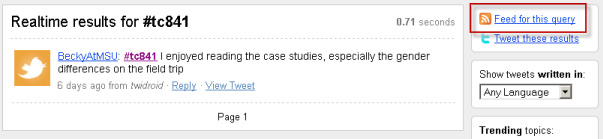
Learners can also view the search results for #tc841read on Twitter search (located at http://search.twitter.com). This view does not limit the number of tweets that are returned unlike the PowerPoint tool (shown above). Heeter subscribes to the RSS feed for that Twitter search, creating a permanent record of the class tweets on her desktop. Heeter says, “Because I can search and archive the tweets, grading classroom discussion becomes more systematic, thorough, and objective. I gain a sense of what matters from the readings, and some feel for how deeply different students are delving in to the readings. The tweets motivate preparation for class and then serve to reinforce the important points; and they give each student a turn.”

Twitter is a public space, leading to the potential for privacy concerns. In Heeter’s design, the students can use their personal Twitter account for class or they can create a unique twitter ID just for TC841. She says, “They control their anonymity in their choice of twitter ID.” For example, one student’s Twitter ID is six letters, all consonants and unpronounceable. Another student is a deceased movie star. Still others use their real names.

Some students post a picture of themselves as their Twitter icon while others post a graphic or picture of something other than themselves. Still others are simply a variation on the default Twitter icon – a white bird silhouette with a color background. “I have one orange student, one purple, and one light blue,” says Heeter. “I know the Twitter ID that each student is using for class so I call on them by their real name (or for fun, sometimes by their silly Twitter name). Their tweets are public, but depending on the set up choices they have made, they are more or less anonymous.”

By navigating to http://search.twitter.com and searching for #tc841read, Heeter can click on the feed for the #tc841 query button to have a folder in her default RSS reader collect and save all textbook tweets.

Heeter feels that using tweets for classroom discussion and collaboration is working well, though she notes that “for larger classes I would need more control.” As it stands, with the number enrolled, she finds “this particular interface happens to be perfect as is right now in this class.”

Heeter lives in San Francisco and teaches in East Lansing. The design research class is a hybrid class with between one hour and 90 minutes of live class and the rest online. Heeter participates via Skype and Breeze connect. Students can either come to the classroom or Skype and Breeze from any remote location. Of course, the instructor need not be remote for Textbook Tweet Time to be an effective component of synchronous class discussion.

‘Digital_Nation’ – Two Reviews

encounters80Introduction: This encounter was suggested by Lynn Zimmerman in an email message to Jim Shimabukuro. It is based on Rachel Dretzin and Douglas Rushkoff’s Frontline special, “Digital_Nation: Life on the Virtual Frontier,” published in video format on 2 Feb. 2010. Jessica Knott and Jim have responded to the 90-minute online program with the articles below. All are invited to comment.


Digital Nation – Geeks May Be Normal, but Are They Listening? by Jessica Knott: With technology comes responsibility. Be it a conference back channel or a course lecture, expectations for use must be set and outcomes made explicit. Ample opportunity for exploration and self-reflection is crucial in any learning environment, and technology can facilitate this in ways that were impossible even 15 years ago. It is important, however, not to lose ourselves in the technical abyss. We are not educators of technology, we are educators harnessing technology. [click here to read the full article]


‘Digital_Nation’ – A Digital_Dud by Jim Shimabukuro: In the end, after 90 minutes, I had the kind of “Huh?” moment that comes after I’ve watched a video out of sequence with key scenes omitted. I must’ve missed something because that couldn’t be all there was. [click here to read the full article]

Social Networking for Academics: An Interview with Ijad Madisch, CEO of ResearchGATE

Stefanie PankeBy Stefanie Panke
Editor, Social Software in Education

ResearchGATE was founded in May 2008. The platform aims to create an international network of scientists and has been quite successful so far. ResearchGATE has 250,000 members worldwide and grows with a rate of approximately 1000 new member registrations daily. The features are targeted to a scientific audience, for instance, supporting the “self-archiving” of publications.

For ETC Journal, I interviewed Dr. Ijad Madisch, the platform’s co-founder and CEO. Ijad spends most of his time in Boston, where he works as a radiology researcher at the Massachusetts General Hospital of Harvard Medical School. He studied medicine and computational science at the German University of Hannover and the Harvard University in Boston. He received a summa cum laude for his doctoral thesis on virology and was awarded the 2008 doctoral research award from the University of Hannover.

The interview offers a look behind the scenes of a social networking start-up.

Dr. Ijad Madisch, co-founder and CEO of ResearchGATE

SP: Please describe the purpose and main idea of ResearchGATE. Does the character of the Web site reflect the academic background of its founding fathers?

IM: ResearchGATE – scientific network is a custom designed online platform and community where researchers and scientists connect with each other to communicate and collaborate: increasing efficiency, interdisciplinary collaboration and the overall effectiveness of research. The academic background of the founders was the driving influence for the Web site. As active researchers, scientists, and programmers we were seeing how the concepts of web 2.0 were changing the way we use the Internet, and we wanted to apply this to the world of science where we felt there was an opportunity to build a new kind of online science community.

SP: How has the platform evolved over time? What were important milestones?

IM: By listening to the needs of researchers and scientists, the platform has evolved to be a dynamic and active community with over 250,000 members. Important milestones include Self-archiving and supporting the open access movement, the Research and Science Job Board and our last innovation, a community generated Research blog, which comes with a new concept, so-called “microarticles.”

SP: How does social networking in general and ResearchGATE in particular fit into your everyday working routine? Has it changed your approach to teaching and/or research?

IM: Social Networking is both a part of my daily life as a researcher and doctor. I can find collaborators easy and fast by searching for individuals with specific research skills. This allows me to be efficient in keeping up with researchers and colleagues in and around my field, and I am able to easily search for papers and articles that are relevant and current. Social networking allows me as a teacher and researcher to manage literature, to make contacts in my field, to join online discussion groups and to discuss lecture topics with a student group.

SP: Who are the typical users of ResearchGATE? What are the benefits for teachers and students?

IM: Our typical user is someone who is involved in some aspects of research, be it academia or corporate. If we focus on the educational context, benefits for teachers and students include: custom built semantic search, literature organization, suggestions for relevant papers and contacts to subject experts, the ability to form specific discussion groups, share documents online, access full-text papers that have been self-archived by other ResearchGATE users, keep up to date with science through our news site.

SP: What should be my first steps to get involved? Can you describe a beginner’s scenario and the pathway to becoming an expert user of academic networking?

IM: Let me give you a brief overview, those interested in more detailed information should check out the ResearchGATE Help.

Obviously, the first step is to sign up for an account on ResearchGATE. All you need is an email address. Then, fill out your profile information, including a list of publications, associations and research interests. A good way to create more interest in your profile page and increase the visibility of your academic achievements is to self-archive your published papers. One you have done that, it is time to show and tell: Add other community members as personal contacts and invite your colleagues to join you on ResearchGATE. To find new contacts, join groups and participate in discussions which are relevant to your field of research. In addition, you can search for relevant papers and add them to your online library where you can efficiently manage literature. The next step of community building is to create your personal ResearchGATE blog to share your ideas, comments, experiences and science news with your followers or try our new feature and write microarticles about your published work.

SP: ResearchGATE is quite unique in its support of the open access movement. Can you describe how specifically the platform’s open access components work?

IM: ResearchGATE encourages members to support the OA movement by self-archiving their published work through a simple process of uploading a full-text version of their paper. This is part of the “Green Route to Open Access” as many publishers allow authors to self-archive a version of their work on a personal Web page. Each ResearchGATE member profile acts as a personal Web page. This makes the open access publishing being in accordance to publishers’ guidelines. As well, our self-archiving platform is connected to Sherpa Romeo, which will automatically list the self-archiving guidelines for the specific journal the member’s work appears in.

SP: Why is open access important to you as a medical researcher?

IM: Open access is extremely important to me as a medical researcher – often important papers require expensive subscriptions to online publishers. Depending on the institution you’re associated with, you may or may not have access to these papers. I think the kind of information that is held in research papers should be easily accessible especially in the medical field where doctors and researchers need to be aware and up to date on the latest theories and findings.

SP: How do you foster interaction with the members of the ResearchGATE community?

IM: First, we are encouraging members to join groups and discussion related to their research – ResearchGATE automatically recommends groups that might be relevant to the individual user. Second, we support discourse by providing members with the option of starting a personal blog and involve themselves in discussion on other members’ blogs. Our users can upload and share research findings and results, and they will receive personalized recommendations to check out resources provided by other members who work in the same field or have similar interests.

SP: Let’s talk about your business model. So far, is ResearchGATE a success?

IM: ResearchGATE is a great success for us so far. Our business model is based on slow but steady growth. It is important to us that areas of revenue are aligned with the community goals. We are focusing right now on the career section: job market information, job opening alerts, résumé postings, etc.

SP: When you look back on almost 20 months of running an academic social networking platform, what are your personal lessons learned? Would you do it again?

IM: First, business is about friendship: Don’t believe that your friends can’t empower you. Friends give more honest advice than consultants, support your cause with greater passion than any employee, and are more likely to tell you when you screw up than any business partner.

Second, if you have a clear goal, you’re more likely to reach it: Don’t get distracted by the bumps along the road but focus on the big picture. What is it that you really want to accomplish? Once you’ve set your mind on something, you’re halfway there.

Third, the wisdom of the crowds is more powerful than you are: It’s easy to think that you have some unique intellect that’s given you an answer the rest of the world disagrees with, but chances are, you’re just wrong. When groups of intelligent, dedicated people focused on the topic at hand build a consensus, chances are they really have arrived at the best decision, even if it’s not the one you would otherwise make.

Fourth, embrace community and listen: Too often companies and their employees boast about how customer-centric they are, but they really aren’t. If the customer is the cornerstone of your company – as they should be – you should be building a community among your customers that enables them to influence product development. Let them lead your company as if each customer is a key executive.

Would I do it again? I would absolutely do it again!

Learning Styles and the Online Student: Moving Beyond Reading

Lynn ZimmermannBy Lynn Zimmerman
Editor, Teacher Education

In his January 30, 2010 article, Reading Ability As a ‘New’ Challenge for Online Students, Jim Shimabukuro focused on the connection between reading skills and the online environment. As a teacher educator, this issue is one of my concerns about online education.  In today’s online environment those who communicate and process well by reading and writing are at a definite advantage, while students who learn and process in other ways may not adapt as easily. As Jim pointed out – reading is more than being able to decode and comprehend words. Therefore, if we want to meet the learning needs of all students, we have to take different ways of learning and processing into account, and use a variety of strategies and techniques to promote learning (see Howard Gardner’s webs site about Multiple Intelligences http://www.howardgardner.com/MI/mi.html or the Illinois Online Network’s page called Learning Styles and the Online Environment at http://www.ion.uillinois.edu/resources/tutorials/id/learningStyles.asp )

Part of the answer is having technology that will handle audio and video, which can be a challenge. For example, this semester I am teaching a class online that I usually teach as a hybrid. There is a video clip that I usually show my students and after determining that I would not be infringing copyright, I enlisted the aid of our AV people to put the clip into a format that my online students could view. It works great if you are using one of the computers in their computer lab. However, for some reason that no one can pinpoint, the link will not work properly everywhere. On the computer in my office on campus, I get audio only. At home, I get nothing. My students are supposed to watch this clip next week and I have no idea how many of them will actually be able to view it, despite the best efforts of our AV people to make it available in a variety of formats.

On a more positive note, I did have success using Adobe Presenter to record audio onto the PowerPoint presentations that the students will view. In this way, those who prefer to listen can do that and those who prefer to read can read the notes that are part of the presentation. I also located some YouTube videos that I assigned instead of readings on a couple of topics.

However, I have not yet come up with a plan for the students’ being able to produce audio or video clips instead of writing. There are options, of course, but again access to technology can be an issue. I considered asking students to upload an audio or video file as one assignment, but rejected that idea because of the possible problems with technology. I want the students to spend time on the content, not on learning new technology. The best scenario, as far as I’m concerned, would be to have one or two synchronous online discussions using Skype, or similar technology so that students could talk to one another. Maybe next, I can develop something along that line.

To be most effective as a learning tool, online technology has to evolve to the point that students can readily use the skills they already have in addition to (perhaps, while learning) these new skills.

While I agree with Jim,  that “the reading tasks online are therefore a significant departure from the traditional, and they require a whole new set of skills,” I think we need to look at the issue from another direction, too. To be most effective as a learning tool, online technology has to evolve to the point that students can readily use the skills they already have in addition to (perhaps, while learning) these new skills. Otherwise, rather than being an educational equalizer, the online environment will be just another way that we sift and sort students. We will lose those who can’t adapt easily, and we will be educating only those who can.

Social Networking: Weaving the Web of Informal Ties

Stefanie PankeBy Stefanie Panke
Editor, Social Software in Education

The term networking describes the behavioral patterns that people display to gain, maintain and make use of social relationships in a professional context. The relevance of the concept has increased in recent years due to its ascribed positive effects on individual career paths. Online social networking aims to strengthen informal ties, even within formal settings. These informal connections may ease the stress and stiffness of work-related tasks. People who are part of the informal social network provide resources or further contacts, and reciprocal advantages emerge among the networkers. Examples include simplifying workflows (“cutting through the red tape”), passing on strategic information and mentoring network members in their professional development.

Whereas networking traditionally takes place during conference breaks, in the office’s kitchenette or at the water dispenser, nowadays more and more business contacts are established online. “Social Networking once meant going to a social function such as a cocktail party, conference, or business luncheon. Today, much social networking is achieved through Web sites such as MySpace, Facebook, or LinkedIn” (Roberts & Roach, 2009, pp. 110-111)

For the majority of students the profile in a social networking community is a natural part of their everyday communication portfolio – just as indispensable as the cell phone or e-mail address.

Since student life is to a great and increasing degree mediated through social networking platforms, academic teachers can hardly ignore these environments.

Platforms such as MySpace and Facebook are likely to attract more student attention than the university’s learning management system. These “social” Web portals form a widely accepted virtual meeting point to deal with the social components of campus life.

This new gathering point challenges academic teachers to find a personal strategy for dealing with social networking sites. Should teachers leave the social networking playground to students or should they actively engage in social networking practices to open up a new communication channel with their students? What platforms are out there to choose from, what appeals to their respective target group and what are the prospects and problems of these Web sites?

Examples

In general, all social networking Web sites are used to organize social contacts online. However, networks differ in their character, which depends on the applications offered, the conventions of use and the kind of relationships displayed in the network. Depending on the character of the site, the member profile page highlights specific aspects of the user’s personality and interests and mediates how he or she interacts with other members. For instance, Facebook, which targets mainly students, features a high amount of informal communication and games, differing in this respect from the platform LinkedIn, which is particularly focused on professional contacts and thus features business recommendations and testimonials. There are numerous social networking sites, which differ greatly in their focus and reach. The following examples are either widely used or specifically target an academic audience:

Facebook: Founded in 2004, the platform has 300 million active users per month. Originally, Facebook was accessible for a limited target group. Until September 2006, users needed the e-mail address of a university to register. Still, students are the dominant member group, though other segments are picking up.

LinkedIn: Since its launch in 2003, the network has attracted 50 million users worldwide. The Web site allows registered users to maintain a contacts list with trusted business acquaintances (so called connections). For student supervisors it is a helpful tool to provide recommendations and support graduates entering the job market.

NING: In this Web community, groups can create and manage their own social network. Ning was launched in October 2005 and has more than 1.6 million members. Examples for e-learning related networks are the AACE Connect community organized by the Association for the Advancement of Computing in Education (AACE) or the Special Interest Group Evaluation of Learners’ Experiences of E-Learning (ELESIG).

MySpace: Since its launch in 2004, the music community and other interest groups continue to heavily use MySpace. Each month 125 million users worldwide log in to their account, search for songs, bands and tour dates, add contacts and post their own photos and videos. Users may continue to access MySpace for political happenings such as the last presidential election or healthcare bill. A rubric dedicated to education and the organization of school events is MySpace School.

ResearchGATE was founded in May 2008. The platform aims to create an international network of scientists and has been quite successful so far. ResearchGATE has 180,000 members worldwide and grows with a rate of approximately 1000 new member registrations daily. The features are targeted to a scientific audience, for instance, supporting the “self archiving” of publications.

scholarz.net has been in existence since 2007 and has approximately 3000 members. The site is a mixture of citation management tool, search engine and meeting point for  scholars. The start-up was originally a research project at the German University of Würzburg. The academic background along with its advertisement free environment adds to the credibility of the site. In the future, their business model foresees member fees.

Prospects

An important part of the university experience is building personal relationship networks. Contacts with fellow students are constantly negotiated, evaluated and maintained collaboratively. Whereas common activities strengthen relationships, inactivity renders them fragile or stagnant at best. Communicating through social networking pages is a means to foster and deepen interpersonal contacts. At this, users are by and large not attracted by the anonymity of the WWW. Despite the potential of global networking, a major amount of contacts maintained through social networks mirrors local binds and relationships to friends, study peers or working colleagues (Livingstone, 2008).

A heavily cited advantage of engaging in social networks goes back to the work and writings of Granovetter (1974). According to the researcher, strong social ties towards friends, neighbors or family members are less relevant for finding a job or choosing a career path than indirect or transient contacts (weak social ties). Social networking platforms make it easier to find indirect connections through visualizing second and third degree contacts. Thereby, one can, with little effort, leverage these contacts and make them a part of one‘s personal network. Plus, the profile page in a social networking site starts to replace the personal homepage. It opens up an easy way to gain experiences in designing Web pages and putting together references and other CV information.

All in all, social networking platforms can be seen as relationship management tools that answer everyday questions of student life. When again is the birthday of my new pal from the introductory course? How can I reach the members of my study group? Short status messages allow for easy navigation in one’s own social network, track activities and keep up to date.  Although students use networks such as Facebook chiefly for informal communication, organizing learning activities is in many cases a sidekick to simply having fun.

Problems

The ubiquitous presence of social networking sites in campus life can develop an unwelcomed dynamic. As a matter of principle, the nature and amount of personal information displayed online should be a personal decision by the individual student. But when all fellow students, the tutors and even the teacher meet on facebook, how can one afford to stay behind? Once a member, the student has to cope with the continuous stream of information. Do I have to react to every short message? Should I also become a member in this new learning network? How many online identities can I manage at a time? The pressure and urge to be ubiquitously present and constantly online can turn out to be detrimental to a student’s learning experience.

The unchecked and uncontrollable aggregation of data and the potential for commercial leverage of member profiles are two central points of criticism when it comes to social networking. Different providers follow specific business models, e.g., collecting fees for special services or unlimited storage, advertising general and personalized products based on information in the members’ profiles.

The close interplay between the social networking profile and the person’s relationship management results in a state of dependence towards the provider. What happens when the provider changes the terms of use? Facebook, for example, introduced in 2006 the feature “Newsfeeds.” Many users protested against this decision that created more transparency and awareness of personal information (Boyd, 2008). In the end users can only choose between the two options of accommodating or leaving the platform altogether.

Likewise, the postings and comments of other users, which are displayed within one’s own profile, result in a loss of personal control. Each online identity needs continuous maintenance to be free of spam and other unwanted pictures, games or comments. This upkeep is particularly important since employers increasingly use the Internet for background checks.

Teaching and Learning Scenarios

  • Coordination: Several academic teachers started using Facebook as a tool for working together with colleagues, tutors, research assistants and students. The short messages and status notifications are ideal for arranging duties and coordinating cooperative tasks. As Sara Dixon from the department of psychology at St. Edward’s University puts it: “It is so fast . . . . They check their facebook profile more often than their email account.” The Creative Writing Network on Facebook is a collection of teaching material shared between academics. As the profile page says: “It’s a place to share book and article titles of craft criticism, announce events related to teaching creative writing, and discuss issues in our field.”
  • Narration: Brown & Donohue (2007) describe the use of social networking portals in literature studies. When discussing fictional characters in the classroom, a character specific MySpace-profile offers the link to a context students are familiar with:  “[…] it can be useful to ask what that character’s MySpace page might look like — what might such a character include in their ‘Interests’ or ‘About Me’ section? The MySpace template offers students a way to talk about identity construction in familiar ways.”

Alumni: The German university RWTH Aachen uses the platform XING as a tool to support alumni. The alumni group was established in October 2004 and now has 9000 members. Another example is the facebook group from Thomas College or the University of California group on MySpace.

  • Lectures: The media informatics work group of Prof. Oliver Vornberger from the German University of Osnabrück has developed a plug-in for Facebook called social virtPresenter. It allows the distribution of lecture recordings via the social networking site. This supports social navigation through the lecture contents.

Conclusions

Whether or not academic teachers choose to create personal social networking profiles and the degree to which they make use of it is a personal decision, one that cannot be made unambiguously from a pedagogical point of view. Mazer et al. (2007) researched the influence of teachers’ Facebook profiles on student motivation, learning behavior and learning climate. In addition, students were allowed to comment on how appropriate they perceived the teachers’ Facebook profiles. Despite positive effects on student motivation in the experimental setting, the majority of subjects surveyed reported that an in-depth teacher profile appears to them as “unprofessional.”

Since student life is to a great and increasing degree mediated through social networking platforms, academic teachers can hardly ignore these environments. Knowledge and personal experience can help instructors to facilitate media competence, critical reflection and responsible use of social networking tools among students. Whenever an openly accessible Web site becomes part of the official learning environment, teachers have a certain responsibility for the way students present themselves and interact with each other online. If open social networks are to be used, it makes sense to develop a respective “netiquette.” Furthermore, teachers need to create awareness of privacy settings.

Social networks with an academic focus, such as ResearchGATE or scholarz, offer the advantage of features that are tailored to the target group of researchers and students. They offer options to manage citations, post presentations and articles, and support educational activities. This makes them a good starting point for teachers to get into social networking.

Reading Ability As a ‘New’ Challenge for Online Students

Totally Online, by Jim Shimabukuro

Mary Alexander, Wayne Clugston, and Elizabeth Tice’s The R-Model for Learning Online and Achieving Lifelong Goals (San Diego: Bridgepoint Education, Inc., 2009) is a self-help guide to assessing readiness for online learning. Ashford News published a review (“Top Tips for Online Learning” 1.25.10) this past week, including a summary of attitudes and abilities required for success in the online classroom.

One of the key suggestions is “restructuring,” or rearranging “your life so that you have time to devote to your studies. Online learning removes the travel, parking and childcare issues related to driving to a brick-and-mortar campus, but there is no getting around the fact that you will have to carve out time to read, write, think and interact with instructors and peers.”

The list also includes a reminder to sharpen writing skills since, “as an online student, writing is your sole means of actively participating, building relationships and demonstrating active learning in an online environment.”

a girl using a laptop outside, in a beautiful hilly landscape, with the words: The R-Model for Learning Online and Achieving Lifelong Goals - Ashford UniversityThe review, however, does not include an item on reading readiness, or the problem of students unprepared for reading online (SUROs). I haven’t had a chance to review the book so I’m not sure if, in fact, this topic is covered. In any case, as an online instructor, I think the lack of effective reading skills is perhaps the biggest obstacle to success.

The crossover from F2F (face to face or real-time) to virtual classrooms is so widespread today that we tend to forget that these are actually very different environments. And one of the key differences is the role that reading plays in web-based classes. In F2F classes, reading is primarily associated with content in textbooks and articles. Procedural instructions are delivered orally and discussed, and printed handouts are used as reminders. In online classes, however, both procedural guidelines and content are accessible only through reading. The reading tasks online are therefore a significant departure from the traditional, and they require a whole new set of skills.

Despite all the advances in web technology, information on a computer screen is still presented one screen at a time.

This isolation of information in a two-dimensional frame creates a critical demand: students must be able to impose a time and space dimension on the information in the otherwise flat screen. Effective readers are able to take individual frames and use them to construct a dynamic, three-dimensional, real-time model. They’re able, in other words, to build a whole from disparate parts — a whole that also incorporates an accurate representation of the entire online learning experience from the first to last day of instruction as well as their own location, at any given time, within the model.

Effective readers are aware that each piece of information is an important part of a larger puzzle that’s continually evolving and that ignoring or forgetting a piece could be disastrous.

The critical difference between F2F and online classes is the sense of now, or knowing where one is in terms of time and space. F2F, students are always in the present, and the future is a linear path that extends from now into tomorrow, next week, etc. They know exactly where they are in the present, e.g., in their classroom, at their desk, on page two of the handout, with the instructor at the chalkboard and classmates seated around them.

Online, however, students don’t have the same sense of now because past, present, and future are equally accessible. They also don’t have the same sense of where they are in terms of classmates and activities since they can’t see others and what they’re doing.

F2F, students who are unwilling or unable to construct an accurate model can still manage to survive and even thrive by simply showing up for class and depending on others in their shared environment for cues. If others are noting a point made by the instructor, then it must be important. The instructor reminds them to turn to page three, now; toward the end of class, he reminds them to submit their drafts in the next session.

Online, these cues are missing from the screen the students are on at the moment.

Red flags for SUROs usually pop up in the first few days of instruction. Perhaps the most common for those who can’t or won’t accept the generative or active function of reading is the following post in discussions or email: “Help. I’ve read everything but don’t have a clue about what to do for this class. Can you (or someone) tell me what I’m supposed to do next?”

The instructor has clearly announced the importance of reviewing the schedule of activities daily, and the assignment that’s due “next” is boldly spelled out in the schedule, but this information is not directly in front of the student at the moment and, thus, doesn’t exist. The student has failed to add this information or, more importantly, the sources of this information to his/her mental construct of the class. In fact, the student’s image of the class is limited to the screen that happens to be in front of him and the other information is lumped into an amorphous mass.

The point is that reality is concrete, abstract, and dynamic, and students who can’t synthesize all three into a working model will have difficulty in an online class.

Another red flag is a student’s insistence on regular F2F or real-time contact with the instructor. These students need to establish and maintain a sense of here and now to get their bearings. They can’t function without the cues that are present in F2F environments. Once the instructor agrees to these real-time interactions, he/she falls into a semester-long trap and literally ends up tutoring the student in a traditional classroom, effectively teaching two classes instead of one, and this places a labor-intensive burden on the instructor.

Students who must have continuous F2F or real-time contact with the instructor simply aren’t ready for online learning.

A third red flag is the consistent failure to follow directions or guidelines. Reminders to do so are usually met with hostility, with the student insisting that he has read the guidelines many times over. For these students, out of sight is out of mind, literally. They’ve read the requirements, but once they’ve moved on to the next screen, the guidelines cease to exist in a form that could inform the current activity.

There are other red flags, I’m sure, but these should suffice for the argument that the reading challenge for online learning is considerable. I’m not sure exactly how to prepare or assist SUROs. I am certain, though, that providing real-time safety nets for them compounds rather than resolves the problem. I’m also certain that, in this day and age, the ability to learn — to reconstruct bits and pieces of virtual information into a real-time working model — online is essential.

Berkeley High School May Eliminate Science Labs

Retort by Harry Keller with a distilling retort on the left
Just put the title of this article into your favorite search engine. The Berkeley High Governance Council (BHGC) has just voted to stop providing science labs to its students so that the roughly $400,000 cost can be redirected into programs to support struggling students.

Berkeley High School (BHS) has a number of features that most schools do not. It’s located in a community that includes lots of University professors and dot-com entrepreneurs and employees as well as plenty of African-American and Latino households.

BHS gives its science labs before and after normal school hours. Five teachers supervise these lab sessions. The reason for the unusual laboratory time scheduling appears to be overcrowding because lab space has been taken during normal school hours for non-lab instructional activities.

Blogs seem to be going wild over this proposed change with charges of racisim flying around like dust on a windy day. The achievement gap at BHS is well beyond national norms. These labs are being labeled as “white” courses. However, one AP teacher claims that her four AP Environmental Science course contain one-third minority students. No figures have been given for AP Physics, AP Biology, or AP Chemistry. The College Board does not label AP Environmental Science as a “laboratory science” course.

Detail of the school building, with the words Berkeley HighWhat’s to be done? Is the threat to close down the science labs just a threat, a ploy to get more money for remedial education? Does the BGHC really believe that science labs should go? The science department certainly does not. “The majority of the science department believes that this major policy decision affecting the entire student body, the faculty, and the community has been made without any notification, without a hearing,” according to Mardi Sicular-Mertens, the senior member of Berkeley High School’s science department.

This news brings a number of issues together at once and makes sorting them out difficult. It also brings focus on some important issues in education.

Regarding the achievement gap, BHS has an unusually large number of high-achieving students, a fact that skews the achievement gap. Low-achieving students at BHS may do better than in the average California school, although one report puts them below the national average. While that statistic does not remove the necessity for helping low-achieving students, it does make the BHGC action seem rather precipitate.

The necessity for holding special lab sessions in which students typically perform 19th-century experiments in 19th-century ways may be crumbling in the 21st century. We all should be asking ourselves what future we’re preparing students for in these lab sessions. Realize that most science laboratory experiences are “poor” according to the National Research Council. Pipetting technique hardly qualifies as a necessity in today’s job market.

Schools have the means to provide valid lab experiences today that weren’t available before. Instead of removing labs for many students, they should be providing them for all students. Provide appropriate challenges to every student, and make those challenges real, not make-work. This issue goes far beyond science instruction. We face the problem that science just happens to cost more than other academic subjects. History, for example, escapes this dilemma because history courses don’t have labs. In fact, of all non-science school activities, only sports seems to have high-cost settings and major equipment costs.

Schools have the means to provide valid lab experiences today that weren’t available before. Instead of removing labs for many students, they should be providing them for all students.

All educators must rethink our educational system. We must face the fact that a large fraction of students entering school each year are unprepared to learn at the pace required. Finding ways to challenge every student to reach an optimal level of learning must be our goal. Some will begin behind, but many can catch up if challenged appropriately.

Science labs may be just a small piece of this puzzle, but they’re an important one. In these labs, if done properly, students will learn scientific thinking, an important tool for everyday life. They’ll come to understand the nature of science and so be better prepared to make important decisions involving science and technology, stuff that can be as mundane as selecting a laundry detergent. And they’ll have experience with empirical data, an experience that models the complex and ambiguous nature of life in our society today.

When taught well, science (and history too) can challenge students to improve reading and writing abilities as well as critical thinking. Science also helps with math skills. Investigating their world brings engagement to students. Engagement can, in the hands of good teachers, lead to motivation to learn communication skills and math. Thus, the science (and history) courses become the remediation courses for all but the most challenged of students.

Our current recession and global competition combined with the ferment of online education and charter schools have placed large burdens on our society. Technology, as usual, may be our downfall or our savior. We have no perfect solution. Let’s hope that BHS and others make informed and successful compromises that will ensure our future remains bright.

Immediacy and Presence in Online Learning

Totally Online, by Jim ShimabukuroCredence Baker‘s study, “The Impact of Instructor Immediacy and Presence for Online Student Affective Learning, Cognition, and Motivation” in The Journal of Educators Online (7.1, January 2010), is a substantial contribution to online instructional pedagogy.

The study focuses on instructor presence and immediacy in online courses. Presence is manifested in “instructional design and organization, facilitating discourse, and direct instruction”; verbal immediacy, in behaviors such as “giving praise, using humor, using self-disclosure.”

Major findings:

  • “While instructor immediacy was shown to be positively related to student affective learning, cognition, and motivation, it was not shown to be a significant predictor.”
  • “Instructor presence . . . is a significant predictor of student affective learning, cognition, and motivation.”

Instructional activities that impact presence “include presenting content and questions, focusing the discussion on specific issues, summarizing discussion, confirming understanding, diagnosing misperceptions, injecting knowledge from diverse sources and responding to student’s technical concerns.”

According to Baker, a “limitation of the study is the self-reporting nature of the measurement instrument [online survey], which hinders the ability to control errors and bias in the participants’ responses.”

Breakdown of the subjects: “The data collected for this study included 377 (n=377) uniquely completed surveys submitted online. Of the 377 respondents, 265 were females and 112 were males. A total of 71 students (18.8 %) indicated that this was their first online course, and 306 students (81.2%) indicated that they had had previous online course experiences. One hundred forty-one (141) respondents (37.5%) reported being graduate students, whereas 236 respondents (62.5%) reported being undergraduate students.”

Comments

One of my concerns centers on the discreteness of the predictor variables, presence and immediacy, which tend to overlap in discussion activities. For example, instructor participation in online class forums, the most direct means of interaction, seems to incorporate both variables, complicating comparisons.

This concern, however, takes nothing away from the confirmation that course design (to establish presence) is critical for an online class, and, arguably, the most critical implication of this finding is the need to provide ongoing released time for online faculty to continually develop, maintain, and update their virtual learning environments.

Perhaps a second important implication to improve presence (and immediacy) is to explore the incorporation of discussion moderators for online forums. This role could be filled by selected students trained to facilitate discussions.

A third implication is probably controversial, but it needs to be examined — recruiting and hiring instructors who are skilled in developing and using online learning environments. Currently, most online instructors use course management systems (CMSs) maintained by information technology (IT) staff. Eventually, through in-service workshops, they become adept at getting the most out of the CMS. To strengthen online offerings, colleges may want to include CMS skill as a prerequisite for employment.

A fourth implication is that colleges may want to provide ongoing released time for the development of skills that take the instructor beyond the confines of CMSs as well as funds and IT support to implement innovations outside the boundaries of CMSs. Since course design is so critical, it may be time to open it up to influences and resources beyond the college’s IT department.

A fifth and final implication is the need for colleges to keep a finger on the pulse of current technology actually used by our students, who are increasingly turning to handheld communication devices that bridge the gap between cell phone and notebook computer. For many or most of our students, the boundary between face-to-face (F2F) and virtual is shrinking so rapidly that they no longer make a distinction between the two. For all practical purposes, they are one and the same. We may, in other words, have reached the point where the online vs. F2F controversy is, literally, academic.

Baker’s study comes at an opportune time, interrupting a relatively dead period in the dialogue on online instruction. This may be just the breakthrough needed to explore the next step in online education.

Deconstructing STEM

Retort by Harry Keller with a distilling retort on the left

In K-12 education these days, you’ll see frequent use of the acronym, STEM. This word stands for “science, technology, engineering, and mathematics.” This term is so widespread that no one even seems to question its use. Yet, the inclusion of these four subjects and the exclusion of any other is actually rather arbitrary and tends to mislead the general public about the nature of these subjects and how to teach them. Possibly, it’s the push from industry for more employees trained in these areas that has resulted in this emphasis.

Many people, even in education, do not have a full understanding of the essential differences between these four subjects. Science teachers may present them to students as being essentially the same. Funding agencies are proposing lots of money for STEM education. What are they proposing to fund? Even if you know all about STEM, please take a moment to read the analysis below and comment on anything that’s incorrect or incomplete.

To begin with, why exclude other subjects? For example, physical education uses science, technology, engineering, and mathematics extensively. If the use of one subject by another is reason enough for inclusion in a grouping, then physical education certainly should be added to form something like STEPEM. You can make a case for inclusion of some other subjects as well. Roping off four subjects from everything else makes no real sense for education.

However, it’s the lumping together of these four that makes the least sense. Why not HELASSAWL, grouping history, English language arts, social science, arts, and world languages? Yeah, it’s a mouthful compared to STEM, but logically, it makes as much sense. To understand why, take a look at each of the four STEM subjects.

Mathematics began centuries ago as a means to an end. It was used to regulate trade (arithmetic) and to deal with land (geometry). Then, Euclid came along and made logical, step-by-step proofs the bedrock of geometry. Mathematics hasn’t been the same since. Instead of being just a means to an end, mathematics now stands by itself in pure abstraction with its proof-based system of functioning.

Something that hasn’t been proved in mathematics is merely a conjecture. Mathematicians don’t have to relate their work to anything going on in science, technology, or engineering. They start with axioms and build a tower of theorems, corollaries, and lemmas. Doing mathematics requires a special way of thinking and extensive training.

In total contrast to mathematics, science is all about disproof. Science doesn’t stand apart from the real world in abstractions. Science involves inquiry, exploration, and discovery within the context of reality. It’s a voyage into the world of ideas that develop into explanations of the universe. Scientific theories mean nothing unless they can be compared with real data.

Scientists know that they can never prove their theories. That’s one reason that they’re called theories. New data tomorrow could overturn or at least modify today’s favorite theory. Examples abound. The geocentric view of the universe was overturned (probably more than once) by the heliocentric theory, which itself was modified when all stars were found to be rotating around a galactic center.

Mathematics plays an important role in every branch of science. The eponymous Lord Kelvin, immortalized as a temperature scale, said, “When you measure what you are speaking about and express it in numbers, you know something about it.” Mathematics then allows processing of those numbers. Whether physicists are doing quantum mechanics or biologists are making statistical analyses of experimental results, mathematics permeates science. Nevertheless, mathematics is not science. Doing science requires a special, nonintuitive way of thinking and extensive training.

Engineering is all about making things. Engineers use the knowledge they have of how things work to create new physical entities. Much of this knowledge comes from other engineers who have tried numerous approaches and found which work best, and the data used are empirical. Other knowledge comes from the discoveries of scientists.

Engineers design, build, and test. They create skyscrapers and highways, toasters and microwave ovens, automobiles and racing bicycles. Scientists discover; engineers create. These two acts, discovery and creation, seem to be wired into our brains so that we consider them to be very pleasurable. There’s little other connection between these two disciplines, except that they seem to require each other. The discoveries of science help to fuel new engineering, and the new stuff that engineers create often provides devices that scientists use in their research such as telescopes, microscopes, spectrophotometers, and so on. Engineers require extensive training.

Technology is the stuff that mankind creates. It comes originally from engineers and inventors.

Technology is the stuff that mankind creates. It comes originally from engineers and inventors. Building a fire and crafting a spear were early examples of using technology. Today, it’s hard to take a step without involving technology, for example, the technology represented by your shoes. Because technologies are closely tied with scientific discoveries and with engineering designs and creations, people may readily confuse these.

A course on technology, by itself, will be a rare occurrence in elementary and secondary schools. Instead, you find technology woven into K-12 science courses along with engineering (e.g., robotics). Technology makes our lives easier, delivers better health, and allows us to explore places previously inaccessible. It also complicates our lives, pollutes our environment in numerous ways, and requires us to extract our planet’s resources to feed it.

Scientists discovered the ideas that made today’s flat panel televisions possible. Engineers turned these ideas along with engineering principles into televisions. The technology consists of the televisions, all of their pieces and parts, and the means to capture and send the images and sound to the individual televisions. In all of these activities, the scientists and engineers use lots of mathematics, but mathematicians play no role in creating televisions. A technologically literate person will know much about the technologies involved in delivering the television experience to living rooms but may not be familiar with the engineering principles involved in the design. This same person may not understand the nature of science either.

Interestingly, the California Institute of Technology provides bachelor’s degrees in mathematics, many branches of science, and several disciplines of engineering. However, there’s no degree in technology.

This conflation of four terms into STEM, an artificial thing that we’re supposed to be excited about teaching to K-12 students, makes little sense. Science and mathematics departments like it because it elevates them somewhat in the din of the discussion of how to improve education. Here’s what’s actually happening on the ground in many school districts. The districts receive some federal money for improving education. The various departments put in their proposals for a piece of this funding. ELA (English language arts) and mathematics ask for more, in total, than is available and receive all of the money. The science and history departments, not to mention music, arts, physical education, and others, get nothing.

The push for improved reading and mathematics scores trumps everything else and shortchanges the places where real learning takes place. But that’s material for another column.

[Note: The paragraphs on technology were revised by the author after initial publication. 1.15.10]

Picture the Story: E-Comics as Teaching Tool

Stefanie PankeBy Stefanie Panke
Editor, Social Software in Education

Adding decorative visualizations to learning content is supposed to render educational material more interesting and motivate students. Though entertaining pictures may distract learners and add to the cognitive load, instructional designers seek to avoid the creation of textual wasteland devoid of graphic oases. Thus, the purposeful and selective use of e-comics and other ornamental illustrations is by all means an ingredient in the e-learning design repertoire.

As a graphic medium of storytelling, comics combine pictorial elements with more or less scarcely used text modules – often in the form of speech bubbles. This results in a dialogic style of narration. One way to use this form of narration in instructional design is to depict controversial topics by engaging two characters in a dispute. Another possibility is to trace historic developments and events as pictorial sequences. Following ideas of anchored instruction, comics can picture a scenario or problem that forms the starting point for investigating the learning content. Finally, comics can also be used to simply loosen the ground, i.e., by including a sketch, learning material can be rendered less dense.

There are a number of Web based tools for the design of educational picture stories. They offer a broad variety of elements to create a comic strip, including a drag and drop feature that facilitates the use of this medium significantly.

(Click to zoom in.)

Toondoo is a comprehensive, yet easy to use flash application to create comics. It comprises a variety of premade backgrounds, figures and objects. Moreover, you can upload your own photos and graphic materials and create new avatars using a step-by-step wizard. All objects can be aligned, enlarged, reduced, placed in the foreground or background, copied, deleted and more. Besides, you can change the pose and facial expression of the figures. The rubric ImageR allows you to cut, crop and alienate photos – however, a basic desktop photo editor such as Picasa or Irfanview provides more options and better handling. This also applies to the embedded drawing tool Doodler. In contrast, the feature Book Maker proves to be an extremely useful add-on. It  allows you to combine several ComicStrips into a book – a great way to present a class project or group work. You can download your completed comics as PNG-files or store them within the toondoo website in a password protected area.

Pixton is an alternative environment to generate comics from existing models. The process is easy to learn and the expressiveness of the figures is impressive. The Web application offers a wide selection of poses, gestures and mimics. The variety of background images is, in contrast, less comprehensive. In designing a comic, the you can choose between three different formats: The option “Regular” leads to a drag & drop editor, which allows the free arrangement of elements. The option “Quickie” leads to a selection of prearranged settings with figures and speech bubbles. The “Large Format” can be used to design a single, large-scale scene. The completed comics are retrievable through a unique URL and publicly accessible. You can embed their products into your personal websites as flash files. Print and download options are available as well, but require a premium membership.

(Click to zoom in.)

Comiqs is an easy to use environment to turn photos into online picture stories. Based on flash, the tool is particularly interesting for members of the photo sharing community flickr. Pictures can be uploaded or imported from your personal flickr account.  Afterwards, straightforward editing options allow you to arrange photos as comic strips and add speech bubbles.

A Technological Solution to Prerequisite Skills

Meeting the Needs by John Adsit

The Problem of Prerequisite Skills

She was a grade 5-6 multi-age teacher, and she was frustrated. She had just graded a basic multi-digit multiplication test. Most of the students had done well, but a large number had done poorly. There was no one in the middle. She suddenly had a revelation. All the students who did poorly were new to her this year—all the rest had been with her the year before. She looked at the poor tests more carefully and then realized those students were mostly missing the same questions.

What could it be about those questions? She studied them and realized that they all had a 0 (zero) somewhere in the digits. It only took a few more minutes to realize that the students were all treating multiplication by zero as if it were multiplication by one. She realized that she had not taught the zero multiplication rule to this group. She took them aside and gave them a quick lesson, after which they repeated the test with high scores.

How much student failure is caused by teaching students something that assumes they already have skills they do not indeed have?  As this true story above illustrates, sometimes a very small and easily-taught skill can be all that is required to lift a student from failure to success. Unfortunately, few of us have the time that this teacher took on this one test, and even then, it took a certain amount of luck for her to spot the problem. How many similar potential revelations passed by her unnoticed?

Although intelligent curriculum design can solve many of these problems, this is the area where developing technology may be able to do the most good in the coming years.

One of my first reviews of an online curriculum was for AP Language and Composition, a course students frequently take in their junior year. In the very first unit, the students did a reading, after which they were required to write an essay in which they explained the author’s use of rhetorical devices in the piece. The unit had no instruction in rhetorical devices.  This curriculum writer was from a prestigious, high achieving school so, perhaps, he was used to students walking into his class with the ability to complete this assignment, but I would bet that at least 90% of the juniors in America have never seen the phrase rhetorical devices before.

A little common sense in curriculum design goes a long way—don’t expect too much prior learning before a course begins. Once we pass that hurdle, though, we see how technology can help. If we can examine every course and lesson we teach and identify the prerequisite skills, we can then create a list of those skills. If the course writer expects students entering a class to be familiar with rhetorical devices, then that should be included in the course plan. Once we have such a list, we can create pre-tests to ensure students have the necessary skills to complete the course.

A Technological Solution

This is where technology can really help. We could create a library of learning objects for these critical skills. Students who need assistance with a prerequisite skill would be directed to a lesson to bring them up to speed as quickly as possible. A curriculum designer planning a lesson would identify the skills necessary for success. Some of them would be taught in the lesson itself, but others that should have been learned previously would be omitted. When students have not had the prior learning, they would be directed to the necessary learning object for remediation.

Ultimately, in many cases, the technology would make this happen automatically. Someday a computer analysis of a multiplication test will be able to indicate that students failed because they did not know how to multiply by zero, and it will direct those students to an appropriate lesson.  We have some basic programs in math and reading that do some of this already, but this feature is rarely integrated into regular online classes at this time. Furthermore, it usually requires students to leave the regular class and enter a separate program, a process that does not work well for a variety of reasons. In the future, all such learning must be integrated into one learning package.

But even with today’s technology much of this can be done.  We can create that library of learning objects easily right now, and we can direct students to appropriate lessons right now. We can adopt instructional policies that reward students who use these processes to reach higher levels of achievement rather than punish them for starting at a lower level.

All we need is the will to do it.

Live by Example

As previously discussed in this column, when it comes to Twitter, there is no “right way” to do things. Learning the right balance of tweets, re-tweets and replies to meet your needs and increase your return on (time) investment is a learning process like any other. For this column, I’ve compiled a list of educators and technologists that I look to as good examples of using Twitter in an approachable way to network, share, learn and grow.

Programs:

@MAET – Michigan State University Master of Arts in Educational Technology – Shares information on upcoming program events as well as what is new in educational technology. This account is excellent at interacting with program students and others.

@CapMSU – Michigan State University Campus Archaeology – @CapMSU – The MSU Campus Archaeology program excavates sites around the MSU campus and shares their findings with the campus community. This account provides a fascinating historical perspective and shows us what archaeologists do and how they work.

Individuals:

@gravesle – Michigan State University – Leigh is the coordinator of MSU’s Master of Arts in Educational Technology program and shares excellent articles and resources.

@Tjoosten – University of Wisconsin Milwaukee – Tanya is very open to sharing her adventures in educational technology at UWM and has great information.

@UWM_CIO – University of Wisconsin Milwaukee – Bruce Maas is the CIO for the University of Wisconsin Milwaukee and very accessible to education colleagues on Twitter. He’s an excellent example of transparency and availability in leadership.

@NealCross – Southwest Baptist University – Neal is an instructor, a learning management system administrator, and very collaborative in his work. He is interactive, helpful and fun to follow.

@Captain_Primate – Michigan State University – Ethan is a professor at MSU and an expert in digital humanities. He is an evangelist for open access teaching and learning, and he teaches his courses outside of the central campus learning management system, using WordPress and more.

@kevinoshea – Purdue University – Kevin is a technologist working closely with online education and is adept at putting Web 2.0 tools to work.

Publications/Organizations:

@Educause, @EducauseReview – EDUCAUSE is a non-profit association with the mission of advancing “higher education by promoting the intelligent use of information technology.” Stay apprised of upcoming events, interesting educational technology news and new study data by following them on Twitter.

@mashable – Mashable is not geared specifically toward higher education, but they offer excellent, short articles on Web 2.0 tools and innovative ways to use them. I get much of my technology news from Mashable and have found them to be an invaluable resource for explaining how things work.

Businesses:

TechSmith: @TechSmith, @TechsmithEDU, @jingTips, @SnagItTips – TechSmith takes a very approachable stance with their customers, offering beta membership, technical support and tips via Twitter. They are always on the lookout for people using their products in innovative ways.

Biggby Coffee: @BiggbyBob, @T_C_B, @BiggbyJedi, @BiggbyFelicity – Biggby Coffee could write the book on using social media in business. The company founders are active, reaching out to customers and offering glimpses of what goes on behind the scenes. Employees obviously love the company, making the excitement contagious.

Insomniac Games: @insomniacgames is an independent video game developer that takes support to new heights using Twitter. Have a question about one of their games? Ask them on Twitter and you’ll often have a response the same day.

Who do you follow that you find interesting? Would you like to add to this list? Please e-mail your favorites to jlknott@gmail.com. You should also follow @etcjournal on Twitter for information and updates each time a new article is posted.

Value Learning Design, Not E-learning Design

Tom PreskettBy Tom Preskett

I’ve been reflecting over the last few days on common questions I’m asked as I go about my job as a Learning Technologist. Questions like “I don’t have time to think about this” or “Why should I use this?” come up a lot. It’s clear to me now that a key skill in my role is to be able to respond to these questions effectively, in such a way as to cause the questioners to rethink their position and open up to a new viewpoint. I can tell you now that this isn’t easy. Here are some pointers:

In my education context, the worst thing you can do is throw blame around and talk about “what we need to do” rather than “it’s terrible that we don’t do such and such.”

Another important point is to relate your talk to your audience. There are many reasons for this. Firstly, among educators in 2010, understanding of learning technology is low so talks about it may be confusing and off-putting. Also, you want to be talking about processes and value they understand and can relate to. Further, it should always be about how the technologies fit into the bigger picture and if you just bang on about the ICT it’ll feel alien to their world.

On the left: someone working on a laptop; on the right, a 1940's traditional classroom

I also like to stress the the possible incorporating of learning technologies is an element of the learning design process. So, as an organisation, the key is to value learning design; to value giving time and space to reflect and think about how you teach. The potential use of learning technologies is part of this process in the sense that they exist as tools in the toolbox from which you pick and choose. I spoke about the tools in the toolbox metaphor a few days ago. Valuing learning design is key, and it comes from the educators themselves and the management of organisations. So the subtle difference here is that you are NOT pushing e-learning because it ticks a box that needs to be ticked, but you ARE promoting good teaching and learning by engendering a culture of giving time and space to reflect on learning design.

Yes, there is learning to be done. But I think a good quality educator should be prepared to continually learn and adapt. Learning and adapting is an important part of living.

Learning online isn’t different to learning offline. Learning is the same as it’s been forever.

The change isn’t so drastic. Learning online isn’t different to learning offline. Learning is the same as it’s been forever. Learning strategies may change as we have more options (more tools), but the end result is the same thing you’ve always been asked to deliver. All you need to do is understand how to work the new tools and, more importantly, understand the values behind each.

The Best of Education, the Worst of Education

Retort by Harry Keller with a distilling retort on the left

If you’ve been paying attention to online education, you’ve seen the hype about how great it is. You may also have noticed that Arne Duncan, the Secretary of Education for the Obama administration, is a big fan of online education. He sees it as a source of new ideas.

Online learning certainly is revolutionary as was steam power, for example, or electricity. But it’s what we do with it that will make the difference. Suppose that you had the opportunity to create a new online learning school. A venture capitalist has provided you with funds, and now you must decide how to proceed. What will you create?

Each choice you make will impact the quality of education that your students receive and will also impact your bottom line. You choices will also affect the teaching experience in your school, your ability to hire good people, the quality of your Internet connection, and so on. Consider these as secondary issues when compared to product quality (i.e., how well your students are educated) and profitability. I focus on these two because they often are at odds with one another.

Online technology promises great education everywhere at low cost. The Internet is becoming ubiquitous. Even very poor countries around the world now have improved Internet access as fiber optic cables are laid to reach them. Here, in the United States, although we lag behind some industrialized nations, access is improving, and most rural locations receive some form of Internet access at a reasonable cost.

A big traditional conference hall, empty, seen from the back, with the words 'Design a new online school' on a screen above the rostrumBecause the cost of servers and broadband access is much lower than that of buildings and buses, the cost of delivering online education must be lower than that of traditional education. As better software tools become available, online teachers will be able to handle as many students as, or more than, their traditional counterparts with equal or better attention to individuals. As a side benefit, these teachers also do not have to commute, saving energy and carbon emissions.

Just imagine that you have no limits on spending and are allowed many years before profitability becomes an issue. You could find the best software for tracking student progress and providing just-in-time intervention if a student has problems. You could locate the best social networking software for allowing productive discussions about the current class topics. You could create curricula that engage students with creative thinking rather than memorizing for tests. You could use the newest multimedia technology to deliver compelling lessons – even in 3-D and Dolby sound. Teachers would become guides, coaches, and mentors helping students to find their own way. Course software would automatically determine when students must have more help and provide it if available or inform the teacher to take action. The software would also inform administrators about these incidents so that new learning threads could be created.

The combination of great teachers, well-trained in online instruction, dynamic software, worldwide social interaction, a database of all student online activity, data mining software that seeks out patterns in that database, and dedicated creative administrators might just build the best education system imaginable. Current traditional classroom education could not hold a candle to it.

However, we don’t live in this utopian world. The bottom line pulls like an albatross and constantly deflects our trajectory. In education, you have little ability to raise your prices. Charter schools, for example, have a fixed amount they receive per student. Even private schools have to deal with competition. Online schools do not have century-old tradition and decades of alumni to attract students and contribute in fund-raising drives. The quest for more profit must focus on costs.

Your school can achieve tremendous cost savings simply by not giving classes. You may laugh before you realize that some online diploma mills are giving diplomas for “life experience.” The highest costs for running online schools appear to be course creation and teacher salaries. The former occurs at the beginning, and the latter is recurring. You can reduce your start-up costs by hiring teachers who already have the courses designed or simply follow a textbook. The latter costs may be reduced by hiring teachers as 1099 employees who contract with you and are paid based on some formula related to the number of students. That way, you don’t offer benefits.

If you pay your teachers W2 salaries, then you reduce costs by increasing the number of students supervised. You also can avoid assigning students to a particular teacher. Instead, the first available qualified teacher handles the next student question. You can reduce or eliminate moderated discussions in classes so that teachers can deal with a larger number of students.

In short, you can minimize the costs of your online school by emulating the worst practices of traditional schools and then finding ways to make your education product even lower in quality than possible in such classes. You’ve turned your class into an online version of Princeton Review or Barron’s review notes and practice exams.

With online classes about to be at least a partial school experience for half of our students and with online tools becoming widespread even in traditional classrooms (sometimes as homework), it’s critically important that we, as a society, work for the best outcome.

I have found science courses offered by online schools that have no lab experience at all, not even virtual. Because few standardized tests actually test for the learning that should take place with such lab experience, it’s not surprising that these online science classes can produce good scores on standardized tests. The courses present the science concepts that will be tested, allow students to memorize them, and provide practice in preparation for the tests. They do not develop the students’ concept of the nature of science and do not exercise scientific reasoning skills. They certainly don’t allow students to collect or even work with empirical data. They’re just “teaching to the test.”

With online classes about to be at least a partial school experience for half of our students and with online tools becoming widespread even in traditional classrooms (sometimes as homework), it’s critically important that we, as a society, work for the best outcome.

At this moment in time, we have a choice. We can have the best of education, better than previously possible for large numbers of students, or we can have the worst of education, worse even than failing schools in large urban districts. We get to choose, but only if we act for our future, which depends on the quality of our education system for every student, and if we don’t get caught up in any “back to basics” movement. Our success lies in the future and not in the past. We need to use the best ideas available, many very old (e.g., Socratic method), and the newest technologies, but we should use these technologies with care and not just because they’re new and exciting.

Internet technology provides the biggest change to education since the invention of the printing press. Let’s use it well!

Solving the Problem of Learning Styles

Meeting the Needs by John Adsit

Rob and Maria are two fictional students who appear in Disrupting Class: How Disruptive Innovation Will Change the Way the World Learns by Christensen, Horn, and Johnson. In the early stages of the book we see Rob struggling to understand a concept in chemistry that Maria picks up easily. Fortunately, Rob’s father has not forgotten those lessons, and he is able to help Rob understand by using a different instructional approach from the one used by Rob’s teacher. The lesson the book would have us learn is that the teacher used an instructional process that fit Maria’s learning style, but Rob needed an approach that matched his learning style in order to find success. The book looks forward to a day in which emerging technology related to online education will allow instruction to match learning styles and bring educational success to everyone.

The concept is seductively simple. A student’s learning style is assessed at the beginning of the class, and the results are used to direct him or her through a succession of learning activities designed to meet his  learning needs. As you explore the concept, though, you begin to see that it isn’t all that easy. Ironically, a little more study may suggest the opposite—that it is even easier than it looks.

The first problem is determining what we mean by learning styles. Most readers probably think they know because they took a workshop or read a book that taught the concept. Most readers are probably thinking along the lines of Visual—Auditory—Kinesthetic. That is not, however, the only theory of learning styles. In fact, my own research indicates that there are at least 100 different theories of learning styles, and many are significantly different from one another. While I have certainly not looked at all 100, the ones I have reviewed all seem to make sense to some degree, but they all seem incomplete as well. I have never found one that perfectly matches the student differences I saw in my teaching career.

What kinds of lessons can we create that work most effectively with the identified [learning] styles?

But let’s say we could come to agreement on an identifiable set of learning styles. What would we do about it? Would we send the student down a path in which every lesson has the same instructional qualities? Most theorists say that you then design instruction to match the learning style, but others say the opposite, that we need to strengthen the weaker areas. What kinds of lessons can we create that work most effectively with the identified styles?

And at what cost will this be? Will each course have to be essentially four to five courses running in roughly parallel paths? It costs enough to make one course, let alone four different courses that somehow interweave.

A number of years ago I had an enlightening experience that may point the way toward a solution, one that is within the means of present technology. Back when people were first realizing that IDEA contained Section 504, which required regular classroom teachers to accommodate the identified learning needs of students, I wrote an article on this on behalf of the school district’s special education director. She gave me a pile of newly compiled documents detailing accommodation suggestions for various handicapping conditions so I could include examples in my article. I was surprised to find that the same instructional strategies were being suggested over and over again for different handicapping conditions. A teacher who routinely used a relative handful of methodologies would have almost never had to change instruction to accommodate any student.

When I asked the special education director about this, she explained that all students, regardless of ability, learn better when these methodologies are used. It’s just that some students have the motivation and the ability to learn without those methods, while other student must have those methods to succeed. Unfortunately, those effective methods are not the most popular ones in education, especially at the secondary and post secondary levels.

So let’s look again at Maria and Rob, whose chemistry teacher presented a traditional fact and math-based lecture on gas laws that Maria understood but which Rob did not. Rob was able to get the lesson later when his father used some visual aids to enhance understanding. I contend that if the teacher had used a different approach, not only would Rob have gotten it, but Maria would have gotten it more easily as well. In other words, Maria was able to overcome the teacher’s weak instruction, but Rob was not.

All students, regardless of learning styles, learn better when they are in an educational environment that includes active learning, mastery learning, engaging tasks, and higher order thinking.

When I first started experimenting with innovative instructional approaches, I was teaching the extremes of secondary education—I had both Advanced Placement and ninth grade remedial classes. At first I tried these methods in the remedial classes, and I was immediately rewarded with significant improvement. I maintained a more traditional approach in the AP classes since they were doing well enough, I thought. Eventually the methods migrated to AP as well, where, to my surprise, they had an even greater effect than in the remedial classes. By the time enough years had passed that I had former ninth grade remedial students passing the AP exam, I was sold.

All students, regardless of learning styles, learn better when they are in an educational environment that includes active learning, mastery learning, engaging tasks, and higher order thinking. We simply need to provide a wide variety of such learning activities throughout our classes.

So can this be done in online education?

The first time we ever had a special education student enroll in our online school, a very unhappy special education teacher pointed at the student’s IEP, with its page-long list of required modifications, and asked us how we were going to meet all those needs. So we looked at them .The first was that the student had to be allowed to take notes on a laptop. OK. The next was that he had to be allowed extended time on tests. OK—our tests were generally untimed.  By the time we had read through the list, she saw that fully 90% of the requirements were met simply by his being in an online environment.

A well designed, varied online curriculum, with a variety of multimedia pieces and engaging learning activities, can meet the needs of students with varied learning styles, even without major advances in technology. It can do many of those things even better than it can be done in a regular classroom.

So I am confident that we can meet the needs of students with varied learning styles. I believe the bigger problems we face involve prerequisite skills, sequencing, and transfer loads, but those topics will have to wait for future columns.

Twit-torial

An interesting theme arose for me in a recent e-mail conversation with my ETC Journal colleague Claude Almansi. She said Twitter is “so simple to use: all you need is to have an idea of what you want to achieve by using it, and be able to effectively communicate in 140 characters.” This got me thinking about effective communication and how hard it is to achieve. This challenge, coupled with Twitter’s ambiguous purpose, makes it easy to see why so many are confused about what Twitter can do. This column defines basic Twitter terms and address some strategies you can implement to communicate more effectively the relatively amorphous Twitter environment.

Definitions

RT – ReTweet. To share a Tweet you found interesting, use the ReTweet function. This is like crediting the original writer for sharing the information.

DM – Direct Message. This is a private message between two people. Some businesses and organizations set Twitter up to automatically DM people when they follow an account. To many Twitter natives, this is considered impersonal and irritating. Use a DM when making plans or when writing something that only affects you and one other person. This saves your common followers from a timeline cluttered with things they find irrelevant.

a red and a green bird tweeting

@ – A Twitter reply. Place @ in front of the username of the person you are writing to. For example: “@etcjournal Thank you for the article! It helped answer my questions!” In this case, @etcjournal would see your reply and know that you enjoyed one of the articles we posted. The followers you have in common with @etcjournal would also see this reply.

# – Hash tag, used for earmarking Twitter search terms. For example, if I wanted to make ETCJournal searchable on Twitter and encourage other people to do so as well, I might say something like “I just read an article on blended teaching and learning in #ETCJournal. It was very helpful!” Then, to search, one would visit http://search.twitter.com and enter #ETCJournal to see all tweets that incorporate that hash tag. Hash tags are especially useful for facilitating conference back channel conversations and identifying themes in your tweets. Note, however, that hash tags are not stored forever and when used too liberally can become clutter.

Lists – A relatively new Twitter feature, lists allow you to organize those you follow into lists based on a theme. For example, adding ed tech colleagues to an “educational_technology” list would allow you to filter out and view what they are saying, obscuring tweets from users not on that list. This tool is helpful for users who follow several hundred individuals to manage what they see and when. To create lists and see who lists you, visit http://www.twitter.com and click Listed (to see who lists you) or New List to begin creating lists of your own.

Back-channel – At conferences, there will often be a “back-channel” of users sharing ideas and thoughts on the conference in real time using Twitter or other social networking sites. This is useful for following others at the same conference who, perhaps, attend different sessions.

TweetUp – An in-person meeting of Twitter users. TweetUps are common at conferences and in larger cities, and an excellent means for building your network and meeting new people with interests or locations in common.

Basic Strategies

Be social. Find people who have similar interests as you, and interact with them. ReTweet the resources they post that you find interesting, and open a dialogue using @ replies and DMs. Often, when people are deciding whether or not to follow you back, they will look at your Twitter page and ascertain whether you interact with those in your followers list. If your account is all one-way, with you merely pushing information outward, they will choose not to reciprocate the follow or view your account as SPAM.

Be approachable. If people are making assertions that you do not agree with, try sending them a DM with your perspective, as opposed to an @ reply. Try to be open to ideas that differ from your own. This was one of the hardest hurdles for me to overcome in my Twitter use.

Attend local and conference TweetUps. Especially at conference, TweetUps can prove to be a valuable resource and a lot of fun. If you are attending a conference, ask the conference staff if they know of a scheduled TweetUp. If there isn’t one, schedule one yourself, using the conference hash tag. Conferences like Educause, SLOAN-C and Purdue’s Teaching and Learning with Technology conference all schedule TweetUps as part of the proceedings to give Twitter users participating in the conference back-channel a chance to meet in person and share what they have learned.

Further Reading

10 Ways You Can Use Twitter Lists

7 Things You Should Know About Twitter

10 Twitter Tips for Higher Education

Hybrid Education: Sharing the Teaching

Judith McDanielBy Judith McDaniel
Editor, Web-based Course Design

An important part of my face-to-face classes now is to allow students a research choice of creating a blog site and posting their research on it for public comment. Since actually getting the “public” to comment on a blog, even on exciting and current topics like “Is there a gay gene?” or “Is Gardasil a good thing or not?” is nearly impossible, I require everyone in the class to post comments on three different blogs other than their own.

As I read through the posts, comments, and author responses to the  comments, I am reminded over and over again that I am not the only person in this classroom with important information. Each of these students has life experience and some have knowledge that is relevant to this subject. From the student with a gay friend to the young woman who was given the Gardasil vaccine without being told what it was, their information is pertinent and—most importantly—it is very important to and valued by their peers. They ask questions in these comments as well as respond to the information, and some of the conversations that result are far more intellectually demanding than the course syllabus.

I still allow a research option that is “just” a traditional research paper. But for the first time, I asked everyone who chooses to write an essay to post it on our discussion forum for comments. Everyone in the class also posted a comment about two research papers.

How did that work?

Every paper had at least one comment, which surprised me, but several topics were very popular. “Women’s reproductive rights” was a topic that received a lot of comments, but the one I want to mention particularly was “Obesity and You.” Although obesity would be a logical topic in a class on Science, Health, Gender and Race, it was not one that I had included in the list of possible research topics—either for the blogs or the papers. When a student approached me about this subject, I was nervous but let her take it on.

Why was I nervous? Obesity is a topic that is emotional, personal, and difficult to talk about in an objective manner—which is what I require for a research paper. The student did a good job on the paper, and when she posted it online for comments, I tracked the responses.

The first was fine: “I found your paper to be very informative on the topic of obesity. Obesity is such a sensitive subject for those that are over weight; however it is such an important topic that needs to be dealt with. I liked all of the statistics that you used throughout your paper. These helped me realize just how obese our world is becoming and how we need to do something to stop it.”

The author expressed surprise and pleasure that someone had actually read her paper (“I didn’t think anyone would”) and found it helpful. Other comments continued to be thoughtful and respectful. Readers asked for more information on connections between genetics and obesity, race and obesity—and the author responded to them all with more information and always thanked them for reading her paper.

I realized that while obesity might be a difficult topic when students are discussing it in person, online offered a medium for a more thoughtful exploration.

What did I learn? Several things. I realized that while obesity might be a difficult topic when students are discussing it in person, online offered a medium for a more thoughtful exploration. No one was casual or thoughtless or cruel in this discussion. While I can’t generalize too much from this particular experience, when I think back to all of my online discussions, I realize that I have seldom had a comment that I needed to correct or censor for tone. Wherever they learned it, my students seem to have netiquette down pat.

I also learned that I was right—students want feedback from their peers, and they are good, conscientious and careful about giving feedback to others.

And the discussions and further research that resulted also contributed to the learning experience.

This is an assignment I will use again.

College Prepared to Go Online When Disaster Strikes

Totally Online, by Jim ShimabukuroThe title of this press release caught my eye: “Ancilla College Ready to Go Completely Online as Part of Emergency Preparedness Plan”[1]. In case of emergency, the college can break the glass and press the red button that says “Campus closed. We’re now completely online.”

Ancilla is in Donaldson, Indiana, about 90 miles southeast of Chicago, and the college has hired The Learning House, Inc., to develop OPEN, which is an acronym for online preparation for emergency needs.

With OPEN in place, the college is now prepared for anything and everything that spells disaster, including flu pandemics, snow storms, floods, hurricanes, and heavy rains. Officials can now shut down the campus without worrying about disruption in learning. Like an emergency generator, all the classes shift into online mode and continue with learning as usual.

What happens if the campus shutdown lasts for months? Not a problem. From the moment OPEN, the emergency backup system, kicks in, it can function until a couple of weeks after the official end of term.

The heart of the OPEN system is Moodle, or modular object-oriented dynamic learning environment. It’s open-source and free, and it serves as a CMS, or course management system — aka as a learning software platform, LMS (learning management system), or VLE (virtual learning environment).

University of Iowa - building on campus flooded

Faculty “pre-load” what are called Moodle “course shells” with all the stuff that’s associated with learning, such as lessons, schedules, readings, lectures, assignments, activities, discussions, resources, etc.

Students, instead of reporting to their classrooms on campus, use their computers and internet connections from home or other locations to log in to the online counterparts of their classes and continue their education.

Interestingly, nowhere in this article does the writer say, directly or indirectly, that the online classes are in any way inferior to F2F (face-to-face) classes. The implication is that nothing in the way of quality is lost, and students continue to receive an effective education.

Don’t get me wrong. No one, including me, wants to see Ancilla shut down by a disaster. However, suppose it does happen in the first week of instruction and extends to a week after the last day of instruction, and suppose learning continues completely online without disruption and student achievement and satisfaction with the online classes are neither more nor less than with F2F classrooms.

Would the college pour millions into reconstructing the F2F campus and continue with business as usual, returning to the classroom-based model of learning and abandoning the online model until the next disaster strikes? Or would it pause to take stock of online learning as a viable alternative?

My guess is that it might take a disaster of this magnitude to change the way colleges view totally online classes. And once they do, they’ll never return to the mindset that classrooms are the only way to teach effectively.

BTW, this article is the first for this column, “Totally Online,” and in coming weeks and months, I’ll be publishing others that touch on the subject of completely online instruction. Other editors and writers are also debuting their columns this week in ETC: Jessica Knott, “ETC, Twitter and Me,” and John Adsit, “Meeting the Needs.”

If Education Is to Succeed . . .

Meeting the Needs by John Adsit

The person who can smile when things go wrong has thought of someone to blame it on.

I got that saying off of a coffee mug years ago, but I think it more accurately sums up the most prominent thinking of American educators than any other statement I know. Sure, we know of the well-documented problems with the results of our educational system, but no matter who we are, we can identify someone else, often several someone else’s, who is really at fault. We ourselves would be doing a topnotch job if not for . . .

And a lot of that is true. There is plenty of blame to be spread around the system. The problem is that since we are surrounded by such wonderful scapegoats, it is easy to feel comfortable in our own processes, even when the people and forces we are blaming are in turn pointing their fingers at us. Even worse, a corollary to the statement from the mug might be that if we know ahead of time that we have someone to blame, we really don’t have to make any effort to succeed.

mug with inscription: The person who can smile when things go wrong has thought of someone to blame it on

Perhaps the most thoroughly blamed individuals are the students themselves. Oh, what wonderful educators we could be if only the students would come to the classroom properly prepared and motivated! Once again, much of that is true. Teachers in inner city schools struggle with horrific challenges, and it would be easy to develop a “What’s the use?” attitude, give up, and just go through the motions. Ironically, the opposite is also true. Many teachers in affluent communities can essentially phone in their lessons with the knowledge that the students will still somehow succeed without us, at least by our conventional standards of measure.

But studies over the last two decades have shown that individual teachers are succeeding far beyond their peers in the same troubled schools with the same students, year after year after year. Studies over the past two decades have shown that in many affluent high schools with impressive achievement results, the students actually lost ground when compared to their level of achievement when they entered the schools.

Educational leaders today call in unison for teachers to adapt their teaching to meet the educational needs of the students, but that call is not well heard in a typical classroom, especially at the secondary and post secondary levels. There the dominant mode of instruction is still generic delivery of information with the hope that the student will somehow master most of it. Before we can truly begin to meet the needs of our students, we must have the will to do so and the belief that it matters. Once we have that, we can begin to talk about the instructional strategies that can make it happen.

If online education is to realize its potential, it cannot have a goal of creating pale imitations of failed classroom practices.

Technology, especially the technology related to online education, is often touted as the great hope for meeting the needs of a diverse student population. It does indeed have that potential, but before it can do that it must understand those needs and find new and innovative ways to meet them.

One of the first commercially developed online education programs created videotapes of college professors lecturing in huge lecture halls, with their presentation slides taking up much of the screen and their talking heads streamed in the upper corner. It was a predictable failure–predictable, at least, to people who understand the needs of students.

If online education is to realize its potential, it cannot have a goal of creating pale imitations of failed classroom practices. It must instead use its resources to create a totally new approach, one that accentuates the positive of its approaches and eliminates the negative to the greatest degree possible. In this column I hope, in effect, to create a generic RFP for the kind of educational services we need in the future of online education. I may not have all the answers, but I do hope I can ask some of the right questions.

Hybrid Education: The Interactive Class of Today and Tomorrow

Judith McDanielBy Judith McDaniel
Editor, Web-based Course Design

I’m learning several new things in the classroom these days, thanks to the opportunity and necessity of online teaching. At the university, every class is assigned a learning management system course site. It is used for all course reserve materials, and as a teacher, I have gradually expanded to using automatically graded quizzes, posting class news and information, and now requiring online discussions. Hybrid classes are those that go beyond using the course site as a bulletin board. Hybrid classes incorporate a significant amount of online learning and interaction along with the face-to-face component of the class.

I teach face-to-face classes at a large public university and I usually have about 100 students in a class. It’s easy for a student to hide in that setting. I don’t know all the names, and even with a seating chart, it is hard for me to call on the right student with the right name! They also don’t know each other, for the most part. A shy student could go through the entire class without ever making a public comment, saying hello to a fellow student, or interacting with me beyond submitting papers and taking an exam.
a group of people discussing; picture artistically blurred
That’s changed now. Every student in my class is part of a small online discussion forum of eight or nine. Each student is required to post in response to regular prompts from me. At least twice during the semester I schedule time for these discussion groups to meet face-to-face. So students not only know that Brad posted an opinion that contradicted or supported their opinions, but they know who Brad is when they sit next to him in class or pass him on campus.

For the most part, students love this kind of interaction. Out of perhaps 1000 students I have engaged this way, I can remember only two comments from students who did not want to be required to express and support an opinion that could be identified as theirs.

A Quick Hello

ETC, Twitter and Me by Jessica Knott
“That sounds useless.”

“I don’t care what a bunch of teenagers are eating for lunch.”

“I just don’t have time for it.”

I’ve heard all of these arguments (and then some), and could not disagree more. Hello, my name is Jessica Knott, I work as an instructional designer at Michigan State University, and I love Twitter. Since I signed up for the Twitter service in 2007, I have watched it (and myself) evolve from “I just ate a sandwich” to “Does anyone have good resources for marketing my online course?” When used well, Twitter is so much more than a status update service, it is a wonderful communication and information gathering device.

From conference back channels to blog post sharing to chatting with friends, the greatest thing about Twitter is that it can be whatever you make it. I have had the great fortune of making friends and valuable contacts from around the world, and fervently believe that the opportunity to network is one that educators should take advantage of. We’re all doing such fascinating things, why not share them?

Twitter

That said, I understand that Twitter is not for everyone, nor will it meet the needs of all. I hope that, in my time here, I will provide information and resources you find useful to improve your Twitter experience, or help you in your implementation decisions.

I would love to hear from you. What do you want to see? What do you struggle with? What are your concerns? Let’s start the conversation! If you’d like to start it on Twitter, I can be found at http://www.twitter.com/jlknott or http://www.twitter.com/etcjournal.  Otherwise, don’t hesitate to e-mail me at jlknott@gmail.com. I look forward to “meeting” you.

Interactive Whiteboards – Fix or Fad?

KellerBy Harry Keller
Editor, Science Education

When such an education luminary as Robert J. Marzano starts singing the praises of interactive whiteboards (IWB), people listen. And sales go up. In an ASCD article, Dr. Marzano writes about huge gains, 16 points, in student achievement when the magic boards are used in classrooms.

Are these boards really the magic fix for our classrooms that we’ve all been so desparate to find? Or, are they just another classroom fad? If the latter, then they’re certainly an expensive one that costs thousands of dollars per classroom.

We should ask two penetrating questions. Is there another less expensive way to match interactive whiteboards?  Do they, uniquely, really produce the gains Dr. Marzano reports?

Answering the first question poses no real challenge. Nearly every classroom already has a projector screen. Many have VGA (or better) projectors installed or available. These projectors that display a computer’s screen are readily available at much lower costs than the IWBs. The IWBs, after all, just display a computer screen. The computer is required in both cases.

For a modest cost, classrooms can have the display capabilities of IWBs. What about the interactive part? IWBs allow teachers to work directly with the projector screen. They can use a special stylus or their fingers to perform the same actions that a mouse does right on the board. In so doing, they must turn, at least partly, away from the students. A computer properly set up allows the same teachers to face the class while manipulating the information on the screen. It could even be a touch screen but wouldn’t have to be. The IWB has no advantage here.

interactive whiteboard at CEBIT 2007

Readily available software will allow teachers to perform the same actions of drawing colored lines that the IWB does along with all of its other capabilities. Generally speaking, the IWB holds no advantage over a much less expensive projector and screen.

What about the advantages of having the teacher standing at the board gesticulating and interacting directly with the board? I can imagine that some teachers with really good showmanship skills could glean some benefits from this technique. They themselves might enjoy preforming in this manner. However, I believe that the students will benefit very little and, in the cases of less capable performers, not at all.

The second question requires looking at what Dr. Marzano reports. He claims that three features “inherent in interactive whiteboards” improve student achievement.

  1. The learner-response device, a handheld voting device or “clicker.”
  2. Use of graphics and other visuals to represent information.
  3. Interactive whiteboard reinforcers such as visual applause for the correct answer.

Of these three “inherent” features, the second two can readily be added to the simple projector and screen system that costs a small fraction of what an IWB costs. They are inherent only in computer-based projection systems, not in expensive IWBs. They require the same amount of teacher preparation in either case and should have the same pedagogical results.

Voting devices in the hands of each student cost extra no matter which system you use. They can be purchased without buying an IWB. So far, results strongly suggest that the appropriate use of voting devices in classrooms truly does improve average student achievement. The student responses are anonymous, and the aggregated responses appear as a bar graph for all to see and discuss. Every student participates.

In my opinion, all the benefits that Dr. Marzano presents can be achieved without using an interactive whiteboard.

Dr. Marzano goes on to explain the common errors made with IWB technology and also to explain that teachers must organize their content carefully if they wish to make the best use of the technology. He makes the important point that technology will not fix anything by itself but requires training and work. Otherwise, results can be worse with the technology than without.

The popularity of IWBs has forced educators to rethink the way courses are taught, and for that, we can be appreciative of their invention. New ideas that have come from classrooms using the technology have been trumpeted across the education marketplace by the manufacturers of IWBs because of the profits that they will gain from increased sales.

In my opinion, all the benefits that Dr. Marzano presents can be achieved without using an interactive whiteboard. Less expensive alternatives exist. The boards use up valuable classroom space and have a very high cost. If you gave each of the teachers in a school the money that might be spent buying (and maintaining) an IWB, would they spend it on one, or would they find better uses for the money? More to the point, if you gave them the alternatives of an IWB system or a projector along with the difference in cost to spend on other classroom material, which would they be most likely to choose?

In these days of declining school budgets, let’s spend our education dollars wisely.

OT Phishing Scam via Twitter

Claude AlmansiBy Claude Almansi
Editor, Accessibility Issues

There is a phishing scam going round via Twitter direct messages sent from already compromised accounts. The message says something like “Is this (from) you?”, followed by an apparently legit link, but which redirects to a scam page that asks you to log into your Twitter account.

If you do, the phisher can in turn use your account to send the same message to all your contacts. And so on. The problem is that the phisher can also use your account to send other messages, like: “I’ve been robbed while I was in X on holiday, can you send me some money I’ll repay as soon as I get home”, for instance.

So, just as with e-mail phishing scam, the best way is not to click on the link. But if you’ve clicked, not to enter your account data unless you are rock-sure the request is from twitter. And if you have entered your account data, to change your password as fast as possible, and warn your contacts about the scam.

warning

That’s what I am doing with this post, because I got caught too.  I realized it a few seconds later and changed the password for the ETCjournal twitter account immediately. Although  no direct messages were apparently sent from that account during these few seconds before I did, it seems safer to send this warning.

In general: the tweets from the ETCjournal twitter account are automatically generated from its two feeds, Entries RSS and Comments RSS, via twitterfeed. So any twitter message by ETCjournal that does not bear the mention “from twitterfeed” should be considered a priori suspect.

i3 Funding Process Unfair to Small Businesses

keller80By Harry Keller
Editor, Science Education

The comment period for the $650 million Department of Education’s “Investing in Innovation Fund,” referred to as i3, has ended. An article in Education Week discusses the main thrusts of these comments. For the entire text of the proposed priorities, click here.

Some large urban school districts object to small rural districts being favored. Small rural districts have problems with devoting resources to writing such complex grant applications and with conducting the studies requested in the guidelines. A requirement for 20% matching funds from the private sector, including foundations, has also received criticism because of the very short time frame. Some districts complain of the “adequate yearly progress” (AYP) requirement.

My perspective is that of a small business president. For this purposes of comment, it only matters that I have been working on innovation in education for over ten years and have encountered just about every road block to having schools use my innovative services as you can imagine.

The i3 guidelines allow three different types of proposals: scale-up grants of up to $50 million, validation grants of up to $30 million, and development grants of up to $5 million. The last of these requires a two-stage application process and does not require the high level of studies with proven results that the other two do.

Here’s the description of the scale-up grants. (Emphasis added.)

Scale-up grants would provide funding to scale up practices, strategies, or programs for which there is strong evidence (as defined in this notice) that the proposed practice, strategy, or program will have a statistically significant effect on improving student achievement or student growth, closing achievement gaps, decreasing dropout rates, or increasing high school graduation rates, and that the effect of implementing the proposed practice, strategy, or program will be substantial and important.

Validation grants are described in the following way. (Emphasis added.)

Validation grants would provide funding to support practices, strategies, or programs that show promise, but for which there is currently only moderate evidence (as defined in this notice) that the proposed practice, strategy, or program will have a statistically significant effect on improving student achievement or student growth, closing achievement gaps, decreasing dropout rates, or increasing high school graduation rates, and that with further study, the effect of implementing the proposed practice, strategy, or program may prove to be substantial and important.

types of awards available under i3, explained in a table. Columns: Development, Validation, Scale-up; Rows: Estimated funding available, Evidence required, Scaling requiredClick the image for the PowerPoint presentation.

This is how development grants are explained.

Development grants would provide funding to support new, high-potential, and relatively untested practices, strategies, or programs whose efficacy should be systematically studied. An applicant would have to provide evidence that the proposed practice, strategy, or program, or one similar to it, has been attempted previously, albeit on a limited scale or in a limited setting, and yielded promising results that suggest that more formal and systematic study is warranted. An applicant must provide a rationale for the proposed practice, strategy, or program that is based on research findings or reasonable hypotheses, including related research or theories in education and other sectors.

Only school districts and nonprofit education businesses may apply. Entrepreneurs who provide tools are not eligible.

Note that the largest awards require “strong evidence.” Those districts that choose to submit “scale up” proposals must include innovations with this evidence. “Strong evidence means evidence from previous studies whose designs can support causal conclusions . . . and studies that in total include enough of the range of participants and settings to support scaling up to the State, regional, or national level . . . .”

It’s a very reasonable assumption that most of the new, innovative tools for education will come from small businesses. In the difficult education marketplace, having a new and better way to provide some aspect of education provides an edge over large existing businesses. The large education companies have an established way of doing business and usually will not seek change unless forced to do so by the market.

The i3 guidelines, however, are skewed toward large entities by their requirements for studies, which are quite expensive to carry out.

The i3 guidelines, however, are skewed toward large entities by their requirements for studies, which are quite expensive to carry out. My business has not been able to do a study and most of those I’ve looked at have the same problem. This basic problem seems to pervade many federal and state operations. The large businesses that can afford lobbyists, studies, extensive marketing, and other activities not accessible to their smaller kin get the bulk of federal largesse.

Besides, education studies often have flaws. I’ve seen two studies produce opposite conclusions on the part of the investigators. Generally, education studies compare a new method or device in classrooms with the status quo. Of course, the teachers and students know that they’re doing something differently and react to that fact as well as to the actual new method or device.

The “new math” was studied and found to be the great savior of our student mathematical literacy. What happened? When rolled out at scale, it just didn’t work, and a generation of students was hobbled in its mathematics learning by this idea. Suddenly, it was “back to basics” again.

The i3 study requirement is therefore doubly flawed. Studies do not produce reliable black-and-white results. Understanding their data requires very knowledgeable people and often they will conclude only that the new idea may help students. It’s much too easy to bias the study results in the direction that the investigator wishes.

The second flaw in the requirement is the institutional bias that such requirements have against our greatest innovators, small organizations and individuals. The greatest new idea in education could be out there right now seeking acceptance, crying in the wilderness and unheard by the districts, agencies, and foundations. You can be sure that a number of good ideas are struggling to be recognized.

The i3 program also appears to assume that innovation will come from within schools. But schools tend toward inertia. An entire system of school districts, state departments of education, and colleges of education has been built to keep things stable, to avoid change. Good ideas have originated within schools to be sure. However, this approach of the i3 program ignores our greatest resource, entrepreneurship. The program should reward schools that reach out to the entrepreneurial community to find new, exciting, and innovative ways to improve education.

We do not know yet what we’ll see in the final guidelines. However, none of the comment summaries in the Education Week article suggest a movement toward encouraging entrepreneurship. If we’re to make a real difference in education, we must engage all of our resources including the most powerful agent for change we have. While, as an entrepreneur myself, I am biased, I believe that the facts support my conclusions.

Let’s engage all of our national resources in this important effort.

The Education Budget Crisis: Is Technology the Answer?

Across the U.S., colleges and schools are facing unprecedented budget cuts. A web search will erase any doubts that the problem is exaggerated or just a bump in an otherwise smooth road. Here are a few articles that surfaced in a quick search:

To encourage discussion on this national (and perhaps international) crisis, ETC is publishing three articles:

Link to the Talketc discussion on this article

The Education Budget Crisis: Is It Necessary?

Jim ShimabukuroBy Jim Shimabukuro
Editor

According to the latest headline, the University of Hawai`i system is facing a $76 million budget crisis that threatens “massive cuts to programs, departments and schools”[1]. Yet, the state recently announced that $203 million has been released to the UH for capital improvements.[2]

The same holds true for the public schools. At a time when budget cuts are forcing layoffs, pay cuts, furloughs, and program reductions, the state is releasing $75 million for — you guessed it — capital improvements.[3]

I’m aware that UH is not alone and that countless colleges and universities around the country are facing similar hard times and budgeting practices. Thus, when I refer to UH specifically, I’m also referring to all the other higher ed institutions that are suffering similar fates.

Link to the TalkETC discussion on this article

For me, the fundamental question is, Are physical structures such as classrooms and offices so essential to education that they must take priority over programs and staff? Or put another way, When push comes to shove and we’re forced to choose between the two, do the buildings win?

Perhaps 20 or even 10 years ago, the answer would have been yes. Without campuses and buildings, education would be impossible.

uhmanoa01

But today, with online programs flourishing, the answer has to be a resounding no. Education is already being delivered online via strategies that don’t require expensive classrooms and offices. In fact, nearly all the physical structures that make up a traditional campus are superfluous for totally online classes. Students and professors can work from anywhere: home, dorm, coffee shop — wherever they have an internet connection.

To its credit, the UH isn’t completely oblivious to the potential of online learning. To address the severe budget cuts, the chancellor has begun a system-wide planning process to prioritize efforts, and under “D. Maximizing resources,” we find “Explore greater use of technology–enhanced learning (distance learning) to increase access to learning opportunities and achieve savings”[4]. The fact that this is last among the six priorities in this category is telling, I think.

The problem, I’ve been told, is the state’s funding process, which treats capital improvements as a separate budget item. Colleges and schools aren’t allowed to reallocate CI funds to other uses. Thus, we face the very real prospect of offering students well-maintained as well as new buildings but severely truncated programs.

But what if . . .

What if the funding process were made more flexible and colleges were given the power to use all or most of the CI funds in innovative ways to save or restore the programs that are now in danger of being cut or curtailed?

If this actually happens, how would we ensure that the funds would be used wisely?

My bias is toward pouring the funds into electronic infrastructure, staff reorganization, and resources that would mazimize a college’s completely online strategies and offerings. In my mind, the money’s there for colleges to thrive, but only if they’re willing to take the leap from physical to primarily virtual structures.

Given the freedom to decide, are colleges ready for this leap? Or would they still opt for capital improvements?

Needless to say, gravity is probably strongest in the middle, where the pull is toward a collegial splitting of the funds between CI and online, But the real danger in this kind of non-decision is that we may simply perpetuate the status quo, watering down the real power of the funds and going through the motions of changing without actually changing and ensuring that the we’ll travel all the way back to where we are now.

__________

1. Dan Nakaso, “University of Hawaii in Crisis Over Deficit,” Honoulu Advertiser, 9 Nov. 2009.

2. “$203M Going to Physical Improvements at UH,” Honoulu Advertiser, 7 Nov. 2009.

3. “Public Schools to Spend $75 Million on Improvements,” KPUA, 5 Nov. 2009.

4. Virginia S. Hinshaw, “Preliminary Recommendations on Prioritization,” University of Hawaii: Communications, 8 Sep. 2009.

Job Security Is a Powerful Argument Against Change

adsit80By John Adsit
Editor, Curriculum & Instruction

As I noted in one of my past articles in which I mentioned the problem the computer giant DEC had with creating critical improvements in its computers, the problem lies in the fact that an incumbent system, created to better accommodate an existing situation, acts to perpetuate itself even after the situation changes. That comes about for two reasons.

The first is simple resistance to change, both psychological and legislative. We have always done something one way, and we are used to it. We also have systems, rules, and regulations that have to be changed, and that requires convincing people who are not experts in the change situation that the change is necessary and beneficial. That has already been mentioned, so I hasten along to the second point, the one on which I wish to dwell.

Link to the TalkETC discussion on this article

Many people may remember the staggering improvements made decades ago at Garfield High School in Los Angeles, a school with almost complete Hispanic enrollments, with 80% on welfare, which went from the poorest imaginable academic success to unbelievable (to the College Board, at least) academic success in only a couple of Jaime Escalanteyears. One small part of that improvement, the efforts of math teacher Jaime Escalante, was depicted in the movie Stand and Deliver. While that movie did a good job depicting Escalante’s work, it failed to show that he was a part of a school-wide revolution, a revolution brought on by earth-shaking changes in the educational process.

One of those changes was instituting a rule that students could not take elective classes if they were below grade level in the key academic areas of reading, writing, and math. As a consequence, the school went from 12 art teachers one year to 2 art teachers the next. That was great for student academic achievement, but it was not so great for the 10 art teachers who lost their jobs. It took a lot of courage for the leadership to override the obvious objections and still make those changes.

I saw the same thing first hand when I was involved with an effort to do something similar, but on a much smaller scale, in a high school. Like almost all schools, such decisions were not made by any one person; they had to be determined by the school’s shared decision making body—in this case the department chair council. All attempts for change proposed by the four key academic departments (English, Math, Social Studies, and Science) had to be approved by the entire council, and those four votes were regularly opposed by the other 17 departments. (Yes, that’s right. Some of the departments represented one teacher or even half a teacher.) Any serious attempt to focus on academic achievement in the core content areas meant a very real threat that we would lose enough jewelry, typing, or vocal music students to cost someone a job. Any proposal that threatened that was a non-starter.

In one whole faculty meeting, an art teacher stood up and said, “I’m against this because it could cost me my job, and if you vote for this, you could be voting to take away my job.” It was the most effective argument anyone made on any side of the issue.

Similarly, when the school board of this very large district considered cutting back on bus transportation, the entire body of employees in the transportation department—a shockingly large number—came out en masse to make sure such a travesty could not be considered.

Whenever any change, such as Jim descries, is considered, we have to remember that a very substantial percentage of people are invested in that status quo, and they will do everything in their power to make sure it is maintained. There are a lot of people whose livelihoods are tied up in capital improvements, and you can be sure they will do whatever they can to keep those funds flowing.

If you want an example, turn on your television today and see how long before you get an urgent appeal from the health care industry trying to make sure that these horrible (to them at least) changes in the health care system are prevented.

Tough Decisions for Extraordinary Times

keller80By Harry Keller
Editor, Science Education

Consider that the board of trustees of a university must be conservative or else that university will not endure. They’re supposed to take the long view and to continue to do things as they have been done for decades or even centuries. Contrast that attitude with corporate America’s narrow focus on next quarter’s results much to our national detriment. Ordinarily, I’d say that the university is making the better decision.

However, these are not ordinary times. For hundreds of years, higher education has, at its root, remained fairly constant. Students live at a university, attend classes given by sages, take tests, and have a social life that they’re unlikely to repeat later in life. The university was intended to be a place apart designed to imbue young adults with certain ideas without the distractions of living in society.

Link to the TalkETC discussion on this article

The Internet now threatens that ages-old constant in a manner not previously seen even with the impact of highways, automobiles, radio, and television. Most of us would agree that the hope exists for a better education world based on broadband communication. We are seeing some experimentation with these ideas in universities Image with text: The virtual gateway to educationnow but not too much. There’s been lots of paper saving and some bureaucracy trimming. Some institutions now deliver online courses. For example, Troy University located in an out-of-the-way area of Alabama makes most of its income from online courses including a contract with eArmyU.

The online courses are taught by adjunct professors, a nice way to say that they were unappreciated and underpaid. The regular faculty, at least those with which I had contact, obstructed efforts to expand the online program. They were not interested in having that online sideshow invade their hallowed halls. As John Adsit suggests, they are very much wedded to the status quo.

Unless they’d like to end up like the music industry, universities had better make plans and investments today. Higher education is a very large industry with lots of money up for grabs. If established universities drop the ball, there are plenty of organizations ready to pick it up. Jim’s bias toward “electronic infrastructure,” etc. is exactly right. Furthermore, universities should be thinking like some planners in Detroit who are considering demolishing entire neighborhoods outside of the city and converting them back to farmland. As lecture halls and classrooms become disused, how should that space best be utilized? What will higher education look like in twenty years?  That’s a short time in the history of many universities.

15th Annual Sloan-C Conference – A Review

John SenerBy John Sener

Disclaimer: I am both uniquely qualified and perhaps ill-suited to write a review of this conference. Uniquely qualified as Director of Special Initiatives for Sloan-C and as one of a handful of people who have attended all 15 Sloan-C conferences; ill-suited because of the possibility of “bias” but also because, frankly, I spent most of my time there as usual talking with colleagues rather than attending conference events. So this will be a more impressionistic review of the conference rather than a comprehensive one. In reality, the conference has gotten so big that it’s not possible for a single individual to provide a complete review.

Link

Up front, one new development is worth noting in particular: tweeting. I started tweeting at conferences earlier this year, but this was the first time for me to do so at a Sloan-C conference, and I did so throughout. The evolution of the tweetosphere even over the past few months is remarkable. People were coming up to me afterwards and thanking/complimenting me for my tweets; I found myself scanning session rooms to find fellow tweeters posting on the same presentation; I was able to get tweeted summaries of other presentations without attending them or being burdened to find print handouts; and I even met someone new because I mistook them for a fellow tweeter — so it’s becoming a notable social undercurrent at many conferences. Oh, and tweets make great notes for preparing articles like this one . . .

Frank MayadasThe person primarily responsible for bringing the Sloan-C conference into existence, Dr. Frank Mayadas, was the keynote speaker. Frank offered a three-part view of the current state of online education: retrospective, current, and future. The retrospective piece was of course gratifying for us “old-timers” who always appreciate the opportunity to reflect on just how far we and the field have come. How in the early days (in my case, pre-World Wide Web) we cobbled together makeshift or relatively primitive products (e.g., Lotus Notes, First Class, Web Course in a Box, Allaire Forums) to create online courses, while remembering the first Sloan-C conference where everyone knew everyone else (95 participants) and there were two presentations for each concurrent session.

Fast forward to the current conference with almost 1400 attendees total, including ~170 virtual attendees, and 40-50 presentations per concurrent session. Online higher education has entered the mainstream and continues to grow at a brisk clip thanks to the development of a lively practitioner community capable of rapid response, along with the growth of a healthy vendor community which has provided tools to fuel online education’s growth. But what about its future? Dr. Mayadas called for online education to reach truly full scale (as also reported in this Chronicle of Higher Education article), which would likely involve additional changes to the current landscape, such as more targeted government support and greater attention to making online education attractive to a much larger proportion of faculty.

Unlike many conferences which are struggling with conference attendance due to budget crises and constraints, this conference actually grew in size relative to last year, with a 5% growth for onsite attendance and 20% overall growth for the conference including virtual attendees. On Thursday morning, I “convened” the plenary session for the virtual attendees, which meant I monitored the computer feed (messages and questions), responded to any transmission issues as well as I could, and relayed any questions or comments to the speaker during the Q&A period. Although it was difficult to know from the messages, it appeared that many if not all of the virtual attendees were finding value in this presentation at least; and as one virtual attendee noted, virtual attendance was good not only for his budget but also for his waistline, as he was eating a lot less food than if he were attending the conference in person. ;-)

Andrew KeenThe speaker, Andrew Keen, has attained some fame due to his book The Cult of the Amateur, and his self-professed aim as a “polemicist” was to provoke thought and discussion through expounding his contrarian positions, for instance:

  • The Internet poses a danger precisely because it makes education too inexpensive (cheap/free).
  • Educators’ authority is based on the authority conferred by their hard-won wisdom and must be maintained; kids don’t really know anything of value (i.e., wisdom).
  • The Internet’s real-time speed prevents thoughtfulness, which is another challenge to educators.

Needless to say, Keen’s talk provoked a fairly lively Q&A session (and evoked strongly contrasting reactions from attendees afterwards). It would have been nice if he had understood his audience a little better; at one point, his speech was proceeding under the assumption that most of his audience were tenured faculty, so he seemed a bit surprised when he actually polled his audience to find that very few (<10%) were in fact tenured faculty. All in all, however, Keen succeeded in his goal to provoke thought and discussion about the issue, even if IMO he missed a golden opportunity to have a more nuanced discussion of the issues with an audience that was more sophisticated about the issues than what I suspect he customarily faces. Then again, perhaps his aim was more on target: over the past several years the Sloan-C conference has evolved into a conference which attracts a large proportion of first-timers, and this year was no exception, with perhaps as many as 50% of the attendees being first-timers (based on a show of hands at a plenary session).

I also attended several concurrent sessions which reinforced for me that online education continues to evolve, expand, even backtrack in a myriad of directions. One of them had a “back-to-the-future” feel for me, as the presenter was advocating a return to modularized learning management systems as an alternative to the current crop of LMSs and their relative inflexibility and drive toward being enterprise-level solutions. The discussion at another session on learning objects reminded me that we were well past the days of attendees looking for wisdom from pioneer presenters; instead, the audience is often at least as knowledgeable as the presenter(s). That session generated a side conversation with an attendee about a particular learning object repository solution her institution was using, so I did that in lieu of attending additional sessions that afternoon.

______________________________

During the panel, I had an epiphany of sorts, realizing the extent to which online education has provided an opening for private sector companies to become more deeply involved in higher education.

______________________________

The next morning, I served on a panel discussing the issue of relationships between higher education and the corporate sector, specifically vendors serving the online higher education market. During the panel, I had an epiphany of sorts, realizing the extent to which online education has provided an opening for private sector companies to become more deeply involved in higher education. Some may react to this insight with a “duh!”, and to some extent I also wondered why it took me so long to realize this. I’d been more focused on the other unanticipated effects of online education on higher education, such as the creation of higher, more concrete standards and expectations for course quality and instructor involvement.

Later that morning, I attended a session which described research showing how the Quality Matters project has positively impacted its users several years later. After the session, I got involved in yet another extended  “shop talk” discussion. No doubt I missed lots of good conference sessions, and indeed that’s now unavoidable. But for me the great value of this conference has been, and continues to be, the quality of interaction with long-time colleagues and meeting new ones. In other words, for me the conference is a non-stop schmoozefest.

Some would say this is a highly ironic observation to make about an online education conference. I would say that an in-person conference is an excellent form of tribal gathering to touch base with those numerous colleagues with whom the primary relationship is an online one. Virtual conferences are on the rise, they already have some advantages, and they will only get better. In-person conferences may be attended less frequently, but they are not going away anytime soon — at least if they maintain the quality provided by events such as the Sloan-C conference.

Effective Leaders Challenge Teachers to Continually Grow

keller80By Harry Keller
Editor, Science Education

John Adsit (Collaborative Leadership Is Essential for Change) has hit on the primary issue with individual teachers. They say, “What I am doing now is working.”  They say that even when it’s demonstrably untrue. It’s a simple litmus test for bad teachers for the simple reason that there’s always a student who could use something different. You never reach perfection in education just as you never have a final theory in science.

Several people have alluded to the necessity for good leadership, leadership that will challenge the teachers who believe that they have reached the final plateau and that everything is working. What happens to businesses with that attitude?  Good leaders must lead and must lead with a vision of what’s coming in the future. They cannot rest on laurels or stick with good enough. Then, they must transmit that vision to their people and find ways to motivate them to improve continually.

Consider that even if a teacher has created the perfect course today, that course will not be perfect tomorrow. Yesterday’s students listened to transistor radios and watched maybe an hour of television a day on 9-inch black-and-white sets. Today, they text constantly and watch hours of incredibly diverse television programming each day. Yesterday, they mailed hand-written letters and waited days for replies. Phone calls outside of the local area were expensive. Today, they have instant communications and can call Europe from the U.S. for free.

______________________________

No matter how resistant to change teachers may seem to be, it’s there in the classroom that change must take place.

______________________________

When your target audience changes, your strategies for creating learning must also change. The perfect becomes imperfect, although the perfect never really was perfect.

Leaders face the problem of predicting the future. Which of many options for improving education do you embrace?  What should you change and what should you retain?  Generally speaking, you must distinguish between strategy and tactics. Find learning strategies that have stood the test of time, that have been working well for a long time. Two examples are discovery and creation. Most people, and especially younger people, love to make new things and to discover new ideas.

Another strategy is paying personal attention to students. Make them believe that you care. Also, challenge students so that they aren’t bored. However, don’t worry about entertaining them. That’s not a teacher’s job. You’ll have to be more specific regarding the particular material that you’re charged with teaching of course.

Changing tactics means finding different ways to involve students in learning. How do you use skills that they have developed and that didn’t exist a few decades ago, skills you may not have? Which old-fashioned ideas still resonate?

No matter how resistant to change teachers may seem to be, it’s there in the classroom that change must take place. If students are bored, the teachers are too. They’d love to have the opportunity to make their jobs more fun and rewarding. Leaders must show them the way so that they become the solution and no longer are seen as the problem. Don’t expect teachers to do this on their own just because a few have. They face many uncertainties and long hours to build change and often are unrewarded and even criticized for it.

Teaching with Technology: Passion, Scholarship, and a Leap of Faith

Bonnie BraceyBy Bonnie Bracey Sutton
Editor, Policy Issues

I always liked that discussion about the body falling down the stairs and how it looked from various perspectives. I consider myself a change agent and that got me called into the office, moved from school to school, and actually allowed me to work for the President of the United States.

The answer is not on the page

KidsNetwork National Geographic and the laser disk programs I had (old technology) made me think in new ways, especially when the kids wanted to know why they couldn’t use the technology that I was using, computers, digital cameras, story boxes, etc. With laser disks, you could capture frames and create presentations. I also had a lumaphone from Hawaii somewhere, and we could see the people we talked to. This was revolutionary. You know what? Even though that stuff is old hat and we have moved on, there are people still looking for the answer on the page.

So what changed was me. I was not looking for the answer on the page. The kids were free to think, read, and use other sources. Dr. Hilda Taba did this without the technology. She used pictures. But that was way before the Internet. There have always been people seeking to create change. Change is chaos to many and quite frightful.

Perhaps you used to be a teacher and you learned what was in the book, so you dropped the book or lost it — easily replaceable — and you could look every kid in the eye while standing your ground. It takes courage to do anything else. I don’t believe I know how classroom management is taught for computer use, nor do I know how people estimate the variables of change over populations not used to being given permission to think, explore, search. That’s a whole discussion for another day.

How do you manage different populations of students using technology?

I learned classroom management for technology through NASA and National Geographic. The Challenger Center and various groups demonstrated and taught as much as they could about different approaches. Earthwatch did some of this too. Everything you teach is not going to be interesting, but there are different ways of teaching.

I made up my own matrix, a game, some books, a classroom display and resources, a field trip, and local and international resources. But I can cheat because I live in Washington, D.C. What expert is not available to me? What gadgets and gizmos, intriguing laser disk lollipops, giant insects, lizards walking on water, astronauts coming in to tell kids how they got started? With the magic of multimedia, though, you can have access to the things that go on in D.C. In fact, most of this stuff have migrated to the web. Now the problem is that there is too much information and too many things to do, and someone has to make choices.

I used the standards that I knew, and the students and I would apply them in reviews of their individual and group projects. Not hard to do except for the first time. I sent home the objectives I wanted to accomplish at the start of every big unit. A mistake?

No. Three things happened. Parents who could help, did. Parents who did not understand or know about the topics asked to come in to learn it and help me. (That was scary, at first.) Kids who were not in my class, unfortunately, wanted in on some of the action. You can see how I was a nuisance.

We did the Challenger Center’s Marsville project in my class. I asked other teachers to be a part of it, but they refused. At that time, I almost had an accident while going home. As I rounded the curve in the neighborhood, I saw a giant Marsville that my kids had built for their friends.

Teaching as a passion

For social studies and geography, I did a study of the Chesapeake Bay, the great shell bay. The Fish and Wildlife Service helped me with field trips; National Geographic had a video and lesson plans, and the map was wonderful. We read sections of the book Chesapeake and learned more than the three paragraphs in the social studies book. We knew the history, the science of the estuaries that lead to the sea, and we seined for crabs, did water turbidity and salinity studies, and examined microscopic organisms. Click here for the lab part — where I work.

school children using microscopes

One teacher told me that when they decide how to do technology and get it right, she would make an effort to learn. I suppose she is still waiting. Another teacher I knew watched me and asked to be a part of the project. So we worked together. This woman was such a good teacher that we joked she could teach the dead to read and write. No kidding, she could get a child up to grade level in about a year. Immigrant kids.

bonnie02

Deloris Davis. What she did was not to do all the work. We had a parent committee who did most of it for us. I never thought of that.

Teachers in Hawaii — I went there to learn about the long canoes. I have a friend from New Zealand who is a book publisher. I studied Hawaii, the islands, and the history in depth because if you are a National Geographic trained teacher that’s what you do.

Lately there is always more to learn

So there is Web 2.0 and the new Blooms Digital Technology and TPACK. You can see why teachers who are used to a book might run screaming from the room.

In Confronting the Challenges of Participatory Culture: Media Education for the 21st Century, Henry Jenkins talks about the new skills:

  • Play— the capacity to experiment with one’s surroundings as a form of problem-solving
  • Performance— the ability to adopt alternative identities for the purpose of improvisation and discovery
  • Simulation— the ability to interpret and construct dynamic models of real-world processes
  • Appropriation— the ability to meaningfully sample and remix media content
  • Multitasking— the ability to scan one’s environment and shift focus as needed to salient details.
  • Distributed Cognition— the ability to interact meaningfully with tools that expand mental capacities
  • Collective Intelligence— the ability to pool knowledge and compare notes with others toward a common goal
  • Judgment— the ability to evaluate the reliability and credibility of different information sources
  • Transmedia Navigation— the ability to follow the flow of stories and information across multiple modalities
  • Networking— the ability to search for , synthesize , and disseminate information
  • Negotiation— the ability to travel across diverse communities, discerning and respecting multiple perspectives , and grasping and following alternative norms.

The school system did not like National Geographic, NASA, Discovery Channel, and others coming into my classroom to film because it made the other teachers feel bad. The teachers did not want to do the work, which I understood. Converting to technology is no easy task. It requires more than a leap of faith and a loss of total control, in some ways, of the classroom. It requires scholarship, diligence, and willingness to learn, and it also takes an inordinate amount of time. Few people appreciate that.

But it also leads to better classroom work. I was invited to leave teaching with early retirement and a bonus. Innovation and that kind of thing was not amusing to the school system where I worked even if I had worked for the President — which seems to have made it worse.

I was not a prima donna or a diva either. I simply love teaching.

Collaborative Leadership Is Essential for Change

John AdsitBy John Adsit
Editor, Curriculum & Instruction

[Note: This article is a response to Steve Eskow’s 22 Oct. 2009 comment on John’s “Teacher Skills Critical for Success in Online Classes.” Steve Eskow: “When I was a college faculty person, I didn’t resist change, I fancied myself a change agent. I did, however, resist change suggested by others, particularly other change agents who looked at my course materials, sighed, and proceeded to suggest changes.” -js]

Steve, what you say is, in my experience, pretty universally true, and it is the ultimate dilemma in staff development. In my reply, I am going to include something from Bonnie’s last post as well.

I was involved with staff development for a number of years. It was my job to do exactly what you said you would not stand for—telling teachers how to do their work differently.

At first I labored under the direction of leaders who used perhaps the most misguided staff development policy of all time. Under the theory of models like the Annenberg Institute’s, the appointed educational leaders of the schools (principals and superintendents) tried to slip into the background and let teachers lead the change process. The idea was that if it appeared to come from within, change would be accepted by others. The opposite turned out to be true, and Annenberg’s own research showed that. Teachers who tried to act as change leaders were universally rejected by their peers, and they either folded their tents and retreated to the periphery of the school, transferred to another school, or dropped out of teaching altogether. I remember all too well the pain inflicted on me by those who openly bristled at my suggestions.

This was made even worse by a process we were required to follow in these attempts, a process that seemed absurd to me and which I fought unsuccessfully. We were supposed to smooth ruffled feathers from the start by telling them they were already doing a great job, but these new techniques, which would require them to change their ways so very much, would make them even better. I thought this would guarantee that they would not listen to us—if I am already doing a great job, why should I change? The National Staff Development Council later showed that I was absolutely right. Effective staff development will only work, it learned, if the people receiving the training could experience the cognitive dissonance that comes from realizing that what they are doing now is not working well.

Robert J. MarzanoAnnenberg’s study showed that those bristling teachers were the primary reason (along with a complementary factor to be discussed later) for the failure of school reforms. In fact, one or two of those bristlers on a staff was enough to derail a reform embraced by nearly the entire rest of the staff. Bob Marzano, then of the Mid Continent Regional Educational Laboratory (MCREL) said in a conference I attended that he could not think of a worse way to implement reform, or a better way to destroy a dedicated teacher.

The Effective Schools research of people like Lazotte pointed toward a solution, one that is mentioned by Bonnie in her last post. The principal (or equivalent) must lead the reform effort. This principal must not impose a vision of reform on the population, but must instead use effective leadership skills (such as those described by DuFour, Fullan, and others) to bring the faculty to a shared vision in which all believe. The bristling resisters had to be dealt with effectively and eliminated from the staff, either by artful persuasion or by removal. I myself participated in a study of schools that were more effective than would be predicted by their the inherent characteristics of the student populations and saw that this was true in every school we analyzed. Believe it or not, every faculty member we interviewed knew by heart and believed in passionately the school’s mission statement, and it was a real mission statement, not the kind of meaningless cant we normally see.

Annenberg’s research showed the same thing. In 100% of the successful schools they surveyed, teachers reported that the primary (by far) reason for success was the way the educational leader was able to deal with teacher dissent and bring the faculty together. In 100% of the failed reform efforts, teachers reported that the primary reason (by far) for the failure was the way the educational leader was unable to deal with dissent and bring the faculty together.

So, a reformer such as myself has little chance of bringing reform to schools that lack such leadership, which is the vast majority.

Given that background, Steve, how do you suggest that change come to teachers who cling to outmoded ideas and bristle when told to do differently?

steve_eskow40Steve Eskow, 23 Oct. 2009, 7:05 am:
A powerful and moving post, John.

All I have to contribute now are some early and unformed thoughts as answers to the question with which you ended your message.

First: I think I would try to rid myself of the vocabulary of teacher resistance, e.g. “teachers who cling to outmoded ideas.” All of us–including people like you and me who cling to constructivism and who would insist it’s not outmoded–are bristlers and resisters when our favorite recipes are challenged, as you document so well.

Based on your account, perhaps we as consultants need to differentiate between “external change agents”–you and me–and “internal change agents”–principals, superintendents, university deans and presidents. Perhaps one commandment for us might be “Thou shalt not undertake to change teachers unless and until there is an internal change agent as advocate.”

And another truism: we may need to do a better job of analyzing the pieces and interconnections of the educational system we’re trying to change to locate the various sources of the resistance to change. Obvious examples: the academic setting: if the building has lecture halls, do they ask to be used, and are we about saying letting them stand empty? If there is a hierarchy of instructional roles, e.g., lecturers and section leaders, which elements of the hierarchy resist the change? Accrediting bodies? National disciplinary bodies which define “standards”? Budget? The teachers to whom we attribute the resistance are one element in an elaborate ecology of forces that create and maintain the status quo, and attributing all the resistance to the teachers alone is patently unfair.

Or maybe not, John.

A beginning, John.

bbracey40Bonnie Bracey Sutton, 22 Oct. 2009, 9:20 am:
What reformers do is to infuse ideas and lend support for the teacher change agents and involve the administration of the schools in meaningful ways. My help was at the highest level. At George Mason, Chris Dede was teaching and he brought a whole class to watch me work, but also invited me to the class to share ideas, frustrations, concerns and anything I wanted to share.

Frank Withrow and other leaders also were there.

Eventually we became a group for change with some funding. You are needed. One teacher can be moved, disposed of in a New York Minute.

John Adsit, 24 Oct. 2009, 9:05 AM:

Steve, I am not sure all of us are bristlers when it comes to change. Perhaps I am fooling myself, but the reason I ended up being a staff developer was my penchant for experimentation with change. When I encountered a new idea, I tried it out. If it worked, I went with it. The instructional processes I taught (with enthusiasm) when I was a staff developer were ones I had never used 5 years before.

A number of books have been published in the last decade that report on research on the effects of different strategies on student achievement. Bob Marzano, for one, has published several. I have read them and taken what I could from them. One of those strategies is the use of graphic organizers for instructional activities, which are apparently quite effective. I have personally always hated them. Hated them. When I read the results of the research, though, I shrugged my shoulders and made sure that strategy was a part of our required instructional design.

What makes teaching so different from other professions? Did doctors continue to use the iron lung after other strategies were shown to be more effective? Did attorneys continue to cite Plessy v. Ferguson after Brown v. Board of Education overturned it?

One of the things I used to hear frequently in protest of change was “What I am doing now is working.” Really? Are all your students learning at a high level? Is there no room for improvement?

A colleague of mine was a major advocate of the traditional lecture as the primary (perhaps only) instructional practice in his classroom. He was, in fact, a very vocal critic of the changes I advocated. One day one of his students openly said that the class was boring. He said, “It is my job to be boring, and it is your job to be bored. That’s how education works.” The fact that his students had the worst record in the history of AP exams (you can’t do any worse than having not a single student take the test during the years you teach the course because of the fear that they will fail) did not deter him from his unshakable belief in the quality of his practices.

I guess I don’t understand that attitude.

24 Oct. 2009, 5:08 AM: [Reply to Bonnie:] That is how it starts. The students taking a class from the likes of Chris Dede are a far different group from teachers at a mandatory inservice workshop.

As I said before, the key element in your experience is the administration, which must understand the reform and know how to lead that change effectively.

thompson40John Thompson, 24 Oct. 2009, 5:29 am:
“What I am doing now is working.” Yes, I hear that all the time. “Why change if I’m already successful?” is the refrain. As a response, I like to highlight Tiger Woods. After he won The Masters golf tournament by a record margin, everyone was singing his praises and how accomplished he was. However, he wasn’t satisfied so he retooled his swing, which was dangerous because sometimes golfers who do that never get back to their previous level let alone to a higher level. But Woods took the risk and was successful after nearly two years of work. His game went to another higher level. After a few years, he did the same. And he did it yet again when he was hurt and came back after a long layoff to recuperate. Here’s the acknowledged greatest golfer in the world and he’s not satisfied with his performance. So how is it that some teachers can smugly assert they are doing everything they can do in their teaching? Plateauing is not an option for Tiger Woods. It shouldn’t be for our teachers either.

Steve Eskow, 24 Oct. 2009, 6:09 am:
Hi John,

First a general comment, then some interlinear commenting.

The general comment is really a question: Is there a bit of bristling in your last message to me?

Steve, I am not sure all of us are bristlers when it comes to change. Perhaps I am fooling myself, but the reason I ended up being a staff developer was my penchant for experimentation with change.

My speculation was this, John, and I am increasingly convinced there is something to it: many teachers do not bristle at change: like you, they have a “penchant for experimentation with change.”

They bristle at change agents.

A number of books have been published in the last decade that report on research on the effects of different strategies on student achievement. Bob Marzano, for one, has published several. I have read them taken what I could from them. One of those strategies is the use of graphic organizers for instructional activities, which are apparently quite effective. I have personally always hated them. Hated them. When I read the results of the research, though, I shrugged my shoulders and made sure that strategy was a part of our required instructional design.

Might it be that in a hypervisual culure one of the overall tasks of the educational system ought to be to balance visuality by emphasizing the language skills–language sans graphics–that make discussion, dialog, and debate possible? Students may have to learn to be comfortable in discussions without Power Point. Like this one.

(You of course are noticing that I am starting to resist–perhaps even bristle a bit.)

What makes teaching so different from other professions? Did doctors continue to use the iron lung after other strategies were shown to be more effective? Did attorneys continue to cite Plessy v. Ferguson after Brown v. Board of Education overturned it?

Here, John, we reach a critical point in our discussion and in our relationship, and I don’t know how to handle it well–so I’ll probably botch it and evoke resistance rather than understanding and agreement.

I’ll deal now only with the matter of education and medicine, and leave the matter of education and the law for another time.

Proposition: education and medicine are profoundly different, and it is a grave error to confound and confuse them.

Education is, at best, a “human science,” not a “natural science,” or a “physical science.”

Dilthey and others distinguished between “understanding”–what is attempted in the “human sciences”–and “explanation”–what is attempted in the natural sciences.

The belief that “educational research” provides us with hard incontestable evidence, e.g., that the research on graphic illustration is as conclusive as the iron lung–is a fallacy.

If it was, John, there would be no more Sages on Stages, all teachers would be Guides by the Side, and Harvard would require Michael Sandel to stop lecturing to a thousand students and become a quiet Guide by the Side.

It probably won’t happen, John.


Bonnie Bracey Sutton, 24 Oct. 2009, 7:09 am:

Well I have been lucky. In my lifetime I met an older woman who pushed me kicking and screaming into study of the out of doors, not just in the book. But she was the supervisor so who was I to say no. She was the change agent. At first I resented the birding, wildflower, and so on courses, but then as I got good, I really enjoyed them and became the summer camp director. No one would have predicted that. I arrived on the first visit in my Chanel suit and Gucchi sandals, and she handed me boots, a big coat, and a bucket. We hiked and she would share what various things were, and we did this over a set of seasons, with proper credit and with some great comforting things at the outdoor lodge.

Then there was the Nanosecond lady. Grace Hopper. I kept thinking she is so old and the men are being deferential to her. She must be really smart. I taught in the shadow of the NSF. How the administrators in the school system razzed us when we did the NSF project, SeeYou SeeMe. There was the most terrible write up and criticism, and so also with the NASA projects. You had to pull teeth to get the supplies and resources or buy them, so I learned to write grants. I forgot who taught me this. Some man, a physics teacher at the museum in Richmond, Virginia. He was a mentor, too, with an unconventional way of teaching physics, and I loved it.

My funniest story is about the professor who got upset about people using wireless in his classroom. It was in the newspaper. He ranted and raved and pulled out the wireless, to no avail. Those students were bored and were surfing the net duing class. If you work with the Supercomputing people and can see them on the grid, you know you have their attention when they stop looking at the computer for a while, but it doesn’t bother you because they can multitask.

There were also supervisors who wanted all of the science materials back in the closet by 4 PM, There were the people who took what I got with the grants and claimed it, so I learned to make my name the total grant recipient. I learned to do this after I won a Mac and the principal declared she was going to put it in the library (they sent it to my home, fortunately).

My latest mentor is Bob Panoff. See http://www.shodor.org — Interactivate. Well, I have a lot of learning to do. I have taken wonderfulworkshops in the computational sciences, and, you know, it’s the way in which people teach that gets your interest and attention. Programming? He says, “What is the story you want to tell?”

Anyway Chris Dede was wonderful. I fought with Seymour Papert who did not understand the restrictions in various schools, but it was a good fight. Got me to go to MIT to share the concerns.

[Steve Eskow:] Based on your account, perhaps we as consultants need to differentiate between “external change agents”–you and me–and “internal change agents”–principals, superintendents, university deans and presidents. Perhaps one commandment for us might be “Thou shalt not undertake to change teachers unless and until there is an internal change agent as advocate.”

And another truism: we may need to do a better job of analyzing the pieces and interconnections of the educational system we’re trying to change to locate the various sources of the resistance to change.

John Adsit, 24 Oct. 2009, 7:26 am:
Steve,

I am not bristling at you. I have heard similar comments so often I rarely associate them with an individual any more. Along those lines though, in my old age my memory for such details is failing me and I must ask a question. Did we have similar exchanges a decade or so ago on WWWEDU?

Faulty research has plagued education for years. I think the greatest harm of all came from the faulty research processes in the Coleman study, which has led several generations of teachers to assume falsely that it does not matter how you teach, for educational achievement is determined by what the student brings to the classroom, not what the individual teacher brings to the student. Subsequent research has shown that the opposite is true, but I doubt if more than a small percentage of teachers is aware of this.

When I speak of the comparison of teaching to medicine, I am speaking primarily of the attitude of the practitioner. Physicians generally assume that no matter how well the procedures or medicines they now use are working, something will eventually come along to improve things. They are thus always on the lookout for such improvements. Teachers use rationales such as the one you provide to deflect all suggestions for change and stay with what they have always done. John Goodlad showed years ago that teachers generally teach the way they themselves were primarily taught, regardless of the educational program they are supposed to be implementing.

Back in the 1970s I was introduced to the idea of group or collaborative learning. I tried it and pronounced it a total failure. Years later I attended a workshop that included that concept once more, but this time they showed how to do it, and they said that if you don’t do it right, it will be a total failure. I realized I had not indeed done it right, for the reasons they showed me. When I used the methods these change agents showed me, it worked wonderfully, and it became a mainstay of my educational technique from then on. The district even had a film crew come in to one of my classes so they could show how effective the process can be.

In the early 1980s, I had to teach writing to a remedial class. I used the best grammar based approach I knew how, and failed utterly to teach them how to write in complete sentences. I concluded they were not capable of writing in complete sentences. Years later a change agent suggested that the grammar-based approach I used was not the best, and when I taught a remedial writing class again, using a totally different approach, I achieved 100% success in getting students to write in complete sentences.

I used to think my instructional approach to teaching Oedipus Rex was my best lesson, once that I would be selected to be evaluated on if given the choice. I would teach it with total pride in a Harvard lecture hall if given the chance. But, just before I was about to teach it one year, change agents suggested a different approach to education, and I immediately thought of a way to do it with Oedipus Rex. The results were so dramatically better than anything I had ever done before that I was stunned. It was, in fact, that experience that propelled me to becoming a change agent.

So, if you embrace change but despise change agents, how is change to occur without them?


keller40Harry Keller, 24 Oct. 2009, 7:51 am:

You [John Thompson] said, “It shouldn’t be for our teachers either.” Indeed, it shouldn’t be for anyone seeking to remain competitive in their activities. I (with some great help) created an excellent online science lab system. However, not a day goes by that I don’t think about how to improve it. My severe resource constraints require me to be more creative and selective about the changes I make, and I continue to make them.

I think that I have the best solution, and I know that without constant improvement, it won’t remain there. If my biased opinion is incorrect, I have even more reason to make it better.

Despite the above, I think that we all should consider the reasons behind teachers not choosing change. Sure, some teachers may just plateau just as those in any activity may do so. However, the entire system thwarts change. Teachers arrive at their first classrooms with visions of all of the good work they’ll be doing. They’d like to try this idea and that idea. Soon, they discover that they aren’t rewarded for good effort or even good results. They may even be punished for innovation. For some the work is its own reward. Some become discouraged and leave teaching. Some others hang on hoping for a better future. Too many get worn out trying to build great education on a foundation of sand and mark time until they retire with a nice pension.

Let’s not be too quick to blame those in the trenches for a system that only partially works. To extend the metaphor, consider the captains and generals, the politicians and citizens, and the environment in which the “battle” is waged. Our education system should be synergistic. Too often, it’s dysfunctional.


Steve Eskow, 24 Oct. 2009, 10:35 am:

Ah, John, how could I hate change agents? That would be selb has, self hate: I’ve been one of those things for a long time.And now I’m working in Africa, where very few teachers care about Marzano.

You may be willing to consider that your personal testimonials (or mine) of transformation are no more convincing to a skeptic than those of car salesman testifying to the quality of the machine he is selling. You’re selling change, and you tell stories of miraculous improvements. I’m sure they’re true, but given your motivation they will be discounted.

Or: you’re explaining why teachers who themselves are actively, even eagerly changing, balk when an outsider tries to sell them on the need for change, and sell them his particular nostrum.

The Coleman Report, with all that star power and all those data collections faulty? Of course it was faulty.It was also a powerful stimulus for an important rethinking of education in the United States.

Incidentally, is the Marzano research faulty? Might it be found faulty tomorrow? If so, what happens to all those teachers and all those courses that are going graphic?

John, it might be useful to consider that just as you’ve heard all the voices of resistance to change, many of the resisting teachers have heard an army of change agents, all with similar messages about sages on stage and guides by the side and constructivism and active learning and digital natives who are pictorial rather than print oriented.

Maybe we change agents have to stop the old sermons and find some new ways to get educators to think about where they are and where they aren’t and how they might get there.

And that new way might not be active learning or constructivism. Are you, am I, able to face the possibility that we may have to abandon our faith in constructivism? Change ourselves and our story?

John Adsit, 24 Oct. 2009, 12:44 PM:

The flaw in the Coleman methodology unfortunately meant that the stimulus it provided for rethinking education may have pushed it in a bad direction.. To summarize very quickly, the study looked at whole school performance and compared school to school, finding that the factors that determined student achievement lay with the student.

The Coleman study did not adequately compare teacher to teacher within a school. More recent studies, especially the Sanders study in Tennessee, have shown a tremendous difference in student achievement from one teacher to another within a school, and they have shown it is not just a good or bad year. Some teachers will have consistently poor or consistently excellent results year after year after year. More important is the overall impact on students. A series of poor or excellent teachers in elementary school can mean the difference between dropping out and going to college.

Today we realize that the most important factor in student success lies in the instructional decisions made by the teacher in the classroom. That is a pretty big shift in thinking, one that is still not embraced by the majority of teachers.


Harry Keller, 24 Oct. 2009, 1:00 pm:

It’s great that someone actually bothered to study what most people instinctively know. The teacher is the primary determinant of student achievement, all student differences being factored out.

[John Adsit:] Today we realize that the most important factor in student success lies in the instructional decisions made by the teacher in the classroom. That is a pretty big shift in thinking, one that is still not embraced by the majority of teachers.


Steve Eskow, 24 Oct. 2009, 6:00 pm:

Harry, John, all:

Might it be all of the above: the school and its setting and climate; the students and their backgrounds and their culture; the teachers and their methods?

In the great US universities,e.g. Harvard, the lecture is a common instructional mode, perhaps the most common instructional mode.

And Harvard spends much time selecting its students for success.

Do we really believe it’s the great teaching methods at Harvard that make for its excellence? That Harvard is great because its faculty practices Marzano’s 9 secrets of great teaching?

Don’t we “instinctively” know that at least some of Harvard’s success is due to the quality of its students rather than the quality of its faculty?

[Harry Keller:] It’s great that someone actually bothered to study what most people instinctively know. The teacher is the primary determinant of student achievement, all student differences being factored out.

[John Adsit:] Today we realize that the most important factor in student success lies in the instructional decisions made by the teacher in the classroom. That is a pretty big shift in thinking, one that is still not embraced by the majority of teachers.


Harry Keller, 24 Oct. 2009, 6:36 pm:
Precisely, Steve.

That’s why Harvard (and Princeton and MIT and Caltech) spends so much effort on student selection.

After all, the courses at these institutions aren’t exactly paragons of excellent teaching. I know. I went to Caltech. The only “good” part of the courses was that they were very challenging. They forced you to think and think hard. The homework was grueling. The tests were unforgiving.

The faculty of these institutions are great but not for their teaching prowess. Many even dislike teaching.

However, primary and secondary education are different animals than post-secondary teaching.

The teacher is the person in the trenches, where the rubber meets the road (to mix metaphors). If all other factors (environment, student capability, family support, etc.) are eliminated, then the teacher is the one who makes the difference. In other words, if you look at the same school with students randomly distributed among teachers in the same subject, you should expect large and significant differences between teachers because there’s no uniformity. Each teacher is allowed to have an individual approach to the same curriculum.

Also, there’s very little control. Without feedback, any system can meander anywhere.

I think I see most of the issues clearly. I don’t have any real solution for the big picture. I continue to work on a small part of the solution for science education and hope that I can make a difference. Science students should have ample opportunities frequently to do science as scientists do no matter what their school or income level or background. That’s my goal.


John Adsit, 25 Oct. 2009, 6:53 am:
Back when America first realized there was a section 504 of IDEA, and teachers were required to accommodate certain student needs in the classroom, I was asked to write an article describing some of the instructional strategies needed to work with students with specified learning needs. I was given a stack of research and recommendations from which to work. To my amazement, I saw that a handful of the same instructional strategies were suggested for the vast majority of these learning needs.

When I asked special education experts to explain this, they told me that all students learn better when those methods are used. The difference is that the “good” students have the self-motivation and personal skills to overcome weak teaching, but the rest of the student must have excellent instructional strategies to succeed.

One study in which I participated as a researcher yields more evidence of this. I was part of a team that looked at student performance within a school (compare student performance entering the school with student performance leaving the school) to see if we could identify the characteristics of schools in which students improved the most during their stay. We were to identify 10 such schools in a very large school district and compare their characteristics. We found a concentration of such schools in one attendance area. (By attendance area, I am referring to a group of elementary schools feeding into a smaller number of middle schools feeding into one high school.) Most of the elementary schools and both of the middle schools in this one area were really doing an excellent job with their students.

As you might guess, the high school, by the most common measures, was doing very well. It sent a very high percentage of its students to elite colleges, like Harvard. The teachers at that high school were very self-confident and proud of what they were accomplishing. But our study showed the opposite. The achievement of their seniors was lower than would be expected in comparison to the achievement of their freshmen. This school’s students were actually losing ground while in those classrooms. They had students of gold walking in their doors, and they had students of silver walking out.

Every one of the high achieving elementary and middle schools in that attendance area used what would be called innovative instructional methods. The high school was quite traditional (lecture) in its instructional approach.

Harvard admits only students who will thrive under any educational experience. The fact that it admits such students does not imply that its teaching is excellent. You also have no comparison. You do not know how these excellent students would perform if Harvard abandoned its lectures and went to different instructional methods. They may do even better with a different approach.

By the way, Harvard medical school dropped its traditional lecture format years ago in favor of a more experiential approach to education. They found that after three years of lecture, their medical students didn’t seem to know anything when they started internships. They switched to a program where students start interning immediately, with great results. I had to study this program’s philosophy as a part of my training.


Harry Keller, 25 Oct. 2009, 7:08 am:

[John Adsit:] Harvard admits only students who will thrive under any educational experience. The fact that it admits such students does not imply that its teaching is excellent. You also have no comparison. You do not know how these excellent students would perform if Harvard abandoned its lectures and went to different instructional methods. They may do even better with a different approach.

John has it exactly right. We don’t know. However, from a strictly statistical estimate, we can expect that some other instructional strategies will work better. The same is true for MIT, which nearly kills their students with huge workloads and class averages that frequently are in the 30s.

I’m not sure where such approaches originate. Is it Darwinian? Is it “what doesn’t kill you makes you stronger?”

I have met MIT grads who have had their self-esteem destroyed. They’re smart but unsure of themselves. That’s a horrible outcome. Other MIT grads are cocky and self-assured beyond reason. That outcome isn’t as bad as the first, in my opinion, but it’s still not rational.

I’m not sure which strategy is best, but I know that MIT could improve theirs.

I’m making the point, in addition to John’s, that even if students survive because they were chosen to be able to survive virtually any educational environment, they may not actually thrive.


John Thompson, 25 Oct. 2009, 8:48 am:
On the other hand…

You can kill with kindness and/or lowered expectations and/or accepting what you see as the inevitable.

Case in point…A number of years ago I taught a one-credit “intro to college” course for freshmen university students at highly respected and tough admissions public higher ed institution. In our conversations during the semester the students related how easy their last half of their senior year in high school was. Apparently their teachers had concluded that there was nothing more to be gained from their insisting that the students continue grinding right through the end of the year. So instead, the teachers had accepted the premise and implications of the supposed “senioritis” syndrome so these otherwise hard driving students had effectively been given much of their last year off. At least this is what the students (pretty much all the students in the class) had admitted. The striking thing was that they expressed resentment and regret for that happening. They would have preferred to continue running right through the finish line instead of ending the race prematurely. But without their teachers mandating such hard work, the students had slacked off and developed bad habits that there dogging them in college.

So to reference another “syndrome,” this seems like what I refer to as the Goldilocks Syndrome. I.e., too hard-too easy-just right, too much-not enough-just right, etc. Where to draw the line? Who gets to draw it?


John Adsit, 25 Oct. 2009, 10:08 am:

Killing with kindness and lowered expectations are not the alternative I am suggesting for poor instructional technique. There are other things you can do.

The extreme Harry describes comes when a teacher sets high standards, leaves the students alone, and then measures the results.

The alternative John describes is to lower the standards, leave the students alone, and measure the results.

I am suggesting something very different:

1. Set high Standards

2. Use strong teaching methods to ensure that students meet those standards

3. Measure the results.

Someday I will write a book about the conspiracy of students, parents, teachers, and administrators in high school, who all work together to make sure that standards stay low, but that is another story—and an extremely long one.

I was once asked to consult with a technical college of nearly the same stature as MIT. There writing program was nearly nonexistent. I wanted to use the instructional methods that I had instituted in a high school that in two years had gone from 20th place in the district writing assessments to 1st place, which was the primary reason I ended up in that role. When they heard what I wanted to do, they were horrified. It would mean too many students would succeed and earn high grades, even though we were maintaining high standards. They needed to make sure that enough students got Ds and Fs to make it appear that they weren’t involved in grade inflation. I pointed out that the grades would not be inflated—the students would have achieved and learned at levels of worthy of As and Bs, but they would have none of it. They needed to make sure that a decent percentage of their students failed so that they could maintain their reputation for toughness.

Setting high standards and then failing those who are not able to get there on your own does not make you a great teacher. Setting high standards and then using your skills to help students reach them makes you a great teacher.


Steve Eskow, 25 Oct. 2009, 12:24 pm:

John, I’m increasingly unsure of your point as you tell these interesting stories.I am tempted to tell personal stories that point in different directions, but I don’t think my stories would help us to agreement.

Do we agree that no single factor can account for educational success? That educational results are influenced by a) the background, motivation, and development of the student; b) the culture of the school: a culture supportive of learning rather than a culture hostile to learning; and c) the skill of the teacher in recognizing a) and b) and adopting a teaching approach responsive to them?

Or are you saying that a) and b) don’t matter, don’t influence outcomes, and that only the skill of the teacher makes the difference?


John Adsit, 25 Oct. 2009, 12:46 pm:
Of course all things count.

What I am saying is that recent research says that the instructional strategies employed by the teacher are the primary factor in education. The others all all factors, too, and sometimes the best teachers with the best strategies cannot overcome all the other factors.

In the past, the belief was that the personal factors associated with the student were so important that the instructional strategies employed by the teacher were insignificant. That belief is still prevalent among educators.


Bonnie Bracey Sutton, 25 Oct. 2009, 6:37 pm:

I always get really upset when the issue of Harvard is raised. How many people get to go to Harvard? Their influence is everywhere, but what are the rest of us supposed to be , chopped liver? My mentor is at Harvard, Chris Dede, but he does not rest on his Harvard reputation, he is out there at FETC, ISTE and other places.

We common people who went to the places that Arnie Duncan talked about are people too,Some of us collect learning experiences that are just as valuable as Harvard’s methodology.I would like to hear from others what they think was valuable as a learning experience.

I would like to know if we only use a few universities too expensive for most of us, and theoretically the best, but an isolated experience as a learning initiative from what is teaching and leanring , and then I question.

If Harvard is all of that, why are we still having minority based institutions ? Minority serving institutions need help but as Arnie Duncan says they need more than that. If Harvard is so great isn’t part of their mission to improve education for the masses? What is their outreach to other groups.

Or do we have an elite organization that pats itself on the back creates initiatives and thumbs away the rest of the teaching instititions?

Regarding students, it is easy to talk and blame the teacher for the lack of student achievement when there are other variables. The perception from the top of what is right. We teach mind numbing math that gets terrible results.

We have this ongoing fight in reading about phonics and other types of reading such as reading as an experiential type of learning. A little girl asked me once why do we have so many ways of teaching phonics from book to book.

For about eight years , science has been neglected in favor of what was tested, in 8 of the states in which I work 20 minutes a week ( probably more time given to announcements and bathroom.. and we want to be first in the world?

I have taught urban, rich, DODDS, ghetto, inner city not ghetto, rural and distant and each population has its needs. Working in inner city DC, I worried more about children’s food, health and living conditions, often finding them sleeping beneath my car , or at my doorstop. There was little in the way of resources in the ghetto schools. More in DODD schools just a really interesting ELL problem, which was over come.

I think the theorists need to put their teaching ideas in practice to show us what works everywhere. There is no universal way to teach that fits all situations. You have to look at the variables of the situation..


John Adsit, 26 Oct. 2009, 5:46 am:
Steve,

I agree with the first part of the message, and I feel it is too bad that you have experienced the last part:

And the notion promoted by some change agents that certain instructional techniques are always and uniformly beneficial are the problem, e.g. the belief that multimediated instruction is always preferable to monomediated instruction, or the insistence that group collaborative instruction is always superior to individualized instruction.

No one I know teaches that. We instead teach that the skilled teacher has a large repertoire of instructional strategies ready to be used. That teacher uses whatever is appropriate to the content, the situation, and the student.


Bonnie Bracey Sutton, 26 Oct. 2009, 5:45 am:
See Stuck in the Shallow End: Education, Race, and Computing, by Jane Margolis


Bonnie Bracey Sutton, 26 Oct. 2009, 6:00 am:
I hear so much talk about the poor teacher. What are the earmarks for such. Teaching is like slavery, by permission, they had permission to service the crops, they did not design the land, create the soil, the weather/climate and or manage the variables of insects, disease or the illnesses that rankled the enslaved and majority population , still they were supposed to pick their bale of cotton. Regardess… Teachers have very limited permission and the more control a school system has the less innovation and creativity there is.


John Adsit, 26 Oct. 200i, 6:07 am:
[Re Stuck in the Shallow End: Education, Race, and Computing, by Jane Margolis] This is a good example of the conspiracy to lower standards I suggested earlier.

There is an assumption that some students are not capable of swimming in the deep end, so they are steered toward lover level classes. The students and parents are generally happy with that, because they have come to believe the same thing and try to avoid the extra work that they believe will not lead to anything positive anyway.

Administrators are happy, too, for they are pressured to improve the percentage of students who graduate. Graduation requires the completion of a certain number of courses, not a certain standard of quality. The schools are thus well served by an academic program that provides enough units to get students graduated. Learning would be a nice actual side benefit, but it is not the goal.

Everyone is working together to make sure students don’t learn.

That is only one segment of the greater conspiracy.


Harry Keller, 26 Oct. 2009, 6:31 am:
As a scientist and not an education researcher, I have to wonder what all of the talk about recent research in education means in light of this comment. It would seem that educators attempt to follow research in choosing what to do in the classroom. The Department of Education, in its new “Investing in Innovation Fund,” has emphasized techniques that have the support of studies.

If each situation requires different approaches, then the research either cannot be universally applied or else must be imperfect in the first place. I know that difficulties should not prevent us from trying. Still, it would seem to be a cautionary note with regard to applying research results blindly.

[John Adsit:] No one I know teaches that. We instead teach that the skilled teacher has a large repertoire of instructional strategies ready to be used. That teacher uses whatever is appropriate to the content, the situation, and the student.


John Adsit, 26 Oct. 2009, 7:45 am:
Different instructional approaches are needed for a variety of reasons. Here are a couple:

  1. Different subjects have different content goals. Some are heavily weighted toward skill and performance, and others have a greater emphasis on content knowledge.
  2. Different students learn in different ways. What works for student A is less effective for student B.
  3. Varying approaches keeps students interested and engaged.
  4. Even within a content area, learning goals are complex and variation in approaches leads to more complete learning.
  5. Different approaches take differing amounts of time, and teachers have to work with an eye to the calendar. A true constructive project takes a lot of time, and the instructor frequently cannot do all learning that way and get the job done. In planning a unit, the instructor will decide that some degree of lecture is needed for some aspects of the learning, some level of practice is needed, and a project might complete the learning process.

Teacher Skills Critical for Success in Online Classes

John AdsitBy John Adsit
Editor, Curriculum & Instruction

The subject of this exchange (“Assuming That Teachers Aren’t the Primary Obstacle to Change . . .“) is near to my heart because it is a problem with which I have struggled for years. I have a somewhat different perspective, though. I chose Bonnie’s post for my reply because of its quotation of the Suzie Boss article.

For many years I have struggled to bring learning activities such as are described in that article to online education. I had to do so in many a different CMS, including WebCT, BlackBoard, eCollege, Moodle, Angel, uCompass, and Desire2Learn. My very first attempts, in 1995, were in pure HTML, writing the code in Pico and corresponding with students in Pine. (Anyone remember those?)

There is no question that the structures of CMS greatly interfered with my ability to do this, and I had to invent many “workarounds” to get something like what I wanted. I was also constrained by the concept of the least common denominator–maybe I had the technology to do something truly innovative, but if my students did not have the computing skills, tools, or bandwidth to participate, I could not use it.

I believe I was successful in doing this to a large extent, but that success uncovered a far larger problem.

When I was managing curriculum, both for an online high school and for a company in the private sector, I led the development of guidelines directing how to implement these kinds of thinking activities into curriculum housed in a CMS. The problem was finding course writers who could do it. I found that it was a rare course developer indeed who understood how to frame constructivist learning activities and authentic learning projects in the first place. If they could not do it in the classroom, there is no way they could do it within the structure of the CMS. For the most part, the teachers we hired started with the notion that a higher order thinking skill activity meant that students had to repeat given facts in a paragraph rather than check them off in multiple choice.

______________________________

It doesn’t matter whether it is a CMS, Web 2.0, or anything yet to be invented. A teacher who does not know how to create meaningful and innovative learning activities in the classroom will not be able to include them in any online environment either.

______________________________

Once we got meaningful activities designed, we encountered the next problem. The teachers who taught the courses we designed had no idea how to facilitate that kind of learning. They expected that they would only have to grade completed assignments, not interact meaningfully and skillfully with the learning process throughout the course. Without such facilitation, the students floundered.

I recently looked at a BlackBoard-based college course in which the students were supposed to work collaboratively on a group project. It was not going well, and the student complained that this online education stuff just didn’t work. When I looked at it, though, I saw that the fault lay with neither online education in general nor BlackBoard in particular. The project was so poorly set up by the professor that it could not possibly succeed, either online or in the classroom. Given 10 minutes, I could have rewritten it into a format that would have worked well.

It doesn’t matter whether it is a CMS, Web 2.0, or anything yet to be invented. A teacher who does not know how to create meaningful and innovative learning activities in the classroom will not be able to include them in any online environment either.

**

Bonnie Bracey-SuttonBonnie Bracey Sutton, 22 Oct. 2009, 9:20 am:

Lots of factors are involved. The way in which teachers are trained, and then there are the divides: the infrastructure divide, the digital divide, the depth of content divide, the cultural idea map on what constitutes knowledge and . . . the tools.

As someone else said, there are so many new ways of working, where is the time to meaningfully evaluate and use what works.

Click here for some suggestions for good practice.

But schools have a culture which is shaped by the leader of the school, most often the principal. So what happens in that space is a result of permission and understanding.

Education Secretary Arne Duncan wants a “revolutionary change” in teacher training, in college programs that train teachers for the classroom, programs that are responsible for educating at least 80% of the country’s teachers. In a speech prepared for delivery today, Duncan said that traditional teacher-preparation programs do not give educators enough classroom experience and do not guide them in using data properly. Officials are predicting about 1 million teaching vacancies over the next four years as veteran baby boomer teachers retire, and teacher training must become a priority.

steve_eskow40Steve Eskow, 22 Oct. 2009, 12:36 pm:

This speedy medium allows for the exchange of half-formed thoughts–even half-baked thoughts–which are subject to recall after others push back against them, so here goes with a half-formed half-baked thought stimulated by John Adsit’s fully thought out post.

The thought was stimulated by John’s reference to “constructivist activities.” I fancy myself a half-baked constructivist, yet I found myself bristling at John’s use of the term.

And after thinking through the other half of the thought, this is what I came up with:

When I was a college faculty person, I didn’t resist change, I fancied myself a change agent. I did, however, resist change suggested by others, particularly other change agents who looked at my course materials, sighed, and proceeded to suggest changes.

That is, teachers may not be resisting change. They may be resisting change agents.

Looking at my old self honestly, I concluded that I would have resented Lisa Lane and John Adsit and Tom and Jim and Bonnie setting up shop as experts who were qualified to look at my courses, find them wanting, and proceed to describe how they should be changed.

(All this before I left the classroom and set myself up as a full-time change agent.)

Was I one of a kind, or one of a very large type?


Bonnie Bracey Sutton, 24 Oct. 2009, 12:03 pm:

I remember most of what you are talking about. My growth and ease in education began with a funded project called Cilt.org. Click here for the link. This will take a little time to look at but it was teachers, professors, research people, companies and even more. We were funded. I participated in several teams. The research findings are there. Time for new funding? Cloud Computing? Participatory Culture? What else?

Assuming That Teachers Aren’t the Primary Obstacle to Change . . .

encounters80Introduction: This encounter began with a comment posted by Lynn Zimmerman to Tom Preskett‘s latest article (“Blackboard Reinforces the Status Quo“). ETC has published variations on this theme in the past, but it seems to be a zimmerman40problem that defies the collective wisdom of educators at all levels. Could it be that we’re barking up the wrong tree? If we assume, for a moment, that teachers aren’t the primary obstacle to change, then who or what is? Why? And what can we do to overcome this obstacle? -Jim S

steve_eskow40Steve Eskow, 21 Oct. 2009, 10:38 am:

I’m trying to recall a period of my professional life when “teacher resistance to change” wasn’t used as the master explanation for the failure to improve education. Education seems almost equally divided between insisters on change and resisters to change.

So: some random, hypertextual questions and thoughts for Lisa, Tom, Lynn–and me.

If an institution dropped an organizing framework like Blackboard or Moodle, and creative instructors used their own knowledge of Web 2.0 or 3.0 to shape their pedagogy, would the students taking five courses have to learn five learning systems?

Education budgets are in shock. Institutions have already moved to drastic economies, including the increasing use of poorly paid adjuncts to do most of the teaching. Will adjuncts using Web 2.0 pedagogies be able to instruct more students, fewer students, the same number?

If an institution using the old organizational structures offers 25 sections of English 101 to Freshman, should those sections teach from a common syllabus, or does each instructor set her own goals and choose her own Web 2.0 pedagogy?

Michael SandelA Harvard prof named Michael Sandel–you’ll find him on YouTube–teaches a course called “Justice” that attracts as many as a thousand students: so many that Harvard has to commandeer its theater building for the course. Apparently the students as well as the prof thinks the course generates “active learning,” despite these numbers. Can a lecture really generate “active learning”? (Sandel is now in the process of putting his course online.)

It’s been said before–by me among others–that it’s more useful to think of the system as eliciting the resistance rather than any one element of the system, like the teacher.

Churchill, you remember, started with the building. “We shape our building,” he said, “and then our buildings shape us.” Lecture halls, classrooms, offices, dorms: those structures resist change at least as insistently as teachers.

When teachers leave the existing system–when campus faculty become part of an all-distance learning initiative, for example–their “resistance to change” often ends.

We need to consider changing our explanations for teacher behavior. And that might require overcoming our own resistance to change.

jims40Jim Shimabukuro, 21 Oct. 2009, 12:49 pm:

Steve Eskow: If an institution dropped an organizing framework like Blackboard or Moodle, and creative instructors used their own knowledge of Web 2.0 or 3.0 to shape their pedagogy, would the students taking five courses have to learn five learning systems?

Good question, Steve. The answer’s yes and no. The underlying issue in online learning seems to be ease of use. On the one hand, CMSs (Course Management Systems) such as Blackboard, Moodle, and Sakai are responses to the problem of learning how to move courses online, either fully or partially. The assumption is that an integrated system, or a CMS, is the best method. It’s the Swiss Army knife approach, the all-in-one. Learn one system, and you have all the functions that you’ll need to teach and learn online.

The problem with this all-in-one approach is that users are locked in to a limited set of features. If we compare teaching to building a house, then a CMS is a closed construction system that provides basic tools and materials. The instructor, as carpenter, quickly discovers the limits of her/his tools and resources. After a while, it’s obvious that the house can take on only a limited number of shapes — and it ends up as a little box in a virtual landscape of boxes that all look just the same.

Teachers are, if anything, fiercely independent. They want to own their courses, and they do so by selecting their own required textbooks and resources and developing their own syllabi and learning activities. They demand the freedom to set up their own schedules, assignments, learning activities, and grading systems. They often demand a specific room in a specific time slot. This is what makes teaching an art and so personally fulfilling. The CMSs, for all their purported simplicity, run counter to this independent spirit.

On the other hand, a completely open system such as Web 2.0 is, at least for the novice, bewildering. Where to begin to build a course? How? In comparison, a CMS is a haven of order and simplicity.

From the perspective of an administrator, a CMS is a simple and logical way to move classes online. The alternative is, apparently, chaos.

But is this true?

I’d argue that it’s not. A quick exploration will reveal that all the functions available in a CMS are also available on the web. The difference is that they are not roofed under a single CMS. In a very real sense, the world’s largest, most flexible, most open, and most powerful CMS is the web itself. Instead of just one format for discussions, you have scores; instead of just one format for submitting or presenting papers and projects, you have countless; instead of just a handful of ways to present course material, you have a nearly infinite number.

The point is that once you’ve seen what’s available in the world’s market place, there’s no going back to the single store in your neighborhood.

From the perspective of IT folks who are assigned the task of guiding neophytes into the brave new e-world, the prospect of putting all their effort into a single closed system versus a nearly infinite variety in an open system is very attractive.

But looked at another way, this one-answer approach is shortsighted and ultimately noneducative. If learning is empowering, then this approach stifles learning. In the end, you have instructors and students using a very limited subset of what the web has to offer, and the transfer of learning from the single CMS to the worldwide web is nil. The web remains a scary, chaotic place, and the users are back at square one when it comes to web proficiency.

Returning to your question, Steve: Yes, the students taking five online classes in a web-wide or open CMS (OCMS) would have to learn five different OCMSs. But the critical difference is that all of the parts of the different OCMSs are on the web and the student will quickly learn how to categorize and use them. It’s like getting your bearings in a strange city or highway system. You learn that they all have the same features, and it’s just a matter of adapting to slight variations.

In the end, the student and teachers learn to be at home on the web rather than in the limited confines of a single, closed CMS (CCMS). It’s the difference between being at home in the world and being at home in your neighborhood. Opportunities for creativity and development are unlimited. The outcome is empowerment of the student and the teacher.

Are there problems in guiding faculty in the use of this open approach? There are, but they are far from being insurmountable. In fact, the process can be quite simple. It’s the same ones we use to teach general skills that need to be applied in different ways for different settings. But that’s for another discussion.

Are there other problems, such as security? Yes, of course, but, again, solutions aren’t all that difficult to develop.

When it comes to technology, freedom of choice is a critical factor. Examples abound. All we need to do is look at our choices of cars, cell phones, entertainment, travel, computers, software, etc. The movement is always toward more options than less. We can expect no less in education, in teaching and learning.

Steve, I was planning to respond to some of your other points, but I’ll need to do that some other time.

bbracey40Bonnie Bracey Sutton, 21 Oct. 2009, 12:55 pm:

I enjoyed the GAID Global Forum in Monterrey, Mexico, because every time a person blamed it on teachers. I queried:

Who decides what the curriculum is that teachers use and what flexibility is there in your system?

Who creates the infrastructure for teaching and learning in digital ways and what is the way, the method of teacher professional development?

Is it like a vaccinatioin — one shot and that’s it, or is it sustained and supported?

Access to information: Is it there? What speeds are there? So many teachers don’t have broadband at home.

What access do teachers have (in the US, too) to broadband and the rich resources on the web? Do they have it in school and at home?

What time is allowed to update practice and to learn new media?

GAID2009

The professors from Latin America were saying that the computer should not replace the teacher. I asked how would that be possible or do you mean you have a problem with elearning initiatives while you are being webcast? Why one technology and not the other?

Infrastructure, content, community of practice and support, sustained support for devices and programs, use of tools like T Pack, understanding of Bloom’s taxonomy, digital understanding of cyberbullying and resources — who makes these decisions and are they known?

There is a lot more. What really gets my goat is that other people tell us how to teach and then when it does not work we get the blame. For example, the last 8 years of no science and all of the groups that have gone to Washington complaining about it.

Ms. Spelling killed the teaching of science with NCLB. Example: the teachers in Washington, DC, following the practices that DC accepted have now been weighed by Ms Rhee and found wanting. So who is to blame when schools don’t have a website or teachers don’t have email. Hello?

Bonnie Bracey Sutton, 21 Oct. 2009, 1:08 pm:

Great questions. I even get bewildered from time to time with so much on my plate. I was single and so time was not a problem. These days I don’t have the time, though I am an eager advocate of what works. Some things are not to my liking, but in a K-12 school system we usually don’t get to make those kinds of decisions.

Some informed practice requires teacher involvement, reflection, and understanding. Everyone tells me teachers can’t program. That is not true, but programing takes an investment of time and support.

Here is an interesting take from an Edutopia Blog: “Let’s Get Real About Innovation in Our Schools,” by Suzie Boss 10/12/09.

Steve Eskow, 21 Oct. 2009, 1:40 pm:

I have to brood some about your provocative comments, Jim.

One question occurs immediately.

Does your thinking about LMS’s and free choice square with your picking a particular blogging program for us to use? I, for one, with my limitations, find much to dislike with the program: I don’t like how it handles replies, and that it doesn’t automatically notify me via email when someone replies to a piece of mine.

Isn’t WordPress exactly the kind of system you criticize?

On the other hand. . .and there’s always another hand:

The system is professional, tested, flexible. . .and allows you and the rest of us to concentrate on ideas rather than systems and technology.

Jim Shimabukuro, 21 Oct. 2009, 2:28 pm:

Steve Eskow: Does your thinking about LMS’s and free choice square with your picking a particular blogging program for us to use? I, for one, with my limitations, find much to dislike with the program: I don’t like how it handles replies, and that it doesn’t automatically notify me via email when someone replies to a piece of mine. Isn’t WordPress exactly the kind of system you criticize?

Good question, Steve. Yes, I think my choice of WordPress (WP) for ETC fits with my views on using the web as an open CMS. ETC uses WP as part of the web — not part of a closed CMS. WP, as used by ETC, is available and accessible to everyone. Anyone can use it to set up a blog for an endless number of purposes. Use it in ETC and become proficient, and the tool is also yours to use for your own purposes. Transfer of learning? Yes, definitely. And it’s free.

I explored four different blogs before deciding on WP. Two were part of packaged systems, a social network (Ning) and a closed CMS (Sakai). The fourth was freely available on the web, Blogger, which is easier to use but not as stable or powerful as WP.

There are other blog programs, but for me, it came down to Blogger and WP. I chose the latter. If there are better open web, free blog platforms, I’d like to explore them.

Is it perfect? Definitely not. But improvements keep coming, and in time, it ought to address many of its shortcomings.

WP doesn’t have the feature you want — email notification of a reply or post — but it probably will someday.

We could shift ETC into the Ning social network (SN), and that would give us the feature you want, I think. I’m not sure how powerful Ning’s blog is. My first impression wasn’t very good. Or we could pour ETC into a Ning discussion forum setup to get the feature you want. But in my mind, we win a battle but lose the war. There are so many more advantages to ETC in the WP environment than in Ning.

This is not to say that WP doesn’t need to beef up its discussion features. It does. But my guess is that WP isn’t fully aware of the potential of discussion in blogs. In time, though, hopefully it’ll learn and turn the discussion feature into a powerful tool that surpasses that found in Ning.

WP’s discussion feature is on a par with most open web blogs that feature posts by selected writers. If a reader comments on an article, he/she doesn’t usually receive notification of comments from other writers. This notification feature seems to be standard for SNs, but not for blogs. But this could change.

I’m not sure if I’ve answered your question, Steve, but if I haven’t, please let me know.

keller40Harry Keller, 21 Oct. 2009, 2:48 pm: In public schools in this country, teachers are the problem and the solution. Because so many classroom decisions are left to the teachers, they can stymie reform and innovation. These days they are underpaid and overworked. When your school sits in a difficult neighborhood and your class size has ballooned, you are a miracle worker if you can have any learning take place. It’s not particularly surprising that they resist new ideas. Besides, many new things get funded for just a year or two. The teachers put in the time to learn about these things and then find that they’ve wasted their time when they disappear.

Teachers are the solution for plenty of reasons that I don’t have time to explore now.

I’m getting ready for CSTA (California Science Teachers Association) and have lots more to do before I leave.

CSTA2009


claude40Claude Almansi, 23 Oct. 2009 12:05 am:

[Steve Eskow, 21 Oct. 2009, 10:38 PM:] If an institution dropped an organizing framework like Blackboard or Moodle, and creative instructors used their own knowledge of Web 2.0 or 3.0 to shape their pedagogy, would the students taking five courses have to learn five learning systems?

[James N Shimabukuro, 22 Oct. 2009, 12:49 AM:] Returning to your question, Steve: Yes, the students taking five online classes in a web-wide or open CMS (OCMS) would have to learn five different OCMSs. But the critical difference is that all of the parts of the different OCMSs are on the web and the student will quickly learn how to categorize and use them. It’s like getting your bearings in a strange city or highway system. You learn that they all have the same features, and it’s just a matter of adapting to slight variations.

Personal experience: in 2007 Università della Svizzera Italiana foresaw an “intensive French module” for their Master course in Intercultural communication, but they have re-used the same URL for the 2008-10 course), to be given in French and English. I was put in charge of this module (which took place Apr. 16-20) rather late, and with indications about number of participants varying from 3 to 15 until the day before it began. Actually, there were four participants, all already inserted in professional life.

When I asked for access to the Master’s Moodle CMS to store info so that students could concentrate on oral activities without having to take notes all the time, the organizers told me I couldn’t because training in the use of the CMS was only foreseen for after the language modules. I thought it was odd to have to train folks in using (managing maybe, but using?) Moodle, but there was no time to argue, so I made a wiki instead (click here to see what it looked like when we started).

When I showed the wiki to the students, their first reaction was, “Why not the Moodle CMS?” I explained, they raised their eyes to the ceiling, then went at the wiki. None of them had ever actively used one before, but it took them under 5 minutes to get the hang of this one. They liked the idea of not having to take notes all the time, particularly the two (a grand 50%) who had broken their writing arm.

I guess nowadays, a new web app is no problem either for younger students who grew up with Web 2.0 things that are all similar due to their XML basis – see Michael Wesch’s classic video “Web 2.0 . . . The Machine is Us/ing Us” (1).

[Steve Eskow, 22 Oct. 2009, 1:40 AM:] I have to brood some about your provocative comments, Jim. One question occurs immediately. Does your thinking about LMS’s and free choice square with your picking a particular blogging program for us to use? I, for one, with my limitations, find much to dislike with the program: I don’t like how it handles replies, and that it doesn’t automatically notify me via email when someone replies to a piece of mine.

(en passant: apart from the RSS solutions I mentioned in the thread about notifications, another work around is to make a comment yourself and check the box for “Notify me of follow-up comments via email.”)

Isn’t WordPress exactly the kind of system you criticize? On the other hand . . . and there’s always another hand: The system is professional, tested, flexible . . . and allows you and the rest of us to concentrate on ideas rather than systems and technology.

Blogs can be used as LMS, but wikis – which nowadays are just as easy to use – are definitely more adapted, because they don’t have the linear constrictions of blogs (2). Moreover, wikis keep the history of changes, so if you or a student bungle/s, you can always revert to the former version – most free wiki platforms enable download as a zipped file in 3 clicks of the latest version of the whole thing, some even of all the history. Fewer bloging platforms offer this possibility.

__________

(1) If you’re already using intranets in your work: re “The Machine is Us/ing Us” video (also see the thread in this list about folks annotating stuff “on” one’s page with tools like Sidewiki and Diigo): there are several Diigo annotations on the video page, collectible in 2 clicks – including one by Wesch himself about adding the video to Mojiti (where the video actually disappeared under several layers of comments, which you could fortunately disable if you wanted to see the video).

(2) These linear constrictions can be bypassed: in 2005, I made a mirror of a Tunisian Human Rights site that was being blocked by censorship in Tunisia, in a blogger.com blog: I made a “table of content” entry I dated something like 2100 so that it’d stay on top, then linked in it to the other entries where I copied the pages of the site. But a blog is short for web log, and logs are intrinsically linear, because they are time-based, like diaries. Wikis *offer the possibility* of a time-based reading, through the history feature, but they don’t impose it.

Patterns in the Design of Ed Media: An Interview with Christian Kohls

Stefanie PankeBy Stefanie Panke
Editor, Social Software in Education

Christian Kohls is a software developer, community manager, and e-learning researcher. Since August 2009, he has worked for SMART Technologies, the international producer of interactive whiteboards. Prior to his current position, he worked at the Knowledge Media Research Center, where we had been colleagues for many years. Christian’s main research foci are patterns for interactive graphics and educational media. In March 2009, he organized an international workshop on e-learning patterns.

He has recently won the best paper award at the E-Learning 2009, the largest conference on e-learning in the German speaking areas. Another indicator of his distinctive contribution to the field of patterns in instructional design is the so called “Shepherding Award” that he received at this years’ EuroPLoP conference in Irsee, for his effort as a conference reviewer.

Christian Kohls

SP: Christian, can you explain what patterns are and what impact they have on designing educational media?

CK: Patterns capture experience about forms of good design or successful practices. Experts have a whole bunch of patterns in their mind, and they apply them in the course of designing media or lesson activities. Somebody who “knows how to do it” knows the right patterns. There is no reason for hype – it’s all about craftsmanship and sharing practical knowledge. And that’s why patterns are important to the design of educational media. Would you go to a doctor who invents a new treatment every time instead of using tried and tested practices? The same is true for educational media: Instructional designers have the professional knowledge to address standard problems. Patterns are an effective way of sharing and communicating this knowledge for two reasons:

  1. First, the pattern format offers a specific reflection on forms or practices. A pattern description reasons about why an established solution is a good solution to recurrent problems and in which context it is applicable. The fit between a solution and the context of a problem is very important and offers a holistic view. A pattern explicitly tells us which forces have influenced the design decisions. In each pattern description you will find context information, a problem statement, a discussion of forces, and the description of a tested solution that resolves these forces.
  2. The second reason that makes patterns useful is their medium level of abstraction. A pattern is neither too abstract nor too concrete. It generalizes enough to reduce the complexity of things a designer needs to know. Only an abstracted form spans a design space which lets the designer adapt to specific needs of a new situation. However, there are limits to the process of abstraction. A pattern that is too abstract loses its “gestalt” and does not provide enough instructions for practical implementation.

SP: When did you first develop an interest in patterns?

CK: I encountered software design patterns when I studied computer science – and I was right into it. The now famous book Design Patterns – Elements of Reusable Object-Oriented Software may have been the most important book for my professional career as a software developer. It addresses a lot of problems that I stumbled into when I tried to design larger architectures. Large architectures soon become very complex, and I lacked the experience of how to deal with such systems. Design patterns gave me answers from experts. Not only did this help me to solve the problems I was aware of but it also uncovered that there were problems I had previously ignored. Design patterns allowed me to understand the problems and become an expert myself. There is a difference between knowing and understanding a problem. Once you understand the problem you can really see how and why the given solutions work.

_______________________________

Many multimedia applications use interactive elements. Can you always tell why the designer has chosen the specific form of interaction? No? Well, me neither. Interactivity should be a means to an end, but very often you get the impression that it is used as an end in itself or to make the product “cool.”

_______________________________

Over time my work focus shifted more and more to the field of education. If you are trained in thinking analytically about computation and programming, all the literature on instructional design, online pedagogy, and learning theory feels like a maze. I was collecting educational patterns in my very own interest: I wanted to learn how to produce and author educational media that have real instructional value. What I found was that very often pedagogical models were too abstract for beginners – that is, they did not tell me what to do practically. On the other hand, I found many case studies and reports that were way too extensive for my purpose. They described a lot of details irrelevant to me. Or, more exactly, as a beginner it’s hard to judge what matters or not when you can’t see the woods for the trees. I felt the need for a structured approach to reflect on the reasons for choosing a specific educational practice. For example, many multimedia applications use interactive elements. Can you always tell why the designer has chosen the specific form of interaction? No? Well, me neither. Interactivity should be a means to an end, but very often you get the impression that it is used as an end in itself or to make the product “cool.” I am interested in what benefits a specific form of interaction offers so I can decide when to use it and when to avoid it. That is why I started writing my own educational patterns about the effective use of interactive graphics. And that’s also when I got in touch with the pattern community for the first time.

SP: What is so special about this particular community?

CK: The pattern community is a great example of a community of practice that really works. Many great books and products are owed to that community. For example, the first Wiki by Ward Cunningham was designed to collaboratively write and share patterns. I think we have a certain spirit in the community: There is a culture of giving and sharing and, yes, we want to make this world a better place. This might sound funny. But seriously, if you create educational media that help people to learn more effectively or to better understand the topic, you have improved the world a little. Patterns are about solving problems – and that’s a good thing, isn’t it? The amazing thing about the pattern community is that it is not only about idealism but about practical work. We reflect a lot about design and then we write down which forms have worked for what reasons. We give this knowledge to the public as a gift. And we get a lot back from other people who are sharing their own experiences. I think gift culture and our common goal to further good design practice is what drives this community.

SP: Can you summarize your personal lessons learned from attending the PLoP conferences?

CK: We use a special format at PLoP conferences, the Writer’s Workshops. In that workshop you are not presenting your paper but other participants are discussing your paper. They point out what they liked and give a lot of suggestions for improvement. I have never experienced a better feedback culture than in PLoPs. In fact, I have learned to give more constructive feedback since I attend PLoP conferences. You will find that even the best paper can be improved, and you will find that even the worst submission has some parts to be praised. And the same is true for every product in the world. You

_______________________________

But not everything that is labeled a pattern really is a good pattern. What we need is to establish quality standards, and I think we can learn a lot from qualitative research methods.

_______________________________

may have noticed that I am fully convinced of patterns. But not everything that is labeled a pattern really is a good pattern. What we need is to establish quality standards, and I think we can learn a lot from qualitative research methods. From my point of view, patterns are theories about good practices, which means we can develop academic standards for pattern mining, pattern writing, and pattern evaluation. Many other members of the community were interested in this idea, and I had some very good discussions. But I have learned that I need to package my scientific reasoning more practically. What we need are patterns to judge the quality of patterns!

SP: Can you name some patterns every instructional designer should know?

CK: I am afraid that we still don’t have one tried and true set of patterns that apply to the wide world of instructional design. This definitely is a task for the community in the next few years. Fortunately, the number of people who write educational patterns is growing. We had workshops on pedagogical patterns on the last EuroPLoPs, the European branch of the community. A good starting point is the pedagogical pattern project which has collected patterns for more than 10 years now. The more recent patterns are found at the EuroPLoP conference web pages.

SP: If somebody is interested in the approach, what is a good starting point to learn more or even get involved in the pattern community?

CK: The best starting point is the website of the Hillside Group. They organize all the PLoPs and offer general information about patterns. Though most of the content is about software patterns, visitors will find many definitions and introductions. If you look for starting points about educational patterns, check out the pattern language network.

Sloan-C’s Virtual Attendance Option: Real or an Afterthought?

encountersIntroduction: The 15th annual Sloan-C Conference on Online Learning will be adding a new virtual attendance option to its October 28-30 event in Orlando, Florida. Hmmm. Will this online “addition” be anything to write home about? Or is it just an afterthought, a pale reflection of the “real” conference? -Jim S

John SenerJohn Sener, ETC writer, on 15 Oct. 2009, 3:54 am:

Sloan-C’s virtual conference option at its San Fran event in June was very well received by its participants. It’s certainly not intended as an afterthought; Sloan-C is very consciously and deliberately moving into this space of virtual conferences, which is driven in part by the high cost of travel and the budget crunch.

Whether or not it’s a pale reflection of the “real” conference depends on one’s perspective about virtual vs. f2f events, I suppose. Recently I’ve been hearing ads by British Airways touting the necessity of f2f contact to conduct business effectively. I interpret that as meaning that virtual meetings must be starting to cut into their business if they feel the need to counterattack the trend in their ads…

claude40Claude Almansi, ETC editor, accessibility issues and site accessibility facilitator, on 15 Oct. 2009, 5:08 am:

I agree with John Sener. Based on participating in 2 virtual conferences recently:

1. Oct. 3: about digital natives, both real-life in Lugano and online.

positive: brilliant moderator for the online part, quick in accepting chat messages, good at drawing speakers’ attention to them (they were all a bit too old and above all set in their ways to know how to multitask between their in-presence do and reading the chat)

negative: the do was only transmitted in streaming video, and at too high a definition, meaning that the moderator kept sending messages: “If the streaming stops, reload the page.”

2. today: work meeting between folks in Lugano, Luzern, Zurich, Brig and Geneva. Real virtual conference, say like Elluminate but as Web app, so no java applets to install.

positive: again, the moderator was good (though there was no connection to be made with a real-life meeting as there was none, and we were all used to video conference softwares, so her job was easier)

positive: the software allowed folks to indicate their connection type (hence speed), and actually everybody used just written chat and audio (not video)

positive: nice whiteboard for slides etc: much better than having them filmed onscreen in a video streaming

negatives: none

So based on these 2 recent experiences (and some older ones) I’d say that when offering an interactive conference both in real life and on the web, success depends on

  • having a separate moderator for the online part
  • using a real online conferencing software rather than just video-streaming the live event + a text chat.

thompson40John Thompson, ETC editor, green computing, on 15 Oct. 2009, 5:12 am:

A growing number of heretofore F2F ed tech conferences (e.g., TCEA, FETC) are now including a virtual attendance component. I suppose it provides another way to reach out to the ed tech community, and perhaps can be seen as a marketing tool, especially when the virtual conference is free. It also attracts attendees who might not otherwise have participated and provides another revenue stream for conferences, many of which are seeing the effects of the strained economy.

Having F2F conferences offer a virtual choice is similar to print media also offering an online edition. And there you’re seeing a gradual shift to online editions being more like the print edition, not “pale” versions. USA Today has recently initiated a free electronic edition for subscribers that is exactly like the print edition, plus add a reduced size Saturday electronic edition to subscribers. The NY Times and Chronicle of Higher Education are two other print pubs that now offer electronic versions to subscribers that are exactly like the print editions.

Interesting to see Sloan-C charging a registration fee for its virtual component, albeit at a significantly reduced level from the F2F conference registration fee. These are changing times for long time institutions such as print pubs and F2F conferences, and those times are exacerbated by the current difficult economic situation. At the very least, Sloan-C needs to be congratulated for taking the initiative.

Disclaimer – I’m presenting at the Sloan-C conference this month.

Blackboard Reinforces the Status Quo

Tom PreskettBy Tom Preskett

According to Lisa M. Lane, in “Insidious Pedagogy: How Course Management Systems Impact Teaching” (First Monday, 5 Oct. 2009):

Course management systems (CMSs), used throughout colleges and universities for presenting online or technology-enhanced classes, are not pedagogically neutral shells for course content. They influence pedagogy by presenting default formats designed to guide the instructor toward creating a course in a certain way. This is particularly true of integrated systems (such as Blackboard/WebCT) . . . . Blackboard “tends to encourage a linear pathway through the content,” and its default is to support easy uploading and text entry to achieve that goal.

I’ve always approached this from the opposite angle and said that VLEs (Virtual Learning Environments) are designed for the current education market rather than to improve or change practice in any way. So it’s file repositories and grading books all the way. Remember, unlike Web 2.0, many of these VLEs are commercial products and, in business, you give the customers what they want, and customers don’t want their pedagogy challenged. You also have to remember that a lot of the collaborative tools have been added on as VLEs react to what is going on out in the real world. But when they are add-ons they don’t really impact the intrinsic design or structure. They could redesign as new versions, but they don’t. Certainly, each “new” version of Blackboard is so simliar to the last that it’s almost indistinguishable. Maybe the consistency is important to them, but it’s a real missed opportunity. By the way, I’m quoting Lisa’s use of CMS, but I use LMS (Learning Management System) and VLE. I steer clear of CMS because it can get mixed up with Content Management System.

A CMS must be designed around a central pedagogy: consistency of interface relies on consistency of approach. It is only important to recognize that the interface of any software reflects its intent.

I’d not thought about it in these terms before. Although I agree with this, I’m not sure that Blackboard is designed with any particular pedagogy in mind. I think it’s more a case of designing around the prevailing perception of what teaching is. Moodle is deliberately different. The collaborative tools are much more prominent, and the grading system is rubbish, probably deliberately so.

Lisa then characterises most educators as “web novices.” She says:

These users were trying to reduce their cognitive load by limiting their use of the software, while Web experts were able to keep their goal in mind easily while searching more deeply.

And:

When faced with a different interface or online environment, novices are inclined to utilize only the aspects they understand from a non-Web context.

It’s a double-whammy. First, you have a majority whose personal ICT (Information and Communication Technology) skills don’t allow them to easily explore and experiment with the full range of what a VLE has to offer. Second, you have a majority who are content, if not happy, with the prevailing pedagogy of current teaching. Thus, there is no desire or compulsion to embrace, explore, or experiment with software that challenges this. I also feel the knowledge of pedagogy within education is pretty limited, but I don’t base this on any hard facts. Anyway, both these issues are massive barriers to the adoption and use of Web 2.0 type tools . If you’ve read my articles in ETC and my blog, then you’ll know how sad that makes me.

More attacks on the Blackboard functionality:

Most professors think in terms of the semester, and how their pedagogical goals can be achieved within the context of time, rather than space . . . . Blackboard’s default organization accepts neither of these approaches in its initial interface.

You can, of course, change this, which is what I often advise my academics to do. But why have it like this? What it does validate and reinforce is the notion that content, course news, and grading is all the VLE is good for. It’s not for teaching or learning, but to retrieve information. It’s a passive rather than active relationship, Web 1.0 not Web 2.0.

She continues:

There is more satisfaction in mastering a few elements than in experimenting. Instructors move very slowly into features of the CMS that support less-instructivist models, and experience with the CMS over time does not necessarily lead to more creative pedagogy, or even to more expanive use of system features.

So we have a situation where educators struggle to get to grips with what a VLE can do AND they don’t really want to anyway. That’s not good.

Investing in Innovation Fund: Criteria May Be a Barrier to Some Innovators

Harry KellerBy Harry Keller
Editor, Science Education

Arne Duncan, the new Secretary of Education and much-praised previous superintendent of Chicago Public Schools, is applying $650 million of his ARRA (federal stimulus) money to a new initiative: Investing in Innovation Fund (i3). At first glance, this program is bold and should bring some much-needed innovation to education, at least in part through education technology and change.

As with any such program, the details will make all the difference. The rules for the i3 program are going out for comment and have already been released in preliminary form. Their thrust is commendable. The rules require that all proposals come from LEAs (essentially school districts), non-profits affiliated with LEAs, or consortia of schools.

Arne DuncanThe program lists four “absolute” priorities. Your proposal only has to meet one of these. In short, they are teacher quality, data use, standards and assessments, and low-performing schools. The program goes on to list four more “competitive” preferences: early childhood programs, college access, disabilities and limited English proficiency, and rural schools. Addressing competitive priorities will gain evaluation points.

The program will provide grants in three categories: scale-up grants, validation grants, and development grants. The size of the grants runs from high to low across these three as does the requirement for evidence for effectiveness of the proposal, which includes research on, significance of, and magnitude of the effect.

All those interested in innovation in education in the United States should be prepared to comment on this major initiative. I see a major weakness of the program as the dependence on experimental studies for deciding which proposals to fund. Perhaps, few alternatives present themselves. Still, I have read a number of studies that purported to prove opposite conclusions. I cannot imagine the equivalent of a double-blind study in education because the instructor and students know that they’re doing something different, and change affects performance.

Then, there’s the expectations. Expecting better results generally creates better results in these studies.

Here’s one definition of “strong evidence” from the draft of the program: “one large, well-designed and well-implemented randomized controlled, multisite trial that supports the effectiveness of the practice, strategy, or program.” This definition leads to the question of who can afford to conduct such a trial?  So, are only wealthy purveyors of education innovation eligible for this sort of grant?  Will the “usual suspects” garner all or nearly all of this federal largesse?

Looking at the criteria for the three grant types yields some interesting information.

Table of criteria for i3 grants

Even if you’re ready to scale to national level, you must have “strong evidence” before doing so. What is “national level” anyway? The draft program requests estimates of costs for reaching 100,000, 250,000, and 500,000 students for validation and development grants. It requests estimates for 100,000, 500,000, and 1,000,000 students for the scale-up grants. Does that mean that national scale is just double regional scale?

As a small business operator, I find myself in a difficult position in the education marketplace, and this program simply underlines my situation. I cannot afford to conduct large studies of my effectiveness. Yet, without such expensive studies, I have trouble attracting enough business or investment to conduct such studies. So, at this time, I have to rely on anecdotal evidence including quite a few enthusiastic testimonials.

For the sake of argument, let’s say that my business has a truly transformative innovation. I can certainly say that it’s new, unique, and exciting without running studies, but let’s assume that such studies would prove the case for my service. The publicity benefits of receiving validation from the Department of Education in the form of one of these grants to a school district for the use of my service would be huge. If my assumption for the sake of argument were true, then schools across the country would reap large benefits too. Yet, I see no clear path to such a result.

I believe that my situation is not unique. Others must have excellent innovations ready to be deployed more widely and are facing numerous obstacles in doing so. Can this government program be amended to provide the opportunity for such innovations to be recognized?  If so, how?

Encounter: Sidewiki – Handy Tool or Destructive Weapon?

encountersIntroduction: This encounter begins with an idea, a “bump,” from Harry Keller, which first appeared in an etcnews-l listserv post on 8 Oct. 2009. To participate in this encounter, post a comment. I’ll append most or all of the comments to this post as they’re published. -js

Harry Keller

Harry Keller, editor, science education, on 8 Oct. 2009, 9:26AM: Has anyone seen Google’s Sidewiki feature?  It’s pretty scary if you begin to think about it as this blogger [Paul Myers, TalkBiz News: The Blog] has in “Google Steals the Web.” Can any of you calm my trepidation regarding this potentially serious problem?

Claude Almansi Claude Almansi, editor, accessibility issues, and ETC site accessibility facilitator, on 8 Oct. 2009, 11:28 pm: Errh, Jim and Harry, am I missing something in this very long and detailed article? In what is Sidewiki new? The same commenting feature is offered by Diigo bookmarking, and Diigo has been around since 2006.

I used Diigo comments on Myer’s article: they all can be viewed by clicking here, even by people who don’t have a Diigo account, as I made them public, whereas only people who have installed Sidewiki on their Google bar can see the Sidewiki comments, according to that article. And people who install a browsing feature on a toolbar should be aware of what it does. I have twittered my bookmark, and I could have my Diigo bookmarks – and thus my public comments – showing on my Facebook page. And I’m not sure Diigo has the filtering-through-algorithms capacity Google Sidewiki has, however imperfect that might be.

So in what way is Google Sidewiki worse than Diigo comments? When I mentioned having added Diigo comments to the e-codices electronic version of Historia destructionis Troiae, the person in charge of the e-codices project did not get his knickers in a twist over my “stealing his content” or “hijacking his server.” He wrote that he had actually been trying to implement something like that for users to comment, just that the Diigo commenting solution was not user-friendly on pictures (true, it works better on text). Maybe he took it serenely because, being a tech person, he really understood how these commenting web apps work. Which apparently the author of the article only does partially.

These social commenting features can be fabulous for learning projects involving several schools, for instance. With Diigo, at least, you can choose to share your bookmarks or individual comments with a group, and Diigo has keyboard shortcuts that make it accessible to the blind. Teachers wishing to do the same with Sidewiki should check if there are the same shortcuts. I’m not going to install the needed toolbar as I already have the Diigo and Webdeveloper ones (not that I am a web developer, but it is very useful to get concrete evidence of why a site makes you queasy).

Harry Keller (10.9.09, 4:17AM): I have never seen Diigo before and hadn’t heard of Sidewiki before reading the article and have never used it. Given those caveats, here’s my take.

For the crowd that has Google toolbar, a huge number of people, they will be asked to add Sidewiki. The pitch will be seductive: social commenting. Sounds great. Most will do so. I’d expect millions of Sidewiki users in short order.

If I don’t have Sidewiki, then comments about my site will be invisible to me. However, any member who arrives at my site will see them all right there along with my intended site. In other words, they don’t have to go to Sidewiki.com to view the comments. They only have to go to smartscience.net, possibly as the result of a Google search. The right portion of my site will be cut off to make room for the Sidewiki, which will not be cut off at all. Those comments will be more prominent than my site. Whenever I send out http://www.smartscience.net to anyone, the possibility exists that they will see any comments. Those comments can be from anyone, including competitors.

It would be very easy for a competitor to use newly created and fake Gmail account to leave false comments about my service on the site. Then, every Sidewiki user who uses my site would see the negative comment and would probably believe it. Sidewiki users might see the comment and repeat it on various other social networks. I would have no recourse except to complain to Google, who could take their time reviewing the complaint and even decide to leave it alone. However, in a very sinister twist, I wouldn’t even know about the sabotage unless I join Sidewiki.

So, the problem has two parts. The first part is that your own URL would deliver Sidewiki, not some other Google-owned URL. The second part is the ease with which those who would do you grief can sabotage your Sidewiki “enhanced” site without your knowledge.

John AdsitJohn Adsit, editor, curriculum & instruction, K-12, on 9 Oct. 2009, 4:42AM: I share Harry’s concern, with a sense of real despair.

Let’s say Google comes to its senses and decides not to do it.

So what? If it can be done, someone will do it. Perhaps the solution is to get Google and other organizations with decent reputations to shun that technology leave it to some organization so unscrupulous that anything that appears in it will have no credibility to the average viewer, who will see it as a nuisance rather than a valuable asset.

Claude Almansi (10.9.09, 5:45AM):

[Harry Keller:] I have never seen Diigo before and hadn’t heard of Sidewiki before reading the article and have never used it. Given those caveats, here’s my take.
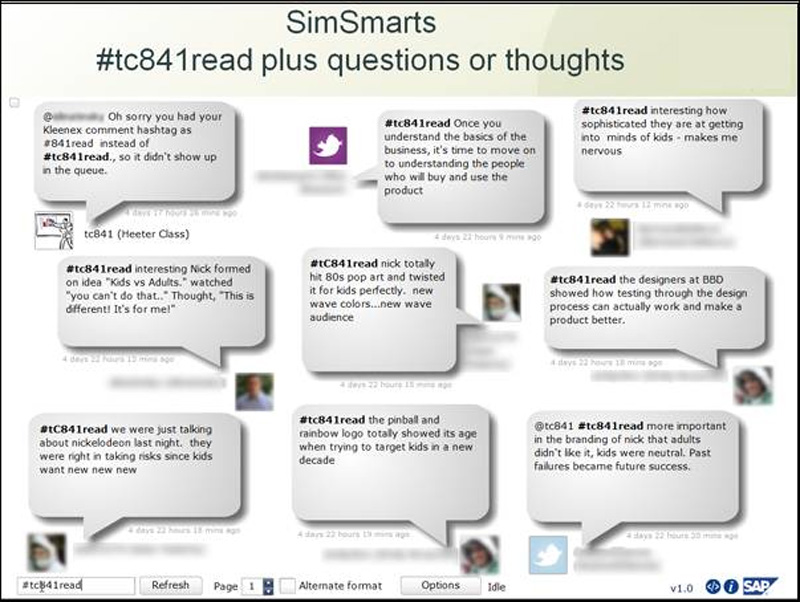
For the crowd that has Google toolbar, a huge number of people, they will be asked to add Sidewiki. The pitch will be seductive: social commenting. Sounds great. Most will do so. I’d expect millions of Sidewiki users in short order.

If I don’t have Sidewiki, then comments about my site will be invisible to me. However, any member who arrives at my site will see them all right there along with my intended site. In other words, they don’t have to go to Sidewiki.com to view the comments. They only have to go to smartscience.net, possibly as the result of a Google search. The right portion of my site will be cut off to make room for the Sidewiki, which will not be cut off at all. Those comments will be more prominent than my site. Whenever I send out http://www.smartscience.net to anyone, the possibility exists that they will see any comments. Those comments can be from anyone, including competitors.

It would be very easy for a competitor to use newly created and fake Gmail account to leave false comments about my service on the site.

Same with Diigo.

Then, every  Sidewiki user who uses my site would see the negative comment and would probably believe it.

If they are Sidewiki users themselves – and they have to be in order to view the comments – they’ll be able to tell the difference between web page and comments.

Sidewiki users might see the comment and repeat it on various other social networks.

From what I understood, you can only share your own Sidewiki comments to other social networks.

I would have no recourse except to complain to Google, who could take their time reviewing the complaint and even decide to leave it alone. However, in a very sinister twist, I wouldn’t even know about the sabotage unless I join Sidewiki.

Same with Diigo sticky notes: you don’t see them unless you are signed into your Diigo account.

So, the problem has two parts. The first part is that your own URL would deliver Sidewiki, not some other Google-owned URL. The second part is the ease with which those who would do you grief can sabotage your Sidewiki “enhanced” site without your knowledge.

Sorry if I was not clear: you can view Diigo sticky notes in the Diigo bookmarking page, AND you can also view them on the site they have been made at, just like Sidewiki comments. For example, click here (from <http://lenovosocial.com/discover/social-site-reviews/diigo/&gt;). They are actually far more invasive than Sidewiki, which stays put in a column on the left of the commented page.

So the Diigo sticky notes present exactly the same potential risks as the Google Sidewiki comments. With the added risk that they are more invasive and can be collected by people who don’t have a Diigo account on the bookmarking page as well. I made 37 frigging Diigo sticky notes on the article you sent, btw.

In nuce: the only way to prevent folks from commenting what you write is not to publish it: whether the authors liked it or not, people wrote comments directly on medieval manuscripts, on printed books, now they do on websites too.

BTW, before Diigo and Sidewiki, there was – still is – Gabbly, which allows you to add a chat to any web page by adding “gabbly.com/” in front of any URL – for instance <http://gabbly.com/etcjournal.wordpress.com/&gt;. Click here for an example.

That could be annoying, too, couldn’t it? I remember joking with a friend about creating such a gabbly chat to promote The Pirate Bay on the site of MPAA or RIAA. And I did that one without registering at gabbly. If you register, you can make money from ads as well. Gabbly has been around for years, and so far as I know there have not been any protests about it.

Claude Almansi (10.9.09, 6:16AM): John, from a search about Gabbly, I got to Gooey, which is apparently the mother of all these applications that allow you to write comments on a web page. So the tech has been around since 1999. As to your suggestion, people who have been using Diigo sticky notes for years for entirely legit research and teaching purposes would not take kindly to Diigo removing this great feature because some people just realized that it has been possible to add comments on a web site unbeknown to the site’s author for 10 years and don’t like it.

Moreover, this is the same tech that enables online captioning of videos e.g. at Overstream.net. And if you can add captions, you can also add comments. So should that captioning possibility be scrapped too?

Why don’t you and Harry trust users’ intelligence a bit more? If a user can view sidewiki, it means s/he has it on her/his toolbar and most likely uses it too, so s/he knows how it works. Therefore it is unlikely s/he’ll be so daft as to confuse the Sidewiki content with the content of the page.

Bonnie Bracey Sutton

Bonnie Bracey Sutton, editor, policy issues, on 9 Oct. 2009, 6:22AM: You guys must have a lot more time than I have, but also you are not in DC where I have too many meetings to go to. I will check Sidewiki out.

Harry Keller (10.9.09, 6:53AM): I see the problem as simply that your web site URL, without any added characters — in my case, http://www.smartscience.net — would be delivered with the added comment to all of those with Google toolbars who, upon urging by Google, accepted the invitation to add Sidewiki. That fact might be just dandy for people publishing research papers and those making Internet noise with their blogs (as I have). However, it invites disaster for all organizations, for-profit and non-profit, who publicize their missions, products, and services on the Internet.

Don’t like the Red Cross? Just Sidewiki-swipe it. Upset that your competitor landed that big contract that you should have? Sidewiki-swipe their site with allegations about sexual misconduct or misappropriation of funds or any other negative stuff you can imagine. Assuming that lots of people have Sidewiki, the allegation could quickly go viral and be unstoppable. Such allegations in blogs are shrugged off these days. You have to find your way to the particular blog, after all. A competitor’s blog would have to be found and would not contain really nasty claims about competition because it would reflect poorly on the company.

On the other hand, the ugly comments would appear to every Sidewiki user who happened upon your site in its native, unamended, and true location in web space: its URL.

I really do not like the idea of my own URL being directly contaminated with stuff over which I have no control. Control of your own web site is a central concept of the Internet.

Furthermore, I have devoted my technical resources for ten years to creating a Web 2.0 resource (although it wasn’t called that when I began). Every customer starts at a specific URL in order to use our service. I may be able to take down my marketing URL, smartscience.net, and avoid Sidewiki problems there. However, I cannot take down my production site. Someone could put pornographic references there for any 6th grade student using my service, and it would reflect on me personally. My business would disappear in a heart beat. A decade of outrageously hard work and self-denial would be snuffed out before I even knew what was happening.

As I said before, I don’t know about Diigo or the others, but I suspect that they have not tied into the unvarnished URLs of web sites as has Google so that when your browser hits that site, whether you care or not, the Sidewiki panel appears. You should have to use another URL or specifically ask for comments. My web site is my web site and my URL should display it and it alone.

David G. LebowDavid Lebow, on 9 Oct. 2009, 8:48AM: I remember people speculating about third-party annotation in the early ‘90s with the advent of the Mosaic browser. Even then, people were concerned about “trespassing” as a problem.

The alternative solution to Sidewiki is to provide “owners” of websites and web pages with Java script libraries and APIs that add third-party annotation. Owners could then choose to add social annotation to their web pages while maintaining control over postings.

Claude Almansi (10.9.09, 9:51AM): Hi Harry. Diigo also works on the web site URL, without any added characters. Click here for an example of a screenshot of the Google page for Sidewiki when viewed by Diigo.com subscribers with the Diigo side navigation bar activated and one set of sticky notes opened inside the web site. I have circled in red the points were Diigo.com subscribers have added sticky notes. I did the screenshot opening the sticky notes set with the one by “Magnolia South” for you, because it is the most critical about Sidewiki.

It is true that Diigo is partly safeguarded from people who would use its sticky notes for trolling because its primary purpose is social bookmarking, and trolls are not much into that. But if the Google anti-troll filter proves efficient enough, trolls will well fall back on Diigo.

[Harry Keller:] Don’t like the Red Cross? Just Sidewiki-swipe it. Upset that your  competitor landed that big contract that you should have? Sidewiki-swipe their site with allegations about sexual misconduct or misappropriation of funds or any other negative stuff you can imagine. Assuming that lots of people have Sidewiki, the allegation could quickly go viral and be unstoppable. Such allegations in blogs are shrugged off these days. You have to find your way to the particular blog, after all. A competitor’s blog would have to be found and would not contain really nasty claims about competition because it would reflect poorly on the company.

On the other hand, the ugly comments would appear to every Sidewiki user who  happened upon your site in its native, unamended, and true location in web space: its URL.

Sidewiki users would immediately know that the comments were done by another Sidewiki user, and would take them with the same skepticism as they would if they stumbled upon an external blog entry. (…)

As I said before, I don’t know about Diigo or the others, but I suspect that they have not tied into the unvarnished URLs of web sites as has Google so  that when your browser hits that site, whether you care or not, the Sidewiki panel appears. You should have to use another URL or specifically ask for comments. My web site is my web site and my URL should display it and it alone.

Granted, Gabbly does not tie into the “unvarnished URLs of websites,” as you have to add gabbly.com after http:// to create the Gabbly chat. But – see above – Diigo does, and has done so for 3 years now, whether you like it or not. So far no Diigo user has added sticky notes to your web site, but it might happen, just as with Sidewiki. If it does, don’t take it too hard. If the comments are legit and constructive, let them be. If they are not, ask the administrators of whichever platform is involved to remove them.

Again, please trust people’s intelligence a bit more: even if the comments appear on the left of your website at its unvarnished URL, they are quite clearly external comments that have nothing to do with the site – both with Diigo and Sidewiki.

PS re your Red Cross example: I confess I have been sorely tempted to add a sticky note to their job application page opened with Firefox, which tells you you have to use Internet Explorer. Quoting the staff officer who told me to go to a cybercafe to use IE there if I don’t have it, as there is no single other way to apply for a Red Cross job. I didn’t, because folks using IE would not see that message for non-IE-users, and because, well, I want to use Diigo for constructive things.

Harry Keller (10.9.09, 12:20PM): Hi Claude, I just have to assume, without any other information, that Diigo is potentially evil too. Given that this all is true, then the major difference is that Google is ubiquitous and so, much more dangerous. My issue is with people searching for “virtual labs” and clicking on the link to smartscience.net, seeing the stuff on the side, and assuming that it’s all true or that I’m somehow responsible.

Among means to thwart this problem are some clever java_script code (defeated if user has java_script off) and simply swarming your pages with your own positive comments and so drowning out any others.

Although the potential for this problem occurred with the first search engine, two big things had to happen since the advent of the Internet. First, commercial sites had to be possible. In the early days they would be flamed. Purists believed that the Internet should not contain commercial messages.

The second was the virtual monopoly of one search engine. I used to think it would be Alta Vista. Was I ever wrong. When a company name becomes a verb, you know trouble is just around the corner.

Although tagging of web sites sounds great in theory, it’s really a dangerous way to run things.

Twitter Could Drive You Cuckoo – If You’re Not Prepared

Claude AlmansiBy Claude Almansi
Editor, Accessibility Issues

[Note: This article was first posted as a comment to Lynn Zimmerman‘s “Twitter Could Drive You Cuckoo” (1 Oct. 2009).]

At first, Dr. Alloway’s criticism of Twitter may seem part of a long line that includes Rousseau’s of La Fontaine’s fables in L’Emile, Flaubert’s of novels in Madame Bovary, Orwell’s of Boys’ Weeklies, and further educational damnings of TV, transistor radio, the internet, blogs, Facebook itself. Education pundits tend to damn new things until they become familiar enough to pundit about them.

But Dr. Alloway is not an education pundit. She is an educator concretely helping a group of slow-learning 11-14 year olds to improve their short term memory and reporting what she has seen in this group. Hence the unfairness of Malcolm Parks’s comment to the Higher Ed Morning article about the fact she has no research paper about new media use and short term memory: one doesn’t write a research paper on such a statistical basis.

Some other comments are more constructive, suggesting the exploration of more active and learning-enhancing uses of Twitter. Also possibly relevant: Danah Boyd’s Twitter: “Pointless Babble” or Peripheral Awareness + Social Grooming? (16 August 2009) on the importance of socializing and on the fact that socializing communication – in real life too – contains a lot of phatic roughage, i.e., utterances only aimed at indicating readiness to interact with others. If you have a bad short term memory, telling this “roughage” apart from content communication might be difficult.

But there might be a very concrete usability factor in the different impacts Facebook and Twitter have on Dr. Alloway’s students. For someone who has short-time memory problems, Facebook is easier to use because Facebook messages stay put, whereas they slide away very fast in Twitter. So her students are more likely to be paralyzed into passivity by this rapid flow than their peers who have a better short-term memory and can use the Twitter search engine or a remembered hashtag to participate in a conversation about a given theme.

_____________________________

Education pundits tend to damn new things until they become familiar enough to pundit about them.

_____________________________

To overcome this issue, she might show her students how they can limit the number of people they are following until they get more familiar with Twitter so that their homepage is less crowded and does not move so fast; how to bookmark the RSS feeds of hashtags for conversation topics they’d like to participate in; how to mark a given tweet as favorite and, in general, explore with them the Getting Started topics of Twitter’s help forum – help forum topics don’t glide away, and they can be bookmarked in a browser.

Another possible factor might be young slow-learners’ fear of seeming dumb in a whirl of fast moving Twitter conversations, just as in real-life fast moving ones: people tend to equate quick-wittedness with intelligence and slower thinking with stupidity, and this is possibly even more true for pre-teens and teens.

Here, an educator might show people who need more time both to understand and to utter how to use twitter to bring people to other modes of conversation, for instance, by tweeting links to blog or forum discussions where they can have enough time. This can even be automated: new posts and comments on ETC are automatically announced at http://twitter.com/etcjournal via twitterfeed.com, which translates the entries RSS feed and the comments RSS feed into tweets. Same with many other twitter accounts.

The twitter whirlwind might drive some people cuckoo if they enter it unprepared. But they can be shown how to use its power to steer themselves and others towards quieter conversation venues.

Twitter Bad for the Brain? – Balderdash, Poppycock, Twaddle

John SenerBy John Sener

[Note: This article was first posted as a comment to Lynn Zimmerman‘s “Twitter Could Drive You Cuckoo” (1 Oct. 2009).]

Studies like this, and the related reportage and unsupported speculation, are what could drive me cuckoo. More accurately, taking such reportage (and the related study behind it?) seriously is likely to be far less healthy for one’s brain and working memory than Twitter.

Look closely at what’s going on here. The cited articles make no mention of how Twitter was used in the study. So I spent (wasted?) 30 minutes or so looking for the actual study. Still haven’t found it. That’s your first clue: the assertion that Twitter is bad is mostly, perhaps entirely, an echo chamber.

A Google search did not yield the study; none of the articles I found have a link to it. I did find Dr. Alloway’s web site; that should have been promising — except that I couldn’t find a link to the study there either. I found a couple of references buried on her web site and through Google searches, but none which appear to be the related study either. Much more easy to find on her web site are links to all the media coverage she’s received and the talks she’s giving. That’s your second clue.

It appears from her web site that she’s doing some good research to establish the importance of working memory, among other areas. Bravo for that. She claims that it’s more valuable than IQ as a measure of intelligence (although the study I found measures the efficacy of working memory in terms of increased performance on IQ, literacy, and numeracy tests — hmmm). But even this appears to be a double-edged sword: she is also promoting “JUNGLE MEMORY, a brain-training program based on my research and promoted by Pearson Education, improved from a grade C to a B, and a B to an A after just 12 weeks! It is the only training program scientifically proven to raise grades.” So her web site is long on self-promotion and short on links to actual research.

______________________________

Clearly working memory as defined is an important skill. But why is it THE most important skill?

______________________________

But here’s the thing: What does all this have to do with Twitter being unhealthy for working memory? Where’s the evidence, the data? I found someone who suggested that the study did not actually test Twitter (can’t find that reference now). Dr. Alloway herself noted in a comment on her web site that the conclusions are “based on findings from a pilot study, more to follow once the study is complete.” Hmmm. Someone else on her web site asked four weeks ago for a link to the complete study; no response was posted. The reportage also suggests that Twitter was not actually tested, and that its detrimental effects are pure speculation on Dr. Alloway’s part. As reported in the Scotsman, “Paul Allen, editor of ComputerActive magazine, questioned the study and said technology like Twitter was ‘too new’ to make conclusions about. He said: “‘It sounds very spurious. I don’t see a correlation between the length of a message you send someone and the effect on memory. It could be a really interesting Twitter message.’” Exactly.

But in the meantime, the blogosphere has already run wild, and sooner or later you’ll be hearing someone tell you how science has shown that Twitter is bad for your brain. Just like another British scientist ran amok earlier this year with unsubstantiated speculation about how social networking sites were harming children’s brains.

Fortunately, the British have also provided us with several fine words for dealing with such situations: Balderdash. Poppycock. Twaddle.

To me, the worst part about this is that it totally obscures a deeper, more important question. As Dr. Alloway says on her web site, “Cutting-edge research has shown that working memory—the ability to store and manipulate information—is the most important learning skill a child can have. Working memory is the foundation of good grades and a successful life beyond the classroom. Without it, students would fail at every task, and with it they can dramatically improve their classroom performance.”

Clearly working memory as defined is an important skill. But why is it THE most important skill? It makes sense to say that if you believe that classroom performance as currently defined (store and manipulate information as per the teacher’s requirements) is in fact most important. But if you believe that there are more important skills, and that getting good grades is at least as much about social conditioning as it is about learning, then you would be asking a different set of questions. Ones, sadly, which we are not going to hear in this media blitz of misinformation…

Anita Pincas

Institute of Education, University of London
Faculty Member, Faculty of Policy and Society

Twitter Could Drive You Cuckoo

Lynn ZimmermannBy Lynn Zimmerman
Editor, Teacher Education

In “Study: How Twitter Is Hurting Students” on the Higher Ed Morning web site, Carin Ford gives an overview of several kinds of social networking sites and how they affect our brains.

The article includes a link to another article, “Facebook ‘Enhances Intelligence’ but Twitter ‘Diminishes It’, Claims Psychologist,” by Lucy Cockcroft, which examines the research conducted by Scottish psychologist Dr. Tracy Alloway.

Tracy AllowayAlloway contends that using Facebook helps improve working memory while Twitter, text messaging, and watching YouTube actually weaken it.

The Ford article invites readers to comment on the article and asks: Do you interact with students on Facebook? The reader responses are equally as interesting as the two articles. One response questions the validity of Alloway’s report. Others discuss pros and cons of using Twitter and Facebook in the educational setting.

These links seem to complement the various discussions that have been on ETC recently regarding the use of social networking sites in the educational setting, including Interview: Steve Cooper of TechUofA. TechUofA uses Facebook as a learning management system.

Science Labs and Accessibility

Harry KellerBy Harry Keller
Editor, Science Education

In all of the time I have been working on making real science labs available over the Internet, I’ve spent little time on accessibility. Of course, I made the obligatory efforts with ALT and TITLE tags to images and made sure that font sizes can be set by the user. The question of who would be using the new technology to reap the benefits of doing real science labs was not foremost in my mind until I read an article in the Montana Kaimin entitled “Disability Services Undermanned and Overworked” written by Kimball Bennion.

Here’s the excerpt that grabbed my attention:

Justyn Field, a senior in print journalism, said he dropped a science class he was taking in the 2008 spring semester because he wasn’t able to get to the class’s science lab in the Health Sciences Building.

Field was born with VACTRL association, a birth defect that limits his mobility and also inflicts other internal problems. Field is able to walk a little, but moves mostly with a wheelchair.

Field said he tried to keep the class while doing an online lab that the department put together for him, but it wasn’t comparable to working in the actual lab.

“How do you do an online lab?” Field said. He also had to pay an extra fee for taking the class online.

“It was absolutely atrocious,” he said.

This small story highlights two significant messages. Online technology holds out great hope for access to learning opportunities denied due to disabilities, and it hasn’t fully delivered on this hope.

Consider the issues surrounding a person in a wheelchair taking a chemistry lab. The aisles where students work back-to-back on their experiments are probably too narrow to accommodate a wheelchair. The countertops are too short for a seated person to reach. Some disabilities affect fine motor coordination and make working with dangerous chemicals, well, dangerous. Safety equipment disabledsuch as eyewash fountains are too high to be useful to a seated person. The lab benches don’t usually have knee space underneath and so prevent a wheelchair user from getting close enough to the bench to do the work even if it weren’t so high. As very much a tyro at understanding disability issues in schools, I am sure that I’ve only begun a list that experts can readily expand. I’m making the point that just getting a wheelchair inside the door of a chemistry lab may not be sufficient.

A great online science lab experience could make a world of difference for Justyn Field and many others. The University of Montana made an effort to provide online labs for him. The article doesn’t say what the subject was, and I suspect that it wasn’t chemistry. Still, the same concepts apply, although not so severely, to many other subjects. Mr. Field ended up taking an astronomy class that had access to the lab facilities.

Our schools and disabled students should have excellent online science labs, not the “absolutely atrocious” ones that Mr. Field was subjected to. I have a personal stake in this discussion because I have worked on one solution for the last ten years. We should have great online lab experiences ready for the Justyn Fields of the world. They would also help immensely in cases where sick students must stay at home for extended periods, for juvenile detention facilities that must provide education to their wards, for very small schools in poor rural areas, for alternative education schools with students who have social problems, and for many others.

This all may seem to be a somewhat minor point to many, but it’s not so minor to the very large number of students affected by the lack of access to science labs. They’re being denied the education they deserve.

Review of Traxler’s ‘Students and Mobile Devices’

Tom PreskettBy Tom Preskett

I heard that the best ALT (Association of Learning Technology, UK) paper this year was Students and Mobile Devices: Choosing Which Dream by John Traxler so I thought I’d review it.

Generally, it was very interesting and gives a good overview of the implications mobile devices have for education. There were times when the words “mobile devices” could have been replaced with “Web 2.0” and there were points with which I disagree.

Here some of the key passages with my comments:

“Students no longer need to engage with information and discussion at the expense of real life but can do so as part of real life as they move about the world, using their own devices to connect them to people and ideas…”

That’s a great description, isn’t it. Even if you don’t agree with it, it’s great. When you read it, you need to think in terms of multimedia rather than text. However, for the connect part I don’t think we are there yet. Certainly, my iphone doesn’t connect well enough in enough places to be used in this way.

“Interacting with mobile technolgies is different and is woven into all the times and places of students’ lives. Mobile phones have created “simultaneity of place”: a physical space and a virtual space of conversational interaction, and an extension of physical space, through the creation and juxtaposition of a mobile social space.”

Thinking about it, maybe mobile devices more than Web 2.0 in general will have more success in challenging the domination of the didactic lecture. With mobile technologies woven in, education will have to accomodate them and their social nature will slowly creep into the teaching and learning.

“When we say we can ignore desktop technologies but not mobile technologies we mean that desktop technologies operate in their own little world, mobile technologies operate in the world.”

Again, this is catchy, but I think this goes too far. It’s not as if every office space with a computer exists in another world or is outside reality. Anyway, the point is well made that there is a here-and-now aspect to mobile technologies that can surely be utilised by education.
iphone
“With the possibility of perpetual contact, the mobile phone ends in fact by shaping time as a container of potentially continuing connection.”

With the always on connection and a myriad of methods to do so, the only constraints to staying in contact is the consent of the people involved. There are now no restrictions. It’s worth saying that this isn’t all about mobile technologies because once people reach home most switch to laptops/PCs. What this means for education is that it’s one of the more obvious challenges to the ridiculous notion that we learn in neat sessions according to a timetable Monday-Friday. This is part of the formal vs informal learning debate.

“Mobile devices are also eroding physical place as a predominant attribute of space. The phrase absent presence (Gergen, 1996) describes situations where groups of people physically together, co-located, are all connected elsewhere.”

This is challenging the physical buildings of our education institutions. Some good points in this issue have been made in the CreateDebate: UK Higher Education needs more radical change than a debate about who funds it. It’s worth noting that it’s wrong to attribute all these notions to mobile technologies in isolation. I see them as part of the Web 2.0/socail media ethos — an ethos which has at its heart the natural human inclination to communicate, network, and, above all, socialise. I talk about this in my blog post Use Social Media — Fulfill Your Destiny!.

“Educational provision is built around time and place: the timetable, hand-in dates, the classroom, the year-group, the deadline and the laboratory… the education system, especially the formal university system, is getting out of step with how many students perceive the world they live in and… changes are needed to keep universitites aligned to a changed and mobile society.”

This is worth recording because it echoes a sentiment that I agree with: Higher education is behind the schools when it comes to use of learning technologies. Again with the above, you could substitute the word “mobile” with “Web 2.0.”

“These changes and trends will cause significant shifts in the idea of ownership, specifically the ownership of technology and of knowledge.”

This is an important point that relates to learners taking more control of their learning. However, it needs unpicking. From students’ point of view, they are owning when and where they access their learning so there is freedom and choice in that sense. This is important because of the impact that it should have on the way learning is delivered.

“In its earliest forms, knowledge and learning came from lectures, a linear format from an authoritative ‘sage-on-the-stage’ with no pause, fast forward or rewind, and from books, substantial and linear but segmented and randomly accessed. the delivery of knowledge and learning by networked comptuers meant . . . new heuristics of usablity that prescribed how knowledge and learning should be chunked and presented.”

There are two important issues here. First, a major motivation for change from me. The transmissive mode is flawed because if you miss something then you’ve missed it. And if you’ve missed something at the beginning then that’s it for the rest of the lesson. It’s as if part of the challenge of learning is being able to concentrate fully for the entire time. Any mind wandering (something I do) and, well, that’s tough! Any disruption (more on this later) like communication and you’re out!

The other issue is the attempts at chunking of textbooks that I remember from school. We would skip from chapter to chapter in an attempt to follow a contextualised route through the learning. You would think once a better mechanism for achieving this were invented education would jump all over it.

“Mobiles devices extend and enhance this voice because they allow users to capture content, for example images, sounds, data and voices themselves, form the real world, from events as they happen, specific to when and where they happen.”

It’s important to note that the other big area where mobile devices can really make a difference (apart from the “simultaneity of place” issue) is with multimedia. It really is so powerful to be able take videos and photos on the spot and network this immediately.

______________________________

It’s important to note that the other big area where mobile devices can really make a difference . . . is with multimedia. It really is so powerful to be able take videos and photos on the spot and network this immediately.

______________________________

Now some things I disagreed with:

“There are drawbacks. The first is that these developments reinforce a tendency to view knowledge and other forms of content merely as commodities or assets. The second is that this choice and control are exercised at a purely personal level, allowing individuals to each pursue their own curiosity, constructing their own private libraries and inhabiting their own worlds of knowledge. This erodes the idea of a commonly accepted canon, a common curriculum, of things we all need to know and are assumed to know and replaces it with what some poeple have referred to a neo-liberal nightmare — not dream but nightmare.”

With the first point, I don’t really see the problem. How people view the knowledge or engage with the learning is up to them. We don’t need to control how people think. The second point I disagree with. He views greater learner freedom and a loosening of control over educational institutions over any aspect of the learning process as a bad thing. The opposite is true for me. He’s actually describing a utopian PLE. Strange as this passage seems at odds with the spirit of the rest of the paper.

More on disruption: “There is a weak version of disruption that amounts to nuisance; phone calls in class, texting in exams, photographs that should not be taken, inappropriate ring-tones and so on. There is however also a strong version of disruption. These devices allow students to access and store images and infromation of their own choosing and perhaps create and distribute new images and information independently of the lecturers and of the university.”

I would add communication opportunities to this. What he’s challenging here is the notion of disruption as necessarily bad. — a notion that prevails at present. Certainly, mobile devices are seen purely as a nuisance in current educational structures. The weak version description is what they say, but really the strong version of disruption is what they are worried about — worried that they will have to change and accommodate.

On infrastructure: “Wholeheartedly adapting an approach centred on student devices is challenging and radical for institutional IT units. Their roles would change drastically, depending on the institution and its mission, and on its finances.”

Not much to say except yes. But I don’t think, wholeheartedly, adaptation will happen any time soon. Here and now, wifi has to be standard and of a high quality in education and elsewhere.

Some points about formal/informal learning: “We used to make a distinction between formal learning activities in our universities on our equipment and self-motivated learning activities outside our institutions not on our equipment… If we are to embrace student devices, this simple dichotomy breaks down and the boundary becomes blurred.”

This is informal or learning that needs to, first, be acknowledged and then engaged. The breaking down of the boundaries is only troublesome if you teach by habit rather than design. If you have deliberate and informed learning design then catering for this is manageable.

“Guaranteeing e-safety becomes more problematic when on the one hand we encourage the use of student devices for learning but on the other hand have no ability or authority to control how, when or where they are used, nor any control over the applications, data or networks they support. At the very least, policies of acceptable use must evolve rapidly to address the affordances of student devices.”

I think seeing everything through the prism of control isn’t correct here. It comes from a standpoint where the institutions are at the centre of education rather than the learner, which is wrong. E-safety is so overplayed in education. Yes, we need to take care, but we shouldn’t shut things down on this proviso. Also, I wouldn’t worry about “policies of acceptable use” as these seem to spring up almost before they know how to use something.

About training: “. . . faces staff developers with the enormous challenge of preparing teachers and lecturers to work with a range of devices.”

Yes, and this is a mantra of mine as I can often not get past this area in my context. However, I would say that the goalposts are shifting in this respect. Increasingly, new tools/environments are becoming easy to use and more intuitive. So it’s more a case of getting educator to experience using a tool/environment rather than learning how-to use it. Only by experiencing a tool/environment can they understand what it’s all about. This is particularly true of Web 2.0.

Lecture Your Way to Stardom!

Tom PreskettBy Tom Preskett

Karl Kapp talks about teachers who have gone on to become rock stars in “Teacher . . . Stepping Stone to Rock Star?”  Interesting . . . and surprising they let a young Sting teach at a convent school! Anyway, my point here is the notion of teacher as a rock star is something that is common and can be negative when it comes to challenging the sage on the stage notion and moving towards a more collaborative approach. Sometimes I see it in their eyes: “Do you really think I’m going to give up being the centre of attention?” Of the many barriers to the adoption of learning technologies of the Web 2.0 variety, this is one of the least acknowledged.

KISS Boston 2004

Taking the focus away from the teacher/lecturer isn’t what the all powerful one wants. This is where ego gets in the way, and quite simply there are many who like the sound of their own voice too much. When thinking about a blended approach, how likely is it that someone like this is going to countenance replacing some of the face-to-face with e-learning? Or adopt any kind of learner centric approach that diminishes his or her role from expert to facilitator or guide?

Sting 2009

I am, of course, playing devil’s advocate to some extent. I have more respect for the teaching profession than almost any other, and there are so many brilliant teachers. However, some of the brilliant ones fall into the above category. They need to be more flexible and, in some ways, feel less threatened by new ideas. 

Remember the focus should be on what’s best for the learner — not the teacher.

‘Please Prepare for Cross Check’: A Review of ‘Digital Habitats: Stewarding Technology for Communities’

Stefanie PankeBy Stefanie Panke
Editor, Social Software in Education

In August 2009, I received an email from Etienne Wenger, announcing a book he has written with Nancy White and John D. Smith called Digital Habitats: Stewarding Technology for Communities (Portland, OR: CPsquare, 2009). In a way, this book is a follow up activity on a survey of community oriented technologies that Etienne published in 2001. I was amongst those who downloaded this report, finding an overview of various technology products and – more important – inspiring insights that helped me to understand the role of technology for communities. We were in the process of implementing community features for the portal e-teaching.org, a German Web site on e-learning in higher education. Since then, the concepts of situated learning and legitimate peripheral participation in communities of practice have greatly influenced my work on the design of educational resources.

In a community of practice “learning means to become, that is, to belong differently than we do at the moment” (Lee & Roth, 2003). Since Howard Rheingold’s seminal work on virtual communities (1993), online communities of various kinds and in very different fields, such as marketing, education, community informatics, etc., attract researchers’ and practitioners’ attention alike. A fundamental question across the various perspectives and domains has been up to now how online communities work: How do they come into existence? What are critical success factors? And how can technology be designed to support community development? Digital Habitats develops a conceptual model to describe the skills necessary for choosing, implementing, and maintaining digital tools that enable a communities’ togetherness. The character of the work can be placed somewhere between practitioner’s guide, academic reflection, and visionary pamphlet. The book’s eleven chapters are clustered into four parts: “Introduction,” “Literacy,” “Practice,” and “Future.” The following summary outlines the content of each part and highlights a chapter or concept that I found particularly inspiring.

Cover of the book Digital Habitats: Stewarding Technology for Communities by Etienne Wenger, Nancy White and John D. Smith

Part I

The first three chapters introduce the idea of learning communities, explore how their development is intertwined with technology, and finally define the notion of technology stewarding: “Technology stewardship is an emerging role that describes both a responsibility and a practice – an attitude as well as all the conversations, decisions, and learning that address the design and management of a community’s technology infrastructure” (33).

I was most impressed with the theme of chapter 2, which gives a historical overview of the mutual influence between communities and technology, drawing a bow from the Well to Web 2.0 and from the physicists at CERN to Ward Cunningham’s first wiki, invented to support the pattern community. “Technologies have changed how we think about communities, and communities have changed our uses of technology” (21). Technologies enable communities to form and to act in new ways, offering infrastructures for interactivity and connectedness. At the same time, communities have played a critical role in the invention of new technologies.

Part II

Chapters 4 to 6 introduce three different models on technology’s role for communities. These models constitute a specific kind of media literacy that allows for analyzing the technology needs of a community and pursuing a course of action. The first model includes different aspects of technologies such as tools, features, platforms, and configurations. The second model points out the inherent dilemmas of everyday community life. The third model deals with the specific traits of different communities, their so called orientation. “Communities learn together in different ways: some meet regularly, some converse online, some work together, some share documents, some develop deep bonds, and some are driven by the mission they serve. We say that these communities have different orientations towards the process of learning together. An orientation is a typical pattern of activities and connections through which members experience being a community” (69).

Chapter 5 offers a thoughtful perspective on the technology landscape, building upon three inherent polarities that challenge technology use in a community: Togetherness vs. separation, participation vs. reification, individual vs. group identity.

  • Togetherness vs. separation: Community interaction follows a rhythm of togetherness and separation. The use of synchronous and asynchronous tools and the alteration between them are part of this rhythm.  “How do synchronous tools contribute to a community’s rhythm, both because they enable members to be together in time and because they often leave traces in the form of recordings or transcripts? In an asynchronous conversation, how often do people have to post something to sustain an experience of togetherness?” (57).
  • Participation vs. reification: One could also call this polarity “interacting vs. publishing.” For instance, the writer’s community behind the ETC blog has a lot of discussion and negotiation that is handled through a mailing list. This is the “participation” part, where we interact with one another and negotiate meaning and identity. The “reification” part is happening when we actually write a blog entry or pursue a project: “Literally, reification means making into an object” (57).
  • Individual vs. group identity: Learning together in a community of practice does not require or produce a homogenous group of people, all focused on the same goals. Communities cannot expect to have everyone’s full attention, since the activity level, learning aspirations, and needs vary individually. This creates both a challenge and potential for discourse, both being fueled by technology. “Technology contributes to the tension between individual and community. While a tool may be designed for groups, it is largely used individually, often when one is alone. Technology also increases the complexity of the group/individual polarity. By providing varied opportunities for togetherness, it also opens the possibilities for extreme multimembership” (59).

______________________________

“Technology contributes to the tension between individual and community. While a tool may be designed for groups, it is largely used individually, often when one is alone. Technology also increases the complexity of the group/individual polarity. By providing varied opportunities for togetherness, it also opens the possibilities for extreme multimembership.” –Wenger, White, and Smith

______________________________

Part III

Although the introduction states clearly that Digital Habitats is neither a shopper’s guide to technology products, nor a roadmap to technology selection, this part of the book comes close to filling out these roles. Chapter 7 addresses contextual factors that have an impact on technology choice, such as stage of community development, diversity and complexity, members’ experiences with and attitudes towards technology. Chapter 8 discusses the pros and cons of different acquisition strategies like “build your own,” “get a commercial platform,” “use open source tools,” “go for the free stuff,” etc.  The focus of chapter 9 is the ongoing role of technology stewardship in the daily life of a community. Chapter 10 gives a practitioner-oriented summary in the form of an “action notebook,” comprising checklists, step-by-step guides, questionnaires, and evaluation sheets. Actually, I found this section also interesting from a research perspective. One can use it as a concise instrument to analyze the characteristics of different online communities (see pages 149-152).

Part IV

The final part is an essay on the future of technology stewardship. The two central questions of this outlook are: “Where is the interplay between community and technology going?” and “How should technology stewards develop their practice?”

Chapter 11 identifies four emerging trends that influence out interaction within digital habitats. First, an increased connectivity around time and space is fostered by ubiquitous Web access through wireless networks and mobile devices (“always on”) as well as the new qualities of virtual co-presence in 3D environments. Second, we are facing new modes of engagement for interacting and publishing. The web is becoming a medium of self-expression. At the same time, technology enables mass collaboration on an increasing scale. Both perspectives are brought together through application programming interfaces (APIs) that support a constant remix of web content.  Third, the geographies of community and identity are changing. The complexity of the Web is growing. People can choose from a multitude of communities and resources. The boundaries between different Web sites are becoming more and more dynamic. Due to search engines, every voice popular enough becomes accessible. Individual content aggregation allows for a personal information diet that makes the mix palatable. Fourth, people are using the Web increasingly as a socially active medium. “The combination of distributed production, digital representation, and search capability make the web an active medium where the social and the informational build on each other” (179). Programs exchange and produce information about social relations, supported by semantic web technologies. Our digital footprints are intermingled with the reflections others imprint on us.

Who should read this book?

A review should not only tell you how much I liked the book, but also what you as a potential reader might get out of it. This calls for a clarification of the target group. Luckily, the authors have already done this job themselves, describing three groups of addressees.

  • Deep Divers are interested in exploring the connections between technology and community from an interdisciplinary angle. Their focus lies in applying conceptual models and learning theories to the domain of technology adoption by communities of practice.
  • Attentive Practitioners are interested in developing their practice, whether technology plays a major or minor part in it. They seek practical advice as well as theoretical concepts to communicate their role as technology stewards effectively.
  • Just Do-It-ers are action oriented with a strong focus on getting the job done. Their main interest is in practical tips and tricks while the more conceptual aspects are in the background.

This review reflects a “deep diver” perspective. A practitioner’s summary would most likely highlight different aspects of the book. Whatever description characterizes best your interest in online communities, Digital Habitats is great reading for those who seek a compass to navigate the technology ocean.
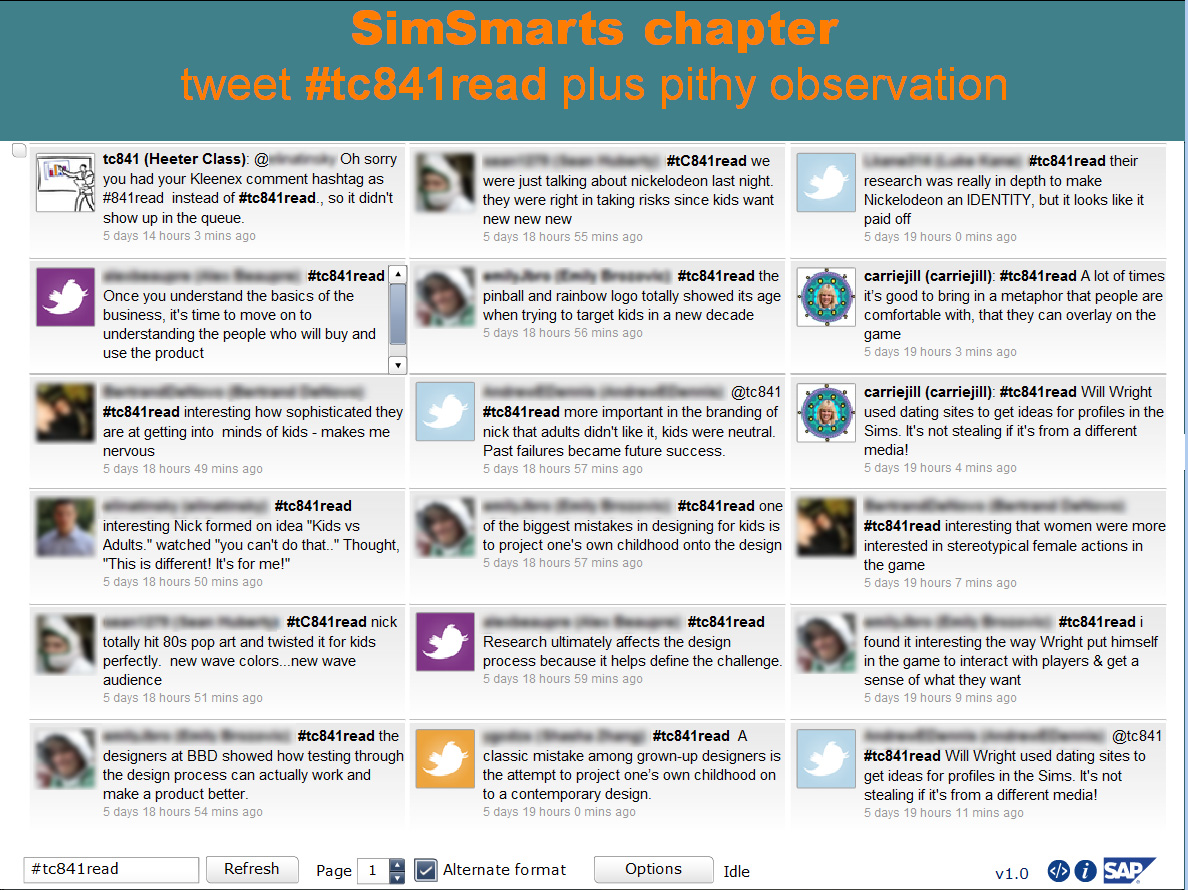
For additional information and further discussion, see the accompanying weblog: http://technologyforcommunities.com/

Interview: Steve Cooper of TechUofA

Jim ShimabukuroBy Jim Shimabukuro
Editor

Steve Cooper is founder of Tech University of America (TechUofA) and a former Army education trainer. The following interview was conducted via email from September 8 to 12.

JS: How did you come up with the idea of offering college courses for a flat monthly fee (e.g., $99 for all the classes a student wants to take) and how long have you been doing this?

SC: All of the courses that we are developing will be free and open to everyone. However, only when students want to begin a transcript and earn an academic certificate or degree is there  a $99/month that allows them to take ten courses per year. We only use free etextbooks/resources so there aren’t any other major fees associated with earning a degree.

While building several online university programs I watched as they artificially raised tuition to the student loan cap. I was one of the few for-profit CEOs who didn’t have an MBA or wasn’t a banker so I looked at things much differently. In 2007 when I took over as CEO of a for-profit university, I decided to lower tuition in order to make higher education accessible to more people. We immediately began to enroll students from Africa and several other countries. I found that if you have the same quality of faculty as other well established schools and run a transparent program then people will attend your school if you lower your tuition. At the same time I started to see the popularity of social networking sites explode while the economy started to weaken. I then realized that three things were hot: social networking sites, online learning, and lower or zero-tuition.

Steve Cooper1

Early in 2008, I used to drive over to University of Phoenix Online and sit in the parking lot in search of inspiration. I would sit there for hours watching the sunset, hoping to soak up some of their creative energies, while asking myself, “What would Dr. John Sperling, the founder of University of Phoenix, do today if he were to do it all over again?” I concluded that the first thing he would do is take education to the masses as he did years ago by bringing education from the ivory tower to the community in office buildings then eventually via distance learning. I think one of his greatest keys to success was leveraging existing resources rather than trying to force people to change. For example, he didn’t try to make the corporate offices where they held classes look “academic” nor did he develop some goofy learning management system to deliver their distance learning courses. Rather, they used the existing business offices and Outlook Express. People were familiar with regular office buildings (not intimidating like a college campus) and it was convenient. Also, most adults have used Outlook or Outlook Express so they lessened the learning curve by using systems students would be familiar with — and if they weren’t, chances were that someone they knew could help them — as opposed to building some esoteric and irrelevant elearning system that wasn’t intuitive to adult learners.

So, I eventually thought that if Dr. Sperling were to start over he would bring higher education to the masses. However, today the masses are in social networking sites. At this point I still had not seen a social networking site but realized that if they were generating that much buzz there had to be a reason. I logged into one and instantly said to myself that this is the ideal online classroom! A week later I directed one of my staff members to teach a course in a social networking site, PerfSpot.com, since I knew their leadership and found them to be dedicated to a global reach — and it was absolutely amazing! Social networking sites allow the faculty and students to control their online learning environment (end-user innovation) and can do all the things that conventional learning management systems can’t or won’t allow such as video, audio, showing photos of the users, widgets, etc.

Moreover, using social networking sites to deliver college courses greatly reduces our cost of delivering education since we pay neither learning management fees, which can be as high as $120 per student per course, nor technical staff for support. In essence, it’s a win-win-win because the social networking sites benefit from having more users (our students), we as a college gain by not having any learning management fees, and our faculty and students win because they get to control their learning environment.

JS: Are TechUofA courses accredited? If yes, by whom? If not, is lack of accreditation a problem?

SC: No. Tech University of America is not accredited. We must be operating for two years before we are eligible to apply for accreditation, and we intend to apply as soon as we are eligible in 2011. Since we are a start-up school we have a lot of R&D, yet, at the same time, we are a business so we have to actively seek ways to grow our student body. In order to better serve new schools as well as their prospective students, I believe that accrediting bodies should have a provision that allows for new schools to be conditionally accredited before they start offering courses and then heavily monitor them until they are accredited. In the meantime, we have to operate for two years prior to seeking accreditation, which does offer us time to improve our academic processes while fine tuning the operations of our university.

JS: Are TechUofA classes completely online? Or are students required to participate in F2F (face-to-face) activities at some point during a course? If not, is this lack of F2F contact a problem?

SC: All of our courses and programs are delivered 100% online, and we do not plan on any residency requirements. Recent studies have shown that online learners can attain the same, if not higher, learning outcomes than their F2F counterparts. Having said that, I do think that F2F interaction is obviously valuable. To this end we are exploring several ways that we can integrate various optional study programs that will bring some of our students who live around the world together for meaningful experiential and F2F learning.

______________________________

Steve Cooper: While I fully agree with Chris Anderson, author of Free: The Future of a Radical Price . . . that anything that becomes digital inevitably becomes free, I do think that we will see a hierarchy emerge within online learning: we will have free or very low priced schools, then more expensive programs, and finally exclusive online programs for the very wealthy . . . .

______________________________

JS: Is it possible for a student to complete a degree or certificate at TechUofA? Would this be a TechUofA degree or a degree offered by a college that relies on TechUofA courses?

SC: We will be offering certificate programs as well as associate, bachelor, and master degree programs in business management with several concentrations in fields such as criminal justice, sustainability, construction management, computer science, and sports management. However, we are beginning to partner with several colleges that are interested in using our courses — in these cases students who are enrolled in a partner school and complete our courses would receive credit/degrees from their school, not Tech University of America. In this case we will serve as a blackboard, if you will, with our courses hosted in Facebook, and partner schools will use them at their discretion.

JS: What is the instructor-to-student ratio for your classes? If the ratio is far greater than for F2F classes, how do TechUofA instructors manage the large number of students?

SC: Our student-to-faculty ratio is 1:20 for most courses, and 1:25 for the rest, which is about the average for most online schools, and considerably less than large research universities where ratios of 1:500 are not uncommon.

JS: If students enter a course at any time and exit at any time, I’d imagine that record keeping may be a major problem. Does the instructor monitor all of her/his students? Or is this managed by someone else?

SC: Non-degree seeking students, those who are just using the course materials, may come and go as they please. For our degree-seeking students we have definite start and end dates for each course, and each course is eight weeks in length. Since our courses have less than 25 students, our faculty are able to manage each course.

JS: Are TechUofA instructor salaries comparable to that of F2F institutions? Do you have full- and part-time instructors?

SC: We engage adjunct faculty members to teach our courses. They must have a graduate degree from an accredited school, with practical work experience in their field of study. We also require that our faculty have teaching experience at a regionally accredited school. This allows us to demonstrate that the quality of our faculty is comparable to that of accredited schools.

We use a variable pay model, with each faculty member earning $50-$75 per student. This incentivizes faculty to teach more students per course and is fair because the more they work, the more they earn. At the same time it helps us contain our costs since we are not paying faculty $2,000 when there are only four students in a course. The fact that we do not cap the amount faculty can earn means that they can do quite well. Also, our model encourages faculty to use their own videos in YouTube, social networking sites, etc., which can increase the likelihood that they will be able to secure a textbook contract because faculty who can demonstrate a substantial following these days are highly sought after by publishers. Finally, given that we charge $99 per month, you can see that 50-75% of our revenues go to faculty pay as they are the most critical part of our team.

JS: Does TechUofA rely on staff from countries where salaries and wages are much lower? If yes, is there a problem in quality?

SC: No. However, as we grow our international student body, we will explore hiring staff who reside in countries where we have a large student base so that our staff can relate well to our students, thus serving them better than we can here in Phoenix, Arizona. I must add that I personally am not convinced that outsourcing labor to other countries always saves a considerable amount of money, especially when you consider the inevitable travel, loss of business from language barriers, rising costs associated with outsourcing, etc.

JS: Is TechUofA international? In other words, do students come from many different nations? In U.S. TechUofA classes, are international students charged a higher fee?

SC: We are proud that we have had many inquiries from international students, and in our model everyone pays the same fees. However, we are working on raising money so that we can offer scholarships to people in developing countries so they do not have pay anything to earn a degree from Tech University of America. Also, we are working on building a networking system that allows more fortunate students to sponsor (pay for tuition) for students who cannot afford the $99 a month to earn a degree. We believe this will lead to several meaningful relationships between our students.

JS: Are services such as TechUofA growing in numbers and popularity? Do you foresee a time when the TechUofA way of providing classes will be the dominant means of earning a diploma, degree, or certificate? Will this be at the K-12 or college level? Or both?

SC: Absolutely. Click here for the best overview of this movement which refers to us as EduPunks. Yes, I do see a day when the Tech University of America model will be the prevailing way of providing online courses, and by this I mean using social networking sites as the learning management system rather than Blackboard, using free etextbooks rather than traditional textbooks, etc., but I do not think all schools will have all their courses offered for free and only charge $99 a month for degree seeking students. While I fully agree with Chris Anderson, author of Free: The Future of a Radical Price, and his assertion that anything that becomes digital inevitably becomes free, I do think that we will see a hierarchy emerge within online learning: we will have free or very low priced schools, then more expensive programs, and finally exclusive online programs for the very wealthy that are as expensive as, if not moreso, than Harvard. At the same time I predict that we will only have 50 state schools – one for each state – that has football teams, fraternities, etc., and the rest of the students will attend private, for profit schools, either onground or online, especially given the rise of online high schools. I have been told there are more than one million online high schools students in America.

JS: Is student cheating a problem in TechUofA classes? If not, how is it handled?

SC: Student cheating, plagiarism, program integrity and student authentication are all serious challenges for all schools. The Higher Education Opportunity Act (HEOA) of 2008 requires that a school that offers online courses have procedures in place to ensure that that students who enroll in a course are the same students who take the course and ultimately receive credits. While the HEOA doesn’t apply to us since we will not utilize Title IV funds (federal student loans), we are fully committed to ensuring program integrity. In addition to having a required assignment on personal accountability and plagiarism in our introductory course, have engaged CSIdentity’s Voice Verified product to ensure that the student who enrolls in Tech University of America is the same student who is in a particular course, completes course assisgnments, and ultimately receives academic credit. This is done by randomly verifying the biometrics of their voice throughout their entire course of studies, and the Voice Verified solution is more accurate than a fingerprint.

JS: Is there anything else you’d like to add?

SC: Sure, I think it is important to point out that Facebook, which is central to our model at Tech University of Ameirca, was created by students, for students, and it is fitting that Facebook is finally becoming the leading learning management system. I predict that within 2-5 years, Facebook will buy Blackboard and move all of its users into Facebook..
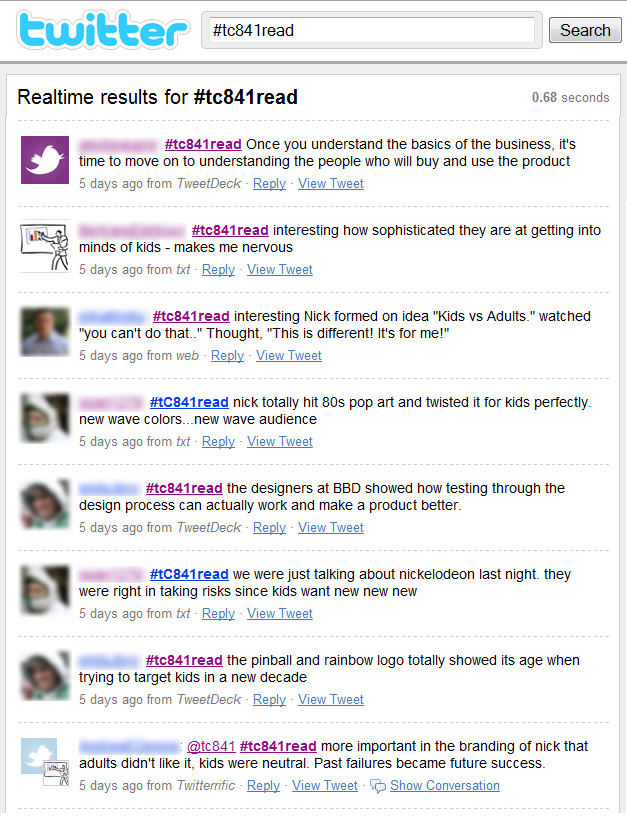
Is a Virtual Revolution Brewing in Colleges?

John SenerBy John Sener

The idea that US colleges and universities are on the brink of demise, or at least radical transformation, has been around for a long time. It’d be interesting to see how long, exactly, but Peter Drucker seems to be the progenitor of most current thinking. Over the past 20 years, based on his musings on education in his 1989 book The New Realities and accelerating with his 1997 prediction that large universities would become relics in 30 years, commentators have been concerned about the obsolete “business design” of the university (1996), echoing Drucker’s predictions of demise (2005) etc.

This year, the pace has picked up: David Wiley asserted that the “university will be irrelevant by 2020“; commentators are predicting that colleges are facing the same doomed fate as ailing newspapers for much the same reasons; and now we have this article, “A Virtual Revolution Is Brewing for Colleges” by Zephyr Teachout (Washington Post, 13 Sep. 2009).

What is really going on here? Certainly it is ridiculous to take these predictions at face value. Every time one looks at them closely, they dissolve into irrelevance on the surface. This WaPo article is no exception: it goes completely off track by the end of the fifth sentence. “The market” is not the force for change in education; colleges are not like newspapers; education is about a lot more than sharing information; the social ritual of getting a dorm room is not disappearing anytime soon either. Teachout, as with other business-oriented commentators on education, does not understand that education is a complex system animated and sustained by a variety of important competing forces interacting dynamically with each other and operating fundamentally differently from business.

Tellingly, when I first tried to find the article on WaPo, the first article I found was a piece on how the University of Maryland is trying to crack down on drinking. It’s not a pretty scene, but social drinking is a much more powerful and cohesive force in university life than the cost of online learning (wasn’t paper-based correspondence learning cheaper also, BTW?). And anyone who thinks that universities will become “relics” in 18 years or so needs to chill out at a tailgating party. Drucker was brilliant, but even geniuses get it way wrong sometimes.

Teachout’s article, and indeed this entire line of thought, only makes sense to me in two respects (other than being flat out wrong): ( 1) the authors are just trying to get attention by provocative exaggeration, and (2) they are trying to move public opinion by asserting a position that is only casually related to rationality or actual facts. Both these are very much in tune with the times, but the numerous disconnects between superficial attention-seeking headlines or sound bites and the underlying reality bother me.

______________________________

What really bothers me, though, are the possible negative consequences of excessive hype. For example, online education has changed the face of higher education, but has it been “revolutionary” or “radical?” I would argue that it hasn’t.

______________________________

What does it mean, for example, to say that “universities will be irrelevant by 2020”? They have already been irrelevant for decades in some ways, which is why small liberal arts colleges exist and why community colleges, private for-profits like University of Phoenix, et al. have filled the vacuum in those areas that universities have mostly ignored during the expansion of higher education in the US over the past 40+ years. But maybe Wiley was merely aiming to provoke or prod in a particular direction rather than to predict. Perhaps this has become commonplace because, in our “blink“ered” world, subtle or complex messages get lost while only simple messages gain traction. Take, for example, the recent USDE report on online learning. The report’s summary messages don’t match its actual content, and its methodology is deeply flawed. But the basic message (online learning is even better than classroom) is getting out there and starting to cause some pushback.

Teachout’s article does not even rise to the level of “Drucker Lite” quality. The ingredients are there, but the article makes a hash of it. “Colleges also sell information?” Redundant Sociology 101 courses are all that stand between the academy and its imminent “structural disintegration?” The drive to cut costs will come to rule higher education policy? Please.

What really bothers me, though, are the possible negative consequences of excessive hype. For example, online education has changed the face of higher education, but has it been “revolutionary” or “radical?” I would argue that it hasn’t. Are the predicted changes greater than the creation of community colleges, the GI Bill, or the growth of private for-profit institutions? If so, how? If not, why all the fuss? I worry that the hype of such pronouncements may actually retard the progress of needed, substantive change; if big changes are afoot, then other needed changes will be overshadowed and ignored.

Here’s what I would really like to see: a deep, reflective examination of what changes are really needed — what would be truly transformational? Ironically, I find more useful material in the reactions to these articles than in the articles themselves. For example, why does a Smith co-ed believe that the “personal touch” is only possible in classroom and campus interactions? (Has she not heard of Facebook?? OMG… ;-) What does “personal touch” actually mean in this context? Why do so many college faculty believe that they have this magic ability to gauge the ‘aha’ moment of all the students in their classrooms? Because as readers’ comments and writers’ reactions show, a myriad of unexamined, deeply held assumptions are out there. At the same time, Drucker and the line of thought he engendered are on to something: change is happening, mostly nibbles around the edges, but there are some serious issues that need to be resolved pretty soon. My bias is that a more thoughtful approach is better. But maybe these articles are a necessary part of the process?

‘Jam on the American Graduation Initiative’ on Sep. 16

Jim ShimabukuroBy Jim Shimabukuro
Editor

On 16 September 2009, from 8:00 am to midnight EST, Knowledge in the Public Interest will sponsor, with LaGuardia Community College as the lead college, Jam on the American Graduation Initiative, an online asynchronous “national conversation” to engage community college leaders, policy makers, and researchers. Convened by the Brookings Institute, The Education Commission of the States, and Jobs for the Future, the focus of the jam will be on President Obama’s recent announcement (see the YouTube video below) to invest $12 billion in America’s community colleges.

The primary topics for discussion will be (1) What we should know—the benefits and consequences—about what the administration is proposing and (2) How we can organize ourselves to make a difference for every community college in the U.S. The purpose of the jam is to influence the discussion on the president’s proposal. The result, according to organizers, will be a “tool kit for action,” which will be available a couple of weeks after the Jam.

The video runs for 29 minutes. The portion on the American Graduation Initiative begins at the 13:30 mark. The president talks about $12 billion in low-interest loans to rebuild and renovate community colleges, and he specifically mentions classrooms and buildings. But at the 25:00 mark, he mentions the electronic infrastructure that opens the door to virtual learning, and he specifically mentions online education for people with day jobs.

Some ETC editors and writers are planning to participate, and they will be sharing their thoughts with ETC readers in a special article that will be updated throughout the day on the 16th. If you aren’t attending but would like to share your thoughts on the proposed topics, please post them as comments to this article.

‘College for $99 a Month’ – Persons Are Important, Presence Is Not?

Lynn ZimmermannBy Lynn Zimmerman
Editor, Teacher Education

Harry Keller wrote in ”Encounters: ‘College for $99 a Month’” that “persons are important; presence is not. It will be a long time before a real, live instructor can be replaced by a machine. However, some of the work traditionally done by instructors can now be done by machines so that teaching becomes more of a mentoring or facilitating job. It becomes elevated to a real person skill.”

As I read Harry’s posts, I realized one thing that has always nagged at me  about some of the discussions about online learning. As I have read some of the various discussions, I have felt that what I consider the human interaction factor is being ignored. As a student and as a teacher, I want to see, hear, feel, even smell the people I am interacting with. After reading Harry’s post, I realized that I am looking through the lens of an instructor who does not teach large lecture style courses, and that I teach courses which are more focused on process than content. I teach classes of 10-25 students and I am a skilled facilitator of these seminar-style classes with groups of students who want to be or are K-12 teachers, people who need to be able to interact effectively face-to-face with other human beings.
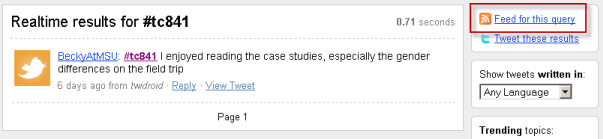
______________________________

As a student and as a teacher, I want to see, hear, feel, even smell the people I am interacting with.

______________________________

However, I can see where a content course with large numbers of students, such as Chemistry 101, would probably be taught more effectively in the online environment. I remember the few large lecture courses I took in college, and I did not perform well in many of them. I would fall asleep or totally zone out. I am sure I would have learned more from a well-designed online course.

However, there’s the rub. John Adsit (‘College for $99 a Month’ – A Step in the Right Direction) referred to schools which are developing high quality online courses. They hire educational theorists who understand how students learn. They hire technology teams to create interactive and engaging multimedia to teach critical concepts. They have project directors who see the whole project through to its conclusion, a process which may take most of a year. They create careful formative and summative assessment programs rarely seen in colleges. A single course costs many tens of thousands of dollars to create.

Unfortunately I don’t think many programs invest the time or money into this kind of design. I have taken online courses which I think were well-designed, and coupled with my self-discipline, I have learned from them, and enjoyed the interaction with other students. I have taken others online courses which were poorly-designed so that I felt more frustration than satisfaction with my learning.

I appreciate the discussion on this topic because I think it really highlights the complexity of the issues that we as modern educators face. I think if we lock ourselves into the idea there is only one modality or one way of delivery we are ignoring the flexibility and versatility that education, with and without technology, can offer.

Is ‘$99 a Month for College’ Really a Cute Little Kitten?

John SenerBy John Sener

In a recent blog post on his Connectivism web site, George Siemens uses the term “cute kitten syndrome” to describe how practitioners commonly treat open education resources — cute, cuddly, beyond reproach — but he offers some constructive criticism anyway.

While reading “College for $99 a Month,” I couldn’t help thinking about cute kittens. Who could be against cut-rate college? We all know how expensive higher education has gotten in the U.S.; the movement to make college more affordable for more people is laudable and much needed. Awww, $99 a month for college, isn’t it cuuuuute? Somebody, though, needs to be thinking about the shots, the litter box, and who’s going to feed it.

Although this is a magazine article with the requisite human interest hooks to heighten reader interest, it’s still a fair question to ask whether or not $99 a month for college, and the business model it implies, really is a cute little kitten in the first place. My take: it is a worthwhile innovation on balance. Catastrophic for universities? This kitten’s got some lumps and warts — the cuteness in this case fades upon closer inspection.

The storyline we’re supposed to absorb appears to be something like this:  the Internet makes cheaper education possible ($99 a month!). Smart innovators are trying to make this happen with the support of eager students and Free Markets. Self-serving faculty and inauthentic, short-sighted accreditors are trying to stop this from happening. But in the long run, consumer choice will win out, and students will learn cheaply! And most everyone will live happily ever after (except for the universities and maybe the accreditors too). The End.

Youngkitten

OK, I don’t want to be too sarcastic here because the article has a lot of good points and some useful information. As a coherent whole, however, I’ve read the thing several times and still can’t make heads or tails of it. The superficial storyline is simple enough to grasp, but its connection to the reality it purports to describe falls apart upon closer examination.

Like Craigslist, StraighterLine threatens the most profitable piece of a conglomerate business: freshman lectures, higher education’s equivalent of the classified section.

Where is the evidence that freshman lectures are the most profitable “piece” of the higher education “business?” Is the comparison between freshman lectures and classified advertising apt? Not really.

The most basic mistake here, of course, is trying to view higher education as strictly a business. Yes, they have revenues and costs. But, name another “business” whose customers are also its products, its performers, and its benefactors. Or one which “sells” every unit it “makes” at a loss, i.e., the gap between tuition and actual costs. (OK, besides most Internet companies.)

Beyond that, the comparison to classified advertising is misleading. According to various sources, classified ads accounted for 40% of total newspaper revenue in 2000; that dropped to 25% in 2008. Does tuition from freshmen account for 25-40% of revenue for IHEs? Figures are hard to find, but if we consider that IHEs have multiple sources of revenue (grants, government & foundation funding, partnerships, etc.) and that freshmen only comprise at most 30-35% of the tuition revenue (far less for universities with graduate programs), it doesn’t appear that tuition from freshmen is anywhere near as important to IHEs as classified advertising has been to newspapers.

Is college getting less affordable for more and more students? Absolutely. Do IHEs guard their underclass revenue streams jealously? You bet they do. I know an instructor who taught the exact same course at the local community college and the nearby university. If a student took the course at the community college, the local university refused to accept transfer credit for the course even though it was supposedly a “sister institution.” Stories like these abound and are one of the reasons we are cheering for solutions that effect change. But is freshmen tuition the soft underbelly of the IHE revenue model? Not feelin’ it…

The only expensive thing left in higher education was the labor, the price of hiring a smart, knowledgeable person to help students when only a person would do. And the unique Smarthinking call-center model made that much cheaper, too.

Has the author priced building construction or football uniforms lately? More to the point, what are the labor costs in intro courses where TAs, large class sizes, and community college-level tuition rates abound? There is an important point here: StraighterLine and others (present and future) offer their services as an improved alternative with a lower cost structure.  But the actual reality is rather more complex than the storyline implies.

______________________________

Big changes need to happen from without and within, but characterizing the existing structures as simply “artificial barriers” is frankly a bit naive and ultimately counter-productive. We can and must do better than that.

______________________________

Where there are cute kittens, there are also usually ugly trolls playing the role of villain and making the kittens look that much cuter. In this article, the ugly trolls are the accrediting agencies:

…the biggest obstacle…was a process called accreditation….And the most prestigious accreditors will only recognize institutions: organizations with academic departments, highly credentialed faculty, bureaucrats, libraries, and all the other pricey accoutrements of the modern university. These things make higher education more expensive, and they’re not necessary if all you want to do is offer standard introductory courses online….The accreditation wall will crumble, as most artificial barriers do.

It’s easy to typecast accreditation agencies as trolls: they’re bureaucracies, they have complex rules and make stupid decisions sometimes. Just get out of the way, you mean accreditation agencies, and let us offer our standard introductory courses in full market freedom! Uh, not so fast. Accrediting agencies are not just “artificial barriers” — they provide tangible and valued benefits (here’s a representative list). “Down with the system!” is just, well, so ’60s and ’70s. Big changes need to happen from without and within, but characterizing the existing structures as simply “artificial barriers” is frankly a bit naive and ultimately counter-productive. We can and must do better than that.

Colleges may have another decade or two, particularly given their regulatory protections. Imagine if Honda, in order to compete in the American market, had been required by federal law to adopt the preestablished labor practices, management structure, dealer network, and vehicle portfolio of General Motors. Imagine further that Honda could only sell cars through GM dealers. Those are essentially the terms that accreditation forces on potential disruptive innovators in higher education today.

Actually, accreditors are more like the EPA in this example. Their policies can be maddening — I waited five years for an EPA-acceptable Smart car to arrive in the US, and then they send us a 40mpg model instead of the 60mpg one? (And of course, we’ll never see a street-legal Smart roadster here.) On the other hand, do we really want hordes of cheap and truly unsafe cars fattening up our traffic death statistics, which is what would happen if there were no EPA regulations?

Likewise, accreditors and their regulations should not somehow disappear from the equation, but accreditors should be looking more closely at alternative models which save students money, and looking very closely at models like StraighterLine. The rest of academe should be too. Is what StraighterLine et al. offer of sufficient quality? If it’s better than 400-person lectures, then why shouldn’t it be acceptable? Are we missing something important by going to the StraighterLine model? If so, should we be looking harder at incorporating it into existing courses? These are good questions to be asking, and I’m glad that StraighterLine is causing enough irritation to bring this issue to greater attention.

In short, we need a less fairytale and more systemic approach to dealing with this situation. Catastrophic for universities? Oops, there goes StraighterLine’s business model along with their clients. Surely Burck Smith and the rest of us can come up with a better, non-catastrophic solution…

div05

steve_eskow40 Click here to see the response from Steve Eskow.

‘College for $99 a Month’ – A Step in the Right Direction

adsit80By John Adsit
Editor, Curriculum & Instruction

Kevin Carey, in “College for $99 a Month,” refers to Christensen and Horn’s application of the concept of “disruptive innovation” in education, in which they predict that online education will someday acquire the necessary quality to upend the existing system. Is StraighterLine such an innovation? Perhaps not yet, but a closer look at Christensen and Horn coupled with the points in Carey’s article show why it is definitely a step in that direction.

One of the key points that Christensen and Horn make in Disrupting Class: How Disruptive Innovation Will Change the Way the World Learns is that the organization that relies on incumbent technology for its product will struggle to implement the disruptive innovation itself, if it can do it at all. Doing so will require it to devote resources to create an, at first, inferior product to compete against itself in the same market place. A company that competes against itself is torn apart. Carey provides ample evidence of this dynamic at work in the StraighterLine experience with Fort Hayes.

Colleges have indeed implemented online education courses, but for the most part they do so in a way that will not allow true competition. Again, Carey gives ample illustrations of how colleges set rules on online education that limit competition. It is, however, the very structure of colleges that prevents them from creating a truly disruptive innovation in online education. Once again, Christensen and Horn show why.

disrupting_classThey give the example of DEC, a giant in the last era of computing. It defined its corporate structure around the basic design of its very successful computer, creating discrete departments that were assigned the task of upgrading the specific component to which they were assigned. While this meant that DEC could continue to improve that basic design, it also meant that it would be forever locked into that basic design, and new systems built on new interrelationships of parts eventually blew them away. Similarly, colleges and universities that work within existing structures will never create a truly innovative online program.

When a typical college undertakes an online education program, it does so within its existing department structure. This means that individual professors, adhering to the principle of academic freedom, create online versions of their classroom experiences. College teaching is one of the few professions in which practitioners are not required to have any training in their profession, and Carey clearly points out that poor quality college classes and huge lecture halls are all too common. So an online program begins with a professor wondering how to take what is too often a very poor face-to-face instructional model and replicate it in an online setting.

Because the school cannot afford to invest vast sums into a technology that will ultimately compete against itself, the professor is given minimal training in how to use a Course Management System like BlackBoard. The professor has little spare time in which to develop the course, and an inordinate amount of time taken in its creation merely takes away from the amount of money ultimately earned for teaching the course. There is thus no incentive to learn how to use the resources creatively.

______________________________

Colleges and universities that work within existing structures will never create a truly innovative online program.

______________________________

Let’s compare that with an organization that is working outside the existing educational system. At the K-12 level, several, including some cited by Christensen and Horn, are developing high quality online courses. They hire educational theorists who understand how students learn. They hire technology teams to create interactive and engaging multimedia to teach critical concepts. They have project directors who see the whole project through to its conclusion, a process which may take most of a year. They create careful formative and summative assessment programs rarely seen in colleges. A single course costs many tens of thousands of dollars to create.

Of course, such a process would be cost prohibitive within the normal college setting. On the other hand, if such a high quality course is marketed through colleges to students, thus distributing the cost over a wide base, students across the country could have access to an outstanding education at a reasonable cost from any place at any time. Contrary to the beliefs of many, this will not eliminate the need for a quality instructor, for the best of such courses will employ activities that demand the meaningful intervention of a skilled educator. To fill that role, the teaching professor will need to learn to facilitate constructivist, project driven instruction instead of broadcasting facts to the multitudes, but that is a change that should be made anyway.

The existence of programs like StraighterLine show that such innovations are on their way. Predictably, colleges and universities will fight them tooth and nail so that they may maintain their quite profitable status quo, but the change will eventually come.

Encounters: ‘College for $99 a Month’

Encounters: ideas that go bumpIntroduction: This encounter begins with an idea, a “bump,” from Steve Eskow. In an email message on Sep. 2, he referred me to Kevin Carey’s “College for $99 a Month: The Next Generation of Online Education Could Be Great for Students—and Catastrophic for Universities” (Washington Monthly, Sep./Oct. 2009). Carey is policy director of Education Sector, an independent think tank in Washington, D.C. Please participate in this encounter by posting a comment. I’ll append most or all of the comments to this page as they’re published. -js

div05

keller40Harry Keller, editor, science education, on 3 Sep. 2009, 4:00AM: This article engendered so many thoughts that I cannot begin to write them all. Note the unfair evaluation criteria; compare with online vs. traditonal A.P. science courses. The disruptive innovation thread is large. What if many StraighterLine clones sprung up if regulatory walls were lowered, and many had lower standards — just like today’s colleges. The social benefits to students of college have been ignored in the article. How much of the tutoring and even teaching will be outsourced offshore? Will the $99 per month be sustainable as a business model? StraighterLine only offers 11 courses now, all oriented to business students; when will they be able to offer degrees? Who will support research in renaissance french pottery <big grin> if universities have to downsize? Will future college professors be able to retire on the job until they really retire as some do today? The protesting professors clearly know on which side their bread is buttered and are reacting to a threat rather than proposing rational solutions to impending change. What will happen to low-enrollment courses; will they be aggregated across states or even nations to keep them viable? Who will teach a course that only provides a small slice of $99 per student? How large will the student load per instructor be? Is the ivory-tower model dying? How will drama and science be taught? For online courses, the major costs are the design of the course (amortizable) and the ongoing cost of the instructor. Interestingly, each corporate online provider must design courses anew. Smaller providers, such as small states, purchase the curricula and resell them packaged with one of their instructors.

And so it goes. This concept goes far beyond the use of “clickers” and “smart” boards in bringing technology to education.

The topic may be too large for us to cover, but if we don’t try, we won’t know for sure.

div05

steve_eskow40Steve Eskow, editor, hybrid vs. virtual issues, on 3 Sep. 2009, 7:14AM: Harry refers to the often-cited “social benefits” of the walled university. Apparently something of educational importance happens when the the 300 students and the lecturer and the images on the screen are together in the lecture hall in real time. Or when the 30 students and the graduate student “discuss” the lecture in real time in a 600-square feet classroom.

Jerry FarberI wish someone in our group with institutional library privileges could get us two articles by Jerry Farber: “The Third Circle; On Education and Distance Learning” and “Teaching and Presence.”

Farber’s first circle is “measurable competence.” That’s what we get in all those studies that come out, it almost seems, every other day. Those “NSD” studies.

The second circle contains those competences that aren’t readily measurable.

And the third circle contains those “benefits” that Harry mentions: the profound educational benefits that Farber and so many other attribute to the face-to-face situation.

The philosophic position behind this “third circle” is often called “the metaphysics of presence,” and this matter of the reality or the mythology of “presence” has, I think, been underreported in the literature of online and mediated and distance learning. ETC could do something about that.

Jacques Derrida wrote much–and densely–about “the metaphysics of presence.” About “logocentrism,” and the power of the Word when present, and , importantly for proponents of mediated instruction, on “phonocentrism,” the assumed differences in impact and meaning of the spoken and the written word.

Perhaps Farber’s articles could help us get a modest shared background on this matter of “presence,” and we might get help from folks in philosophy on Heidegger and Derrida and the implications of “the metaphysics of presence” for the future of online learning.

div05

Harry Keller (9.3.09, 7:22AM): The social benefits happen outside of the classroom. People make lifelong friends and set up future business relationships. They join clubs that foster success after graduation. I would never suggest (at least from my personal experience) any social benefits from sitting in a classroom.

div05

Steve Eskow, (9.3.09, 7:32AM): Harry is not talking, then, about “learning” as the curriculum defines it, but about “social capital.” About the so-called “extra-curriculum.”

(When he was President of Princeton Woodrow Wilson wrote extensively about what he called student excitement and involvement in the “sideshows” and their lack of of interest in “the main tent”: the classroom and the curriculum.

Others here and everywhere attribute important learning enhancement and benefits from “presence”: from the living word, from the face-to-faceness of the classroom as opposed to what they see as the “distance” imposed by distance learning: the lack of this almost mystical “presence.”

Farber is one strong voice speaking for this “presence.” Hubert Dreyfus is another.

I don’t think the issue has found its way into distance learning circles, and it’s at the very center of our work, and yet largely unrecognized and unremarked.

div05

Harry Keller (9.3.09, 8:26AM): Regarding “presence”:

1. I don’t see it. Except for the very unusual show types, having a prof in the room with you gains little or nothing.

2. It’s more useful for the instructor who can gauge the impact of what’s going on by the faces (rapt or blank stares or whatever). Tools available today to online instructors can do even better than face-reading, however.

3. I often had the person who wrote the book (and in one case was writing it daily) giving the lectures. The only advantage to the class was being able to ask questions, but with 180 students, the opportunities to do so were small. Online is better in that respect.

4. Seeing professors out of their element gives little idea of what they really do. However, every first-year student cannot visit the professors as they’re working.

5. Many online students have remarked that they’re cowed in traditional classes but can open up and become involved in online classes.

Persons are important; presence is not. It will be a long time before a real, live instructor can be replaced by a machine. However, some of the work traditionally done by instructors can now be done by machines so that teaching becomes more of a mentoring or facilitating job. It becomes elevated to a real person skill.

div05

Steve Eskow, (9.3.09, 8:49AM): Harry, it seems increasingly clear to me that many of us heavily involved in mediated instruction are unfamiliar with the large and important literature on this matter of “presence” and “the metaphysics of presence,” and unaware of the role it plays in philosophy and practice–and, importantly for our work, in the serious resistance to distance learning.

An interesting and intricate example of the power of presence thesis is MIT: hardly an enemy of technology and technology-enhanced learning. MIT is increasingly technologizing its instruction–but on campus. As far as I know, complee resistance to distance learning for its students. All MIT credit instruction, as far as I know, requires that you be “present.” On the other hand, distance learning students around the world can make arrangements to access the4 MIT “i-labs” program: lab instruction online.

Hubert Dreyfus is a philosopher who has written such important books as WHAT COMPUTERS CAN’T DO. His book ON THE INTERNET is a serious critique of mediated instruction built around the “presence” thesis.

If we want to engage the important critics of distance learning we need to know more about their position and deep concerns. That means, I think, taking their arguments seriously and engaging with them.

Farber’s articles, and Dreyfus’ ON THE INTERNET would give us a start in developing a common background on the “presence” thesis.

Or: we should know more about it before we attack. It’s serious, substantial stuff–not just anti-technology claptrap.

div05

Harry Keller (9.3.09, 10:08AM): I’d like to see the gloves come off in the discussion on this topic. Although our view of the future is hazy and dark, we can consider the effects of various futures.

Replacing the sage on the stage with the net mentor has to be a positive step. Loss of a place (secondary school or college) where people gather together ostensibly to learn but really have learning as the secondary purpose, will have repercussions. What are they? Where do those sports teams go? Will the academic part of a college evaporate leaving behind a sports program as its residue? I’m guessing that some alums wouldn’t mind, but the national fraternities and sororities will. Can they have virtual counterparts?

If students can get high school diplomas and college degrees online, they’ll be at home much more putting more of a burden on the parents. Actually going to college exposes many students to other regions and other cultures. When I went to graduate school in New York City, I had never been East of the Mississippi or ridden on a subway or been to a coffee house. I saw a woman’s purse snatched right across the street from me. I saw Jackie Kennedy going to my own drugstore. I saw Robert Preston walking to a rehearsal on a nearly empty Broadway early in the morning. I met Tom Clancy (of the Clancy Brothers and Tommy …) in a bar once. I saw Gene Kruppa practicing his drums in a nightclub in the middle of the day. All of this stuff has nothing to do with classes. It’s the other part of your education.

We’ve only begun to scratch the surface here. The implications of StraighterLine are very very far-reaching as are those of the entire online movement.

Charlie Fitzpatrick

[posted 8.24.12]
Charlie Fitzpatrick
Esri Schools Program Manager
2001 N 15th St #1403
Arlington VA 22201
email: cfitzpatrick@esri.com
http://esriurl.com/fitzblog
http://edcommunity.esri.com
http://www.facebook.com/schoolGIS

ETC Publications

Mapping Dragons: Esri 2012 Conferences

Are Full Teaching Loads the Answer to the Recession?

jims80By Jim Shimabukuro
Editor

As we tighten our individual and collective belts in the university system where I work, I can’t help but worry about some of the decisions administrators are making to weather the current recession. I’m sharing these concerns in this publication because I sense that the underlying issues transcend the state I live in and weigh heavily in other systems throughout the U.S. and the world.

The decision that has my attention is the insistence on full teaching loads for faculty this fall and elimination of nearly all reassigned time activities. The assumption seems to be that non-instructional activities are expendable. This may be true, but it is not true in all cases. Many activities are actually aimed at exploring and developing innovative ways to accomplish traditional tasks, and in many instances, this involves the use of computer and internet technology. The point is that technology has the potential to cut costs and improve the quality of instruction and services.

The problem with indiscriminately cutting reassigned time funds for those involved in technology activities is that colleges may be simultaneously eliminating the sources of potential solutions and answers. By closing the door on innovation, we may be exacerbating instead of ameliorating the problems caused by the recession.

When I look back on tech-oriented activities that I pursued with reassigned time, I can clearly see the direct relationship between research and cost effective practice.

Like many of you, I’ve been involved in online instruction and college-related projects for many years. I began teaching completely online semester-length classes in spring 1997, over a decade ago, and nearly a decade earlier, in spring 1988, I experimented with a primitive bulletin board system (BBS) in one of my freshman composition classes. This was before the web was more than just an idea. I set up the BBS via a 2400-baud modem connected to an IBM-PC XT with a whopping 10MBs of storage. IIRC, it had the full 640KBs of RAM. The BBS ran off the standard phone lines. I had a 1200-baud modem on my home XT, and the two students who joined me in this experiment had a 300-baud and a 2400-baud modem connected to a Commodore 64 and an XT. I don’t think I’ll ever forget the stream of high-pitched electronic squawk that the modems produced when they made contact.

We hooked the PC-based BBS into a phone line in the college’s study lab and logged in to the board to complete the full cycle of activities for a single assignment that lasted about three weeks. The two students received, as a reward for participating, permission to be absent from class during that period. Despite a steady series of crashes (if anyone in the lab inadvertently picked up the receiver on the phone, the BBS went down), we persevered and were excited about actually teaching and learning online. It was our equivalent to walking on the moon.

For me, the upshot of the experience over twenty years ago was the conviction that completely online instruction was not only possible but cost-effective and potentially highly effective. Still, it took another nine years to convince my department to allow me to teach a fully online course.

The point of this story is that, throughout all these years, I received reassigned time from my instructional duties to pursue these interests. Without the release time, I wouldn’t have been able to do any of it. The result, today, is fully online classes and other cost-effective technology, and in the remainder of this essay, I explain the savings that these represent.

Today, at the start of the fall 2009 semester, I find myself for the first time in nearly twenty years with a full teaching load and zero reassigned time. The mandate is from the top down. All instructional faculty are to teach a full load. An exception has been made for a few, for administrative functions, but the vast majority are left with no time to do more than teach. And for community college instructors, a full load is five classes. (In all fairness to the administration, though, I should say that I would have received a release from one of my classes if paperwork had been submitted in time.)

I’m teaching three different writing classes, all of them online: a transfer-level freshman composition class, two advanced expository writing classes, and two creative nonfiction classes. Those who have taught or are teaching fully online classes understand just how much preparation goes into each class. Far more, by a very wide margin, than that for traditional face-to-face (F2F) equivalents.

This teaching load means little time for innovative activities that directly or indirectly impact instruction. As part of my special assignments in the past, I’ve been developing and experimenting with blogs for student assessment and for planning student services. Much of what I’ve been learning about blogs is finding direct application in my online instruction, and, in turn, much of what I’m learning in instruction benefits my other activities.

For instruction, I no longer use the college’s server for course webpages. Instead, I’ve placed all of my course material in blogs that are provided free of charge by WordPress and Google’s Blogger. In this medium, the amount of developing power and speed over the old webpages is staggering. I do use the college’s Sakai CMS, but for its discussion forums and bulk mail services only. My students use Blogger to share their drafts with classmates.

I’ve been developing an online open textbook for my freshman comp class, and for the last year or so my students haven’t had to spend a dime for required texts. I’ve also created electronic journals to publish selected works from students in my advanced expository and creative nonfiction classes. One is already up and running, and the other is about half done. These, too, are based in blogs, and they allow me and the student editors to quickly select, edit, and publish exemplary papers. Publication costs such as printing, special equipment, and office space? None.

The use of web resources, such as blogs, that are off-campus represents a savings that’s difficult to measure. One of the most obvious is the elimination of reliance on college IT personnel to maintain, secure, and instruct users on the technology. Another is the elimination of reliance on the campus’s server resources.

But there are many other cost-saving results that may not be obvious. Instructors and students who learn to use non-campus technology and resources begin to realize that they can accomplish many other tasks with the same technology, thus placing little or no burden on the college in terms of cost or maintenance. Students will be able to use blogs for their other classes and eliminate the need to use the college’s resources to accomplish the same purposes. Staff will learn to use blogs to accomplish web-based tasks that currently require the assistance of the college’s IT staff and resources. This independence that off-campus technology offers can reduce the cost of campus-based technology, and the savings could be put to good use elsewhere.

Other “invisible” cost-savings that derive from the use of technology developed via released time are related to online classes. Online classes don’t require classrooms. If all of my classes were F2F and met twice a week, they would take up ten 75-minute time slots for an entire semester. This impact on the available classrooms is not trivial in terms of dollars and resources. To make the F2F classes viable, they need to be offered at times when students are willing to commute to campus. If rooms aren’t available in these prime times, the classes have to be canceled. Or new classrooms need to be built.

Traditional classrooms require a tremendous amount of electrical power for air-conditioning, lighting, daily maintenance, security, furniture, and equipment. Because writing instruction is heavily tied to the internet, many F2F classes are run in classrooms equipped with computers. The cost of maintaining computer labs and classrooms is absolutely staggering.

Finally, online instructors seldom use campus offices so the college realizes a savings in this regard. Furthermore, online faculty and students don’t drive to campus as often as others so they don’t add to the cost of maintaining parking facilities.

If administrators devote time to examining the full implications of faculty involvement in developing innovative practices through the use of technology, they may not be so quick to order a blanket cut of nearly all reassigned time. They may realize that, in the long run, the new technology may actually help to reduce costs at a rate infinitely greater than the dollar amounts for reassigned time. They may realize that the cost, today, may literally be an investment in the college’s future.

Encounters: USDE 2009 Report on Effectiveness of Online Learning

encounters9Introduction: This encounter begins with a bump from Judith McDaniel (ETC editor, web-based course design), who posted a comment to Steve Eskow re Evaluation of Evidence-Based Practices in Online Learning: A Judith_McDaniel2_80Meta-Analysis and Review of Online Learning Studies (Washington, D.C., 2009), conducted by the U.S. Department of Education, Office of Planning, Evaluation, and Policy Development.

After reviewing the excerpts or the complete report, please post your extended comments re the findings. Some or all of the comments will be appended to this article as they are submitted.

Here are some of the key findings:

• Students who took all or part of their class online performed better, on average, than those taking the same course through traditional face-to-face instruction.

• The observed advantage for online learning in general, and blended learning conditions in particular, is not necessarily rooted in the media used per se and may reflect differences in content, pedagogy and learning time.

• Most of the variations in the way in which different studies implemented online learning did not affect student learning outcomes significantly.

• The effectiveness of online learning approaches appears quite broad across different content and learner types.

• Studies in which analysts judged the curriculum and instruction to be identical or almost identical in online and face-to-face conditions had smaller effects than those studies where the two conditions varied in terms of multiple aspects of instruction.

• When a study contrasts blended and purely online conditions, student learning is usually comparable across the two conditions.

• Elements such as video or online quizzes do not appear to influence the amount that students learn in online classes.

• Online learning can be enhanced by giving learners control of their interactions with media and prompting learner reflection.

• Providing guidance for learning for groups of students appears less successful than does using such mechanisms with individual learners.

encounters: ideas that go bump

thompson80John Thompson, editor, green computing, on 17 August 2009, at 5:43 am, said:

This discussion on F2F, blended, and online learning reminds me of Matthew Arnold’s quote:

Wandering between two worlds, one dead,
The other powerless to be born.
With nowhere yet to rest my head
Like these, on earth I wait forlorn.

F2F proponents (right up there with the Luddites supporting print publications against digital encroachment) refuse to acknowledge a broken system. F2F served educational purposes well in another age (in a galaxy far, far away). And while there are still excellent F2F synchronous instructors (e.g., Randy Pausch), by and large the student audience has moved on. This government study merely confirms the obvious — almost anything is as good or even better than F2F instruction, at least as too many F2F instructors practice it. For all intents and purposes, F2F instruction is dead. Yet, online still remains in the wings, albeit with one foot on stage.

encounters: ideas that go bump

keller80Harry Keller, editor, science education, on 17 August 2009, at 7:53 am, said:

I also noted the small coverage of K-12 learning.

I did not see any discussion of the self-selection effect. Students in online or blended learning may have chosen to do so. Such students may be more motivated to do well, on average.

I believe that the instructor remains the key to success. Really good teachers manage to get good results regardless of the surroundings. By providing excellent tools to instructors, we can make the good ones very good. Perhaps, these same tools can help us identify and weed out the poor ones — emphasis on perhaps.

Even if online learning does not, by itself, make learning better, it has and will continue to provide incentives for new ideas in education from which these important new tools will arise.

Of course, as a creator of such a new tool, I have a bias.

encounters: ideas that go bump

jims80Jim Shimabukuro, editor, on 17 August 2009, at 11:15 am, said:

We tend to forget that communication is at the heart of learning, and that schools and classrooms are basically a medium or form of communcation. The problem is that we’ve become so accustomed to the classroom that we no longer view it as a medium of communication but equate it with learning. The danger of this equation is the tendency to dismiss other critical media such as the web.

Another way of viewing this dichotomy is the notion of formal and informal learning. For many educators, the distinction is clear: formal happens in the classroom, and informal, outside. Since the web appears to be clearly “outside” the classroom, it’s informal and irrelevant.

Fortunately, students don’t buy into the belief that learning is limited to what happens in the classroom. They understand, intuitively, that the web is a natural medium for communication and learning, and that the distinctions between formal and informal learning are all too often arbitrary and meaningless.

John Thompson, in his comment above, says, “By and large the student audience has moved on” to online modes of communication. I agree. For them, traditional F2F classrooms are becoming, like telephone landlines, anachronisms, sharing the same fate as typewriters, newspapers, and horse-drawn carriages. The web’s instant, anywhere, anytime communication with anyone or with any information source in the world is a given in their daily lives.

Increasingly, for students today, the question isn’t “Online or F2F?” but “Why limit learning to classrooms?” And increasingly, they’ll want to know, “Why do we have to gather in a classroom for instruction that could be delivered much more effectively and efficiently via the web?”

In their lives outside the classroom, students have become expert at informal learning or learning that’s not guided by an instructor. They use their mobile electronic communication devices to get information instantly on the latest news, entertainment, products and sales. If they need information, they automatically turn to the web simply because it’s there and they have access to it from anywhere at anytime. And more importantly, it’s a way to keep in touch with friends, allowing for the creation of social networking that’s unprecedented. Through the web, they can stay in touch with all their friends 24-7. They’re never more than a few seconds apart, regardless of the physical distances between them.

Replacing some of their F2F class meetings with online activities is a way for educators to acknowledge the undeniable impact of web technology in the lives of their students. This adjustment is considered “blending,” and the result is blended instruction. It seems to be working very well, and many if not most claim that it’s superior to both completely F2F and completely online methods. The USDE report seems to support this contention, but the gap between online and blended is apparently closing.

My concern with the term “blended” is its inclusiveness. It includes such a wide range of practices that it has little or no power to define an actual pedagogy.

Like a storm building at sea, online learning is gradually making its way to landfall, and all indications are that it’s strengthening rather than weakening, and when it hits shore, the impact will change the educational landscape.

The significance of the USDE report is not so much in telling us where we are but in showing us where we’re headed. There’s a trend, and its direction is unmistakable and unavoidable. In the meantime, as Harry Keller says above, “Even if online learning does not, by itself, make learning better, it has and will continue to provide incentives for new ideas in education from which these important new tools will arise.”

The coming years will be exciting, but we can’t really see the dramatic changes that are coming. However, we can read the signs and imagine.

encounters: ideas that go bump

john_sener2_80John Sener, ETC writer, on 17 August 2009, at 10:41 am, said:

There is an inherent danger and limitations to these studies, even meta-analyses such as this one. In particular, the danger is in absorbing the report’s summary findings (e.g., “the use of video and online quizzes…does not appear to enhance learning”) and applying it in a blanket fashion, when in reality the report itself describes findings which indicate that a more nuanced interpretation/response is needed. (Why reports like this one are so schizoid about this is one of the things that bugs me about them.)

For example, the actual language of the report states that the existing research on online quizzes “does not provide evidence that the practice is effective,” which means that:

1) The research does not indicate that the practice of using online quizzes is ineffective either.
2) As the report indicates, each study looked at slightly different things. The above comment was based on very few studies.
3) There are several important but unstated qualifiers. For example, one study found that discussions worked just as well as quizzes; that doesn’t mean that the quizzes weren’t effective.
4) Effectiveness depends on other variables. (Duh!) Interestingly, one study found that one LMS platform was better than another (WebCT vs. IDLE), suggesting that “details of their user interfaces” may have been the key variable in that case. As this example shows, there are LOTS of elements that can explain differences — elements that IMO are impossible to control using (quasi-) experimental designs.

Likewise, the Media Elements section of the report provides clues about possible practices related to using video effectively. For example, the Zhang study “found that the effect of video on learning hinged on the learner’s ability to control the video.” Now, read that sentence juxtaposed with the report’s summary paragraph for this section:

‘In summary, many researchers have hypothesized that the addition of images, graphics, audio, video or some combination would enhance student learning and positively affect achievement. However, the majority of studies to date have found that these media features do not affect learning outcomes significantly.’

Do you see the same disconnect that I do? On one level, this is simply an echo of Clark’s findings from 25+ years ago, as the report itself notes:

“Clark (1983) has cautioned against interpreting studies of instruction in different media as demonstrating an effect for a given medium inasmuch as conditions may vary with respect to a whole set of instructor and content variables.”

On another level, the report’s summary findings do NOT point out significant findings such as the Zhang study because, as one of my colleagues has put it, they are asking the wrong questions. But if you take the summary findings at face value, it’s easy to lose the more important and useful findings such as Zhang’s.

Also IMO, here is the report’s real message:

“That caution applies well to the findings of this meta-analysis, which should not be construed as demonstrating that online learning is superior as a medium. Rather, it is the combination of elements in the treatment conditions, which are likely to include additional learning time and materials as well as additional opportunities for collaboration, that has proven effective. The meta-analysis findings do not support simply putting an existing course online, but they do support redesigning instruction to incorporate additional learning opportunities online.”

To me, that means that you’re much better off in looking at the “combination of elements in the treatment conditions” than in taking the report’s summary findings as stated and running with them.

One other important point about this report: it apparently fails to take differences in learning outcomes assessment methods into account. in some cases, they simply report that learning outcomes were the same (or not) without telling us what methods were used. This is a clear yellow flag IMO.

Brian Mulligan

[This bio was first published on 10 Aug. 2012]

Brian Mulligan
Programme Manager
Centre for Online Learning
Institute of Technology
Sligo, Ash Lane, Sligo, Ireland
Online bio: http://brian.mulligan.googlepages.com/
Email: mulligan.brian@itsligo.ie

Brian Mulligan graduated as a Civil Engineer in 1978 from University College Dublin and later with a Masters in Engineering Design. His early employment was mostly in mathematical modelling and simulation and the application of information technology within engineering. He is currently on secondment as a Programme Manager responsible for online learning development in the Centre for Online Learning at the Institute of Technology Sligo where he has lectured since 1984.   He has been instrumental in the rapid growth in online learning in IT Sligo since 2002 and significantly involved in the growth of e-learning in Ireland since 1999, organising the EdTech series of conferences since 2000 and as a founding member of the Irish Learning Technology Association in 2002.  His main areas of expertise are now in web-casting, webinar management, synchronous online training, instructor-led online training, lecture capture and the rapid development of online training.  He is the organiser of the IT Sligo/NDLR Teaching and Learning Webinar Series. He has recently started a blog on education here: “Well I wouldn’t start from here anyway!“.  His personal website is: http://brian.mulligan.googlepages.com/


ETC Publications

Constructing a Sustainable Model for Higher Education: Part 1 – Disaggregation of Teaching

Encounters: Blended Learning Is Largely an Illusion

Encounters: ideas that go bumpIntroduction: This encounter begins with an idea, a “bump,” from Steve Eskow. It was originally posted as a reply to Lynn Zimmerman’s “Computers in the Classroom Can Be Boring.” Please participate in this encounter by posting a comment. I’ll append most or all of the comments to this page as they’re published. -js

steve_eskow80Steve Eskow, editor, hybrid vs. virtual issues, on 24 July 2009, said:

What Lynn is confirming, I think, is that blended learning is largely an illusion.

The “campus” is a collection of spaces designed to feature a standing and speaking “instructor” and a sitting and silent “student.”

The “lecture hall” is designed for lecturing, not for computers.

Again, the “classroom” is designed for a standing instructor speaking to sitting students.

Despite all attempts to to mute or end the lecture, it continues to be–overwhelmingly–the favored mode of instruction in our elite colleges. And it should be: Why pay distinguished scholars to teach and not listen to them?

Perhaps it is time to consider the possibility that the classroom and the computer are oil and water.

encounters: ideas that go bump

claude80Claude Almansi, editor, accessibility issues & site accessibility facilitator, on 25 July 2009, at 11:09 am, said:

“Blended learning” always reminds me of the mush I prepared in a blender, scrupulously following sadistic pediatricians’ instructions to wean my daughter. She contemptuously spat it out. Then our landlady asked me: “Have you tried that revolting stuff yourself?” and had hysterics when I did. Then she suggested tiny pasta with peeled and seeded raw tomato and some parmesan cheese and real olive oil. It worked.

By the same token, maybe computers still do have their place in the classroom, but a separate, not blended one. I once organized an intensive French workshop for which I’d made a wiki, with the precise purpose that students would not be distracted by note-taking during discussions and other active things. There were the active moments, then there were other moments when they wrote about these activities in the wiki, or did other writing assignments, like captioning videos. It worked too.

encounters: ideas that go bump

Steve Eskow, on 25 July 2009, at 2:19 pm, said:

Claude, suppose we added the video captured lecture to the blog and the wiki, and occasional web cam interactgions between teacher and student.s Is there something important lacking in this pedagogy that requires us to bring teachers and students to specially constructed buildings for face-to-face interaction?

(I like very much your gastronomic illustration of “blending,” and will steal it shamelessly. I may change it to what happens when you “blend” two splendid fluids, wine and water.)

encounters: ideas that go bump

Claude Almansi, on 25 July 2009, at 8:10 pm, said:

Replying to: Steve Eskow’s July 25th, 2009 at 2:34 pm comment:

Steve, for foreign language learning, I still believe that F2F can produce better results, as discussing in real time is part of using a language. But I left the wiki online (micusif.wikispaces.com so that the students who took part in the workshop could refer to it during their MA course. And others too: they can use the references to the materials we used and the activities we did with them, and even a link to some abominable snapshots I took with a webcam of what we wrote on flip charts. No videos: I don’t know how to. Had I lectured, I might have made an audio recording (did some of their discussions).

encounters: ideas that go bump

keller80Harry Keller, editor, science education, on 25 July 2009, at 11:11 am, said:

How many lectures have you attended that inspired you? What is the percentage? Most lectures I’ve attended would be just as good as pages in books.

Exceptions may abound. I was always engaged by Richard Feynman’s lectures. Perhaps, it was his engaging grin along with an infectious love of discovery and of explaining things so that his audience could comprehend. Still, the exceptions are rare.

Large lecture halls have been around for centuries. Maybe it’s time for them to give way to smaller venues and to social networking tools. My junior English literature classes typically had 3-5 students attending. Imagine having the professor (not a teaching assistant) almost to yourself.

I have sat in lectures by enough distinguished scholars. I’m talking about CalTech and Columbia. With few exceptions (e.g. Feynman), I could just as well as had a teaching assistant. Having distinction in scholarly affairs does not indicate lecturing talent. Great scholars are not always great teachers. Besides, they get paid for bringing in grant money and making the institution more famous. Undistinguished scholars (read assistant professors) are the ones who really get paid to teach.

So, yes, computers in the classroom take away from the interactive flavor that can be established by good teachers. Classrooms full of computers *look* boring. Computers at home or in the dorm room are another matter.

What will the future of instruction be? We’re in a state of extreme flux. The situation is too fluid to know for sure. It will include computers and the Internet. It will, for a long time anyway, include instructors. I predict that it will not include large lectures except as entertainment, which can be educating at times.

encounters: ideas that go bump

Steve Eskow, on 25 July 2009, at 2:34 pm, said:

Harry, if you were in charge of staffing for a new university, would you hire folks such as Richard Feynman and ask them to teach?
Richard Feynman
(I’m assuming that to take get faculty such as Feynman you’d have to offer them teaching loads no larger than five or six hours a week, right?)

Or would you not hire distingusiehd scholasr and researchers as teachers?

encounters: ideas that go bump

Harry Keller, on 25 July 2009, at 5:54 pm, said:

[@ Steve] Not ever having been a university administrator, I’m not certain what I’d do given the chance. I feel that the traditional role of institutions of higher education is being challenged. For many decades, students at Harvard, Yale, Stanford, et al. have discovered that their famous faculty is rarely seen by them.

These institutions perform two services. One is research and publication. The other is teaching. As much as I decry the University of Phoenix’s excessive concern with their bottom line, they have set out a model of the university solely as a teaching institution.

Universities have plenty of non-teaching researcher/publisher personnel who are called postdoctoral fellows. I was once a member of that tribe. Many professors view teaching undergraduates as a necessary evil they perform in order to hold a job at their chosen school.

The whole concept that undergraduate students will benefit from the crumbs that get scattered from on high makes little sense. What do they get for their high tuition? Mostly, they seem to get associations with their fellow students that will stand them in good stead in the future. The courses can be as good or better in other schools.

To answer your question, I would not be in charge of any part of a new university. If forced into it, I would have to understand fully the goals of that school before I could make such a decision.

It’s just as I harp on regarding science labs in secondary school. You shouldn’t do them until you know why you’re doing them. Teacher impose labs on students just because. Without clear reasons for having them, they’re a waste of time and money.

There are just too few Richard Feynman and Harry Gray types in the world to staff all of the universities that could use their services.

encounters: ideas that go bump

Claude Almansi, on 25 July 2009, at 8:10 pm, said:

Harry Keller’s July 25th, 2009 at 11:11 am comment. Re “I could just as well as had a teaching assistant” – when I had to take the history of the French language course in the 70’s, the professor was on sabbatical and his lectures were being read by his teaching assistant, who’d say things like “here the professor inserts a little joke:…” It was all the more zany as most other professors had agreed to have their lectures they repeated from year to year a) published as “polycopiés”; b) recorded on audio-cassettes, for students who could not attend lectures.

But like you, I also remember great lectures, like you: Jean Starobinski’s, George Steiner’s for instance. But thei impact was also due to the fact that they were combined with seminars where we could discuss with them.

encounters: ideas that go bump

Carrie HeeterCarrie Heeter, editor, games development, on 25 July 2009, at 4:22 pm, said:

Blended learning is the best!

I feel that my fully online courses finally became as good as or better than in person classes when I added one hour of synchronous time per week. My students report valuing the mix, claiming to enjoy it much more than fully online classes.

I never lecture during our precious hour. The online aspects of my blended courses include lots of mini-lectures (10 to 20 minutes of audio, often plus power point or video) and guest interviews (10 to 15 minute edited audio interviews with industry professionals), plus online readings. Individual and group project work also occurs outside of the hour “together.”

I use the hour to answer and ask questions. We often use polleverywhere,com to have small breakout discussions and come back and vote on an intriguing question. We negotiate changes in class assignments, and coordinate forming groups for group projects.

It would impair the quality of the student experience if I were not allowed to blend a dash of synchronicity.

encounters: ideas that go bump

Harry Keller, on 25 July 2009, at 5:58 pm, said:

[@ Carrie] You are reaching the perfect blend of blended instruction. You have figured out what instructors really can do best. You plan the course and then you execute it while making yourself the moderator of the discussions that you engender. The last part is critical for science and, I assume, for many other subjects as well.

Students should be full of questions raised by the curriculum you created. By having them discuss these questions among themselves with an expert helping to guide them, they’ll learn more than from a hundred hours of lectures.

encounters: ideas that go bump

jims80Jim Shimabukuro, editor, on 25 July 2009, at 8:00 pm, said:

Carrie, I think your definition of “blended” is unique. I believe most people would define “blended” as combinations of F2F physical meetings in a classroom and online activities such as participating in forums and logging in to webpages for readings. I also believe that many define “blended” as a smart classroom where instructor and students meet, F2F, and use the equipment to extend the learning environment to incorporate the web as well as social networks that allow all participants to communicate virtually. In some cases, the blended class replaces F2F meetings with online synchronous or asynchronous activities.

Then there are online classes that require a very small number of F2F physical meetings, sometimes as few as 1 or 2. I’m not sure exactly how to categorize these, but I think most would say these are online classes with minimal F2F requirements. Purists, though, might argue that even a single F2F requirement makes this a blended class. The point is that that requirement automatically excludes large numbers of students who cannot meet the F2F requirements. I tend to be a purist, but I’d be hard pressed to come up with a viable justification for my position.

IMHO, Carrie, your classes aren’t blended. They’re completely online but with synchronous requirements. Students and instructors can participate from anywhere without ever having to physically attend a required F2F session. I believe most online instructors require or at least encourage synchronous activities. For my completely online classes, I know that I always enjoy impromptu live interactions in the chat room that’s built into our university’s Sakai course management system. I drop in at times when I know many are online, working on assignments.

But I also know that, at least for my students, a synchronous requirement would be a huge stumbling block, negating the primary attraction that online has for them, which is the freedom to log in when it’s most convenient for them. My guess is that your population of students differs from mine, and this is why synchronous works for you and wouldn’t work for me.

encounters: ideas that go bump

Carrie Heeter, on 26 July 2009, at 6:31 am, said:

Jim,

Actually, my students are F2F together (in Michigan) for the in person part, although I am online, for our synchronous hour. Since my department currently does not offer an online curriculum, the students are physically on campus. I Skype and Breeze in to the group. For my Serious Game Design class, they meet in a lab. For the Design Research class, they meet in a classroom.

However, I do entertain a mixed blended mode for those who live relatively far from campus. Students have the option of coming in person, or coming electronically.

It depends on the class composition each semester, but typically either all or most are F2F in the traditional sense, except that the instructor telecommutes.

C

encounters: ideas that go bump

Jim Shimabukuro, on 26 July 2009, at 8:05 am, said:

Thanks for the clarification, Carrie. I should’ve remembered this from your earlier articles Online Hybrid as Asynchronous, Co-present, and Remote and Adventures in Hybrid Teaching: The First Day Is the Hardest. Your courses are, indeed, unique. Still, the fact that you’re in San Francisco and the students are in Michigan tells me that the course is theoretically fully online — and the only major physical difference with other online classes is that the students happen to regularly gather in the same place at the same time, F2F, for sessions. They could just as easily be scattered throughout the world for instruction to occur, with their peer-to-peer interactions occurring virtually instead of F2F. However, I do realize that the students’ in-person interactions on site are qualitatively different from virtual interactions.

encounters: ideas that go bump

Harry Keller, on 26 July 2009, at 1:16 pm, said:

Carrie, I still think you’ve got the right idea. The tools may be incomplete, but the direction is good. The real advantage for young people to go to universities lies in getting away from their home towns, meeting diverse people, making friendships that will be useful in the future, and stuff like that. As our network tools mature, those goals also may be achievable in online settings.

The courses are just an excuse these days because you can learn course content without “being there.” You may even learn it better.

I went to an atypical school and have to carefully avoid using my own experience as a guide most of the time. I did not obtain the advantages I listed above because: I lived at home; everyone was a nerd and most were white males, and I maintained contact with none of my schoolmates. I am ready to be corrected if I have misread the more usual university environment.

Computers in the Classroom Can Be Boring

Lynn ZimmermannBy Lynn Zimmerman
Editor, Teacher Education

The headline of an article in the Chronicle of Higher Education this week caught my attention: “‘Teach Naked’ Effort Strips Computers from Classrooms.” The article, posted on July 20, 2009, is written by Jeffrey Young and is actually called “When Computers Leave the Classroom, So Does Boredom.”

Young writes that, according to studies, students think lectures and labs depending on computer technology are less interesting than those relying on discussion and interaction. PowerPoint presentations (one of the main areas of complaint), for example, are often used as a replacement for transparencies shown on an overhead projector and make no substantive difference in lesson delivery. An effective use of video technology should be to spark discussion and not be a replacement for a lecture.

Young says students also complain that these interactive classes require more effort than lectures. He says that students who are used to the lecture model are often resistant to this type of participatory learning. I can attest to this from my own computer lab with 1990's computers round a central tableexperience. I teach my face-to-face classes seminar-style with small group and large group activities and discussion. I will never forget one student telling me, “Instead of all this group stuff, why don’t you just tell us what you want us to know.” (Unfortunately, that student is now a teacher who probably lectures to his students.)

Despite its title, the article is not insisting that all technology and all computers should be thrown out of the classroom. It is making the point that the way technology is used in the classroom needs to be reassessed and changed so that it is not just being used to replicate the traditional modes of delivery.

Many of the authors in this journal have advocated just such changes (most recently, Judith Sotir in Two Steps Forward . . . Several Back and Judith McDaniel in What Students Want and How to Design for It: A Reflection on Online Teaching). As McDaniel pointed out, we need to “design for a structure that challenges and rewards.”

I agree that this attention to design is important not only in the online environment McDaniel was referring to but also in the face-to-face classroom with or without technology. As Young says, with stiff competition from online courses, face-to-face courses need to engage students so that they see a reason for being in the classroom.

Two Steps Forward . . . Several Back

Judith SotirBy Judith Sotir

I absolutely agree with Judith McDaniel (What Students Want and How to Design for It: A Reflection on Online Teaching, posted on July 19, 2009) that online learning of any sort requires a different dynamic than traditional teaching techniques. Although technology has moved from an interesting idea in the latter part of the last century to a defining role in this century, I don’t see schools necessarily following suit.

A good example is a recent workshop I did for staff from a local school district. The instructors specifically requested a workshop on “Using Blogs and Wikis in the Classroom” and were willing to give up some summer sun hours to attend. The tech coordinator (or facilitator, since the position of technology coordinator was eliminated and a principal stepped in to fill the gap) was more than willing to set up the workshop. However, when I got to the school (and remember, the TOPIC was blogs and wikis), I found that the firewalls blocked all access to any form of social websites, including blogs and wikis. I spent a good amount of time with the IT department getting access to a limited number of blogs and had to verify the content of those (even my own, by the way) I was given access to.

laptop with the words The Internet crossed out by a red St Andrew's Cross

Even after gaining access, throughout the workshop, that access was spotty, as links were sometimes allowed and sometimes blocked. From the instructor viewpoint, wanting to bring these tools into the classroom was questionable, given that experience. While filtering websites is important to schools, better dialogue is needed to allow instructors the access they need to teaching tools while still maintaining control of questionable content.

As a former school board member, I recall similar issues in the late’ 80s and ’90s with the IT department, administrators, and even board colleagues regarding having access to the Internet itself from the classrooms. While they saw the value of administrators and staff using the Internet, they balked at allowing the same access in the classrooms. I understand well the frustration of instructors who want to use these tools with their students but run into brick walls when they try.

While not identical, limiting access to Internet resources strikes me as similar to banning books. Instead of allowing instructors to develop educational content as needed, a concern from a limited group blocks all access to these sites. A better dialogue needs to be developed, including perhaps even a faculty liaison committee to bring these concerns to the proper channels. Simply assuming that teaching with computers is the same as traditional teaching keeps students from the tools they need to succeed in the real world.

Science Labs Don’t Have to Cost an Arm and a Leg

Harry KellerBy Harry Keller
Editor, Science Education

A recent article in District Adminstration magazine discusses the aging science labs in schools across our nation and the cost of upgrading them all.

The article points out that science standards have been raised recently while lab facilities have been left to deteriorate. It says that the costs of fixing the existing labs run between $150 and $200 per square foot, meaning that an adequate lab space for 24 students will cost around $250,000 to upgrade.

In these days of plunging school budgets, this allocation of funds is simply not possible. When you add in the cost of including science labs in new school construction and count all of the schools around the country that are likely to require upgrades, the cost of fancy science lab facilities can reach hundreds of millions of dollars.

However, there’s another answer. Scale back the full upgrade of the lab spaces so that only inexpensive, safe, and efficient hands-on labs remain. Safety equipment may be partially eliminated. Gas would no longer be required. Bunsen burners come from the 19th century and are really archaic today. Highly chemical resistant desktops could be replaced with less expensive alternatives.

Why can we make this adjustment? Because the primary advantages of hands-on labs are two-fold.

  1. They provide a kinesthetic learning experience, rounding out the other learning in science classes.
  2. They allow students to do experimental design and redesign, providing excellent experience in understanding the nature of science and in developing scientific reasoning skills.

Any other purpose cited for having hands-on labs either can be handled in alternate, safer, and less expensive ways or is not really necessary for high school students. The two purposes listed above are easily achieved in a facility that is no more complex or expensive than a kitchen. While such facilities are more expensive than ordinary classrooms, they fall far below the cost of a fully-equipped science lab.

M_Faraday_Lab

What do you then do to provide the science experiences that can’t be conducted in a kitchen? After all, simulations will not do. They misrepresent the nature of science and can even deliver erroneous results. The data all come from a programmer’s pencil, which cannot represent the real world and may have other flaws as well.

To many, simulations are the “new thing.” Actually, people have been using simulations for a very long time. Uranus and Neptune were discovered with the assistance of simulations. Note that these simulations were not being investigated but were a tool being used to investigate the solar system where the real data was being collected. The recent widespread availability of inexpensive computer time simply meant that simulations could be done with less expense and in less time.

Replacing science labs with simulations has become popular with some for a number of reasons, including cost, safety, and the “gee-whiz” factor of using a computer and seeing animations. None of these are valid excuses for cheating students of the opportunity to investigate the real world.

Instead, we must find newer ways to use the available technology to provide true inquiry science experiences.  Ideally, science labs should allow students to inquire, explore, and discover. Even when this goal is only partially realized, the labs should advance the goals of understanding the nature of science and of developing scientific reasoning skills. Any other use wastes valuable class time.

It’s time to harness our country’s ability to innovate and convert new ideas into great products. My personal efforts have centered on prerecorded real experiments. Others must also have ideas that can bring us better science education for less money. The future will require no less, and we can no longer afford these show-piece science labs that don’t deliver learning value in proportion to their cost.

Green Computing – Clippings from the Web

thompson80By John Thompson
Editor, Green Computing

Green computing. Green IT. Whatever you call it, it still means the same thing – doing what you can to reduce the carbon footprint associated with technology use, whether using technology at home or on the office desk or in the IT department’s lair.

Here are a few snippets from recent Web sites, blogs, etc. Click on the associated link to finish reading “the rest of the story” (as Paul Harvey would say).

Green Computing – Laptop Only Offices

There are ways to go green in IT that might not be obvious. Some businesses may have already made the change to laptops for reasons other than portability and a traveling workforce. Laptops are power savers, and saving power is a green goal. Let’s look at how laptops can help you go green.

http://superbatteryy.blogspot.com/2009/07/green-computing-laptop-only-offices.html

MIS 1 Assignment4: Green Campus Computing

The growing use of computers on campus has caused a dramatic increase in energy consumption, putting negative pressure on CU’s budget and the environment. Each year more and more computers are purchased and put to use, but it’s not just the number of computers that is driving energy consumption upward. The way that we use computers also adds to the increasing energy burden.
http://emilios-blog-emilio.blogspot.com/2009/07/mis-1-assignment4-green-campus.html

Seven Design Considerations for a Green Data Centre

greenexpresIT depart­ments are under increas­ing scrutiny and pres­sure to deliver environmentally‐sound solu­tions. Large data cen­tres are one of the most sig­nif­i­cant energy con­sumers in an organisation’s IT infra­strucure so any mea­sures that can be taken to reduce this con­sump­tion (and there­fore also car­bon diox­ide emis­sions) will have a pos­i­tive impact on an organisation’s envi­ron­men­tal foot­print.

http://expressiongreen.com/2009/07/19/seven-design-considerations-for-a-green-data-centre/

Green Campus Computing

Green computing is the study and practice of using computing resources efficiently. The primary objective of such a program is to account for the triple bottom line, an expanded spectrum of values and criteria for measuring organizational (and societal) success. The goals are similar to green chemistry: reduce the use of hazardous materials, maximize energy efficiency during the product’s lifetime, and promote recyclability or biodegradability of defunct products and factory waste.

http://juvz14.blogspot.com/2009/07/what-is-green-computing-green-computing.html

Google banks on data centre with no chillers

Google has taken a radical new approach when it comes to cooling data centres. The search giant has opened a unique data centre in Belgium that has no backup chillers installed but, instead, relies totally upon free air cooling to keep its servers cool.

http://www.computerworld.com.au/article/311616/google_banks_data_centre_no_chillers

The Sustainability Potential of Cloud Computing: Smarter Design

If you listen to venture capitalists and tech gurus, cloud computing is “the new dot-com,” the “biggest shift in computing in two decades” or even the “Cambrian explosion” of the technology era. Among its other heavenly attributes, the cloud is being touted for its ability to address the enormous need for energy efficiency of IT’s own footprint.

http://ow.ly/15IfwE

Greening the Internet: How Much CO2 Does This Article Produce?

Twenty milligrams – that’s the average amount of carbon emissions generated from the time it took you to read the first two words of this article. Now, depending on how quickly you read, around 80, perhaps even 100 milligrams of CO2 have been released. And in the several minutes it will take you to get to the end of this story, the number of milligrams of greenhouse gas emitted could be several thousand, if not more.

http://www.cnn.com/2009/TECH/science/07/10/green.internet.CO2/index.html

Sustainable Desktop Computing

To achieve a sustained reduction in energy consumption associated with desktop computers we recommend groups across the collegiate university to work through these five steps:

Step 1: Estimate. First estimate how much electricity your desktop computing infrastructure will consume if computers are (a) left on all the time or (b) switched off at the end of the day.

Step 2: Research. Many groups within the university and around the world have implemented projects to reduce IT-related greenhouse gas emissions and costs. OUCS is working with these groups to write up a variety of approaches in the form of case studies.

Step 3: Implement. There are many tools you can implement to reduce IT-related electricity consumption. How you achieve this within your group will depend on the needs and skills of your users, and the hardware and software infrastructure you own.

Step 4: Communicate. You will need to encourage as many people as possible to “do their bit.” Behavioural change is likely to be a significant and critical part of any initiative that aims to improve environmental performance.

Step 5: Share. In step two we suggest you read about the work of other groups. In this last step we encourage you to share your experiences by documenting your approach in the form of a case study.

http://www.oucs.ox.ac.uk/greenit/desktop.xml

grass2

Happy reading “the rest of the story.” Where/how did I find this material? Using Tweetdeck, I set up Twitter searches on “green computing” and “green IT,” although almost all the URLs were found in the “green computing” (without using quotation marks) search. Using “green it” (with and without quotation marks) yielded mostly junk results. There was redundancy in the resulting tweets as people send retweets of the same information, plus there were soft/hard sells for related products. But you also find such information as cited above. You also might want to view my archived “Webinar, Blueprint for Green Computing,” found at the inaugural Virtual FOSE show’s site, http://virtual.fose.com/. It is a free registration.

Besides all this material, I hope that the resulting comments to this blog posting will contain more such green computing sites chockfull of more good information.

What Students Want and How to Design for It: A Reflection on Online Teaching

Judith_McDaniel2_80By Judith McDaniel
Editor, Web-based Course Design

I just finished teaching my Women in Western Culture course online for the third time. The course materials span from prehistory—in the form of various creation myths in diverse cultures—to modern art and literature. It’s a quick overview with a theme: How were women seen in each of these instances and did the literature create or reflect women’s positions in the culture? Topics for discussion include the effect of religious myth on gender stereotypes, gender expectations of men and women, gender biases in language, among others. This is a class that I have taught at least a dozen times in a face-to-face format over the last 15 years. In the summer of 2008, I designed the class for online presentation for the first time.

Here are a few of the comments from students at the end of this summer term. I offer them not to compliment myself but to lead into an examination of what these students appreciate in a university level course and how we can design experiences that will take them there.

Preference for online format—personal interaction and group dynamics:

  • Ellie—I would definitely recommend a class like this, whether it was a boy or a girl. I think that an online class like this may be an even better experience because people can express their feelings and reactions to certain readings without having to worry about the reactions of their classmates. I am very glad I took this class.
  • Grant—I’m glad I’m not the only one who felt like it was easier to post my opinion online than in a classroom. When I started posting I was sort of nervous about posting my ideas, but after a little while I felt a lot more comfortable with it than I would have in a classroom. I’m not sure what it is exactly, but I guess just not having to see everyone’s responses immediately kinda changes things.
  • Ashley—I would definitely recommend this class to a friend. I would tell them to take it in an online format over a classroom format. This class requires your opinion and not everyone is comfortable in expressing their opinion in a classroom format because they don’t want to be judge. The online format makes you worry less about other peoples judgments which makes it easier to express your opinion.
  • Hoi Ying—I agree with you that this class is perfect for web-delivered. Since some of the topics that we discussed were relatively controversial, it was better for us to discuss it online, where we would not see each other’s races and sexes. I know I certainly would be too embarrassed or timid to voice my opinion in the classroom.

How do we design for anonymity and protection of opinions?

We don’t. To a large extent, this is one of the gifts of the online format. Students don’t see one another and any intimacy they develop (and they do grow to know and like one another in varying degrees) is based on their expression of ideas and exchange of ideas. The one important role for an instructor in this regard is making sure that appropriate online etiquette is described, modeled, and enforced.

Significant learning from online interactive discussions:

  • Arlene—The most surprising thing that happened consistently over this semester, was not necessarily in relation to the readings, but to the responses that my classmates had for each discussion. I was so surprised by the numerous postings, holding such high quality and different responses. There were definitely remarks made that I had never considered before reading their posting. All I can say for my fellow classmates is job well done, you made it easier for me to discuss the readings – whether it was giving me a new perspective or answering a question that I simply couldn’t answer. Actually, to be completely honest, I enjoyed every day that we had discussions because I could write what I thought and have the ability to comment on the totally opposite idea that someone else had. There were definitely some good discussions from this semester.
  • Keith—The thing that surprised me the most was that the course wasn’t about women’s oppression in the business world or the objectification of women in the media but the course was more about the oppression of a woman’s ability to think and act for herself. The most important thing I learned was to listen to not just women but to other people as they express their opinion because i never know when they may bring up a topic or have an idea that I never thought about. This will help me with being a doctor and being a better human being.
  • Carley—When you mentioned that each classmate has very different ideas and opinions that they bring to the discussion, and it helps you form your own ideas, I can honestly agree. In the beginning of the class I would always read what everyone said before me but I realized that wouldn’t help me when it came to my turn to write my initial post. I think it really helps to go with your gut instinct of what you pulled to the reading. It brings more conversation, cause you might find people agree and disagree with you but it helps you learn.

Annie Leibovitz

How do we design for interactive discussions?

The first time I taught this course, I was pretty pleased with myself when I looked at the discussion forums I had created. And then I wasn’t. Student responses were perfunctory, not expansive. I required them to “respond” to one or two other postings, which they did in very limited ways: “Oh, great idea!” or “I guess I hadn’t thought of that.” I went back to the drawing board with the discussions remaining and was more specific. “Respond to an opinion that disagrees with yours.”  That was better, but an even greater improvement came when I asked them to “Respond to an opinion that disagrees with yours and ask a question about the source of that opinion.”

I also developed a rubric to give the students along with the syllabus: “How will I be graded in these online discussions?” A response that is social rather than an intellectual engagement will receive no points. A perfunctory response that indicates the reading has been done will receive one point. The highest level (5 points) requires engagement, a reference to the reading for the post (or previous posts), and a question that will further the discussion. It did not take long before most students became very good conversationalists.

Hard work that is rewarding and rewarded:

  • Brittany—It was somewhat difficult because I worked everyday of this course, but it was not impossible to do in any way, shape or form. It definitely kept me on my toes though! In fact, I read more for this course than I did all last semester…I learned a lot, but each of us had to put effort into this class, it wasn’t to be taken lightly or for an easy grade. This course was structured to learn and grow, which is honestly what I believe happened for us all. I have not read one posting that said my fellow classmate learned nothing during this semester.
  • Cameron—I agree this class was a lot of work but I feel that McDaniel did her best to structure this class in a way that all people are able to do the work especially when they work everyday. This was also the best history class I have taken and would also recommend it to anyone

How do we design for a structure that challenges and rewards?

When I am designing a course for web delivery, I spend more time than otherwise attempting to balance the amount of time and work a student will need to commit. I want the reading to be fairly even across the course, which is hard when I have some poems, some short stories, and some novels. I bring in feature length films, video excerpts, both short (3 minutes) and longer (up to 20 minutes). I try to alternate straight reading assignments with time spent in interactive research on the web.

I use no lecture material in this course. All of the information is included in the prefaces to the discussion prompts, the background for the Essay responses, and in my interjections during the students’ discussions—just to make sure they have all of the pieces I want them to be considering. Moving away from the lecture format was both scary and freeing for me. After 30 years doing it one way, I had to be reassured over and over that students would have an equivalent (if not better) learning experience as I began to adopt this new format.

Discovery through original research:

  • Corey—I also found it interesting to learn about the Bloomsbury group. I had no idea that a group like that with such sexual differences existed in a time era that anything out of the ordinary would classify you as different.
  • Erika—I was actually really excited when I saw today’s assignment because I already had an idea of who I wanted to talk about! I come from a family of photographers (My grandfather was a published photographer) so it has been a passed-down passion. The female artist I wanted to reference and discuss was Annie Leibovitz. She has taken many famous photographs that many people may not know that they were hers. Annie became interested in photography in high school and then went to learn at the San Francisco Art institute and then started doing photography while living in the Philippines during the Vietnam War. She returned to the states in 1970 and became a photographer for Rolling Stone magazine, which she worked for until 1983. Her most famous photograph was that of John Lennon and Yoko Ono where Lennon is curled up next to Ono.

How do we use the web and its resources for original research online?

What I have learned since I started teaching online, which I had not been aware of in quite the same way before, is what extraordinary resources are available for teachers and students. I need to make sure the quality meets my standards, but I would never be able to find a better intellectual resource, for example, than the Itsukushima_toriiwebsite produced by a Brandeis University professor on a Shinto shrine in Japan—the history, the present day use, the myths that support it, and the art work that has grown up around it.

In this Western Culture class, I had three original research projects: one on creation myths, one on women artists from 1975-2009, and one on the social and historical background of Virginia Woolf’s novel, Mrs. Dalloway. I think the danger for a course designer is to become trapped in the idea that “equivalency” means using all of the same tools but somehow just shifting them from the classroom or library to the web. To some extent, we can do that, but if we do that we are missing a huge potential learning experience for our students. To me, encouraging our students to live that classic goal of higher education, the life of the mind, means giving them engaging research to do and a forum in which to discuss it with peers and mentor(s).

And in conclusion:

  • Sarah—I think the most important thing I learned from this class is being a better writer. Having to write a paper each week, and a discussion each day really improved my writing skills. I found out that I really enjoyed talking to people in our discussions, and finding ways that I could add to the conversation. I think this type of learning is very important because you learn from your other classmates. They might have found something in the text that you missed or didn’t understand. I also really liked this class cause it breaks you out of your shell and requires you to converse with other classmates. Overall I think this class has brought great improvements to myself as a writer. I’m not as afraid to write papers each week.

‘At-Risk’ – Concerns About Its Effectiveness

Judith_McDaniel2_80By Judith McDaniel
Editor, Web-based Course Design

[Note: Judith McDaniel originally posted this as a comment to Carrie Heeter’s “Review of ‘At-Risk’: A Simulation Training Program for College Staff.” We’ve decided to publish it as an article to stimulate further discussion on this and similar simulation programs. -js]

Carrie – thanks for the interesting summary and analysis of At Risk. I had several responses myself after trying out the same “free” sample interaction that you did. Let me see if I can summarize some of my discomfort with this product.

First, I don’t think I have had a class at the university level with only 20 students in it since the 1980s. So for me, one necessary assumption is that most instructors are going to be dealing with far larger classes than the one represented here – at least double, probably triple or more. That makes this entire process problematic for me since it assumes that I will be talking to these students about their work outside of class – and in very large classes that seldom happens.

I am concerned too that my role as an instructor, not a therapist or counselor, not be confused – by me or by my students.

a frontal lecture where all the students are using laptops

Further, the self-reporting of changed attitudes is interesting. I did not have the same experience that you did with feeling more comfortable. But that aside, self-reporting, no matter how well-meaning, is not evidence that the program works. Changed behavior in terms of frequency of reporting would be more relevant, but of course that takes years and $ investment.

I also found the “flags” for what we should notice in our students to border on the ludicrous. Does a student come to class looking tired and with messy hair? Yes, that describes about half of a freshman class in early November. Is a student anxious or withdrawn or sullen or non-participative? Yes, inevitably when there are 100 or more students in a class, that describes some of them. I have never found that to correlate to a need for referral . . . that I would have known.

And, finally, that is my last discomfort. I did have a student who disappeared last semester two-thirds of the way through class. She had been doing really well. Emails did not get a response. Finally, the last week of the class, she reappeared. She had been hospitalized after a suicide attempt and was back. I am still working with her to finish her Incomplete. But could I have referred her sooner? I honestly can’t imagine how. Would having taken this training have let me identify her? Not from what I have seen of it.

Meet the Endless Summer – A Review of ED-MEDIA 2009

Stefanie_Panke80By Stefanie Panke
Editor, Social Software in Education

The 21st annual World Conference on Educational Multimedia, Hypermedia & Telecommunications (ED-MEDIA) attracted 1200 participants from 65 countries. A diverse crowd, including K-12 teachers, university faculty members, researchers, software developers, instructional designers, administrators and multimedia authors, came together at the Sheraton Waikiki Hotel from the 22nd to 26th of June with a common goal: to share the latest ideas on e-learning and e-teaching in various educational settings and at the same time enjoy the aloha spirit of tropical Oahu, Hawaii.

Organized by the Association for the Advancement of Computing in Education (AACE), the annual conference takes place at varying locations in the US, Europe and Canada. Thanks to funding by the German Academic Exchange Agency, I was able to join my colleagues in Hawaii to present two current research projects on social tagging and blended learning and en passant absorb the international flair and information overflow that go together with a packed conference program.

ed_media09

The attendees experienced a full program. In addition to various invited lectures, 210 full papers and 235 brief papers were presented, complemented by numerous symposiums, round tables, workshops and an extensive poster session. The conference proves to be exceedingly competitive with an acceptance ratio for full paper submissions of 37%, and 56% for brief papers. Eleven submissions were honored with an outstanding paper award. My favorite was the work of Grace Lin and Curt Bonk on the community Wikibooks, which can be downloaded from their project page.

Beginning with Hawaiian chants to welcome the participants at the official conference opening and the local adage that “the voice is the highest gift we can give to other people,” audio learning and sonic media formed a recurring topic. The keynote of Tara Brabazon challenged the widely held perception that “more media are always better media” and argued for carefully developed sonic material as a motivating learning format. She illustrated her point with examples and evaluation results from a course on methods of media research (see YouTube excerpt below). Case study reports from George Washington University and Chicago’s DePaul University on iTunesU raised questions about the integration into learning management systems, single-sign-on-procedures and access management.

Among the invited lectures, I was particularly interested in the contribution of New York Times reporter Alex Wright, who reflected upon the history of hypertext. The author’s web site offers further information on The Web that Wasn’t. Alan Levine, vice-president of the Austin based New Media Consortium, clearly was the darling of the audience. Unfortunately, his talk took place in parallel to my own presentation on social tagging, but Alan has created a web site with his slides and hyperlink collection that gives a vivid overview on “50+ Web 2.0 ways to tell a story.”

A leitmotif of several keynotes was the conflict between open constructivist learning environments on one side versus instructional design models and design principles derived from cognitive psychology on the other. Stephen Downes advocated the learning paradigm of connectivism and praised self-organized learning networks that provide, share, re-use and re-arrange content. For those interested in further information on connectivism, an open content class starts in August 2009. This radical turn to free flowing, egalitarian knowledge networks was not a palatable idea for everyone. As an antagonist to Downes, David Merrill presented his “Pebble in the Pond” instructional design model that — similar to “ADDIE” (analysis, design, development, implementation, evaluation) — foresees clear steps and predictable learning outcomes. Tom Reeves, in turn, dedicated his keynote to a comprehensive criticism of multimedia principles derived from the cognitive load theory, picking up on an article by Kirschner, Sweller & Clark (2006), “Why Minimal Guidance Does Not Work . . . .” The audience, in particular the practitioners, reacted to this debate true to the Goethe verse “Prophet left, prophet right, the world child in the middle.” As Steve Swithenby, director of the Centre for Open Learning of Mathematics at Open University (UK) posted in the ED-MEDIA blog: “Well, actually, I want to do both and everything in between. I can’t see that either is the pattern for future learning – both are part of the ways in which learning will occur.”

With blog, twitter feed, flickr group and ning community, the conference was ringing with a many-voiced orchestra of social software tools. Gary Marks, member of the AACE international headquarters and initiator of the new ED-MEDIA community site, announced that he has planned several activities to foster interaction. So far, however, the few contributions are dedicated to potential leisure activities on Hawaii. The presentation “Who We Are” by Xavier Ochoa, Gonzalo Méndez, and Erik Duval offered a review on existing community ties of ED-MEDIA through a content analysis of paper submissions from the last 10 years. An interactive representation of the results is available online.

Twitter seems to have developed into a ubiquitous companion of conference talks. Whether the short messages add to the academic discourse and democratize ex cathedra lectures or divert the attention from the presenter, replacing substance with senseless character strings, is a controversial discussion. Accordingly, twitter received mixed responses among the conference attendees and presenters. In the end, 180 users joined the collective micro-blogging and produced approximately 2500 postings — an overview may be found at Twapper. As a follow-up to this year’s ED-MEDIA, participants were invited to take part in an online survey, designed by the Austrian/German twitter research duo Martin Ebner and Wolfgang Reinhardt. The results will hopefully further the understanding of the pros and cons of integrating microblogging in e-learning conference events.

The AACE used ED-MEDIA as an occasion to announce plans for future growth. Already responsible for three of the largest world-wide conferences on teaching and learning (ED-MEDIA, E-LEARN and SITE), the organization extends its catalog with two new formats. A virtual conference called GlobalTime will make its debut in February 2011. Additionally, the new face-to-face conference GlobalLearn targets the Asian and Pacific regions.

Is ED-MEDIA worth a visit? The sheer size of the event leads to a great breadth of topics, which often obstructs an in-depth discussion of specific issues. At the same time, there is no better way to gain an overview of multiple current trends in compact form. Another plus, all AACE conference contributions are accessible online through the Education and Information Technology Library. The next ED-MEDIA will take place in Toronto, Canada, from June 28 to July 2, 2010.

Review of ‘At-Risk’: A Simulation Training Program for College Staff

heeter80By Carrie Heeter
Editor, Games Development

I vividly remember the day I received email from a graduate student who had gone missing from my online class, announcing that he had “just gotten back from the loony bin.” He wrote that he had checked himself in to a mental hospital and was now back and ready to start making up late assignments (with one week left in the semester). Over the years as professors each of us comes to realize our students are enrolled in classes other than just the ones we are teaching, and beyond that they have real lives, jobs, and families. Our official job is to teach well, to inspire, and to grade fairly while juggling our own impossible to meet demands of work and life. Unofficially, the unfolding joys and concerns experienced by everyone’s whole self may enrich or undermine teaching and learning.

At-Risk is a simulation training program designed to addresses one specific, potentially lifesaving dimension of this complex milieu.

At-Risk was created by Kognito, in partnership with the Mental Health Association of New York City (MHA-NYC). MHA-NYC programs help raise awareness about mental health problems and encourage people to seek treatment. The At-Risk training simulation teaches college faculty to identify mental health problems among their students and to refer mentally distressed students to the college counseling office for assistance.

poster with 3 small people in front of 1 taller person and the words: at-risk - identify students in mental distress - refer them to the campus counselling center

In the simulated 20 person class, 6 students have been flagged as potentially experiencing mental distress. As the instructor, your goal is to talk with each of those students and, if appropriate, refer them to the counseling center. You can review each student’s grades, behavior in the class, and appearance. You are told at the beginning that three of the six are at-risk, but you are not told which three. The training simulation lasts approximately 45 minutes. It is 2D web based and includes many lengthy narrated explanations before and after the interactivity.

At-Risk uses “conversation menus” organized by category to offer choices of what to say next. The animated student responds, choices of what the instructor says next are presented, and the simulation offers encouragement or criticism about the conversation choices.

I played through the free online demo of one of the six students. Wendy’s problems were exaggerated and extreme. She is a 4.0 student who is so nervous she comes in to talk about every assignment. Heart palpitations caused her to go to the health clinic, causing her to skip the class presentation. As I played through the simulation, I argued with myself about whether it is reasonable for professors to call a meeting with 4.0 students who are nervous about speaking in class, even if the student is very nervous. I made a note to myself to check whether my university counseling center still exists, after the latest round of budget cuts, and what services they offer.

I also found that experiencing the simulated conversation was helpful and informative, even though I was trying to figure out what the simulation expected me to choose. It was useful to choose and hear spoken exactly how to bring up the counseling center. If sending students there has a chance of helping them cope better with life and with school, that’s something I would be willing to do. And now I have a better sense of how it’s done. The simulation was more useful in convincing me of the importance of identifying mental health problems and in showing me how to refer people than reading a brochure would have been.

clip-art-like image of a class where students at risk are marked by a white triangle above their heads

I also naively expect socially useful serious games to be free. At-Risk is definitely not free. Licensing fees are way beyond what any individual faculty member would consider paying. I am not familiar with how universities prioritize nontrivial expenses like this for 45 minutes of online simulation, especially in times of deep budget cuts. The online free demo for one of the six students was informative and useful. Playing the other five conversations would not add five times more value — just playing one was enough to get the most important message: referring students is not hard to do and could help them a lot.

Serious game design needs to be accompanied by research to determine whether the serious goals have been met. Kognito has taken this important step. They are studying their own product and using the findings in marketing. And yet, product specific efficacy studies are not an expected domain for academic scientific research. The research findings offer a window onto desired and achieved impacts of the At-Risk simulation. I contacted the company for details about the sample size that I didn’t see online. They responded that 42 colleges and universities (who were not paying customers) were invited to use a trial subscription. The first 35 individuals who completed the training at each institution were automatically invited to complete an anonymous online survey. Respondents who were full time practicing psychologists were excluded from study results which, instead, focus on faculty and staff reactions. A total of 375 respondents are represented in the results. No response rate percentage is known.

Key findings from the Kognito.com online research report:

  • Over 80% reported that At-Risk increased their awareness that identifying and referring students is part of their job role and that At-Risk made them more likely to engage in identifying and referring at-risk students.
  • 87% of respondents indicated they were better prepared to identify, refer, and approach at-risk students, and 82% felt better prepared to help a suicidal student.
  • 99% of respondents said the simulated conversations were realistic representations of conversations they were likely to have with at-risk students.

If I had been a respondent, I would have answered the way the majority of respondents did, based only upon playing the demo.

For more information about the simulation see http://www.kognito.com/atrisk/

A Review of ‘The Opportunity Equation’

Harry KellerBy Harry Keller
Editor, Science Education

In 2009, a commission formed jointly by the Carnegie Corporation of New York and the Institute for Advanced Studies released a report titled “The Opportunity Equation.”  This report, in the strongest terms, called for improving mathematics and science education in the United States. Furthermore, it set out a series of recommendations on how to achieve this improvement.

In the executive summary, the report states:

The nation’s capacity to innovate for economic growth and the ability of American workers to thrive in the global economy depend on a broad foundation of math and science learning, as do our hopes for preserving a vibrant democracy and the promise of social mobility for young people that lie at the heart of the American dream.

The report immediately suggests that three very important societal goals depend critically on our ability to educate our young people successfully in mathematics and science. If we do not do so we may lose

  1. our competitiveness in a global economy,
  2. our democratic way of life, and
  3. hope for a better life for our children.

These are very serious statements. However, the question remains: If we concentrate much of our resources on the goal of improving mathematics and science education, will other educational goals suffer?

When the No Child Left Behind act was passed by Congress, it focused specifically on basic mathematics and English skills. With all of the mandatory testing required, curricula were revamped to spend more time on these subjects. Necessarily, less time was spent on social sciences, science, and the arts. In my opinion, that was a poor decision. It ignored, without any rationale, the importance of motivation for students being taught rudiments. It also diverted resources. For example, I visited one school whose computer labs were given entirely over to programs that drilled students on these basics and so were unavailable for science teachers or others with valid reason to use this resource.

Text image: The Opportunity Equation - Transforming Mathematics and Science Education for Citizenship and the Global Economy

In response to my earlier question about other educational goals suffering if we concentrate our resources on improving mathematics and science education, my answer is no. I believe that a balance can be achieved if we view schooling differently. The commission came to a similar conclusion:

For the United States, the “opportunity equation” means transforming American education so that our schools provide a high-quality mathematics and science education to every student. The Commission believes that change is necessary in classrooms, schools and school districts, and higher education. The world has shifted dramatically — and an equally dramatic shift is needed in educational expectations and the design of schooling.

The report goes on to suggest more specific changes. Here’s where many of my colleagues and those in the education community at large may dispute the commission:

Mobilize the nation for excellence and equity in mathematics and science education. Place mathematics and science at the center of education innovation, improvement, and accountability.

Yes, there’s a problem, but is it really that grave?  Note that the numbers of postdoctoral students in science and engineering include well over half with temporary visas, according to the National Science Foundation’s report on enrollments in 2007. Our own schools aren’t producing graduates interested in continuing their schooling to its logical conclusion in science and engineering. I was once a postdoctoral fellow and can appreciate the sacrifices these people must make to complete their education and be ready to take their places among the top ranks of science researchers in the world. They certainly will make more money elsewhere. For example, I was working in industry when I made the decision to move back to academia, and I had to take a 50% salary cut!

There are more statistics that carry with them all of the built-in problems of statistics. Mark Twain suggested the problem when he said that there were lies, damn lies, and statistics. Different people focus on different aspects of statistical reports. I have looked over some of these reports and see a growing problem. Anecdotally, a local paper publishes two columns regularly. One is called “Mind Games” and contains math and logic problems. The other is the astrology column. The former runs on alternate weeks. The latter runs every week. The former delivers useful mental calisthenics. The latter provides pablum to a deceived public. It’s truly sad to see superstition rank higher than reality.

Once you agree that our schools really do have to improve the math and science product they create, then you start looking for a solution. Can you really put math and science at the center of your school’s educational curriculum as the commission suggests?

I hold a slightly different view. Of course, I’m biased by being a scientist.

A Curriculum Based on Social Science and Science

I would like to see a curriculum that uses social science and science as its root. Both engage students in real-world ideas and challenges. Both are important to a functioning democracy and to a nation that can compete in today’s world. Both provide opportunities for learning the more “basic” skills of mathematics and communication. Both can engage students in artistic expression. Science certainly can engage students in learning mathematics, not for itself, but for the benefits it can bring to studying the world. By the way, I’m not suggesting that we eliminate multiplication tables. Arithmetic must be learned the hard way. But beyond the elements of arithmetic, the motivation for learning any more mathematics should come from real-world oriented goals.

I’m very inexpert in the social science area and so will say little. I imagine that great art can illuminate the social sciences very well. I know that communication skills are very important to social sciences as they are to science as well.

How would you rearrange a school like the one I envision?  You might extend the time spent on science and social science and have the teachers who previously taught mathematics and English in unique classes join the other teachers appropriately to support the learning of the other subjects. It would be a variant of team teaching.

Whatever the approach, we as a nation must agree to devote substantial resources to preserving those three crucial things that will allow us to continue to exist essentially as we have: competitiveness, democracy, and a better future for our children. The alternative may well be decay into just another country.

Web 2.0 – Challenging Didactic Teaching

tom_preskett2_80By Tom Preskett

Web 2.0 and didactic teaching may not seem directly related, but Web 2.0 challenges the way we teach across the board, and the impact will be felt as much in higher education as anywhere else. In general terms, in England, didactic delivery of lectures is prevalent. I’m happy to be challenged on this, but that is my experience. Whatever my motivation for starting this job (as a learning technologist), my motivation for continuing is very much to do with trying to change this status quo. There are others, but this is dominant.

Why? This is difficult to get to the heart of. But it might have something to do with my experiences of education. What worked best for me. What was negative for me. It might have something to do with the fact that where I perceive bad teaching, it usually involves didactic, transmissive models. Didactic teaching is also the setup lecturing200that requires the least planning, sometimes no more than deciding on the content. In some ways, it’s lazy teaching. People who don’t want to think about how they teach, will be didactic.

Coincidentally, these people will also not want to hear about learning technology. I never saw myself as championing particular pedagogies, but the various collaborative models lend themselves to everything that is positive about Web 2.0 and, therefore, my way of thinking. I have used the phrase “Web 2.0” rather than “learning technologies” because some learning technologies are concerned with presenting content (albeit in a flexible way) rather than offering different ways of delivering and learning. Web 2.0 gives us the right social, collaborative, creative idea.

So how does Web 2.0 or any learning technology challenge didactic teaching? The simple answer is that when you show educators any learning technology, they are forced to think about how they teach. For higher education in England, the didactic, transmissive model is prevalent so this is being challenged. So, by making people think about how they teach, you are breaking down the status quo as I called it earlier. It’s worth noting that I’m not convinced our educators think about how they teach enough. My role is not ostensibly about challenging teaching methods; it’s about learning technology. But the didactic approach is often the issue underlying resistance to change.

This is where the obvious impact of Web 2.0 on all of our lives is important. The more the impact, the harder it is to ignore. The more obvious the benefit, the harder it is to ridicule. Just look at Twitter and the Iran elections.

What Can Colleges Learn from Online K-12 Schools?

Jim ShimabukuroBy Jim Shimabukuro
Editor

K-12 school systems, such as California Virtual Academies (or CAVA), are providing completely online programs. Obviously, colleges are very different from K-12 schools, but are there lessons to be learned from the school model? At a time when budgets are being slashed, colleges are forced to look closely at their online programs as a possible means to reduce instructional costs. If existing programs aren’t as effective as they ought to be, colleges may want to examine K-12 models for elements that could be adapted to college programs.

In this article, I provide resources and links to information about CAVA and how California public schools are approaching completely online learning. After reviewing the information and, perhaps, conducting your own research, please join the discussion on the question, What can colleges learn from online K-12 school systems such as CAVA? To post a comment, click on the title of this article. This will take you to a page that displays the article, the ongoing discussion, and a box to compose your comment. Alternately email your comment to me at jamess@hawaii.edu, and I’ll post it for you.

The California Virtual Academies

The California Virtual Academies is a completely online K-12 charter public school system. CAVA is fully-accredited by the Accrediting Commission for Schools (ACS) of the Western Association of Schools and Colleges (WASC). In place of an actual campus, the State loans students a complete computer system and textbooks, and pays for broadband connection. “There are no buildings to heat or maintain so costs per student are low. Kids are assigned a teacher and software links them to their class and curriculum. There is also daily attendance and homework.”

According to the general FAQs, “The K-8 program is self-paced and flexible within the parameters specified by state law. The high school program is a combination of self-paced work and scheduled lessons and activities.”

Audio excerpts of Len Ramirez, KPIX reporter, from the video:

Click here for the video.

(Sources: Len Ramirez, KPIX reporter, “Virtual High School” [CBS News 4.7.09] and “More Calif. Kids Schooled at ‘Virtual Academy’” [CBS5  3.9.09]; the California Virtual Academies site)

Computers – The End of an Era

kimura80By Bert Kimura
Editor, Ed Tech in Japan

[Note: Bert Kimura posted the following as a comment on 19 June 2009, in response to “‘The College of 2020: Students’ – A Chronicle Report.” We’ve decided to publish Kimura’s comment as an article to facilitate further discussion. The original comment has been expanded to include a note from his email message to me on 6.20.09. -JS]

Jim, thanks for posting the summary. From my own experiences teaching online classes at UH-Manoa in Educational Technology and also having tried such classes with Japanese students, the items summarized certainly make a lot of sense.

There are three items that I believe will become important by then, if not, perhaps passé by then:

1. The 2020 students may not have had any familiarity at all with desktop computers and traditional operating systems. Instead, all of the communications, creation, and retrieval of info will be done with mobile devices. I also believe that, as may of us have two or mobile notebook computers today, 2020 students will have multiple devices to accomplish their online tasks. The proverbial “toaster” could still be one of them. :-)

The idea of the end of the desktops should also be attributed to Alan Levine, CTO of the New Media Consortium. He also does a very informative (with a unique perspective) blog: http://cogdogblog.com/. Alan was formerly the instructional technologist for the Maricopa CC system and was tremendously influential in getting faculty in the system to adopt technology in teaching and learning.

2. Texting such as this comment will be replaced by or, at least, on par with verbal, visual or multimedia communication modes. Consequently, faculty need to be able to reach visual learners in an effective pedagogical manner as well.

3. Internationalization will enable many more distance learners to participate in online courses, and thus the online student community will be more multicultural than the current group. I believe that this will result in a much richer student experience.

‘The College of 2020: Students’ – A Chronicle Report

Jim ShimabukuroBy Jim Shimabukuro
Editor

In the the first of a three-part series in the Chronicle of Higher Education (6.19.09), Chronicle Research Services reports on what higher education will look like in the year 2020. Click here to view a copy of the free executive summary. The first report focuses on students. Here are some quotes from the summary:

  • More students will attend classes online, study part time, take courses from multiple universities, and jump in and out of colleges.
  • By 2020, almost a third of respondents [121 institutions that responded to a survey] said, students will be taking up to 60 percent of their courses entirely online. Now almost no students at those colleges take courses only online.
  • Colleges that have resisted putting some of their courses online will almost certainly have to expand their online programs quickly.
  • Many colleges are learning from the for-profit college industry that they must start courses and certificate programs at multiple times throughout the year.
  • Students will increasingly expect access to classes from cellular phones and other portable computing devices.
  • Classroom discussions, office hours with a professor, lectures, study groups, and papers will all be online.
  • The faculty member . . . may become less an oracle and more an organizer and guide, someone who adds perspective and context, finds the best articles and research, and sweeps away misconceptions and bad information.
  • The average age of students will keep trending higher as expectations shift in favor of people going back to college again and again to get additional credentials to advance their careers or change to new ones. The colleges that are doing the best right now at capturing that demographic are community colleges and for-profit institutions.
  • At some point, probably just after 2020, minority students will outnumber whites on college campuses for the first time.

The New Social Networking Frontier

judith_sotir_80By Judith Sotir

The idea of using social networks in the classroom is still outside the comfort zone of many classroom instructors. Sites such as Facebook, MySpace and  Twitter have connotations that many instructors instinctively avoid. They see the pitfalls, but not the value. There are warning flags all over the place. I’ve heard educators say, “If you allow students to use a site like Twitter in the classroom, students will abuse it and just network with friends.” Sure, always a possibility. But if you allow students Internet access on computers, they can always access sites you don’t want them accessing. It all comes down to the control an instructor has in the classroom. An ineffective instructor with no classroom discipline doesn’t need Internet access to fail. Those are the teachers who would not notice handwritten notes being passed around the classroom in the pre-tech days.

We’ve (reluctantly) moved to acceptance of using academic websites in the classroom. Instructors see the value, and students know and like using them. We’ve found the value in YouTube, but have developed Teacher Tube to combat many of the content concerns. Social network sites are still a new frontier. First, instructors are not all that familiar with them. I think every instructor (and parent) should get on the computer and sign up for one or more of the social network sites, if only to know what it is that the kids are doing. One thing is certain, the KIDS are on them, daily, and even hourly. They can access them from classroom computers or cell phone browsers. I have Facebook and Twitter buttons on my iPhone so access takes less than a second. Of course they also let me know via email when someone has added something new to my page. It’s all about accessibility, and for kids, accessibility is like breathing. They just do it. My nephew once said that if he had to go more than a few hours without Facebook he would implode. I honestly believe him.

(Video source: “Twitter for Teachers” by Thomas Daccord, added to TeacherTube on 20 March 2009)

So how do educators use these tools? Tom Preskett in his article Blogs for Education, Blogs for Yourself referenced the Write4 website, which allows one to publish articles, photos, videos, etc. without set-ups or logins. Your work is published to your Twitter account. What’s the value? Easy and fast access. You give your students one site (such as your classroom Twitter account), and give them the ability to access these sites wherever and whenever they wish. You simply tell them to follow you on Twitter. It’s simple and effective because students are there anyway. Will all students actually read your Tweets? No, but not all students will read the homework you assign or even participate in class discussions. But the point is that students are familiar with social networking and use it regularly. And as educators, we have to believe that most students want to learn and want to succeed.

(Video source: “How Do You Use Twitter” by David Di Franco, added to YouTube on 8 April 2009)

I’ve never been able to understand instructors who believe students want to fail. They may not hang on your every word, but they do listen and know the correlation between work and success. Give them something they can use, and they will pay attention. Will they push the envelope? Of course. But that happens with any age group. Case in point: professional development programs. Put a group of instructors into a professional development class and watch them as they stare out the window, play with anything but the prescribed websites on the computer, and even talk and laugh with each other. In a training setting, most professional educators mirror the behavior of their students. The key to success is the same as the key needed to succeed with students: give them something they find useful and they will pay attention.

Bend It Like a Lab Instructor

judith_sotir_80By Judith Sotir

People often comment on the quality of my lab staff. They ask me my secret for getting the best and most talented candidates. My answer is: flexibility. Yes, I work in an ed-tech environment, but I never consider a person’s background in technology as a key factor in whether I should or shouldn’t hire him/her. I’ve learned that tech skills can be taught. Indeed, they change so often that even the most highly skilled technicians would be at a loss if they didn’t keep up. Instead, I look for a great teacher who is able to effortlessly share her knowledge with students, and someone who is flexible enough to try out new apps and ideas without a sense of dread.

I’ve also built-in my own openness to the mix. Whenever we’re faced with a changing set of circumstances, such as a new grant that takes us in a different direction, I open the floor to ideas. How should this be approached? What’s the best and most efficient way of developing the educational plan to effectively teach this new subject area? Which apps would make this content easier for students to access?

A simple example is the development of hotlists for subject areas. We had lists of Websites. Lots and lots of lists. My specialists said that while the lists were useful, there were several aspects that they found frustrating. One issue was that students had a difficult time accessing the sites because the URLs were impossible to type correctly. We found that apps such as Tiny URL would solve that problem, though students still had to type out something to get to the site. Another issue was that it was difficult to add to the printed lists, and we ended up throwing out a lot of lists when we needed to update. Our solution was to switch to a web-based list that could be printed (and updated) as needed but was, unfortunately, specific to the computers in our labs. Both of these tools worked but never offered the usability that we really wanted to achieve. We tried putting the lists on disks, but those too became outdated pretty quickly.

One day I was reading through the blogs and found a site called Filamentality which gave us the ability to create hotlists of Websites that we could add to a blog site. Suddenly we had the kind of tool that filamentality2actually worked for giving students and instructors the access to the academic Websites they needed, was available to them wherever they had Internet access, and could be updated and shared immediately by accessing one simple web address. A sample of the Filamentality hotlists can be seen on our AELC Instructor Blog. These can be organized by area, and a simple click on the title of the URL would take students exactly where they should be on the site. Although the other methods worked, this method had the flexibility to allow for immediate changes as new Websites became available. Even though the original lists took a lot of effort to put together, this newer system accomplished the same goal, but in more efficient way. Overnight we switched to the hotlists, and our ability to share the Websites increased dramatically.

Change is always difficult, especially in education. Educators are always pressed for time, and change requires effort. You have to learn a new application. You have to take what you previously had (which may still be somewhat effective) and change it to the new format. Often it means tossing out the old ideas and developing a new system from the ground up. It takes a certain amount of courage to move from the old “If it isn’t broken why fix it?” mentality. Ed-tech is all about change. What is new and exciting today is old news in six months. You don’t need to change constantly, but you do need to assess constantly and review new apps and ideas with the idea that they can make your program or classroom, work more effectively.

Blogs for Education, Blogs for Yourself

tom_preskett2_80By Tom Preskett

Some things are obvious about blogging, some are not. Anyone familiar with blogs knows that it’s a way to publish content online. I used to think that the journal aspect was also a given. That is until I facilitated on a Web 2.0 distance learning module recently and found that many of the blogs the students created consisted of descriptions and links without much personal thoughts and opinion. This was surprising because I assumed that giving your perspective made a blog a blog. I should mention that many of them had a job which required them to share Web 2.0 resources with colleagues. But you can do this and still give your perspective, for example, Jane’s Pick of the Day.

A blog that presents information with little or no opinion is fine if that’s what you want to do. My point to the students was that if you just blog information then you might as well have a website instead where you can organise things better. This is especially pertinent as we were studying a course where the nature of blogging is the subject matter.

When I look at the use of blogging in courses, I often see that instructors don’t fully appreciate the social networking aspect of blogs. They are attracted by the reflective nature of blogs and ask students to record their learning at regular intervals. But the instructors treat the blogs as a private space between them and their students and often use blogs that are built into VLEs (virtual learning environments). I find this a great shame. Why? Well, the social nature and openness of blogs (and anything Web 2.0) is very important. It’s the essence, the lifeblood of what makes blogging so successful. It’s a shame to cut this off.

I don’t mind so much if the educators made an informed choice on this issue, but often it’s a natural instinct to keep thing private. “Of course, no one else will see it,” they say to the students. As if public exposure would be hiedweb20abhorrent to them. Why? What are they afraid of? This is partly a reflection of the insular, controlling nature of education and partly a reflection of their experiences and expectations of learning. Even if a student doesn’t want to blog public facing, it’s worth building in because creating and publishing online in a Web 2.0 setting is an important skill in the 21st Century. I don’t have a ready made study to prove this, but I’m going to say it anyway. At the least, instructors ought to create links between the student blogs to give them a ready made support network.

It may well be the case that blogging has diminished and will diminish due to social networks (at least for the teenagers), but blogging is still a valid and vibrant tool in the adult world. It’s not important for people to learn about blogging for blogging’s sake, but it’s important they learn about the ethos and the spirit of blogging, which is the essence of Web 2.0. It’s important they learn about collaboration, self-direction, independent learning, and networking. The new CLEX (Committee of Inquiry into the Changing Learner Experience) document Higher Education in a Web 2.0 World characterises these as “soft skills” which are desirable in the new job market.

When it comes to using blogs for your own learning as part of your CPD (computer professional development), the plea I would make is don’t do it in isolation. Instead, immerse yourself in the blogosphere. In my context, this is true because reading others’ blogs is a really good way to keep up in my area of interest, learning technology. But this is true for any subject. Maybe not to the same extent, but it’s still true. It’s quick and easy and, most importantly for me, bitesize. With bitesize, I can knit things together much easier (tagging is very important here). The concepts can stick to my brain much easier, and I can make links better. I also approach it with less dread than I would an academic paper or book although my motivation might be different to yours. You can do all this without having your own blog, but this is where the knitting occurs. Well, some of it anyway. Also, one of the things that drew me to blogging was it’s conversational nature although this might be more my style than a rule.

To feel part of the blogosphere or a network of bloggers may be difficult if you don’t know anyone directly who blogs on your subject and if no one visits your blog. Just because you publish a blog doesn’t mean anyone is going to read it. You need to be okay with this, otherwise you’ll get disappointed very quickly.

My motivation for blogging is to capture my learning for myself. By making it public facing, I’m forced to be coherent, and it’s in that process where the learning happens. Quite often I end up in different places than I expected. So for me, if no one reads it, the blog is still valuable since it serves my purpose.

I’ve used Blogger for mine with the presentation Learning from Blogging: Creating Your Own and Learning from Others, by Tracy Hamilton, as the starting point. WordPress is the other main player but there are many more. The best way to start is to spend an hour browsing the blogosphere (not my favourite term) on Technorati or Icerocket. However, if you are reading this, you probably know all that.

ESL/EFL Teachers and How They Use Technology

lynnz80By Lynn Zimmerman
Editor, Teacher Education

There is a wide variety of hardware and software available for teachers of English as a Second Language (ESL) and of English as a Foreign Language (EFL). Even though the contexts between the two types of teaching/learning are different, the motivations are the same. Teachers and students want and need access to techniques and strategies that effectively teach English. Depending on the  specific context,  the teachers and students may have more or less access to various types of technology.

Before we go any further, for those of you who are not familiar with this field, I will define ESL and EFL. The ESL teacher is teaching English in an English immersion context.  The students are learning English in an environment where English is the primary language spoken, such as the US or Australia. The EFL teacher is teaching English as a Foreign Language in an environment where some other language (or languages) is primary, such as in France or Taiwan.

As I stated earlier, context often determines the type and amount of technology that is available. For example, ESL teachers who teach adults in American community colleges also iwb2often incorporate teaching computer skills into their classes. A teacher in an online program, whether ESL or EFL, uses a variety of web technologies for his/her class, which may include Skype, Ning, or other such online tools. A teacher in Peru may not have classroom access to a computer, but have access at home so that she/he can find lesson ideas online to use in class.

I decided to interview several ESL/EFL teachers to find out how they use technology, especially computer-based technology, in their classes, and I will start with myself. I do not usually teach English, but this semester, spring 2009, I am teaching EFL to university students in Poland who are studying to be English teachers. There is a computer with Internet access in the teachers’ office and I have my own laptop and Internet access at home, so I can reproduce and create classroom materials. One classroom where I teach has a computer and projector for showing DVDs and PowerPoints. Therefore, I have been able to integrate some computer-based technology into lessons. Most of my students have regular access to computer-based technology and use it regularly, so, besides my own use of the computer for presentations and the Internet for gathering materials, I set up a Ning so students could engage in a couple of online discussions.

In addition to classroom teaching, I have been tutoring a woman in another country using Skype, and I also email her occasional homework assignments. Since she only has access to a computer at work, we talk during her lunch break about once a week. I often use the chat feature to type a correction as she is speaking, so I do not interrupt her flow. Her spoken English is quite fluid, and, because of the slight lag in Skype, I have found that if I correct her verbally, it is more disruptive than when I type her the note. She can look at the note when she pauses and can then ask me about it or repeat it as necessary. I also use the text function sometimes to give her the phonetic spelling of a word or to write a phrase out for her. Combining these two functions has worked well for us.

Even though I am not an English teacher, I meet them through conferences, online courses and workshops, and the invisible network that English teachers seem to have. I decided it would be interesting to see how some of my colleagues in different English teaching environments use technology in their classes. The following comes from interviews with two of them.

Australia, Adult Intermediate ESL

Teacher A told me that she has “been involved in teaching ESL with computers since 1995, starting with using ESL programs in a computer lab.” She said that she learned very quickly that she needed to upgrade her computer skills “and since that time,” she said, “I haven’t stopped doing that, formally and informally. Formally I’ve done many computer-related jazz_chants2courses, including a Graduate Certificate in Multimedia, Certificate III in IT, and Masters in Education (Computers in Education). Informally, though, I haven’t stopped, being involved with CoP Webheads in Action for quite a few years.” Since 1999, she has also trained ESL teachers in her college in the use of computer technology.

She then went on to tell me how her use of computer technology has evolved. “I’ve tried using various applications,” she said, “through MS Office, ESL programs, blogging, wikis, and IWBs [interactive whiteboards]. Each of them has been useful for different purpose and audience.” In an attempt to maintain a paperless classroom almost everything is set up so that it is done on the computer, including grammar exercises, reading activities, and listening activities. Over her years of teaching English using technology, she has found that hands-on activities, either individual (in the computer lab) or individual/group with Smartboard have been effective.

In her present class she has access to a wide range of technology. She uses an interactive white board for web-based and Notebook (Smartboard proprietary software) interactive exercises. These activities can also incorporate audio and video, so she often uses a camera to take photos and short videos to enhance her lessons. She also has access to a Student Response System (clickers) that she uses for tests and other assessments. Teacher A also relies on email to stay in contact with students and has found that wikis are useful for developing and posting class programs, files, and links. They are especially helpful for students who are absent to keep up with what is happening  in class.

However on the downside, she has found that technology is not always an effective learning tool for some of her students for a variety of reasons. One form of technology which she has found problematic with her students is SMS (text messaging). She stated that the English they have learned through this medium is a different kind of English and that once students learn it, it is difficult to unteach.

She has also learned that student blogs require too much time for many of these students so that they do not do them at home and have too little in-class time for them. She said that the students in her present evening class are a mixture of young and old people (21 to 50), long-term residents and new migrants (from 3 to 23 years in the country). They either come to class after work or after swapping childcare duties with their husbands. Most of them have no energy or time to study at home, let alone to use the computer (often occupied by younger generation). Only a few students in her class check the class website/wiki.

United States, College-Level Academic ESL Writing

Teacher B originally told me that she doesn’t use technology much in her classes, but I encouraged her to talk to me anyway. She said that one reason she doesn’t use technology much is that she has “an incompetence complex.” Then she went on to say, “Ironically, I run my school’s computer lab.”

She said that another reason she does not use technology a lot is that she thinks it can be overused. She found that, because young people “feel comfortable with this low-context, pronunciationpeople unfriendly medium,” they will often overuse it and ignore other ways of interaction. She gave an example of teaching students irregular verbs with flashcards. Most were not interested. However, when they discovered an online irregular verb quiz, they were eager to participate. Her comment was that “they obviously prefer the impersonal to the personal.” She thinks that this type of interaction “does not include important human contextual clues during discourse” and is concerned that the development of interpersonal communication skills will suffer as a consequence.

However, do not get the idea that Teacher B is a technophobe. She uses the ELMO document camera with a Smart Board to display papers for group discussion and uses audio equipment to play Jazz Chants, rhythmic chants for teaching English pronunciation and stress. She said that she likes “to refer students to on-line exercises, but it takes a lot of time to find good matches for each student.” She also encourages use of the computer lab for independent reading comprehension work using the Kenmei Internet Reading Lab.

Teacher B also uses other technology with her students, but she thinks it should be moderated and mediated by the teacher. For example, she likes to use Pronunciation Power software, but she commented that “It is useless if used unmonitored, and that is the way it is promoted!” In the fall semester she is planning an inductive grammar activity for her students using an online corpus, which she believes will help them improve their writing.

Can Virtual Labs Replace Hands-On?

Harry KellerBy Harry Keller
Editor, Science Education

[Editor’s note: The author, Harry Keller, is president of Paracomp, which owns Smart Science®, the PRE system mentioned in this article. -JS]

With the proliferation of virtual science lab systems these days, someone must ask whether it’s even possible to replace a hands-on science experience with a virtual one. One group of educators insists that this replacement is impossible. Another group stridently declares that hands-on is old-fashioned, even obsolete, and that virtual is the future.

Florida Virtual School has just announced that it’s abandoning its long-used hands-on labs for middle school students and replacing them with online simulations. With the largest state-run online school leading the way, will others follow?

Until recently, only traditional hands-on experiments and simulations have vied for student science lab time. The success of online courses has put the spotlight on the latter. However, new technologies have opened the way for alternatives. Below, the two common approaches are compared and contrasted with a newer idea that effectively straddles them. Can either the new approach or simulations supplant hands-on labs as valid methods for scientific investigations?

Three Approaches

What sorts of science lab experience can students have? There’s the traditional lab experience (TLE) that involves direct physical involvement with the materials. Usually, TLE is investigating the real world, but sometimes it’s some sort of simulation as with nuclear decay being simulated with a can full of dice.

Low-cost access to computers made possible rapid calculations and, as a result, simulations (SIM). A simulation, which could be done by hand, uses equations or algorithms to compute the results of an experiment. Students set the experimental parameters and are provided with calculated results, often in the form of an animation and some summary results. Simulations can have essentially unlimited precision.

The advent of the Internet expands the options. Some educators have students investigate large online scientific databases. Some are experimenting with remote robotic experiments. However, both of these approaches have limitations of scope.

The sole new approach that has truly broad scope is prerecorded real experiments (PRE) as exemplified by the Smart Science® system (www.smartscience.net). Experiments are recorded on video many times. Students select which experiments to investigate and are provided with software that allows them to take data directly from the videos. Their judgment and care affect the results.

These three approaches have their advantages and disadvantages depending on the pedagogical goals.

vlab

For the purpose of understanding science, high data precision is a negative. On the other hand, for memorizing scientific principles, equations, or laws, it is useful.

Examples

Concrete examples will aid in understanding the essential differences between these three approaches. Below are four examples, one each from physics, earth science, chemistry, and life science.

Projectile Motion

TLE: One of the first experiments to be simulated, projectile motion, poses significant challenges for traditional labs. Using safe (light and soft) projectiles results in significant air resistance and complicates the data analysis excessively. Using dense and hard projectiles makes the experiment unsafe in classrooms.

motionIn any event, students cannot track the projectile over its trajectory and must measure only the distance travelled. They might also measure the time but would have difficulty in correlating that measurement to investigation goals.

SIM: Simulations allow students to alter the angle, the projectile mass, and the launch force (or energy) and watch an animation of the trajectory. The data collected depend on the particular simulation and may include maximum height as well as distance. Usually, these simulations assume that the launch height is zero, an assumption not true in real life. The simulations ignore air resistance and produce results that fit Newtonian physics with great precision.

While high precision simplifies analysis, it also creates a false impression in students. They don’t realize that science requires extracting meaning from often ambiguous data that may contain significant random errors. These errors can obscure the conclusions and can allow different people to come to different conclusions.

Because the data collected are summary data (height and distance), students don’t have the opportunity to see the quadratic nature of the trajectory or to understand that the vertical and horizontal components separate and can be individually analyzed. These latter issues also exist for the TLE experiments.

PRE: Real projectiles, e.g., bocce balls, are launched with a reproducible launching mechanism. A video camera records the flight of the balls. With proper calibration, students can track the ball in fractional second intervals and determine the horizontal and vertical positions and speeds.

The mass of the projectile can vary, for example, by using hollowed-out balls or lead-weighted balls.

Students now have real-world data. They may have had to skip collecting some data points because the balls were not clearly visible in every video frame. Their positioning of a mouse on the ball provides the x and y coordinates at each frame. The inter-frame time provides the “clock” for the experiments.

The number of experiments available depends entirely upon the number of videos recorded for the experiments. For example, having three masses, three angles, and three values for launch force, you’d get 27 experiments. Each experiment might have 20 or more data points collected for analysis.

Daily Tides

TLE: No classroom can have measurement of tides over a period of hours and also do so for many days during a month. Most classrooms aren’t even close to the ocean.

Teachers can provide students with tables of tidal data to analyze, but then students don’t collect their own data.

tideSIM: Simulations of tides generally ignore the fact that the nature of tides varies considerably depending on location. The motion of tides may be simulated as a sine wave, which is a rather inaccurate representation.

Students have to take on faith that the simulations of tides are accurate representations, which they cannot be.

PRE: By simply placing a pole in a bay and photographing the motion of the water level as it moves up and down the pole, students will have ample opportunity to examine real tides. They’ll discover, depending on the class level, how the amplitude, phase, and period of tides vary (or don’t) day by day.

The smoothness of the water changes throughout the day and provides ample random error. Yet, the patterns remain clear even with some points omitted and the random error.

Analysis of Hydrates

TLE:  This experiment has become a standard in chemistry classes everywhere. Students dry and weigh a crucible. Then, they place some chemical in the crucible and weigh again. Finally, they heat the crucible to remove the water of crystallization from the chemical and weigh once more.

The mass of unheated and of heated chemical provides the data required to measure the mass of water lost and, along with the molecular mass of the anhydrate, the molecular ratio of water to chemical.

This experiment is fraught with burned fingers and broken crucibles. Only a few chemical hydrates are safe enough to use in a classroom. Few students have enough time to analyze more than one sample in a class period. Most of the time is spent weighing and waiting for the crucible to cool.

SIM: Simulations of this experiment tend to focus on the procedure more than on the science. The weighing and heating operations clearly are unreal. Students don’t see the interesting physical changes in the appearance of the chemicals. Attempts to simulate these changes are inaccurate.

Using simulations for this experiment results more in repeated exercises in calculations than in understanding the nature of science.

PRE: Just about any chemical hydrate can be used. In the case of the Smart Science® system, ten were chosen. For each chemical, ten masses were carefully weighed in one-gram increments. One hundred experiments were run. Students must read the triple beam balance to obtain the masses of the heated crucible plus chemical. The empty crucible provides an eleventh point.

Students make their own choice about how to handle the data. Should they calculate the water of hydration for each mass and then average them? Should they fit a least-squares line to the dry masses and use the slope to determine the water of hydration? If they find outliers, how should they be treated?

With so much data, especially when compared with the TLE approach, students begin to gain an understanding of what science really is like. Of course, the data are not precise and may not all be accurate. Some compounds may decompose on heating and provide results that do not match textbook answers.

Biodiversity and Relationships

TLE: Unless you’re from New York, you may not have heard of this lab from the Regents’ “The Living Environment.” The portion being considered here relates to performing an enzyme test and doing chromatography to discover the chemical relationships between various plants.

enzymesThe enzyme test being performed uses a number of phony plant “extracts” that really are just food colors mixed or not mixed with a little vinegar. When a special enzyme test powder (baking soda) is mixed with the “extracts,” some fizz and some don’t. Students record the results.

Paper chromatography on the “extracts” depends on whether blue food coloring has been added to the green coloring present in all samples.

In reality, this lab is a hands-on simulation. Only the most clumsy student could avoid coming to the same conclusions as all of the other students. This simulated lab has no nuances, no ambiguities, no opportunity for error except the most extreme. It’s just pretend and play.

SIM: I haven’t seen a computer simulation of the hands-on simulation yet. You can, however, discover simulations of enzymes and of chromatography. As with the TLE case, they tend to be very clear-cut without the flavor of real science.

Because of the low cost of the hands-on version, don’t expect anyone to make a computer simulation soon.

PRE: In this lab unit, a large number of plants were grown. For every plant, a time-lapse video shows the plant from germination to about four weeks afterward. Students are shown the physical aspects of the plant (seed, leaf, stem cross section). They also are shown the effect of hydrogen peroxide on ground leaves and thin layer chromatography of the leaves. The TLC videos also show the progress of the TLC in motion.

Students must decide on the intensity of the enzyme reactions and record their results. Two students may readily rank the same experiment differently. They must also decide which three of ten possible chromatography bands to use to distinguish between the plants. Then, they must rank the intensity of the bands based on a scale of their own making.

Here, the advantages of the PRE approach over the TLE and SIM approaches becomes most obvious. Also, students can be provided with some leaf samples by their teacher and can perform simple paper chromatography on them in class to gain further understanding of the process. By combining real virtual experiments with some hands-on activities, the students end up with the best possible learning opportunity.

Which is Better?

You’re welcome to make your own decision and to comment here. As should be obvious by now, this writer prefers the PRE approach, especially when combined judiciously with TLE experiments. An example should help to explain how this is done.

In the PRE example of analyzing hydrates above, the hands-on components was left out. A very inexpensive and safe compound can be purchased inexpensively at any grocery or drug store. A piece of aluminum foil, an oven heated to 450 ºF, and a cheap postal scale provide the remaining materials. Despite the poor precision of the scale, students readily can find the correct ratio of water to dehydrated compound. They should perform this experiment at least three times on different masses of compound. They’ll begin to get a feeling for how the amount of compound used can affect their results and also for the effects of their care in weighing and handling the materials.

In the Smart Science® system, the combined PRE and TLE labs are called “hybrid labs.” Some labs, such as inorganic synthesis, really don’t lend themselves well to being virtual and are strictly done hands-on. Others, such as colorimetric determination of copper, are too dangerous and require expensive equipment. So, they are left as only virtual.

Nevertheless, the example of analysis of hydrates demonstrates the power of combining the two approaches into a single lab. Students have kinesthetic experiences and do experimental design. With the PRE experiments, they also are able to investigate a range of materials and obtain much more real-world data than they could with the TLE approach. As a result, they achieve a full science experience.

What should also be apparent is the relative paucity of real learning in the SIM approach. Truly, these attempts at online lab substitutes are really more like the early computer drills once popular. Like textbooks and videos, their focus is on the parts of science that don’t require lab experience: words, laws, equations, and procedures. These are the results of science and not the nature of science. They are best left to the non-lab portion of a science course. While lab experience may support this learning, its primary purpose must be to expose students to the nature of science, to give them an opportunity to perform scientific reasoning, and to come to appreciate the complexity and ambiguity of the sorts of empirical work that scientists actually do.

Some will argue for the classroom hands-on experiments despite the foregoing. They should realize that the classroom limits the ability of students to do experimental design and to explore ideas. Having to report to a classroom, set up equipment, run some experiment, clean up, and exit the room within a strictly determined period makes doing science quite difficult. In high school, the time alloted is usually less than an hour. Colleges know better and allot three hours for a lab period.

One large high school in a huge urban district is beginning to transition to entirely Smart Science® labs right now.  Hopefully, this school signifies the beginning of a trend that can take our science education to new heights.

By providing a means for students to do their real experiments online and means to do at-home experiments safely and at very low cost, a good combination of PRE and TLE provides the best overall science investigation possible for our students.

Are Online Programs Growing or Dying?

Jim ShimabukuroBy Jim Shimabukuro
Editor

Judith McDaniel, in her response (28 May 2009) to John Sener‘s article, “The Recession Is Affecting Online Higher Education – Duh…,” points us to an article that appears in the Chronicle of Higher Education, “Rocky Start for Colorado State U.’s Online-Education Start-Up” (28 May 2009). She gives us a paradox to think about. As we receive glowing reports on the growth of online programs, we’re also seeing signs of their possible demise.

judithm_johns

I did a quick google and found two more articles that suggest a decline. Citing “low and declining enrollment,” Butler Tech is eliminating one of its three online learning programs (Lindsey Hilty, “District to Revamp Online Programs,” JournalNews 5.31.09). The Navy, in response to a lack of funding, is dropping nearly 4,000 online courses (David J. Carter, “Navy Cuts Online Business, Technology Courses,” Stars and Stripes 6.2.09).

Which is it? And perhaps more importantly, why are we getting these mixed messages?

The Recession Is Affecting Online Higher Education – Duh…

John SenerBy John Sener

In an earlier article in March (How Is the Recession Affecting Online Higher Education?), I asked whether anyone had found any “concrete evidence on the recession’s effect on online education” and received little response.  I noted that I had only been able to find speculation and perception about this topic.

Well, apparently I asked too soon or was not using the right search terms or something — this evening I’m finding all sorts of examples of how online education is on the rise thanks to the economy, especially at community colleges, for example:

Amy Rolph, “Colleges Nationwide See a Boost in Enrollment as the Economy Sours” (Seattle.pi.com, 10.9.08)

North Seattle Community College reports a 32 percent increase in online enrollments over 2007. Seattle Central Community College officials say their online-course registration is up 27 percent this year. Most online students take “hybrid” classes taught partly online and partly on campus, so they don’t have to drive to school every day and have more flexibility for work.

Jeffrey J. Selingo, “Community-College Leaders Confront a Challenge: Enrollments Are Up but Money Isn’t” (Chronicle of Higher Education, 4.5.09)

Thelma White, president of Elizabethtown Community and Technical College, a Kentucky institution that has seen its enrollment jump by 18 percent this year as automobile-parts suppliers cut jobs in the area, has developed a career-transition program. It offers a 50-percent discount on tuition up to six credit hours for workers laid off since last fall. “The important part is that this is not costing us anything more to provide,” Ms. White said. “We’re looking to fill spaces in courses. We’re not going out to create new sections and hire more faculty.”

Dana Forde, “Online Programs See Uptick in Enrollment, Despite Economy” (Diverse, 3.6.09)

Dr. Jennifer Lerner, director of the Extended Learning Institute at Northern Virginia Community College (NOVA), says officials have added more course sections and additional instructors to help keep up with the increased demand for online learning. “We are currently 10 percent larger than we were last spring,” says Lerner, adding that about 7,500 students are enrolled per semester in distance-learning programs at NOVA. “I definitely think that either the economy is a significant part of the cause for that growth or it is the result of people losing jobs or wanting to retain or bulk up on their skills so that they are prepared for opportunities that may arise.”

Grace Chen, “Why Student Enrollment Rises as the Economy Falls” (Community College Review, 10.22.08)

Some experts theorize that a dwindling economy actually helps to stimulate student enrollment. As Inside Higher Education explores, “Whether it’s the economy, new academic programs or better recruiting, community colleges are seeing an enrollment boom. While enrollment has been growing steadily at many two-year institutions, this fall appears likely to set records for many of these colleges.”

ccpressurvClick the image for the graphic presentation. Click here to view the report.

“New Survey of Community College Leaders Finds Rising Enrollments, Declining Budgets” (Pearson Education, 3.18.09)
Scott Jaschik, “Community College Surge” (Inside Higher Ed, 3.18.09)
Kenneth C. Green, “Community Colleges Surge Amid Economic Downtown” (Converge, 3.18.09)

The last three are reporting on the same study by Kenneth C. Green, The Campus Computing Project (see the image above), in February-March of this year — a survey of 120 community college presidents who have actual figures to report. But online education is on the rise at four-year schools as well, for example:

Eric Ferreri, “Distance Education Enrollment Up 20%: Online Classes Help Jobless, Reduce Need for Buildings” (News & Observer, 1.8.09)

Enrollment in distance education courses through UNC system campuses shot up more than 20 percent in 2008. The jump points in part to the desperation of out-of-work people looking to shift careers and make themselves more marketable. More than 22,000 UNC system students stayed off campus entirely last year, taking courses either at satellite sites or over the Internet. They are a relatively small but rapidly growing piece of the UNC system’s overall student pool, which topped 215,000 in 2008.

Bridget Botelho, “Mass High Tech – Online Universities Grow Enrollment” (UMassOnline, 3.30.09)

According to the 2008 report about Online Education in the United States by the Needham-based Sloan Consortium, more than 20 percent — 3.9 million — of all college students were taking at least one course online in the fall of 2007, and the numbers continue to grow. The number of students enrolled in online learning increased 12 percent over the previous year, and online enrollment growth far exceeded the 1.2 percent growth of the overall higher education student population, according to Sloan, an organization dedicated to integrating online education into mainstream higher education.

etc. etc. . . .

Creating the Need to Know

Judith_McDaniel2_80By Judith McDaniel
Editor, Web-based Course Design

What motivates someone to learn?

On another website, I wrote about how online learning can function to break down some serious fear-based barriers to learning. So let me say up front, I believe there are at least two steps to creating motivation to learn. The first is to address these fear barriers; and online learning, if done well, has the ability to help with this. Some of the most common fears and a happy response from an online student:

Fear 1. I’m not quick off the mark when a teacher asks a question.
Online student: No one can watch me try to think!

Fear 2. I don’t always manage to say what I mean.
Online student: I can try my words out in private before I post them.

Fear 3. My ideas are complicated and I’m afraid of being misunderstood.
Online student: I can try out new ideas in a safe place.

Fear 4. When I respond in class I sometimes end up feeling like I needed a dress rehearsal!
Online student: I can practice alone in front of my mirror.

Fear 5. I hate how people seem to expect me to respond in a certain way because of how I look or how they see “people like me.”
Online student: I get to choose how much I let people know about me, so I don’t feel “prejudged.”

The second factor, given that learners have overcome the first hurdle, is whether the learner feels a strong need to know something. Educators have argued for years about student “motivation” and I would broaden that to actually talk about the human motivation to learn. We are all students, all the time. We put young people and adults who want professional skills in the category of students and we send them to something called a school. Whether they are studying the alphabet or electrical wiring or legal procedure, they are in school. Progressive educators would argue that older studentsfreire175 who have chosen to acquire professional skills have an edge over younger students because they are motivated to learn information and they have sought an appropriate environment in which to learn it.

Paolo Freiere, the Brazilian educator, said that there exist two primary forms of education: the banking model and the problem-posing model. The banking model is the traditional school process. Students are “given” information by an instructor, which they then memorize or “bank” in their brains for future use. Maybe. John Dewey’s addition to this model was that students then also needed an “experience” that would allow them to use what they had banked, incorporate it into their experiential worlds. Dewey knew (in the words of a professor of mine during the sixties as he observedjohn_dewey2we-students-who-would-try-anything) “There are some experiences that are not worth having.” Dewey said it differently: in order for an experience to be educational, it had to be carefully planned with that goal in mind.

The problem-posing model relies on the student’s motivation. I must (or I want to) do something and I don’t know how, so I will find resources and learn how to solve this problem. In this model the student is the initiator, the instructor, the learner, and the evaluator. Is there room for a guide or instructor in this model of education? Surely, but it is not the role of a traditional teacher. In this model, students are the creators of knowledge as well as the consumers of knowledge and their satisfaction with what they have learned is the outcome measurement. The teacher can help frame the problem, suggest areas for research, suggest resources, and ask questions.

My suggestion that online learning has an edge in creating problem-posing models of education for learners is not new or original. On the issue of technology as a tool learners can use themselves, there is an impressive literature that has already developed and a number of websites. One blog this week (May 19) asked, “Are your e-learning courses pushed or pulled?” In other words, are the courses you design pushing information out to “learners” or are you offering an interactive design that will encourage learners to pull the content they need out of the resources you have provided. Another e-learning site offers the image of technology as a toolbox, a set of tools with which people can build and manage their own learning.

push01

But how does this help create motivation? How can technology create a “need to know” in learners?

At the most basic level, we have technologies that engage learners, that draw them into a dialogue, a relationship, a community (or a tribe, as Seth Godin would put it). But those technologies don’t function by themselves. They are part of a package. Course design is the key. What questions will matter to the people who are coming into your course?

One of my students in an online college program was trying to create a literature study for herself. She lives in Texas and has two small children. At some point in our early interaction, she mentioned how fascinated she had been by the story of the Texas woman who had killed her five children. And how appalled she was at her own fascination. That was her question—why would a woman kill her children? Couldn’t she study that issue in a traditional classroom? Sure, and I would assign Euripides’ Medea and Toni Morrison’s Beloved and George Eliot’s Adam Bede, all great literature in which a woman kills at least one of her own children. What does the web offer that the classroom does not?

Look back at my first paragraph in this article. Not sure how to say it? Not sure how it will be received? Maybe a classroom in a small town in Texas would not be the place to explore this topic in front of friends and neighbors?

So there is the protection of a certain amount of anonymity in looking for answers to this difficult kind of question. But there is more. I have not searched this topic, but I am sure there are websites, chat rooms, historical archives, legal briefs from the cases themselves. Do we want to know more about Margaret Garner who was the historical figure Toni Morrison drew on? The Ohio historical society has an entry that will be useful. The Kentucky Archaeological Society has devoted part of a website to the farm in Kentucky that Garner escaped from with her children as a slave seeking freedom. Photographs of her slave hut, interior and exterior, are available. For the student, there is the allure of the search for accurate details, for motivation. The question belongs to my student. I am not her teacher. I am her guide, pointing her in the right direction occasionally, suggesting ways in which she can determine whether a website is credible and sound or biased and not useful.

And then she returns to her study cohort, all of whom have been asking their own questions, and she needs to describe her journey. She does, creating timelines and a history that starts with the Greeks of Euripides’ time and comes forward to a Texas murder trial in the twenty-first century. She has worked with these other students for several months now, and they are important community to her—she is motivated by the relationship that has grown among them.

What I am struck by over and over as I teach students online is the level of possibility. Would Paolo Freire have found the internet a companion or a burden?  I can only wonder. But for many, it has opened worlds beyond the ones they were born into.

Is There a Place for CAI in the 21st Century?

By Steve Eskow
Editor, Hybrid vs. Virtual Issues

In the period 1960-1990 there was much hope invested in the power of this wonderful new machine, the computer, to transform education. B.F. Skinner, Patrick Suppes, Alfred Bork were among the intellectual luminaries exploring variations of the computer mystique: “CAI,” Computer-Assisted-Instruction,”CBI,” Computer-Based Instruction, “Intelligent Tutoring Systems” were widely explored and debated. Skinner’s “teaching machines” and “programmed learning” seemed destined to transform educational practice, or so his followers claimed. Thousands of students were engaged in conversation with machines calling themselves, modestly, “Plato.”

It seems safe to say that the computer tutoring movement, if it exists at all, is not now what it was then.

Now we talk of “21st Century” skills and 21st Century instruction.

One aspect of “21st Century instruction” that strikes the unwary observer is that it seems to be falling apart– or, at the very least, traditional instructional methods are subject to enormous strain.

plato july1978

To pick one segment of postsecondary education in one nation, the US: 3000 community colleges are struggling to find funds and live tutors for hordes of secondary school graduates who come to higher education without acceptable levels of literacy and numeracy. And there is some evidence that this phenomenon is everywhere, and growing.

The question then becomes: can these 20th century experiments in using the computer as a patient drillmaster, presenting to such students manageable units of instruction, noting their answers, responding to those answers with encouragement and advice, be usefully revived?

Might a new kind of partnership assign these crucial but lower-level teaching functions to machines reduce our need for the poorly paid educational peons who now do this kind of work. (What happens to the poorly paid peons when they are no longer needed is a standard part of Western economic drama.)

Are there examples of currently successful CAI and CBT experiments that we should know about?

Is there a future for such ventures, or should they be consigned to the dustbin of history?

How to Turn Your Online Program into a Net Revenue Generator

John SenerBy John Sener

A recent listserv discussion elsewhere prompted me to ask participants to share their opinions/knowledge on what factors enable online programs to become net revenue generators (while avoiding becoming “cash cows”). I’ve been asking this question in various venues (Facebook, Twitter, et. al), and now I’ll ask it here. Responses I’ve received to date on this question focus on several areas.

Since they are net revenue producers by definition, a relatively easier path is to do what the for-profits do: cherry-pick program offerings (no physics or Greek literature here); reduce costs by outsourcing services, sener27apr09futilizing physical space efficiently, etc.; cut out additional functions (e.g., research) and amenities (e.g., sports and entertainment complexes); use adjuncts extensively, etc.

However, administrators of successful, revenue-producing online programs cite several other factors as well, such as using online learning to extend established programs; reach out to find new audiences; offer programs that are different from other available ones; use economies of scale, and plan for the long term (see this posting for a more complete list ).

Although no doubt there are some “secrets” for generating net revenue from online learning which are being held proprietarily, I believe that there are many people who would be interested in a more public description of this information. So, care to share your ideas? If you were to write a document that describes strategies for turning online programs into net revenue generators, what else would you include?

India Steps Forward in Science Education

Harry KellerBy Harry Keller
Editor, Science Education

A recent press release in The Hindu newspaper, titled “Virtual lab for exploring science in top 10 institutes,” explained a new initiative by the government of India.

The release states, “Students pursuing higher studies at the country’s top technical institutes will now be able to do any experiment without going to a laboratory but through virtual labs.” It goes on to note that the government will be spending $40 million (Rs 2 billion) to complete this project within a year.

Coming on the heels of new virtual science lab commercial products from Romania, Turkey, and Scotland, this announcement should have our attention for two reasons.

It shows that India has made a huge commitment to gaining ground in science and engineering. They have decided to increase their ability to graduate qualified students in these fields from their premier education organization, the India Institutes of Technology.

The announcement also highlights our own problems. Rather than engaging in our own initiatives, we are spending our education tax dollars to import simulation software from foreign countries. We’re sending our stimulus dollars to the Middle East! As I have noted previously, the end of this process could be outsourcing not just of software services, but of entire courses including the teachers to foreign countries.

keller_21apr2009aFor a relatively paltry fraction of the money that India is spending, we could be promoting great science education technology initiatives right here at home. A few million dollars to make us more competitive in science education seems like nothing compared with trillions in spending and even with $40 million being spent on a single project by India.

I contacted our Department of Education about this topic and received a polite letter informing me that the Department does not do this sort of thing. I should contact the states, all 50 of them, one at a time! I have contacted many of the states too. They say that I should contact the individual districts, most of which say to contact the schools. Talk about buck passing!

I have a vested interest in all of this. My modest company produces a solution for online science labs that uses prerecorded real experiments. I do my best to avoid bias and like to think that my involvement just allows me to focus better on what’s going on. I see little support for innovation and entrepreneurship in education. As a scientist, I have great concern about this entire issue, which is why I entered the virtual lab business in the first place.

This journal is the perfect place to discuss these matters. It’s all about technology and change, after all.  While these two can be discussed separately, I prefer to discuss the use of technology to effect change in education. In fact, I see technology as our only hope for bringing about real and useful change, at least in science education.

The well-known challenges in science education today include:

  • increasing class sizes, sometimes over forty students
  • decreasing budgets made even worse by the recession
  • loss of lab time to high-stakes testing
  • complete removal of some labs due to new safety regulations
  • increasing costs for hazardous waste disposal
  • greater insurance costs for science labs where overcrowding causes more accidents
  • reluctance of overworked and underpaid teachers to change their methods
  • high teacher turnover due to the stresses of some current school environments
  • lack of new teachers trained in science, especially physical sciences

Great efforts have been made over the last quarter century to improve science education. The National Science Education Standards (NSES) were published to great fanfare, and have not fixed the problems. New professional development efforts also leave the science classrooms unimproved. Billions of dollars have been spent.

The Obama administration has proposed new curriculum standards, new science labs, and more professional development. These solutions require an abundance of two things we have little of: time and money. The sort of technology that involves physical materials, for example, smart boards, also requires lots of money and professional development to utilize them well.

Internet technology, on the other hand, requires only Internet access, which now is available nearly everywhere, and Internet-literate teachers. This evolving technology, if applied well, can overcome all of the above list of challenges except for the reluctance of many teachers to change methods to employ the new ideas. Given the potential benefits, we should certainly be investigating this approach in as many way as possible.

Why should our government talk about bold steps and yet be so timid compared with India?

Science Education Retrospective

Harry KellerBy Harry Keller
Editor, Science Education

In 1929, Science Teaching was published. This book, by Frederick W. Westaway, went through a number of printings and was the book on teaching science of that era. Westaway wrote many books, including one on scientific method. His knowledge was encyclopedic, and he understood what the goals and objectives of science teaching should be. Reading his thoughts remains valuable to this day.

science_teaching2In science education, you can truly see that those who do not read about history are doomed to repeat it. So much of what you read today was known 80 or 100 or even 140 years ago. Science teachers still repeat the same old mistakes that Westaway wrote about. To be fair, he makes quite clear that beginning science teachers have a very difficult task and takes great pains to explain how they can learning their trade more rapidly.

I believe that to understand change in education, we should know about the past, especially the best of past method and process. In that spirit, I’m going to provide some of the wisdom of Westaway to those among you who have a serious interest in teaching science and in improving it. He did not perform extensive studies of science teaching, but he was an inspector of secondary schools and understood what separated good teaching from bad from long experience.

I’ll begin with his separation of the old science teaching from the new. He points out that prior to the middle of the nineteenth century, science education was anything but a core subject. He writes, “Science teachers were few, and those few were engaged in fighting down opposition all round.”  He credits Canon Wilson with planting the seeds of change, writing that in 1867 he “rang up the curtain on modern science teaching.”

Here is one of the quotes from Wilson’s book as reported by Westaway:

Science is the best teacher of accurate, acute, and exhaustive observation of what is; it encourages the habit of mind which will rest on nothing but what is true; truth is the ultimate and only object, and there is the ever-recurring appeal to facts as the test of truth.

Here, he is presaging Carl Sagan’s The Demon-Haunted World, in which Prof. Sagan speaks of scientists obtaining a “baloney detection kit” as a matter of course just by the nature of their studies and work. Wilson is making a strong case for the value of science education as a part of any liberal education.

Westaway’s quotes of Wilson continue:

It is important to distinguish between scientific information and training in science. Both of these are valuable, but the scientific habit of mind, which is the principal benefit resulting from scientific training, can better be attained by a thorough knowledge of the facts and principles of one science than by a general acquaintance with many.

We have been seeing an increasing call for more depth of science education and less breadth lately. Here, in a few words and 142 years ago, is this very point made and explained. Wilson distinguishes between the stuff of science and science itself. Science teachers generally place too much emphasis on words, laws, equations, and procedures and too little on what science truly is. Of course, it’s much easier to test for the former than the latter. The difference is crucial and insufficient comprehension of it has created many problems today in science education.

The next quote from Wilson is longer and brings science education forward to the modern era:

The lecture may be very clear and good; and this will be an attractive and not difficult method of teaching, and will meet most of the requirements. It fails, however, in one. The boy is helped over all the difficulties; he is never brought face to face with nature and her problems; what cost the world centuries of thought is told him in a minute; his attention, understanding, and memory are all exercised; but the one power which the study of physical science ought preeminently to exercise, the power of bringing the mind into contact with facts, of seizing their relations, of eliminating the irrelevant by experiment and comparison, of groping after ideas and testing them by their adequacy in a word, of exercising all the active faculties which are required for an investigation in any matter these may lie dormant in the class while the most learned lecturer experiments with facility and with clearness.

You can argue very accurately that the last 140 years in science education have been a continuing search for the means to fulfill this vision. (You’ll have to forgive the sexist nature of the references from 1867.)  The purpose of a science class is not the exercise of attention, understanding, and memory. The purpose must be to develop a mind that does not take evidence on face value, that can experiment and compare, that, in a phrase, can use scientific reasoning and will do so in daily life.

demon_haunted_worldWestaway’s final quote from Wilson speaks directly to the science teacher:

A master who is teaching a class quite unfamiliar with scientific method, ought to make his class teach themselves, by thinking out the subject of the lecture with them, taking up their suggestions and illustrations and criticizing them, hunting them down, and proving a suggestion barren or an illustration inept.

We should all ask what sort of teacher would be able readily to perform this service. What training would be required?  How many of our science teachers today are ready for teaching in this manner?

Given this perspective, what does change in science education mean?  Perhaps, it means going backward 140 years. Even Westaway writes, “All this reads as if written in 1928 instead of more than sixty years ago.”  So it might have been written today, except for some of the language details. Change must take place, but not from the old to the new. Rather it must take place from the ordinary to the extraordinary. The gauntlet was thrown down nearly a century and a half ago. We must not fear to pick it up.

How about technology in science education? How can someone in 1867 or 1929 even begin to imagine cell phones and smart boards? What should the purpose of technology be? One thing is clear. Technology must be the servant of good education rather than the reverse. Too often, we see educators attempting to fit a new technology with which they are enamored into their teaching methods without considering its real value.

Westaway understood very well that the teacher and not the method produces the best results. In using technology to produce positive change, we must seek to support the average teacher, the beginning teacher, the out-of-discipline teacher, and all who can improve their teaching results. We must provide the means to raise up the teachers and students and aspire to the best possible learning. Wilson set a standard that Westaway elaborates at length.

Interview with Bert Kimura: TCC 2009 April 14-16

Jim ShimabukuroBy Jim Shimabukuro
Editor

The following ETC interview with Bert Kimura, coordinator of the annual TCC (Technology, Colleges and Community) Worldwide Online Conference, the longest running virtual conference, was conducted via email on April 7-8, 2009. Dr. Kimura, a professor at Osaka Gakuin University, orchestrates the completely online event from Japan. The theme of the 14th annual conference is “The New Internet: Collaborative Learning, Social Networking, Technology Tools, and Best Practices.” It will be held on April 14-16, 2009. TCC is a conference designed for university and college practitioners including faculty, academic support staff, counselors, student services personnel, students, and administrators.

Question: What’s the theme of this year’s conference and, more specifically, why did you choose it?

The Internet world is abuzz with social networking and Web 2.0 technologies and, recently, its impact on teaching and learning. We thought that this focus would be appropriate for faculty along with what their colleagues have been doing with these technologies in their (i.e., the early adopters’) classrooms.

TCC coordinators pay attention to the Horizon Report published annually by the New Media Consortium and EduCause. Two years ago, the report cited social media as a technology to have short term impact on teaching and learning.

bert_kimura2Question: What are the primary advantages of online vs. F2F conferences?

1. Ability to “attend” all conference sessions, including the ability to review sessions and content material.
2. No travel expenses or time lost from the workplace.
3. No need to obtain travel approval and submit complex documents to meet administration and/or business office requirements.

Question: What are some innovative or new features that you’ve added to TCC?

1. Live sessions have made the conference alive, i.e., people seem to like knowing that others are doing the same thing at the same time. Through these sessions they can interact with each other through the “back door,” a background chat that is going on simultaneously; this is the same as speaking to your neighbor when sitting in a large plenary session at a conference. Additionally all sessions are recorded and made exclusively available for review to registered participants for six months.
2. Collaboration with LearningTimes. The LearningTimes CEO and president are very savvy technically and hands-on, and they understand how educators work, how tech support should be provided, and they provide an excellent online help desk to conference participants, especially presenters. Their staff support responds quickly and accurately to participant queries. They also respond graciously and encouragingly to those with much less technical savvy.
3. Paper proceedings (peer reviewed papers). We believe that this is one way to raise the credibility of this event and make it accessible to a broader higher education audience. Research institutions still require traditional (and peer reviewed) publications for tenure and promotion. However, by publishing entirely online, we also promote a newer genre. Proceedings can be found at: http://etec.hawaii.edu/proceedings/
4. Inclusion of graduate student presentations. We feel that we need to invest in the future and that TCC can also become a learning laboratory for graduate students. Grad students, especially if they are at the University of Hawai`i, may have much greater difficulty in getting to F2F conferences than faculty.

Question: What’s the secret to TCC’s success?

1. Great collaboration among faculty, worldwide, to bring this event together. We have over 50 individuals that assist in one way or another — advisory panel, proposal reviews (general presentations, e.g., poster sessions), paper proceedings editorial board, editors (writing faculty that review and edit descriptions), session facilitators, and a few others.
2. Quality of presentations — they are interesting, timely, and presented by peers, for and about peers.
3. Continuity and satisfaction among participants. Our surveys (see Additional Sources below) consistently show very high rates of satisfaction. We have managed to persist, and TCC is recognized as the longest running online (virtual) conference.
4. Group rates for participation — i.e., a single charge for an entire campus or system.
5. TCC provides a viable professional development venue for those that encounter difficulty with travel funding.

Question: What are the highlight keynotes, presentations, workshops, etc. for this year’s conference?

See tcc2009.wikispaces.com for the current conference program, presentation descriptions, etc. For keynote sessions, see http://tcc2009.wikispaces.com/Keynote+sessions

tsurukabuto_kobe
“Sakura in early morning. Taking out the trash was pleasant this morning.”
iPhone2 photo (8 April 2009) and caption by Bert Kimura. A view of cherry
blossoms from his apartment in Tsurukabuto, Nada-ku, Kobe, Japan.
See his Kimubert photo gallery.

Question: What’s the outlook for online conferences in general? Are they growing in popularity? Will they eventually surpass F2F conferences? If they’re not growing or are developing slowly, what are some of the obstacles?

At the moment, I’m not sure about the outlook — there are more virtual individual events or hybrid conferences, but not many more, if any, that are entirely online. One thing that is clear is many established F2F conferences are adding or considering streaming live sessions. Some openly indicate that a virtual presentation is an option.

The biggest challenge is the view that online events should be “free,” i.e., they should use funding models that do not charge participants directly. For an event that is associated with a public institution such as the University of Hawai`i (Kapi`olani Community College), it is impossible to use “micro revenue” funding models because institutional business procedures do not accommodate them easily.

Likewise, there is no rush among potential vendors to sponsor single online events. I have been talking with LearningTimes, our partners, to see if a sponsor “package” might be possible, where, for a single fee, a vendor might be able to sponsor multiple online conferences.

Even with 50+ volunteers, a revenue stream is vital to assure continuity. We operate on a budget that is one-twentieth or less of that for a traditional three-day F2F conference. Without volunteers, we could not do this.

Question: What are the prospects for presentations in different languages in future TCC conferences? If this is already a feature, has it been successful? Do you see it growing?

At the moment and with our current audience, there has not been an expressed need for this. However, if we were to target an event for a particular audience (e.g., Japan or China), then we would need to provide a support infrastructure, i.e., captioning and/or simultaneous interpretation.

On the other hand, the Elluminate Live interface that we use for live sessions does allow the user to view the interface and menus in his native language. Elluminate is gradually widening its support of other languages. Having experienced the use of another language interface, Japanese, I find that it makes a big difference to see menu items and dialogue boxes in your native language.

Question: Tell us about your international participants. Has language been a barrier for their participation?

– So far language has not been a challenge. It might be that those who suspect that it will be don’t register. Some, I think, see this as an opportunity to practice their English skills.
– International participants are much fewer in number (less than 10 percent). We’ve had presenters from Saudi Arabia, UK, Scandinavia, Brasil (this year’s keynoter), Australia, Japan, Sri Lanka, Canada, Israel, Abu Dabi,  Greece, India, as well as other countries.
– In some regions such as Asia (Japan is the example that I’m most knowledgeable about) personal relationships make the difference in terms of participation. On the other hand, it is difficulty for a foreigner, even if s/he lives in the target country, to establish personal networks. I have been able to do this gradually over the past seven years — but it is still, by far, not enough to draw a significant number (even with complimentary passes) to the event. In Japan, it also coincides with the start of the first semester (second week of classes) and, consequently, faculty are busy with regular duties. If we were to hold this event in the first week of September, the effect would be the same for the US. We would have difficulty attracting good quality presentations and papers that, in turn, will draw audiences to the event.

Question: What’s in the works in terms of new features for future conferences?

– Greater involvement with graduate students as presenters and conference staff. It provides TCC with manpower and, at the same time, TCC serves as a valuable learning laboratory for students.
– Events, either regional or global, on occasion, to keep the community interacting with one another throughout the year.
– Some sort of ongoing social communications medium to keep the community informed or to share expertise among members on a regular basis (e.g., a blog, twitter, etc.)

[End of interview.]
_________________________
The official registration period for TCC 2009 is closed, but you can still register online at https://skellig.kcc.hawaii.edu/tccreg
The homepage for the event can be found at http://tcc.kcc.hawaii.edu

Additional Sources: For additional information about the annual TCC conference, see the following papers presented at the 2006 and 2008 Association of Pacific Rim Universities (APRU) Distance Learning and the Internet (DLI) conferences at Toudai and Waseda: Online Conferences and Workshops: Affordable & Ubiquitous Learning Opportunities for Faculty Development, by Bert Y. Kimura and Curtis P. Ho; Evolution of a Virtual Worldwide Conference on Online Teaching, by Curtis P. Ho, Bert Kimura, and Shigeru Narita.

Collaborative Text Translation with DotSUB

Claude AlmansiBy Claude Almansi
Editor, Accessibility Issues

In a discussion about Uwe Müller’s dissertation regarding open access journals (see abstract with download link) on the A2k (access to knowledge) mailing-list, Arif Jinha wrote that it would be great to translate it collaboratively into English. Great idea, especially for a  269-page long  dissertation.

The way Arif Jinha intends to  collaboratively translate scholarly texts is based on the hypothesis that if two specialists thoroughly know each other’s subject, specialist B, even if he does not know specialist A’s language, is able to better understand – and render in own his language – specialist A’s work on the basis of even a dubious computer translation than would a generic translator who masters both languages. However, generic bilingual translators could be of use for checking possible mistakes in details.

This is very true. For instance, the best translation of a poem by Seferis into French was done by the French poet Yves Bonnefoy – who didn’t know Greek – on the basis of several English translations, in collaboration with Seferis who told him what he liked and disliked in these translations. And the same possibly extends to other fields of specialisation.

Collaborative Text Translation Tools

However, being just a generic translator, I have to  translate the other way round, from the small end as it were. So Arif Jinha’s suggestion got me thinking about collaborative translation tools. There are such tools for software, like Pootle, for instance, which split the interface into short strings presented in a table: a volunteer starts translating some, then another volunteer goes on. You can navigate by untranslated and “fuzzy” strings.

  • Problem 1: the strings are presented by alphabetical order, with only some coded indications of where the strings come from, and it takes some time to start understanding them. And one-word strings can be tricky: is “post” a noun or a verb, and if a verb, should we use the infinitive or the imperative, and if the imperative, the polite or the familiar form (in languages where both exist)?
  • Problem 2, you need a server on which to install this kind of tool.

Collaborative Text Translation with DotSUB

And then I remembered DotSUB. It is normally used for collaboratively captioning videos, but its  interface is very similar to one of the software translation tools that I covered in Three Video Captioning Tools. And you can have longer strings, in the order you decide – in the order of a text too…

But I needed a video pre-text first. So I made one, inserting a 4k black JPEG file in a video editor:

Black JPEG file

I timed it for 10 minutes and exported the video in the lowest possible resolution. Then I uploaded it into DotSUB and inserted some text from my blog post Making Web Multimedia Accessible Needn’t Be Boring, sentence by sentence:

Dotsub Transcription Tool:

video player left; things already transcribed top right; box for transcribing bottom left

I left the default 3-second timing for each string in the “Add a transcription line” box and paid no attention to the pre-text black video. Each transcribed string moves to the top-right table when you hit return and is automatically saved. When that was done, I clicked on “Mark this transcription complete” (bottom left) and moved to the DotSUB Translation Tool.

DotSUB Translation Tool

The transcription is in a tabled list, with each item followed by a link you can click to translate it

I clicked on the links to translate each string (actually,  I only translated the text into French, but I forgot to make a screenshot, first, so I made one of the interface for translating into Italian instead).

When you choose a language for the captions in the video player of the resulting Collaborative translation DotSUB page, you get the translation in the corresponding language as a drop-down list under Video Transcription. To get rid of the list markings, just copy-paste it into the “source” or “html view” of a web editor. Here is the almost unedited result (I just redid a separate paragraph for the subtitle and bolded it, and I put the rest in italics) :

Certains pensent que l’obligation légale de se conformer aux règles d’accessibilité des contenus Web – celles du W3C ou, aux USA, la “section 508” mène forcément à des pages ennuyeuses, rien qu’en texte En fait, ces règles n’excluent pas l’utilisation du multimédia sur le web, mais imposent de le rendre accessible en “offrant des alternatives équivalentes pour des contenus auditifs ou visuels et en particulier: “Pour toute présentation multimédia à base temporelle (p. ex. film ou animation), il faut offrir des alternatives équivalentes (p.ex. sous-titres ou descriptions audios de la piste visuelle) avec la présentation [Priorité 1]” [1] Ce n’est pas une corvée aussi terrible qu’il ne semble, et elle peut être partagée entre plusieurs personnes, même si elles ne sont pas expertes en technologie et n’ont pas d’instruments perfectionnés.

Sous-titrage avec DotSUB.com

Exemple: Phishing Scams in Plain English de Lee LeFever, en http://dotsub.com/view/41ffcc22-6609-4780-bf9d-5bcf88d3197d  [2] Ici, la vidéo a été téléchargée dans DotSUB.com, et plusieurs volontaires l’ont sous-titrée en diverses langues. Le résultat peut être insérer dans un blog, un wiki ou une page web. Les sous-titres apparaissent aussi comme texte copiable sous “Video Transcription”: commode si des gens veulent citer des passages dans une discussion de la vidéo. En outre, une transcription d’une vidéo tend aussi à améliorer sa position dans les moteurs de recherche, qui indexent principalement les textes. Le seul problème est que les sous-titres couvrent une partie substantielle de la vidéo

Summing up so far:

Of course, I attempted this alone. But it would also work with several people collaborating in the translation. In theory, even the transcription, sentence by sentence, of the original text could be shared, but I haven’t checked yet if a collaborator could decree that a transcription is finished when it isn’t, thus blocking the transcription.

In case of a longish text that must be translated into several languages (hopefully in collaboration with many people), this way of using DotSUB might prove useful due to the ease of toggling between the different versions from the main page.

A Digital Educator in Poland

lynnz80By Lynn Zimmerman
Editor, Teacher Education

During this Spring 2009 semester, I am teaching at a major university in a large city in Poland. My students are 3rd, 4th , and 5th year students , most of whom plan to be English teachers. Technology is playing a role in this experience in some expected and unexpected ways.

First of all, I have easy access to the folks back home. I served as a Peace Corps volunteer in Poland from 1992-1994 and, during that time, the communications infrastructure was rudimentary.  Many people did not have telephones, myself included. The couple of times I called my mother in the U.S. I had to go to the post office and order the call. Then I had to wait until the overseas operator was able to connect to me. When I returned to Poland in 2000 the cell phone boom had occurred, and Internet service was on its heels. Now with Skype and IM and all the other communication devices at our fingertips, it is almost as though I never left home. This easy accessibility is actually a mixed blessing. The chair of my department has been able to give me tasks to do, even though I am several thousands of miles away.

Although I travel quite a bit and try to journal, I am rarely successful keeping up the journaling process. This time, I decided to set up a “private” social network on Ning (www.ning.com) for my friends. I recorded a video about my impending trip. I put up links to my Polish university and other interesting places. I have been posting pictures of my adventures and have written blogs to keep my friends informed. I think that having an audience other than myself is helping me keep up the process.

On the downside has been the lack of technology available to my students here. The building where I teach has one lecture room, reserved only for large lecture classes, that has a computer and projector, but no Internet access. The technology guy here did show me how to download some clips that I was planning to use from YouTube (using mediaconverter.org), so I was able to work polandaround the no Internet access issue. I have one class of about 40 students and that is the only one allowed to use that room. Unfortunately this week when I was planning to show a DVD and a YouTube clip, the system was not functioning. For my other classes, I have had to re-think how I teach them, taking into account that I would not be able to use the videos and PowerPoints that I usually use with my classes.

Another issue that arose is that none of my students have ever done an online discussion. I use online discussions once or twice a semester when I have to go to a conference. The university here does not have a built-in classroom management system like WebCT or Blackboard, so I set up a discussion on Ning. Because I did not have Internet access in the classroom, I had to take “snapshots” of the screens to show the students what to do. (The computer system was functioning that day.) Then I had to deal with the students’ anxiety about doing this activity. Most of the students participated, and I must say that the ones who did participate did a really good job, better than many of my students in the US. However, another professor has referred several times to the week I “missed” class. She obviously has no idea of how time-intensive setting up and conducting an online discussion is for the teacher or the students.

On the other hand, I was recently at a symposium in another part of Poland and technology, including Internet access, was available in many classrooms. This particular university also specializes in providing services for students with vision and hearing disabilities. They have special adaptive equipment in several classrooms to aid these students’ learning.

So far I have experienced the advantages of technology for staying in touch as well as the challenges it poses when there is little or no access in the classroom. I feel a little bit like I have fallen into Dean McLaughlin’s short novel, Hawk Among the Sparrows (http://www.fantasticfiction.co.uk/m/dean-mclaughlin/hawk-among-sparrows.htm), which is about a pilot in a modern fighter jet with nuclear missiles and technological guidance systems who goes through a time warp to World War I. None of his highly sophisticated weaponry will work in this low-tech time period so that, in the end, the only way he can be effective is to use his jet as a projectile and crash into the enemy’s installation. I certainly hope that is not my fate!

All Learning Is Hybrid Learning: The Idea of ‘The Organizing Technology’

By Steve Eskow
Editor, Hybrid vs. Virtual Issues

Our vocabularies conceal as well as reveal, our conceptual tools often build walls where we need windows.

Consider the instruction on college campuses prior to the arrival of the Internet: a hybrid made up of various forms of reading, writing, listening, making — learning technologies all. And the forms of those learning technologies were, and are, varied and blended: “listening” and “speaking” include forms as diverse as the mass lecture, the small group discussion, the individual tutorial.  “Reading”: in the library, that old great technology, or on the lawn, or in one’s dorm room. And the hands-on lab. And bulletin boards. And of course, more recently, the media technologies that could bring in distant lecturers or music or drama via radio, television, film, 35mm slides . . .

uh_manoaThe campus has always been the scene of blended learning.

However, the master technology — what I’ll call “the organizing technology” — is the one that is usually unremarked and unnoticed, yet it sets the terms and conditions for all the others. And that technology is, of course, the “campus” itself: a piece of real estate in a particular geography; and a set of buildings whose shape and environment allowed or disallowed what sorts of instructional activities could go on within them.

And, of course, the master limitation of the campus was its setting in a particular space: only those who were invited to that space, and whose life conditions allowed them to accept the offer, could study at the college, could benefit from all the other technologies of instruction and learning that it housed.

International education and service-learning  support the case, not refute it. If you wanted to learn in a workplace, or a community agency, or another country, you had to leave the campus for that kind of “blended” learning. Such forms of experiential learning do not “blend” with the campus, but require leaving it. And, of course, such episodes away from “campus” had to “blend” with the rhythms and routines set by the master technology, the campus: fitted into a “semester,” or a spring or summer break.

acer_manoaThe search for ways to avoid the restraints and limitations of the “campus” are almost as old as the campus itself: the search for a university without walls includes university extension and its various forms: circuit-riding teachers; correspondence study; instruction by radio and television.

Distance learning is the negation of place-bound learning.

So what is being called “hybrid” or “blended” learning is the addition of Internet-based learning to the other learning technologies available to the campus-based student. The organizing technology, the master technology, of such hybrids is the campus, and students must live with the limitations as well as the benefits imposed by a particular piece of geography and the buildings erected upon it.

The discussion, then — the argument — is not between the champions of “blended” learning and those who propose all-online learning.

The struggle is between learning defined and organized by one technology — the “campus” — and another — call it “cyberspace” or “Internet” for now — that wants to exploit the possibilities of a technology that frees instruction and learning from the traditional constraints of space, place, and time.

And “blended” learning continues the hegemony of the campus: it does not end it.

Three Online Libraries: Hawai`i, Taiwan, China

vincent-k-pollard_80By Vincent K. Pollard

I have been teaching politics, Asian studies, and research design on three campuses of the University of Hawai’i System since the 1990s. My first book is Globalization, Democratization and Asian Leadership (Ashgate Publishing Ltd., 2004). In revised form, two chapters of that book have been reprinted as journal articles. And one is being translated into Chinese for publication by East China Normal University’s Center for Cold War International History Studies.

My teaching and research have also generated three annotation-intensive online libraries, each of which is part of a larger Internet library. In chronological order, these ongoing online projects and their respective superordinate online libraries are as follows:

“Taiwan Cross-Strait Directory”
http://apdl.kcc.hawaii.edu/~taiwan/
Asia Pacific Digital Library
2001- present

“Chinese Cultures Abroad WWW Virtual Library”
http://www2.hawaii.edu/~pollard/chculture.html
China WWW Virtual Library & Asian Studies WWW Virtual Library
2003 – present

“Hawai’i Politics WWW Virtual Library”
http://www2.hawaii.edu/~pollard/Hawaii.html
Polynesia WWW Virtual Library & Pacific Studies WWW Virtual Library
2005 – present

The number of hits that the “Chinese Cultures WWW Virtual Library” and the “Hawai’i Politics WWW Virtual Library” get is substantial since of those two each is part of a larger unit in the WWW Virtual Library.

__________

Email comment by Claude Almansi on 31 March 2009:

claude80Your online libraries are really awesome, Vincent – both in their rich
content and in the userfriendliness of their organization.

I had suggested something far more primitive and in “perpetual beta”
to collect resources mentioned by people in the Innovate-Ideagora
network to Denise Easton, off the
<http://innovate-ideagora.ning.com/forum/topics/really-cool-tools-sites>
discussion: a social bookmarking group at Diigo: like
<http://groups.diigo.com/groups/images4education> whose feed is
integrated on the right – under  the “about” rubric – of
<http://images4education.ning.com/> .  Denise was interested but she
thought asking people to sign up for one more social tool would be a
bit too much.

She has a point there, of course. Yet the “images4education” Diigo
group grew without any formal announcement: members of the Ning
network saw the feed on the right, thought it was a good idea, and
joined to add their bookmarks to it.

Do you think we could consider something similarly informal for ETC?
Then if it doesn’t work, we could just scrap the diigo group.

Best
Claude

The President’s Town Hall Meeting Could Have Been Entitled ‘No Teacher Left Behind’

bbracey80By Bonnie Bracey Sutton
Editor, Policy Issues

[Note: The following article was originally posted by Bonnie Bracey Sutton in a WWWEDU (The Web and Education Discussion Group) discussion thread on “The State of Education in the Nation. Uneven But the President is on task,” on 26 March 2009. It has been revised for ETC. -js]

One of the advantages or disadvantages that I have is that I live in Washington, DC. That means I get to go to the hill and hear what President Obama actually says as well as reports from the different groups and sources on the latest in education.

I just attended an online Town Hall Meeting at White House.gov. You may want to review this presentation and or listen to the President, in his own words, share his perspective on education in the nation. I have heard the pleas from Compete.org, The Convocation on the Gathering Storm, the Innovation Proclamation, and the MIT PiTAC groups. It was like going to the hill with the cheerleaders for change in education. But today, the President talked directly about teachers, early childhood education, charter schools and evaluation, and innovation.

What was so interesting to me was that he talked about the support that is needed for teachers. Unlike Michelle Rhee, he did not play the blame game. He acknowledged that he had the best of education but that education is delivered unevenly in the US. He said that teachers need professional development, first, and then we can talk about measurement and merit pay. He must have been reading the local DC papers. How refreshing to see that he gets it..

Here in Washington there is a school where students are throwing books at teachers when they turn their backs. It’s not about technology. It’s about classroom management and attitudes. The President said that not only do teachers need to know curriculum, but they also need to know how to manage the classroom.

STEM

I attended a STEM initiative yesterday that was presented by the National Center for Technological Literacy, NSTA, and NCTM. It was a briefing of the House STEM Education Caucus. I also attended two STEM workshops yesterday. One was excellent. The various groups talked about science, math, technology, and engineering, and gave references, links to websites, and resources. The participants at the STEM advocacy meeting were encouraged to network. There were plentiful materials for all, and even a handout of all of the powerpoints. This was organized by Sharon Robinson and the STEM Alliance, The House STEM Education Caucus, and Innovative STEM Teacher Preparation Programs. It was worth getting up to go to.

At the Education of Science Teachers in Pre-Service for college teachers, in a powerpoint on Science Teacher Education, the focus was on content knowledge and content courses in programs. There was mention of the pressures from NCLB and other mandates. They actually said that in many states science in elementary schools had become a nonentity because it has not been tested and relegated to 20 minutes a week, if taught at all. There was discussion of the disconnect between “Digital Natives” and “Digital Immigrants,” but the group acknowledged that there were some who were digitally disconnected and barack-obamatherefore not in either category. Discussion revolved around a holistic approach to educating pre-service teachers. This was the point made by Jon Pederson from the Association for Science Teacher Education.

Often people teach teachers how to use technology without explaining how that technology changes the classroom and the ways in which we must work.

In Mathematics Teacher Preparation, Dr. Francis Fennell discussed teacher education programs, emphasizing mathematical and pedagogical content knowledge needed for teaching math. Based on evidence from the 2009 National Mathematics Advisory Panel, he said that a substantial part of the variability in student achievement gains is due to the teacher’s ability and knowledge of math.

He discussed the critical shortage in most states of high school and middle school teachers. He talked about the various pathways into teaching and said that we must improve teacher mentoring, professional development, and retention. He was clear that the National Math Panel supported the idea of elementary math specialists. He predicted that there might be mathematics specialists at every level.

The only disconcerting thing for me was that he did not seem to know what computational math is and why it should be included in his road map to math excellence. See http://www.shodor.org

There was handout from the National Council of Teachers of Mathematics. It stated that every student has the right to be taught mathematics by a highly qualified teacher — a teacher who knows mathematics well and who can guide students toward understanding and learning. A highly qualified teacher understands how students learn mathematics, employs a wide range of teaching strategies, and is committed to lifelong professional development.

An interesting variation and new discussion centered on the Atlas Program, Advancing the Technological Literacy and Skills of Elementary Educators, sponsored by the Museum of Science, Boston (http://www.mos.org/eie/atlas). They shared a rationale for engineering technology in elementary grades and discussed the needs, goals and outcomes, and a plan for distribution of this program to community colleges and four years institutions. This program and its highlights are available on the web.

Then I went to the NEA building to the 21st Century STEM initiatives presentation. Chris Dede began the talk in maybe ’92, and we discussed the 21st Century Initiatives. I actually worked for the first initiative, doing outreach to teachers after I finished my work on the NIIAC, and shared resources, ideas, and philosophy on the use of technology in the US. There were many players who had ideas at that time who were collaborating with the 21st Century Initiative. Sadly, I learned yesterday that the group is stll wedded to Margaret Spellings and the original NCLB talk.

There was no mention at all of science, geography, and the innovative part of STEM that we have come to know about from Compete.org. The innovation seemed to come from INTEL, and there was little mention of UDL, but Ken Kay never mentioned science, engineering, and/or technology as a complete subject. Maybe they need to retool and re-educate themselves on the new direction in which the President is going. Instead they wanted states to sign up for more standards. Maybe Ken Kay has not heard the Secretary of Education’s speech at the NSTA conference.

Arnie Duncan and the President mentioned SCIENCE and Technology. The difference between what the President actually says and what others SAY he says is huge. It is significant that the President and the Secretary of Education pay particular attention to the STEM work. Governors are also on board. There are special STEM academies and Project Lead the Way. Robotics First and other initiatives are being shared, as well as the results of ITEST NSF grants as ways of working. The vocational science issues that are addressing workforce readiness and the Perkins initiative were also important additions to the discussion by the President and Duncan.

The 21st Century Initiative seems to be more a membership initiative that is looking for state buy in. If they are not really going to include real science, real math, computational math, and science and engineering, they should not call their work STEM initiatives.

Geography (http://mywonderfulworld.org)? No one mentioned it.

Don’t Boycott Amazon’s Over-$9.99 Kindle E-Books!

claude80By Claude Almansi
Staff Writer

Don’t boycott Amazon’s over-$9.99 Kindle e-books.

Boycott Amazon‘s Kindle e-book reader.

Guy Kellogg

[Published 26 March 2020]

Guy Kellogg is a Professor at the University of Hawaii – Kapiolani CC. He teaches ESOL courses in the Languages, Linguistics and Literature department.

List of ETCJ publications:

box My First Week Teaching Online During the COVID-19 Shutdown

How Is the Recession Affecting Online Higher Education?

John SenerBy John Sener

It’s been a long time since I’ve watched the 11 o’clock news on television. My recollection is that it consists of an endless series of deaths, accidents, and other disasters, relieved only by the commercials and an occasional human interest story. Ray Schroeder’s blog “New Realities in Higher Education” is the 11 o’clock news for higher education — except without the heartwarming human interest stories or commercials. The stories are pretty much one hair-raising signal of impending doom after another — make sure you’re in a reasonably good mood before tackling this one.

Once the train wreck/auto crash voyeuristic feeling wears off, inevitably when reading New Realities I find myself wondering: Is the recession helping speed the adoption of online higher education, or slowing it down, or some of both? On the one hand, many community colleges are reporting the increases in enrollment demand that economic downturns typically bring, North Carolina being one example. On the other hand, many (often the same) community colleges are also reporting budget cuts which force them to cancel classes and otherwise reduce offerings, North Carolina also being one example.

One school of thought is that the recession will drive adoption of online learning as a cost-saving measure or as a way to provide access to education for cost-conscious students. A counter-argument is that initial implementation of online education requires investment in infrastructure, faculty development, culture change, etc. and that such funds are not available, hence online education adoption is being slowed down.

So far, I haven’t been able to find anything other than speculation about this topic. By contrast, one of Ray Schroeder’s previous blog efforts, Fueling Online Learning, showed pretty clearly that last year’s astronomical gasoline prices had a strong correlation with increased enrollments in online higher education. (The causal connection is less clear, but a case can be made that there was one.)

Anyone have any concrete evidence on the recession’s effect on online education?

Ilene Frank

Published 3/16/20
Ilene Frank remembers participating in the very first TCC online conference! She taught her first online course in 1996. Since retiring from University of South Florida’s Tampa Library, she has taken a reference librarian position at Hillsborough Community College (Florida). She is also volunteer Director of Library Services for University of the People, an accredited, global, tuition-free, online university. She teaches online courses for University of Maryland Global College.

List of ETCJ Publications:

box Resources for Moving to Online Teaching: A COVID-19 Response

box Some Definitions of ‘Online Course’ May Be Legalese

Tech Tools Are Just Tools

Claude AlmansiBy Claude Almansi
Editor, Accessibility Issues

Has technology “reduced our social capital — the relationships that bind people together and create a sense of community,” as Dider Grossamy wrote in a comment to David G. Lebow’s Ten Dollar Computers and the Future of Learning in the Web Era [1]? Didier Grossamy himself adds: “Even though technological advances have contributed significantly to the problem of isolation, the emphasis on individualism in today’s society has compounded it.”

It might be the other way round: technology tools — the internet, computers, cell phones — are very powerful tools, but just tools. They can emphasize social trends, but they cannot create them. Read/Write tools like blogs, wikis, even Twitter — which might seem at first glance the epitome of self-absorption — can also be used very effectively for the defense of human and civic rights. See Don’t Block the Blog [2], Global Voices Online [3] and the Herdict [4] tool recently launched by Harvard’s Berkman Center for Internet and Society, which allows users to report inaccessible sites and to see what site has been reported inaccessible in what countries, thus avoiding false censorship alarms.

Civic and Human Rights

karachi_demo

“November 8 [2007]: Karachi Rally – No military rule, imperialism war” by > ange <. Some rights reserved.

These are great tools under dictatorships: when then President General Musharraf proclaimed the state of emergency in Pakistan in November 2007, the first sign was the blacking out of all independent televisions. Within a few hours, their political broadcasts were accessible again on the internet (with audio-only versions for people with low connectivity). Activists used twitter from their cell phones to let others know when they got arrested. And now that President Zardari is more and more emulating his predecessor’s autocratic behavior (look up Zardari in Google News), civil society is ready to use these tools again.

Of course, governments — and not only tyrannies — attempt to control these tools. In October 2004, at the request of the Swiss government, the FBI seized a server that hosted a page of Indymedia giving personal data of two plainclothes policemen who were inquiring about unrest episodes in Geneva during the Evian G8 Summit, with a not-too-veiled threat. The page was still retrievable through Google cache, and it was mirrored in a student’s page at the site of a US university. Indymedia responsibly deleted all attempts to link to that mirror, but it was very easy to find with a search engine (see, in Italian, L’FBI oscura vari siti Indymedia su richiesta della Svizzera e dell’Italia, ma…. [5]) – Oct. 10, 2004).

More dangerously, last fall, a Sicilian judge condemned historian Carlo Ruta for “stampa clandestina” (clandestine press) because he had published his research about the Mafia in his blog, using a 1948 Italian law that makes the official registration of press organs compulsory (see John Ozimek’s How an Italian judge made the internet illegal [6] – The Register, Sep. 26, 2008). As a result, many Italian bloggers now avoid this risk by adding a disclaimer saying that their blog is not a press organ.

Technology Education and Technology Scares

is_google_making_us_stupid

Is Google Making Us Stupid? by Salvor. Wikimedia Commons. In the Public Domain.

The point is, if these tools are to be used positively, people must learn how to use them, as with any other tool. Unfortunately, traditional media — from Nicholas Carr’s Is Google Making Us Stupid? [7] (The Atlantic, July/August 2008) to David Derbyshire’s Social websites harm children’s brains: Chilling warning to parents from top neuroscientist [8] (Daily Mail, Feb. 24, 2009) — feeling threatened by these tools, are all too ready to demonize them. And as a result, education authorities tend to block access to these tools rather than face the responsibilities involved in using them at school, where students could learn how to do so responsibly and efficiently.

Most such scare-mongerers’ arguments can be easily refuted, of course. Either they lack scientific evidence, or they quote it only partially, or they use fallacies: Derbyshire, for instance, suggests that the fact that autistic people can express themselves more easily with computers might imply that computers induce autism.

Constructive Criticism

However, we must also beware of the negative effect that an over-enthusiastic advocacy of these tools can have. In 1995, I attended a conference announcing the opening of the Università della Svizzera Italiana and its School of Communication Studies in Lugano (CH), pretentiously entitled “Oxford on the Lake.” I left midways: the zealot enthusiasm and sociological jargon of the “cybernaut” speakers put me off the internet for two solid years.

So it is important to pay necessary attention to serious criticism of these tools voiced by people really involved in using them for social and educational purposes. Two recent telling examples:

  • In From Red Guards to Cyber-vigilantism to where next? [9] (Feb. 24. 2009): Rebecca MacKinnon reflects on the limitations of only exposing socially harmful behaviors and human right violations rather than acting to prevent them: “Just because people have an expanded ability to speak truth to power thanks to new technology, that doesn’t automatically lead to a more just society in the long run unless you have institutional change. I wonder whether people will be so distracted and excited about the ability to use the Internet to speak truth to power that they’ll have less interest in such institutional change.” As she is co-founder of the above-mentioned Global Voices Online [3], which aims at giving voice to people directly concerned by events that traditional media do not normally cover, her invitation to go beyond simple information is particularly interesting.
  • In The use and misuse of computers in education: evidence from a randomized experiment in Colombia [10] (Feb. 1, 2009 — with links to the full report as downloadable 3.01Mb PDF [11] or plain text [12] files): Felipe Barrera-Osorio and Leigh L. Linden analyze the results of scientifically conducted statistical surveys of a Colombian project in which more computers were offered to schools and teachers were provided training. In spite of this training, teachers made little use of the increased learning possibilities of computers, and as a result, the impact on students was minimal. Providing computers and training teachers in their use in education — even if this training follows a constructivist pedagogical approach, as in this Colombian case — is necessary, but it is not enough to make teachers effectively use the available computers with their students.

Motivation and Follow-Up

Citizens who struggle to defend their rights under a dictatorship are more likely to be motivated to master the use of information and collaboration tech tools than teachers who have to help their students pass national tests that bear only on memorized notions. Motivation is essential.

But training offered to motivated people cannot be limited to a single initial course because technology evolves and, more importantly, needs to evolve. Therefore people must have the opportunity to further explore these tools “in action.” This can be done online, provided they are initially trained to use online networks where they can find or ask others for reliable additional information and help.

Why Is Transformational Leadership So Elusive?

adsit80By John Adsit
Editor, Curriculum & Instruction

Dale Lick’s very fine article talks about the importance of culture, transformational leadership, and staff development in creating effective educational change. Of the three, it can be argued that transformational leadership is the most important, for such leadership is critical to bringing about the kind of staff development that can change the culture of a school. Unfortunately, finding such leadership seems to be the most elusive aspect of educational change. When we look to see why, we realize that it is actually the current culture that is most important, for it makes transformational leadership impossible.

In Leading Minds: An Anatomy of Leadership, Howard Gardner describes the skills and qualities of effective leadership, and he provides a series of biographical sketches to illustrate his points. As I read them, I drew an ironic conclusion about leadership that was different from (although not contradictory to) his thesis: people who display the potential for transformational leadership are generally disqualified from being transformational leaders.

leading_mindsLet’s look at one of Gardner’s examples. He chronicles the life of an obscure Italian priest named Angelo Giuseppi Roncalli, whose lifetime journals showed that at an early age he resolved to live his life so that no one would ever doubt his allegiance to the existing order of the Catholic Church. By doing absolutely nothing of note throughout his life, he found himself in his old age among the College of Cardinals, helping to elect a Pope. The Cardinals debated and voted for days and could not agree, because all of the nominated candidates were too controversial, too likely to rock the boat in one direction or another. Roncalli’s journals show that he well understood that when his peers finally elected him Pope, they were in effect tabling the motion by electing an aged and nondescript man who would do nothing in the few years of his reign, after which the debate could be renewed.

After his election, Roncalli took the name John XXIII, convened the second Vatican Council, and provided the transformative leadership that brought the greatest change to the church in centuries. If the Cardinals had had any inkling he would have done that, they never would have elected him, and he would have died in obscurity.

This election process is almost exactly what happens in the world of education. When a K-12 school needs a new principal or a college needs a new president, some kind of a search committee is formed to oversee the process and select the new leader. Who sits on this committee? Although the process is different in different schools, the one constant is that the members of the committee are generally people who have been thriving under the outgoing leadership. They are at the heart of the current culture.

In their search and their interviews, they are not likely to be persuaded to favor a candidate who says, “If you choose me, I am really going to shake things up. You won’t recognize this place when I am done.” Such a leader can only come into a leadership by either disguising true potential (like Roncalli) or by being thrust upon the culture from outside. Lick accurately says that “without serious adsit27feb09aintervention, the culture always wins. This is cultural paralysis: the very culture that gives education its great stability also stands in the way, potentially inhibiting major progress in new directions.” It is hard enough for a transformational leader to change the culture within the system; it is impossible when a potential leader is never even given the role.

Years ago, the Annenberg Institute’s Re:Learning program had the opposite point of view, that such leadership was actually counterproductive to educational change, and they required a system that had school leadership hiding in the wings while change took place. Their own research showed that this approach was dead wrong, and that all their failed reforms (and they were many) were primarily due to this absence of leadership.

Today we know that reform efforts without transformational leaders are doomed. The only problem we have to solve is getting these leaders through the door. In one case I know of, a large school district violated its own policies when it learned to its horror that the principal search committee of a dysfunctional school was preparing to replace the principal with an assistant principal who promised to carry on the policies of the past. By forcing an unwanted reformer on that school, the district put that new leader in a challenging position, but she had the skills to pull it off eventually.

If we want transformational leadership, we must do something along those lines. We must deal effectively with that current culture before the new leader is even selected. We need policies that will force the leadship selection process to truly understand what is needed in transformational leadership and set its sights on such a person.

Rare Ancient Manuscripts Online at E-codices

claude80

By Claude Almansi
Staff Writer

Thanks to Rafael Schwemmer, Project Manager/Web Developer of e-codices, and to Sylviane Messerli, scientific collaborator in charge of the library of the Bodmer Foundation, for their help and explanations.

cb-0078_049rCologny, Fondation Martin Bodmer, Cod. Bodmer 78, p. 49r (www.e-codices.unifr.ch).

Historia Destructionis Troiae

This manuscript page is from Guido de Columnis’ Historia Destructionis Troiae (or History of the Destruction of Troy). This text is an interesting knot in the rich tapestry of the Troy stories told and retold from Homer to our days. (This tapestry can be explored from Category:Trojan War literature – Wikipedia, the free encyclopedia [1], for instance.)

In fact, Historia Destructionis Troiae is an early 14th century Latin translation of the late 13th century French Roman de Troie by Benoît de Sainte-Maure, itself based on several classical sources. This Latin version led in turn to further translations – among these, John Lydgate’s Troy Book (downloadable in several formats from the Internet Archive: see the pages for volume 1 and volume 2), which was one of the sources of Chaucer’s Troilus and Cryseide (see Troilus and Cryseide – Wikisource [2]) and of Shakespeare’s Troilus and Cressida (see Troilus and Cressida – Wikisource [3]), among other works.

chaucer“Chaucer reading from Troilus and Cryseide.” From Jane Zatta’s Chaucer The Canterbury Tales.

Thus Historia Destructionis Troiae raises interesting questions: What was a “translation” back then? Is our “post-modern” mash up and remix culture as post-modern as is sometimes claimed? What are these Troy stories and these manuscripts to us?

E-codices Virtual Manuscript Library of Switzerland

Before July 2007, when this manuscript of Historia Destructionis Troiae was digitized and put online within the e-codices – Virtual Manuscript Library of Switzerland [5], non-scholars were only able to see it open at a given page by going to the Fondation Martin Bodmer’s Museum and Library [6] in Cologny (Geneva, CH). True, the Bodmer Foundation is one of the most interesting cultural venues of Geneva, with exciting temporary exhibitions alongside its ancient manuscript collections: presently, you can read there letters sent by some of the most important 20th century French authors to Gaston Gallimard, the editor of the Nouvelle Revue Française, which crucially shaped French literature for a century.

Nevertheless, a story in a glass case is a dead story. But now, the manuscript of Historia Destructionis Troiae – together with 362 other manuscripts from 16 Swiss libraries gathered by e-codices – can be viewed in full facsimile. And from any page of the facsimile, with one single click, you can access a scholarly yet highly readable description of the manuscript, provided in turn with links to specific pages of the facsimile.

The description of the Historia Destructionis Troiae manuscript draws our attention, for instance, to f. 88, where a note in Hebrew tells us that it got pawned in 1646.

hdt_f_88r_pawnbrokerScreenshot of the pawnbroker’s note on f. 88 of Historia Destructionis Troiae.

And further down the page, someone, in the 17th c., wrote a love declaration and a poem in Venitian dialect.

The description also points to the instructions for the illuminator scribbled by the editor on some pages, like the ones at the bottom of the page 49r at the beginning of this post:

cb-0078_049r_det_note_circledCologny, Fondation Martin Bodmer, Cod. Bodmer 78, p. 49r (www.e-codices.unifr.ch).
Author’s note: Screenshot of the editors’ notes; the one I circled in red says: “fa qua de sovra Troia como lo re Priamo xe (?) in lo so palazo in una gran sala . . . et fa li con le gran barbe” (above, do [paint] Troy, how King Priamus is in his palace in a big room . . . and to them with long beards).

Moreover, from any page of an e-codices digital manuscript, with just one click, you can browse and search all the e-codices collections, or e-mail that page to yourself or others. The correct bibliographical reference gets added automatically to the e-mail.

Innovation and tradition

The e-codices project also highlights eerie similarities in how people dealt with “text objects” back when manuscripts were created and in our electronic era. Just as the editor, scribe, illustrator, and owners of the Historia Destructionis Troiae collaborated in the creation of the manuscript and added their notes to it, you can now add notes – as relevant or irrelevant as the original ones – to any part of a digitized page with tools like Diigo. You can keep these notes to yourself or share and discuss them further with a group or with all readers (see “Links” below).

One thing has changed, though: as we saw, the manuscript of Historia Destructionis Troiae was pawned by one of its owners. This cannot be done with its digital version.

Usability and durability through openness

Of course, this does not mean that digital content cannot be monetized. It can, but not by putting proprietary electronic barriers around it: as I showed in Unhide this Hidden Text, Please about the ActivePaper software and the archives of the Journal de Genève, such barriers only hamper study – and access by people with disabilities. But they are a totally ineffective “intellectual property protection.”

Conversely, the useful features of e-codices are made possible by a judicious combination of several OpenSource software programs, as explained in the New Web Application [7] page of e-codices. Moreover, this choice of OpenSource also ensures the durability of the e-codices archives because, even if the programs evolve, they will always be able to reconstruct them from their source. Whereas archives powered by proprietary software only last as long as the applications are supported by the firms that produce them.

Like the archives of the Journal de Genève, e-codices does not have a commercial aim. However, the absence of proprietary electronic barriers does not mean that others are free to exploit its material commercially. Instead, in its Terms of Use [8], the e-codices team explains very clearly what can be done under what conditions for noncommercial use; it also explains that permission must be requested for commercial use. This approach is also more effective in that users who benefit from it are more likely to defend it (see Wikipedia: Wikipedia Signpost/2006-01-02/Reporter plagiarizes Wikipedia [9]) than if they are hampered by technological “protections” that are insultingly assuming their dishonesty.

Links

The links in this post and a few other pertinent ones have been gathered under http://www.diigo.com/user/calmansi/e-codices+innovate. Some of the links are to pages with annotations, as described in the “Innovation and tradition” section above. You can see the annotations either by clicking on “Expand” on the right of the link, or on “All Annotations” below – which also allows you to add your own comments.

The $10 Indian Laptop: Implications?

(Update Jan 25, 2011: this post was initially posted on I-blog, then imported here. As I-Blog since disappeared, the original internal links don’t work anymore. I’m adding the working links to the imported versions of the posts in that discussion between square brackets. – Claude Almansi,)

On February 3, after a tremendous amount of hype, India’s $10 laptop was finally unveiled. In anticipation of the event, Jim Morrison, Innovate editor-in-chief, distributed an eblast to Innovate board members, which was followed up by Jim Shimabukuro’s I-Blog post “India: $10 Notebooks for Students” [now at: etcjournal.com/2009/02/02/india-10-notebooks-for-students] on February 2. As we all know by now, the Sakshat “laptop” turned out to be a computing device, a far cry from a computer. In the aftermath, Shimabukuro put out a call for articles: What are the implications of the Sakshat or a similar cheap computer device for education?
friday13_4c

Four I-Blog writers responded to the call :

David G. Lebow, Ten Dollar Computers and the Future of Learning in the Web Era [now at etcjournal.com/2009/02/13/ten-dollar-computers-and-the-future-of-learning-in-the-web-era]
Dale W. Lick,  Effective Learning Requires More than Cheap Technology [now at etcjournal.com/2009/02/13/effective-learning-requires-more-than-cheap-technology]
Claude Almansi, Sakshat Is a Learning Program – Not a Laptop [now at etcjournal.com/2009/02/13/977].
Jim Shimabukuro, End of the Computer Era [now at etcjournal.com/2009/02/13/end-of-the-computer-era]

Also see:

friday13_4c-copy

Harry Keller‘s comment, “It’s not the hardware; it’s the software!”
Judith McDaniel‘s response to Lick’s “Effective Learning Requires More than Cheap Technology.”

The I-Blog community of writers hopes you’ll enjoy the articles and decide to post a comment or submit a brief article of your own (email it to jamess@hawaii.edu). To post a comment, click on the title of any article in the group and scroll down until you see the composing box.

Ten Dollar Computers and the Future of Learning in the Web Era

lebow80By David G. Lebow
Guest Author

I was in the eighth grade sitting in a first-year French class. As Mr. Woodward passed back our quizzes from the previous day, he announced that the results were uniformly abysmal. Although he was not recording any grades, he emphasized that he had made many corrections to our work. When Mr. Woodward handed me my quiz, which was covered in red marks and marginalia, I glanced at it briefly, crumbled it up, and tossed it from my second row seat into the waste basket. As I vividly recall, Mr. Woodward was outraged at my behavior and demanded that I fetch my crumbled quiz from the trash. The next time the class met, Mr. Woodward told me that he had discussed the incident at the faculty meeting the previous afternoon, and the story had created quite a stir. Looking back with the benefit of 50 years of research in the learning sciences, I see my behavior as an unconscious act of defiance. I was a product of the system, and according to the rules that “they” had set, school was about earning good david_feb13grades (i.e., a performance rather than learning orientation). In my preconditioned mind, if the quiz didn’t count toward my grade, it was irrelevant.

What has this anecdote to do with a discussion about $10 computers for everyone? When someone proposes a solution to a problem, my colleague at FSU, Roger Kaufman (needs assessment and planning are his domains), likes to ask, “For what problem is this the solution?” If teaching and learning activities do not reflect knowledge and best practices from the learning sciences (e.g., establish a classroom culture that promotes a learning orientation), putting a computer into the hands of every child on the planet is not likely to have the desired effect of establishing universal opportunity for learning and self-actualization.

In an essay entitled “The Next Information Revolution” (1997), Peter Drucker suggested that the current information revolution will have a transformational effect on society only when new technology realizes its potential impact on the meaning of information. In the context of education, computer technology is one element in the formula for triggering a transformational impact on education. Ultimately, the future of learning in the web era will not only include computers and related technology but also access to the digital storehouse of human knowledge, social software for collaborative knowledge-building activities, cognitive tools powered by a combination of human and machine intelligence, and, perhaps most critically, teaching, learning, and assessment practices consistent with the learning sciences. For example, this includes applying what we know about the role of emotional and social context in learning, characteristics of proficient learners, differences between novices and superior performers, milestones along the trajectory from novice to expert, and authentic assessment for both measuring and supporting learning.

tascpl3Internet “juggernauts” Google and Microsoft see the future of information technology in an ever-expanding digital storehouse of human artifacts linked together in one searchable information universe. In this vision, sprawling server farms will provide anytime, anyplace access to virtually everything ever written or recorded. As this vision moves toward becoming a reality, individuals and entities who learn to leverage this information storehouse will be the big winners. From this perspective, innovations in social software, cognitive tools, and teaching, learning, and assessment  practices will change the cognitive architecture (i.e., how information is organized inside the mind) of people who engage in these practices and accelerate the journey along the trajectory from novice to expert. In sum, the future of learning in the web era must engage participants in computer-enhanced practices that harness the cognitive and social-interaction potential of knowledge-based social networks and accelerate learning, creativity, and improvements in performance of members. Stated more succinctly as a “general theory of learning in the web era,” to borrow a phrase from Jim Shimabukuro, computer technology (e.g., $10 computers) + access to the digital storehouse of human knowledge + social computing + cognitive tools + teaching and learning practices consistent with the learning sciences + leadership to catalyze change = transformation of education.

Effective Learning Requires More than Cheap Technology

lick80By Dale W. Lick
Guest Author

As David Lebow and others explain, $10 computers could have a major influence on the advancement of learning, but it takes more than cheap computers to turn around learning systems that have been ingrained in our education systems, culture, and practitioners for many decades.

The national report, Education Counts 2007, gives us a snapshot of this situation: “. . . few states have put in place policies to ensure that teachers and students can make constructive use of that technology.” With so much powerful technology available and with such a comprehensive integration of it into education, why have we enjoyed so little success in using technology to substantially improve learning processes?

The effective use of technology to improve learning processes turns out to be a far greater “change problem” than most leaders and practitioners appreciate and one that is inconsistent with the rigid and powerful cultural aspects (i.e., assumptions, beliefs, and behaviors) of education. Among the key reasons for this limited success are (a) the all too common “cultural paralysis” in education, (b) the lack of adequate transformational leadership for providing the necessary “learning vision,” “change sponsorship,” and relevant “circumstances and rewards,” and (c) few proactive professional faculty development programs that meaningfully prepare faculty change methods, “change creation,” that provide approaches for long-term improvement.

dale_feb13Culture. The single most important factor for why there has been only limited success in effectively applying technology meaningfully in education is the culture, including professional,  organizational, educational and people aspects of the culture!  It truly is the “elephant in the room” relative to effectively transforming learning and educational practices. Daryl Conner in Managing at the Speed of Change (1993, p. 176) relates that whenever a discrepancy (inconsistency) exists between the current culture and the goals of a change project, without serious intervention, the culture always wins. This is cultural paralysis: the very culture that gives education its great stability also stands in the way, potentially inhibiting major progress in new directions. To effectively align an organization’s culture with a decision to change often requires developing assumptions, beliefs, and behaviors that are consistent with the new desired outcome, a culture shift.

Transformational Leadership. Traditional leadership and management are important elements in creating the future, but not adequate! What is required is transformational leadership. Transformational leaders are distinguished by their ability to bring about meaningful innovation, successful change and transformation, and broad-based effectiveness. Transformational leaders:

  • See the big picture, create shared values and vision, and empower and inspire others in the organization
  • Serve as an institutional model by respecting others’ ideas and skills and developing trust and integrity
  • Are committed to learning, sharing, and relearning by all
  • Understand the essentials of change, share them broadly, and execute them effectively
  • Develop sharing and relationships, team building and synergy, and learning communities across the institution
  • Create an environment that nurtures excellence, risk taking, and creativity
  • Provide fair and balanced reward and incentive systems

Faculty Development. The “rubber meets the road” with the faculty! Either they make it happen or it just doesn’t happen. To have successful outcomes from the application of new learning and technology systems in education, the faculty must be engaged, prepared, lick_feb13supported, rewarded, and committed beyond their normal roles. This has just not happened in most faculty development efforts in educational institutions and programs, and reflects a major reason as to why we have been so ineffective in the meaningful integration of technology into education.

Although technology has been helpful in numerous ways in education, our success in improving student learning and increasing productivity has been at best spotty and, in general, limited. The culture and other unique characteristics of education have been far more difficult to overcome than initially expected and will require much deeper understandings of  learning research and a far greater appreciation of genuine change principles than present commitments have shown.

Sakshat Is a Learning Program – Not a Laptop

claude80By Claude Almansi
Staff Writer

Jim Shimabukuro’s India: $10 Notebooks for Students post (February 2, 2009, with several updates) well illustrates the misunderstandings caused by the misleading description of the Sakshat device as a “laptop.”

If a toddler expects savory rice and is served sweet rice pudding, chances are that s/he’ll spit the first spoonful. And that’s what most reviewers of the Sakshat device quoted by Jim Shimabukuro did when they found out it was not the laptop they expected, instead of discussing the actual potential of its several connection means (ethernet, wireless, USB) and its use in the context of the Sakshat program.

Something without a monitor and without a keyboard is not a laptop. However, a device that can work with a TV monitor and with a printer may well be a very interesting alternative to a laptop for distance education in places where internet connectivity and money are scarce. Moreover, as Harry Keller says in his comment to Jim Shimabukuro’s post, “It’s not the hardware; it’s the software” that counts, and Sakshat is first and foremost an education program, with a resource and interaction portal in http://www.sakshat.ac.in/ . The device is just one tool of this program but might be of crucial importance for students to be able to work at home, without an internet connection, on material either printed or saved in digital form.

The brouhaha about the Sakshat device reminds me of precedent misunderstandings due to misnomers, for instance:

In December 2006, a €50 package comprising a USB key with OpenOffice, Thunderbird and Firefox, plus a 5-year subscription to a storage site and web e-mail got touted as an “ecoPC,” with high-sounding arguments about ecology and free software ethics, though the USB key only worked with Windows computers and, of course, a USB key is not a PC by any stretch of imagination. Moreover anyone could install these software on a USB key, and there already were heaps of free and for-free online document storage and web e-mail options.

In fall 2007, the online “IT-Fitness” test, purporting to assess people’s competencies in the use of information technologies, was launched in great claude_feb13pomp: in Germany by Federal Chancellor Angela Merkel and in Switzerland by Minister of Economy Doris Leuthard. The idea of the test was first aired by Bill Gates in Ingolstadt (DE) in 2006, and therefore the criticism first centered on its Microsoft bias – staunchly denied by Ms. Leuthard in the same interview where she said she had not taken the test yet. While most questions do indeed bear on MS products, the main problems were elsewhere: the test only assesses knowledge about some IT features, but not people’s capacity to use them. Above all, there is no verification of the testee’s identity: this is stated in very small font at the end of the “certificate” one can download and print or add to an e-portfolio, but not in the assessment report. As I write this, 1,152,247 people have taken the test in Germany and 20,996 in Switzerland, “qualifying themselves for the future” as the respective www.it-fitness.de and www.it-fitness.ch sites misleadingly state (further links gathered in http://www.diigo.com/user/calmansi/itfitness).

Now there is a big difference between these last two misnomers and calling the Sakshat device a laptop. The “ecoPC” was just expensively redundant, the “IT-Fitness test” is useless at best, and maybe dangerously misleading if employers take its certificate seriously. But the Sakshat device, integrated in the Sakshat education program, does open new possibilities, even though, or rather precisely because, it is not a laptop.

Before the misunderstanding was cleared, Jim Shimabukuro asked in his India: $10 Notebooks for Students post: “What impact will the $10 notebooks have on education?” The question still obtains, with a slight rewording: “What impact will the $10 computing devices have on education?” Let us hope that the disappointed reviewers and the educational community will address it, bearing in mind the whole context of the Sakshat program. For instance, suggestions might be made about the http://www.sakshat.edu.in/ portal: there are far more usable and accessible Content Management Systems than the 2003 Visual Studio .NET 7.1 presently used: an inner search engine and the tagging and description of external links, for instance, would facilitate the search for specific resources.

Such small details could more easily be fixed if there is a discussion based on the real thing, instead of focusing on the hype “laptop” word. When toddlers get reconciled to the existence of sweet rice pudding, they sometimes come to appreciate the stuff for what it is instead of spitting it out. Let’s hope tech reviewers show the same learning curve.

End of the Computer Era

Jim ShimabukuroBy Jim Shimabukuro
Editor

In late January, we began to hear about the unveiling of India’s $10 laptop on February 3. The news got the media’s attention, and when the day finally arrived, the anticipation worldwide was palpable. Then, as the day wore on and the silence became underwhelming, news gradually leaked into the web that the Rs-500 or Sakshat was not a computer but a computing device. The excitement quickly turned to deprecation. The bang turned out to be a whimper, what the Times of India refers to as a “damp squib.” It seemed we’d been had.

But had we?

What exactly is a computer anyway? Right now, I’m writing this article at my neighborhood Starbucks on a $350 laptop the size of a large paperback novel. It came with everything you’d associate with a computer, including 1GB of RAM, a 120GB hard drive, Windows XP, wireless and ethernet connectivity. As a laptop, it does all the computing I need to do, including working online. For example, when I checked my email earlier, I found a message from my daughter, who uses her iPhone, which is a little smaller than a Hershey’s chocolate bar, to surf the web and read/write email.

When I envision my Aspire One and my daughter’s iPhone side by side, I can’t help but see a continuum, an evolutionary chain. In this chain, the computer gradually evolves into a web interface device, or WID 10dollar_laptop(pronounced “wide”), which integrates web and standard phone capabilities. My laptop is at the juncture of that shift, and further up the line is the iPhone.

And in between the two, I see what some are calling netbooks or nettops that look and behave like computers but rely on the web for applications, storage, and information. These hollowed-out computers are really just WIDs, with a keyboard for input, an LCD for output, and a minmal CPU to access and process web information.

This in-between stage is where I imagine the brick-sized Sakshat residing. It’s a WID on what might be a dead-end tangent or short-lived link. It doesn’t have a keyboard or an LCD. Its limited CPU will probably allow the unit to function independently or in tandem with a computer for web and other applications. The onboard memory for storing information will more than likely give way to web-based sources. In short, in its current configuration, it’s more a prototype than a finished product.

But the Sakshat’s role doesn’t end here. It may be the precursor to WIDs of the future, that is, if we can imagine an iPhone without its soft keyboard or LCD. The major drawback of the iPod and similar devices is the keyboard and display. They’re too small. But there will come a time when other forms of input such as voice will replace keyboards and other types of display such as projections or paper-thin sheets that can be folded or rolled up will supplant LCDs. Freed from the design constraints of keyboards and displays, these future WIDs will be much smaller than the chunky Sakshat and the candy-bar-sized iPhone.

The important point is that, without a keyboard and display, the WID won’t look like a computer. With its built-in functions limited to simply interfacing with the web, we’d be able to carry them on keychains much as we do thumb drives. When we arrive at this stage, when WIDs are more like the Sakshat than a laptop, I don’t think we’ll call them computers anymore. The computer era will have run its course, and it will be replaced by the WID era.

And WIDs will usher in the possibility of a whole new approach to education and learning. I can imagine them being mass produced for anywhere from $15 to $50 dollars. Everyone in the world will have cheap and easy access to the networking and information available on the web. WIDs, in conjunction with widely available Wi-Fi access, will literally turn anywhere and anytime into a classroom for learning, obviating the need for prohibitively expensive schools and campuses, construction and maintenance.

When that time arrives, we probably won’t remember the Sakshat except as an odd bump in the evolution of web interface devices.

Hybrid vs. Completely Online

It isn’t a matter of online or F2F, but, rather, completely online or hybrid. On one side is Eskow, who argues for completely online instruction, and on the other are Zimmerman and Heeter, who argue for a hybrid approach that includes both online and F2F strategies. Heeter’s version of F2F, though, combines F2F and online participants in synchronous sessions so it’s technically a hybrid variation. Please join this discussion by posting your comments at the end of any of the articles listed below. If you’d like to publish a longer piece on this topic, email a copy to Jim Shimabukuro at jamess@hawaii.edu

esk_zim_hee2a
The 375-Billion Dollar Question. And the New Agora by Steve Eskow
Access: The New Imperialism? by Lynn Zimmerman
The Campus: The Old Imperialism? by Steve Eskow
Steve Eskow: An Open E-University
Adventures in Hybrid Teaching: The First Day Is the Hardest by Carrie Heeter
Online Hybrid as Asynchronous, Co-present, and Remote by Carrie Heeter
Hybrid, Online, or F2F – It Depends by Lynn Zimmerman
It Depends ­– On the Economics of Education by Steve Eskow

It Depends ­– On the Economics of Education

By Steve Eskow
Editor, Hybrid vs. Virtual Issues

Lynn (“Hybrid, Online, or F2F – It Depends“), as you and Carrie (“Online Hybrid as Asynchronous, Co-present, and Remote“) and all of us agree: it depends. And perhaps it depends on some matters you haven’t mentioned.

For example, it depends on whether your students can get to campus, have the auto or the bus fare, have the baby sitter or husband who will babysit. Those who can’t may take their graduate study in an all online program.

You’re a researcher, Lynn, so I can ask this: Is it possible that the agreement you report – your students and you having similar opinions in favor of hybridity – is a result of their clear awareness of what you’d like them to think? Would they give me the same opinions you get if you weren’t in the room? If I were your student and clearly aware of your views, I don’t think I’d want to risk offending you by suggesting that I’d just as soon have all the sessions online.

eskow_feb09I’m a bit troubled by your frequent references to students who are better at expressing themselves orally than in writing. I’m not sure the best pedagogic response to that common feeling among students is to go with it. Perhaps those students weak in writing are those most in need of more practice.

Increasingly we hear of students resisting buying the required textbooks and, crucially, resisting reading them. And I hear of teachers in this age of student evaluations who react to this resistance by respecting it: less reading and writing, in an age where the new technologies put a premium on the reader (of blogs, if nothing else) and the writer (of blogs, if of nothing else). Might we as a profession need to take a stand on more writing in academic instruction?

As I’ve indicated, my own work is in the poor countries and is influenced by the economics of building-based education as well such other social impacts as the disruption of communities. I’d be willing to bet with you, Lynn, that as the economic situation in the US worsens we’ll experience lots less resistance to technology-mediated education by taxpayers, teachers, and students. Those buildings your students come to are a technology that costs millions to construct and maintain.

It does indeed depend.

Hybrid, Online, or F2F – It Depends

lynnz80By Lynn Zimmerman
Editor, Teacher Education

In her articles, “Adventures in Hybrid Teaching: The First Day Is the Hardest” and “Online Hybrid as Asynchronous, Co-present, and Remote,” Carrie Heeter addressed the issues that face teachers and students in a hybrid classroom, including technical, personal, and pedagogical. How the classroom environment is shaped by these issues is summed up in Carrie’s response to a comment by Steve Eskow, which appeared in “The Campus: The Old Imperialism?” Carrie said, “It depends.”

Her account of the issues and reader responses to her articles highlights the complexity of online versus face-to-face teaching and combinations thereof. In any classroom environment the technical, personal, and pedagogical issues are interconnected, making “it depends” a legitimate answer. For example, questions of whether live instruction is less demanding than online depend on the goals and objectives of the course; what kind of technology the teacher and students have access to; and the personal circumstances, personalities, attitudes, and motivations of the students and the teacher.

lynn2009febA graduate course that I teach, Multicultural Education, provides an illustration of this interconnectedness. The students are full-time teachers, and the course is offered in the evening at a regional campus. The course has evolved from a face-to-face class using one online discussion a semester to a hybrid using asynchronous discussion boards for student interaction online as well as face-to-face meetings. The students and I both agree that the hybrid class allows for options and opportunities to engage and interact in different ways.

The online part of the course, as others have mentioned, gives my very busy students an opportunity to engage actively in class without having to drive anywhere. Because it is asynchronous, they can also do it at their convenience, within parameters that they as a group agree upon. Because the forums are written and not oral, it gives those students who are comfortable with and good at writing a chance to engage the material in a different way and at a different level than face-to-face offers. Some of these students even try to engage their classmates more actively in the discussion. However, some of the students write enough to fulfill the assignment requirements and do not go beyond that.

The face-to-face format offers advantages as well. First of all, there are some students who are better at expressing themselves orally than in writing. Face-to-face discussions give them the chance to engage effectively with the materials and with each other. Face-to-face also seems more open to spontaneity. Perhaps I feel this way because I am a fairly good discussion facilitator. I watch faces and listen to tone of voice. I listen to what is being said and what is not being said, and I guide the discussion accordingly, creating more flow than I often find in my students’ written online discussions. As with the online assignments, some students participate more fully than others, despite my attempts at engaging all the students.

(I can hear someone out there saying, “You take care of the issue of oral discussions by giving your students the opportunity to have them online. Let’s save that discussion for later.”)

educating_net_genIn their essay “Preparing the Academy of Today for the Learner of Tomorrow” in Educating the Net Generation (an e-book), Hartman, Moskal, and Dziuban (2005) conclude that what constitutes good teaching practice is universal. “Students believe that excellent instructors:

  • Facilitate student learning
  • Communicate ideas and information effectively
  • Demonstrate genuine interest in student learning
  • Organize their courses effectively
  • Show respect and concern for their students
  • Assess student progress fairly and effectively” (section 7).

I think that hybrid classes serve as one example of good teaching practice because, in order to meet the needs of all of our students, we need to offer them as broad a learning environment as possible.

References

Hartman, J., Moskal, P., and Dziuban, C. (2005). Preparing the academy of today for the learner of tomorrow. Educating the Net Generation. Retrieved February 3, 2009 from http://www.educause.edu/Resources/EducatingtheNetGeneration/PreparingtheAcademyofTodayfort/6062

India: $10 Notebooks for Students

jims80By Jim Shimabukuro
Editor

Here’s a tip from Innovate‘s editor-in-chief, Jim Morrison: India’s $10 Laptop to be revealed Feb. 3 (Physorg.com, 30 Jan. 2009)

I’ll be adding more sources to this post as they become available. In the meantime, please submit posts of your thoughts re this new development. What impact will the $10 notebooks have on education? or Is it really possible to produce a useful notebook for $10?

UPDATE 2/2: “Early reports of the cheap laptop suggested that it would cost only 500 rupees (£7). However, this could be a mistranslation, because transcripts of the speech, in which it was unveiled, mentioned it costing $10 (£7) but this was later corrected to $100 (£70).” (“India to unveil low cost laptop,” BBC News, 2 Feb 2009)

UPDATE 2/2: Many other sources are reporting the price at $20, for example, James Lamont in “India to follow $2,000 car with $20 laptop” (FT.com, 2 Feb. 2009)

UPDATE 2/4: $10-laptop proves to be a damp squib (The Times of India, 4 Feb. 2009). Photo below by K.V. Poornachandra Kumar, from The Hindu (4 Feb. 2009).

10dollar_laptop

Additional Sources:

The Times of India, 30 Jan. 2009: Rs 500 laptop display on Feb 3

Expressindia.com (29 Jan. 2009 IST): Govt set to make computers available @ Rs 500

Amarendra Bhushan, CEOWORLD Magazine, 1 Feb. 2009: India plans $10 or Rs 500 laptop computers for everybody: Sakshat is it for real?

DWS Tech (1 Feb. 2009): Rs 500 laptop announced by Indian govt. – that’s just $ 10 for a little computer!

Background Sources:

From 247wallst.com (2 Feb. 2009): Will India’s $10 Laptop Kill PC Business? (DELL, HPQ, AAPL, MSFT, RHT)

Gartner Says the $100 Laptop Is at Least Three Years Away 28 July 2008

nicholas-negroponte-100-dollar2This is a photo of Nicholas Negroponte’s $100 Laptop. (Photo from One Laptop Per Child.) Click the image for David Kirkpatrick’s “This PC wants to save the world” (Fortune Magazine, 24 Oct. 2006).

Here’s a YouTube video of the Victor-70, a “$10 Educational Computer,” posted on 3 Aug. 2008. Could this be the prototype?